The designs have evolved, and designers are more focused towards attaining streets that are “reconfigurable, safer, and more accessible to pedestrians, cyclists, and tomorrow’s self-driving vehicles”. The services are beyond the buildings and such advancements provide both accessible and energy-harvesting sources. The dynamic property of the street also has a potential place-making factor. The research paper is to analyze the pattern of development and morphology of the commercial street specifically- the 1.4-kilometre redeveloped street network of Chandni Chowk. Despite having become an urban wasteland, the location continues to draw visitors from all over India and the globe who come to sample the cuisine and experience life in the middle Ages. Such streets focus on the origin of pedestrians and their flow towards the activities. The commercial outlook and functioning of the streets bring in more pedestrian footfall directed towards it. The redevelopment project has changed the pattern and morphology of the place blending with the past to give a new futuristic outlook while staying true to its roots. Chandni Chowk serves as the best example to cater to pedestrians' needs. Such public spaces connect various hot spots in the city and maintain both formal and informal pedestrian flow in a city. This research concludes by investigating the viability of place-making and place-marketing tactics to reproduce the 'old-world' magnificence of Chandni Chowk. The goal is to create a well-balanced approach that combines marketing and place-making concepts, repositioning this area as a tourism hotspot of Delhi's history.
Pedestrianization is the ultimate change to reverse placemaking and public street networks in an urban setting. Urban areas have seen a rise in population, making them denser than they used to be. This has resulted in making the streets more occupied than usual and more functional than before. Ultimately it demands a flow in street networking making it easy for pedestrians to have a regulated and hassle-free experience. Commercial streets are the epitome of major footfall where an increasing number of vehicle-pedestrian disputes occur, as we move ahead in time welcoming electric and automated driverless vehicles in future the need to review public street networking has become an important task 1. Vehicle and pedestrian traffic segregation plays a major role in achieving such a task. It requires understanding chaos that could break off the flow and cause accidents. Public commercial streets thus require to be planned pedestrian-friendly while providing connections for public and private transportation 2.
The 2030 Agenda for Sustainable Development Objective 11 (United Nations, 2015) sets forward the goal of making cities inclusive, safe, resilient, and sustainable. This goal is related to the design of urban infrastructure. It is not possible to achieve sustainable development without fundamentally altering how we design and maintain our cities 3. Collectively sustainable development is possible by using sustainable energy and by ensuring access to affordable, reliable, sustainable, and modern energy for citizens. Our streets must be improved to accommodate all modes of transportation, ensure everyone can use them safely, reduce their negative environmental effects, encourage investment in the neighbourhood, and enhance the neighborhood’s beauty and quality of life while also making it self-sufficient 4.
Delhi is a remarkable example of having pedestrian bustling commercial streets with various connectivity to heritage spaces. The research paper focuses on the street of Chandni Chowk to identify and highlight the opportunities that lead to its redevelopment and the outcomes of pedestrianizing such a hotspot 5. Chandni Chowk dates to the formation of Shahjahanabad built then by the Mughal Emperor Shahjahan. Jahanara Begum, the daughter of Shahjahan, constructed an octagonal square that was originally given the name Chandni Chowk. Two squares separated the three portions of Chandni Chowk 6. The imperial household's preferred bazaar was the first part between the fort and the rectangular plaza. The Kotwali, where the city's police and magistrate are located, lies to the south of the square. A big serai was built for privileged traders near the second square's cross-axis towards the north 7. The bazaar's original dimensions were 40 yards wide by 1,520 yards long, with 1,560 stores. The overall degradation and deterioration of this magnificent old Chandni Chowk over time was contributed to by Several factors, including overcrowding, encroachment by vendors, markets, wholesale commerce, rickshaws and traffic, unpermitted constructions, conversion of heritage buildings, dominant business objectives and private motives, coupled with a lack of controls. These changes led to various uncalled incidents and difficulties in the functionality of the street which henceforth led to the redevelopment of Chandni Chowk 8.
To perform a detailed study both literature and live studies were done to understand the urban commercial streets which assisted in analysing them based on their function and pedestrian behaviour as well. Since pedestrianization involves the public as a major stakeholder, a survey was conducted through an online form asking questions to evaluate their views on pedestrianization and urban streets.
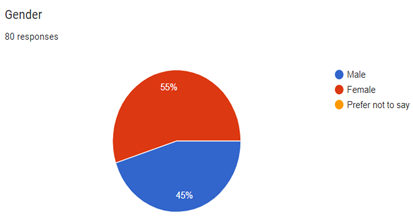
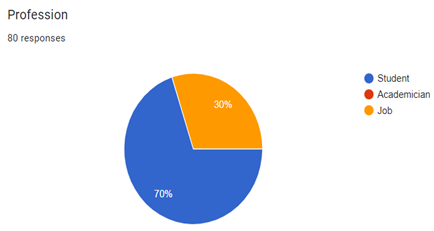
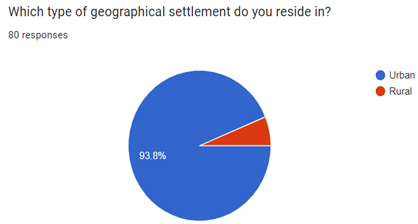
Data from a total of 80s people were collected and analysed. Figure 1 shows the demographic information of the respondents. The proportion of men was higher than that of women at 55% and 45%, respectively. Ages from the 18s to 32s made up most respondents. 70% of respondents are from educational backgrounds ranging from bachelor's to research scholar while 30% are architects who are involved in offices or practising architects. Also, more than 90% of respondents are from urban backgrounds.

This is mainly because the study focuses on user experience data for analysis.
• Ranging from 18 to 32 years of age,
• 55% Female and 45% Male
• 70% Student (Architecture) and 30% Job (Architect)
• 93.8% residing in urban settlements and 6.2% residing in rural settlements.

The detailed report compiled by Shahjahan Redevelopment Corporation has featured the redevelopment of Chandni Chowk. It states the land use of Chandni Chowk to be categorized as commercial and mixed-use. Apart from the Town Hall, which has an open area in the foreground, the constructed fabric on each side of the street of Chandni Chowk is rather dense and actively used. Colonnades are found in front of many of the structures. The establishments frequently use these areas as spillover areas or to accommodate vendors. Designing and managing public spaces using a multidisciplinary approach known as place-making attempts to create places that are inviting for people to live, work, and play. It entails considering the wants and needs of the neighbourhood and including stakeholders in the process of influencing their environment 9.
Beyond conventional urban planning, place-making emphasizes the human experience inside a site. It acknowledges that successful locations promote a sense of identity, community, and social engagement in addition to their physical design. Chandni Chowk was revitalized through place-making and place-led development, where "place" is prioritized and the subject of planning and policymaking. The local community and the government both helped to rebuild this social space. Additionally, a comprehensive re-imaging strategy is adopted to develop for the external audiences. This research paper is an interdisciplinary analysis of the pattern of development and morphology of the commercial street of Chandni Chowk 10.
i. Designing and managing public spaces: Using a multidisciplinary approach known as place-making attempts to create places that are inviting for people to live, work, and play. It entails taking into account the wants and needs of the neighbourhood and including stakeholders in the process of influencing their environment. Beyond conventional urban planning, place-making emphasizes the human experience inside a site it acknowledges.
ii. Community Engagement: Participating in the design and decision-making process with the community and many stakeholders is known as place-making. The wants and needs of those who will use the area are considered.
iii. Identity and Sense of Place: Enhancing a place's distinctive identity and character is the goal of effective place-making. It takes into account the history, culture, and surroundings of the area to produce a unique sense of place that appeals to the neighbourhood.
iv. Multi-functionality: Great sites frequently accommodate a multitude of activities and serve various purposes. Place-making places a strong emphasis on creating areas that can be used for various activities throughout the day.
v. Accessibility and Connectivity: No matter their age, level of ability, or financial status, everyone should be able to access the places that are created through place-making. It encourages connectedness to nearby neighbourhoods and locations as well as walkability, cycling, and public transportation.
vi. Human Scale and Proportions: The necessity of creating areas that are human-scaled, with cosy proportions, pedestrian-friendly elements, and a variety of building heights and densities is emphasized by place-making.
vii. Activation and Programming activities and events that attract visitors and foster a lively mood are frequently essential to successful place-making. This could apply to fairs, shows, festivals, or other community events.
viii. Green Spaces and Nature Greenery, trees, and other natural components are frequently incorporated into place-making projects. These components improve aesthetics, aid the environment, and improve quality of life.
ix. Sustainability and Resilience Placemaking takes long-term resilience and sustainability into account. This entails incorporating energy conservation, stormwater management, and the use of locally sourced materials.
The effective width of the road for vehicle traffic is decreased to about 1 lane in each direction, which is the primary cause of vehicular congestion in Chandni Chowk. As a result, slow speeds and traffic congestion are witnessed. Each direction's rush-hour traffic is between 1000 and 1500 pcu. During peak hour, 196 two-wheelers and 172 cars were counted. Most people only park for a few minutes, usually about 30 minutes. The busiest time for pedestrians is from 5 to 8 p.m., when they are roughly dispersed on both sides of the street and in both directions of travel. Near the gurudwara, 32,203 pedestrians were recorded at peak hour. Further, the data received from traffic police are: Chandni Chowk receives over 20,000 vehicles per day across multiple roadways. (10 a.m. – 7 p.m.). Around 474 cars and 406 two-wheelers make up most of the peak parking demand, at around 2:00 pm.
Strength – Chandni Chowk is a street in the urban capital of India acting as a cultural and commercial hub for catering to larger footfall. The street is a significant piece of history that attracts pedestrians. The use of local rickshaws increased which boosts the local economy as well. The AQI improved in the area due to less use of motor vehicles.
Weakness – The major conflicts faced in the streets of Chandni Chowk are traffic congestion, overcrowding, lack of parking and lack of safety for pedestrians. The mixed-use increased complexity of the stretch which makes it denser and more populated.
Opportunities – The streets are home to ages-old traditions, cuisine and goods which attract a lot of domestic shoppers and tourists. The low-cost market attracts lower-income groups. The redevelopment makes them user-friendly while moving on streets.
Threat – Hygiene and cleanliness have always been an issue in such streets. Another major concern is the lack of an evacuation plan in case of any hazardous situation. The situation may become insufficient due to the heavy density of the area and attractive market.
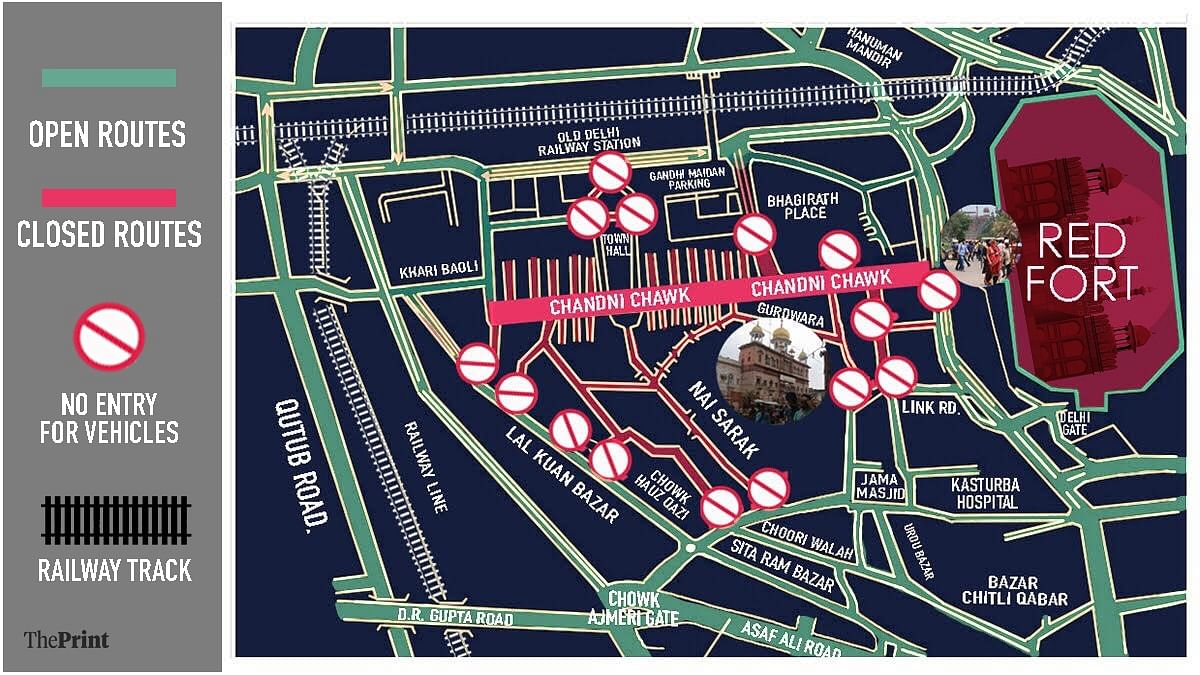
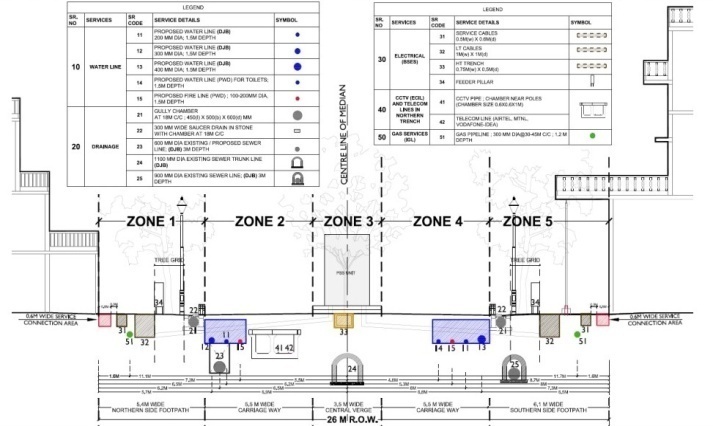
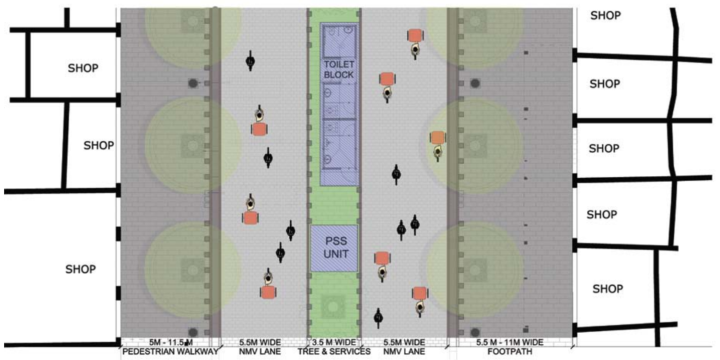
Chandni Chowk's street segment is being renovated to limit automobile movement to the late hours and early mornings and to make it a pedestrian and NMV-only roadway during the day. To prevent vehicles from entering Chandni Chowk, the traffic police have created a plan for the area's traffic flow. The street will have a 3.6-meter-wide central median, 5.5-meter-wide NMV lanes on either side and a spacious sidewalk along the curb. Transformers, restrooms, and other facilities will be situated above the service trenches for HT lines and water supply that are currently present in the median.


To boost tourism, Chandni Chowk was renovated into a heritage trail using Heritage Street Amritsar as an example. The organization in charge of completing this work is Shahjahanabad Redevelopment Corporation, which operates under the direction of the Government of the NCT of Delhi. To make the area more pedestrian-friendly for a high number of shoppers and visitors, the reconstruction plan incorporates pathways. From Red Fort to Fatehpuri Masjid, Chandni Chowk will be closed to vehicular traffic during the day. Additionally, it is intended to decongest the roads and barricade parts of them. To get there, one must use the E-bus.
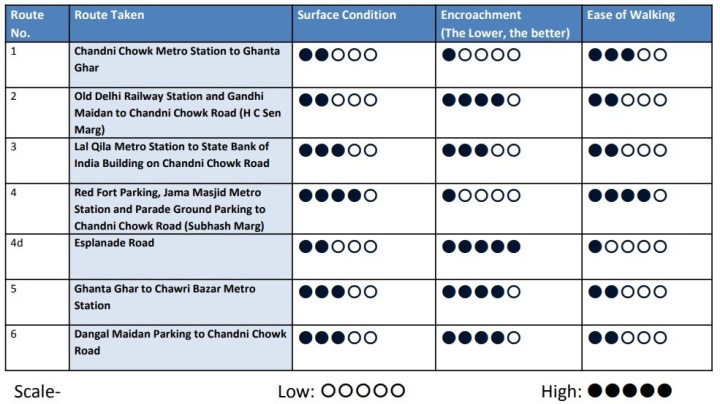
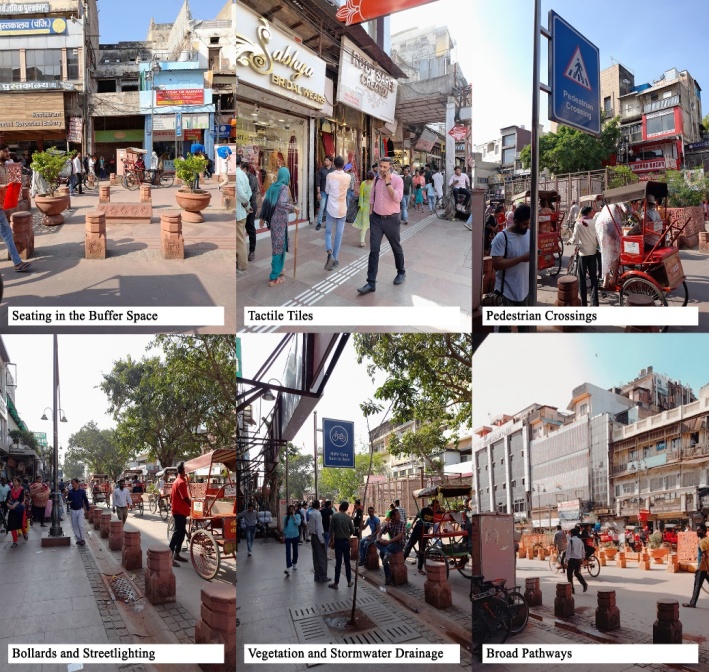
8.1.Observationsi.The streets get lifted by the entire cover of red sandstone used for the pavement and the bollards.
ii.The use of tactile tile to highlight the inclusive design for the pedestrian is another change.
iii.To maximize the pedestrian flow, the street is completely closed to motorized vehicles which give a greater footpath span.
iv.The street still functions for non-motorized vehicles like rickshaws thus to have proper movement pedestrian crossings are given at regular intervals.
v.The bollards act as functional barricades between the pathways since they can be used as seating too.
vi.The buffer space in the middle of the street consists of transformers that have been covered with jail making it not look like a foreign entity in the design.
vii.The vegetation has been added to the pathways at regular intervals which is a part of soft scape leading to seepage of water.
viii.The streetlights are arranged along the pathway ensuring the space remains lit up.
Following are the results and analysis of the survey.
9.1. PedestriansThe increase in the number of pedestrians due to better connectivity and the wide range of places available has increased the need for pedestrianization.
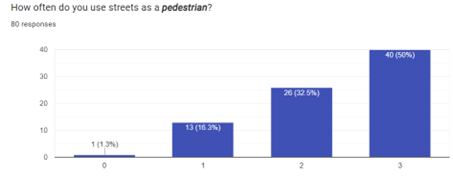
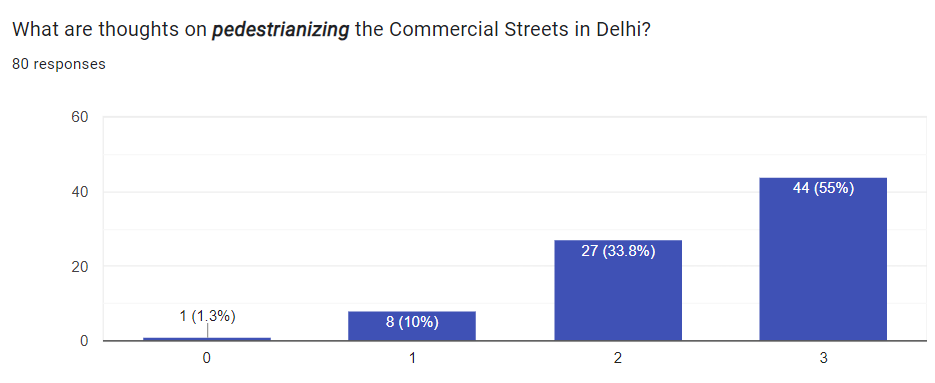
According to the survey 50% of the people most often access places as pedestrians. 55% of people majorly agreed with the pedestrianization of commercial streets.

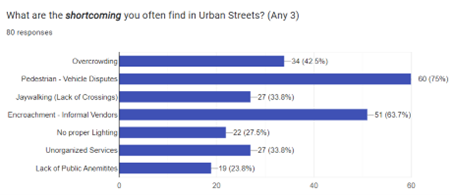
The urban streets have a heap of problems and areas of improvement. The development of urban society has brought major changes in the infrastructure which also led to various issues 11. The often-seen issues include:
i.Overcrowding – The increase in population in urban spaces has led to an increase in demand for commercial spaces that often ends up making these places overcrowded.
ii.Pedestrian-vehicle dispute – The failure to segregate the space for pedestrians and automobiles has always caused accidents and conflicts in the proper functioning.
iii.Jaywalking – The safety of pedestrians is questioned when no provision for crossings is given.
iv.Encroachment – The streets often get encroached by informal and migrating vendors which becomes an obstacle to the pedestrian flow, which results in pedestrians accessing the carriageway.
v. No Proper Lighting – Some streets of urban areas don’t have proper lighting making them dark spaces and giving unsafe characteristics leading to not being used by pedestrians.
vi. Unorganized Services – The services are superficial in some streets which are often prey to vandalism and exploitation.
vii. Lack of Public Amenities – The urban streets attract huge pedestrians every day but sometimes fail to provide necessities like toilets, drinking fountains etc.
75% of people chose pedestrian-vehicle disputes as major shortcomings followed by Encroachment (63.7%) and Overcrowding (42.5%).

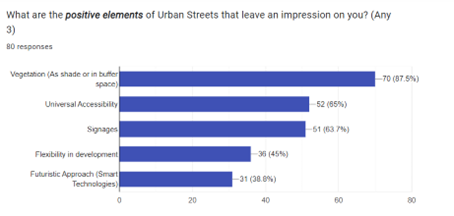
i.Vegetation – The hint of green cover either on the side of pathways or on the buffer space brings a positive element, it acts as a soft scape and calms the pedestrians.
ii.Universal Accessibility – The design seems inclusive to the public, with elements like no differences in curb heights, availability of ramps and tactile tiles.
iii.Signages – Signages play an important role in guiding pedestrians throughout the place and making tasks easy. Legible signage is always a positive sign that makes the place to be easily accessible.
iv.Flexibility in development – Growth and advancements are unstoppable processes; the streets must be flexible to adopt any such advancements.
v. Futuristic Approaches – The use of smart technologies not only eases the way of living but also helps in saving energy and resources. The urban street with such additions often assists pedestrians.

87.5% of people chose vegetation as the most positive element in urban streets followed by Universal Accessibility (65%) and Signage (63.7%).
9.4. Regeneration of Chandni Chowk
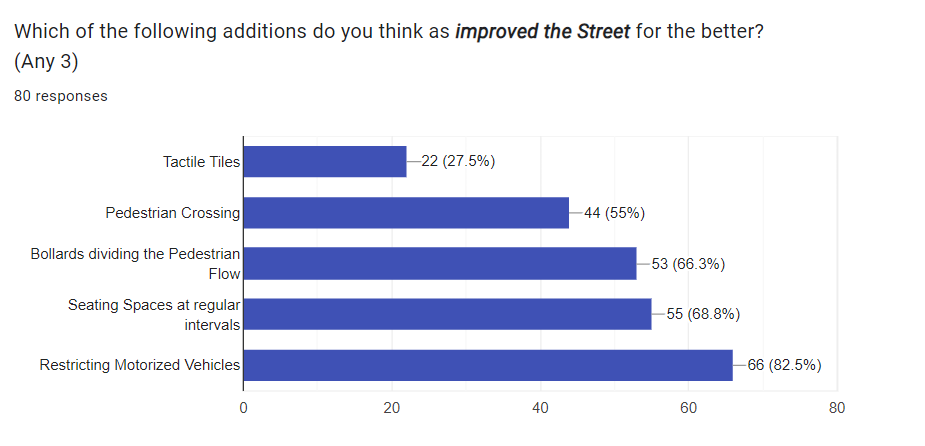
55% of pedestrians agree that the redevelopment plan of Chandni Chowk is highly beneficial for pedestrians.

The additions or changes most favoured by the people are:
i.Restricting Motorized Vehicles – 82.5%
ii.Seating Spaces at Regular Intervals – 68.8%
iii.Bollards dividing the Pedestrian – 66.3%
The architecture depicts both the art and functional aspects of space by redeveloping such streets aesthetics of the streets can be increased which would give a secure outlook to the users. The countries are working towards green and clean energy such initiatives could contribute to the power generation in India through minimal harm to the environment. Public spaces have always seen challenges to cater for the needs of people with various needs, the concept of “universal design” can be implemented on streets by providing tactile tiles and no level differences in the movement.
Today, there is a growing movement to design streets that are more sustainable, safe, and accessible for all users. This entails actions like traffic slowing, cycling and pedestrian infrastructure, and green areas. We can make cities that are more livable and dynamic for everyone by advancing and enhancing our streets. Urban roadway improvements can encourage environmentally friendly modes of mobility like walking, cycling, and public transportation 12. This has the potential to lower greenhouse gas emissions, enhance air quality, and support active and healthy lifestyles. By establishing appealing and inviting locations for people to live, work, and shop, improving urban streets can boost the economy. Additionally, property values might rise, and businesses and investors can be drawn to areas with attractive and accessible roadways. By developing hospitable and appealing public spaces that encourage social interaction, community development, and cultural activities, bettering urban streets can enhance the quality of life 13. Urban street improvements can promote social justice by creating welcoming, safe, and accessible public areas for all people in the community, regardless of their age, income, or ability. Chandni Chowk has enormous potential as a tourist destination and a haven for event organizers. By emphasizing and enhancing the city's identities, a mental image of the city can be imprinted in the brains of the target audience. A well-balanced marketing mix can also aid in branding and reimagining the city. From a severely cluttered, filthy, and overcrowded environment, Chandni Chowk might be repositioned as a welcoming place for tourists and visitors, combining its historic charm with cleanliness and ease of access.
| [1] | Bhattacharya, S., Delhi: Cops Ready March Plan for 'New Chandni Chowk’, The Times of India, 2018. | ||
| In article | |||
| [2] | Garg, A. HC: Explain Opposition to Chandni Chowk Plan. The Times of India, 2019. | ||
| In article | |||
| [3] | Mathur, A., Will Consult Chandni Chowk Traders: AAP. The Times of India, 2018. | ||
| In article | |||
| [4] | Suryanarayana M. G., & Bari, A., Contested Space: The Living Urban Heritage of Hyderabad & Shahjahanabad, Delhi. Creative Space, 2(1), 63–83, 2014. | ||
| In article | View Article | ||
| [5] | Official Website of Government of National Capital Territory of Delhi, India. (n.d.). Redevelopment of Chandni Chowk. Shahjahanabad Redevelopment Corporation Government of NCT of Delhi, 2023, Available: https:// srdc.delhi.gov.in/ en/srdc/ redevelopment-chandni-chowk. | ||
| In article | |||
| [6] | Pantic, V. How community engagement can increase bicyclist and pedestrian safety. CitizenLab’s Blog, 2022, Available: https://www.citizenlab.co/blog/mobility-infrastructure/how-community-engagement-can-increase-bicyclist-and-pedestrian-safety/. | ||
| In article | |||
| [7] | Sengupta, Sen. (in press). Re-Creating Chandni Chowk : Place-Making and Place-Marketing of ‘Old Delhi’s Historic City Centre. Indian Journal of Spatial Science, 47–53, 2022. | ||
| In article | |||
| [8] | Public Works Department, Redevelopment of Jama Masjid Precinct and Chandni Chowk. In Shahjahanabad Redevelopment Corporation Government of NCT of Delhi, 2023, Available: https://drive.google.com/file/d/1HW2hFLQ3rH1OtbXHfvOPGczmkNs5XPm1/view. | ||
| In article | |||
| [9] | Sachdeva P., Design Associates. Redevelopment of Chandni Chowk. In Shahjahanabad Redevelopment Corporation Government of NCT of Delhi, 2018, Available: from https:// srdc.delhi.gov.in/sites/default/files/cc-presentation-27-11-18.pdf. | ||
| In article | |||
| [10] | Vp, S., Pedestrians compete with rickshaws at Chandni Chowk’s overhauled street. The Patriot, 2021, Available: https:// thepatriot.in/reports/pedestrians-compete-with-rickshaws-at-chandni-chowks-overhauled-street-22623. | ||
| In article | |||
| [11] | Garg R., Pankaj, Kumar A., Warsi T. R., Kamal Arif M., User Experience and Expectations of Streetscape: A Planning Framework for Urban Streets in India. Civil Engineering and Architecture, 11(3), 1480-1486, 2023. | ||
| In article | View Article | ||
| [12] | Jain R., Brar T.S., Kamal Arif M., Environmental Impact and Mitigation Benefits of Urban Heat Island Effect: A Systematic Review, Architecture Engineering and Science, 3(4), 230-237, 2022. | ||
| In article | View Article | ||
| [13] | Farooq S., Kamal Arif M., Analysis of Landscape Design and Facilities in National Bank Park, Lahore, Pakistan, Journal of Civil Engineering and Architecture, 9(2), pp. 386-393, 2021. | ||
| In article | View Article | ||
Published with license by Science and Education Publishing, Copyright © 2024 Mohammad Arif Kamal, Vanishya Vasanth and Mohd. Afzal Khan
 This work is licensed under a Creative Commons Attribution 4.0 International License. To view a copy of this license, visit
https://creativecommons.org/licenses/by/4.0/
This work is licensed under a Creative Commons Attribution 4.0 International License. To view a copy of this license, visit
https://creativecommons.org/licenses/by/4.0/
| [1] | Bhattacharya, S., Delhi: Cops Ready March Plan for 'New Chandni Chowk’, The Times of India, 2018. | ||
| In article | |||
| [2] | Garg, A. HC: Explain Opposition to Chandni Chowk Plan. The Times of India, 2019. | ||
| In article | |||
| [3] | Mathur, A., Will Consult Chandni Chowk Traders: AAP. The Times of India, 2018. | ||
| In article | |||
| [4] | Suryanarayana M. G., & Bari, A., Contested Space: The Living Urban Heritage of Hyderabad & Shahjahanabad, Delhi. Creative Space, 2(1), 63–83, 2014. | ||
| In article | View Article | ||
| [5] | Official Website of Government of National Capital Territory of Delhi, India. (n.d.). Redevelopment of Chandni Chowk. Shahjahanabad Redevelopment Corporation Government of NCT of Delhi, 2023, Available: https:// srdc.delhi.gov.in/ en/srdc/ redevelopment-chandni-chowk. | ||
| In article | |||
| [6] | Pantic, V. How community engagement can increase bicyclist and pedestrian safety. CitizenLab’s Blog, 2022, Available: https://www.citizenlab.co/blog/mobility-infrastructure/how-community-engagement-can-increase-bicyclist-and-pedestrian-safety/. | ||
| In article | |||
| [7] | Sengupta, Sen. (in press). Re-Creating Chandni Chowk : Place-Making and Place-Marketing of ‘Old Delhi’s Historic City Centre. Indian Journal of Spatial Science, 47–53, 2022. | ||
| In article | |||
| [8] | Public Works Department, Redevelopment of Jama Masjid Precinct and Chandni Chowk. In Shahjahanabad Redevelopment Corporation Government of NCT of Delhi, 2023, Available: https://drive.google.com/file/d/1HW2hFLQ3rH1OtbXHfvOPGczmkNs5XPm1/view. | ||
| In article | |||
| [9] | Sachdeva P., Design Associates. Redevelopment of Chandni Chowk. In Shahjahanabad Redevelopment Corporation Government of NCT of Delhi, 2018, Available: from https:// srdc.delhi.gov.in/sites/default/files/cc-presentation-27-11-18.pdf. | ||
| In article | |||
| [10] | Vp, S., Pedestrians compete with rickshaws at Chandni Chowk’s overhauled street. The Patriot, 2021, Available: https:// thepatriot.in/reports/pedestrians-compete-with-rickshaws-at-chandni-chowks-overhauled-street-22623. | ||
| In article | |||
| [11] | Garg R., Pankaj, Kumar A., Warsi T. R., Kamal Arif M., User Experience and Expectations of Streetscape: A Planning Framework for Urban Streets in India. Civil Engineering and Architecture, 11(3), 1480-1486, 2023. | ||
| In article | View Article | ||
| [12] | Jain R., Brar T.S., Kamal Arif M., Environmental Impact and Mitigation Benefits of Urban Heat Island Effect: A Systematic Review, Architecture Engineering and Science, 3(4), 230-237, 2022. | ||
| In article | View Article | ||
| [13] | Farooq S., Kamal Arif M., Analysis of Landscape Design and Facilities in National Bank Park, Lahore, Pakistan, Journal of Civil Engineering and Architecture, 9(2), pp. 386-393, 2021. | ||
| In article | View Article | ||