Regular preventive medical and dental checkups are part of a healthy lifestyle. However, mental health has not been viewed in the same way. Integrating mental health checkups into the universal routine of a healthy lifestyle will require a fundamental restructuring of how we view wellbeing. This study aims to explore the benefits of regular mental health checkups and “provide real-world solutions” to include this service as part of a healthy lifestyle routine. A literature review was conducted to explore the potential health outcomes, the complications of changing cultural perspectives, cost, and societal effects associated with mental health checkups. Recommended guidelines for offering such a service, billing instructions, training, education, and promotion strategies are provided. Future research implications of additional peer-reviewed trial studies on their patient outcomes are suggested.
In an era where regular checkups with medical and dental professionals are widely practiced to uphold physical health, the question arises: Should mental health checkups not be equally routine 1? Mental Health Checkups can be called mental wellness assessments, cognitive health screenings, mental health evaluations, and initial mental health assessments. Regardless of what they are called, mental health checkups serve as a fundamental practice for continuous monitoring and proactively addressing one's mental wellbeing 2. This concept is not a novel approach in the physical health or dentistry industry. The American Dental Association (2024) recommends visiting the dentist for a checkup and cleaning at least twice a year, and the American Medical Association (2025) generally recommends seeing a medical physician at least once a year for a checkup 3, 4. Most individuals have developed a habit of regular preventive checkups as part of a healthy lifestyle. Like routine checkups with medical practitioners, mental health checkups are crucial in proactively managing mental health 5, 6. However, mental health has not been viewed in the same way. Preventive mental health care has been researched, but there appears to be a gap in the literature on how to shift cultural norms so more individuals can effectively start using this service. Integrating mental health checkups into the cultural routine of a healthy lifestyle will require a fundamental restructuring of how we view wellbeing. In advocating the regularity of mental health checkups, this article will explore the advantages and challenges of regular mental health checkups and provide the reader with guidelines for making this service a common practice.
1.1. Preventive vs TreatmentMental health is a fundamental element of a holistic approach to general wellbeing. The traditional mental health approach is to provide treatment once an individual is diagnosed with a disorder. However, preventive strategies involve stopping mental disorders before they start through early identification and screenings. Preventive mental health refers to proactive approaches aimed at reducing the risk of developing mental illnesses. Research supports that early prevention, especially in youth, significantly reduces the risk of developing chronic mental disorders 7. Prevention measures are more cost-effective when compared to outpatient services or hospitalizations. The average cost of outpatient mental health services is between $100-$300 per session, and inpatient care typically ranges from $500-$2,000 per day, potentially reaching $15,000 to $60,000 for a 30-day stay 8, 9, 10, 11. Treatment cost can vary greatly depending on the type of service, provider, location, and insurance coverage, but a mental health checkup may cost no more than a regular doctor visit. Prioritizing preventive measures like mental health checkups is more sustainable and beneficial. Long-term savings are only one of the advantages; fewer hospitalizations, greater accessibility, and the fact that a checkup is less stigmatizing than traditional psychotherapy make this preventive measure a better choice.
1.2. Individual Cost and Societal Loss of Untreated Mental Health DisordersAccording to research, more than one in five U.S. adults live with a mental illness (59.3 million), and 33.5% also experienced a substance use disorder, 19.4 million 12, 13. By introducing more frequent screenings in various communities, attending therapy could become as commonplace as visiting a physician or dentist. Mental health checkups could potentially reduce the prevalence of untreated disorders by addressing them at an early stage and lower the overall cost of treating mental illness. With such a large portion of the United States population being affected by mental health, it can be assumed that it will have a significant effect on the economy as well. It is estimated that mental illness causes $193.2 billion in lost earnings across the U.S. economy 14. This financial liability is deeply tied to the personal and societal challenges faced by individuals living with serious mental illness.
Individuals with serious mental illness are twice as likely to drop out of school, three times more likely to repeat a grade, will earn less than other Americans, and have a higher rate of unemployment (7.4%), resulting in societal loss of revenue 15. These individual hardships extend beyond education, finance, and vocation; families, workplaces, and communities as a whole experience the impact of mental illness. There are also caregivers of individuals who have a mental illness who, on average, spend over 32 hours per week providing care. It is estimated that roughly 8.4 million Americans are caregivers to an adult with a mental or emotional health issue 14.
1.3. Criminalization of Mental IllnessMental illness is not only costly for our economy, but it is also affecting our criminal justice system and safety. The annual average cost of providing mental health services to an individual in jail ranges from $33,000 to $168,000, while community-based treatment is around $10,000 to $35,000 16. In America, a disproportionate number of individuals diagnosed with mental health disorders are incarcerated. Roughly 43 % of individuals in state prisons and 44% in local jails have been diagnosed with a mental disorder, but only 23.1% of adults in the U.S. experienced mental illness 17, 18. Furthermore, police officers are often the first responders to a mental health crisis. However, they are not trained mental health professionals equipped to handle every issue. This interaction usually leads to violence or incarceration 19. Individuals with mental illness are also likely to have higher rates of recidivism and be incarcerated longer, which puts a strain on the criminal justice system. By providing mental health checkups, individuals will be screened before interacting with law enforcement, increasing the probability that they will receive proper treatment, avoid imprisonment, and not cost taxpayers money to treat this person in prison.
1.4. Mind Body ConnectionMental and physical health are interconnected. A person's mental health can significantly influence physical health, and vice versa. Mental illness, like depression or anxiety, can increase the risk of developing physical health problems like heart disease, diabetes, and other chronic illnesses 6, 14, 20. Physical illnesses or poor diet can lead to stress, anxiety, low self-esteem, and depression 12, 15, 20. Sleep deprivation can also result in psychotic symptoms 14. Individuals with mental illness also often have difficulties communicating needs, resolving conflicts, and bridging emotional distance in relationships. Mental health conditions like anxiety, depression, or psychosis may make it difficult for an individual to share feelings, empathize, or be emotionally withdrawn. Obstacles like these impede open communication and can trigger arguments or feelings of isolation. 21, 22. Implementing annual mental health screenings, akin to medical or dental appointments, would provide a precise universal method for communicating a patient's needs across multiple healthcare disciplines.
1.5. Universal Shift to Regular Medical and Dental VisitsMedical and dental care were considered emergency services until the 20th century 23. Regular checkups became normalized in the early-to-mid 20th century with the advent of vaccinations, diagnostic tools like the stethoscope and X-ray, and germ theory of disease became widely accepted, helping to shift the focus from treatment to prevention 24, 25. Dentistry, on the other hand, did not become a formal profession until the 19th century. The idea of regular cleanings and checkups did not catch on widely until after World War II, when fluoride use and education campaigns gained momentum 26. In medicine and dentistry, targeted campaigns promoting routine checkups normalized the image of visiting the family doctor or dentist as part of suburban America.
Furthermore, health insurance encouraged preventive care to reduce long-term costs around the same time. Although medicine and dentistry began as emergency-based care, public support and changes to institutional infrastructure have shifted the cultural norm to preventive models. The changes in these fields revolutionized how people think about their health, and we can easily replicate this cultural shift to include routine mental health checkups.
The financial implications of routine mental health screenings also need to be considered when discussing the potential of this service. In the past, some employers were not required to provide insurance coverage for mental health services, placing the financial burden on individuals 11. As a result of this inequality, lawmakers have put numerous policies in place to equalize insurance coverage for mental health and physical health. In 1996, President Bill Clinton signed the Mental Health Parity Act of 1996 (MHPA), H.R.4058 (1996), into law 27. Before this law, insurance companies did not have to cover mental health services, which severely limited access to treatment. The MHPA requires insurance companies to apply the same dollar limits to mental health care as medical care 27. Despite this progress, many issues remained, especially around reimbursement rates and treatment limitations. Annual medical physicals and bi-annual dental checkups were supported ideologically (by society) and fiscally (by insurance providers), while mental health services were not.
In contrast, they offered far less support for mental health services. A Research Triangle Institute (2024) study confirmed that insurance companies reimburse mental health services at significantly lower rates than medical services 11. This disparity forced many clients to seek out-of-network mental health providers and pay out of pocket, if they received services at all. It also discouraged mental health professionals from partnering with insurance networks because the reimbursement failed to cover their costs. As a result, the insurance system created a culture that discouraged mental health care. Society often values what it financially supports. Even though the nation invested little in mental health, the need for those services remained strong.
In 2008, President George W. Bush signed the Paul Wellstone and Pete Domenici Mental Health Parity and Addiction Equity Act (MHPAEA), H.R.6983 (2008), into law 28. This federal law ensures that insurance providers must treat mental health and substance use disorder (MH/SUD) benefits the same as medical and surgical benefits 28. Health plans can no longer impose stricter limits—such as higher copays or fewer visits—on mental health or substance use treatment. MHPAEA preserved and expanded MHPA's protections, especially by including substance use disorder coverage. In 2024, lawmakers responded to growing demand for mental health care—fueled by the mental health crisis following COVID-19—by amending the MHPAEA. Clients increasingly sought therapy and mental health treatment, but faced obstacles when trying to get insurance coverage.
On September 9, 2024, the U.S. Departments of Health and Human Services (HHS), Labor, and the Treasury released the new final MHPAEA rules, scheduled for implementation in 2025 29. The final rules included the following amendment summaries: 1-Protection of People from Unequal Coverage: people with health insurance are protected from having more limits on mental health and substance use disorder (MH/SUD) care than on medical or surgical care; 2- Requirements for Insurance Plans to Use Data to Ensure Fair Access: Health plans must collect and review data to see if certain rules (called NQTLs, or non-numerical limits) make it harder to get mental health or substance use care 29. If the insurance provider determines discrepancies, they are obligated to make corrections. 3- A Mandate on Detailed Comparisons: Insurance providers must create assessments to ensure their guidelines affect access to care equally, between mental health and medical care. This includes reviewing things like network size, payment rates for out-of-network care, and rules about getting prior approval for treatment; 4- A Ban on Biased Regulations: Insurance companies can no longer use unfair or discriminatory methods, standards, or data that are designed to make it harder for people to access mental health or substance use care; 5- An End to Opting-out Certain Plans: This amendment ends the ability of self-funded non-federal government plans to avoid following mental health parity laws (known as the sunset provision); and 6- Clarity in Who Must Follow the Law: The rule provides an explanation of which types of health plans are required to follow the MHPAEA 29.
There have been significant societal shifts toward supporting mental health treatment through policy. However, both the implementation of the MHPAEA and society's attitude toward mental health care remain in the early stages of meaningful change. Many Americans have neglected their mental health because finding treatment often came with high costs and financial hardship. Mental health insurance coverage has posed challenges for decades. This financial constraint may discourage people from pursuing, starting, or stopping therapeutic services, presenting a noteworthy challenge.
2.1. Screenings, Assessments, and Early InterventionEarly intervention is paramount in preserving the mental wellbeing of individuals. Left untreated, mental health concerns can often escalate into more severe psychological and physical diagnoses, underlining the urgency of preventive screenings. According to the American Psychological Association (2022), a screening is defined as an early identification process used to identify individuals at high risk for specific conditions or disorders. They are usually brief components of a clinical visit and can be administered by a variety of appropriately trained staff. An assessment is defined as a comprehensive clinical process that provides detailed information regarding an individual's functioning across multiple domains 30, 31. The term mental health checkups fall in this gray area between the two procedures. They are designed to assess your mental wellbeing and identify potential problems. However, the term implies a routine of regularly tracking mental health and/or symptoms. After reviewing several articles and standards of practice, the researcher developed procedural guidelines for the proposed mental health checkup.
A literature review was conducted using academic and professional databases to identify existing mental health screening tools, preventive care strategies, health outcomes data, complications of changing perspectives, laws, cost, and societal effects associated with mental health checkups. The review included peer-reviewed articles, government and institutional reports, professional standards of practice, and current mental health policies. After reviewing several articles and standards of practice, common themes in the research across the literature were identified. The thematic analysis findings indicated that most preventative mental health care procedures include initial screenings, interviews, clinical observations, diagnosis, and treatment recommendations. Additionally, literature on the overall transformation of public attitudes toward other preventive health services, such as dental checkups and annual physicals, was analyzed to explore parallel strategies that could be modified for mental health checkups. These strategies included policy shifts and historical events that normalized preventive care. Based on those findings, procedural guidelines for improving public opinion, increasing societal acceptance, and promoting the professional implementation of routine mental health checkups were developed.
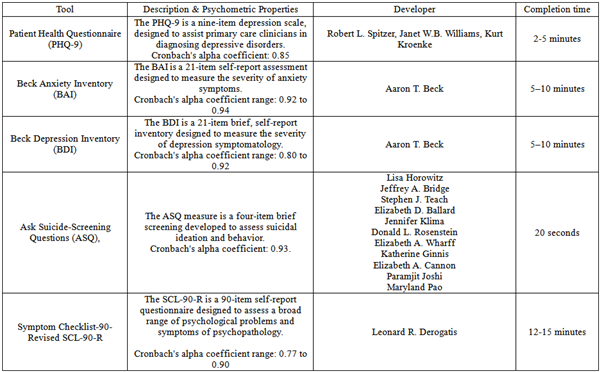
The mental health checkup begins with the client filling out different screenings and assessments. Evaluations and assessments are done to discover possible challenges, as well as to understand the nature of any mental health concerns. Clients may complete self-report screening tools or questionnaires before the initial session, either online or as part of the initial paperwork, before meeting with the mental health professional. The estimated completion time for the brief screening and assessment phase can be as short as 20 seconds or up to 15 minutes. Commonly used screening and assessment tools are listed below in Table 1 2, 10, 32, 33. However, the mental health clinician or agency may choose their preferred screening tools.
The second part of a mental health assessment is the clinical interview and observation. It is an interaction between the clinician and the client. The purpose of clinical interviews is to obtain relevant information about the client's condition, history, and lifestyle. Mental health providers or agencies may use biopsychosocial assessments as guidelines or documentation to record this information. Mental Status Examination (MSE) is incorporated as part of the observation to assess the client's behavior, mood, affect, cognitive functioning, orientation, memory, and thought processes 34. The duration of clinical interviews and observation can vary depending on the specific context and purpose. However, the researchers suggest that this process can be completed within 30 minutes to an hour. This process establishes strong relationships, greater comprehension of the client's perspective, and formulates the next phase of the checkup.
4.3. Diagnostic Impressions and RecommendationsThe last step of the mental health checkup is forming a diagnostic impression and offering the client recommendations. The clinical information collected in steps one and two is taken by the mental health practitioner and used to form a case conceptualization of the mental state of the client. It is a concise summary of the client's presentation, strengths, areas of struggle, potential diagnoses, and what recommendations there may be for support or treatment. This process can be completed with or without the client present. Diagnostic impressions and recommendations can easily be documented as part of a progress note and submitted for billing purposes if necessary. Once the mental health professional determines whether the client meets medical necessity or not, they'll review this information with the client and develop a treatment plan or provide referrals if necessary. The researcher indicates that this process can be completed within 15 to 30 minutes.
4.4. Mental Health Checkup ReimbursementMental health checkups are not a new concept. The screening and assessment tools we recommend have been used by mental health professionals for decades. According to the American Medical Association (2025), behavioral health codes such as 99401, 99402, 99403, and 99404 are designated for individual preventive medicine services 4, 35. Medicare and other insurance providers offer coverage for mental health checkups and other preventive services. Commonly used Current Procedural Terminology (CPT) codes and reimbursement rate estimates are listed below in Table 2 7, 36.
The advent of telehealth applications provides an innovative avenue for individuals to engage in mental health checkups and counseling services 37. According to Forbes (2025), the top five online therapy services of 2025 include: BetterHelp, Talkspace, Cerebral, Talkiatry, and Headspace 16. These services can enhance the enrollment of mental health checkups among clients. Online applications can offer several accommodations for consumers of mental health services, like the privacy and comfort of talking to a professional while at home. Additionally, providing mobile applications for mental health ensures timely and convenient access for clients to mental health checkups 13, 38.
Although the research provides evidence to support the benefits of mental health checkups, the limitations should be acknowledged. The study offers a theoretical model for mental health checkups but lacks evidence-based experimental research demonstrating the overall effectiveness of the service. The research also lacks detailed information regarding how the general population or specific cultural groups may respond to the mental health marketing campaigns. Finally, the study indicates that telehealth can be used for mental health checkups, but provides limited information on integrating telehealth services and other technology as part of a mental health checkup. Additional quantitative experimental studies focused on the effectiveness of the mental health checkups, different cultural groups' norms and acceptance of novel mental health initiatives, and further research on telehealth services and integrated models is suggested to address these concerns.
The intention of this research is to provide mental health professionals with practical guidelines, policies, and procedures to implement routine mental health checkups. The research provides step-by-step instructions for the immediate implementation of this service and the current insurance billing. Once the providers implement these services, research data can be collected to evaluate the procedure's efficacy and other possible additional clinical uses. The first recommendation is for practitioners to implement mental health checkups and conduct additional peer-reviewed trial research on their patient outcomes. Peer-reviewed literature supporting the actual or potential clinical efficacy of mental health checkups is essential to increasing healthcare professionals' and the community's awareness of the benefits of the service. Future research into mental health checkups should also focus on effective methods of integrating mental health checkups into traditional health care models, training providers, utilization of new technology for interventions, the cost-effectiveness of the service, implementation barriers, and patient outcomes.
6.1. Training and EducationTo increase the utilization of mental health checkups, it is recommended that health care professionals across disciplines be trained and educated about this service. Training and educating healthcare professionals on routine mental health checkups would not only equip them to identify mental health issues better, but it would also assist in coordinating care for the patient. Health care professionals would be educated on updated policies and insurance programs for routine mental health checkups. The training and education recommendation is essential to normalizing mental health checkups. Most individuals trust and have an established rapport with their primary physician. If doctors integrated mental health checkups as a part of their treatment regimen, people are more likely to trust that it is a vital part of their overall health.
6.2. Mental Health Marketing CampaignsThe normalization of mental health checkups is vital. Developing and implementing public campaigns to promote routine mental health checkups can increase societal participation. Using social media platforms and community outreach programs to encourage early intervention through mental health checkups would reduce the stigma surrounding mental health. Reframing the narrative that mental health checkups are a proactive part of overall wellbeing instead of an indicator of weakness would be a central theme of the marketing strategy. Educating the public about mental health facts and the accessibility and affordability of services would also be necessary. These campaigns can provide resources for accessing support by providing clear and concise information about insurance coverage for mental health services.
6.3. Holistic Approach to HealthcareMental health should not be considered separate or different from other health care services. Instead, a holistic approach to health can be adopted to ensure that all parts of an individual are considered. Integrating mental health checkups into the routine of regular physical examinations would help providers and patients identify early signs of mental illness and prevent further damage through combining interdisciplinary interventions. Incorporating regular mental health checkups as a standard part of holistic preventive care can reduce individual and societal costs, decrease the involvement of people with mental health issues in the overburdened criminal justice system, and lower the financial burden on taxpayers. Simultaneously, it will improve mental and physical health treatment outcomes by providing another evidence-based, interdisciplinary tool for overall wellbeing.
| [1] | Abrams, Z. (2022). Why the benefits of annual anxiety and depression screenings for kids and teens outweigh the risks. American Psychological Association. https:// www.apa.org/ monitor/2023/01/screening-kids-anxiety-depression. | ||
| In article | |||
| [2] | Gilbody, S., Richards, D., Brealey, S., & Hewitt, C. (2007). Screening for depression in medical settings with the Patient Health Questionnaire (PHQ): A diagnostic meta-analysis. Journal of General Internal Medicine, 22(11), 1596–1602. | ||
| In article | View Article PubMed | ||
| [3] | American Dental Association (ADA). (2024). Home oral care recommendations. https://www.ada.org/resources/ada-library/oral-health-topics/home-care. | ||
| In article | |||
| [4] | American Medical Association. (2025). Behavioral health coding resource. https://www.ama-assn.org/ system/ files/ behavioral-health-coding-resource.pdf. | ||
| In article | |||
| [5] | Cano, A., Sprafkin, R. P., Scaturo, D. J., Lantinga, L. J., Fiese, B. H., & Brand, F. (2001). Mental health screening in primary care: A comparison of 3 brief measures of psychological distress. Primary Care Companion to The Journal of Clinical Psychiatry, 3(5), 206–210. | ||
| In article | View Article PubMed | ||
| [6] | Yu, A. (2021). The importance of mental health check-ins. Lumino Health. https://luminohealth.sunlife.ca/s/article/The-importance-of-mental-health-check-ins?language=en_US. | ||
| In article | |||
| [7] | Medicare Learning Network (2024). Medicare & Mental Health Coverage. U.S. Department of Health & Human Services (HHS). https://www.cms.gov/files/document/mln1986542-medicare-mental-health-coverage.pdf. | ||
| In article | |||
| [8] | AMFM Mental Health Treatment. (n.d.). Average cost of mental health treatment and counseling programs. https:// amfmtreatment.com/cost. | ||
| In article | |||
| [9] | Benson, N. M., & Song, Z. (2020). Prices and cost-sharing in-network vs. out-of-network for behavioral health. Health Affairs, 39(7), 1210–1218. | ||
| In article | View Article PubMed | ||
| [10] | Kroenke, K., & Spitzer, R. L. (2002). The PHQ-9: A new depression diagnostic and severity measure. Psychiatric Annals, 32(9), 509–515. | ||
| In article | View Article | ||
| [11] | Mark, T. L., & Parish, W. J. (2024). Behavioral health parity – Pervasive disparities in access to in-network care continue. RTI International. https://www.rti.org/publication/behavioral-health-parity-pervasive-disparities-access-network-care-continue/ fulltext. pdf. | ||
| In article | |||
| [12] | National Institute of Mental Health (NIMH). (n.d.). Understanding the link between chronic disease and depression. https:// www.nimh.nih.gov/health/publications/chronic-illness-mental-health. | ||
| In article | |||
| [13] | Neulinger, B., Ebert, C., Lochbühler, K., Bergmann, A., Gensichen, J., & Lukaschek, K. (2024). Screening tools assessing mental illness in primary care: A systematic review. European Journal of General Practice. 30(1):2418299. | ||
| In article | View Article PubMed | ||
| [14] | National Center for Health Statistics (NCHS). (2020). Mental health in the United States: New estimates from the National Center for Health Statistics. The Centers for Disease Control and Prevention. https://www.cdc.gov/nchs/data/events/nhis-mental-health-webinar-2020-508.pdf. | ||
| In article | |||
| [15] | National Alliance on Mental Illness (NAMI). (2023). Mental health by the numbers. https://www.nami.org/about-mental-illness/mental-health-by-the-numbers/ | ||
| In article | |||
| [16] | Delgado, D., Breth, A., Hill, S., Warburton, K., & Stahl, S. M. (2020). Economics of decriminalizing mental illness: When doing the right thing costs less. CNS Spectrums, 25(5), 566–570. | ||
| In article | View Article PubMed | ||
| [17] | National Institute of Mental Health (NIMH). (2022). 2022 National Survey on Drug Use and Health (NSDUH). https://www.nimh.nih.gov/health/statistics/mental-illness. | ||
| In article | |||
| [18] | Wang, L. (2022). Chronic punishment: The unmet health needs of people in state prisons. Prison Policy Initiative. https:// www.prisonpolicy.org/ reports/ chronicpunishment. html# mentalhealth. | ||
| In article | |||
| [19] | Rogers, M. S., McNiel, D. E., & Binder, R. L. (2019). Effectiveness of police crisis intervention training programs. Journal of the American Academy of Psychiatry and the Law Online, 38(6), 3–19. | ||
| In article | |||
| [20] | Centers for Disease Control and Prevention (CDC). (2025). About mental health. https://www.cdc.gov/mental-health/ about/ index.html. | ||
| In article | |||
| [21] | Mokoena, A. G., Poggenpoel, M., Myburgh, C., & Temane, A. (2019). Lived experiences of couples in a relationship where one partner is diagnosed with a mental illness. Curationis, 42(1). | ||
| In article | View Article PubMed | ||
| [22] | Stein, C. H., Redondo, R. A., Simon, S., & Silverman, Z. J. (2024). Strengths, struggles, and strategies: How adults with serious mental illness navigate long-term romantic relationships. Curationis, 60(7), 1322–1332. | ||
| In article | View Article PubMed | ||
| [23] | Ghoneim, A., Ebnahmady, A., D’Souza, V., Parbhakar, K. K., Helen, H., Gerbig, M., Singhal, S., & Quiñonez, C. (2022). The impact of dental care programs on healthcare system and societal outcomes: A scoping review. BMC Health Services Research, 22(1). | ||
| In article | View Article PubMed | ||
| [24] | Verghese, A., Charlton, B., Cotter, B., & Kugler, J. (2011). A history of physical examination texts and the conception of bedside diagnosis. Transactions of the American Clinical and Climatological Association, 122, 290–311. https:// www.ncbi.nlm.nih.gov/ pmc/articles/PMC3116347/. | ||
| In article | |||
| [25] | Walker, H. K. (1990). The origins of the history and physical examination. In H. K. Walker, W. D. Hall, & J. W. Hurst (Eds.), Clinical Methods: The History, Physical, and Laboratory Examinations (3rd ed., pp. 14–15). Butterworths. https://www.ncbi.nlm.nih.gov/books/NBK458/. | ||
| In article | |||
| [26] | Spielman, A. I. (2023). Illustrated encyclopedia of the history of dentistry. https://historyofdentistryandmedicine.com/. | ||
| In article | View Article PubMed | ||
| [27] | Constantino, J. N. (2023). Bridging the divide between health and mental health: New opportunity for parity in childhood. Journal of the American Academy of Child & Adolescent Psychiatry, 62(11), 1182–1184. | ||
| In article | View Article PubMed | ||
| [28] | Presskreischer, R., Barry, C. L., Lawrence, A. K., McCourt, A., Mojtabai, R., & McGinty, E. E. (2023). Enforcement of the Mental Health Parity and Addiction Equity Act: State insurance commissioners’ statutory capacity. Psychiatric Services, 74(6), 652–655. | ||
| In article | View Article PubMed | ||
| [29] | Centers for Medicare & Medicaid Services. (2024). The Mental Health Parity and Addiction Equity Act (MHPAEA). https://www.cms.gov/marketplace/private-health-insurance/mental-health-parity-addiction-equity. | ||
| In article | |||
| [30] | American Psychological Association (APA). (2022). Understanding psychological testing and assessment. https:// www.apa.org/ topics/ testing-assessment-measurement/ understanding. | ||
| In article | |||
| [31] | American Psychological Association (APA). (2020). APA guidelines for psychological assessment and evaluation. https://www.apa.org/about/policy/guidelines-psychological-assessment-evaluation.pdf. | ||
| In article | |||
| [32] | Pearson Assessments. (1994, 2024). Beck Anxiety Inventory (BAI), Beck Depression Inventory (BDI), Symptom Checklist-90-Revised (SCL-90-R). https://www.pearsonassessments.com/. | ||
| In article | |||
| [33] | Thom, R., Hogan, C., & Hazen, E. (2020). Suicide risk screening in the hospital setting: A review of brief validated tools. Psychosomatics, 61(1), 1–7. | ||
| In article | View Article PubMed | ||
| [34] | Voss, R. M., & Das, J. M. (2024). Mental status examination. StatPearls. https://www.ncbi.nlm.nih.gov/books/NBK546682/. | ||
| In article | |||
| [35] | Rumpakis, J. (2020). New codes: A waiting game: Carriers may not pay yet, but Category III codes are crucial, particularly for a number of new ocular surface procedures. Review of Optometry, 157(11), 31. file:///C:/Users/miss_/Downloads/EBSCO-FullText-06_08_2025%20(1). pdf. | ||
| In article | |||
| [36] | Centers for Medicare & Medicaid Services. (n.d.). Physician Fee Schedule. https://www.cms.gov/medicare/physician-fee-schedule | ||
| In article | |||
| [37] | Calear, A., Yeager, C., Musiat, P., & Torous, J. (2018). Impact of Mental Health Screening on Promoting Immediate Online Help-Seeking: Randomized Trial Comparing Normative Versus Humor-Driven Feedback. National Center for Biotechnology Information. https://www.ncbi.nlm.nih.gov/pmc/articles/PMC5938694/. | ||
| In article | |||
| [38] | Christensen, K. S., Toft, T., Frostholm, L., Ørnbøl, E., Fink, P., & Olesen, F. (2005). Screening for common mental disorders: who will benefit? Results from a randomised clinical trial.22(4), 428-434. https://academic.oup.com/fampra/article/22/4/428/662701. | ||
| In article | View Article PubMed | ||
Published with license by Science and Education Publishing, Copyright © 2025 Sean I. Gibbs, Jayna Parker and Bailey Auzenne
 This work is licensed under a Creative Commons Attribution 4.0 International License. To view a copy of this license, visit
http://creativecommons.org/licenses/by/4.0/
This work is licensed under a Creative Commons Attribution 4.0 International License. To view a copy of this license, visit
http://creativecommons.org/licenses/by/4.0/
| [1] | Abrams, Z. (2022). Why the benefits of annual anxiety and depression screenings for kids and teens outweigh the risks. American Psychological Association. https:// www.apa.org/ monitor/2023/01/screening-kids-anxiety-depression. | ||
| In article | |||
| [2] | Gilbody, S., Richards, D., Brealey, S., & Hewitt, C. (2007). Screening for depression in medical settings with the Patient Health Questionnaire (PHQ): A diagnostic meta-analysis. Journal of General Internal Medicine, 22(11), 1596–1602. | ||
| In article | View Article PubMed | ||
| [3] | American Dental Association (ADA). (2024). Home oral care recommendations. https://www.ada.org/resources/ada-library/oral-health-topics/home-care. | ||
| In article | |||
| [4] | American Medical Association. (2025). Behavioral health coding resource. https://www.ama-assn.org/ system/ files/ behavioral-health-coding-resource.pdf. | ||
| In article | |||
| [5] | Cano, A., Sprafkin, R. P., Scaturo, D. J., Lantinga, L. J., Fiese, B. H., & Brand, F. (2001). Mental health screening in primary care: A comparison of 3 brief measures of psychological distress. Primary Care Companion to The Journal of Clinical Psychiatry, 3(5), 206–210. | ||
| In article | View Article PubMed | ||
| [6] | Yu, A. (2021). The importance of mental health check-ins. Lumino Health. https://luminohealth.sunlife.ca/s/article/The-importance-of-mental-health-check-ins?language=en_US. | ||
| In article | |||
| [7] | Medicare Learning Network (2024). Medicare & Mental Health Coverage. U.S. Department of Health & Human Services (HHS). https://www.cms.gov/files/document/mln1986542-medicare-mental-health-coverage.pdf. | ||
| In article | |||
| [8] | AMFM Mental Health Treatment. (n.d.). Average cost of mental health treatment and counseling programs. https:// amfmtreatment.com/cost. | ||
| In article | |||
| [9] | Benson, N. M., & Song, Z. (2020). Prices and cost-sharing in-network vs. out-of-network for behavioral health. Health Affairs, 39(7), 1210–1218. | ||
| In article | View Article PubMed | ||
| [10] | Kroenke, K., & Spitzer, R. L. (2002). The PHQ-9: A new depression diagnostic and severity measure. Psychiatric Annals, 32(9), 509–515. | ||
| In article | View Article | ||
| [11] | Mark, T. L., & Parish, W. J. (2024). Behavioral health parity – Pervasive disparities in access to in-network care continue. RTI International. https://www.rti.org/publication/behavioral-health-parity-pervasive-disparities-access-network-care-continue/ fulltext. pdf. | ||
| In article | |||
| [12] | National Institute of Mental Health (NIMH). (n.d.). Understanding the link between chronic disease and depression. https:// www.nimh.nih.gov/health/publications/chronic-illness-mental-health. | ||
| In article | |||
| [13] | Neulinger, B., Ebert, C., Lochbühler, K., Bergmann, A., Gensichen, J., & Lukaschek, K. (2024). Screening tools assessing mental illness in primary care: A systematic review. European Journal of General Practice. 30(1):2418299. | ||
| In article | View Article PubMed | ||
| [14] | National Center for Health Statistics (NCHS). (2020). Mental health in the United States: New estimates from the National Center for Health Statistics. The Centers for Disease Control and Prevention. https://www.cdc.gov/nchs/data/events/nhis-mental-health-webinar-2020-508.pdf. | ||
| In article | |||
| [15] | National Alliance on Mental Illness (NAMI). (2023). Mental health by the numbers. https://www.nami.org/about-mental-illness/mental-health-by-the-numbers/ | ||
| In article | |||
| [16] | Delgado, D., Breth, A., Hill, S., Warburton, K., & Stahl, S. M. (2020). Economics of decriminalizing mental illness: When doing the right thing costs less. CNS Spectrums, 25(5), 566–570. | ||
| In article | View Article PubMed | ||
| [17] | National Institute of Mental Health (NIMH). (2022). 2022 National Survey on Drug Use and Health (NSDUH). https://www.nimh.nih.gov/health/statistics/mental-illness. | ||
| In article | |||
| [18] | Wang, L. (2022). Chronic punishment: The unmet health needs of people in state prisons. Prison Policy Initiative. https:// www.prisonpolicy.org/ reports/ chronicpunishment. html# mentalhealth. | ||
| In article | |||
| [19] | Rogers, M. S., McNiel, D. E., & Binder, R. L. (2019). Effectiveness of police crisis intervention training programs. Journal of the American Academy of Psychiatry and the Law Online, 38(6), 3–19. | ||
| In article | |||
| [20] | Centers for Disease Control and Prevention (CDC). (2025). About mental health. https://www.cdc.gov/mental-health/ about/ index.html. | ||
| In article | |||
| [21] | Mokoena, A. G., Poggenpoel, M., Myburgh, C., & Temane, A. (2019). Lived experiences of couples in a relationship where one partner is diagnosed with a mental illness. Curationis, 42(1). | ||
| In article | View Article PubMed | ||
| [22] | Stein, C. H., Redondo, R. A., Simon, S., & Silverman, Z. J. (2024). Strengths, struggles, and strategies: How adults with serious mental illness navigate long-term romantic relationships. Curationis, 60(7), 1322–1332. | ||
| In article | View Article PubMed | ||
| [23] | Ghoneim, A., Ebnahmady, A., D’Souza, V., Parbhakar, K. K., Helen, H., Gerbig, M., Singhal, S., & Quiñonez, C. (2022). The impact of dental care programs on healthcare system and societal outcomes: A scoping review. BMC Health Services Research, 22(1). | ||
| In article | View Article PubMed | ||
| [24] | Verghese, A., Charlton, B., Cotter, B., & Kugler, J. (2011). A history of physical examination texts and the conception of bedside diagnosis. Transactions of the American Clinical and Climatological Association, 122, 290–311. https:// www.ncbi.nlm.nih.gov/ pmc/articles/PMC3116347/. | ||
| In article | |||
| [25] | Walker, H. K. (1990). The origins of the history and physical examination. In H. K. Walker, W. D. Hall, & J. W. Hurst (Eds.), Clinical Methods: The History, Physical, and Laboratory Examinations (3rd ed., pp. 14–15). Butterworths. https://www.ncbi.nlm.nih.gov/books/NBK458/. | ||
| In article | |||
| [26] | Spielman, A. I. (2023). Illustrated encyclopedia of the history of dentistry. https://historyofdentistryandmedicine.com/. | ||
| In article | View Article PubMed | ||
| [27] | Constantino, J. N. (2023). Bridging the divide between health and mental health: New opportunity for parity in childhood. Journal of the American Academy of Child & Adolescent Psychiatry, 62(11), 1182–1184. | ||
| In article | View Article PubMed | ||
| [28] | Presskreischer, R., Barry, C. L., Lawrence, A. K., McCourt, A., Mojtabai, R., & McGinty, E. E. (2023). Enforcement of the Mental Health Parity and Addiction Equity Act: State insurance commissioners’ statutory capacity. Psychiatric Services, 74(6), 652–655. | ||
| In article | View Article PubMed | ||
| [29] | Centers for Medicare & Medicaid Services. (2024). The Mental Health Parity and Addiction Equity Act (MHPAEA). https://www.cms.gov/marketplace/private-health-insurance/mental-health-parity-addiction-equity. | ||
| In article | |||
| [30] | American Psychological Association (APA). (2022). Understanding psychological testing and assessment. https:// www.apa.org/ topics/ testing-assessment-measurement/ understanding. | ||
| In article | |||
| [31] | American Psychological Association (APA). (2020). APA guidelines for psychological assessment and evaluation. https://www.apa.org/about/policy/guidelines-psychological-assessment-evaluation.pdf. | ||
| In article | |||
| [32] | Pearson Assessments. (1994, 2024). Beck Anxiety Inventory (BAI), Beck Depression Inventory (BDI), Symptom Checklist-90-Revised (SCL-90-R). https://www.pearsonassessments.com/. | ||
| In article | |||
| [33] | Thom, R., Hogan, C., & Hazen, E. (2020). Suicide risk screening in the hospital setting: A review of brief validated tools. Psychosomatics, 61(1), 1–7. | ||
| In article | View Article PubMed | ||
| [34] | Voss, R. M., & Das, J. M. (2024). Mental status examination. StatPearls. https://www.ncbi.nlm.nih.gov/books/NBK546682/. | ||
| In article | |||
| [35] | Rumpakis, J. (2020). New codes: A waiting game: Carriers may not pay yet, but Category III codes are crucial, particularly for a number of new ocular surface procedures. Review of Optometry, 157(11), 31. file:///C:/Users/miss_/Downloads/EBSCO-FullText-06_08_2025%20(1). pdf. | ||
| In article | |||
| [36] | Centers for Medicare & Medicaid Services. (n.d.). Physician Fee Schedule. https://www.cms.gov/medicare/physician-fee-schedule | ||
| In article | |||
| [37] | Calear, A., Yeager, C., Musiat, P., & Torous, J. (2018). Impact of Mental Health Screening on Promoting Immediate Online Help-Seeking: Randomized Trial Comparing Normative Versus Humor-Driven Feedback. National Center for Biotechnology Information. https://www.ncbi.nlm.nih.gov/pmc/articles/PMC5938694/. | ||
| In article | |||
| [38] | Christensen, K. S., Toft, T., Frostholm, L., Ørnbøl, E., Fink, P., & Olesen, F. (2005). Screening for common mental disorders: who will benefit? Results from a randomised clinical trial.22(4), 428-434. https://academic.oup.com/fampra/article/22/4/428/662701. | ||
| In article | View Article PubMed | ||