 sciepub.com
 Quick Submission

Transmuted Laplace Distribution: Properties and Applications
Dina H. Abdel Hady1, , Rania, M. Shalaby2
1Department of Statistics, Mathematics and Insurance, Faculty of Commerce, Tanta University
2The Higher Institute of Managerial Science, Culture and Science City, 6th of October
Abstract
New parameters can be introduced to expand families of distributions for added flexibility or to construct covariate models and this could be done in various ways. In this article, we generalize the Laplace distribution using the quadratic rank transmutation map studied by Shaw et al. (2007) to develop a transmuted Laplace distribution (TLD). We provide a comprehensive description of the mathematical properties of the subject distribution along with its reliability behavior. To show that the TLD distribution can be a better model than one based on the LD distribution we use a real data set of number of million revolutions before failure for each of the 23 ball bearings in the life tests and The usefulness of the transmuted Laplace distribution for modeling reliability data is illustrated.
Keywords: Laplace distribution, maximum likelihood estimation, moments, order statistics, likelihood ratio test
Copyright © 2016 Science and Education Publishing. All Rights Reserved.Cite this article:
- Dina H. Abdel Hady, Rania, M. Shalaby. Transmuted Laplace Distribution: Properties and Applications. American Journal of Applied Mathematics and Statistics. Vol. 4, No. 3, 2016, pp 94-98. http://pubs.sciepub.com/ajams/4/3/5
- Hady, Dina H. Abdel, and Rania, M. Shalaby. "Transmuted Laplace Distribution: Properties and Applications." American Journal of Applied Mathematics and Statistics 4.3 (2016): 94-98.
- Hady, D. H. A. , & Shalaby, R. M. (2016). Transmuted Laplace Distribution: Properties and Applications. American Journal of Applied Mathematics and Statistics, 4(3), 94-98.
- Hady, Dina H. Abdel, and Rania, M. Shalaby. "Transmuted Laplace Distribution: Properties and Applications." American Journal of Applied Mathematics and Statistics 4, no. 3 (2016): 94-98.
| Import into BibTeX | Import into EndNote | Import into RefMan | Import into RefWorks |
1. Introduction
This template, created in MS Word 2003 and saved as “Word 2003 – doc” for the PC, provides authors with most of the formatting specifications needed for preparing electronic versions of their papers. All standard paper components have been specified for three reasons: 1) ease of use when formatting individual papers, 2) automatic compliance to electronic requirements that facilitate the concurrent or later production of electronic products, and 3) Margins, column widths, line spacing, and type styles are built-in; examples of the type styles are provided throughout this document. Some components, such as multi-leveled equations, graphics, and tables are not prescribed, although the various table text styles are provided. The formatter will need to create these components, incorporating the applicable criteria that follow. Use the styles, fonts and point sizes as defined in this template, but do not change or redefine them in any way as this will lead to unpredictable results. You will not need to remember shortcut keys. Just a mouse-click at one of the menu options will give you the style that you want. In many applied sciences such as medicine, engineering and finance, amongst others, modeling and analyzing lifetime data are crucial. Several lifetime distributions have been used to model such kinds of data. The quality of the procedures used in a statistical analysis depends heavily on the assumed probability model or distributions. Because of this, considerable effort has been expended in the development of large classes of standard probability distributions along with relevant statistical methodologies. However, there still remain many important problems where the real data does not follow any of the classical or standard probability models.
The Laplace distribution is named after Pierre-Simon Laplace (1749-1827), who obtained the likelihood of the Laplace distribution is maximized when the location parameter is set to be the median. The Laplace distribution is also known as the law of the difference between two exponential random variables.
In this article we present a new generalization of Laplace distribution called the transmuted Laplace distribution.
Definition 1: A random variable X is said to have transmuted distribution if its cumulative distribution function (cdf) is given by
 | (1) |
where G(x) is the cdf of the base distribution. Observe that at  we have the distribution of the base random variable.
Many transmuted distributions are proposed. A new generalization of Weibull distribution called the transmuted Weibull distribution [4]. [13] proposed and studied the various structural properties of the transmuted Rayleigh distribution. [11] introduced the transmuted modified Weibull distribution. Transmuted Lomax distribution is presented by [2]. [16] introduce transmuted Pareto distribution. Transmuted Generalized Linear Exponential Distribution introduced by [9] among other. Aryal et al. (2009) studied the transmuted Gumbel distribution and it has been observed that transmuted Gumbel distribution can be used to model climate data. In the present study we will provide mathematical formulation of the transmuted Laplace distribution and some of its properties.
2. Transmuted Laplace Distribution
The Laplace distribution, also called the double exponential distribution, is the differences between two independent variates with identical [1].
Definition 2: A random variable X is said to have the Laplace distribution with parameter  if its probability density is defined as:
 | (2) |
The corresponding cumulative distribution function (c.d.f.) is c:
 | (3) |
Now using (1) and (3), we have the cdf of a transmuted Laplace distribution
 | (4) |
Hence, the pdf of transmuted Laplace distribution with parameter  is:
is:
 | (5) |
Note that the transmuted Laplace distribution is an extended model to analyze more complex data and it generalizes some of the widely used distributions. The Laplace distribution is clearly a special case for  = 0. Figure 1 illustrates some of the possible shapes of the pdf of a transmuted Laplace distribution for selected values of the parameters
  and
and  .
.
 |
Using (4) and (5), the hazard rate function of transmuted Laplace distribution is:
 |
3. Moments
Now let us consider the different moments of the transmuted Laplace distribution.
Suppose X denote the transmuted Laplace distribution random variable with parameter  and
and  , then:
 |
After simplification, the  moment of (TLD) is:
 | (6) |
Therefore putting  , we obtain the mean as
 | (7) |
And putting  we obtain the second moment as
 | (8) |
Then the variance of (TLD) is
 |
The moment generating function of (TLD) can readily obtained as:
 |
After simplification, the moment generating function of (TLD) is:
 | (9) |
Note That
 |
Mean and variance of (TLD) can be found by using (6).
 |
These results are the same results previously obtained in (7) and (8), and can also reach to the same value of the variance as the previous mentioned, can also find skewness and kurtosis by the calculation of moments with degrees higher than the second degree easily.
4. Order Statistics
In statistics, the kth order statistic of a statistical sample is equal to its kth smallest value. Together with rank statistics, order statistics are among the most fundamental tools in non-parametric statistics and inference. For a sample of size n, the nth order statistic (or largest order statistic) is the maximum, that is,
 |
The sample range is the difference between the maximum and minimum. It is clearly a function of the order statistics:
 |
We know that if  denotes the order statistics of a random sample
  from a continuous population with cdf
  and pdf
  then the pdf of
  is given by
 |
 |
For  . The pdf of the jth order statistic for (TLD) is given by
a) At x<0
 | (10) |
Therefore, the pdf of the largest order statistic  is given by
 |
and the pdf of the smallest order statistic  is given by
 |
b) At x>0
 |
Therefore, the pdf of the largest order statistic  is given by:
 |
and the pdf of the smallest order statistic X(1) is given by
 |
5. Maximum Likelihood Estimators
In this section we discuss the maximum likelihood estimators (MLE’s) and inference for the TLD  distribution. Let
  be a random sample of size n from TLD
  then the likelihood function can be written as
 | (11) |
Where  is number of the negative observations and
  is number of the positive observations. By accumulation taking logarithm of equation (11), and the log- likelihood function can be written as
 | (12) |
Differentiating equation (12) with respect to  and
and  then equating it to zero. The normal equations become
 | (13) |
 | (14) |
We can find the estimates of the unknown parameters by maximum likelihood method by setting these above nonlinear system of equations (13, 14) to zero and solve them simultaneously. These solutions will yield the ML estimators for  and
and  . For the two parameters transmuted Laplace distribution TLD
  pdf, all the second order derivatives exist.
Under certain regularity conditions,  (here
(here  stands for convergence in distribution), where
  denotes the information matrix given by
 |
This information matrix  may be approximated by the observed information matrix
 |
Then, using the approximation  one can carry out tests and find confidence regions for functions of some or all parameters in
  .
.
Approximate two sided 100(1 − α) % confidence intervals for  and
and  are, respectively, given by
 |
and
 |
where  is the upper αth quantile of the standard normal distribution. Using R we can easily compute the Hessian matrix and its inverse and hence the standard errors and asymptotic confidence intervals.
We can compute the maximized unrestricted and restricted log-likelihood functions to construct the likelihood ratio (LR) test statistic for testing on some transmuted LD sub-models. For example, we can use the LR test statistic to check whether the TLD distribution for a given data set is statistically superior to the LD distribution. In any case, hypothesis tests of the type  versus
  can be performed using a LR test. In this case, the LR test statistic for testing
  versus
  is
is  where
where  and
and  are the MLEs under
  and
and  , respectively. The statistic
  is asymptotically (as n → ∞) distributed as
  where k is the length of the parameter vector θ of interest. The LR test rejects
  if
if  where
where  denotes the upper
  quantile of the
  distribution.
6. Applications
In this section, we use a real data set to show that the TLD distribution can be a better model than one based on the LD distribution. The data set given in Table 1 taken from Lawless (1986) page 228. The data are the number of million revolutions before failure for each of the 23 ball bearings in the life tests and they are:





We will use these data minus the overall average for the experiment; this average was 68 to fit the data with both Laplace distribution (LD) and transmuted Laplace (TLD).


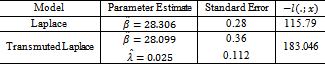


The variance covariance matrix of the MLEs under the transmuted Laplace distribution is computed as
 |
Thus, the variances of the MLE of  and
and  are
are  = 0.41 and
  = 0.0132,. Therefore, 95% confidence intervals for
  and
and  are [26.895, 29.339], and [−0.198, 0.248] respectively.
The LR test statistic to test the hypotheses  versus
  is
is  , so we reject the null hypothesis.
7. Conclusion
Here we propose a new model, the so-called the transmuted Laplace distribution which extends the Laplace distribution in the analysis of data with real support. An obvious reason for generalizing a standard distribution is because the generalized form provides larger flexibility in modeling real data. We derive expansions for moments and for the moment generating function. The estimation of parameters is approached by the method of maximum likelihood; also the information matrix is derived. An application of TLD distribution to real data shows that the new distribution can be used quite effectively to provide better fits than LD distribution.
References
| [1] | Abramowitz, M. and Stegun, I. A. (Eds.). Handbook of Mathematical Functions with Formulas, Graphs, and Mathematical Tables, 9th printing New York: Dover, 1972. | ||
 In article In article | |||
| [2] | Ashour S. K., and M. A. Eltehiwy, 2013 Transmuted Lomax Distribution, American Journal of Applied Mathematics and Statistics, Vol. 1, No. 6, 121-127. | ||
| In article | View Article | ||
| [3] | Aryal, G. R., and Tsokos, C. P. On the transmuted extreme value distribution with application. Nonlinear Analysis: Theory, Methods and Applications, 2009 71(12), e1401-e1407. | ||
| In article | |||
| [4] | Aryal, G. R., and Tsokos, C. P. 2011, Transmuted Weibull Distribution: A Generalization of the Weibull Probability Distribution, European Journal of Pure and Applied Mathematics, 4(2), 89-102. | ||
| In article | |||
| [5] | Barlow R. E., and Proschan F., Statistical Theory of Reliability and Life Testing, Begin With, Silver Spring, MD, 1981. | ||
| In article | |||
| [6] | Drapella, A., 1993, The complementary Weibull distribution: Unknown or Just forgotten?. Quality and Reliability Engineering International, 9(4), 383-385. | ||
| In article | View Article | ||
| [7] | Gusmo, F. R., Ortega, E. M., and Cordeiro, G. M., 2011, The generalized inverse Weibull distribution. Statistical Papers, 52(3), 591-619. | ||
| In article | View Article | ||
| [8] | Gradshteyn, I. S., and Ryzhik, I. M., Table of Integrals, Series, and Products 6th edn (New York: Academic), 2000. | ||
| In article | |||
| [9] | Elbatal I., L.S. Diab and N. A. Abdul-Alim, 2013, Transmuted generalized linear exponential distribution, International Journal of Computer Applications, Vol. 83, No. 17, 29-37. | ||
| In article | View Article | ||
| [10] | Johnson, N. L., Kotz, S., and Balakrishnan N. Continuous Univariate Distributions-1, Second Edition, John Wiley and Sons, 1995. | ||
| In article | |||
| [11] | Khan, M. S., and King, R., 2013, Transmuted modified weibull distribution: A generalization of the modified weibull probability distribution. European Journal of Pure and Applied Mathematics, 6(1), 66-88. | ||
| In article | |||
| [12] | Lawless, J.F., Statistical Models and Methods for Lifetime Data, John Wiley and Sons, New York, 1982. | ||
| In article | |||
| [13] | Merovci, F., 2013, Transmuted Rayleigh distribution. Austrian Journal of Statistics, Volume 42, Number 1, 2131. | ||
| In article | |||
| [14] | Merovci, F., 2013, Transmuted generalized Rayleigh distribution. Journal of Statistics Applications and Probability, Volume 2, No. 3, 1-12. | ||
| In article | |||
| [15] | Merovci, F., 2013, Transmuted Lindley distribution. International Journal of Open Problems in Computer Science and Mathematics, Volume 6, No. 2, 63-72. | ||
| In article | View Article | ||
| [16] | F. Merovci, and L. Puka, 2014, Transmuted Pareto distribution. ProbStat Forum, 7, 1-11. | ||
| In article | |||
| [17] | Mudholkar, G. S., and Kollia, G. D., 1994, Generalized Weibull family: a structural analysis. Communications in statistics-theory and methods, 23(4), 1149-1171. | ||
| In article | View Article | ||
| [18] | Miller Jr, R. G., 2011, Survival analysis (Vol. 66). John Wiley and Sons. | ||
| In article | PubMed | ||
| [19] | Murthy, D. P., Xie, M., and Jiang, R., Weibull models: John Wiley and Sons, 2004, Vol. 505. | ||
| In article | |||
| [20] | Swain, J. J., Venkatraman, S., and Wilson, J. R., 1988, Least-squares estimation of distribution functions in Johnson’s translation system. Journal of Statistical Computation and Simulation, 29(4), 271-297. | ||
| In article | View Article | ||
| [21] | Shaw, W. T., Buckley, I. R., 2009, The alchemy of probability distributions: beyond Gram- Charlier expansions, and a skew-kurtotic-normal distribution from a rank transmutation map. arXiv preprint arXiv:0901.0434. | ||
| In article | |||
 CiteULike
 Mendeley
 StumbleUpon
 Delicious
 Facebook
 Twitter
 LinkedIn