 OPEN ACCESS
  PEER-REVIEWED
Roulette Model of Systematic Sampling
Fumito Muguruma
Abstract
Considering a natural model of systematic sampling, we can calculate the expectation of statistic exactly as it is without regarding it as any other sampling methods. I will demonstrate the details of calculation and get some results. It can be shown that the sample mean of systematic sampling is an unbiased estimator of population mean. Variance of sample mean can be described explicitly and depends on how to sort a population list. Sum of the variance of sample mean and the mean of sample variance is kept constant between random and systematic sampling. As the sample size becomes larger, the variance of sample mean converges to 0.
Keywords: systematic sampling, roulette model
American Journal of Applied Mathematics and Statistics, 2014 2 (5),
pp 344-351.
DOI: 10.12691/ajams-2-5-8
Received September 09, 2014; Revised October 10, 2014; Accepted October 15, 2014
Copyright © 2013 Science and Education Publishing. All Rights Reserved.Cite this article:
- Muguruma, Fumito. "Roulette Model of Systematic Sampling." American Journal of Applied Mathematics and Statistics 2.5 (2014): 344-351.
- Muguruma, F. (2014). Roulette Model of Systematic Sampling. American Journal of Applied Mathematics and Statistics, 2(5), 344-351.
- Muguruma, Fumito. "Roulette Model of Systematic Sampling." American Journal of Applied Mathematics and Statistics 2, no. 5 (2014): 344-351.
| Import into BibTeX | Import into EndNote | Import into RefMan | Import into RefWorks |
1. Introduction
So many studies have been done about systematic sampling (Kish [1], Cochran [3], Särndal et al. [4], Sharon [5], Thompson [6], Groves et al. [7]). In this paper, on a basis of former studies, I propose a new model of systematic sampling, which procedure is a little bit different from the former ones, and try giving a theory. The model, which I call Roulette Model, can be executed easily and enables us to calculate the expectation of statistic exactly as it is.
1.1. What is and what should be Systematic Sampling?1.1.1. Procedures so far
Let us consider a problem to select n out of N elements by systematic sampling.
 |
When  is an integral multiple of
  the sampling interval
  is also an integer. If a random start
  is drawn from 0 to
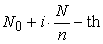
  the sample is determined by
 | (1.1.1) |
elements in a population list for  But
But  is given at first and what we can decide is only
  What if
  is a prime number? In general,
  is not necessarily an integer and problems with the sampling intervals will arise.
By Kish [1], the following four solutions were given (pp. 115-117).
1. Permit the sample size to be either  or
or  .
.
2. Eliminate with epsem (equal probability of selection method).
3. Consider the list to be circular.
4. Using fractional intervals.
He wrote “the sampler should choose the most convenient”. Cochran [3] gave an integral sampling interval at first and permitted the sample size to change (pp. 205-206). He also introduced a method suggested by Lahiri [8] (see Murthy[2] p. 139). Särndal et al. [4] organized the former studies and gave the definitions and main results. Anyway, the sampling procedures are optional.
1.1.2. Arrangement and Reconstruction
On a basis of former studies, I will arrange and reconstruct the procedure of systematic sampling in my own way as follows. Let us draw a numerical line across N●-points.
 |
Let the random start  be a random number over
 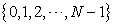 and consider the population list to be circular.
 |
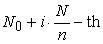
And decide the sample by
 | (1.2.1) |
elements in the list for  The problem lies in the case when
  is not an integer. Which should I select
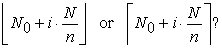 | (1.2.2) |
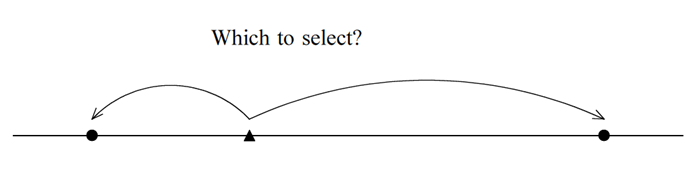 |
In a sampling problem, I don't think it essential whether  is an integer or not. I also think it unnatural that only the first sampling point (when
  ) is always an integer. Since
  is not necessarily an integer, the procedure of systematic sampling should be considered as a continuous problem. The following concept seems to be the most natural for me.
1.1.3. Roulette Model
i. Draw two circles with the same length of circumference N. On one, put N●-points
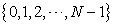 |
with the same interval 1 and set the point 0 at the top. On another, put n▲-points
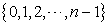 |
with the same interval  and setthe point 0 at the top. It doesn't matter whether
  is an integer or not.
 |
 |
ii. Rotate the latter circle by random angle along the circumference like roulette.
 |
 |
iii. And lap it over the former one.
 |
iv. As a sample, choose ●-points correspondent to where ▲-points dropped.
This simple procedure above is a concept of Roulette Model. It can be formulated as follows.
2. Formulation
2.1. AssumptionIn this paper, I assume all functions are defined on  . That is, if a parameter of a function is outside of the interval
 | (2.1.1) |
I add or subtract  by necessary times so as to settle it within
  .
.
i. A circle with the length of circumference  can be regarded as an interval
  . So I identify the population list
 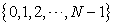 with an interval
  .
.
ii. As the interval  is a disjoint union of
  unit intervals
 | (2.2.1) |
I identify an element  in a population list with a unit interval
 | (2.2.2) |
iii. If a ▲-point belongs to  , select
  as an element of sample. Here I don't require any relation between
  and
and  . So, when
 can be selected repeatedly the same times as the number of ▲-points which belong to
  .
.
In the above procedure, I used a random angle, which is a uniform random number over an interval
 | (2.3.1) |
Along the circumference, this is equivalent to a uniform random number over an interval
 | (2.3.2) |
I consider producing the latter from now on.
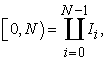
As an interval  is a disjoint union of
  unit intervals
 | (2.3.3) |
I consider producing two independent random numbers  and
and  as
as
 | (2.3.4) |
Here  is a discrete uniform random number over
 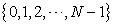 and
and  is a continuous uniform random number over
  Then
Then  will surely be a uniform random number over
 | (2.3.5) |
By  , I select a unit interval
  among
among  intervals
  And by
  , I focus on a point in the selected interval. That is, I decide a random number over
  in two steps.
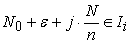
In Roulette Model, I decide the first sampling point not by  but by
  identify an element
  in a population list with a unit interval
  and choose
  when
when
 | (2.4.1) |
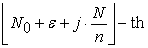
for  Then
Then
 | (2.4.2) |
elements for  re selected as a sample because
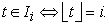 | (2.4.3) |
The existence of  -term is a different point from the former procedures. By contribution of
  -term, even if the same first sample
  and the same sampling interval
  are given, stilla different sample can be selected when neither
  nor
nor  is an integer.
3. Calculation
3.1. Expectation of StatisticThe greatest advantage of Roulette Model is, just by adding  -term, to enable us to calculate the expectation of statistic exactly as it is.
Assume that our interest is value  The population is described as
 | (3.1.1) |
and the sample is described as
 | (3.1.2) |
Given  and
and  , the sample is decided. Considering any statistic written by
 | (3.1.3) |
as is known from how we produced two random numbers  its expectation is calculated by
 | (3.1.4) |
where the order of summation and integral is commutative.
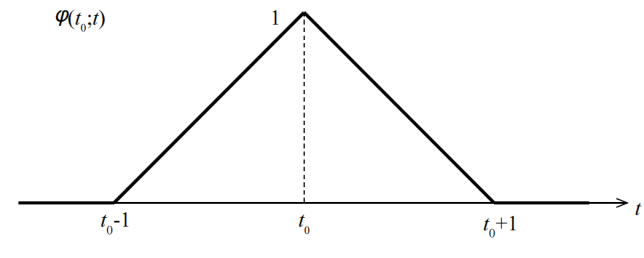
3.2. Mathematical PreparationI define a characteristic function  and a pulse function
  by
by
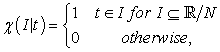 | (3.2.1) |
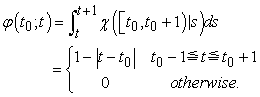 | (3.2.2) |
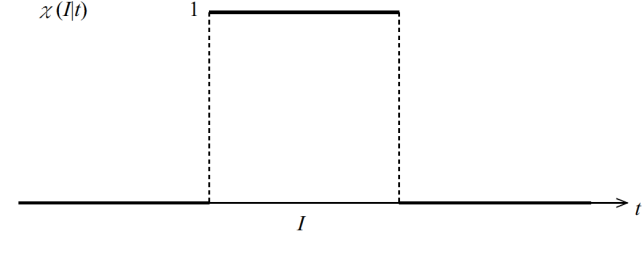 |
 |
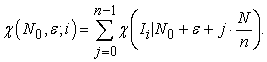
For an interval  , I write
 | (3.2.3) |
Then it leads
 | (3.2.4) |
Considering the meaning of  and
and  , we obviously have the following lemmas.
Lemma 1. For any integer  ,
,
 | (3.2.5) |
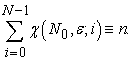
Lemma 2.
 | (3.2.6) |
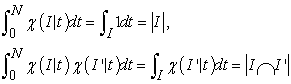
Lemma 3.
 | (3.2.7) |
Lemma 4. For any real number  ,
,
 | (3.2.8) |
Lemma 5.
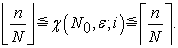 | (3.2.9) |
Let the population mean and the population variance
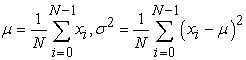 | (3.3.1) |
respectively.
Given  and
and  the sample is decided. So we can regard the sample as a function of
  and, by the meaning of
  we have
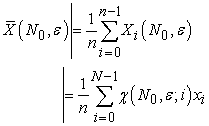 | (3.3.2) |
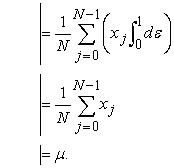
as a sample mean. By lemma 1 and 2, we can calculate its expectation as follows.
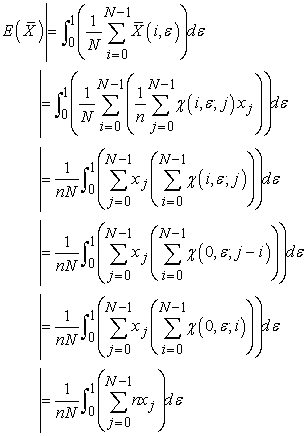 | (3.3.3) |
 | (3.3.3) |
We hereby get the proof of unbiasedness of sample mean by systematic sampling. As is known from the above process of calculation,  -term does not contribute at all. So unbiasedness still holds when
Theorem 1. Sample mean by systematic sampling is an unbiased estimator of population mean.
 | (3.3.4) |
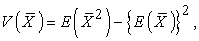
In an identity
 | (3.4.1) |
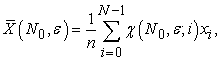
we have the relation
 | (3.4.2) |
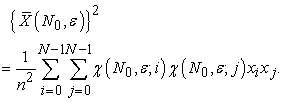
so we have
 | (3.4.3) |
The expectation is calculated by
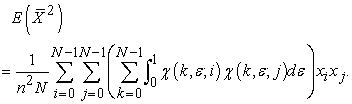 | (3.4.4) |
By the definition of  , we get
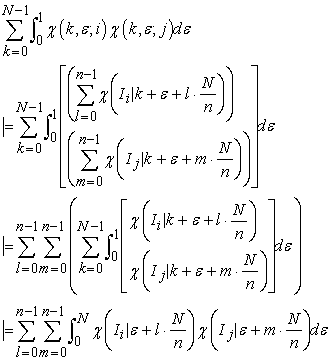 | (3.4.5) |
Here, if we put
 | (3.4.6) |
by lemma 3, we have
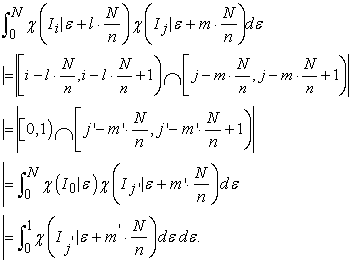 | (3.4.7) |
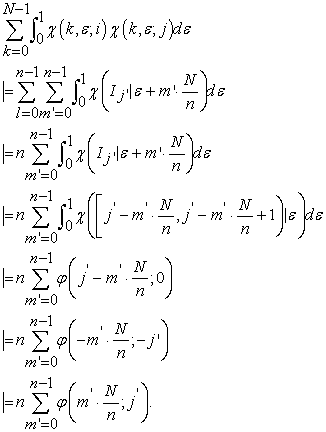 | (3.4.8) |
At last, we obtain
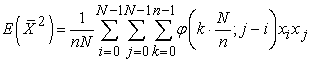 | (3.4.9) |
Here I define a function  by
by
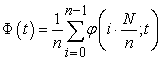 | (3.4.10) |
and get the explicit description of the variance of sample mean as
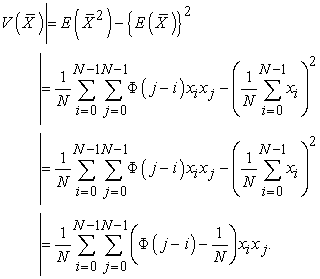 | (3.4.11) |
Theorem 2. The variance of sample mean by systematic sampling is described as
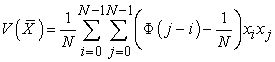 | (3.4.12) |
That a function  has a parameter
  means that
  depends on how to sort a population list.
The expectation of sample variance
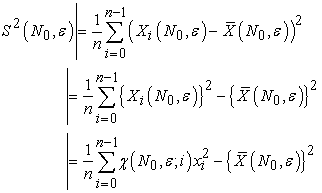 | (3.5.1) |
is calculated, by lemma 1, 2 and 3, as
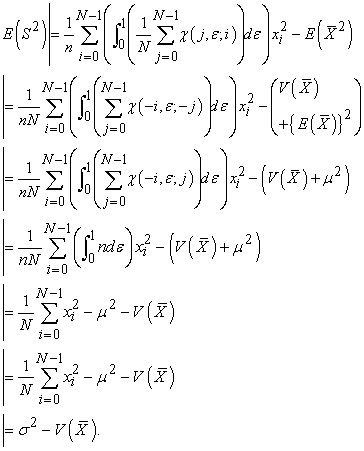 | (3.5.2) |
In general, sample mean and sample variance can be regarded as functions of sample size  . So I write them
  and
and  respectively from now on. From the result of 3-5, in systematic sampling,
 | (3.6.1) |
holds. On the other hand, in random sampling with replacement,
 | (3.6.2) |
so we have
 | (3.6.3) |
In random sampling without replacement, because
 | (3.6.4) |
we again have
 | (3.6.5) |
While  and
and  are random variables,
  and
and  are constants. In general,
 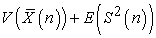 is considered to depend on sample size n and how to select a sample. So the above results tell us the conserved quantity between random and systematic sampling.
Theorem 3. Between random and systematic sampling, the following quantities are conserved.
 | (3.6.6) |
In
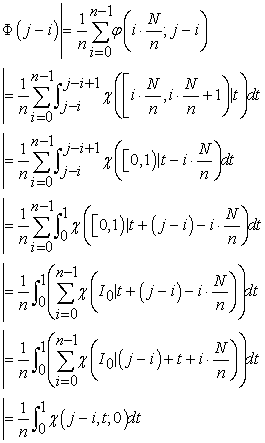 | (3.7.1) |
from lemma 5, we immediately have inequalities
 | (3.7.2) |
 | (3.7.3) |
so we obtain
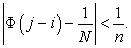 | (3.7.4) |
Applying this estimation to
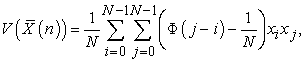 | (3.7.5) |
we get an analogy of law of large numbers.
Theorem 4. In systematic sampling, while
 | (3.7.6) |
is kept,
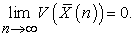 | (3.7.7) |
Moreover, while we obviously have
 | (3.7.8) |
for random sampling without replacement, we also have
 | (3.7.9) |
for systematic sampling because, when 
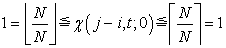 | (3.7.10) |
and
 | (3.7.11) |
That is,  of systematic sampling has both properties of random samplings with and without replacement.
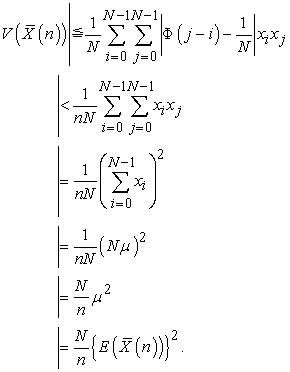
When  is nonnegative and
  , from (3.7.4), we can estimate
 | (3.7.12) |
So the coefficient of variation of  is less than
Corollary 1.  When is nonnegative and
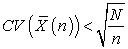 | (3.7.13) |
Applying lemma 5 to
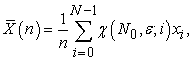 | (3.7.14) |
we get the following estimation.
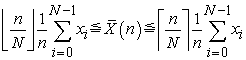 | (3.7.15) |
and
 | (3.7.16) |
Here, as
 | (3.7.17) |
we have
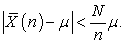 | (3.7.18) |
This result suggests the robustness of systematic sampling.
Corollary 2. When  is nonnegative and
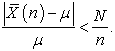 | (3.7.19) |
4. Discussion
Define a vector  and an
  matrix
  as
as
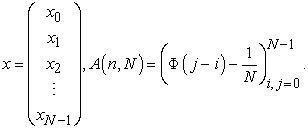 | (4.1) |
Then  can be regarded as a quadratic form
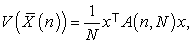 | (4.2) |
where  s obviously a positive semi definite matrix.
Proposition. For any 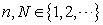 and any real vector
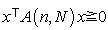 | (4.3) |
and
 | (4.4) |
How to sort a population list is nothing but how to permutate a population list mathematically. So, if I write
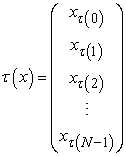 | (4.5) |
for  where
where  is a permutation group of degree
 can be regarded as a function of
  and written as
 | (4.6) |
Here the next question will arise.
What kind of  givesless
  ?
?
Obviously the value is conserved according to a cyclic permutation. I leave this problem to the readers. Thank you so much for reading my poor English to the end.
Acknowledgement
I would like to express my gratitude to Reiji Murayama and Yoshihiro Yumiba for their sincere encouragement. Also I would like to extend my indebtedness to Takashi for his endless love, understanding, support and encouragement throughout my study. The responsibility for any errors is entirely mine.
References
| [1] | Leslie Kish, Survey Sampling, John Wiley & Sons, Inc., 1965. | ||
 In article In article | |||
| [2] | Murthy, M. N., Sampling Theory and Methods. Statistical Publishing Society, Calcutta, India, 1967. | ||
| In article | |||
| [3] | William G. Cochran, Sampling Techniques, John Wiley & Sons, Inc., 1977. | ||
| In article | |||
| [4] | Carl-Erik Särndal, Bengt Swensson and Jan Wretman, Model Assisted Survey Sampling, Springer, 1992. | ||
| In article | CrossRef | ||
| [5] | Sharon L. Lohr., Sampling: Design and Analysis. Duxbury Press, 1999. | ||
| In article | |||
| [6] | Steven K. Thompson, Sampling, John Wiley & Sons, Inc., 2002. | ||
| In article | |||
| [7] | Robert M. Groves, Floyd J. Fowler, Jr., Mick P. Couper, James M. Lepkowski, Eleanor Singer, and Roger Tourangeau., Survey Methodology. John Wiley & Sons, Inc., 2004. | ||
| In article | |||
| [8] | Lahiri, D. B., “A method for sample selection providing unbiased ratio estimates”. Bull. Int. Stat. Inst., 33, 2, 133-140, 1951. | ||
| In article | |||

 CiteULike
 Mendeley
 StumbleUpon
 Delicious
 Facebook
 Twitter
 LinkedIn
 Print
Print