This study provides primary information about the population status the fruit bat species called Indian Flying Fox (Pteropus giganteus) in Guwahati city of Assam, Northeast India. The study revealed that the entire city had only two roosting sites, Pan Bazar roosting site and Judge Filed roosting site, both within close proximity of each other. During the three months study from March to May, 2018, peak colony size was observed in the month of May. At Pan Bajar roosting site, the total colony size of Indian flying fox was 1,137±10 in March, 1,345±10 in April and 1,380±10 in May. Eight species of roosting trees were observed which included Eucalyptus globusus, Delonix regia, Ficus religiosa, Ficus benghalensis, Tamarindus indica, Polyalthia longifolia, Mangifera indica and Grevillea robusta. In the Judge filed roosting site, only two types of roosting trees were observed namely Eucalyptus globusus and Polyalthia longifolia. Here, the total colony size of was 152±10 in March, 170±10 in April and 179±10 in May. In both the cases, the bats have chosen large, tall and well exposed tree species as their roost. The roosting sites were also seen to be in close proximity to water bodies. The study also showed that increase in the built up area was posing a threat to the species which is playing a very important ecological role in seed dispersion and pollination. Further felling of trees in this rapidly growing metropolitan area will lead to complete extinction of this species from the urban landscape of Guwahati city.
Bats are a very richly diversified group of mammals. There are approximately 1,400 species of bats 1, 2 distributed all over the world with the tropics having the highest diversity with new bat species being constantly discovered. India being situated in the tropics also supports a large variety of species of bats. There are about 123 species in India and about 28 species are found in Assam 3. The Indian Flying Fox (Pteropus giganteus) plays a very important role in the environment from an ecological point of view. Their most important ecological role is that of plant pollinators and dispersing fruit seeds. Many tropical plant species depend entirely on them for distribution of their seeds 4. Bats also contribute to soil fertility and nutrient distribution due to their high mobility and use of different habitats for roosting and foraging which facilitates nutrient transfer in degraded or fragmented landscapes 5. Bat guano (bat dung) has great ecological potential as bats sprinkle it over the landscape throughout the night. More than 289 plant species are known to depend on pollination and seed dispersal by Old World fruit bats, providing essential ecosystem services in different habitats of the Old World tropics 6, 7, 8, 9, 10. They also have economic importance because they consume insect pests and reduce the need of pesticides.
However, the bat population appears to be declining in recent years due to anthropogenic activities which put a lot of stress on the environment. Environmental stresses such as - habitat destruction and fragmentation, disturbance to caves, depletion of food resources, overhunting of bush meat, persecution, use of pesticides, diseases, wind energy turbines are taking a toll on their population size 11. Over 20% of the world’s bats are threatened with extinction out of which 25 species are classified as Critically Endangered by the IUCN Red Data List and may not survive without human help. At least 5 species have already gone extinct 12.
Pteropus giganteus commonly known as the Indian Flying Fox (also known as the Greater Indian fruit bat) is a species of bat which is widely distributed in the South Asia and also occurs in some parts of China and Southeast Asia. It is commonly found in India, Bangladesh, Bhutan, Maldives, Myanmar, Nepal, Pakistan, Sri Lanka and China 8, 13. They roost in large colonies of hundreds to thousands of individuals on large trees in urban and rural areas, close to agricultural fields, ponds and by the side of roads 14. They are usually found roosting near water bodies so that they can drink water immediately after they become active at dusk before going to forage for food. The sizes of the colonies keep on fluctuating with the different seasons. The species roosts mainly on the forest trees such as Ficus sp., Tamarindus indica, Albizia sp., Pterocarpus marsupium, Azadirachta indica, Mangifera indica, Dalbergia sp., Casuarina sp., Eucalyptus etc 15. Many tree species like Ficus, Livistona and Syzygium species are planted and grown within cities to increase the aesthetics of the city. These species are used as a food source for the bats have been studied in Hong Kong 16, 17, India 18 and Japan 19.
Today Pteropus giganteus is listed as Least Concern (LC) because it is widely distributed and has a large population and occurs in a number of protected areas. However, man has today become the greatest enemy to the Indian Flying Fox. They are mostly threatened by the anthropogenic activities. Common threat arises from cutting down of the roosting trees for construction of roads, agricultural fields, and infrastructure etc. In Southeast Asia, conditions for flying foxes are especially critical. The relative deforestation rate and associated wildlife habitat loss in Southeast Asia is the highest for all tropical regions 20. Ongoing habitat loss due to anthropogenic pressures and the lack of conservation efforts are the most crucial threats to the survival of bats 21. They are also hunted in some regions for meat and medicine 3, 8. They are also the most persecuted bat in South Asia and are listed as vermin under Schedule V of the Indian Wildlife (Protection) Act 22, 23.
Guwahati like any other metropolitan is expanding quite rapidly in the past decades. As such much of the flora and fauna within the city premise has been reduced. Deforestation, construction of infrastructure, roads etc are major activities in a growing city which show their ill consequences on the diversity of the area. In 1999, four roosting sites were observed in Guwahati 24, while Kachari being the largest roosting site having a population of 650-700 bats. However, it was observed that later on the Kachari roosting site has shifted to Pan Bazar area 25. These changes taking place in Guwahati city is likely to affect the population of Indian Flying Fox (Pteropus giganteus) found within the city premise. This study will help us to know the population status of Pteropus giganteus and identify the threats to their population and whether or not any intensive conservation strategies are required for the protection of their population. Although Northeast India has a rich diversity of bats, very little study has been done on this species of mammal in the region. In Assam there is very little research done on the P. giganteus or the bat community as a whole in the state. Some work done has been done on the status and ecology of P. giganteus in some districts of Assam 3, 26. More research is needed to fully understand how the population dynamics of the species is changing in the state so that a well-rounded conservation plan can be made for the declining population.
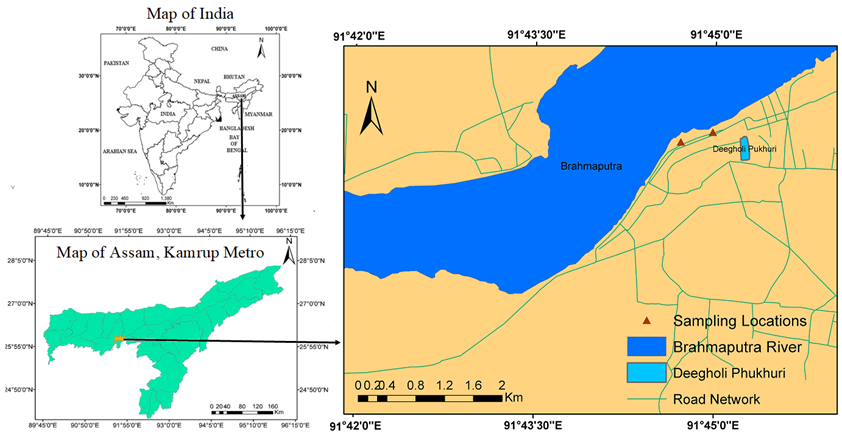
Guwahati is one of the largest and fastest growing cities in North east India. It consists of an area about 556 km2 at an altitude 55.5 m from mean sea level (MSL). The latitude is 26°10'45"N and longitude is 91°45'0"E. The whole of Guwahati is divided into two parts - the north bank and the south bank by the River Brahmaputra.
The city experiences humid subtropical climate, characterized by the peak summer temperature rising upto 38°C, while in winter, it sometimes it falls to 10°C. The average annual rainfall at Guwahati is 1746.5mm. The climate of Guwahati city is a sub-tropical one and hence suitable to support bat fauna. The map of the study area is given in Figure 1.

The study sites which have been selected within the city are located at Pan Bazar [SS-1 (26°11'17.97" N and 91° 44'43.93"E)] and Judges Field[(SS-2) (26°11'20.38"N and 91°44'58.71" E)]. Both the sites are located in commercial areas where large amount of human activities are carried out on a daily basis. The sites are surrounded by localities of Fancy Bazar, Ambari, Latasil, Paltan Bazar, Uzan Bazar etc. There are also numerous institutional as well as other important infrastructures surrounding the sites like the High Court, Deputy Commissioner’s Office, Cotton State University, Pan Bazar Water Treatment plant, Churches, Residence of the Chief justice, Indian Postal Head Quarter etc.
The study was carried out in the months from March to May, in 2018. For studying the population of Pteropus giganteus direct roost count method was adopted. It was carried out by observing the bat colonies in the roosting site at the time of roosting. Observers were positioned to ensure unobstructed view of the roosting bats. The roost search was conducted during day hours. The colony size was assessed through direct count using binocular and photographic methods 27. The most consistent and reliable counts could be made soon after sunrise and late afternoon. The Roosting sites were observed and the species of the roosting trees were noted. Species density was determined with the Transect Design method whereas circular transect of 5 m radius is plotted around each tree and the total area occupied by the roosting trees was calculated. Observation of the surrounding area of the roosting site was done so that potential threats to the bat population could be identified and recorded. The formula used for the study was
 | (1) |
 | (2) |
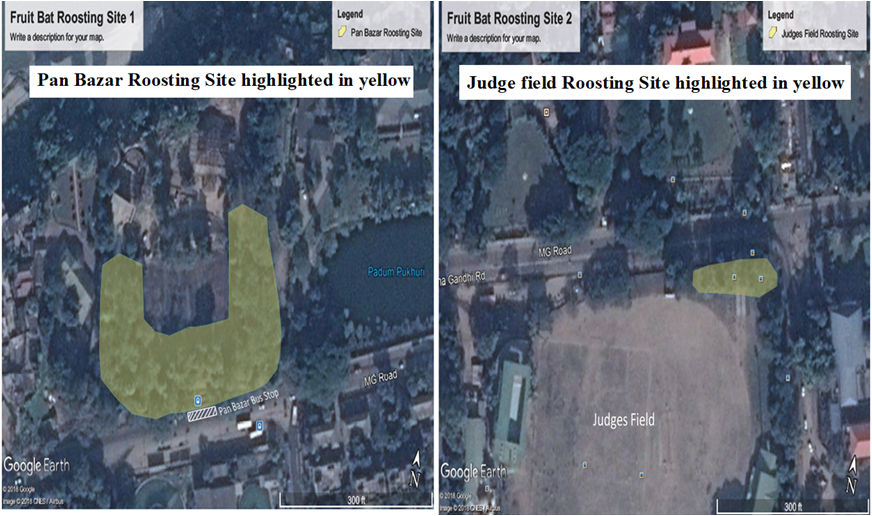
The study was carried out in the months from March to May, in 2018. In the study two roosting sites of Pteropus giganteus were identified. The first site being the Pan Bazar Roosting spot (SS-1) and second site Judges Field roosting spot (SS-2) shown in Figure 2.

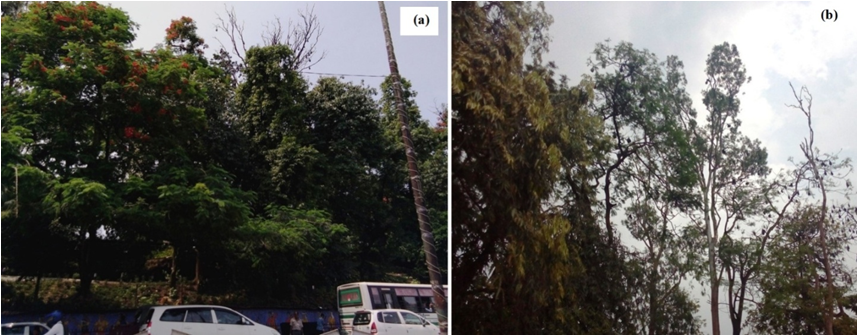
Bats used 43 trees of eight different species for roosting at Pan Bazar roosting site while 6 trees of two species were used at Judge Field Roosting site. Large numbers of Eucalyptus sp. (17) were used at SS 1 followed by Royal Poinciana (Delonix regia) (10). The list of the roosting tree along with the individual species is given in Table 1.
In the Pan Bazar roosting site 8 roosting tree species were identified. They were Eucalyptus globusus, Delonix regia, Ficus religiosa, Ficus benghalensis, Tamarindus indica, Polyalthia longifolia, Mangifera indica and Grevillea robusta. Out of all the 8 species Eucalyptus globusus has the highest population with 17 individual trees providing roosting space for the bats followed by Delonix regia with 10 individual trees and Ficus bengalensis, Ficus religiosa and Mangifera indica with the lowest population of only 1 individual. A total of 43 roosting trees were observed at this roosting site. In the Judges Field roosting site (SS 2), only two types of roosting tree species were found namely, Eucalyptus globusus and Polyalthia longifolia. Eucalyptus globusus has 5 individual trees while Polyalthia longifolia had only 1 individual tree serving as the roosting space for the bats. A total of 6 roosting trees were observed at this roosting site. The most abundant tree species found at the roosting sites was Eucalyptus globusus and it was also the most commonly used tree species for roosting by the P. giganteus. This may be because the bats found the E. globusus trees to be the most abundant in number and selected it for roosting so that they could roost together in larger colonies as they are social mammals like other megachiropteran bats.
The total area covered by the roosting site was estimated and the results shown in Table 2. The map showing the roosting area is shown in Figure 3. It is seen that SS-1 happens to occupy a bigger area of 3375.5m2 compared to SS-2, which occupies an area of 471 m2.
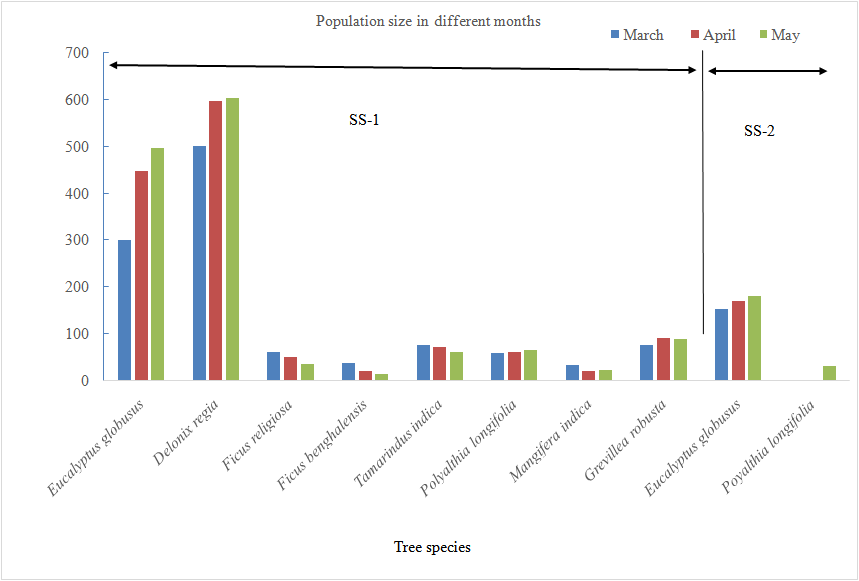
The bat population was studied at the Pan Bazar and Judges Field roosting site for the months of March-May. During the time of the study the bat population was counted by direct roost count method. The counting was done between late mornings to afternoon. The population at the roost site was estimated and the numbers of bats were counted and their numbers in each roosting tree species is given in Table 3. At Pan Bajar roosting site, the total colony size of Indian flying fox was 1,137±10 in March, 1,345±10 in April and 1,380±10 in May. The maximum number of bats was observed in the tree species Delonix regia where 500±10 bats in March, 597±10 bats in April and 603±10 bats in May was reported. It was followed by the Eucalyptus globulus tree species where 300±10 in March, 447±10 in April and 496±10 in May was reported. Minimum number of bats were observed in Ficus benghalensis with 36±10 in March, 20±10 in April and 13±10 in May. In the Judge filed roosting site (SS 2), only two types of roosting trees were observed. The total colony size of Indian flying fox was 152±10 in March, 170±10 in April and 179±10 in May. The monthly variation in Eucalyptus globusus tree species was 152±10 in March, 170±10 in April and 209±10 in May. On the months of March and April no bats were observed in Poyalthia longifolia tree species. In both the roosting site, the peak population of the Indian flying fox was observed during May. This may be due to favorable temperature and weather conditions in this region during this period. In the Pan Bazar roosting site, the average population of bats has been approximately1290 while in Judge field roosting site it was found to be approximately 177.

The population of the bats at the roosting sites was found to be the highest during the month of May out of all the 3 months for which the study was carried out. Similar observation was also observed by other author 28. The population of bats was observed to be the highest during the afternoons when they showed the least amount of activity. It was also observed that the number of bats roosting in the different roosting trees were not always constant, which is shown in Figure 4. Their movement patterns are also influenced by the spatio-temporal distribution of food and roosting resources 29, 30. It is observed that on days when it was sunny and hot, the bats were seen to be roosting in the trees which provided the most shade and sheltered them from the direct sun whereas on cloudy days the bats were more evenly distributed around the roosting sites.
It was observed that the roosting sites were located in commercial areas with thickly populated human settlements nearby. This was in accordance with the report of 31 which stated that P. giganteus colonies were usually located in close association with human habitats and were mostly found in cities and villages. It was also observed that the roosting sites were located in close association to perennial water bodies like ponds and rivers. Two ponds were located nearby - the Padum Pukhuri, Digholi Pukhuri and the mighty River Brahmaputra was also observed flowing alongside the location of the roosting sites. From observing the activities of the P. giganteus it was seen that the water bodies served as a valuable source of drinking water for the mammal. Just after sunset when the P.giganteus became active and emerged from their roost they were seen flying in the direction of the ponds in order to drink water.
Guwahati city has been growing very rapidly and hence is facing problems related to land use/land cover (LULC) changes. These problems are a result of unplanned urban growth. There has been a decrease in the natural and semi-natural vegetated areas as well as artificial and natural water bodies. While built-up areas, cultivated and managed areas and scrublands and waste lands have increased. The built-up area has increased from 23.9 km2 in 1976 to 115.1 km2 in 2015. Natural and semi-natural vegetated land was reduced by 88.9 km2 at an annual rate of 2.2 km2 32. From 1972 to 2016, the Guwahati city has witnessed drastic change in the land use/ land cover, as the build up area showed an increase in 38.3%, but open area and forest cover showed a decrease in 22.12% and 13.28% respectively. The water bodies had also shown a decrease by 13.28% 33. Guwahati is the largest city in Assam and has seen rapid development in recent decades. The population of the city has increased 6.5 times from 123,783 in 1971 to 809,895 in 2001. Along with this increase the municipal limit of the city has also increased from 43.82 km2 in 1971 to 216.79 km2 in 2001. With this increase in population and extension of the city there has been significant increase in the residential areas. It was also observed that both the roosting site being located in commercial area is exposed to many anthropogenic activities which have the potential of becoming threats to the bat population residing at these places. Being located alongside the roadsides they experience disturbance in the form of noise from automobiles, honking of horns, sports events etc. Large numbers of vehicles are seen travelling along the adjacent roads on a daily basis. The nearby areas consist of a large number of infrastructures like buildings, electrical lines, telecommunication towers etc. Moreover, it is reported that they are naturally exposed to continuous intense sound levels from their own neighboring sonar emissions while foraging, orienting and emerging from their roosts 34. So, the presence of these tree species like Polyalthia logifolia, Delonix regia, Tamarindus indica etc. at the roosting sites may also significantly reduce the amount of noise reaching the roosting bats nas these trees are effective in controlling noise pollution due to their noise absorbing capacity 35. Hence it becomes very important that these trees are protected and saved from felling for infrastructure development.
These roosting sites being on commercial site is illuminated during the evenings and nights with abundant artificial lightings. Artificial lights like streetlights and headlights of automobiles cause a lot of light pollution in the urban scenario. This can act as a major deterrent to the nocturnal activities of the foraging bats 36. Light pollution is especially deterrent to the activities of bats depending more on their sights than echolocation to forage for food. The P. giganteus is a frugivorous bat and hence it relies more on its sight to forage for food and it is affected by artificial lighting.
The numerous urban infrastructures like tall buildings, telecommunication towers etc. littered around the roosting sites are obstructing the flight paths of the bats. These are also disturbing their commuting routes and forces the bats to change their travel routes making them stray far from their roosting sites and eventually abandon their original roosting sites. They are also seen to collide with these infrastructures which could prove fatal to the bats in flight. This happens due to the misinterpretation and interference of the echolocation of the bats during flight due to the material of the buildings especially glass 37.
Guwahati being an urban area is littered with electrical power supply lines. These power lines are a major obstacle to the bats during their flight. Electrocution is a regular cause for the death of bats in almost all cities and states in India 3, 38, 39. The bats during their flight are unable to avoid these sudden obstacles and hence they get tangled up in these high-tension power lines and get electrocuted.
The construction and infrastructure development activities has led to habitat fragmentation and decreased the extent and quality of accessible area for foraging and roosting. Since the area and quality of habitat is the major determinant of population size hence habitat fragmentation will definitely lower the population size.
In this study two roosting sites were identified in the urban areas of Guwahati city. The total population size of P.giganteus in both the sites together was confirmed at 1467±10. The roosting sites were mostly composed of the moist mixed deciduous forest type along with evergreen type of tree species. Out of the 8 roosting tree species observed Eucalyptus globusus, Delonix regia, Tamarindus indica, Ficus religiosa are of the moist mixed deciduous type whereas the species Mangifera indica, Ficus benghalensis, Polyalthia longifolia, Grevillea robusta are of the ever green types. The roosting sites were quite thickly populated by these tree species. During the study period it was noticed that both the roosting sites were located in close proximity to perennial stagnant water bodies i.e. ponds and the mighty Brahmaputra. The nearest pond to the Pan Bazar roosting site is the Padum Pukhuri. While the nearest pond to the Judges Field roosting site is the Digholi Pukhuri. The two roosting sites are located in close proximity to each other with only a mere 1 km separating the two sites from each other. The P. giganteus bats were seen to be well adapted to live within the urban setting by the study done on its population. Hence the main reason for the reduction in the number of P. giganteus roosting sites will definitely have to be attributed to the increase in the built up land of the city. The loss of roosting ground by felling of roosting trees for commercial purposes, industrial use and urban expansion is the main reason behind shifting of their population from the city into more undisturbed areas leading to the loss in the urban wildlife. These areas with important roosting sites should be made into protected areas so that felling of trees in these areas are illegal. Another threat to the conservation of this bat species is the fact that it is actually listed as vermin in the Schedule V of the Indian Wildlife (Protection) Act due to which it is largely killed for destroying fruits and agricultural crops. Although the P. giganteus is listed as Least Concern (LC) by the IUCN (2008) Red Data list there is still a need for conservation strategy before its population is reduced to a critical state. As for the population within the Guwahati city there is also a need for conservation practice and protecting the roosting sites and stop their hunting for meat and medicinal uses. Thus, the results of present investigation indicated that the bat population in the Guwahati city is very much under threats on account of increasing anthropogenic activities and ongoing habitat loss due to urbanization, and further studies on the bioecology of these flying mammals are to be carried out with a view to conserve this ecologically important species.
Authors declare no conflict of interest.
| [1] | Bat conservation Trust Accessed on June 2020 https://www.bats.org.uk/about-bats. | ||
| In article | |||
| [2] | Burgin, C.J., Colella J.P., Kahn P. L., et al. (2018). How many species of mammals are there? J. Mammal, 99, 1-14. | ||
| In article | View Article | ||
| [3] | Sinha, Y.P. (1999). Contribution to the knowledge of bats (Mammalia: Chiroptera) of North East hills, India. Zoological Survey of India. | ||
| In article | |||
| [4] | Vendan, S.E. and Kaleeswaran, B. (2011). Plant dispersal by Indian flying fox Pteropus giganteus in Madurai region, India. Elixier Bio Diversity, 3, 1810-1813. | ||
| In article | |||
| [5] | Corlett, R.T. (2009). Seed dispersal distances and plant migration potential in tropical East Asia. Biotropica, 41, 592-598. | ||
| In article | View Article | ||
| [6] | Start, A.N. and Marshall, A.G. (1976) Nectarivores bats as pollinators of trees in west Malaysia. In: Burley J, Styles BT, editors. Tropical trees. variation, breeding, and conservation. Oxford: Oxford University Press; pp. 131-149. | ||
| In article | |||
| [7] | Fujita, M.S. and Tuttle, M.D. (1991) Flying foxes (Chiroptera: Pteropodidae): threatened animals of key ecological and economic importance. Conservation Biology, 5, 455-463. | ||
| In article | View Article | ||
| [8] | Mickleburgh, S. Hutson, A.M. and Racey, P.A. (1992) Old World fruit bats: an action plan for their conservation. International Union for Conservation of Nature and Natural Resources (IUCN), Gland, Switzerland. | ||
| In article | View Article | ||
| [9] | Muscarella, R. and Fleming, T.H. (2007). The role of frugivorous bats in tropical forest succession. Biological Reviews, 82, 573-590. | ||
| In article | View Article PubMed | ||
| [10] | Kunz, T.H., Torrez, E.B., Bauer, D., Lobova, T. and Fleming, T.H. (2011) Ecosystem services provided by bats. Annals of the New York Academy of Sciences, 1223, 1-38. | ||
| In article | View Article PubMed | ||
| [11] | Kasso, M. and Balakrishnan, M. (2013). Ecological and economic importance of bats (Order Chiroptera). ISRN Biodiversity. | ||
| In article | View Article | ||
| [12] | Bat Conservation Trust. 2016. (www.bats.org.uk). | ||
| In article | |||
| [13] | Bumrungsri, S.D., Lang, C., Harrower, E., Sripaoraya, K. and Racey, P.A. (2013). The dawn bat, Eonycteris spelaea Dobson (Chiroptera: Pteropodidae) feeds mainly on pollen of economically important food plants in Thailand. Acta Chiropterologica, 15, 95-104. | ||
| In article | View Article | ||
| [14] | Molur, S., Srinivasulu, C., Bates, P. and Francis, C. (2008). Pteropus giganteus. The IUCN Red List of Threatened Species 2008: e.T18725A8511108. | ||
| In article | |||
| [15] | Gulraiz, T.L., Javid, A., Mahmood-Ul-Hassan, M., Maqbool, A., Ashraf, S., Hussain, M. and Daud, S. (2015) Roost characteristics and habitat preferences of Indian flying fox (Pteropus giganteus) in urban areas of Lahore, Pakistan. Turkish Journal of Zoology, 39(3), 388-394. | ||
| In article | View Article | ||
| [16] | Corlett, R.T. (2005). Interactions between birds, fruit bats and exotic plants in urban Hong Kong, South China. Urban Ecosyst, 8(3), 275-283. | ||
| In article | View Article | ||
| [17] | Corlett, R.T. (2006). Figs (Ficus, Moraceae) in Urban Hong Kong, South China. Biotropica 38(1), 116-121. | ||
| In article | View Article | ||
| [18] | Caughlin, T.T., Ganesh, T. and Lowman, M.D. (2012). Sacred fig trees promote frugivore visitation and tree seedling abundance in South India. Curr Sci, 102(6), 918-922. | ||
| In article | |||
| [19] | Nakamoto, A., Kinjo, K. and Izawa, M. (2007). Food habits of Orii’s flying-fox, Pteropus dasymallus inopinatus, in relation to food availability in an urban area of Okinawa-jima Island, the Ryukyu Archipelago, Japan. Acta Chiropterologica. 9(1), 237-249. | ||
| In article | View Article | ||
| [20] | Sodhi, N.S., Koh, L.P., Brook, B.W. and Ng, P.K.L. (2004) Southeast Asian biodiversity: an impending disaster. Trends in Ecology & Evolution 19, 654-660 | ||
| In article | View Article PubMed | ||
| [21] | Molur, S., Srinivasulu, C., Bates, P., and Francis, C. (2008). Pteropus giganteus. The IUCN Red List of Threatened Species 2008: e.T18725A8511108. | ||
| In article | |||
| [22] | International Union for Conservation of Nature (IUCN) 2008. The IUCN Red list of threatened species™. IUCN, Gland, Switzerland. (www.iucnredlist.org/). | ||
| In article | |||
| [23] | Singaravelan, N., Marimuthu, G. and Racey, P.A. (2009). Do fruit bats deserve to be listed as vermin in the Indian Wildlife (Protection) & Amended Acts? A critical review. Fauna & Flora International Oryx, 43(4), 608-613. | ||
| In article | View Article | ||
| [24] | Ali, A. and Basistha, S.K. (1999). Fruit Bats in and around Guwahati city, Assam. ZOOS, Print Journal, Vol. I-XIV, No.1-10: 136. | ||
| In article | View Article | ||
| [25] | Ali, A. (2017) Guwahati City Fruit Bat Roosting Site Permanently shifted to a New Location: A major Ecobiological event for Fruit Bat Community in the New Millennium in Assam, India.”, Proc. Vol., ISBN: 978-1-947099-21-0, Dept. Of Zoo. B.N. College, Dhubri, Assam, india. pp. 24-27. | ||
| In article | |||
| [26] | Ali, A. (2010). Population trend and conservation status of Indian flying fox Pteropus giganteus Brunnich, 1782 (Chiroptera: Pteropodidae) in Western Assam. The Ecoscan 4(4), 311-312. | ||
| In article | |||
| [27] | Tuttle, M. D. (1979). Status cause of decline, and management of gray endangered bat: Journal of Wildlife Management, 43, 1-17. | ||
| In article | View Article | ||
| [28] | [Mishra R, Dookial S, Bhattacharya P (2019) Avenue Plantations as Biodiversity Havens: A Case Study of Population Status of the Indian Flying Fox, Pteropus giganteus Brunnich, 1782 and Implications for Its Conservation in the Urban Megacity, Delhi, India.Proc Zool Soc. | ||
| In article | View Article | ||
| [29] | Nelson, J.E. (1965) Behaviour of Australian pteropodidae (Megachiroptera). Animal Behavior, 13, 544-557. | ||
| In article | View Article | ||
| [30] | Eby, P. (1991). Seasonal movements of grey-headed flying-foxes, Pteropus poliocephalus (Chiroptera: Pteropodidae), from two maternity camps in northern New South Wales. Wildlife Research, 18, 547-559. | ||
| In article | View Article | ||
| [31] | Bates, P.J.J and Harrison, D. (1997). Bats of the Indian Subcontinent, Harrison Zoological Museum, Sevenoaks.Kent, UK. | ||
| In article | |||
| [32] | Pawe, C.K. and Saikia, A. (2018). Unplanned urban growth: land use/ land cover change in the Guwahati Metropolitan area. India. Geografisk Tidsskrift Danish J Geography, 118 (1), 88-100. | ||
| In article | View Article | ||
| [33] | Talukdar, K.K. (2018). Impact of Urban Growth On Land use, A Case Study Of Guwahati City, Assam. International Journal of Engineering Science Invention, 7 (8), 26-32 | ||
| In article | |||
| [34] | Simmons, A.M., Hom, K.N., Warnecke, M. and Simmons, J.A. (2016). Broadband noise exposure does not affect hearing sensitivity in big brown bats (Eptesicus fuscus). J Experimental Biology, 219(7), 1031-1040. | ||
| In article | View Article PubMed | ||
| [35] | Kumar, S.R., Arumugam, T., Anandakumar, C.R., Balakrishnan, S., and Rajavel, D.S. (2013). Use of Plant Species in Controlling Environmental Pollution- A Review. Bull. Env. Pharmacol. Life Sci, 2 (2), 52-63. | ||
| In article | |||
| [36] | Stone, E.L. (2013) Bats and lighting: Overview of current evidence and mitigation guidance. University of Bristol, Bristol, UK. | ||
| In article | |||
| [37] | Greif, S., Zsebők, S., Schmieder, D. and Siemers, B.M. (2017) Acoustic mirrors as sensory traps for bats. Science, 357 (6355), 1045-1047. | ||
| In article | View Article PubMed | ||
| [38] | Kumar, J. and Kanaujia, A. (2015). Distribution and population status of fruit-bat (Pteropus giganteus) in district Lakhimpur-Kheri,T., Uttar Pradesh, India. Journal of Environmental Science and Technology, 3(3), 23-28. | ||
| In article | |||
| [39] | Rajeshkumar, S., Raghunathan, C. and Venkataraman, K. (2013) Observation on electrocution of flying fox Pteropus giganteus in Andaman islands and conservation strategies. J Andaman Science Association, 18(2), 213-215. | ||
| In article | |||
Published with license by Science and Education Publishing, Copyright © 2020 Pallavi Sharma and Mandira Rai
 This work is licensed under a Creative Commons Attribution 4.0 International License. To view a copy of this license, visit
http://creativecommons.org/licenses/by/4.0/
This work is licensed under a Creative Commons Attribution 4.0 International License. To view a copy of this license, visit
http://creativecommons.org/licenses/by/4.0/
| [1] | Bat conservation Trust Accessed on June 2020 https://www.bats.org.uk/about-bats. | ||
| In article | |||
| [2] | Burgin, C.J., Colella J.P., Kahn P. L., et al. (2018). How many species of mammals are there? J. Mammal, 99, 1-14. | ||
| In article | View Article | ||
| [3] | Sinha, Y.P. (1999). Contribution to the knowledge of bats (Mammalia: Chiroptera) of North East hills, India. Zoological Survey of India. | ||
| In article | |||
| [4] | Vendan, S.E. and Kaleeswaran, B. (2011). Plant dispersal by Indian flying fox Pteropus giganteus in Madurai region, India. Elixier Bio Diversity, 3, 1810-1813. | ||
| In article | |||
| [5] | Corlett, R.T. (2009). Seed dispersal distances and plant migration potential in tropical East Asia. Biotropica, 41, 592-598. | ||
| In article | View Article | ||
| [6] | Start, A.N. and Marshall, A.G. (1976) Nectarivores bats as pollinators of trees in west Malaysia. In: Burley J, Styles BT, editors. Tropical trees. variation, breeding, and conservation. Oxford: Oxford University Press; pp. 131-149. | ||
| In article | |||
| [7] | Fujita, M.S. and Tuttle, M.D. (1991) Flying foxes (Chiroptera: Pteropodidae): threatened animals of key ecological and economic importance. Conservation Biology, 5, 455-463. | ||
| In article | View Article | ||
| [8] | Mickleburgh, S. Hutson, A.M. and Racey, P.A. (1992) Old World fruit bats: an action plan for their conservation. International Union for Conservation of Nature and Natural Resources (IUCN), Gland, Switzerland. | ||
| In article | View Article | ||
| [9] | Muscarella, R. and Fleming, T.H. (2007). The role of frugivorous bats in tropical forest succession. Biological Reviews, 82, 573-590. | ||
| In article | View Article PubMed | ||
| [10] | Kunz, T.H., Torrez, E.B., Bauer, D., Lobova, T. and Fleming, T.H. (2011) Ecosystem services provided by bats. Annals of the New York Academy of Sciences, 1223, 1-38. | ||
| In article | View Article PubMed | ||
| [11] | Kasso, M. and Balakrishnan, M. (2013). Ecological and economic importance of bats (Order Chiroptera). ISRN Biodiversity. | ||
| In article | View Article | ||
| [12] | Bat Conservation Trust. 2016. (www.bats.org.uk). | ||
| In article | |||
| [13] | Bumrungsri, S.D., Lang, C., Harrower, E., Sripaoraya, K. and Racey, P.A. (2013). The dawn bat, Eonycteris spelaea Dobson (Chiroptera: Pteropodidae) feeds mainly on pollen of economically important food plants in Thailand. Acta Chiropterologica, 15, 95-104. | ||
| In article | View Article | ||
| [14] | Molur, S., Srinivasulu, C., Bates, P. and Francis, C. (2008). Pteropus giganteus. The IUCN Red List of Threatened Species 2008: e.T18725A8511108. | ||
| In article | |||
| [15] | Gulraiz, T.L., Javid, A., Mahmood-Ul-Hassan, M., Maqbool, A., Ashraf, S., Hussain, M. and Daud, S. (2015) Roost characteristics and habitat preferences of Indian flying fox (Pteropus giganteus) in urban areas of Lahore, Pakistan. Turkish Journal of Zoology, 39(3), 388-394. | ||
| In article | View Article | ||
| [16] | Corlett, R.T. (2005). Interactions between birds, fruit bats and exotic plants in urban Hong Kong, South China. Urban Ecosyst, 8(3), 275-283. | ||
| In article | View Article | ||
| [17] | Corlett, R.T. (2006). Figs (Ficus, Moraceae) in Urban Hong Kong, South China. Biotropica 38(1), 116-121. | ||
| In article | View Article | ||
| [18] | Caughlin, T.T., Ganesh, T. and Lowman, M.D. (2012). Sacred fig trees promote frugivore visitation and tree seedling abundance in South India. Curr Sci, 102(6), 918-922. | ||
| In article | |||
| [19] | Nakamoto, A., Kinjo, K. and Izawa, M. (2007). Food habits of Orii’s flying-fox, Pteropus dasymallus inopinatus, in relation to food availability in an urban area of Okinawa-jima Island, the Ryukyu Archipelago, Japan. Acta Chiropterologica. 9(1), 237-249. | ||
| In article | View Article | ||
| [20] | Sodhi, N.S., Koh, L.P., Brook, B.W. and Ng, P.K.L. (2004) Southeast Asian biodiversity: an impending disaster. Trends in Ecology & Evolution 19, 654-660 | ||
| In article | View Article PubMed | ||
| [21] | Molur, S., Srinivasulu, C., Bates, P., and Francis, C. (2008). Pteropus giganteus. The IUCN Red List of Threatened Species 2008: e.T18725A8511108. | ||
| In article | |||
| [22] | International Union for Conservation of Nature (IUCN) 2008. The IUCN Red list of threatened species™. IUCN, Gland, Switzerland. (www.iucnredlist.org/). | ||
| In article | |||
| [23] | Singaravelan, N., Marimuthu, G. and Racey, P.A. (2009). Do fruit bats deserve to be listed as vermin in the Indian Wildlife (Protection) & Amended Acts? A critical review. Fauna & Flora International Oryx, 43(4), 608-613. | ||
| In article | View Article | ||
| [24] | Ali, A. and Basistha, S.K. (1999). Fruit Bats in and around Guwahati city, Assam. ZOOS, Print Journal, Vol. I-XIV, No.1-10: 136. | ||
| In article | View Article | ||
| [25] | Ali, A. (2017) Guwahati City Fruit Bat Roosting Site Permanently shifted to a New Location: A major Ecobiological event for Fruit Bat Community in the New Millennium in Assam, India.”, Proc. Vol., ISBN: 978-1-947099-21-0, Dept. Of Zoo. B.N. College, Dhubri, Assam, india. pp. 24-27. | ||
| In article | |||
| [26] | Ali, A. (2010). Population trend and conservation status of Indian flying fox Pteropus giganteus Brunnich, 1782 (Chiroptera: Pteropodidae) in Western Assam. The Ecoscan 4(4), 311-312. | ||
| In article | |||
| [27] | Tuttle, M. D. (1979). Status cause of decline, and management of gray endangered bat: Journal of Wildlife Management, 43, 1-17. | ||
| In article | View Article | ||
| [28] | [Mishra R, Dookial S, Bhattacharya P (2019) Avenue Plantations as Biodiversity Havens: A Case Study of Population Status of the Indian Flying Fox, Pteropus giganteus Brunnich, 1782 and Implications for Its Conservation in the Urban Megacity, Delhi, India.Proc Zool Soc. | ||
| In article | View Article | ||
| [29] | Nelson, J.E. (1965) Behaviour of Australian pteropodidae (Megachiroptera). Animal Behavior, 13, 544-557. | ||
| In article | View Article | ||
| [30] | Eby, P. (1991). Seasonal movements of grey-headed flying-foxes, Pteropus poliocephalus (Chiroptera: Pteropodidae), from two maternity camps in northern New South Wales. Wildlife Research, 18, 547-559. | ||
| In article | View Article | ||
| [31] | Bates, P.J.J and Harrison, D. (1997). Bats of the Indian Subcontinent, Harrison Zoological Museum, Sevenoaks.Kent, UK. | ||
| In article | |||
| [32] | Pawe, C.K. and Saikia, A. (2018). Unplanned urban growth: land use/ land cover change in the Guwahati Metropolitan area. India. Geografisk Tidsskrift Danish J Geography, 118 (1), 88-100. | ||
| In article | View Article | ||
| [33] | Talukdar, K.K. (2018). Impact of Urban Growth On Land use, A Case Study Of Guwahati City, Assam. International Journal of Engineering Science Invention, 7 (8), 26-32 | ||
| In article | |||
| [34] | Simmons, A.M., Hom, K.N., Warnecke, M. and Simmons, J.A. (2016). Broadband noise exposure does not affect hearing sensitivity in big brown bats (Eptesicus fuscus). J Experimental Biology, 219(7), 1031-1040. | ||
| In article | View Article PubMed | ||
| [35] | Kumar, S.R., Arumugam, T., Anandakumar, C.R., Balakrishnan, S., and Rajavel, D.S. (2013). Use of Plant Species in Controlling Environmental Pollution- A Review. Bull. Env. Pharmacol. Life Sci, 2 (2), 52-63. | ||
| In article | |||
| [36] | Stone, E.L. (2013) Bats and lighting: Overview of current evidence and mitigation guidance. University of Bristol, Bristol, UK. | ||
| In article | |||
| [37] | Greif, S., Zsebők, S., Schmieder, D. and Siemers, B.M. (2017) Acoustic mirrors as sensory traps for bats. Science, 357 (6355), 1045-1047. | ||
| In article | View Article PubMed | ||
| [38] | Kumar, J. and Kanaujia, A. (2015). Distribution and population status of fruit-bat (Pteropus giganteus) in district Lakhimpur-Kheri,T., Uttar Pradesh, India. Journal of Environmental Science and Technology, 3(3), 23-28. | ||
| In article | |||
| [39] | Rajeshkumar, S., Raghunathan, C. and Venkataraman, K. (2013) Observation on electrocution of flying fox Pteropus giganteus in Andaman islands and conservation strategies. J Andaman Science Association, 18(2), 213-215. | ||
| In article | |||