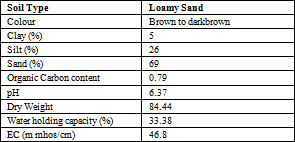
Leaching is one of the key parameter for the contamination of ground-level water. A study was conducted to determine the leaching potential of oxyfluorfen following the Organization for Economic Co-operation and delopment (OECD) 312 guideline. The loamy sand soil collected from the IIBAT, padappai research farm was used. The collected soil was filled into the polyvinyl chloride (PVC) column (35 cm in length and internal diameter 4 cm) up to the 30 cm mark. The Oxyfluorfen 23.5% Emulsifiable concentrate (EC) formulation was sprayed @: 100 gram active ingredient/ hectare (g a.i/ha), 150g a.i/ha and 200g a.i/ha. The aim was to explore the impact of of artificial rain (0.01Molar(M) Cacl2) fall rates (60 millimeters (mm), 100 mm and 140 mm) on the leaching potential of the herbicide in soil. Before initiation of the study, the soil was characterized for soil type, the content of clay, silt, sand, organic carbon content, pH, dry weight, WHC max (maximum water holding capacity), and electrical conductivity. The column leachate was collected from the initial day up to 15 days and analyzed validated High-performance liquid chromatography using the diode array detector (HPLC-DAD) method. After completion of the experiment, the soil samples were extracted and analyzed by HPLC-DAD. The linearity concentration ranged between 0.005 – 10.0 mg/L of oxyfluorfen with a correlation coefficient of 0.9999 was established. The assay accuracy showed 90 – 92% recovery in 0.01M CaCl2 at 0.01 milligram/Liter (mg/L) fortification level; 92-94% at 0.1 mg/L fortification level and 95 -96% at 0.5 mg/L fortification level. Recovery in soil was 89 – 91% at 0.01 milligram/kilogram (mg/kg) fortification level; 92-94% at 0.1 mg/kg fortification level and 94 -96% at 0.5 mg/kg fortification level. The collected leachate residues at the rainfall rate 60 mm, 100 mm and 140 mm rainfall was 5.09, 10.93, 13.62 mg/L; 4.92, 9.33, 11.74 mg/L; and 5.22, 8.45, 9.56 mg/L at different dose rates 100g a.i/ha. 150g a.i/ha and 200g a.i/ha respectively.
Pesticides are widely using in agriculture fields. Once the pesticides are sprayed in the field, they contaminate the soil, air, river/pond water, and the ground level water (by leaching). Herbicides are widely used for the control of weeds on the soil. These herbicides by direct contact with the soil possess a potential risk to human and environment 1. The pesticides transport follows five different pathways for their leaching into ground water. The pathways are diffusion, volatilization, leaching, erosion and runoff. Some pesticides move slowly and leach into the soil. Some compounds cannot leach simply into the soil. The higher quantity of Dimethoate and fenitrothion was reported few hours after spraying and perhaps due to rapid leaching 2. The laboratory experiment showed that the thiamethoxam soil dissipation rate depends on the soil moisture content. Three different situations were studied and reported: dry conditions, field conditions and submerged conditions. The soil dissipation in dry soil showed rapid degradation and in the submerged condition, the degradation was slow. The leaching experiment conducted at a single rainfall rate did not conclude the specific degradation pattern. The column leaching study with artificial rain (0.01M Cacl2) was introduced into the column and analysed for every 650 ml of rain. None of the residues were found in the leachate. Penconazole and Flusilazole were highly detected in the 0-5cm layer of the column soil 3. Is is notable that the mobility of most of the pesticides in soil is greater in frozen conditions than in unfrozen conditions. High concentrations were observed in frozen condition columns (-3°C) than in unfrozen condition columns (5°C) 4. Wood-based biochar was used to reduce the amount of the pesticides that were leaching in column mobility of chlorpyrifos, Diuron, glyphosate and MCPA (4-chloro-2 methyl phenoxy acetic acid sodium salt monohydrate). Leaching was low in all cases when the pesticides were allowed through the biochar. It is reported as most effective sorbent 5, 6 for pesticide residues. The behavior of propyzamide formulation and technical material in soil leaching column showed residue levels at higher concentrations 7. When leaching happens, two types of flow are detected; (a) preferential flow, related to water that flows rapidly through the large void, root channels and cracks. (b) Matrix flow, small pores of the soil having a long time contact pesticide due to the small movement of pesticide/water. Pesticides leach into the soil by rains or by irrigation of water. The leaching behavior depends on the physical, chemical, biological factors and temperature. The soil properties CEC (cation exchange capacity) SOM (soil organic matter) and clay content play an important role in the reduction effect. The factors may vary across the soil. CEC (cation exchange capacity) can influence changes in soil pH 8, 9, 10. Pesticides mobility and degradation depends on different subjects like soil science, clay mineralogy, physical chemistry, surface chemistry, environmental microbiology, plant physiology 11. Oxyfluorfen is widely used in agriculture fields. Oxyfluorfen is a herbicide, it contains the Diphenyl ether group. Some studies have been conducted on oxyfluorfen concerning soil enzyme activity and oxyfluorfen in soil and detection of its residues in rice crops 12, 13, 14, 15. No data is available on oxyfluorfen leaching in soil under rainfall conditions and the research work is presented is here.
Methanol, Acetonitrile, Ortho Phosphoric acid (H3Po4), Calcium chloride and Sodium sulphate are the chemicals used and have been procured from Merck Limited, Mumbai. The Oasis HLB cartridge (1g) has been supplied by Waters Corporation.
2.2. InstrumentsHigh Performnece Liquid Chromatography: Agilent 1290 series - Binary pump, Auto sampler and thermostat with interfaced open LAB Chem station software. The chromatographic column consists of water x terra –C18 (150mm x 3.5µm x 5µ), the mobile phase 0.1% H3Po4 in Milli Q water (40%) and acetonitrile (60%) used as mobile phase and isocratic condition was adhered to. The column temperature was at 40°C and the sample temperature at 8°C. The detector wave length was performed at 210 nm. The method validation parameters are specificity, linearity and assay accuracy.
2.3. Experimental ProceduresLoamy sand soil samples were collected from the IIBAT agricultural field, Padappai (Geographical location-80.0216 longitude and 12.8866 latitude), Chennai, India, with the sampling depth of 0-20 cm. No pesticides have been used in the last four years prior to study initiation. Neither was any organic or mineral fertilizer applied on the soil in the last two years prior to study initiation. The soil was sieved with a 2mm sieve.
The collected soil was packed in PVC columns as per OECD 312 guidelines 12. The PVC column specifications 35 cm in length and internal diameter of 4 cm. The column was packed up to 30cm height with appoximately 1500g soil .The bottom of the column was sealed and a hole of ≈0.3 cm was made for collecting the leachate. The column was saturated with 0.01M CaCl2 (artificial rain) solution overnight. Sand was used to cover the column soil surface, to prevent any disturbance to the soil surface. The sand was previously washed with acid followed by water and solvent. The column was covered with a black cloth to avoid photo degradation, and kept at a temperature of 25 ± 2°C in a ventilated greenhouse. The following soil parameters were characterized before the study initiation: soil type, content of clay, silt, sand, organic carbon content, pH, dry weight, WHCmax (maximum water holding capacity) and electrical conductivity. The Oxyfluorfen stock solution was prepared with the test item (purity 23.5%): The oxyfluorfen stock solution was prepared by weighing 570.22 mg of the test item accurately into a 50 ml volumetric flask. Then it was dissolved and brought up to the mark with deionized water. The concentration of this stock solution was 2680.03 mg/L, the concentration of stock solution conformed by validated HPLC method. The test item oxyfluorfen was applied @ 100 g a.i/ha, 150g a.i/ha, 200g a.i/ha on the surface of the different columns. During the leaching study, different rainfall rates of 60mm, 100mm and 140mm were conducted and the leachate was collected up to 15 days. The collected leachate residue was analysed in HPLC-DAD validated method. After completion of the 15days study duration, the soil columns were equally sectioned at 0-5 cm, 6-10 cm, 11-15cm, 21-25cm and 26-30cm. The collected soil was extracted and analysed in the validated method.
The collected leachates were passed through Oasis HLB cartridge which was placed on a vacuum manifold. The cartridge was conditioned with 2 ml of acetonitrile followed by 2 ml of milli-Q-Water at the rate of ~2 mL/min. The eluent was discarded and cartridges (were not become the dry). The supernatant was set for evaporation in a low volume concentrator. The extract was reconstituted with 1:1 acetonitrile and acidified water (0.1 % Phosphoric acid). The tubes were placed in the sonicator and homogenized again. The extract was filtered through a 0.2 μm nylon membrane filter and subsequently injected to HPLC-DAD for content of oxyflourfen residue analysis.
Ten g of homogenized sample was taken in to a centrifuge tube and 10 ml Acetonitrile and acidified water (0.1 % Phosphoric acid) (90:10). The mixture was homogenized for 5 min and 10 g Na2SO4 was added. The mixture was homogenized for 1 min and centrifuged for 5 minutes at 5000 rpm. The supernatant was passed through Oasis HLB cartridge which was placed on a vacuum manifold. The cartridge was conditioned with 2 ml of methanol followed by 2 ml of milli-Q-Water at the rate of ~2 ml/min. The eluent was discarded and cartridges were (not become the dry). The supernatant was set for evaporation in a low volume concentrator. The extract was reconstituted with 1:1 acetonitrile and acidified water (0.1 % Phosphoric acid- H3Po4). The tubes were placed in the sonicator and then homogenized again. The extract was filtered through a 0.2 μm nylon membrane filter and subsequently injected to HPLC-DAD for residue analysis.
2.4. Analytical ProcedurePreparation of stock solution with reference analytical standard: A 10.14 mg of reference analytical standard of Oxyfluorfen Supplied by sigma Aldrich (Purity-99.8%) was weighed in to a 10 ml volumetric flask and the volume was filled up to the mark using HPLC grade acetonitrile. Different known concentrations of solutions (0.005-10.0 mg/L) were prepared by diluting the stock solution with the diluent.
Recovery experiment was conducted in five replicates at three fortification levels in 0.01M Cacl2 (0.01mg/L, 0.1 mg/L, 0.5 mg/L) e and analyzed by HPLC-DAD. Recovery in soil (0.01mg/kg, 0.1 mg/kg, 0.5 mg/kg) was determinmed by adding a known volume of the oxyfluorfen standard solution to the known amount of the soil weight (50 g for each replicate) at the LOQ (0.01µg/g) and 10 x LOQlevel (0.1µg/g) and Higher level (0.5µg/g). Validation of the method was performed in terms of recovery studies before the analysis of unknown samples by spiking the three different known concentrations with five replicates in control soil samples. No inference was observed at this quantification level as evidence by the control sample. From the analytical determinations, the limit of detection and limit of quantification (LOQ) were established as 0.01 µg/g. The signal to noise ratio is 3:1, and 10:1 was considered for calculating the limit of detection and limit of quantification, respectively.
The following soil parameters were characterized results: soil type, content of clay, silt, sand, organic carbon content, pH, dry weight, WHCmax (maximum water holding capacity) and electrical conductivity.
The Method validation was performed to evaluate the analytical performances of HPLC-DAD according to the following criteria: System suitability, System precision, Specificity, Linearity, Assay accuracy, Limit of determination (LOD) and Limit of Quantification (LOQ) in spiked soil samples. For validation, the SANCO guideline was used SANCO/12495/2011, 2012.
The method was found to be linear in the concentration range of 0.005-10.0mg/L for oxyfluorfen with a correlation coefficient of 0.9999. The assay accuracy control samples showed no interferences. The Oxyfluorfen showed recovery in 0.01M Cacl2 90 – 92% at 0.01 mg/L fortification level; 92-94% at 0.1 mg/L fortification level and 95 -96% at 0.5 mg/L fortification level. The soil showed recovery 89 – 91% at 0.01 mg/kg fortification level; 92-94% at 0.1 mg/kg fortification level and 94 -96% at 0.5 mg/kg fortification level.
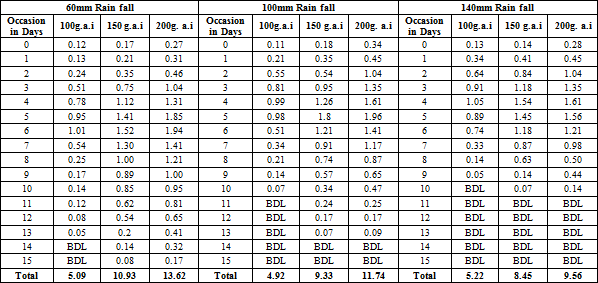
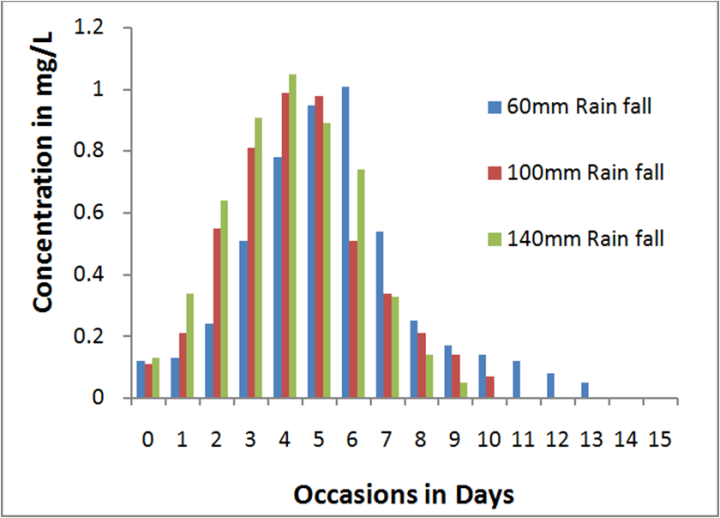
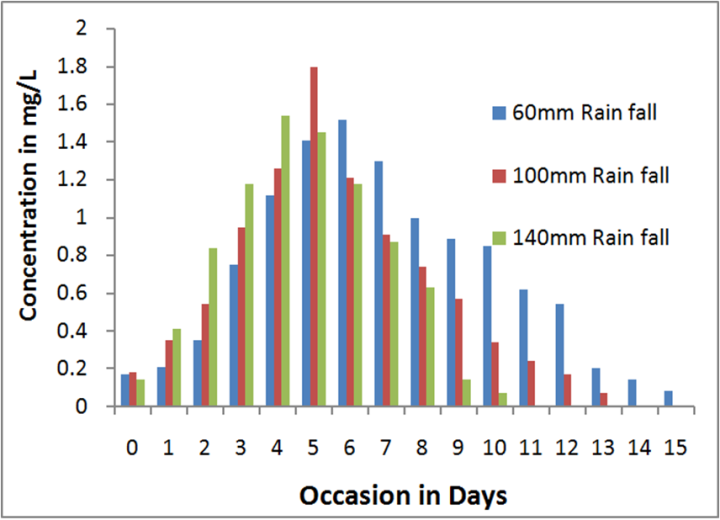
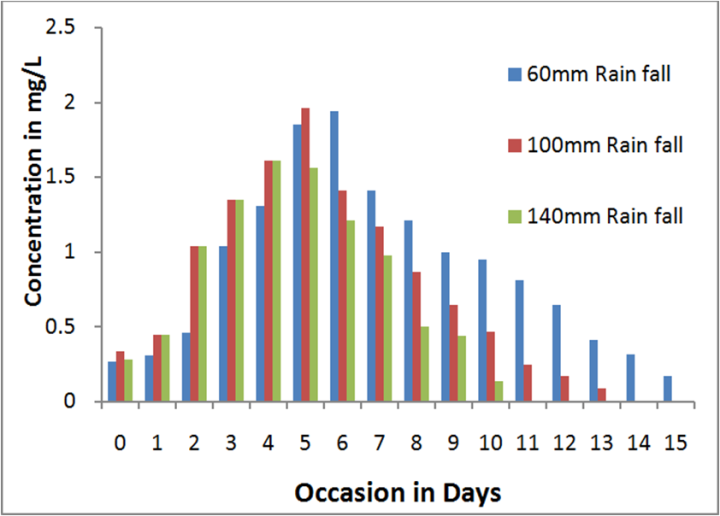
3.2. Leachate Concentration at Different Rainfall Rate and Dose RatesThe collected leachate was analyzed and the results are as follows; after the first rainfall rate 60mm, the leachate shows the concentrations 0.05-0.15 mg/L, 0.08 - 0.17 mg/L, 0.17-0.27 mg/L and the total residue 5.09, 10.93 mg/L, 13.62 mg/L at different dose rates 100, 150 and 200g a.i/ha respectively. The residue in lower dose leachate showed (100 g a.i/ha) below detectable levels on the 14th and 15th days.
The second rainfall rate 100mm, resulted the residues in leachate at the concentrations 0.07-0.11 mg/L, 0.07- 0.18 mg/L, 0.09-0.34 mg/L and the total residue 4.92, 9.33, 11.74 mg/L at different dose rates were 100, 150 and 200g a.i/ha respectively. The residue in leachate tested in all the applied dose rates, were found to be below detectable levels on the 14th and 15th days, except for the 100g a.i/ha dose rate, which showed below detectable levels from the 11th day onwards.
The third rainfall rate 140mm resulted the leachate concentrations 0.05-0.15 mg/L, 0.07- 0.14 mg/L, 0.14-0.28 mg/L and the total residue 5.22, 8.45, 9.56 mg/L at different dose rates 100, 150 and 200g a.i/ha respectively.
The residue in leachate showed below detectable levels from the 11th day to the 15th day for all dose rates, except for the 100g a.i/ha dose rate, which shows below detectable levels from the 10th day onwards. The results are presented in the Tables.
The test item movement and dissipation rate depends on the rainfall rate. If the rainfall rate is low, the test item was retained for long periods in the soil.
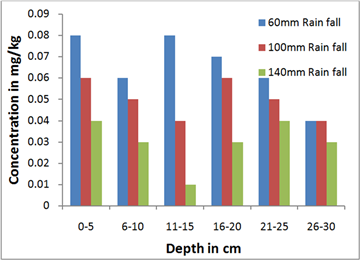
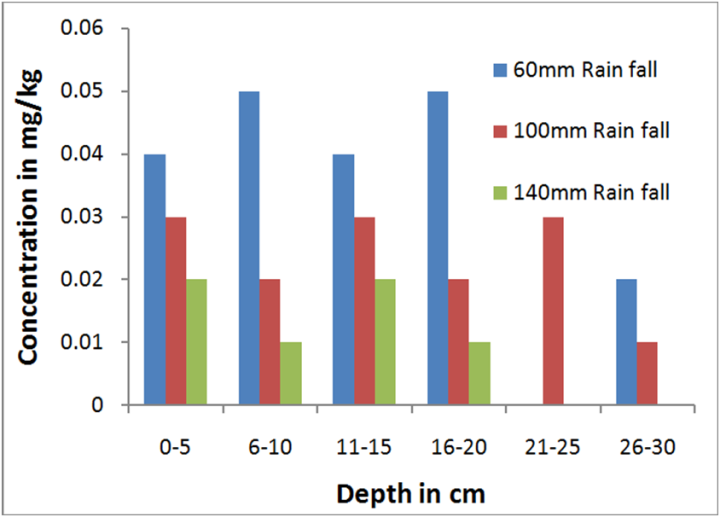
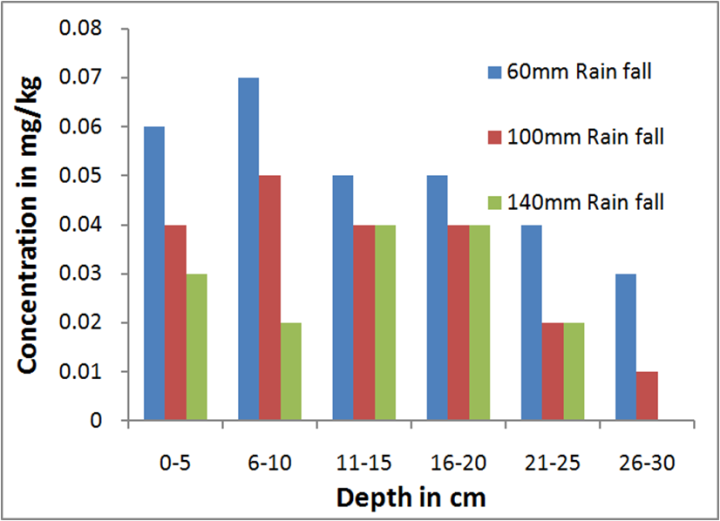
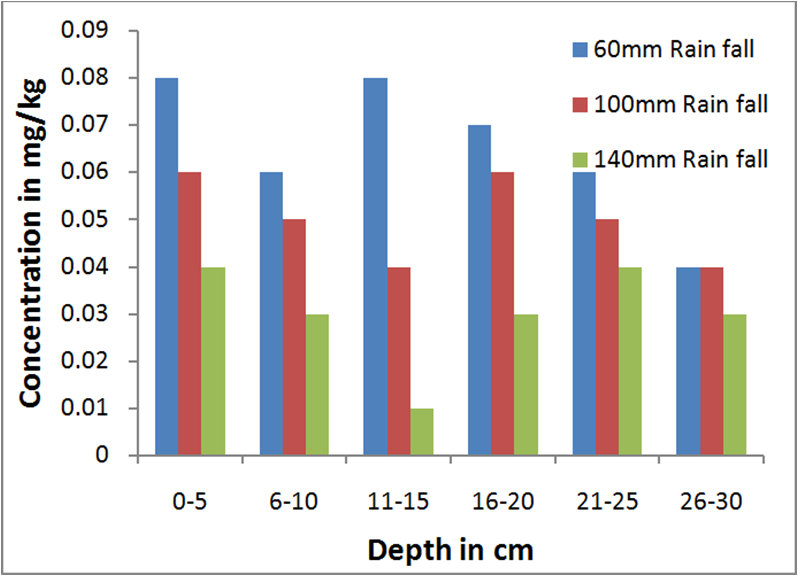
3.3. Leaching at Different Rainfall Rate and Dose RatesThe column was sectioned and analyzed soil for residue content at different sections. The first rainfall rate of 60mm resulted a potential residue concentrations of 0.02-0.05 mg/kg, 0.03-0.07 mg/kg, 0.04-0.08 mg/kg and the total residue 0.20, 0.30and 0.39 mg/kg at different dose rates 100,150 and 200g a.i/ha respectively. The residue at a lower dose only (100g a.i/ha) showed below detectable at 21-25 cm.
The second rain fall of 100mm showed the residue concentrations 0.01-0.03 mg/kg, 0.01-0.05 mg/kg, 0.04-0.06 mg/kg, the total residue 0.14, 0.20 and 0.30 mg/kg at different dose rates 100,150 and 200g a.i/ha respectively.
The third rain fall rate of140mm showed the residue concentrations 0.01-0.02 mg/kg, 0.02-0.04 mg/kg, 0.01-0.04 mg/kg the total residue 0.06, 0.15 and 0.18 mg/kg at different dose rates 100,150 and 200g a.i/ha respectively. The residue at lower dose (100g a.i/ha) showed below detectable level at 21-25 cm and 26-30cm: dose rate 150g a.i/ha showed 26-30cm below detectable level.
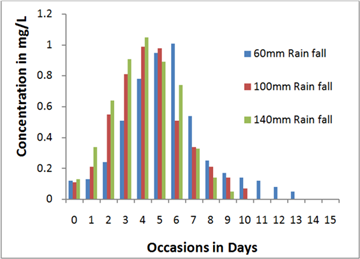
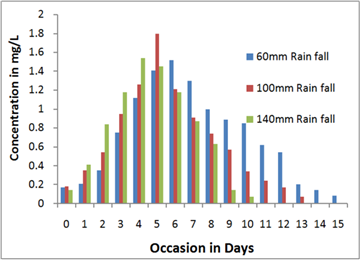
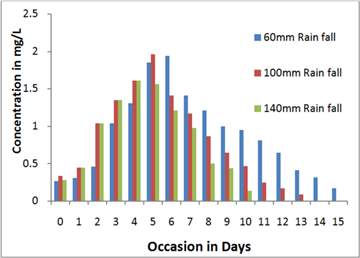
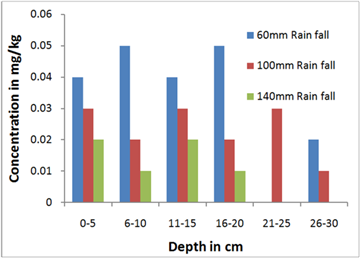
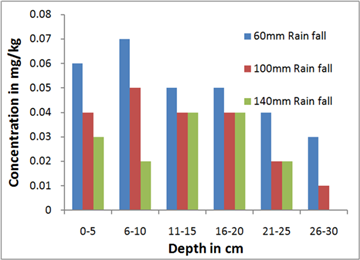
The oxyfluorfen herbicide soil leaching experiment was conducted at different dose rates 100. 150 and 200g a.i/ha and at different rainfall rates 60mm, 100mm and 140mm. The residue (leachate, soil) values were slightly varied in different dose rates. But high rainfall rate resulted rapid mobility in soil columns. So it can be inferred that high rainfall rates induce the fast mobility of oxyfluorfen in soil.
The authors thank the Director, Test facility management for supporting the facilities to conduct the research.
| [1] | S. H. Futch, M. Singh. Herbicide Mobility Using Soil Leaching Columns; Bull. Environ. Contam. Toxicol. 62, 520-529. | ||
| In article | View Article PubMed | ||
| [2] | Maria Anyusheva, Marc Lamers, Nguyen La, Van Vien Nguyen, Thilo Streck : Persistence and Leaching of Two Pesticides in a Paddy Soil in Northern Vietnam.Clean-Journal,Clean – Soil, Air, Water 2016, 44 (9999), 1-9. | ||
| In article | View Article | ||
| [3] | KahinaAıtHammi, El´ıas Nieto-Latorre, Mar´ıa D. Ureña-Amate, Mar´ıa M. Soc´ıas-Viciana, Hafida Miloudi, and Naoufal Debbagh-Boutarbouch (2019). Effect of Peat Addition on Sorption and Leaching of Triazole Fungicides in Oran Soils, Hindawi Journal of Chemistry Volume 2019, Article ID 9019817, 7 pages. | ||
| In article | View Article | ||
| [4] | Holten, R., M. Larsbo, N. Jarvis,M. Stenrød, M. Almvik, and O.M. Eklo (2019). Leaching of Five Pesticides of Contrasting mobility through Frozen and Unfrozen Soil, Vadose zone journal advancing critical zone science. | ||
| In article | View Article | ||
| [5] | D.L. Jones, G. Edwards-Jones, and D.V. Murphy: 2011. Biochar mediated alterations in herbicide breakdown and leaching in soil, Soil Biology & Biochemistry 43 (2011) 804-813. | ||
| In article | View Article | ||
| [6] | Harald Cederlund, ElisabetBorjesson, John Stenstrom. (2017). Effects of a wood-based biochar on the leaching of pesticides chlorpyrifos, diuron, glyphosate and MCPA, Journal of Environmental Management 191, 28-34. | ||
| In article | View Article PubMed | ||
| [7] | Majid Ali Khan, Colin D. Brown (2017). Influence of commercial formulation on the sorption and leaching behavior of propyzamide in soil. Science of the Total Environment 578, 158-166. | ||
| In article | View Article PubMed | ||
| [8] | Georg Haberhauer, Brigitta Temmel, Martin H. Gerzabek. (2002). Influence of dissolved humic substances on the leaching of MCPA in a soil column experiment. Chemosphere 46, 495-499. | ||
| In article | View Article | ||
| [9] | Gabriel Pérez-Lucas, Nuria Vela, Abderrazak El Aatik and Simón Navarro. (2018). Environmental Risk of Groundwater Pollution by Pesticide Leaching through the Soil Profile. | ||
| In article | View Article | ||
| [10] | OECD-Guideline for the Testing of Chemicals, Leaching in Soil Columns: Guideline 312, 2000, dated 13 April (2004). | ||
| In article | |||
| [11] | Manuel Arias-Este vez, Eugenio Lo pez-Periago, Elena Martı nez-Carballo, Jesu s Simal-Ga ndara, Juan-Carlos Mejuto, Luis Garcı a-Rı o. (2008). The mobility and degradation of pesticides in soils and the pollution of groundwater resources. Agriculture, Ecosystems and Environment 123 (2008) 247-260. | ||
| In article | View Article | ||
| [12] | Adil A. El Hussein, Afrah T. Mohamed, Marmar A. El Siddig, Ashraf M. Sherif and Awad Osman G. (2012). Effects of oxyfluorfen herbicide on microorganisms in loam and silt loam soils, Research Journal of Environmental Sciences 6 (4),134-145. | ||
| In article | View Article | ||
| [13] | Janaki P, Chinnusamy C and Jaya Kumar B. (2014) Persistence of oxyfluorfen in acid soil and tea leaves. Indian Journal of Weed Science 46 (2), 200-202. | ||
| In article | |||
| [14] | Sondhia S. (2008) Persistence of oxyfluorfen in soil and detection of its residues in rice crop. Toxicological & Environmental Chemistry 91(3), 425-433. | ||
| In article | View Article | ||
| [15] | Sireesha A, Rao P.C, Ramalaxmi C.S, Swapna G. (2012) Effect of pendimethalin and oxyfluorfen on soil enzyme activity. Journal of Crop and Weed. 8 (1), 124-128. | ||
| In article | |||
Published with license by Science and Education Publishing, Copyright © 2020 A.V.Rama Subbaiah and Atmakuru Ramesh
 This work is licensed under a Creative Commons Attribution 4.0 International License. To view a copy of this license, visit
http://creativecommons.org/licenses/by/4.0/
This work is licensed under a Creative Commons Attribution 4.0 International License. To view a copy of this license, visit
http://creativecommons.org/licenses/by/4.0/
| [1] | S. H. Futch, M. Singh. Herbicide Mobility Using Soil Leaching Columns; Bull. Environ. Contam. Toxicol. 62, 520-529. | ||
| In article | View Article PubMed | ||
| [2] | Maria Anyusheva, Marc Lamers, Nguyen La, Van Vien Nguyen, Thilo Streck : Persistence and Leaching of Two Pesticides in a Paddy Soil in Northern Vietnam.Clean-Journal,Clean – Soil, Air, Water 2016, 44 (9999), 1-9. | ||
| In article | View Article | ||
| [3] | KahinaAıtHammi, El´ıas Nieto-Latorre, Mar´ıa D. Ureña-Amate, Mar´ıa M. Soc´ıas-Viciana, Hafida Miloudi, and Naoufal Debbagh-Boutarbouch (2019). Effect of Peat Addition on Sorption and Leaching of Triazole Fungicides in Oran Soils, Hindawi Journal of Chemistry Volume 2019, Article ID 9019817, 7 pages. | ||
| In article | View Article | ||
| [4] | Holten, R., M. Larsbo, N. Jarvis,M. Stenrød, M. Almvik, and O.M. Eklo (2019). Leaching of Five Pesticides of Contrasting mobility through Frozen and Unfrozen Soil, Vadose zone journal advancing critical zone science. | ||
| In article | View Article | ||
| [5] | D.L. Jones, G. Edwards-Jones, and D.V. Murphy: 2011. Biochar mediated alterations in herbicide breakdown and leaching in soil, Soil Biology & Biochemistry 43 (2011) 804-813. | ||
| In article | View Article | ||
| [6] | Harald Cederlund, ElisabetBorjesson, John Stenstrom. (2017). Effects of a wood-based biochar on the leaching of pesticides chlorpyrifos, diuron, glyphosate and MCPA, Journal of Environmental Management 191, 28-34. | ||
| In article | View Article PubMed | ||
| [7] | Majid Ali Khan, Colin D. Brown (2017). Influence of commercial formulation on the sorption and leaching behavior of propyzamide in soil. Science of the Total Environment 578, 158-166. | ||
| In article | View Article PubMed | ||
| [8] | Georg Haberhauer, Brigitta Temmel, Martin H. Gerzabek. (2002). Influence of dissolved humic substances on the leaching of MCPA in a soil column experiment. Chemosphere 46, 495-499. | ||
| In article | View Article | ||
| [9] | Gabriel Pérez-Lucas, Nuria Vela, Abderrazak El Aatik and Simón Navarro. (2018). Environmental Risk of Groundwater Pollution by Pesticide Leaching through the Soil Profile. | ||
| In article | View Article | ||
| [10] | OECD-Guideline for the Testing of Chemicals, Leaching in Soil Columns: Guideline 312, 2000, dated 13 April (2004). | ||
| In article | |||
| [11] | Manuel Arias-Este vez, Eugenio Lo pez-Periago, Elena Martı nez-Carballo, Jesu s Simal-Ga ndara, Juan-Carlos Mejuto, Luis Garcı a-Rı o. (2008). The mobility and degradation of pesticides in soils and the pollution of groundwater resources. Agriculture, Ecosystems and Environment 123 (2008) 247-260. | ||
| In article | View Article | ||
| [12] | Adil A. El Hussein, Afrah T. Mohamed, Marmar A. El Siddig, Ashraf M. Sherif and Awad Osman G. (2012). Effects of oxyfluorfen herbicide on microorganisms in loam and silt loam soils, Research Journal of Environmental Sciences 6 (4),134-145. | ||
| In article | View Article | ||
| [13] | Janaki P, Chinnusamy C and Jaya Kumar B. (2014) Persistence of oxyfluorfen in acid soil and tea leaves. Indian Journal of Weed Science 46 (2), 200-202. | ||
| In article | |||
| [14] | Sondhia S. (2008) Persistence of oxyfluorfen in soil and detection of its residues in rice crop. Toxicological & Environmental Chemistry 91(3), 425-433. | ||
| In article | View Article | ||
| [15] | Sireesha A, Rao P.C, Ramalaxmi C.S, Swapna G. (2012) Effect of pendimethalin and oxyfluorfen on soil enzyme activity. Journal of Crop and Weed. 8 (1), 124-128. | ||
| In article | |||