Rapid urbanization in sub-Saharan Africa is placing increasing pressure on municipal solid waste management (MSWM) systems, which remain largely fragmented and are often limited to primary waste handling due to institutional, technical, and financial constraints. In many medium-sized cities, the high proportion of organic matter and elevated moisture content further restrict the range of feasible treatment options, thereby challenging the sustainability of conventional composting-based approaches. This study presents a system-oriented technical assessment of MSWM in Abomey-Calavi, one of the fastest-growing cities in southern Benin, and proposes an integrated management framework specifically adapted to local waste characteristics and socio-economic conditions. The analysis draws on validated waste characterization data, field observations, and comparative insights from operational experiences in other West African cities. Municipal solid waste generation in Abomey-Calavi averages approximately 0.89 kg·cap-1·day-1, with a predominance of organic matter (approximately 51%) and a high average moisture content (around 70%). These characteristics significantly constrain direct thermochemical conversion and necessitate the integration of sorting and moisture-reduction stages along the waste management chain. The proposed MSWM framework is structured around three interconnected stages, pre-collection, collection, and treatment, and emphasizes complementary valorization pathways. Composting is maintained for the fermentable fraction but is demonstrated to be insufficient as a standalone solution. Consequently, thermochemical treatments, particularly pyrolysis and controlled combustion, are incorporated to enhance energy recovery and achieve substantial waste volume reduction following appropriate pre-treatment. The framework further integrates decentralized transfer centers and a controlled landfill for the final disposal of residual fractions. The results indicate that combining biological and thermochemical processes within a coordinated institutional and financial structure can significantly improve the technical performance and environmental sustainability of MSWM systems in rapidly urbanizing contexts. Beyond the specific case of Abomey-Calavi, the proposed approach offers a transferable planning framework for cities facing similar constraints across sub-Saharan Africa and other developing regions. The framework is intended as a strategic planning and decision-support tool and does not aim to provide process-level modeling or site-specific techno-economic optimization.
Rapid urbanization in low- and middle-income countries is profoundly transforming municipal solid waste management (MSWM) systems. Demographic growth, urban expansion, and evolving consumption patterns have led to a sustained increase in waste generation, while institutional capacity, technical infrastructure, and financial resources often remain inadequate to ensure effective service delivery. Consequently, MSWM has emerged as one of the most pressing environmental and public health challenges confronting rapidly growing cities in sub-Saharan Africa and other developing regions 1, 2, 3. Recent continental assessments have highlighted that these challenges are exacerbated in Africa by low collection coverage, limited waste treatment capacity, and a strong reliance on open dumping, as documented in the Africa Waste Management Outlook 4.
In principle, an efficient MSWM system relies on an integrated and sequential chain encompassing waste generation, source separation, collection and transport, treatment and valorization of recoverable fractions, and final disposal in environmentally controlled landfills. In high-income countries, these stages are supported by well-established regulatory frameworks, optimized logistics, and advanced treatment technologies, resulting in high recovery rates and reduced environmental impacts. By contrast, MSWM systems in most developing countries remain fragmented and technically incomplete. In many sub-Saharan African cities, municipal solid waste management remains largely limited to primary collection or pre-collection activities, with insufficient development of downstream treatment and disposal infrastructure 3, 5. This institutional and operational fragmentation contributes directly to the proliferation of uncontrolled dumping sites, environmental degradation, and public health risks 6. Integrated and sustainable solid waste management therefore requires more than technical solutions alone; key success factors include stakeholder involvement, appropriate institutional arrangements, financial viability, and social acceptance, as demonstrated in empirical assessments of waste recovery projects 7.
Pre-collection points initially located at neighborhood margins often evolve into permanent open dumps that are progressively encircled by housing, thereby increasing population exposure to environmental and health hazards. Such dysfunctions have been widely documented in West African cities and underscore the urgent need for integrated, context-specific MSWM strategies 2, 5.
Despite these persistent challenges, several West African cities have demonstrated that meaningful improvements in MSWM performance are achievable through integrated approaches that combine waste characterization, appropriate treatment technologies, and strengthened institutional coordination. The experience of Ouagadougou (Burkina Faso), where sorting, composting of the fermentable fraction, and controlled landfilling have been implemented within a structured management framework, illustrates the technical feasibility of such systems under regional constraints 8. These initiatives highlight the importance of aligning waste treatment pathways with both the physicochemical properties of municipal solid waste and local socio-economic conditions.
In Benin, municipal solid waste is characterized by a high organic fraction and elevated moisture content, with per capita generation rates generally ranging from 0.6 to 1.0 kg·cap-1·day-1 depending on urban density and income levels 9, 10. While the predominance of organic matter offers significant potential for biological treatment through composting, high moisture content represents a major technical constraint for both biological and thermochemical processes. Moreover, previous studies indicate that composting alone is rarely sufficient to ensure sustainable municipal solid waste management (MSWM) in West African cities, due to limited market demand, variable compost quality, and operational challenges 11. As a result, complementary valorization pathways, including thermochemical treatments, must be explored to achieve substantial waste volume reduction and energy recovery.
The city of Abomey-Calavi, one of the fastest-growing urban centers in southern Benin, exemplifies these systemic challenges. The current MSWM system is essentially limited to pre-collection, which remains the only functional link in the waste management chain. No structured system exists for waste collection, treatment, or controlled disposal, and waste management practices are not guided by comprehensive technical planning. Instead, the system relies on a multitude of uncoordinated actors operating primarily according to short-term economic considerations. This results in a fragmented and inefficient MSWM system characterized by irregular service coverage, pervasive illegal dumping, and substantial environmental and public health risks 8, 12. Recent evaluations of pilot reforms implemented since 2020 confirm that the system remains neither optimal nor sustainable, and that stronger public-private-community partnerships are required to achieve lasting improvements 13.
Although numerous studies have documented waste generation rates and composition in Beninese cities, there is still a notable lack of integrated, technically grounded MSWM frameworks that explicitly address the combined challenges of high moisture content, limited institutional capacity, and the need for diversified valorization pathways. In particular, the potential contribution of thermochemical treatments, such as pyrolysis and controlled combustion, as complements to composting has received limited attention in operational planning studies for medium-sized West African cities.
The objective of this study is therefore to conduct a system-based technical assessment of municipal solid waste management in Abomey-Calavi and to propose an integrated MSWM scheme specifically adapted to local waste characteristics, socio-economic conditions, and institutional constraints. Building on validated waste characterization data, field observations, and lessons drawn from comparable West African contexts, the proposed framework emphasizes sorting strategies, moisture reduction, and complementary valorization pathways combining composting and thermochemical treatments. By embedding these technical options within a coherent institutional and financial structure, this work aims to contribute actionable knowledge for the design of sustainable MSWM systems in rapidly urbanizing cities of sub-Saharan Africa and other developing regions. Unlike technology-centered studies that focus on individual treatment processes, this research adopts a system-level planning perspective by explicitly articulating waste characteristics, treatment complementarities, and institutional organization within a unified MSWM framework.
For clarity and consistency throughout the manuscript, the term “drying” is used to refer to passive or low-energy moisture reduction processes, including solar drying and biodrying. The term “transfer” centers designates decentralized facilities that enable temporary storage, secondary sorting, and logistical consolidation prior to transport to treatment or final disposal facilities, as commonly defined in integrated MSWM literature 2, 14.
2.1. Study AreaThe study was conducted in the municipality of Abomey-Calavi, located in southern Benin within the Atlantic Department. As an integral part of the Greater Cotonou metropolitan area, Abomey-Calavi has experienced sustained and rapid demographic growth over recent decades. Its population increased from fewer than 200,000 inhabitants in the early 2000s to more than 300,000 by 2015, and has continued to rise since then 15. This demographic expansion has been accompanied by extensive urban sprawl, marked by the coexistence of formally planned neighborhoods with paved road networks and informal or unstructured areas characterized by limited accessibility and inadequate urban services.
The municipality is characterized by a tropical sub-equatorial climate with two rainy seasons per year, which strongly influences the physicochemical properties of municipal solid waste, particularly its moisture content. The interaction between climatic conditions, urban morphology, and socio-economic heterogeneity plays a decisive role in shaping waste generation patterns, collection efficiency, and the technical feasibility of available treatment and valorization options.
2.2. Data sources and waste characterizationThis study is based on a combination of field observations, analysis of existing datasets, and an extensive review of the scientific literature. Primary waste characterization data were not collected within the scope of this work. Instead, the analysis relies on validated secondary datasets derived from previous waste characterization campaigns conducted in Abomey-Calavi and in comparable urban contexts in Benin, notably those reported by 8, 9, 10, 13.
This methodological choice is deliberate and justified by the strong temporal stability of municipal solid waste composition observed in Abomey-Calavi over the past decade. Independent studies employing comparable sampling protocols consistently report similar mass distributions, particularly the predominance of organic and inert fractions. These datasets have been widely used as reference inputs in previous technical, kinetic, and planning-oriented studies, and are therefore considered sufficiently robust to support system-level analysis and infrastructure planning.
According to these sources, the average per capita municipal solid waste generation rate in Abomey-Calavi is approximately 0.89 kg·cap-1·day-1. Waste composition is largely dominated by organic matter, which accounts for about 51% of the total mass, followed by other combustible material, such as paper, cardboard, and plastics, representing approximately 7%. Inert or non-combustible fractions, including sand, glass, metals, and construction debris, account for the remaining 42%. Household waste is characterized by a high moisture content, with average values approaching 70%.
Although municipal solid waste composition may exhibit seasonal and socio-economic variability, studies conducted in Abomey-Calavi and in comparable Beninese cities indicate that the relative dominance of these fractions remains stable throughout the year. Observed variability primarily affects moisture content rather than overall mass distribution. Consequently, the values adopted in this study are considered representative for medium-term technical and strategic planning, rather than for short-term operational optimization.
The objective of this work is therefore not to update waste composition data, but to analyze their implications for the design and integration of appropriate treatment and valorization pathways under local technical, institutional, and socio-economic constraints. This approach is consistent with planning-oriented MSWM studies, where robustness and systemic coherence are prioritized over short-term operational precision 2, 3.
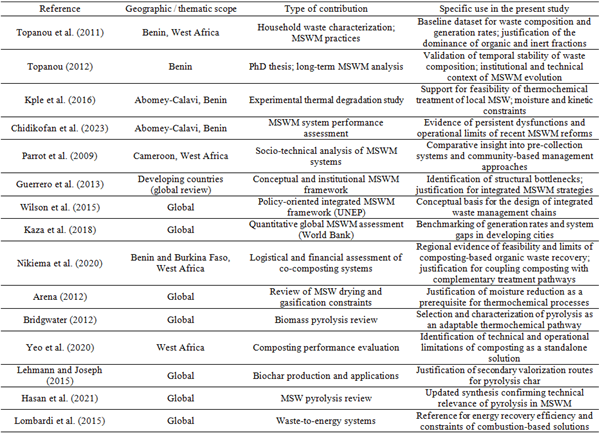
To enhance methodological transparency and clarify the role of the scientific literature in the present analysis, Table 1 summarizes the key references mobilized and specifies their respective contributions to the different components of the analytical framework. These references were not used solely for contextualization, but served as validated inputs for waste characterization, system diagnosis, technology selection, and institutional design.
2.3. Analytical Framework for Waste Management Chain DesignA system-based analytical approach was adopted to design the proposed municipal solid waste management (MSWM) chain. Rather than assessing individual technologies in isolation, the analysis considers the waste management system as an integrated whole, encompassing the entire waste life cycle from generation to final disposal. Particular attention is given to interactions between operational stages, material flows, and institutional actors.
The MSWM chain was structured into three main operational stages: pre-collection, collection, and treatment. For each stage, technically feasible options were identified and assessed in relation to local constraints, including road accessibility, urban density, climatic conditions, availability of equipment, financial resources, and institutional capacity. This systemic perspective ensures coherence between successive stages and reduces the risk of technological mismatches that could undermine overall system performance.
The adopted approach is consistent with the principles of integrated waste management and aligns with international guidelines 16. It is particularly well suited to planning-oriented studies aimed at identifying technically viable and context-adapted solutions for rapidly urbanizing cities in low- and middle-income countries 1, 2.
To operationalize this analytical framework under comparable regional conditions, field visits, surveys, and semi-structured interviews were conducted in the municipality of Ouagadougou (Burkina Faso) to derive comparative insights from an operational MSWM system implemented under similar regional conditions. These observations informed the selection, adaptation, and sequencing of technical options proposed for Abomey-Calavi.
The present study adopts a planning-oriented analytical framework and does not aim to conduct a full techno-economic assessment, detailed energy balance, or life-cycle emission analysis. Instead, representative performance ranges reported in the scientific literature were mobilized to qualitatively benchmark the proposed treatment and valorization pathways 7. Indicative values of lower heating values, typical conversion efficiencies, and emission reduction potentials were considered to ensure the technical plausibility and environmental consistency of the proposed integrated system 1, 2, 17. This methodological positioning is consistent with system-level MSWM studies conducted in data- and resource-constrained urban contexts, where strategic planning and institutional feasibility take precedence over detailed process optimization 1, 2.
This section translates the analytical framework into concrete treatment choices by explicitly linking waste properties, operational constraints, and technological robustness.
The selection of waste treatment and valorization pathways was based on a qualitative multi-criteria assessment that considered the following dimensions:
• compatibility with the physicochemical properties of the waste, with particular emphasis on moisture content;
• technical maturity and operational robustness under low-resource conditions;
• infrastructure and skill requirements; and
• institutional feasibility at the municipal scale.
Among these criteria, compatibility with waste characteristics and operational robustness in constrained contexts were identified as the primary decision drivers. Economic performance and energy efficiency were treated as secondary screening criteria, in line with the planning-oriented scope of the study and the absence of detailed site-specific cost and energy data.
Rather than applying a quantitative multi-criteria decision analysis, which would require detailed information on investment costs, operating expenditures, and energy demand profiles beyond the scope of this work, the analysis focuses on identifying technically coherent and context-adapted combinations of treatment options that can be realistically integrated within a municipal MSWM system.
Biological treatment through composting was assessed for the fermentable fraction, drawing on documented experiences in Benin and other West African countries. While composting offers clear advantages in terms of organic matter stabilization and potential agricultural reuse, well-documented constraints related to compost quality, market demand, and long-term operational sustainability were explicitly taken into account 11.
Thermochemical treatment options, including pyrolysis and controlled combustion, were examined for the combustible fraction. Gasification was deliberately excluded due to its higher technical complexity and operational sensitivity, which are less compatible with current local technical capacities and institutional conditions.
2.5. Role of Moisture Reduction as a Pre-treatment StepGiven the high average moisture content of municipal solid waste in Abomey-Calavi (approximately 70%), moisture reduction was identified as a critical pre-treatment step for both biological and thermochemical treatment pathways. In this study, drying is therefore considered as a functional pre-treatment within the overall waste management chain, rather than as a standalone process subject to detailed optimization.
Passive solar drying and biodrying were identified as low-energy, low-cost options compatible with decentralized waste management systems and well suited to the climatic conditions of southern Benin. The analysis does not seek to model drying kinetics or establish detailed energy balances. Instead, it focuses on assessing the technical feasibility of reducing moisture content to levels compatible with composting stability and thermochemical conversion, based on thresholds and performance ranges reported in the literature 14, 18.
2.6. Evaluation Criteria and System IntegrationThe proposed municipal solid waste management (MSWM) scheme was evaluated using a set of qualitative and semi-quantitative criteria, including technical feasibility, environmental performance, economic plausibility, and institutional compatibility. Particular emphasis was placed on the integration of treatment facilities with a controlled landfill for the safe disposal of residual, non-recoverable waste, in order to ensure overall system completeness and environmental compliance.
The potential for energy recovery was assessed qualitatively, based on waste composition and treatment pathways documented in the scientific literature, rather than through detailed energy balance calculations. This methodological choice reflects the planning-oriented nature of the study, which seeks to identify robust technological directions and coherent system configurations, rather than to design, size, or optimize specific treatment facilities.
The analysis of the existing municipal solid waste management (MSWM) system in Abomey-Calavi confirms that pre-collection currently constitutes the only operational stage. This activity is primarily carried out by non-governmental organizations (NGOs) and small private operators using human-powered carts or light equipment. Although pre-collection enables partial removal of household waste, it functions in isolation, without integration into a structured system for collection, treatment, or final disposal. Consequently, pre-collected waste is frequently discharged into uncontrolled dumps located within or near residential areas, resulting in significant environmental degradation and heightened public health risks.
Field observations and previous surveys further reveal pronounced spatial disparities in service coverage. Structurally planned neighborhoods with adequate road access benefit from relatively regular pre-collection services, whereas unstructured or informal areas remain poorly served or entirely excluded. This uneven coverage exacerbates socio-spatial inequalities and encourages illegal dumping practices. Comparable dysfunctions have been documented in other West African cities, where fragmented and incomplete MSWM systems have proven unable to keep pace with rapid urban expansion 3, 5.
In line with international guidelines, a functional MSWM system should encompass the full waste management chain, including pre-collection, collection, and treatment, supported by appropriate disposal infrastructure 1, 2. The current situation in Abomey-Calavi, characterized by the absence of downstream stages, highlights the structural inadequacy of the existing system and underscores the need for an integrated approach to municipal solid waste management.
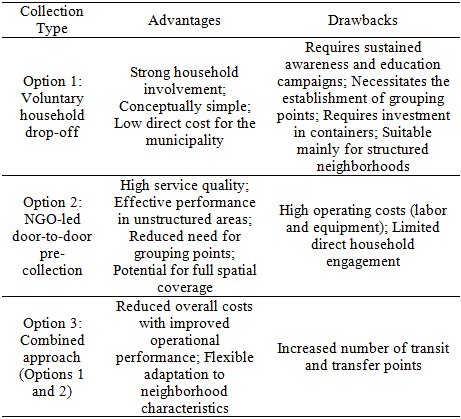
3.2. Pre-collectionPre-collection constitutes the critical interface between household waste generation and temporary storage at neighborhood grouping points. When appropriately adapted to local socio-economic conditions, pre-collection systems have demonstrated their effectiveness in several West African cities 5. In this study, three pre-collection options were comparatively assessed, as summarized in Table 2, which highlights their respective operational advantages, cost implications, and suitability for structured versus unstructured neighborhoods. This comparison provides the analytical basis for identifying a hybrid pre-collection configuration as the most context-adapted option for Abomey-Calavi.
(i) Voluntary drop-off, which relies on household initiative and requires sustained public awareness and behavioral change efforts;
(ii) NGO-led door-to-door pre-collection, similar to systems implemented in cities such as Yaoundé and Douala 5; and
(iii) A mixed pre-collection system, integrating voluntary drop-off and NGO-led services, and proposed as a compromise solution.
The comparative assessment of these options highlights the limitations of systems based exclusively on voluntary household drop-off. Such systems require a dense and well-maintained network of grouping points, as well as a high level of public compliance, which can be difficult to achieve in practice. Conversely, NGO-led door-to-door pre-collection generally ensures higher operational performance and broader spatial coverage, but entails higher operating costs and often limited direct involvement of households in waste management practices.
The combined option, which integrates voluntary drop-off in accessible and structured areas with NGO-led pre-collection in unstructured neighborhoods, emerges as the most technically and economically viable solution. This hybrid configuration allows for a reduction in operational costs while maintaining acceptable service quality and promoting household participation. Similar hybrid models have been successfully implemented in cities such as Ouagadougou, where they contributed to improved collection efficiency and a reduction in illegal dumping 8.
The proposed hybrid pre-collection system represents a balance between operational efficiency and social inclusion. Similar findings have been reported in other West African cities, where mixed pre-collection systems have demonstrated superior performance compared with single-mode approaches, both in terms of service coverage and cost control 3, 5.
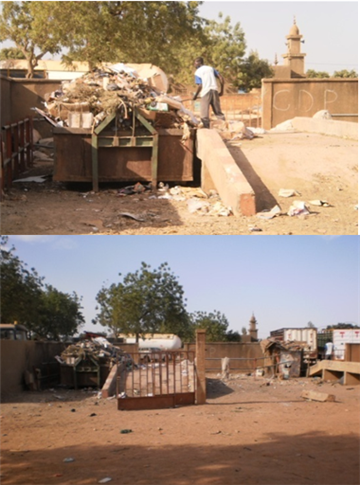
Collection activities remain a critical bottleneck in Abomey-Calavi due to the lack of transfer stations and appropriately equipped transport vehicles. The establishment of decentralized collection and transfer centers is therefore essential to ensure continuity between pre-collection and subsequent treatment stages. Such centers would also provide opportunities for secondary sorting and temporary storage under controlled conditions, improving overall system efficiency and environmental compliance.
The absence of a structured municipal collection system contributes to widespread illegal dumping, a phenomenon extensively documented in developing countries 3. The implementation of collection and transfer centers, analogous to those successfully established in Ouagadougou, is therefore a key prerequisite for achieving a functional and integrated municipal solid waste management system.
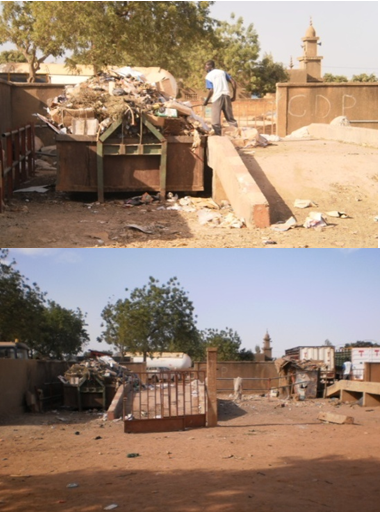
This situation has contributed to a significant increase in illegal dumping across the city. To address this issue, one or more controlled landfills, functioning as waste collection and transfer centers, should be established in each pre-collection area. These centers would serve as designated points where residents are responsible for depositing their waste. A dedicated transport system would then be required to transfer the waste from these centers to treatment or final disposal facilities. Figure 1 illustrates examples of decentralized collection and transfer centers implemented in Ouagadougou, highlighting their role in improving logistical continuity between pre-collection and treatment stages, reducing illegal dumping, and enhancing overall system efficiency under comparable urban and institutional conditions.
3.4. TreatmentSorting constitutes a critical step in effective municipal solid waste (MSW) management. Given the heterogeneous nature of MSW, the efficiency of recovery processes largely depends on the quality of sorting. In line with this study, waste should be separated into at least three categories:
• Organic materials (fermentable fraction)
• Other combustibles (paper, cardboard, plastics, etc.)
• Inert and non-combustible materials (construction debris, gravel, sand, metal, glass, etc.)
Sorting can be organized in two stages: at-source sorting, involving households and pre-collection NGOs, and more thorough sorting at collection or treatment centers. Proper implementation of this sorting strategy would result in approximately 51% organic matter, 7% other combustibles, and 42% inert and non-combustible materials. To facilitate effective source separation, it is recommended to provide households with dedicated collection bins for each category.
Pre-treatment through moisture reduction significantly enhances the performance of both biological and thermochemical processes. Reducing the average moisture content of municipal waste in Abomey-Calavi from approximately 70% to below 20% improves calorific value, combustion stability, and pyrolysis efficiency. Passive solar drying and biodrying are particularly suitable under local climatic conditions, offering low-cost and energy-efficient alternatives to conventional thermal drying 14, 18.
Moisture reduction is essential for thermochemical processes, as the current average moisture content approximately 70%) is too high. Studies on pyrolysis and gasification indicate that moisture must be reduced to below 20% to ensure process efficiency 18, 19.
Thermochemical valorization provides additional opportunities for energy recovery and waste volume reduction. Controlled combustion offers high thermal efficiency and effective destruction of organic pollutants, although the heat generated may exceed local demand. Electricity generation from combustion is feasible but typically yields low electrical efficiency.
Pyrolysis provides greater flexibility by producing both solid char and gaseous products. The char can be used as a domestic fuel or further processed into activated carbon, while the gas fraction can support process self-sufficiency or electricity generation. These characteristics make pyrolysis particularly attractive in contexts where multiple energy vectors are required 18, 20. In contrast, the technical complexity of gasification limits its applicability under current local conditions.
At a broader scale, several studies have highlighted the significant potential of municipal solid waste as a renewable energy resource through waste-to-energy technologies, provided that technology selection remains aligned with local waste characteristics and institutional capacities 21.
Considering the annual waste production in Abomey-Calavi approximately 97,500 tons), three treatment pathways appear most suitable:
• Pyrolysis, which simultaneously produces char and combustible gases 17, 18;
• Combustion, which provides efficient energy recovery 22;
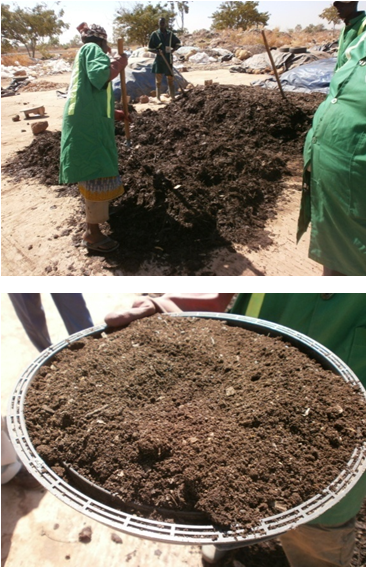
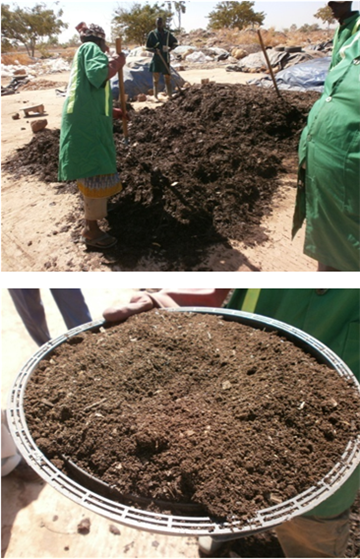
• Composting, which is essential for stabilizing the fermentable fraction but insufficient as a standalone solution 11, 23. Operational experiences from Ouagadougou illustrate the feasibility of this option under similar climatic and socio-economic conditions, notably through windrow turning and compost production at the CTVD (Figure 2).
Biochar produced through pyrolysis can also serve environmental and agricultural purposes, such as soil amendment or carbon sequestration 20, 24.
It should be noted that the present analysis focuses on system coherence and technical integration rather than detailed process modeling. The comparative assessment of composting and thermochemical pathways is based on waste characteristics, operational robustness, and documented performance in similar regional contexts, rather than on site-specific energy balances or cost calculations. Quantitative evaluations of energy yields, emissions, and economic performance would require dedicated feasibility studies and detailed local data, representing a necessary next step before implementation.
Although no site-specific energy balance was conducted, the proposed valorization pathways are consistent with performance ranges reported in recent studies. Controlled combustion of municipal solid waste typically achieves net electrical efficiencies in the range of 15-25%, depending on plant scale and energy recovery configuration 2, 22. Thermochemical conversion through pyrolysis allows for combined energy and material recovery, with overall recovery efficiencies generally reported between 60 and 75% when char and gaseous products are jointly valorized 17, 18.
These ranges should be interpreted as indicative benchmarks rather than predictive values for Abomey-Calavi, pending site-specific feasibility studies.
From an environmental perspective, the diversion of biodegradable waste from uncontrolled disposal and the application of thermochemical treatment following moisture reduction can reduce methane emissions from final disposal by more than 80% compared to open dumping or unmanaged landfilling 1, 11. These indicative values confirm that the proposed system is technically and environmentally coherent with comparable applications in developing urban contexts.
Despite their technical relevance, thermochemical treatment pathways are associated with operational and environmental risks that must be explicitly considered at the planning stage. Variability in waste composition, particularly with respect to moisture content and inert fractions, can adversely affect process stability, energy efficiency, and equipment lifespan 14, 17. In addition, thermochemical systems require regular maintenance, reliable spare parts supply, and adequately trained personnel, which may constitute significant constraints under current local institutional conditions 25.
Emission control represents another critical issue. Controlled combustion and pyrolysis facilities must be equipped with appropriate flue gas treatment systems, including particulate removal and acid gas neutralization, to ensure compliance with environmental and public health standards 2, 22 Experiences from pilot and small-scale facilities in West Africa indicate that these risks can be effectively mitigated through phased implementation strategies, beginning with pilot-scale units, progressive capacity building, and gradual technological scaling 1, 11
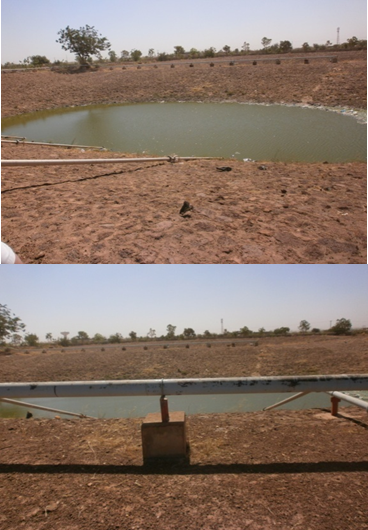
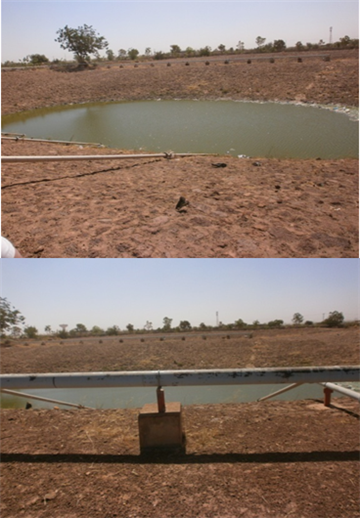
Despite the focus on waste reduction and valorization, a controlled landfill remains an indispensable component of the municipal solid waste management (MSWM) system. Only residual waste that cannot be further treated or recovered should be directed to the landfill. Given the high moisture content of waste in Abomey-Calavi, engineered landfills must be equipped with leachate collection and treatment systems to prevent soil and groundwater contamination, as exemplified by the facilities in Ouagadougou (Figure 3).
The role of controlled landfills as the final stage of an integrated MSWM system is widely recognized in international guidelines, which emphasize the importance of engineered liners, leachate management, and post-closure monitoring to minimize environmental risks 1, 2.
Integrating thermochemical treatment prior to landfilling significantly reduces both the quantity of residual waste and its environmental impact. Experiences from Ouagadougou show that combining composting, thermal treatment, and controlled landfilling can markedly improve environmental performance and enhance operational sustainability 26.
Consequently, the amount of waste ultimately sent to the landfill is minimized. It is therefore incumbent upon the municipal authorities to establish a Final Waste Storage Centre (CSDU) that complies with international standards. Given the very high moisture content of waste in Abomey-Calavi, the CSDU should include leachate collection basins similar to those at the CTVD in Ouagadougou. Moreover, by directing waste to landfills only after thermochemical treatment, the environmental risks associated with high-moisture residual waste are drastically reduced.
Waste transport should be entrusted to private operators selected through a transparent public tender process, in accordance with best practices recommended in integrated waste management frameworks 2. Financing of municipal solid waste management should be organized through a dedicated municipal account and supported by a user fee system based on the polluter-pays principle, ensuring that households and businesses contribute proportionally to the cost of waste collection, treatment, and disposal. This approach promotes financial sustainability, accountability, and equitable cost distribution.
The proposed integrated municipal solid waste management (MSWM) scheme requires strong institutional coordination, with the municipality serving as the central authority responsible for planning, regulation, and supervision. The involvement of private operators through concession contracts and public-private partnerships is essential to mobilize technical expertise, operational capacity, and financial resources. However, long-term success depends on clear contractual arrangements, transparent cost recovery mechanisms, and effective monitoring.
Overall, the results indicate that an integrated and technically adapted MSWM system can be successfully implemented in Abomey-Calavi, provided that technical solutions are aligned with local waste characteristics, socio-economic conditions, and institutional capacities. The proposed division of responsibilities is as follows:
Residents: Participate actively by using designated bins, avoiding illegal dumping, and paying service fees.
NGOs: Conduct pre-collection activities, awareness campaigns, billing, and deposit collected waste in designated centers.
Private companies: Manage waste transport, treatment facilities, and the Final Waste Storage Centre (CSDU).
Municipality: Supervise the entire waste management chain, manage finances, launch public tenders, and enforce regulations.
Such multi-stakeholder involvement is consistent with best practices observed in comparable West African cities 2, 3. Strong governance arrangements are critical to ensuring long-term system sustainability, as weak institutional coordination has been identified as a primary cause of MSWM failure in rapidly urbanizing cities of developing countries 2, 3.
3.5. Waste Management Plan for the City of Abomey-CalaviThe following section translates the analytical findings of the system assessment into planning-oriented recommendations. While these proposals are grounded in the technical analysis and comparative evidence presented above, they are not intended as detailed engineering designs or implementation blueprints. Rather, they provide strategic guidance to support decision-making, policy formulation, and the progressive development of an integrated municipal solid waste management system adapted to local conditions, in line with international integrated MSWM frameworks 2, 3.
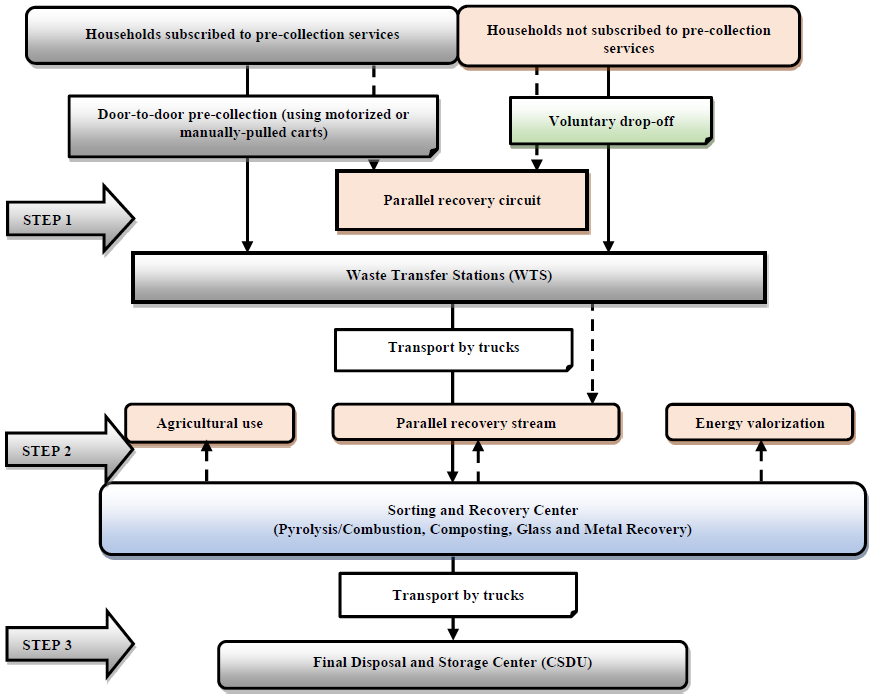
The proposed municipal solid waste management scheme can be summarized in three main stages, as illustrated in Figure 4.
At this stage, the system distinguishes between households subscribing to door-to-door collection and non-subscribing households, reflecting the socio-economic diversity and the coexistence of formal and informal practices. A parallel recovery circuit facilitates early valorization of recyclable materials, consistent with practices commonly observed in African cities 3, 5. Collected waste is then transported to intermediate transfer sites, which optimize logistics, reduce transport distances, and improve operational efficiency before final conveyance to treatment facilities by lorry.
The second stage focuses on integrated valorization pathways. Waste is subjected to sorting at centralized facilities to separate organic, combustible, and inert fractions. Treatment operations include composting for the fermentable fraction, pyrolysis and combustion for combustible materials, and recovery of glass, metals, and other recyclables. Moisture reduction through biodrying or solar drying is applied as a pre-treatment to enhance both biological and thermochemical processes.
Residual non-recoverable waste is directed to a controlled landfill equipped with leachate collection and treatment systems to minimize environmental risks. By combining pre-collection, integrated valorization, and controlled final disposal, the system ensures operational coherence, environmental protection, and resource recovery.
This structured approach aligns with international best practices and sustainable waste management principles, providing a technically feasible framework for rapidly urbanizing cities like Abomey-Calavi 1, 2.
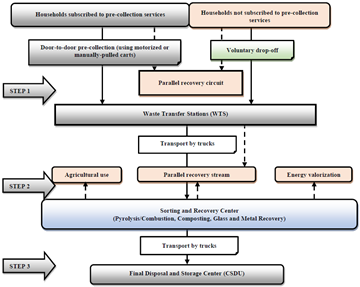
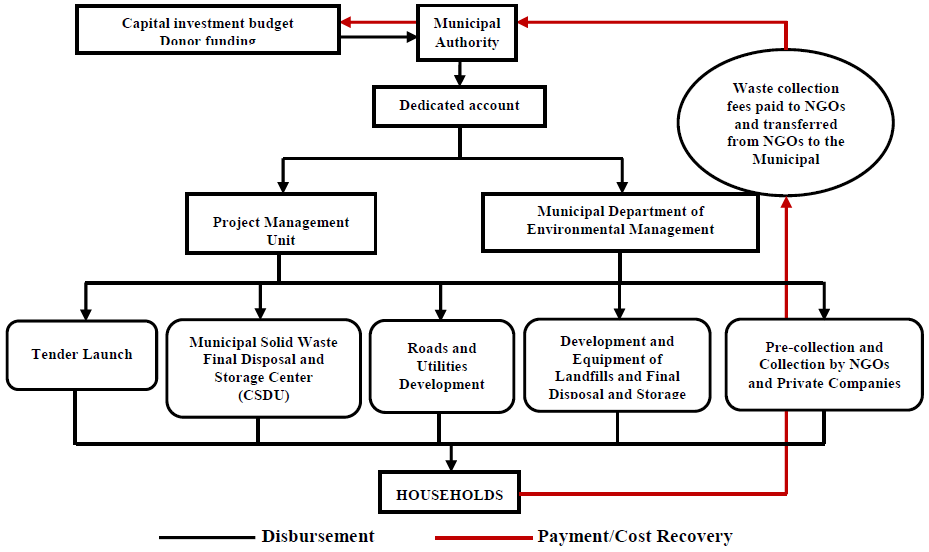
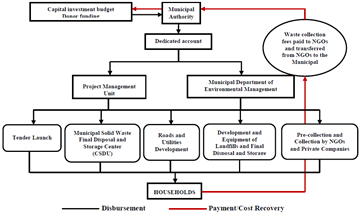
Figure 5 illustrates the proposed financial and institutional framework for the municipal solid waste management (MSWM) system in Abomey-Calavi. The diagram emphasizes the central role of the municipality, which manages the investment budget and a dedicated account to finance waste management infrastructure and services.
Households contribute to the system through waste collection fees paid to NGOs and private operators. A portion of these funds is then transferred to the municipality, ensuring cost recovery in accordance with the polluter-pays principle. Budget allocations are managed through the Project Management Unit and the Municipal Environmental Management Technical Service, covering tendering procedures, construction of transfer and treatment centers, controlled landfill facilities, and supporting road and utility infrastructure.
Operational responsibilities, including pre-collection and collection, are carried out by NGOs and private companies under municipal supervision. This integrated governance and financing scheme aligns with international recommendations for sustainable urban waste management in developing countries, emphasizing institutional coordination, financial transparency, and active private sector participation 1, 2, 3.
3.7. Policy and Implementation PathwaysThe transition from the current fragmented waste management system in Abomey-Calavi to the proposed integrated MSWM framework requires a phased and adaptive strategy. In the short term, priority should be given to strengthening pre-collection, source separation, and low-cost pre-treatment options such as biodrying and decentralized composting, which have proven effective in comparable sub-Saharan African contexts 11, 27. Inclusion of informal waste workers in pre-collection, sorting, and recycling activities enhances social sustainability and overall system performance 16, 28. Embedding circular economy principles at this stage, through improved material recovery and energy valorization, provides a strong foundation for sustainable system development 29.
In the medium term, pilot-scale thermochemical treatment units can be implemented to validate operational performance, emission control, and maintenance requirements under local conditions. Lessons learned from these pilots should guide scaling and investment decisions 17, 22. Policy coherence, stakeholder engagement, and monitoring mechanisms are crucial to ensure that infrastructure investments translate into tangible environmental and socio-economic benefits 29.
In the long term, integrating composting, thermochemical treatment, and controlled landfilling within a unified institutional and financial framework ensures system completeness, environmental protection, and resource recovery. Comprehensive policy frameworks that combine regulatory enforcement, stakeholder engagement, economic incentives, and community participation have been identified as critical enablers of sustainable municipal solid waste management and circular economy adoption, particularly in contexts where institutional fragmentation and resource constraints prevail 30.This phased approach aligns with international best practices for rapidly urbanizing cities 1, 2 and supports the 29 recommendation to shift from linear waste disposal toward circular, resource-efficient systems that generate economic opportunities while enhancing sustainability.
This study provides a technical assessment of municipal solid waste management (MSWM) in Abomey-Calavi and proposes an integrated system adapted to local waste characteristics and socio-economic conditions. Quantitative analysis indicates that the waste stream is dominated by organic and combustible fractions, offering significant potential for valorization. However, the high moisture content of waste constitutes a major technical constraint, making sorting and moisture reduction indispensable pre-treatment steps.
Composting alone is insufficient to ensure sustainable waste management, whereas thermochemical treatments, particularly pyrolysis and controlled combustion, offer substantial benefits in terms of energy recovery, volume reduction, and environmental performance. The integration of these processes, as illustrated in the proposed management scheme (Figure 4), allows for a substantial reduction in landfill requirements and associated environmental impacts. Further socio-economic analysis is, however, needed to determine local energy demand and to select the most sustainable waste-to-energy model.
The success of the proposed system depends on effective institutional coordination, adequate infrastructure, and sustainable financing mechanisms. It should be noted that the current framework represents a planning-level assessment; implementation should be preceded by site-specific techno-economic and environmental feasibility studies. By combining local waste characterization data, technical analysis, and lessons from regional experiences, this study contributes to the development of technically viable MSWM solutions for rapidly urbanizing cities in sub-Saharan Africa and provides a transferable framework for similar urban contexts.
The authors gratefully acknowledge the support of the municipal authorities of Abomey-Calavi and Ouagadougou for providing access to local data and facilitating field observations. Special thanks are extended to the pre-collection NGOs and municipal technical services involved in waste management for their cooperation during surveys and site visits. This work also benefited from scientific exchanges with researchers engaged in waste management and thermochemical conversion studies in West Africa.
The authors hereby declare that there are no financial, personal, or professional conflicts of interest that could have influenced the research, authorship, or publication of this study.
| [1] | Kaza, S., Yao, L., Bhada-Tata, P., and Van Woerden, F., What a Waste 2.0: A Global Snapshot of Solid Waste Management to 2050. Washington, DC: World Bank. Washington, DC: World Bank, 2018. https://hdl.handle.net/10986/30317 | ||
| In article | View Article | ||
| [2] | Wilson, D. C., Rodic, L., Modak, P., Soos, R., Velis, C., Iyer, M., and Simonett, O., Global Waste Management Outlook Report. United Nations Environment Programme (UNEP) and International Solid Waste Association, 2015. https:// wedocs.unep.org/ 20.500.11822/9672 | ||
| In article | |||
| [3] | Guerrero, L.A., Maas, G., and Hogland, W., Solid waste management challenges for cities in developing countries. Waste Management, 33(1), 220-232, 2013. | ||
| In article | View Article PubMed | ||
| [4] | UNEP, Africa Waste Management Outlook. United Nations Environment Programme, Nairobi, Kenya, 2018, 224p. https://wedocs.unep.org/20.500.11822/25514 | ||
| In article | |||
| [5] | Parrot, L., Sotamenou, J., and Dia, B.K., Municipal solid waste management in Africa: Strategies and livelihoods in Yaoundé, Cameroon. Waste Management, 29(2), 986-995, 2009. | ||
| In article | View Article PubMed | ||
| [6] | Ferronato, N., Torretta, V., Waste mismanagement in developing countries: A review of global issues. International Journal of Environmental Research and Public Health, 16(6), 1060, 2019. | ||
| In article | View Article PubMed | ||
| [7] | Zurbrügg, C., Gfrerer, M., Ashadi, H., Brenner, W., and Küper, D., Determinants of sustainability in solid waste management- The Gianyar Waste Recovery Project in Indonesia. Waste Management, 32(11), 2126-2133, 2012. | ||
| In article | View Article PubMed | ||
| [8] | Topanou, N., Domeizel, M., Fatombi, J., Josse, R. G., and Aminou, T., Characterization of household solid waste in the town of Abomey-Calavi in Benin. Journal of Environmental Protection, 2(6), 692–699; 2011. | ||
| In article | View Article | ||
| [9] | Topanou, N., Gestion des déchets solides ménagers au Bénin. Thèse de doctorat, INSA Lyon, France, 2012, 194p. | ||
| In article | |||
| [10] | Kple, M., Girods, P., Fagla, B., Anjorin, M., and Rogaume, Y., Thermal Degradation of Household Solid Waste in the Town of Abomey- Calavi in Benin: Kinetic Study. Waste and Biomass Valorization, 7, 59-70, 2016. | ||
| In article | View Article | ||
| [11] | Yeo, D., Dongo, K., Mertenat, A., Lüssenhop, P., Körner, I., and Zurbrügg, C., Material flows and greenhouse gas emissions reduction potential of decentralized composting in SubSaharan Africa: A case study in Tiassalé, Côte d’Ivoire. International Journal of Environmental Research and Public Health, 17(19), 7229, 2020. | ||
| In article | View Article PubMed | ||
| [12] | Kple, M., Etude des voies de valorisation des déchets ménagers au Bénin : cas de la ville d’Abomey-Calavi. Thèse de Doctorat, Université de Lorraine, France, 2015, 267p. | ||
| In article | |||
| [13] | Chidikofan, D.M.G.F., Yatakpo, G.L., Kplé, M., Nonviho, G., and Adjakpa, B.J., Performance and challenges of current household solid waste management system in AbomeyCalavi district in Benin. International Journal of Advanced Research, 11(10), 27-42, 2023. | ||
| In article | View Article | ||
| [14] | Arena, U., Process and technological aspects of municipal solid waste gasification: A review. Waste Management, 32(4), 625-639, 2012. | ||
| In article | View Article PubMed | ||
| [15] | INSAE, Effectifs de la population des villages et quartiers de ville du Bénin (RGPH-4, 2013). Cotonou, Bénin, 85p., 2016. INSTaD [Accessed January 11, 2026] | ||
| In article | |||
| [16] | Sembiring, E., and Nitivattananon, V., Sustainable solid waste management toward an inclusive society: Integration of the informal sector. Resources, Conservation and Recycling, 54(11), 802-809, 2010. | ||
| In article | View Article | ||
| [17] | Hasan, M.M., Rasul, M.G., Khan, M.M.K., Ashwath, N., and Jahirul, M.I., Energy recovery from municipal solid waste using pyrolysis technology: A review on current status and developments. Renewable and Sustainable Energy Reviews, 145, 111073, 2021. | ||
| In article | View Article | ||
| [18] | Bridgwater, A.V., Review of fast pyrolysis of biomass and product upgrading. Biomass and Bioenergy, 38, 68-94, 2012. | ||
| In article | View Article | ||
| [19] | Chen, D., Yin, L., Wang, H., and He, P., Reprint of: Pyrolysis technologies for municipal solid waste: A review. Waste Management, 34(12), 116-136, 2015. | ||
| In article | View Article PubMed | ||
| [20] | Lehmann, J., and Joseph, S., Biochar for Environmental Management: Science, Technology and Implementation (2nd ed). Routledge (Taylor & Francis Group), London and New York, 2015, 944p. | ||
| In article | View Article | ||
| [21] | Moya D., Aldás, C., López, G. and Kaparaju, P., Municipal Solid Waste as a Valuable Renewable Energy Resource: A Worldwide Opportunity of Energy Recovery by Using Waste-to-Energy Technologies. Energy Procedia, 134, 286-295, 2017. | ||
| In article | View Article | ||
| [22] | Lombardi, L., Carnevale, E. and Corti, A., A review of technologies and performances of thermal treatment systems for energy recovery from waste. Waste Management, 37, 26-44, 2015. | ||
| In article | View Article PubMed | ||
| [23] | Diaz, L.F., de Bertoldi, M., Bidlingmaier W., Compost Science and Technology. Elsevier, Waste Management Series, 8, 2011, 364p. | ||
| In article | |||
| [24] | Liu, J., Yu, S. and Shang, Y., Toward separation at source: Evolution of Municipal Solid Waste management in China. Frontiers of Environmental Science and Engineering, 14(2), 36, 2020. | ||
| In article | View Article | ||
| [25] | Astrup, T. F., Tonini, D., Turconi, R., and Boldrin, A., Life cycle assessment of thermal Waste to Energy technologies: Review and recommendations. Waste Management, 37, 104-115, 2015. | ||
| In article | View Article PubMed | ||
| [26] | Graça, J., Kwapinska, M., Murphy, B., Duggan, T., Leahy, J. J., and Kelleher, B., Pyrolysis, a recovery solution to reduce landfilling of residual organic waste generated from mixed municipal waste. Environmental Science and Pollution Research, 31(21), 30676-30687, 2024. | ||
| In article | View Article PubMed | ||
| [27] | Nikiema, J., Tanoh-Nguessan, R., Abiola, F., and Cofie, O. O. (2020). Introducing co-composting to fecal sludge treatment plants in Benin and Burkina Faso: A logistical and financial assessment (Resource Recovery & Reuse Series No. 17). International Water Management Institute (IWMI), Sri Lanka, India, 2020. https://cgspace.cgiar.org/handle/10568/108512. | ||
| In article | View Article | ||
| [28] | Shah, A. V., Srivastava, V. K., Mohanty, S. S., and Varjani, S., Municipal Solid Waste as a Sustainable Resource for Energy Production: State-of-the-Art Review. Journal of Environmental Chemical Engineering, 9, Article ID: 105717, 2021. | ||
| In article | View Article | ||
| [29] | OECD, Improving resource efficiency and the circularity of economies for a greener world. OECD Publishing, 2020 https://EconPapers.repec.org/RePEc:oec:envaac:20-en. | ||
| In article | |||
| [30] | Awino, F.B., and Apitz, S.E., Solid waste management in the context of the waste hierarchy and circular economy frameworks: An international critical review. Integrated Environmental Assessment and Management, 20 (1), 2024, 9-35. | ||
| In article | View Article PubMed | ||
Published with license by Science and Education Publishing, Copyright © 2026 Chaim Vivien DOTO, Bidossessi Avinou Melhyas KPLE, Wilfrid ADIHOU, Maurel AZA-GNANDJI, Grâce CHIDIKOFAN, Guevara NONVIHO, Gontrand Comlan BAGAN, Aristide HOUNGAN and Hyppolite AGADJIHOUEDE
 This work is licensed under a Creative Commons Attribution 4.0 International License. To view a copy of this license, visit
http://creativecommons.org/licenses/by/4.0/
This work is licensed under a Creative Commons Attribution 4.0 International License. To view a copy of this license, visit
http://creativecommons.org/licenses/by/4.0/
| [1] | Kaza, S., Yao, L., Bhada-Tata, P., and Van Woerden, F., What a Waste 2.0: A Global Snapshot of Solid Waste Management to 2050. Washington, DC: World Bank. Washington, DC: World Bank, 2018. https://hdl.handle.net/10986/30317 | ||
| In article | View Article | ||
| [2] | Wilson, D. C., Rodic, L., Modak, P., Soos, R., Velis, C., Iyer, M., and Simonett, O., Global Waste Management Outlook Report. United Nations Environment Programme (UNEP) and International Solid Waste Association, 2015. https:// wedocs.unep.org/ 20.500.11822/9672 | ||
| In article | |||
| [3] | Guerrero, L.A., Maas, G., and Hogland, W., Solid waste management challenges for cities in developing countries. Waste Management, 33(1), 220-232, 2013. | ||
| In article | View Article PubMed | ||
| [4] | UNEP, Africa Waste Management Outlook. United Nations Environment Programme, Nairobi, Kenya, 2018, 224p. https://wedocs.unep.org/20.500.11822/25514 | ||
| In article | |||
| [5] | Parrot, L., Sotamenou, J., and Dia, B.K., Municipal solid waste management in Africa: Strategies and livelihoods in Yaoundé, Cameroon. Waste Management, 29(2), 986-995, 2009. | ||
| In article | View Article PubMed | ||
| [6] | Ferronato, N., Torretta, V., Waste mismanagement in developing countries: A review of global issues. International Journal of Environmental Research and Public Health, 16(6), 1060, 2019. | ||
| In article | View Article PubMed | ||
| [7] | Zurbrügg, C., Gfrerer, M., Ashadi, H., Brenner, W., and Küper, D., Determinants of sustainability in solid waste management- The Gianyar Waste Recovery Project in Indonesia. Waste Management, 32(11), 2126-2133, 2012. | ||
| In article | View Article PubMed | ||
| [8] | Topanou, N., Domeizel, M., Fatombi, J., Josse, R. G., and Aminou, T., Characterization of household solid waste in the town of Abomey-Calavi in Benin. Journal of Environmental Protection, 2(6), 692–699; 2011. | ||
| In article | View Article | ||
| [9] | Topanou, N., Gestion des déchets solides ménagers au Bénin. Thèse de doctorat, INSA Lyon, France, 2012, 194p. | ||
| In article | |||
| [10] | Kple, M., Girods, P., Fagla, B., Anjorin, M., and Rogaume, Y., Thermal Degradation of Household Solid Waste in the Town of Abomey- Calavi in Benin: Kinetic Study. Waste and Biomass Valorization, 7, 59-70, 2016. | ||
| In article | View Article | ||
| [11] | Yeo, D., Dongo, K., Mertenat, A., Lüssenhop, P., Körner, I., and Zurbrügg, C., Material flows and greenhouse gas emissions reduction potential of decentralized composting in SubSaharan Africa: A case study in Tiassalé, Côte d’Ivoire. International Journal of Environmental Research and Public Health, 17(19), 7229, 2020. | ||
| In article | View Article PubMed | ||
| [12] | Kple, M., Etude des voies de valorisation des déchets ménagers au Bénin : cas de la ville d’Abomey-Calavi. Thèse de Doctorat, Université de Lorraine, France, 2015, 267p. | ||
| In article | |||
| [13] | Chidikofan, D.M.G.F., Yatakpo, G.L., Kplé, M., Nonviho, G., and Adjakpa, B.J., Performance and challenges of current household solid waste management system in AbomeyCalavi district in Benin. International Journal of Advanced Research, 11(10), 27-42, 2023. | ||
| In article | View Article | ||
| [14] | Arena, U., Process and technological aspects of municipal solid waste gasification: A review. Waste Management, 32(4), 625-639, 2012. | ||
| In article | View Article PubMed | ||
| [15] | INSAE, Effectifs de la population des villages et quartiers de ville du Bénin (RGPH-4, 2013). Cotonou, Bénin, 85p., 2016. INSTaD [Accessed January 11, 2026] | ||
| In article | |||
| [16] | Sembiring, E., and Nitivattananon, V., Sustainable solid waste management toward an inclusive society: Integration of the informal sector. Resources, Conservation and Recycling, 54(11), 802-809, 2010. | ||
| In article | View Article | ||
| [17] | Hasan, M.M., Rasul, M.G., Khan, M.M.K., Ashwath, N., and Jahirul, M.I., Energy recovery from municipal solid waste using pyrolysis technology: A review on current status and developments. Renewable and Sustainable Energy Reviews, 145, 111073, 2021. | ||
| In article | View Article | ||
| [18] | Bridgwater, A.V., Review of fast pyrolysis of biomass and product upgrading. Biomass and Bioenergy, 38, 68-94, 2012. | ||
| In article | View Article | ||
| [19] | Chen, D., Yin, L., Wang, H., and He, P., Reprint of: Pyrolysis technologies for municipal solid waste: A review. Waste Management, 34(12), 116-136, 2015. | ||
| In article | View Article PubMed | ||
| [20] | Lehmann, J., and Joseph, S., Biochar for Environmental Management: Science, Technology and Implementation (2nd ed). Routledge (Taylor & Francis Group), London and New York, 2015, 944p. | ||
| In article | View Article | ||
| [21] | Moya D., Aldás, C., López, G. and Kaparaju, P., Municipal Solid Waste as a Valuable Renewable Energy Resource: A Worldwide Opportunity of Energy Recovery by Using Waste-to-Energy Technologies. Energy Procedia, 134, 286-295, 2017. | ||
| In article | View Article | ||
| [22] | Lombardi, L., Carnevale, E. and Corti, A., A review of technologies and performances of thermal treatment systems for energy recovery from waste. Waste Management, 37, 26-44, 2015. | ||
| In article | View Article PubMed | ||
| [23] | Diaz, L.F., de Bertoldi, M., Bidlingmaier W., Compost Science and Technology. Elsevier, Waste Management Series, 8, 2011, 364p. | ||
| In article | |||
| [24] | Liu, J., Yu, S. and Shang, Y., Toward separation at source: Evolution of Municipal Solid Waste management in China. Frontiers of Environmental Science and Engineering, 14(2), 36, 2020. | ||
| In article | View Article | ||
| [25] | Astrup, T. F., Tonini, D., Turconi, R., and Boldrin, A., Life cycle assessment of thermal Waste to Energy technologies: Review and recommendations. Waste Management, 37, 104-115, 2015. | ||
| In article | View Article PubMed | ||
| [26] | Graça, J., Kwapinska, M., Murphy, B., Duggan, T., Leahy, J. J., and Kelleher, B., Pyrolysis, a recovery solution to reduce landfilling of residual organic waste generated from mixed municipal waste. Environmental Science and Pollution Research, 31(21), 30676-30687, 2024. | ||
| In article | View Article PubMed | ||
| [27] | Nikiema, J., Tanoh-Nguessan, R., Abiola, F., and Cofie, O. O. (2020). Introducing co-composting to fecal sludge treatment plants in Benin and Burkina Faso: A logistical and financial assessment (Resource Recovery & Reuse Series No. 17). International Water Management Institute (IWMI), Sri Lanka, India, 2020. https://cgspace.cgiar.org/handle/10568/108512. | ||
| In article | View Article | ||
| [28] | Shah, A. V., Srivastava, V. K., Mohanty, S. S., and Varjani, S., Municipal Solid Waste as a Sustainable Resource for Energy Production: State-of-the-Art Review. Journal of Environmental Chemical Engineering, 9, Article ID: 105717, 2021. | ||
| In article | View Article | ||
| [29] | OECD, Improving resource efficiency and the circularity of economies for a greener world. OECD Publishing, 2020 https://EconPapers.repec.org/RePEc:oec:envaac:20-en. | ||
| In article | |||
| [30] | Awino, F.B., and Apitz, S.E., Solid waste management in the context of the waste hierarchy and circular economy frameworks: An international critical review. Integrated Environmental Assessment and Management, 20 (1), 2024, 9-35. | ||
| In article | View Article PubMed | ||