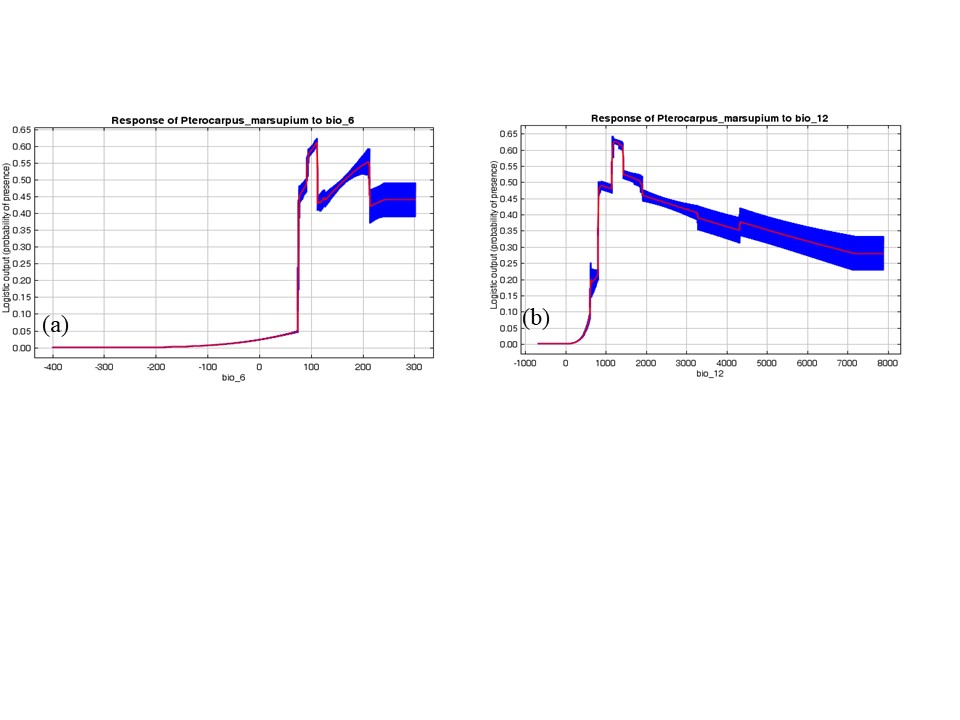
Pterocarpus marsupium is a multipurpose tree with high economic value. Due to its high commercial value, P. marsupium is susceptible to a high degree of anthropogenic pressure. Despite the enormous threats, there have been very limited concentrated efforts to address conservation concerns, such as mapping of the distribution pattern. Therefore, the present study was carried out to predict the current and future suitable distribution of P. marsupium in India using Maxent species distribution model. Output of maxent model reveal that the suitable habitat for distribution is Western Ghats and Middle part of India. Future prediction model for 2050 showed decrease of habitat area by 37.12%. The strongest predictors for the distribution of P. marsupium were Minimum temperature of the coldest month (bio 6) and Annual Precipitation (bio_12).
Pterocarpus marsupium Roxb. (Fabaceae) is a large deciduous tree native to India, Sri Lanka, and parts of Nepal and Bhutan, at elevations ranging up to 1200 m [1-3] 1. In India it is found in central and peninsular part, chiefly in dry mixed deciduous tropical forests of Gujarat, Madhya Pradesh, Bihar, Jharkhand, Odisha and sub-Himalayan tracts, at up to 1000 m altitude 2 4, 5.
P. marsupium is often described as one of the most 'multipurpose forest trees' 3. The tree is well known for pharmaceutically important gum kino 6 which is a powerful astringent 7. The species especially carries anti-diabetic properties 8, 9 and is being extensively exploited for its timber and bark 10. The timber can be used for bridge, boat and small scale construction material, plywood, veneer, tool and container production and to produce musical instruments (ITTO 2017). P. marsupium has been used in traditional, ayurvedic for many centuries (RPRC 2014). The heartwood of the tree is widely used to produce a tonic to treat diabetes 11, 12. The wood is considered astringent, antioxidant, anthelminitc and anti-inflammatory so is used to treat a variety of illnesses. Leaves and resin can be used to treat skin conditions and other ailments 4. The species may also be used for agroforestry, revegetation and soil improvement (CABI 2008).
Population of P. marsupium is declining, due to over exploitation for its timber and medicinal uses 10 and is considered as near threatened by the International Union for the Conservation of Nature, on the basis of its decreasing population and declining habitat in its native range 13. Although over exploitation and deforestation have been the major cause of its decline, the effects of climate change on this species remain to be evaluated rigorously 14. Despite being an important forest tree species, information on suitable habitat distribution range of P. marsupium and its response to changing climatic conditions are scanty. For India, Kumar et al. (2020) 5 modeled the potential distribution of P. marsupium in eastern India; Ghosh et al. (2021) assessed the species' distribution under climate change scenarios across India, based on a model for the species at a global scale. However, Kumar et al. (2020) 5 study was based on models calibrated across only a single district within a single state (Ranchi, Jharkhand) in India, such that the models are certain to under-appreciate the full extent of the fundamental ecological niche of the species. The Ghosh et al. (2021) 2 analysis was based on a highly biased sample of occurrence data (central India only) for the species, which omitted large sectors of the species' geographic distribution.
The present study aims to construct a habitat suitability map and predict suitable habitats for reintroduction and conservation under current climatic conditions as well as to conduct an area change analysis under future climatic conditions projected for 2050.The application of suitable ecological methods, such as phytosociological analysis and environmental niche modeling, plays a crucial role in preserving and conserving the natural populations of endangered species. However, without a clear understanding of the population status, habitat distribution, and climatic preferences of P. marsupium, it is challenging to formulate effective measures and management strategies for its conservation, cultivation, or reintroduction. Therefore, this study was done to construct a habitat suitability map and predict suitable habitats for reintroduction and conservation under current climatic conditions as well as to conduct an area change analysis under future climatic conditions projected for 2050.
To achieve these objectives, we employ the maximum entropy model (Maxent version 3.3.3) 15. This selection is based on the model's superior performance with small sample sizes compared to other modeling methods [16-18] 16. Maxent, which is based on the principle of maximum entropy, utilizes presence-only data to predict species distribution, while aiming to estimate a probability distribution of species occurrence that aligns as closely as possible with uniformity but is still subject to environmental constraints 19. The Maxent model inherently includes variable interactions and can manage both continuous and categorical predictor variables. It employs a set of features, such as linear, quadratic, product, threshold, and hinge, which are functions of environmental variables that limit the geographic distribution of a species. Additionally, it utilizes an empirically determined regularization parameter to prevent model overfitting.
Occurrence data collection
Primary occurrence data for model building and evaluation were collected through field surveys in different parts of India. We also obtained occurrence records from the web resource of Global Biodiversity Information Facility (http://www.gbif.org) and published literature [20-22] 20. The coordinates of all the occurrence points obtained through field surveys were recorded to an accuracy of ≤ 10 m using a GPS (Garmin). These coordinates were then converted to decimal degrees for use in modeling the distribution of habitats of the species. To avoid spatial autocorrelations, only one location per grid (1 km × 1 km) was used in modeling. Finally, a total of 144 occurrence points of P. marsupium were compiled and included in this study to model current and future potential distribution of the species.
Climatic data
Bioclimatic variables 23, 24 with 30 seconds spatial resolution, downloaded from World Clim dataset (www.worldclim.org) were used in the present study. The WorldClim data (for the period from 1950 to 2000) are compiled from measurements of temperature and precipitation collected from weather stations worldwide. These data are often used in species distribution modeling [24-27] 24. The 19 bioclimatic variables from the WorldClim dataset were used to assess current climatic conditions. These variables are frequently used in modeling species distributions 24, 25, 28, and capture annual ranges, seasonality, and limiting factors such as monthly and quarterly temperature and precipitation extremes 23. Future climate scenario data for 2050 (A2a emission scenario) were obtained from Consultative Group on International Agricultural Research (CGIAR)’s Research Program on Climate Change, Agriculture and Food Security (CCAFS) climate data archive (http://ccafsclimate.org). These future climate projections are based on IPCC 4th assessment data and were calibrated and statistically downscaled using the data for ‘current’ conditions.
Predictive modeling
The habitat model was constructed using the Maximum Entropy Distribution software, Maxent version 3.3.3 (http://www.cs.princeton.edu/wschapire) 15. This software generates a likelihood estimation for the presence of species, providing a range from 0 to 1, where 0 signifies the lowest probability and 1 indicates the highest probability. Of the 144 records, seventy-five percent were used for model training and twenty five percent for testing. To validate the model robustness, 10 replicated models runs for the species with a threshold rule of 10 percentile training presence was executed. In the replicated runs, cross validation technique was employed, where samples were divided into replicate folds and each fold was used for test data. Other parameters were set to default as the program is already calibrated on a wide range of species datasets 29. From the replicated runs average, maximum, minimum, median and standard deviation were generated. Jackknife procedure and percent variable contributions were used to estimate the relative influence of different predictor variables. Receiver operating characteristics (ROC) analyses the performance of a model at all possible threshold by a single number called, the area under the curve (AUC). AUC is a measure of model performance and varies from 0 to 1 30. Higher AUC values correspond to better model quality and accuracy. The Area under the ROC curve was used to evaluate model performance.
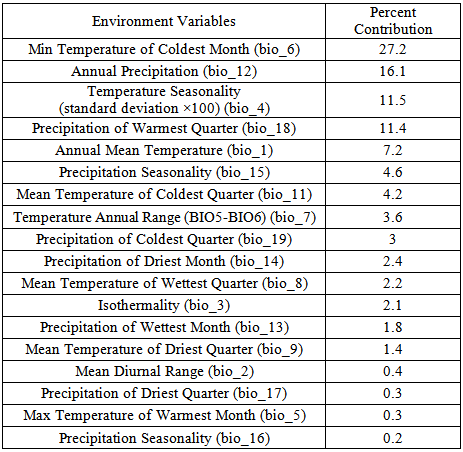
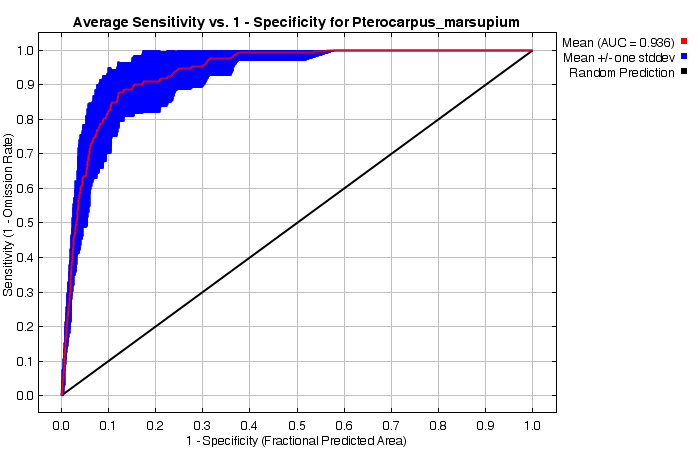
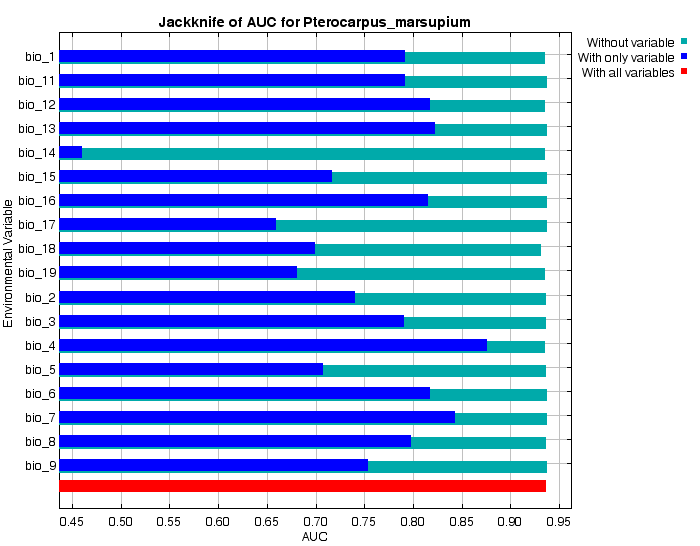
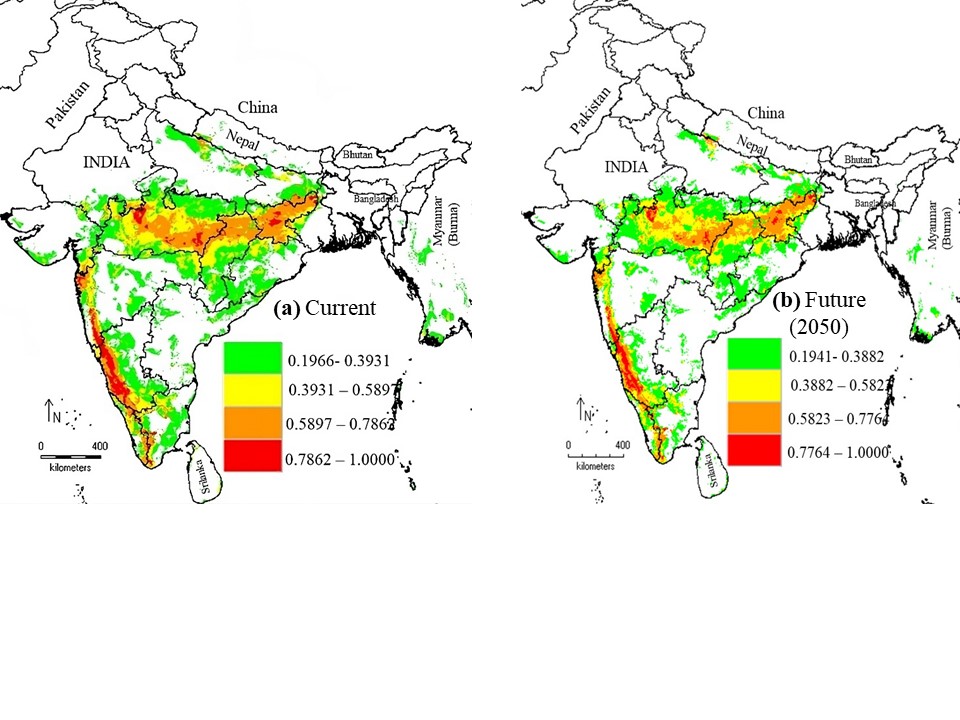
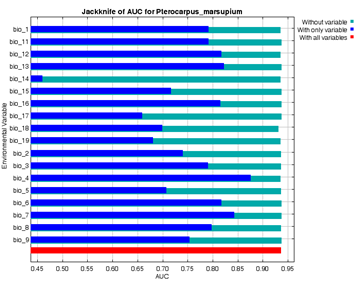
An AUC value of 0.50 indicates that model did not perform better than random whereas a value of 1.0 indicates perfect discrimination 31. The maxent model for P. marsupium performed well with an average AUC value of 0.936 (Figure 1). Relative importance of different environmental variables based on results of jackknife tests in Maxent are shown in Figure 2. To minimize the possible errors in species occurrence data, duplicate records were eliminated. The model suggests Western Ghats, Madhya Pradesh and Jharkhand to be the most suitable habitat with a significant area of 1,00,678 km2 (Figure 3a) However, major portion of the most significant habitat is seen in Western Ghats. The relative contributions of the predictor variables in Maxent for distribution of P. marsupium is given in Table 1. Minimum temperature of the coldest month (bio 6) and Annual Precipitation (bio_12) were the strongest predictors for the distribution of P. marsupium with 27.2% and 16.1% respectively.
When compared to the currently predicted most suitable habitat area of 1,00,678 km2, the future prediction model for 2050 (under the A2a emission scenario) indicates a reduction in habitat, as illustrated in Figure 3b, with an optimal geographic distribution measuring 63,359 km2. While the prospective distribution of P. marsupium closely mirrors the existing potential distribution, the model's findings suggest a decrease in highly suitable habitat by 37.12% in terms of area.


The natural populations of P. marsupium have experienced considerable depletion due to overharvesting, increased human activities and shifting climatic conditions in their habitats (5). Species like P. marsupium, which possess recognized economic value, face pressures like habitat loss resulting from rapid climate change, land use and land cover alterations, and overexploitation due to their known usefulness (26). Land transformations for agricultural and urban purposes, along with climate changes, will lead to an expansion of unsuitable habitats in the species' range. Therefore, proper planning is essential to preserve the species through successful execution of in-situ conservation within protected areas offering suitable habitats, as well as ex-situ conservation (9). Both macro- and micropropagation techniques should be employed to cultivate plantlets, which can then be introduced to appropriate protected sites identified via ecological niche modeling.
The model outputs show that the Minimum Temperature of Coldest Month (bio 6), significantly influences the potential habitat distribution of P. marsupium. The model identifies the Western Ghats and middle part of India as the most suitable natural habitat for the species. The areas pinpointed through current distribution modeling can be utilized for the re-introduction of the species. Regarding future species predictions, Maxent modeling indicates a loss of habitat in Western Ghat and middle part of India by 2050 within the presently predicted areas. Given the forecast of habitat contraction in the future, it is essential to prioritize and diligently preserve potential suitable areas.
The current study describes the application of ecological niche modeling to identify the areas that support P. marsupium populations using occurrence points and environmental variables. The areas located through current distribution modeling can be very helpful in identifying suitable habitats for reintroducing P. marsupium. Under future climatic scenarios (A2a emission scenario), this plant species shows a decrease in the habitat suitability (63,359 km2) as compared to the current prediction where the suitable habitats range across 1,00,678 km2. Based on habitat contraction prediction in the near future, potential suitable areas must be prioritized and maintained at an utmost importance.
The predicted areas in this research could help in the species' rehabilitation and improve its conservation status. Employing various integrative in-situ conservation approaches, along with captive propagation in controlled settings like natural habitats, botanical gardens, and other conservation facilities, could boost species recovery rate and promote germplasm conservation. The Maxent model, which is used to estimate a species' ideal habitat, may be used to forecast the potential suitable habitats of other economically important vulnerable species, assisting in conservation planning of these species.
PS made contributions in conception & design of the paper and Species Distribution Modelling programme.
RP was involved in collection of the coordinates of Pterocarpus marsupium drafting the manuscript
Authors are thankful to Pro-Chancellor Prof. Arun K. Pandey, Mansarovar Global University, Sehore for encouragement and facilities.
| [1] | Badkhane, Y., Yadav, A. S., Sharma, A. K., Raghuwanshi, D. K., Uikey, S. K., Mir, F. A., ... & Murab, T. Pterocarpus marsupium Roxb-Biological activities and medicinal properties. International Journal of Advances in Pharmaceutical Sciences, 1(4). 2010. | ||
| In article | |||
| [2] | Ghosh, B. G., Garai, S., Rahaman, S. M., Khatun, M., Mohammad, N., Mishra, Y, ... & Tiwari, S. Assessing potential habitat distribution range of the endangered tree species Pterocarpus marsupium Roxb. Under the climate change scenario in India. Trees, Forests and People, 6, 100124. 2021 | ||
| In article | View Article | ||
| [3] | Khanal, S., Timilsina, R., Behroozian, M., Peterson, A. T., Poudel, M., Alwar, M. S. S., ... & Osorio-Olvera, L. Potential impact of climate change on the distribution and conservation status of Pterocarpus marsupium, a Near Threatened South Asian medicinal tree species. Ecological Informatics, 70, 101722. 2022. | ||
| In article | View Article | ||
| [4] | Gairola, S., Gupta, V., Singh, B., Maithani, M., & Bansal, P. Phytochemistry and pharmacological activities of Pterocarpus marsupium: a review. Int Res J Pharm, 1(1), 100-4. 2010. | ||
| In article | |||
| [5] | Kumar, A., Kumar, A., Adhikari, D., Gudasalamani, R., Saikia, P., & Khan, M. L. Ecological niche modeling for assessing potential distribution of Pterocarpus marsupium Roxb. In Ranchi, eastern India. Ecological Research, 35(6), 1095-1105. 2020. | ||
| In article | View Article | ||
| [6] | Mishra, A., Srivastava, R., Srivastava, S. P., Gautam, S., Tamrakar, A. K., Maurya, R., & Srivastava, A. K. (2013). Antidiabetic activity of heart wood of Pterocarpus marsupium Roxb. and analysis of phytoconstituents. | ||
| In article | |||
| [7] | Sukhadiya, M., Dholariya, C., Behera, L. K., Mehta, A. A., Huse, S. A., & Gunaga, R. P. Indian Kino Tree (Pterocarpus marsupium ROXB.). Biography of Excellent Timbe r Tree Species. 2019. | ||
| In article | |||
| [8] | Omesh, B., Jitendra, P., & Chaudhary, L. B. Ethnomedicinal uses of tree species by Tharu tribes in the Himalayan Terai region of India. Research Journal of Medicinal Plant, 10(1), 19-41. 2016. | ||
| In article | View Article | ||
| [9] | Vats, V., Grover, J. K., & Rathi, S. S. Evaluation of anti-hyperglycemic and hypoglycemic effect of Trigonella foenum-graecum Linn, Ocimum sanctum Linn and Pterocarpus marsupium Linn in normal and alloxanized diabetic rats. Journal of Ethnopharmacology, 79(1), 95-100. 2002 | ||
| In article | View Article PubMed | ||
| [10] | Ramya, S. Phytochemical screening and antibacterial activity of leaf extracts of Pterocarpus marsupium Roxb. (Fabaceae). Ethnobotanical Leaflets, 2008(1), 136. 2008. | ||
| In article | |||
| [11] | Abirami, B., Gayathri, P., & Uma, D. In vitro antioxidant potential of Pterocarpus marsupium bark. Int J Chem Pharm Sci, 3, 17-24. 2012. | ||
| In article | |||
| [12] | Halagappa, K., Girish, H. N., & Srinivasan, B. P. The study of aqueous extract of Pterocarpus marsupium Roxb. on cytokine TNF-α in type 2 diabetic rats. Indian journal of pharmacology, 42(6), 392. 2010 | ||
| In article | View Article PubMed | ||
| [13] | Barstow, M. Pterocarpus marsupium The IUCN Red List of Threatened Species 2017: e. T34620A67802995. 2017. | ||
| In article | |||
| [14] | Khanal, S., Timilsina, R., Behroozian, M., Peterson, A. T., Poudel, M., Alwar, M. S. S., ... & Osorio-Olvera, L. Potential impact of climate change on the distribution and conservation status of Pterocarpus marsupium, a Near Threatened South Asian medicinal tree species. Ecological Informatics, 70, 101722. 2022. | ||
| In article | View Article | ||
| [15] | Phillips, S. J., Anderson, R. P., & Schapire, R. E. Maximum entropy modeling of species geographic distributions. Ecological modelling, 190(3-4). 231-259. 2006. | ||
| In article | View Article | ||
| [16] | Elith, J., H. Graham, C., P. Anderson, R., Dudík, M., Ferrier, S., Guisan, A, ... & E. Zimmermann, N. Novel methods improve prediction of species’ distributions from occurrence data. Ecography, 29(2). 129-151. 2006. | ||
| In article | View Article | ||
| [17] | Pearson, R. G., Raxworthy, C. J., Nakamura, M., & Townsend Peterson, A. Predicting species distributions from small numbers of occurrence records: a test case using cryptic geckos in Madagascar. Journal of biogeography, 34(1). 102-117. 2007. | ||
| In article | View Article | ||
| [18] | Kumar, S., & Stohlgren, T. J. Maxent modeling for predicting suitable habitat for threatened and endangered tree Canacomyrica monticola in New Caledonia. Journal of Ecology and natural Environment, 1(4), 94-98. 2009. | ||
| In article | |||
| [19] | Elith, J., Phillips, S. J., Hastie, T., Dudík, M., Chee, Y. E., & Yates, C. J. A statistical explanation of MaxEnt for ecologists. Diversity and distributions, 17(1), 43-57. 2011. | ||
| In article | View Article | ||
| [20] | Mahatara, D., Acharya, A. K., Dhakal, B. P., Sharma, D. K., Ulak, S., & Paudel, P. Maxent modelling for habitat suitability of vulnerable tree Dalbergia latifolia in Nepal. Silva Fennica, 55(4). 2021. | ||
| In article | View Article | ||
| [21] | Singh, S., Verma, A. D., & Naik, R. Study on regeneration of tree species in TFRI campus plantations, Jabalpur, Madhya Pradesh. Indian Journal of Tropical Biodiversity, 25(1). 20-30. 2017. | ||
| In article | |||
| [22] | Damaiyani, J., & Prabowo, H. Conservation strategy of a vulnerable species of ‘Rosewood’ (Dalbergia latifolia Roxb) by insect pollinator identification. In Journal of Physics: Conference Series (Vol. 1363, No. 1, p. 012005). IOP Publishing. 2019. | ||
| In article | View Article | ||
| [23] | Hijmans, R. J., Cameron, S. E., Parra, J. L., Jones, P. G., & Jarvis, A. Very high resolution interpolated climate surfaces for global land areas. International Journal of Climatology: A Journal of the Royal Meteorological Society, 25(15). 1965-1978. 2005. | ||
| In article | View Article | ||
| [24] | Booth, T. H., Nix, H. A., Busby, J. R., & Hutchinson, M. F. BIOCLIM: the first species distribution modelling package, its early applications and relevance to most current MAXENT studies. Diversity and Distributions, 20(1), 1-9. 2014. | ||
| In article | View Article | ||
| [25] | Sanchez, A. C., Osborne, P. E., & Haq, N. Climate change and the African baobab (Adansonia digitata L.): the need for better conservation strategies. African Journal of Ecology, 49(2). 234-245. 2011. | ||
| In article | View Article | ||
| [26] | Khanum, R., Mumtaz, A. S., & Kumar, S. Predicting impacts of climate change on medicinal asclepiads of Pakistan using Maxent modeling. Acta Oecologica, 49, 23-31. 2013. | ||
| In article | View Article | ||
| [27] | Adhikari, U., Nejadhashemi, A. P., & Herman, M. R. A review of climate change impacts on water resources in East Africa. Transactions of the ASABE, 58(6). 1493-1507. 2015. | ||
| In article | View Article | ||
| [28] | Evangelista, P. H., Kumar, S., Stohlgren, T. J., Jarnevich, C. S., Crall, A. W., Norman III, J. B., & Barnett, D. T. Modelling invasion for a habitat generalist and a specialist plant species. Diversity and distributions, 14(5). 808-817. 2008. | ||
| In article | View Article | ||
| [29] | Phillips, S. J., & Dudík, M. Modeling of species distributions with Maxent: new extensions and a comprehensive evaluation. Ecography, 31(2). 161-175. 2008. | ||
| In article | View Article | ||
| [30] | Fielding, A. H., & Bell, J. F. A review of methods for the assessment of prediction errors in conservation presence/absence models. Environmental conservation, 24(1). 38-49. 1997. | ||
| In article | View Article | ||
| [31] | Swets, J. A. Measuring the accuracy of diagnostic systems. Science, 240(4857). 1285-1293. 1988. | ||
| In article | View Article PubMed | ||
| [32] | URBINA‐CARDONA, J. N., & Flores‐Villela, O. S. C. A. R. Ecological‐niche modeling and prioritization of conservation‐area networks for Mexican herpetofauna. Conservation biology, 24(4). 1031-1041. 2010. | ||
| In article | View Article PubMed | ||
| [33] | Adhikari, D., Barik, S. K., & Upadhaya, K. Habitat distribution modelling for reintroduction of Ilex khasiana Purk., a critically endangered tree species of northeastern India. Ecological Engineering, 40. 37-43. 2012. | ||
| In article | View Article | ||
Published with license by Science and Education Publishing, Copyright © 2023 Pragya Sourabh and Ritu Patel
 This work is licensed under a Creative Commons Attribution 4.0 International License. To view a copy of this license, visit
http://creativecommons.org/licenses/by/4.0/
This work is licensed under a Creative Commons Attribution 4.0 International License. To view a copy of this license, visit
http://creativecommons.org/licenses/by/4.0/
| [1] | Badkhane, Y., Yadav, A. S., Sharma, A. K., Raghuwanshi, D. K., Uikey, S. K., Mir, F. A., ... & Murab, T. Pterocarpus marsupium Roxb-Biological activities and medicinal properties. International Journal of Advances in Pharmaceutical Sciences, 1(4). 2010. | ||
| In article | |||
| [2] | Ghosh, B. G., Garai, S., Rahaman, S. M., Khatun, M., Mohammad, N., Mishra, Y, ... & Tiwari, S. Assessing potential habitat distribution range of the endangered tree species Pterocarpus marsupium Roxb. Under the climate change scenario in India. Trees, Forests and People, 6, 100124. 2021 | ||
| In article | View Article | ||
| [3] | Khanal, S., Timilsina, R., Behroozian, M., Peterson, A. T., Poudel, M., Alwar, M. S. S., ... & Osorio-Olvera, L. Potential impact of climate change on the distribution and conservation status of Pterocarpus marsupium, a Near Threatened South Asian medicinal tree species. Ecological Informatics, 70, 101722. 2022. | ||
| In article | View Article | ||
| [4] | Gairola, S., Gupta, V., Singh, B., Maithani, M., & Bansal, P. Phytochemistry and pharmacological activities of Pterocarpus marsupium: a review. Int Res J Pharm, 1(1), 100-4. 2010. | ||
| In article | |||
| [5] | Kumar, A., Kumar, A., Adhikari, D., Gudasalamani, R., Saikia, P., & Khan, M. L. Ecological niche modeling for assessing potential distribution of Pterocarpus marsupium Roxb. In Ranchi, eastern India. Ecological Research, 35(6), 1095-1105. 2020. | ||
| In article | View Article | ||
| [6] | Mishra, A., Srivastava, R., Srivastava, S. P., Gautam, S., Tamrakar, A. K., Maurya, R., & Srivastava, A. K. (2013). Antidiabetic activity of heart wood of Pterocarpus marsupium Roxb. and analysis of phytoconstituents. | ||
| In article | |||
| [7] | Sukhadiya, M., Dholariya, C., Behera, L. K., Mehta, A. A., Huse, S. A., & Gunaga, R. P. Indian Kino Tree (Pterocarpus marsupium ROXB.). Biography of Excellent Timbe r Tree Species. 2019. | ||
| In article | |||
| [8] | Omesh, B., Jitendra, P., & Chaudhary, L. B. Ethnomedicinal uses of tree species by Tharu tribes in the Himalayan Terai region of India. Research Journal of Medicinal Plant, 10(1), 19-41. 2016. | ||
| In article | View Article | ||
| [9] | Vats, V., Grover, J. K., & Rathi, S. S. Evaluation of anti-hyperglycemic and hypoglycemic effect of Trigonella foenum-graecum Linn, Ocimum sanctum Linn and Pterocarpus marsupium Linn in normal and alloxanized diabetic rats. Journal of Ethnopharmacology, 79(1), 95-100. 2002 | ||
| In article | View Article PubMed | ||
| [10] | Ramya, S. Phytochemical screening and antibacterial activity of leaf extracts of Pterocarpus marsupium Roxb. (Fabaceae). Ethnobotanical Leaflets, 2008(1), 136. 2008. | ||
| In article | |||
| [11] | Abirami, B., Gayathri, P., & Uma, D. In vitro antioxidant potential of Pterocarpus marsupium bark. Int J Chem Pharm Sci, 3, 17-24. 2012. | ||
| In article | |||
| [12] | Halagappa, K., Girish, H. N., & Srinivasan, B. P. The study of aqueous extract of Pterocarpus marsupium Roxb. on cytokine TNF-α in type 2 diabetic rats. Indian journal of pharmacology, 42(6), 392. 2010 | ||
| In article | View Article PubMed | ||
| [13] | Barstow, M. Pterocarpus marsupium The IUCN Red List of Threatened Species 2017: e. T34620A67802995. 2017. | ||
| In article | |||
| [14] | Khanal, S., Timilsina, R., Behroozian, M., Peterson, A. T., Poudel, M., Alwar, M. S. S., ... & Osorio-Olvera, L. Potential impact of climate change on the distribution and conservation status of Pterocarpus marsupium, a Near Threatened South Asian medicinal tree species. Ecological Informatics, 70, 101722. 2022. | ||
| In article | View Article | ||
| [15] | Phillips, S. J., Anderson, R. P., & Schapire, R. E. Maximum entropy modeling of species geographic distributions. Ecological modelling, 190(3-4). 231-259. 2006. | ||
| In article | View Article | ||
| [16] | Elith, J., H. Graham, C., P. Anderson, R., Dudík, M., Ferrier, S., Guisan, A, ... & E. Zimmermann, N. Novel methods improve prediction of species’ distributions from occurrence data. Ecography, 29(2). 129-151. 2006. | ||
| In article | View Article | ||
| [17] | Pearson, R. G., Raxworthy, C. J., Nakamura, M., & Townsend Peterson, A. Predicting species distributions from small numbers of occurrence records: a test case using cryptic geckos in Madagascar. Journal of biogeography, 34(1). 102-117. 2007. | ||
| In article | View Article | ||
| [18] | Kumar, S., & Stohlgren, T. J. Maxent modeling for predicting suitable habitat for threatened and endangered tree Canacomyrica monticola in New Caledonia. Journal of Ecology and natural Environment, 1(4), 94-98. 2009. | ||
| In article | |||
| [19] | Elith, J., Phillips, S. J., Hastie, T., Dudík, M., Chee, Y. E., & Yates, C. J. A statistical explanation of MaxEnt for ecologists. Diversity and distributions, 17(1), 43-57. 2011. | ||
| In article | View Article | ||
| [20] | Mahatara, D., Acharya, A. K., Dhakal, B. P., Sharma, D. K., Ulak, S., & Paudel, P. Maxent modelling for habitat suitability of vulnerable tree Dalbergia latifolia in Nepal. Silva Fennica, 55(4). 2021. | ||
| In article | View Article | ||
| [21] | Singh, S., Verma, A. D., & Naik, R. Study on regeneration of tree species in TFRI campus plantations, Jabalpur, Madhya Pradesh. Indian Journal of Tropical Biodiversity, 25(1). 20-30. 2017. | ||
| In article | |||
| [22] | Damaiyani, J., & Prabowo, H. Conservation strategy of a vulnerable species of ‘Rosewood’ (Dalbergia latifolia Roxb) by insect pollinator identification. In Journal of Physics: Conference Series (Vol. 1363, No. 1, p. 012005). IOP Publishing. 2019. | ||
| In article | View Article | ||
| [23] | Hijmans, R. J., Cameron, S. E., Parra, J. L., Jones, P. G., & Jarvis, A. Very high resolution interpolated climate surfaces for global land areas. International Journal of Climatology: A Journal of the Royal Meteorological Society, 25(15). 1965-1978. 2005. | ||
| In article | View Article | ||
| [24] | Booth, T. H., Nix, H. A., Busby, J. R., & Hutchinson, M. F. BIOCLIM: the first species distribution modelling package, its early applications and relevance to most current MAXENT studies. Diversity and Distributions, 20(1), 1-9. 2014. | ||
| In article | View Article | ||
| [25] | Sanchez, A. C., Osborne, P. E., & Haq, N. Climate change and the African baobab (Adansonia digitata L.): the need for better conservation strategies. African Journal of Ecology, 49(2). 234-245. 2011. | ||
| In article | View Article | ||
| [26] | Khanum, R., Mumtaz, A. S., & Kumar, S. Predicting impacts of climate change on medicinal asclepiads of Pakistan using Maxent modeling. Acta Oecologica, 49, 23-31. 2013. | ||
| In article | View Article | ||
| [27] | Adhikari, U., Nejadhashemi, A. P., & Herman, M. R. A review of climate change impacts on water resources in East Africa. Transactions of the ASABE, 58(6). 1493-1507. 2015. | ||
| In article | View Article | ||
| [28] | Evangelista, P. H., Kumar, S., Stohlgren, T. J., Jarnevich, C. S., Crall, A. W., Norman III, J. B., & Barnett, D. T. Modelling invasion for a habitat generalist and a specialist plant species. Diversity and distributions, 14(5). 808-817. 2008. | ||
| In article | View Article | ||
| [29] | Phillips, S. J., & Dudík, M. Modeling of species distributions with Maxent: new extensions and a comprehensive evaluation. Ecography, 31(2). 161-175. 2008. | ||
| In article | View Article | ||
| [30] | Fielding, A. H., & Bell, J. F. A review of methods for the assessment of prediction errors in conservation presence/absence models. Environmental conservation, 24(1). 38-49. 1997. | ||
| In article | View Article | ||
| [31] | Swets, J. A. Measuring the accuracy of diagnostic systems. Science, 240(4857). 1285-1293. 1988. | ||
| In article | View Article PubMed | ||
| [32] | URBINA‐CARDONA, J. N., & Flores‐Villela, O. S. C. A. R. Ecological‐niche modeling and prioritization of conservation‐area networks for Mexican herpetofauna. Conservation biology, 24(4). 1031-1041. 2010. | ||
| In article | View Article PubMed | ||
| [33] | Adhikari, D., Barik, S. K., & Upadhaya, K. Habitat distribution modelling for reintroduction of Ilex khasiana Purk., a critically endangered tree species of northeastern India. Ecological Engineering, 40. 37-43. 2012. | ||
| In article | View Article | ||