Energy conservation and carbon emission reduction are the same root and homology issues. A comprehensive accounting of CO2 emissions of the research objects can objectively evaluate their green and low-carbon levels at the current stage, tap their energy conservation and emission reduction potential, and lay a solid foundation for formulating energy conservation and emission reduction policies according to local conditions. Therefore, this paper firstly takes the “traditional carbon” accounting based on the carbon emissions of energy consumption as the accounting basis, adds the accounting of potential carbon emissions of waste discharge, implicit carbon emissions of net electricity input and forest carbon sequestration, and constructs a new “Full Carbon” accounting system. Then, the carbon emission intensity of China's provinces under the “Full Carbon” accounting system during the 13th Five-Year Plan period is calculated to characterize the low-carbon level of each province. Finally, the spatial correlations of China's provincial low-carbon levels under the two accounting systems are analyzed by using Moran's I index method, and the two results are compared. The results show that there are some differences in the spatial correlations of provincial low-carbon levels under the “traditional carbon” and the “Full Carbon” accounting systems, which are as follows: (1) On the whole, the low-carbon levels of the “traditional carbon” accounting system showed more significant spatial correlations in provinces than in the “Full Carbon” accounting system, but the regional spatial spillover effect of spatial agglomeration formed by the “Full Carbon” accounting system was more obvious; (2) From a local perspective, under the “traditional carbon” accounting system, the “Low-Low” agglomeration regions formed by southeast and south-central China showed positive spatial spillover effect. Under the “Full Carbon” accounting system, the “Low-Low” agglomeration area formed by Sichuan and Yunnan in southwest China showed a positive spatial spillover effect, while the “High-High” agglomeration area located in Nei Mongolia showed a negative spatial spillover effect.
The uncontrolled destruction of the environment by human beings has caused many environmental problems that have seriously threatened human survival, and the greenhouse effect is one of the most obvious environmental problems. Carbon, as the most basic element in nature, is inseparable from human production and life. The large amount of CO2 emissions is the main cause of the greenhouse effect. The carbon cycle is closely related to the future fate of all human beings, and every country should bear the corresponding responsibility for emission reduction. How to reasonably calculate CO2 emissions and effectively control them within a certain threshold range has become an important global issue. However, with the deepening of theoretical and practical researches, the research on carbon accounting has expanded to a wider range of fields from the initial accounting of direct carbon emissions caused by energy consumption. For example, Kerong Zhang et al. 1 incorporated the sub-accounts of carbon emissions from waste discharge, energy consumption and the sub-account of carbon absorption into the carbon accounting system, compiled the carbon emission list of Anhui Province from 2000 to 2019, and comprehensively analyzed the carbon emission and carbon absorption capacity of Anhui Province based on this. Pieter et al. 2 included the sub-accounts of waste emission carbon emissions and energy consumption carbon emissions into the carbon accounting system and used the FEWprint comprehensive carbon accounting platform to calculate the carbon emissions of cities such as Tokyo, Doha, and Amsterdam, providing a feasible path for urban-scale carbon accounting. However, few studies have included carbon emissions from the net input of electricity into the accounting system for environmental equity. To make up for this shortage, this paper includes the net input (output) of electricity into the carbon accounting system, and constructs a “Full Carbon” accounting system that includes the carbon emissions of traditional energy consumption, the potential carbon emissions of waste emission, and the implicit carbon emissions of net input (output) of electricity.
In terms of the spatial correlations of regional low-carbon levels, Moran’s I index is widely used. For example, Xuhui Ding et al. 3 studied the spatial correlations of carbon emission intensities in 11 provinces of the Yangtze River Economic Belt from 2004 to 2016 by using global and local Moran's I index. Mei Song et al. 4 studied the spatial correlations of carbon emission intensities in the Bohai Rim Economic Zone from 2006 to 2017 by using Moran’s I index and further analyzed the influencing factors of the spatial spillover effects of the intensities by using the spatial Durbin model. Qingwei Shi et al. 5 studied the spatial correlation of carbon emission intensity in China’s urban construction sector from 2000 to 2015 by using global and local Moran’s I index, and further analyzed the corresponding influencing factors by using the spatial Durbin model. Based on this, this paper uses global and local Moran’s I index to analyze the spatial correlations of low-carbon levels in provinces in China during the 13th Five-Year Plan period under the two carbon accounting systems of “traditional carbon” and “Full Carbon”, to verify the progress of the “Full Carbon” accounting system.
The marginal contributions of this paper are as follows:(1) Different from the “traditional carbon” accounting system that only considers the carbon emissions from energy consumption, the “Full Carbon” accounting system,which is more comprehensive in CO2 emissions accounting, is constructed to account for direct carbon emissions from energy consumption, potential carbon emissions from waste discharge, implicit carbon emissions from net power input and forest carbon sequestration; (2) By comparing the spatial correlations of low-carbon levels at the provincial level under the two carbon accounting systems, the paper verifies the progress and operability of the “Full carbon” accounting system compared with the “traditional carbon” accounting system from an empirical perspective, laying a foundation for the formulation of more targeted regional CO2 emission reduction policies.
“Full Carbon” accounting includes not only the accounting of direct carbon emissions generated by traditional energy consumption but also the accounting of potential carbon emissions from waste discharge, implicit carbon emissions from net input of electricity and carbon sequestration in forests. The composition of “Full Carbon” accounting accounts is shown in Table 1.
The necessity of adding three sub-accounts is explained as follows:
1. Potential Carbon Emissions from Waste Discharge
According to the law of energy conversion, any energy will lose and dissipate in the process of doing work or storing energy, that is, some energy will dissipate in the form of heat energy, thus losing its function. The dissipated heat energy emitted into the environment will cause environmental pollution, and the consumption or degradation of this part of pollutants requires further energy consumption and generates carbon emissions, which also forms potential carbon emissions. The higher the energy utilization efficiency of the system, the smaller the difference between the total energy input and the useful energy of the system, the fewer pollutants emitted to the environment, the less energy used to absorb or degrade pollution, and the corresponding potential carbon emissions. The waste energy generated by the production of products of the same quality can be used as a scale to measure the production level. The less waste emissions, the higher the energy efficiency, and the higher the production level. This study will include the potential carbon emissions from waste emissions into the “Full Carbon” accounting account, to objectively compare and analyze the impact of different production levels on carbon emissions and carbon balance.
2. Implicit Carbon Emissions from Net Power Input
If the transfer of power resources between different research objects is not considered, the environmental capacity (i.e. carbon share) occupied by carbon emissions generated in the process of power generation will be totally included in the total carbon emissions of the research objects that export power resources. In the context of carbon neutrality, the research objects that export power resources will also bear the responsibility for emission reduction and pay the corresponding emission reduction costs, while the research objects that receive power resources do not bear the corresponding emission reduction responsibility, nor do they need to pay the costs. Obviously, this is not reasonable. Therefore, from the perspective of environmental equity, this study will include the power input and output into the “Full Carbon” accounting system.
3. Forest Carbon Sequestration
In nature, forests, soil, grasslands, wetlands and other areas have carbon sequestration, among which forests account for the largest amount of carbon sequestration. Based on this, the Kyoto Protocol published in 1997 stipulated that “In the joint performance, emission trading and clean development mechanism, countries are allowed to offset their carbon emission reduction commitments through artificial afforestation, forest, farmland management and other man-made activities”. The Paris Agreement published in 2015 also included forests as a separate provision in the agreement. Therefore, when constructing the “Full Carbon” accounting system, this study takes forests as a representative and takes their carbon sequestration as a sub-account into the accounting system.
In summary, this study combines the three sub-accounts of potential carbon emissions from waste discharge, implicit carbon emissions from net power input and forest carbon sequestration with the traditional energy carbon emission accounts to form the “Full Carbon” accounting system to comprehensively calculate the CO2 emissions of each research object.
The carbon emission accounting methods of each sub-account are as follows:
1. Direct Carbon Emissions from Energy Consumption: The traditional emission factor method is used to calculate the direct carbon emissions from traditional energy consumption. The calculation formula is as follows:
 (1)
(1)
In the formula,  is the direct carbon emissions from energy consumption; Vi is the consumption of class i’s energy; λi is the carbon emission factor of class i’s energy consumption; α is the carbon emission adjustment factor of energy consumption in each year.
2. Potential Carbon Emission of Waste Discharge: Based on the energy value analysis theory (Odum, 1983) 6, the potential carbon emission of waste discharge is calculated according to the conversion idea of “waste discharge → solar energy value → electric energy → carbon emission”, and the calculation formula is as follows:
 (2)
(2)
In the formula, is the potential carbon emission of waste discharge; vi is the emission of class i’s waste; βi is the solar energy value conversion coefficient of class i’s waste; γ is the energy conversion rate of electric energy and its value is 1.05×10⁵/sei/J; δ is the CO2 conversion factor of the national power grid in China.
3. Implicit Carbon emission of net power input: The implicit carbon emission of net power input is calculated by the power carbon emission factor method, that is, the implicit carbon emission of net power input (net power output area is negative) can be obtained by multiplying the net power input with the CO2 conversion factor of the national power grid, and the calculation formula is as follows:
 (3)
(3)
In the formula,  is the implicit carbon emission of net power input (output);
  is the net power input. (When the net power input is negative, it indicates that the area is a net power output area); δ is the same as above.
4. Forest carbon sequestration: Referring to the relevant regulations in the Kyoto Protocol and the Paris Agreement, with 2015 as the base year, the new afforestation area after 2015 as the representative of carbon sequestration, and incorporated into the “Full Carbon” accounting system, the forest carbon sequestration is calculated by the accumulation method, and the calculation formula is as follows:
Forest carbon sequestration = Tree biomass carbon sequestration + Carbon sequestration by understory vegetation + Woodland carbon sequestration
 (4)
(4)
In the formula, CFn is the forest carbon sequestration in the year n; n is the evaluation year; υ1 is the carbon conversion coefficient of understory vegetation, which is 0.195; υ2 is the conversion coefficient of woodland carbon sequestration,
which is 1.243; υ3 is the biomass expansion coefficient, which is 1.9; υ4 is the volume coefficient, which is 0.5; υ5 is the carbon content rate, which is 0.5; υ6 is the forest accumulation per unit area; S is the new afforestation area.
The “Full Carbon” emission of the studied area can be obtained by summing up the calculation results of the carbon emission or carbon sequestration of the above sub-accounts, and the calculation formula is as follows:
 (5)
(5)
In the formula,  is the “Full Carbon” emission, and the other symbols have the same meaning as above.
See the appendix for other conversion coefficients and adjustment factors used in the “Full Carbon” accounting in this study.
2.2. Spatial Correlation Analysis of Low- carbon LevelBased on the results of the “Full Carbon” accounting in each research region, the carbon emission intensity in each research region is used as the measurement index of low-carbon level. By analyzing the global and local spatial correlations of low-carbon levels and comparing them with the results under the “traditional carbon” accounting system, the progressiveness and feasibility of the “Full Carbon” accounting system are verified.
The construction of a spatial weight matrix is the basic work for the study and analysis of spatial correlation. The commonly used spatial weight matrices include spatial adjacency weight matrix, inverse distance weight matrix, economic distance weight matrix, or the nested form of the two weight matrices. This study adopts the spatial Queen adjacency weight matrix established according to whether the research region has adjacency. Assuming that i and j represent any two different spatial units (i≠j), the construction method of the spatial Queen adjacency weight matrix is as follows:
 (6)
(6)
Global spatial auto-correlation is usually used to detect the attribute values of the research region units adjacent or close to space. This study uses the global Moran's I index (Anselin, 1988) 7 widely used in the academic field to test whether the low-carbon level in the research region has global spatial auto-correlation. The construction method of the global Moran's I index is as follows:
 (7)
(7)
In the formula, I is the global Moran’s I index; n is the number of research regions; Wij represents the spatial Queen adjacency weight matrix that has been constructed; Xi and Xj represent the observed carbon emission intensities of research region i and the region j respectively.
To study whether the low-carbon level of each province has a spillover effect on its adjacent regions, and if there is a spillover effect, in what way, this study further constructs the local Moran’s I index, namely the local auto-correlation Lisa index (Anselin, 1995) 8, to identify the local spatial auto-correlation of the low-carbon level. The construction method of the Lisa index is as follows:
 (8)
(8)
In this formula, Ii is the local Moran's I index. When it is positive, it means that the similarity values of local spatial units tend to be spatially clustered; When it is negative, it means that the units tend to be spatially dispersed. Wij represents the constructed spatial adjacency weight matrix. Xi and Xj represent the observed carbon emission intensities of research region i and the region j respectively;


The 31 provinces and regions of China during the 13th Five-Year Plan period (2016-2020) were taken as research objects. Due to the missing data of Hong Kong, Macao and Taiwan, they were not included in the research scope of this study. The data used in this study came from China Statistical Yearbook (2017-2021), China Energy Statistical Yearbook (2017-2021), China Environmental Statistical Yearbook (2017-2021), China Provincial Statistical Yearbook (2017-2021), environmental statistical bulletin of some provinces and wind database. BP database, World Bank database, etc.
3.2. Provincial “Full Carbon” Accounting ResultsAccording to formulas (1)-(5), the “Full Carbon” of 31 provinces in China during the 13th Five-Year Plan period was calculated. Due to space limitation, only the Full Carbon accounting results of 31 provinces in China in the first and last years of the 13th Five-Year Plan period (namely, 2016 and 2020) are presented here, as shown in Table 2 and Table 3.
3.3. Calculation of Provincial Low-Carbon LevelBy dividing the Gross Regional Product (GRP) created by each province in each year by its “Full Carbon” accounting result, the CO2 emissions generated by the creation unit of GRP, namely carbon emission intensity, can be obtained. In this study, the low-carbon level of each province is directly measured by this index. The smaller the index value, the higher the low-carbon level of the province, and vice versa. The calculation results are shown in Table 4.
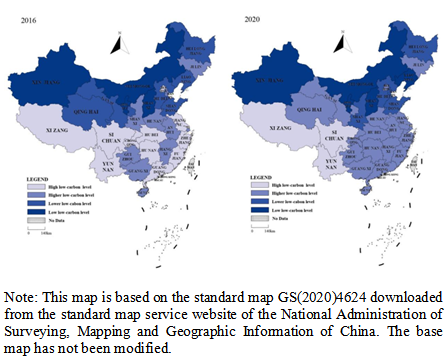
To more intuitively reflect the spatial distribution of low-carbon level in each province, based on the calculation results in Table 4, this study uses the natural break point method (Jenks method) in GIS10.7 software to classify the low-carbon levels in each year. Due to space limitations, only the spatial distribution of low-carbon levels in China's 31 provinces in 2016 and 2020 is shown here, as shown in Figure 1.

It can be seen from Figure 1 that under the “Full carbon” accounting system, the low-carbon levels of 31 provinces in China during the 13th Five-Year Plan period show the spatial distribution characteristics of “high in the south and low in the north.” Specifically, in 2016, the southwest and southeast regions had high low-carbon levels, the south-central regions had higher low-carbon levels, and the northeast and northwest regions had low low-carbon levels; In 2020, the southwest region had high low-carbon levels, the southeast and south-central regions had higher low-carbon level, and the northeast and northwest regions had lower low-carbon levels.
3.4. Spatial Correlation Analysis of Provincial Low-Carbon LevelUsing stata17 software and according to formula (7), the global spatial correlation of low-carbon levels in 31 provinces in China during the “13th Five-Year Plan” period under the “Full Carbon” accounting system was tested, and the results are shown in Table 5.
It can be seen from Table 5 that the global Moran's I index of the low-carbon level of the 31 provinces in China during the 13th Five-Year Plan period is positive, and it is significant at the 1% confidence level from 2016 to 2019, and at the 5% confidence level in 2020, indicating that the low-carbon levels of the 31 provinces in China during the 13th Five-Year Plan period showed obvious positive spatial auto-correlation.

In addition, under the “traditional carbon” accounting system, the provinces also showed significant positive spatial auto-correlation, indicating that under the two accounting systems, China's provincial low-carbon levels during the 13th Five-Year Plan period showed significant global spatial auto-correlation.
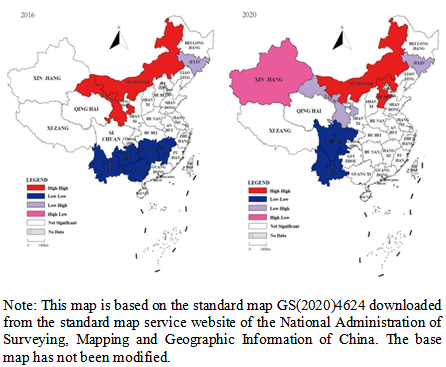
After verifying the global spatial correlation of low-carbon level in each province, the local Moran's I index was calculated by Formula (8), and the local spatial characteristics of the level in each province were visualized by drawing a Lisa diagram. With 2016 and 2020 as representatives, the local spatial correlation of low-carbon levels in all provinces under the “Full Carbon” accounting system is shown, as shown in Figure 2.
Figure 2 directly reflects four local spatial aggregation forms of low-carbon levels in 31 provinces during the 13th Five-Year Plan period in China, namely, High-High agglomeration, Low-Low agglomeration, Low-High agglomeration, and High-Low agglomeration. From the indicator of low-carbon level, the area with a “High-High” agglomeration form in this study indicates that the low-carbon levels of this area and its adjacent areas are low. The area with a “Low-Low” agglomeration form indicates that the area and its adjacent areas have a high low-carbon level; The area with a “Low-High” agglomeration form indicates that the low-carbon level in this area is high, but the low-carbon level in its adjacent area is low. A region with a “High-Low” agglomeration pattern indicates that the region has a low low-carbon level, but its adjacent regions have a high low-carbon level.
It can be seen from Figure 2 that the specific manifestations of the four spatial agglomeration forms are as follows: (1) “High-High” agglomeration: In 2016, Nei Mongolia and Gansu showed “High-High” agglomeration; In 2020, Nei Mongolia and Hebei showed “High-High” agglomeration, indicating that the low-carbon levels of the provinces mentioned above and their adjacent areas were low, which is consistent with the situation shown in Figure 1. Among them, Hebei had changed from insignificant in 2016 to “High-High” agglomeration in 2020, indicating that the low low-carbon level in Nei Mongolia had hindered the improvement of low-carbon level in its adjacent regions; (2) “Low-Low” agglomeration: In 2016, Yunnan, Guizhou, Guangxi, Hunan and Jiangxi showed “low-low” agglomeration, and in 2020, Sichuan and Yunnan showed “Low-Low” agglomeration, indicating that the low-carbon levels of the above provinces and adjacent areas were high, which is consistent with the situation shown in Figure 1. Among them, Sichuan had changed from insignificant in 2016 to “Low-Low” agglomeration in 2020, indicating that the spatial agglomeration areas with high low-carbon levels formed in Yunnan, Guizhou, Guangxi, Hunan and Jiangxi had a positive spillover effect on the surrounding areas, which promoted the improvement of low-carbon level in the surrounding areas. (3) “Low-High” agglomeration: In 2016, Jilin showed “Low-High” agglomeration, and in 2020, Jilin and Gansu showed “Low-High” agglomeration, indicating that Jilin and Gansu had a high low-carbon level, but due to their limited capacity, they could not drive the improvement of low-carbon level in adjacent areas, so the adjacent areas still maintain a low low-carbon level. Among them, Gansu had changed from “High-High” agglomeration in 2016 to “low-high” agglomeration in 2020, indicating that there was a spillover effect in the “Low-Low” agglomeration areas formed by Sichuan and Yunnan, which promoted the improvement of low-carbon level in adjacent areas. (4) “High-Low” agglomeration: Xinjiang has changed from insignificant in 2016 to “High-Low” agglomeration in 2020, which indicates that its low-carbon level was low, but the adjacent regions had high low-carbon levels, which indicates that its ability to undertake spatial spillover from the adjacent regions with high low-carbon levels was poor, so it could not improve its own low-carbon level.
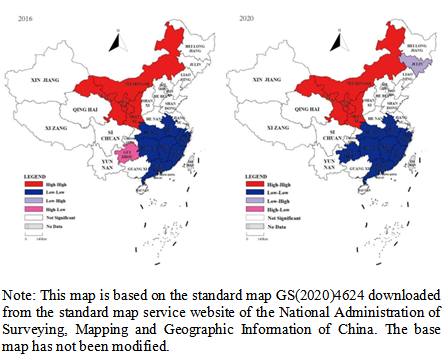
This study also studies the spatial correlation of low-carbon levels in 31 provinces during the 13th Five-Year Plan period under the “traditional carbon” accounting system. Due to space limitations, only the results of 2016 and 2020 are shown, as shown in Figure 3.

By comparing Figure 2 with Figure 3, it can be seen that there are certain differences in the local spatial correlations of low-carbon levels in 31 provinces under the “traditional carbon” and “Full Carbon” accounting systems in 2016 and 2020.
On the whole, compared with the “traditional carbon” accounting system, there were fewer regions with significant spatial agglomeration of low-carbon levels under the “Full Carbon” accounting system. However, from the perspective of the dynamic change of spatial correlation of low-carbon levels, the spillover effect of provincial low-carbon level spatial agglomeration under the “Full Carbon” accounting system was more obvious.
Locally, firstly, in terms of “High-High” agglomeration, Ningxia and Shanxi had changed from “High-High” agglomeration under the “traditional carbon” accounting to insignificant agglomeration under the “Full Carbon” accounting. The reasons are as follows: (1) Ningxia and Shaanxi were both net power output provinces and the implicit carbon emission of net power input was negative, which is manifested as carbon reduction. In particular, Ningxia's net power output carbon reduction per unit GRP ranked first among 31 provinces; (2) The forest carbon sequestration per unit GRP in Shanxi was higher, which promoted the promotion of low-carbon level; Secondly, in terms of “Low-Low” agglomeration, the “Low-Low” agglomeration areas under the “traditional carbon” accounting were mainly concentrated in the southeast coastal areas and the south-central regions of China, while the “Full Carbon” accounting system was concentrated in the southwest and some south-central regions of China. Specifically, provinces in the southeast coastal region had changed from “Low-Low” agglomeration under the “traditional carbon” accounting to insignificant agglomeration under the “Full Carbon” accounting system, and Sichuan and Yunnan in the southwest region had changed from insignificant under the “traditional carbon” accounting to “Low-Low” agglomeration under the “Full Carbon” accounting system, because: (1) Most provinces in the southeast coastal region were large power net input provinces, with high power net input carbon emission per unit GRP, and the role of forest carbon sequestration was relatively limited; (2) Sichuan and Yunnan in the southwest China are both large net power output provinces, their carbon reductions per unit GRP of net power output were at the forefront of 31 provinces, and they were rich in forest resources, their forest carbon sequestration roles were also at the forefront of the country.
To sum up, under the “traditional carbon” and “Full Carbon” accounting systems, the spatial correlation of the low-carbon level of the same research object presented different characteristics, which proves the progress of the “Full Carbon” accounting system at the empirical level and lays a solid foundation for proposing regional policies to reduce carbon and increase efficiency under the Full Carbon” accounting system.
(1) Under the “Full Carbon” accounting system, China's provincial low-carbon level during the 13th Five-Year Plan period generally presented a distribution trend of “high in the south and low in the north”. Specifically, the low- carbon levels ware high in southwest and southeast China, higher in south-central China, and low in northeast and northwest China. The “Low-Low” agglomeration area formed by Sichuan, Yunnan, Guizhou, Guangxi, Hunan and Jiangxi had a spatial spillover effect, which promoted the improvement of the low-carbon levels of the surrounding provinces, while the “High-High” agglomeration area of Nei Mongolia inhibited the improvement of the low-carbon levels of the surrounding provinces.
(2) Under the “traditional carbon” accounting system, there was a spatial spillover effect in the “Low-Low” agglomeration areas formed by the southeast region and the south-central region, which promoted the improvement of the low-carbon levels of the surrounding provinces.
(3) There were differences in the agglomeration characteristics of the spatial correlations of regional low-carbon levels under the two accounting systems of “traditional carbon” and “Full Carbon”. When facing with two different carbon accounting systems, people will have different profit-seeking tendencies. The use of the “Full Carbon” accounting system, which includes potential carbon emissions from waste emissions, implicit carbon emissions from net power input and forest carbon sequestration into the accounting system at the same time, is conducive to the reasonable allocation of carbon responsibilities among regions, enhance environmental equity, and stimulate the positive initiative of improving energy utilization efficiency and greening work in all regions.
| [1] | Zhang K, Jiang L, Jin Y, Liu W. The Carbon Emission Characteristics and Reduction Potential in Developing Areas: Case Study from Anhui Province, China. International Journal of Environmental Research and Public Health. 2022; 19(24): 16424. | ||
| In article | View Article PubMed | ||
| [2] | Pieter Nick ten Caat, Martin J. Tenpierik, Tithi Sanyal, Nico M.J.D. Tillie, Andy A.J.F. van den Dobbelsteen, Geoffrey Thün, Sean Cullen, Shun Nakayama, Theodora Karanisa, Stewart Monti.Towards fossil free cities – Emission assessment of food and resources consumption with the FEWprint carbon accounting platform. Cleaner Environmental Systems. Volume 4, 2022, 100074. | ||
| In article | View Article | ||
| [3] | Ding X, Cai Z, Xiao Q, Gao S. A Study on The Driving Factors and Spatial Spillover of Carbon Emission Intensity in The Yangtze River Economic Belt under Double Control Action. International Journal of Environmental Research and Public Health. 2019; 16(22): 4452. | ||
| In article | View Article PubMed | ||
| [4] | Mei Song, Jin Wu, Mengran Song, Liyan Zhang, Yaxu Zhu. Spatiotemporal regularity and spillover effects of carbon emission intensity in China's Bohai Economic Rim. Science of The Total Environment. Volume 740, 2020, 140184. | ||
| In article | View Article PubMed | ||
| [5] | Shi Q, Gao J, Wang X, Ren H, Cai W, Wei H. Temporal and Spatial Variability of Carbon Emission Intensity of Urban Residential Buildings: Testing the Effect of Economics and Geographic Location in China. Sustainability. 2020; 12(7): 2695. | ||
| In article | View Article | ||
| [6] | Odum E P. Basic ecology. U. S.: CBS College Publishing. 1983: 1-80. | ||
| In article | |||
| [7] | Anselin L. Spatial Econometrics: Methods and Models. Berlin: Springer. 1988: 143-178. | ||
| In article | View Article | ||
| [8] | Anselin L. Local indicators of spatial association-Lisa. Geographical Analysis. 1995; 27(2), 93-115. | ||
| In article | View Article | ||
Published with license by Science and Education Publishing, Copyright © 2023 Wanyue Li and Xuehua Zhang
 This work is licensed under a Creative Commons Attribution 4.0 International License. To view a copy of this license, visit
http://creativecommons.org/licenses/by/4.0/
This work is licensed under a Creative Commons Attribution 4.0 International License. To view a copy of this license, visit
http://creativecommons.org/licenses/by/4.0/
| [1] | Zhang K, Jiang L, Jin Y, Liu W. The Carbon Emission Characteristics and Reduction Potential in Developing Areas: Case Study from Anhui Province, China. International Journal of Environmental Research and Public Health. 2022; 19(24): 16424. | ||
| In article | View Article PubMed | ||
| [2] | Pieter Nick ten Caat, Martin J. Tenpierik, Tithi Sanyal, Nico M.J.D. Tillie, Andy A.J.F. van den Dobbelsteen, Geoffrey Thün, Sean Cullen, Shun Nakayama, Theodora Karanisa, Stewart Monti.Towards fossil free cities – Emission assessment of food and resources consumption with the FEWprint carbon accounting platform. Cleaner Environmental Systems. Volume 4, 2022, 100074. | ||
| In article | View Article | ||
| [3] | Ding X, Cai Z, Xiao Q, Gao S. A Study on The Driving Factors and Spatial Spillover of Carbon Emission Intensity in The Yangtze River Economic Belt under Double Control Action. International Journal of Environmental Research and Public Health. 2019; 16(22): 4452. | ||
| In article | View Article PubMed | ||
| [4] | Mei Song, Jin Wu, Mengran Song, Liyan Zhang, Yaxu Zhu. Spatiotemporal regularity and spillover effects of carbon emission intensity in China's Bohai Economic Rim. Science of The Total Environment. Volume 740, 2020, 140184. | ||
| In article | View Article PubMed | ||
| [5] | Shi Q, Gao J, Wang X, Ren H, Cai W, Wei H. Temporal and Spatial Variability of Carbon Emission Intensity of Urban Residential Buildings: Testing the Effect of Economics and Geographic Location in China. Sustainability. 2020; 12(7): 2695. | ||
| In article | View Article | ||
| [6] | Odum E P. Basic ecology. U. S.: CBS College Publishing. 1983: 1-80. | ||
| In article | |||
| [7] | Anselin L. Spatial Econometrics: Methods and Models. Berlin: Springer. 1988: 143-178. | ||
| In article | View Article | ||
| [8] | Anselin L. Local indicators of spatial association-Lisa. Geographical Analysis. 1995; 27(2), 93-115. | ||
| In article | View Article | ||