This study was carried out to provide information on Metal Trace Element concentrations in the muscles, gills, and liver of five commercial fish species available in Vembanad backwater systems and to evaluate the possible risk associated with their consumption. The concentration of Cadmium (Cd), Chromium (Cr), Copper (Cu), Nickel (Ni), Lead (Pb), and Zinc (Zn) were determined in Etroplus suratensis, Mughil cephalus, Scatophagus argus, Epinephelus areolatus, and Elops machnata. The liver and gills showed higher metal concentrations than the muscles. The concentration of MTEs was analysed using Inductively Coupled Plasma Mass Spectrometry. The mean maximum heavy metal levels in the muscles were as follow; Zn (62.12 µg/g)>Cr (30.17 µg/g)>Cd (29.62 µg/g) >Cu (23.47 µg/g)>Ni (20.95 µg/g)>Pb (18.34 µg/g) respectively. Human health risk levels from fish consumption were assessed using multiple indices like Estimated Daily Intake (EDI), Target Hazard Quotient (THQ), Hazard Index, and Carcinogenic Risk (CR). The Carcinogenic values for Cd, Pb, Ni, and Cr were calculated and evaluated in all species, while CR values calculated for all 6 elements did not pose a risk, it was found above the threshold value of 10-4. THQ for both adult and children consumers were <1 indicating no hazard from consumption. In addition, Since HI is <1 it has been concluded that the consumption of fish species will not pose a potential health risk.
In recent years, fish consumption has increased simultaneously with the growing concern about their nutritional and therapeutic benefits. In addition to its essential source of protein, fish typically have rich contents of excellent sources of omega-3 fatty acids, vitamins, selenium, and calcium, and are increasingly consumed by humans 1. 2 Studies have been reported that in 2008,115 million tons of fish were consumed with an average of 17 kg per capita. As fish contribute an important part of the human diet it is not that surprising. The concentration of Metal Trace Elements (MTEs) in fish have been studied in past several decades. Studies have shown that the accumulation of MTEs in fish occurs with respect to various factors like metal type, fish species, and tissues respectively 3. MTEs have become a serious concern in the majority of major metropolises due to their toxicity even at deficient concentrations, persistence in the environment, and capacity to accumulate in fish tissues. These are metallic elements that have a density greater than 5g/cm3. These metals occur naturally in the environment but can also be released into the ecosystem through various human activities. Although some of the metals are essential as micronutrient, their high concentration in the food chain cause toxicity and environmental impacts 4. Metals such as zinc and copper are classified as essential metals due to the fact that they play a role in biological systems. On the other hand, metals such as lead, and cadmium become toxic in small quantities and are therefore non-essential metals. Non-degradable nature of MTEs plays a major role in making them persistent pollutants. Our environment receives these MTEs through various anthropogenic activities like industrial emissions, domestic wastes, sewage, acid mine drain, and stormwater. The ecological risks posed by these MTEs when they enter the food chain depend mainly on the quantity and partitioning of metals present in water and sediments; metal speciation and solubilization. Aquatic species get irreversibly mutilate due to the toxicity and bioaccumulation nature of MTEs released into the water body. Fish can accumulate a large number of toxicants and are considered bioindicators to monitor MTEs in the aquatic environment 5. As at the top of the food chain in the aquatic system, fish can accumulate a substantial quantity of MTEs through gill, surface skin, and oral ingestion of food and water 6. Accumulation of MTEs above the maximum permissible limit can cause changes in blood composition, impaired development, and reproduction 7, 8, renal failure, liver damage, cardiovascular diseases, and even death 9, 10. Therefore, many international programs for monitoring and controlling of MTEs that negatively affect public health have been established.
Vembanad backwater, situated on the southern part of the western coast of India, is highly polluted due to industrial effluents, insecticide usage in agricultural fields, urban sewage, and soil erosion caused by deforestation in the highland areas. The ecosystem is an essential source of Livelihood for thousands of fishermen and supports a wide range of aquatic flora and fauna. The backwater system is also a vital tourist destination, attracting millions of visitors every year. However, the ecosystem is facing numerous environmental challenges due to various human activities. The rapid industrialization and urbanization in the region have led to discharge of various toxic pollutants into the backwater system. More than 60% of industries in Kerala, including the chlor-alkali industry, are situated on the banks of the Vembanad backwaters 11. Rapid industrial growth and economic development have occurred around the lake since the 1980s 12 Studies have been reported that Vembanad lake was moderately polluted by MTEs based on their study of sediments, whereas increased nutrient inputs related to population and economic growth have led to eutrophication. The increased level of pollution and eutrophication leads to the degradation of water quality, loss of biodiversity and decline in fish stocks Most pollutants come from rivers discharging into the lake. Since the study area is considered an important source of the fishery the presence of toxic MTEs in water and sediments would be the primary source for the biomagnifications of metals in fish, invertebrates, and other aquatic plants animals and cause ill effects to those who consume the contaminated fish 13. The present study aims to evaluate the concentration of MTEs in commercially important fish species from the Vembanad backwater system The objective of the present study is to (i) determine the MTEs accumulation in muscle, gill, and liver tissues of sampled fish commonly consumed by the people of that region, (ii) toxic risk level assessment, (iii) investigate the relationship between heavy metal concentrations in fishes using Pearsons Correlation Coefficient.
Vembanad lake, one of the three Ramsar sites in Kerela, Southern part of India having an area of 151,250 ha is the largest brackish water, humid tropical wetland system. Seven rivers (Manimala, Meenachil, Pamba, Achankovil, Muvattupuzha, Periyar, and Chalakudy) which originate in the Western Ghats Biodiversity Hotspot, drain the largest estuarine system on the south-west coast of India. The system opens into the Arabian Sea in Cochin and Munambam. The major hydrological variable in the backwater is Salinity. Salinity gradient supports diverse species of flora and fauna depending on their capacity to tolerate all conditions. The lake benefits the people that live along its shores. Fishing, tourism, coir retting, inland navigation, lime shell, and agriculture are some of the occupations they are employed in. The potential of the aquatic system, which previously supported high levels of bio productivity and biodiversity, has been negatively impacted by recent alterations made to the estuary, such as reclamation and the subsequent reduction of the backwater and the discharge of pollutants.
2.2. Field SamplingSampling was conducted during the pre-monsoon period (January – May). Fish samples have been collected randomly from different locations, recognized as a popular fishing point of the lake. They were purchased from fishermen within the bank of the study area after interaction and confirming the location of the catch with respect to each sampling station. Samples were washed with deionized distilled water and stored in pre-cleaned plastic bags and kept frozen in an ice box for transportation. The samples were stored at -20°C for further analysis.
2.3. Sample Extraction and AnalysisFive commercially importance fish species, Etroplus suratensis, Mughil cephalus, Scatophagus argus, Epinephelus areolatus, and Elops machnata, were selected for the present study from the catch. 7 specimens of each species were collected for analysis. Standard taxonomic manuals and keys from the fisheries survey of India and worms 14 were used to identify the specimens. Morphometric data of each fish were measured. The photos of the studied fish along with length and weight are given in Table 1. Prior to analysis, frozen fish samples were partially thawed and dissected using stainless steel scalpels. Using clean equipment, the gills, liver, and muscle tissues were dissected and oven-dried at 90°C. 200 mg of dried sample is weighed and digested using 10ml triacid (9:2:1), i.e., (nitric: sulphuric: perchloric acid), and the sample was made up to 10 ml using deionized distilled water and filtered with a syringe filter of pore size 0.22µm and directly analyzed 15. After digestion, the samples were analyzed using Perkin Elmer ICPMS (model NexIonTM 300X). The Instrument Parameter used during the analysis included a nebulizer gas flow rate of 15 L/min, a spray chamber temperature of 2°C, and a mass spectrometer setting of m/z 45-238. Calibration was performed using a series of standard solutions (multi element standard, conc 100mg/L) containing known concentrations of the target analytes, and quality control measures were taken by analyzing blank solutions and spiking samples with certified reference materials. The methodology involved performing 3 cycles of 30 seconds each, and recording the signal intensity for each analyte in triplicate. The resulting data was then analyzed using signal intensity to calculate the concentration of each analyte, normalizing the data using the internal standard, and correcting for matrix effects using a calibration curve based on the spiked samples.
MPI was calculated to examine total heavy metal pollution in various tissues of different species. MPI for each species calculated using following equation:
 | (1) |
where Mn is the concentration of metal expressed in microgram per gram 16.
2.5. Health Risk AssessmentIn this study, the human health risk from metals in the edible muscle parts of the examined species was assessed with EDI, THQ, HI, and CR. Health risk assessments were carried out independently for adults and children because children are considered to be more sensitive to pollutants than adults.
MTEs in fish species were calculated using the concentration of metal in fish in mg/kg. The estimated daily intake of MTEs was determined according to the following equation
 | (2) |
Where DFC = daily food consumption, C = metal concentration in the fish sample, and WAB = Average body weight. In the present study, the regional daily consumption rate for fish in adult as well as in children were not available yet, therefore daily consumption rate of fish in children and adult were considered to be 57.5g/day and 92.6g/day and the average body weight used for Indian man and children are 55.9kg and 32.7 kg 17.
The health risk associated with the consumption of fish species were assessed based on the Target Hazard Quotients and calculations were made using the standard hypothesis of an integrate 18.
 | (3) |
Where EF = exposure frequency (365 days/year) 19, ED = exposure duration (65 years) 20, FIR= Food Ingestion Rate (57.5g/person/day for children and 92.6g/person/day for an adult), C = metal concentration in fish tissues in mg/kg, RfD = Oral reference dose in mg/kg/day. As per the 21, 22, the oral reference dose for Cd, Cr, Cu, Ni, Pb, and Zn were 0.001, 0.003,0.3,0.02,0.004 and 0.3 correspondingly, WAB = Average body weight (55.9 kg for adult and 32.7 kg for children) 17, TA = exposure time for noncarcinogens (EF×ED). The acceptable guide value for THQ is “1” 21. If the THQ Value is less than 1, the exposed population is unlikely to experience an adverse health hazard. Conversely, if the THQ value is greater than 1, there is a potential health risk.
Hazard Index is the sum of the hazard quotients for all metals observed 23. The equation is as follows:
 | (4) |
Where THQ is the risk values of multiple elements from fish samples 18. HI values higher than 1 refers that consumers will experience significant non-carcinogenic health risk effects 7.
Carcinogenic risk is the incremental probability of cancer in an individual, over a lifetime due to exposure to a substantial carcinogen 19. The CR is calculated by the multiplication of the carcinogenic slope factor of the metal contents 24 and the equation is as follows
 | (5) |
Where TA represents the mean exposure period for carcinogens (365days/year × ED) and the CSFo is the oral carcinogenic slope factor derived from the Integrated Risk Information System (Cr:0.5; Ni:1.7; Pb:8.5×10⁻³; Cd:6.3 mg/kg/day) 24.
2.6. Statistical AnalysisThe data were statistically analyzed using the statistical package IBM SPSS 22. The means and standard deviations, of the metal concentrations in fish samples were calculated using SPSS 22 and other calculations were performed by Microsoft excel 2013.
Heavy metal contamination in fish is one of the severe threats to humans and aquatic animals among the brackish fish species, a varied assortment of MTEs concentrations was noted. In this study most commonly consumed fishes from the region are selected. Seven species of each fish were obtained and used to determine the MTEs concentration. The concentration of selected metals (Cd, Cr, Cu, Ni, Pb and Zn) in various fish species were presented in Table 2.
The Cd concentration in analyzed fish samples varied from 24.62 µg/g to a maximum of 36.32µg/g. Among the species and the organs analyzed, maximum and minimum concentration was recorded in the gills (36.32µg/g) and liver (24.62) of E. suratensis. The measured mean concentration of Cd in all the fish muscles are in the following order: E. suratensis> S. argus>M.cephalus> E. machnata>E.areolatus. 25 reported that the agricultural runoff from the catchment of the lake could be a potential source of Cd as the use of fertilizers and pesticides in agriculture can introduce cadmium into the soil. The concentration of Cu in fish muscles varied between 29.42 µg/g and 30.03 µg/g with an average of 29.624 µg/g. according to 26, 27, the maximum permissible limit of Cd for human consumption is 50 µg/g and all the tissues analyzed are under the permissible limits.
Cr levels recorded in muscles, gills, and liver of different species were 95.36,101.64 and 81.69 for E. suratensis, 17.98, 28.64, and 22.61 for M. cephalus, 12.22,19,19.06 and 15.56 for S. argus,11.70,17.65 and 22.16 for E. areolatus and 13.63, 18.64 and 23.01 for E. machnata. Cr concentrations in the muscles of E. suratensis were determined to be higher than the maximum permissible limits. sources of chromium in lakes could be industrial effluents, domestic sewage 28, untreated municipal sewage, and runoff from agricultural areas 29.
Copper is recognized as an essential element, which plays a major role in cell components having a vital function in all living things. The highest mean concentration of Cu was determined in the gill of M. cephalus (76.62µg/g) and the lowest was found in the muscle (21.78) of the same species, the maximum permissible limit of Cu is 20 and all the muscle tissue of fishes were under the limits. Industries such as electroplating, pharmaceutical manufacturing, and mining involve the use of copper and these industries may discharge partially treated effluents into the lake 30.
Nickel is a naturally occurring element and its presence in the Vembanad lake could be atmospheric deposition. It can be present in the air as a result of mining, burning of fossil fuels, and other industrial activities 31. The highest mean concentration of Ni in fish muscle was determined in E. suratensis (22.25). The highest Ni concentration of gills and liver of fishes were 14.68 and 18.69 in E. areolatus. the average Ni concentrations in this study were found to be below the maximum permissible limits of 26, 27.
Pb contamination in the muscles, gills, and liver tissues of fishes was found between 15.32- 26.16 µg/g, 5.01- 31.61 µg/g, and 6.43- 21.04 µg/g respectively. The highest level of Pb was detected in the gills (31.61 µg/g) of E. suratensis and the lowest was detected in the gills (5.0131.61 µg/g) of S. argus. the average Pb concentration in this study was found to be exceeded the maximum permissible limit of 26, 27. Pb in Vembanad lake can be from various industries like battery manufacturing, smelting, and mining. Untreated or partially treated industrial effluents can be significant sources of Pb in lakes 33.
Zn accumulation was higher than all other metals in all sampled fishes when the accumulation number of metals in the muscle tissue is evaluated. The highest Zn concentration was detected in the liver (119.4 µg/g) of E. suratensis and followed by the gills (111.1331.61 µg/g) of E. suratensis. Industrial effluents and other anthropogenic sources are the primary reasons for the heavy metal contamination in the lake 33, 34 as well as the natural weathering of rocks and soils in this region 35.
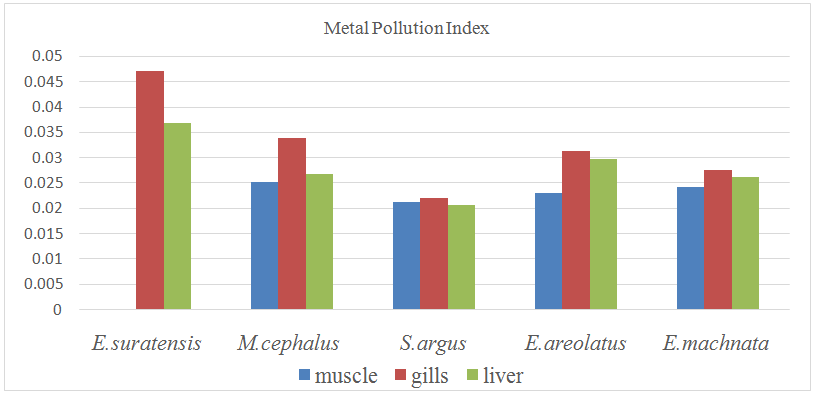
3.2. Ecological and Human Health Risk AssessmentThe present study analyzed the MPI for Cd, Cr, Cu, Ni, Pb, and Zn in the studied fish species, and the obtained results are shown below (Figure 1). If the value is less than 2, it is considered that the degree of pollution is not impacted, while the values varied between 2 and 5, observing very low contamination and the value ranged from 5 to 10 deals with low contamination 36. MPI was calculated for the gills, liver, and muscles of each fish species. The values calculated from the gills were more than that in the muscles and liver. MPI values analyzed were less than 2 in all the fishes. The highest MPI value (0.045) was found in the gills of E. suratensis. The distribution pattern of total concentrations of heavy metal accumulations in the studied fish species follows the order: E. suratensis>M.cephalus>E. areolatus>E.machnata> S. argus (Figure 1). In recent years E. suratensis has been the most consumed and cultured fish in Kerela. Therefore, the high MPI value of E. suratensis is a matter of metal contamination-related health hazards to local people.

Fish in general have a tendency to accumulate MTEs in their various organs, which can then enter the human metabolism through consumption and pose significant health risks. Therefore, to determine if the metal levels detected in fish samples from the Vembanad lake were safe for human consumption (adults & children), the daily intake of some selected trace metals was assessed and compared with the recommended values (Table 3). Since people consume most of the fish's muscles, this study literally took that into consideration. The highest recorded EDI values were 0.1579 and 0.1676 (mg/day/person) found in Cr for adults and children in E. suratensis. The EDI values of children were higher than the EDI values of adults for all the metals. For ingestion, the results in the study area for adults and children were below the recommended daily allowance (RDA), which suggested that the targeted groups of people might experience low or no health effects.
THQ and HI are the parameters used for the risk assessment and compare the amount of pollutant ingested with a standard reference dose 24. The THQ and HI estimated for 6 individual trace metals through consumption of studied fish species in adults and children are listed in the table below: The USEPA proposed accepted guideline value for THQ is 1. The highest value of THQ was observed for Cr 4.88944E-05 and 5.19016E-05 For adults and children respectively. THQ values were less than 1 for all five individuals. None of the metals exceeded the hazard quotient threshold. It indicates there is no noncarcinogenic health risk from ingestion of a single trace element through the consumption of these fishes. Thus, we can suggest that these levels of human exposure to the analyzed metals should not cause any deleterious effects. These findings enhanced the necessity of evaluation of HI. HI is the sum of the THQ of each element studied in individual fish species and an indicator of potential noncarcinogenic risk to humans. The highest HI value (0.000107451 for adults and 0.000114068 for children) was detected in E. suratensis.
3.5. Carcinogenic RiskCR values of Cd, Cr, Ni, and Zn were calculated and presented in Table 5. CR values above 10-6 are considered unacceptable, below 10-6 are considered insignificant and between 10-4 and 10-6 are considered acceptable carcinogenic risks 38. The measured CR values of Cd, Cr, Pb, and Ni ranged from 0.000285 to 0.000291, 8.99E-06 to 7.33E-05, 2.003E-07 to 3.42E-07, and 5.30E-05 to 5.81E-05 respectively in adults and 0.000302 to 0.000308, 9.55E-06 to 7.78E-05, 2.12E-07 to 3.63E07, and 5.63E-05 to 6.17E-05 in children. The results showed that children were exposed to higher CRs than adults. But, calculated CR values for both age groups were noted far from the risk as the acceptable range is 10-6 to 10-4.
Heavy metal accumulation in Vembanad Lake is a significant environmental problem that threatens the health and well-being of humans and aquatic life. The accumulation of MTEs in the lake is primarily due to anthropogenic activities such as industrial and agricultural discharges, sewage and waste disposal, and other human activities. The high concentrations of MTEs in the lake can cause various adverse effects, including water contamination, sediments, and biota, bioaccumulation, biomagnification in the food chain, and potential health risks to humans who consume fish or other aquatic organisms from the lake. Efforts should be made to monitor and control the discharge of MTEs into the lake, reduce pollution, and maintain the ecological balance of the lake. This can be achieved by implementing strict regulations, promoting eco-friendly practices, and educating the public about the harmful effects of heavy metals. It is essential to take immediate action to address the heavy metal accumulation in Vembanad Lake to preserve the lake's biodiversity, maintain the ecosystem's balance, and safeguard the health and well-being of the local communities.
The authors are thankful to the Department of Environmental Sciences, Bharathiar University, for constant encouragement.
The authors have no competing Interests.
| [1] | Bosch, A. C., O'Neill, B., Sigge, G. O., Kerwath, S. E., & Hoffman, L. C. (2016). Heavy metals in marine fish meat and consumer health: a review. Journal of the Science of Food and Agriculture, 96(1), 32-48. | ||
| In article | View Article PubMed | ||
| [2] | FAO (Food and Agriculture Organization) (2000). Compilation oflegal limits for hazardous substances in fish and fisheryproducts. FAO Fishery Circular No. 464 (pp. 5-10). Food and Agriculture Organization of the United Nations. | ||
| In article | |||
| [3] | Li, P., Zhang, J., Xie, H., Liu, C., Liang, S., Ren, Y., & Wang, W. (2015). Heavy metal bioaccumulation and health hazard assessment for three fish species from Nansi Lake, China. Bulletin of Environmental Contamination and Toxicology, 94, 431-436. | ||
| In article | View Article PubMed | ||
| [4] | Shanbehzadeh, S., Vahid Dastjerdi, M., Hassanzadeh, A., & Kiyanizadeh, T. (2014). Heavy metals in water and sediment: a case study of Tembi River. Journal of environmental and public health, 2014. | ||
| In article | View Article PubMed | ||
| [5] | Boohene M, Agbasah W. 2018. Levels of heavy metals in water, fish (Oreochromis niloticus) and sediment from the Afram River, Ghana. Haya: The Saudi J Life Sci. 3(3): 259-268. | ||
| In article | |||
| [6] | Voigt CL, da Silva CP, Doria HB, Ferreira RandiMA, de Oliveira Ribeiro CA, de Campos SX (2015) Bioconcentration and bioaccumulation of metal in freshwater Neotropical fish Geophagus brasiliensis. Environ Sci Pollut Res 22:8242-8252. | ||
| In article | View Article PubMed | ||
| [7] | Saha, N., Mollah, M. Z. I., Alam, M. F., & Rahman, M. S. (2016). Seasonal investigation of heavy metals in marine fishes captured from the Bay of Bengal and the implications for human health risk assessment. Food control, 70, 110-118. | ||
| In article | View Article | ||
| [8] | Varol, M., Kaya, G. K., & Alp, A. (2017). Heavy metal and arsenic concentrations in rainbow trout (Oncorhynchus mykiss) farmed in a dam reservoir on the Firat (Euphrates) River: Risk-based consumption advisories. Science of the Total Environment, 599, 1288-1296. | ||
| In article | View Article PubMed | ||
| [9] | Rahman, M. S., Molla, A. H., Saha, N., & Rahman, A. (2012). Study on heavy metals levels and its risk assessment in some edible fishes from Bangshi River, Savar, Dhaka, Bangladesh. Food chemistry, 134(4), 1847-1854. | ||
| In article | View Article PubMed | ||
| [10] | Al-Busaidi, M., Yesudhason, P., Al-Mughairi, S., Al-Rahbi, W. A. K., Al-Harthy, K. S., Al-Mazrooei, N. A., & Al-Habsi, S. H. (2011). Toxic metals in commercial marine fish in Oman with reference to national and international standards. Chemosphere, 85(1), 67-73. | ||
| In article | View Article PubMed | ||
| [11] | Ouseph, P.P. (1996). Distribution of mercury, copper, zinc, cadmi-um, lead and chromium in the sediments of River Periyar andcochin harbour. Report submitted to Kerala State Council for Science, Technology and Environment. | ||
| In article | |||
| [12] | Shyleshchandran, M. N., Mohan, M., & Ramasamy, E. V. (2018). Risk assessment of heavy metals in Vembanad Lake sediments (south-west coast of India), based on acid-volatile sulfide (AVS)-simultaneously extracted metal (SEM)approach. Environmental science and pollution research, 25(8), 7333-7345. | ||
| In article | View Article PubMed | ||
| [13] | Anagha, B., Athira, P. S., Anisha, P., Charles, P. E., Anandkumar, A., & Rajaram, R. (2022). Biomonitoring of heavy metals accumulation in molluscs and echinoderms collected from southern coastal India. Marine Pollution Bulletin, 184, 114169. | ||
| In article | View Article PubMed | ||
| [14] | J. Mees, G.A. Boxshall, M.J. Costello, F. Hernandez, S. Gofas, B.W. Hoeksema, M. .World Register of Marine Species (WoRMS). | ||
| In article | |||
| [15] | Element, C. A. S. (2007). Method 3051A microwave assisted acid digestion of sediments, sludges, soils, and oils. Z. Für Anal. Chem, 111, 362-366. | ||
| In article | |||
| [16] | Usero, J., Gonzalez-Regalado, E., & Gracia, I. (1997). Trace metals in the bivalve molluscs Ruditapes decussatus and Ruditapes philippinarum from the Atlantic Coast of Southern Spain. Environment International, 23(3), 291-298. | ||
| In article | View Article | ||
| [17] | Gupta SK, Chabukdhara M, Singh J, Bux F (2015) Evaluation and potential health hazard of selected metals in water, sediments, and fish from the Gomti River. Hum Ecol Risk Assess 21(1): 227-240. | ||
| In article | View Article | ||
| [18] | USEPA, 2000. Guidance for assessing chemical contaminant data for use in fish advisories, vol 2. Risk assessment and fish consumption limits, 3rd edit. Washington, DC, USA. | ||
| In article | |||
| [19] | Ahmed, M. K., Baki, M. A., Islam, M. S., Kundu, G. K., Habibullah-Al-Mamun, M., Sarkar, S. K., & Hossain, M. M. (2015). Human health risk assessment of heavy metals in tropical fish and shellfish collected from the river Buriganga, Bangladesh. Environmental science and pollution research, 22, 15880-15890. | ||
| In article | View Article PubMed | ||
| [20] | U.S. Environmental Protection Agency. (2008). Guidelines for carcinogen risk assessment. EPA/630/P-03/001F. https://www.epa.gov/risk/guidelines-carcinogen-risk-assessment. | ||
| In article | |||
| [21] | United States Environmental Protection Agency. (1997). Guidance for Data Quality Assessment: Practical Methods for Data Analysis. Office of Water, EPA 815-R-97-005. https://www.epa.gov/sites/default/files/2015-08/documents/owm120. | ||
| In article | |||
| [22] | USEPA I. R. I. S. (2011). Integrated risk information system. Environmental protection agency region I, Washington DC, 20460. | ||
| In article | |||
| [23] | Li, J., Huang, Z. Y., Hu, Y., & Yang, H. (2013). Potential risk assessment of heavy metals by consuming shellfish collected from Xiamen, China. Environmental Science and Pollution Research, 20(5), 2937-2947. | ||
| In article | View Article PubMed | ||
| [24] | USEPA. 2015. Regional Screening Level (RSL) Summary Table (TRD1E-06, HQD1) November 2015. Office of Health and Environmental Assessment, Washington, DC, USA. | ||
| In article | |||
| [25] | Nazeer, A., and Shaija, A. (2014). Bioaccumulation of heavy metals in commercially important fishes from Vembanad Lake, Kerala, India. International Journal of Current Microbiology and Applied Sciences, 3(9), 971-981. | ||
| In article | |||
| [26] | World Health Organization. (1989). Health guidelines for the use of wastewater in agriculture and aquaculture: Report of a WHO scientific group. World Health Organization. | ||
| In article | |||
| [27] | Food and Agriculture Organization of the United Nations. (1989). The state of food and agriculture 1989. http://www.fao.org/3/y5352e/y5352e00.htm. | ||
| In article | |||
| [28] | Bineesh, K. K., Deepu, P. G., Basheer, V. S., and Pillai, N. G. K. (2013). Heavy metal concentration in different components of the Vembanadu Lake ecosystem, Kerala, India. Journal of the Marine Biological Association of India, 55(1), 1-8. | ||
| In article | |||
| [29] | Ravikumar, P., Krishnamoorthy, R., and Ramesh, R. (2015). Heavy metal concentration in water and sediments of Vembanad Lake and its tributaries, Kerala, India. International Journal of Environmental Science and Technology, 12(11), 3655-3664. | ||
| In article | |||
| [30] | Kumar, N. P., Krishnakumar, P. K., and Shaija, A. (2013). Assessment of heavy metal concentration in water and sediments of Vembanad Lake, Kerala. Indian Journal of Geo-Marine Sciences, 42(5), 619-625. | ||
| In article | |||
| [31] | Sahoo, S. K., Panda, U. C., & Das, S. K. (2010). Chemical speciation of nickel in water and sediments of Mahanadi estuary (India) and evaluation of its bioavailability. Journal of Hazardous Materials, 183(1-3), 238-247. | ||
| In article | |||
| [32] | S. K. Sujitha, V. B. Sreeja, and P. S. Kumar. (2018). Bioaccumulation of heavy metals in selected tissues of four commercially important fish species from Vembanad Lake, Kerala, India. Environmental Monitoring and Assessment, 190(11), 657. | ||
| In article | |||
| [33] | Sujatha, C. H., and Ramaswamy, V. (2015). Assessment of heavy metal contamination in Vembanad Lake, Kerala, India. Journal of Environmental Biology, 36(3), 607-614. | ||
| In article | |||
| [34] | Kumar, N., and Philip, L. (2019). Accumulation of heavy metals in fishes of Vembanad backwater system, Kerala, India. Environmental Science and Pollution Research, 26(27), 27843-27854. | ||
| In article | |||
| [35] | Venugopal, T., Suseelan, C., and George, K. (2008). Bioaccumulation of heavy metals in commercial fishes from Vembanad Lake, Kerala, Southwest coast of India. Journal of Ocean University of China, 7(4), 359-366. | ||
| In article | |||
| [36] | Jamil T, Lias K, Norsila D, Syafinaz NS (2014) Assessment of tracemetal contamination in squid (Loligo spp.) tissues of Kedah-Perlis waters, Malaysia. Malay J Anal Sci. 18: 195-203. | ||
| In article | |||
| [37] | World Health Organization, & WHO Expert Committee on Malaria. (2000). WHO Expert Committee on Malaria: twentieth report (No. 892). World Health Organization. | ||
| In article | |||
| [38] | Environment Protection Agency (EPA), IRIS Assessments. | ||
| In article | |||
Published with license by Science and Education Publishing, Copyright © 2023 Anupama Prakash, Muhammed Thaniem, Rangasamy Eswaran, Palanisamy Sundarabalan and Muniyandi Muniasamy
 This work is licensed under a Creative Commons Attribution 4.0 International License. To view a copy of this license, visit
http://creativecommons.org/licenses/by/4.0/
This work is licensed under a Creative Commons Attribution 4.0 International License. To view a copy of this license, visit
http://creativecommons.org/licenses/by/4.0/
| [1] | Bosch, A. C., O'Neill, B., Sigge, G. O., Kerwath, S. E., & Hoffman, L. C. (2016). Heavy metals in marine fish meat and consumer health: a review. Journal of the Science of Food and Agriculture, 96(1), 32-48. | ||
| In article | View Article PubMed | ||
| [2] | FAO (Food and Agriculture Organization) (2000). Compilation oflegal limits for hazardous substances in fish and fisheryproducts. FAO Fishery Circular No. 464 (pp. 5-10). Food and Agriculture Organization of the United Nations. | ||
| In article | |||
| [3] | Li, P., Zhang, J., Xie, H., Liu, C., Liang, S., Ren, Y., & Wang, W. (2015). Heavy metal bioaccumulation and health hazard assessment for three fish species from Nansi Lake, China. Bulletin of Environmental Contamination and Toxicology, 94, 431-436. | ||
| In article | View Article PubMed | ||
| [4] | Shanbehzadeh, S., Vahid Dastjerdi, M., Hassanzadeh, A., & Kiyanizadeh, T. (2014). Heavy metals in water and sediment: a case study of Tembi River. Journal of environmental and public health, 2014. | ||
| In article | View Article PubMed | ||
| [5] | Boohene M, Agbasah W. 2018. Levels of heavy metals in water, fish (Oreochromis niloticus) and sediment from the Afram River, Ghana. Haya: The Saudi J Life Sci. 3(3): 259-268. | ||
| In article | |||
| [6] | Voigt CL, da Silva CP, Doria HB, Ferreira RandiMA, de Oliveira Ribeiro CA, de Campos SX (2015) Bioconcentration and bioaccumulation of metal in freshwater Neotropical fish Geophagus brasiliensis. Environ Sci Pollut Res 22:8242-8252. | ||
| In article | View Article PubMed | ||
| [7] | Saha, N., Mollah, M. Z. I., Alam, M. F., & Rahman, M. S. (2016). Seasonal investigation of heavy metals in marine fishes captured from the Bay of Bengal and the implications for human health risk assessment. Food control, 70, 110-118. | ||
| In article | View Article | ||
| [8] | Varol, M., Kaya, G. K., & Alp, A. (2017). Heavy metal and arsenic concentrations in rainbow trout (Oncorhynchus mykiss) farmed in a dam reservoir on the Firat (Euphrates) River: Risk-based consumption advisories. Science of the Total Environment, 599, 1288-1296. | ||
| In article | View Article PubMed | ||
| [9] | Rahman, M. S., Molla, A. H., Saha, N., & Rahman, A. (2012). Study on heavy metals levels and its risk assessment in some edible fishes from Bangshi River, Savar, Dhaka, Bangladesh. Food chemistry, 134(4), 1847-1854. | ||
| In article | View Article PubMed | ||
| [10] | Al-Busaidi, M., Yesudhason, P., Al-Mughairi, S., Al-Rahbi, W. A. K., Al-Harthy, K. S., Al-Mazrooei, N. A., & Al-Habsi, S. H. (2011). Toxic metals in commercial marine fish in Oman with reference to national and international standards. Chemosphere, 85(1), 67-73. | ||
| In article | View Article PubMed | ||
| [11] | Ouseph, P.P. (1996). Distribution of mercury, copper, zinc, cadmi-um, lead and chromium in the sediments of River Periyar andcochin harbour. Report submitted to Kerala State Council for Science, Technology and Environment. | ||
| In article | |||
| [12] | Shyleshchandran, M. N., Mohan, M., & Ramasamy, E. V. (2018). Risk assessment of heavy metals in Vembanad Lake sediments (south-west coast of India), based on acid-volatile sulfide (AVS)-simultaneously extracted metal (SEM)approach. Environmental science and pollution research, 25(8), 7333-7345. | ||
| In article | View Article PubMed | ||
| [13] | Anagha, B., Athira, P. S., Anisha, P., Charles, P. E., Anandkumar, A., & Rajaram, R. (2022). Biomonitoring of heavy metals accumulation in molluscs and echinoderms collected from southern coastal India. Marine Pollution Bulletin, 184, 114169. | ||
| In article | View Article PubMed | ||
| [14] | J. Mees, G.A. Boxshall, M.J. Costello, F. Hernandez, S. Gofas, B.W. Hoeksema, M. .World Register of Marine Species (WoRMS). | ||
| In article | |||
| [15] | Element, C. A. S. (2007). Method 3051A microwave assisted acid digestion of sediments, sludges, soils, and oils. Z. Für Anal. Chem, 111, 362-366. | ||
| In article | |||
| [16] | Usero, J., Gonzalez-Regalado, E., & Gracia, I. (1997). Trace metals in the bivalve molluscs Ruditapes decussatus and Ruditapes philippinarum from the Atlantic Coast of Southern Spain. Environment International, 23(3), 291-298. | ||
| In article | View Article | ||
| [17] | Gupta SK, Chabukdhara M, Singh J, Bux F (2015) Evaluation and potential health hazard of selected metals in water, sediments, and fish from the Gomti River. Hum Ecol Risk Assess 21(1): 227-240. | ||
| In article | View Article | ||
| [18] | USEPA, 2000. Guidance for assessing chemical contaminant data for use in fish advisories, vol 2. Risk assessment and fish consumption limits, 3rd edit. Washington, DC, USA. | ||
| In article | |||
| [19] | Ahmed, M. K., Baki, M. A., Islam, M. S., Kundu, G. K., Habibullah-Al-Mamun, M., Sarkar, S. K., & Hossain, M. M. (2015). Human health risk assessment of heavy metals in tropical fish and shellfish collected from the river Buriganga, Bangladesh. Environmental science and pollution research, 22, 15880-15890. | ||
| In article | View Article PubMed | ||
| [20] | U.S. Environmental Protection Agency. (2008). Guidelines for carcinogen risk assessment. EPA/630/P-03/001F. https://www.epa.gov/risk/guidelines-carcinogen-risk-assessment. | ||
| In article | |||
| [21] | United States Environmental Protection Agency. (1997). Guidance for Data Quality Assessment: Practical Methods for Data Analysis. Office of Water, EPA 815-R-97-005. https://www.epa.gov/sites/default/files/2015-08/documents/owm120. | ||
| In article | |||
| [22] | USEPA I. R. I. S. (2011). Integrated risk information system. Environmental protection agency region I, Washington DC, 20460. | ||
| In article | |||
| [23] | Li, J., Huang, Z. Y., Hu, Y., & Yang, H. (2013). Potential risk assessment of heavy metals by consuming shellfish collected from Xiamen, China. Environmental Science and Pollution Research, 20(5), 2937-2947. | ||
| In article | View Article PubMed | ||
| [24] | USEPA. 2015. Regional Screening Level (RSL) Summary Table (TRD1E-06, HQD1) November 2015. Office of Health and Environmental Assessment, Washington, DC, USA. | ||
| In article | |||
| [25] | Nazeer, A., and Shaija, A. (2014). Bioaccumulation of heavy metals in commercially important fishes from Vembanad Lake, Kerala, India. International Journal of Current Microbiology and Applied Sciences, 3(9), 971-981. | ||
| In article | |||
| [26] | World Health Organization. (1989). Health guidelines for the use of wastewater in agriculture and aquaculture: Report of a WHO scientific group. World Health Organization. | ||
| In article | |||
| [27] | Food and Agriculture Organization of the United Nations. (1989). The state of food and agriculture 1989. http://www.fao.org/3/y5352e/y5352e00.htm. | ||
| In article | |||
| [28] | Bineesh, K. K., Deepu, P. G., Basheer, V. S., and Pillai, N. G. K. (2013). Heavy metal concentration in different components of the Vembanadu Lake ecosystem, Kerala, India. Journal of the Marine Biological Association of India, 55(1), 1-8. | ||
| In article | |||
| [29] | Ravikumar, P., Krishnamoorthy, R., and Ramesh, R. (2015). Heavy metal concentration in water and sediments of Vembanad Lake and its tributaries, Kerala, India. International Journal of Environmental Science and Technology, 12(11), 3655-3664. | ||
| In article | |||
| [30] | Kumar, N. P., Krishnakumar, P. K., and Shaija, A. (2013). Assessment of heavy metal concentration in water and sediments of Vembanad Lake, Kerala. Indian Journal of Geo-Marine Sciences, 42(5), 619-625. | ||
| In article | |||
| [31] | Sahoo, S. K., Panda, U. C., & Das, S. K. (2010). Chemical speciation of nickel in water and sediments of Mahanadi estuary (India) and evaluation of its bioavailability. Journal of Hazardous Materials, 183(1-3), 238-247. | ||
| In article | |||
| [32] | S. K. Sujitha, V. B. Sreeja, and P. S. Kumar. (2018). Bioaccumulation of heavy metals in selected tissues of four commercially important fish species from Vembanad Lake, Kerala, India. Environmental Monitoring and Assessment, 190(11), 657. | ||
| In article | |||
| [33] | Sujatha, C. H., and Ramaswamy, V. (2015). Assessment of heavy metal contamination in Vembanad Lake, Kerala, India. Journal of Environmental Biology, 36(3), 607-614. | ||
| In article | |||
| [34] | Kumar, N., and Philip, L. (2019). Accumulation of heavy metals in fishes of Vembanad backwater system, Kerala, India. Environmental Science and Pollution Research, 26(27), 27843-27854. | ||
| In article | |||
| [35] | Venugopal, T., Suseelan, C., and George, K. (2008). Bioaccumulation of heavy metals in commercial fishes from Vembanad Lake, Kerala, Southwest coast of India. Journal of Ocean University of China, 7(4), 359-366. | ||
| In article | |||
| [36] | Jamil T, Lias K, Norsila D, Syafinaz NS (2014) Assessment of tracemetal contamination in squid (Loligo spp.) tissues of Kedah-Perlis waters, Malaysia. Malay J Anal Sci. 18: 195-203. | ||
| In article | |||
| [37] | World Health Organization, & WHO Expert Committee on Malaria. (2000). WHO Expert Committee on Malaria: twentieth report (No. 892). World Health Organization. | ||
| In article | |||
| [38] | Environment Protection Agency (EPA), IRIS Assessments. | ||
| In article | |||