Salt tolerance in plants with respect to their environmental conditions has become a concerning issue nowadays as the soil of various parts of agricultural land has been degraded due to various ecological factors and human activities. Salinity can affect soil heath, decrease plant growth and reduce crop productivity. Cicer arietinum L. (Chickpea) being one of the most abundantly consumed foods by humans and as well as animals. The present research work aims to study the effect of salt stress and if the salt stress can be ameliorated by Gibberellic Acid (GA3) in chickpea. The effect has been studied on seed germination of two different varieties of Cicer arietinum L. (RVG 202 and GNG 2144). The experiment was done by using a Completely Randomized Block Design with three replicates of each variety at different concentrations of salt and hormone. Different concentrations of NaCl used were 0, 25, 50, 75 and 100 mM, and the different GA3 concentrations used were 0, 50 and 100 ppm by pre-treatment. GA3 treated seeds were sown in different saline conditions in cocopeat under natural climatic conditions. and the plant seedlings were analyzed after 20 days of sowing the seeds The application of GA3 was found to play a great role in seed germination under saline conditions. Maximum seed germination was observed in the GNG 2144 variety (more than 96%) at two different concentrations of GA3 and the minimum seed germination was found at the highest given salt concentration in both varieties. The present study suggests that GA3 application has potential to improve the seed germination in chickpea grown under salt stress.
The Salinity of soil is a major limiting factor to crop growth and leads to loss of agricultural productivity globally 1. The Global Map of Salt affected soils released by the Food and Agricultural Organization in 2021 indicates that more than 360 million hectares of topsoil (0-30 cm) are saline in the world 2. The soils affected by salinity are increasing especially in arid and semi-arid regions where there is also a need to increase crop productivity for food and nutritional security 3, 4.
Cicer arietinum L. (Chickpea) is third in terms of the production of pulses globally and salinity is one of the major constraints on its productivity 5, 6. Salinity affects different life stages of chickpea such as, (i) germination, (ii) vegetative growth and (iii) reproductive stages 4. Germination is one of the major factors determining crop yields and in general, it has been noted that higher soil salinity decreases the overall germination percentage in various crops 7. Variation in salinity tolerance has been recorded between different cultivated genotypes of chickpea 6, 8.
Gibbrellic Acid (C9H22O6) or GA3 is pentacyclic diterpene compound which is an important plant hormone and plays a vital role in seed germination and plant growth 9. Seed priming by GA3 has been used as a tool to improve seed germination under abiotic stresses including salinity. Studies have shown that GA3 has an ameliorative effect on abiotic stresses such as chilling 10 and salinity 11. GA3 has been reported to increase germination percentage and seedling growth and overcome the preventive effects of salt stress on germination 12. The application of GA3 increases the development of plants by attributing to the fact that they increase the amino acid content in the embryo and stimulate the synthesis of hydrolytic enzymes required for digestion of endospermic starch when seeds renew growth at seed germination 13, 14.
Previously studies have been carried out on various cultivars of Chickpea concerning salinity tolerance. The present study focuses on the effect of GA3 on the germination of two cultivars of chickpea at increasing concentrations of NaCl to better understand the role of GA3 in salinity tolerance specifically with respect to germination.
The seeds of two Chickpea cultivars viz. RVG202 and GNG2144 were obtained from the Indian Agricultural Research Institute (IARI), New Delhi, India. The seeds were surface sterilized and thoroughly rinsed post sterilization.
2.2. Experimental DesignThe study was carried out following a two-factorial randomized complete block design with three replications 15. The two factors were NaCl and GA3. The NaCl concentrations used for the experiment were 0, 25, 50, 75 and 100 mM. The concentration of GA3 was 0, 50 and 100 ppm. The control treatment was set up with no NaCl or GA3 concentration. Twenty uniform and healthy seeds were raised in each pot (assigned to each treatment) containing 280g of cocopeat per pot with three replications for each concentration of NaCl and GA3.
2.3. Seed Priming with GA3 and NaCl TreatmentSeed priming was carried out by dipping the seeds in a well aerated solution of GA3 consisting of 0, 50, and 100 ppm of GA3 at room temperature for 24 hr. The primed seeds were thoroughly rinsed after priming with GA3 solution.
The seeds were sown in pots with cocopeat and 40 ml of NaCl solution (0, 25, 50, 75, 100 ppm) was applied post sowing of seeds. Plants were allowed to germinate in natural environmental conditions for 20 days. To maintain the moisture in germinating plants, water was added to pots at a regular interval of 5 days.
Germination Percentage (%): The number of seeds germinated after 20 days of sowing was recorded as per International Seed Testing Association (ISTA) method. The germination percentage was calculated as per 14 The formula is given below.
 |
All statistical parameters such as mean and standard deviation (SD) were computed along with a one-way analysis of variance (ANOVA), computed on SPSS.
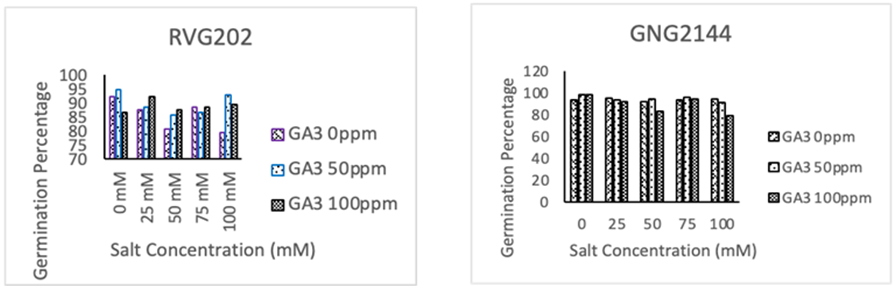
The RVG 202 cultivar of Chickpea showed a decreasing trend in the germination percentage with increasing concentration of NaCl. The germination percentage of RVG 202 cultivar with no NaCl was 92.16%, while the germination percentage was 79.57% at 100mM of NaCl. In contrast, the germination percentage of the GNG 2144 cultivar did not show any decrease with the increase in the concentration of NaCl from 25 mM to 100 mM (Table 1, Figure 1). The germination percentage of the GNG 2144 cultivar was significantly different from RVG 202 at 0 and 100mM concentrations of NaCl (Table 1, Figure 1).

This indicates that the GNG 2144 cultivar is more tolerant to increasing salinity as compared to the RVG 202 cultivar of Chickpea. The GNG 2144 is a high-yielding variety released in 2016. It has Fusarium wilt tolerance and has minimum yield loss under late sown irrigated conditions 16. The RVG 202 variety was introduced in 2012 17.
Present study shows the potential of application of GA3 for overcoming the effects of salinity stress, and improved the seed germination of salt-stressed plants. This study can also help farmers to select the cultivars to be grown in field based on the salinity conditions of the field 13. Low and slow germination could reduce yield, the response of germination to salinity should be considered in the choice of variety for planting by farmers and in breeding programs.
The present study is an outcome of Undergraduate students project work. We are thankful to the Principal, Hansraj College, for the permission and encouragement to pursue the present study. We also thank our laboratory staff for their support in the completion of this project.
The manuscript has been prepared through contributions of all authors. All authors have given approval to the final version of the manuscript. All authors declare that they have no conflicts of interest.
| [1] | T. Yamaguchi and E. Blumwald, “Developing salt-tolerant crop plants: Challenges and opportunities,” Trends Plant Sci., vol. 10, no. 12, pp. 615-620, 2005. | ||
| In article | View Article PubMed | ||
| [2] | “Global Map of Salt-affected Soils | FAO SOILS PORTAL | Food and Agriculture Organization of the United Nations.” https://www.fao.org/soils-portal/data-hub/soil-maps-and-databases/global-map-of-salt-affected-soils/en/ (accessed Jun. 27, 2022). | ||
| In article | |||
| [3] | K. H. M. Siddique et al., “Innovations in agronomy for food legumes. A review,” Agron. Sustain. Dev., vol. 32, no. 1, pp. 45-64, 2012. | ||
| In article | View Article | ||
| [4] | L. Kotula, P. L. Clode, J. D. L. C. Jimenez, and T. D. Colmer, “Salinity tolerance in chickpea is associated with the ability to ‘exclude’ Na from leaf mesophyll cells,” J. Exp. Bot., vol. 70, no. 18, pp. 4991-5002, 2019. | ||
| In article | View Article PubMed | ||
| [5] | S. Rout, N. Khare, S. S. Patra, S. Beura, and S. Nayak, “Effect of seed pre-treatment with different concentrations of gibberellic acid (GA3) on seed germination and seedling growth of Cassia fistula L,” ~ 135 ~ J. Med. Plants Stud., vol. 5, no. 6, pp. 135-138, 2017. | ||
| In article | |||
| [6] | N. C. Turner et al., “Salinity tolerance and ion accumulation in chickpea (Cicer arietinum L.) subjected to salt stress,” Plant Soil, vol. 365, no. 1-2, pp. 347-361, 2013. | ||
| In article | View Article | ||
| [7] | E. Yildirim, A. Dursun, M. A. Kumlay, and Í. Güvenç, “The effects of different salt, biostimulant and temperature levels on seed germination of some vegetable species,” Acta Agrobot., vol. 55, no. 2, pp. 75-80, 2013. | ||
| In article | View Article | ||
| [8] | V. Vadez et al., “Large variation in salinity tolerance in chickpea is explained by differences in sensitivity at the reproductive stage,” F. Crop. Res., vol. 104, no. 1-3, pp. 123-129, 2007. | ||
| In article | View Article | ||
| [9] | A. CAVUSOGLU, “Effects of gibberellic acid (GA3), indole-3-acetic acid (IAA) and water treatments on seed germination of Meli̇a azedarach L.,” Pap. B, …, vol. LIX, 2015, [Online]. Available: http://horticulturejournal.usamv.ro/pdf/2015/art51.pdf. | ||
| In article | |||
| [10] | T. Aziz and E. Pekşen, “Seed priming with gibberellic acid rescues chickpea (Cicer arietinum L.) from chilling stress,” Acta Physiol. Plant., vol. 42, no. 8, 2020. | ||
| In article | View Article | ||
| [11] | B. A. Tsegay and M. Andargie, “Seed Priming with Gibberellic Acid (GA3) Alleviates Salinity Induced Inhibition of Germination and Seedling Growth of Zea mays L., Pisum sativum Var. abyssinicum A. Braun and Lathyrus sativus L.,” J. Crop Sci. Biotechnol., vol. 21, no. 3, pp. 261-267, 2018. | ||
| In article | View Article | ||
| [12] | A. M. E Abdel-Hamid Heba I Mohamed, “the Effect of the Exogenous Gibberellic Acid on Two Salt Stressed Barley Cultivars,” Eur. Sci. J., vol. 10, no. 6, pp. 1857-7881, 2014. | ||
| In article | |||
| [13] | A. Chauhan et al., “Influence of gibberellic acid and different salt concentrations on germination percentage and physiological parameters of oat cultivars,” Saudi J. Biol. Sci., vol. 26, no. 6, pp. 1298-1304, Sep. 2019. | ||
| In article | View Article PubMed | ||
| [14] | A. Chauhan, N. Rajput, D. Kumar, A. Kumar, and A. K. Chaudhry, “EFFECT OF DIFFERENT SALT CONCENTRATION ON SEED GERMINATION AND SEEDLING GROWTH OF DIFFERENT VARIETIES OF OAT (Avena sativa L,” 2016. | ||
| In article | |||
| [15] | Y. Bai, X. Zhou, and D. L. Smith, “Crop ecology, management and quality: Enhanced soybean plant growth resulting from coinoculation of Bacillus strains with Bradyrhizobium japonicum,” Crop Sci., vol. 43, no. 5, pp. 1774-1781, 2003. | ||
| In article | View Article | ||
| [16] | N. A. Di Benedetto et al., “The role of plant growth promoting bacteria in improving nitrogen use efficiency for sustainable crop production: A focus on wheat,” AIMS Microbiol., vol. 3, no. 3, pp. 413-434, 2017. | ||
| In article | View Article PubMed | ||
| [17] | “ICAR-Indian Institute of Pulses Research.” http://dalhangyanmanch.res.in/eng/ (accessed Jun. 27, 2022). | ||
| In article | |||
| [18] | S. J. Roy, S. Negrão, and M. Tester, “Salt resistant crop plants,” Curr. Opin. Biotechnol., vol. 26, no. April, pp. 115-124, 2014. | ||
| In article | View Article PubMed | ||
| [19] | H. AbdElgawad, G. Zinta, M. M. Hegab, R. Pandey, H. Asard, and W. Abuelsoud, “High salinity induces different oxidative stress and antioxidant responses in maize seedlings organs,” Front. Plant Sci., vol. 7, no. MAR2016, 2016. | ||
| In article | View Article | ||
Published with license by Science and Education Publishing, Copyright © 2022 Anand Sonkar, Shalini Kaushik Love, Romila Rawat Bisht, Sharda Mahilkar Sonkar, Saumya Agrawal, Gunjan Verma, Rishu Raj, Gaurav Bansal and Nitasha
 This work is licensed under a Creative Commons Attribution 4.0 International License. To view a copy of this license, visit
http://creativecommons.org/licenses/by/4.0/
This work is licensed under a Creative Commons Attribution 4.0 International License. To view a copy of this license, visit
http://creativecommons.org/licenses/by/4.0/
| [1] | T. Yamaguchi and E. Blumwald, “Developing salt-tolerant crop plants: Challenges and opportunities,” Trends Plant Sci., vol. 10, no. 12, pp. 615-620, 2005. | ||
| In article | View Article PubMed | ||
| [2] | “Global Map of Salt-affected Soils | FAO SOILS PORTAL | Food and Agriculture Organization of the United Nations.” https://www.fao.org/soils-portal/data-hub/soil-maps-and-databases/global-map-of-salt-affected-soils/en/ (accessed Jun. 27, 2022). | ||
| In article | |||
| [3] | K. H. M. Siddique et al., “Innovations in agronomy for food legumes. A review,” Agron. Sustain. Dev., vol. 32, no. 1, pp. 45-64, 2012. | ||
| In article | View Article | ||
| [4] | L. Kotula, P. L. Clode, J. D. L. C. Jimenez, and T. D. Colmer, “Salinity tolerance in chickpea is associated with the ability to ‘exclude’ Na from leaf mesophyll cells,” J. Exp. Bot., vol. 70, no. 18, pp. 4991-5002, 2019. | ||
| In article | View Article PubMed | ||
| [5] | S. Rout, N. Khare, S. S. Patra, S. Beura, and S. Nayak, “Effect of seed pre-treatment with different concentrations of gibberellic acid (GA3) on seed germination and seedling growth of Cassia fistula L,” ~ 135 ~ J. Med. Plants Stud., vol. 5, no. 6, pp. 135-138, 2017. | ||
| In article | |||
| [6] | N. C. Turner et al., “Salinity tolerance and ion accumulation in chickpea (Cicer arietinum L.) subjected to salt stress,” Plant Soil, vol. 365, no. 1-2, pp. 347-361, 2013. | ||
| In article | View Article | ||
| [7] | E. Yildirim, A. Dursun, M. A. Kumlay, and Í. Güvenç, “The effects of different salt, biostimulant and temperature levels on seed germination of some vegetable species,” Acta Agrobot., vol. 55, no. 2, pp. 75-80, 2013. | ||
| In article | View Article | ||
| [8] | V. Vadez et al., “Large variation in salinity tolerance in chickpea is explained by differences in sensitivity at the reproductive stage,” F. Crop. Res., vol. 104, no. 1-3, pp. 123-129, 2007. | ||
| In article | View Article | ||
| [9] | A. CAVUSOGLU, “Effects of gibberellic acid (GA3), indole-3-acetic acid (IAA) and water treatments on seed germination of Meli̇a azedarach L.,” Pap. B, …, vol. LIX, 2015, [Online]. Available: http://horticulturejournal.usamv.ro/pdf/2015/art51.pdf. | ||
| In article | |||
| [10] | T. Aziz and E. Pekşen, “Seed priming with gibberellic acid rescues chickpea (Cicer arietinum L.) from chilling stress,” Acta Physiol. Plant., vol. 42, no. 8, 2020. | ||
| In article | View Article | ||
| [11] | B. A. Tsegay and M. Andargie, “Seed Priming with Gibberellic Acid (GA3) Alleviates Salinity Induced Inhibition of Germination and Seedling Growth of Zea mays L., Pisum sativum Var. abyssinicum A. Braun and Lathyrus sativus L.,” J. Crop Sci. Biotechnol., vol. 21, no. 3, pp. 261-267, 2018. | ||
| In article | View Article | ||
| [12] | A. M. E Abdel-Hamid Heba I Mohamed, “the Effect of the Exogenous Gibberellic Acid on Two Salt Stressed Barley Cultivars,” Eur. Sci. J., vol. 10, no. 6, pp. 1857-7881, 2014. | ||
| In article | |||
| [13] | A. Chauhan et al., “Influence of gibberellic acid and different salt concentrations on germination percentage and physiological parameters of oat cultivars,” Saudi J. Biol. Sci., vol. 26, no. 6, pp. 1298-1304, Sep. 2019. | ||
| In article | View Article PubMed | ||
| [14] | A. Chauhan, N. Rajput, D. Kumar, A. Kumar, and A. K. Chaudhry, “EFFECT OF DIFFERENT SALT CONCENTRATION ON SEED GERMINATION AND SEEDLING GROWTH OF DIFFERENT VARIETIES OF OAT (Avena sativa L,” 2016. | ||
| In article | |||
| [15] | Y. Bai, X. Zhou, and D. L. Smith, “Crop ecology, management and quality: Enhanced soybean plant growth resulting from coinoculation of Bacillus strains with Bradyrhizobium japonicum,” Crop Sci., vol. 43, no. 5, pp. 1774-1781, 2003. | ||
| In article | View Article | ||
| [16] | N. A. Di Benedetto et al., “The role of plant growth promoting bacteria in improving nitrogen use efficiency for sustainable crop production: A focus on wheat,” AIMS Microbiol., vol. 3, no. 3, pp. 413-434, 2017. | ||
| In article | View Article PubMed | ||
| [17] | “ICAR-Indian Institute of Pulses Research.” http://dalhangyanmanch.res.in/eng/ (accessed Jun. 27, 2022). | ||
| In article | |||
| [18] | S. J. Roy, S. Negrão, and M. Tester, “Salt resistant crop plants,” Curr. Opin. Biotechnol., vol. 26, no. April, pp. 115-124, 2014. | ||
| In article | View Article PubMed | ||
| [19] | H. AbdElgawad, G. Zinta, M. M. Hegab, R. Pandey, H. Asard, and W. Abuelsoud, “High salinity induces different oxidative stress and antioxidant responses in maize seedlings organs,” Front. Plant Sci., vol. 7, no. MAR2016, 2016. | ||
| In article | View Article | ||