Quantitative assessment of drainage basin through morphometric analysis is one of the important methods in hydrological and hydrogeological investigations. In the last couple of decades, Geographical Information System (GIS) techniques are being used in such analysis and has become an important tool, for assessing various terrain and morphometric parameters of the drainage basins, as it provides a comfortable and reliable environment for the analysis and interpretation of spatial information. In the present study, an attempt has been made to evaluate the morphometric characteristics of Pallimon watershed for the assement of hydrogeological conditions. The objective of the present study is to analyse the linear, areal, and relief morphometric attributes of Pallimon watershed and the 13 sub basins, South Kerala, India, and its third-order sub-basins, using Geographical Information System. The basin is characterised by a well-developed dendritic drainage pattern, wherein the sub-basins and falls under the moderate to a well-drained category, representing the influence of geological characteristics on drainage development. It is found that the river basin development is in the mature stage. The structural control over the river basin development is lesser in most parts of the area, which is evident from the lower constant of channel maintenance values. The relief aspect indicates that the basin is characterised by high recharge and is less susceptible to soil erosion. The study also indicates that the Pallimon watershed as a whole and its sub-basins are characterised with complex physiography and structures.
Morphometry refers to the quantitative representation of landforms using a set of mathematical equations 1. The morphometric analysis of river basins provides useful information to build a framework to understand the geomorphic evolution as the hydrologic responses of river basins are generally affected by the drainage basin characteristics 2.
The application of morphometric studies has been successfully used in evaluating sediment yield and decision-making process for disaster management and risk reduction, especially in flood-prone zones 3, 4, 5. Similar approaches have been reported, which include evaluation of soil erosion 6, 7, estimation of the growth of plants 8, and groundwater management 9. In the present study digital elevation model data is used with the aid of geographical information systems (GIS) for computing the multiple parameters which are being used for interpretation and understanding the area.
In the last couple of decades a number of studies have been carried out by numerous researchers to evaluate the drainage basins through morphometric analysis in various part of the country 10, 11, 12. The present study is an attempt to get first-hand information about the watershed which can help to develop an integrated database about the water environment of the watershed on a spatial platform. It can also be used as one of the parameter to find out the groundwater potential zones and spatial pattern of recharge. Hence, the present study aims to evaluate the morphometric parameters of Pallimon watershed using GIS as a tool.
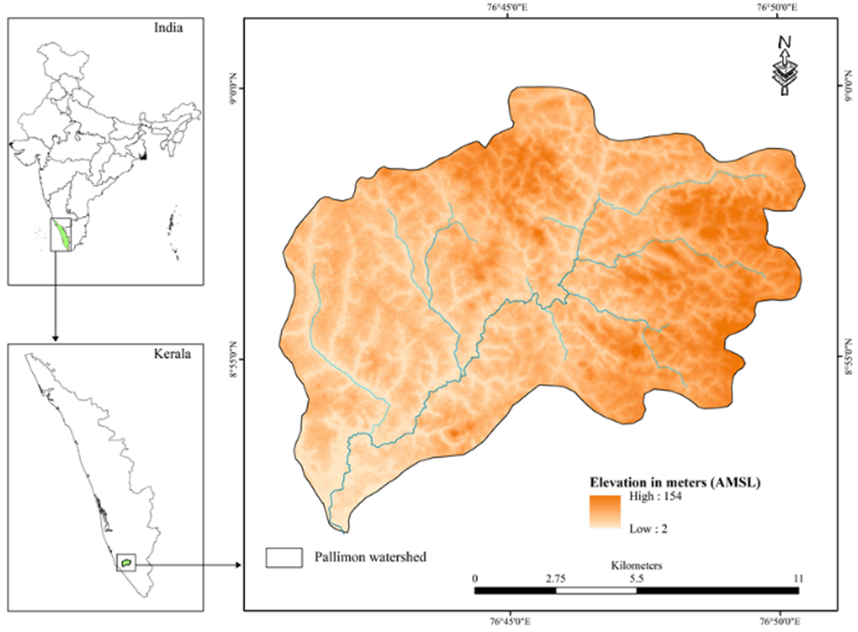
Pallimon, a south west flowing river is located in the Kollam district of Kerala state, India. The study area is restricted to the catchment boundary of Pallimon river (Figure 1) and lies between latitude 8°54' N and 9°00' N and longitude 76°41' E and 77°50' E, covering an area of 158.15 km2. The Pallimon river is a perennial river and originates at an elevation of 154 m AMSL. The length of the main drainage is 19.4 km, and it joins the Ithikkara river just before the Paravaur Estuary. A considerable portion of the study area is occupied by rubber, paddy, coconut, and banana cultivation. The topography of the area is characterised with steep slopes which are found in the northern central, and eastern parts. The major soil type in the area is riverine alluvium. However, lateritic soil is also present in some parts of the study area.

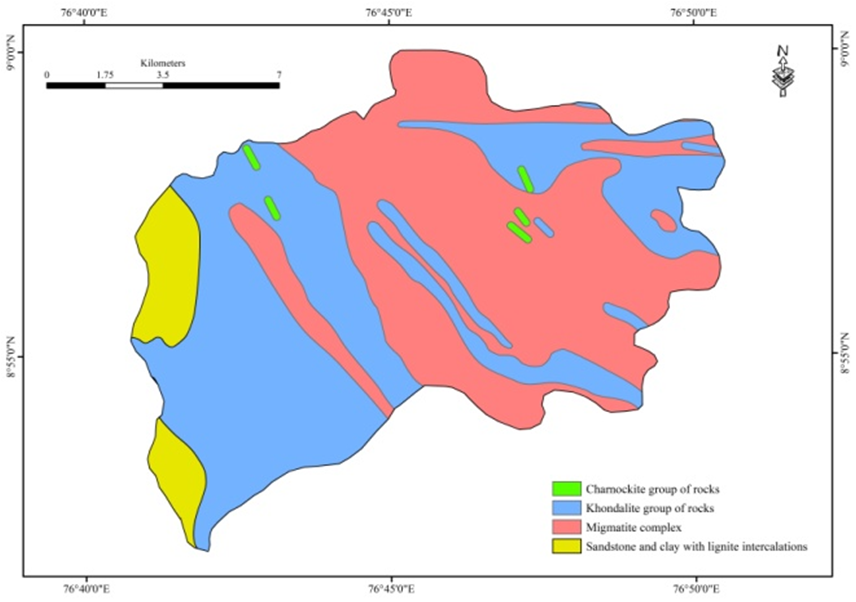
The study area is located in the southern part of Peninsular India. Quadrangle geological map 13 is utilized and found that geologicaly the area can be divided into two major units such as Precambrian crystallines and Tertiary sediments (Figure 2). The migmatite complexes are compact, foliated and fractured. A major part of western portion of PWS is covered by Tertiary sedimentary layers, especially of Warkalli sandstone of Lower Miocene age, which unconformably overlie the Precambrian and comprise primarily of Neogene deposits. These rocks are ferruginous, often with lignite intercalations. It is observed that major trunk of the Pallimon is flowing across the regional geological trend (NW-SE) and the tributaties of the same is more or less flowing along the geological unit trend (Figure 2).
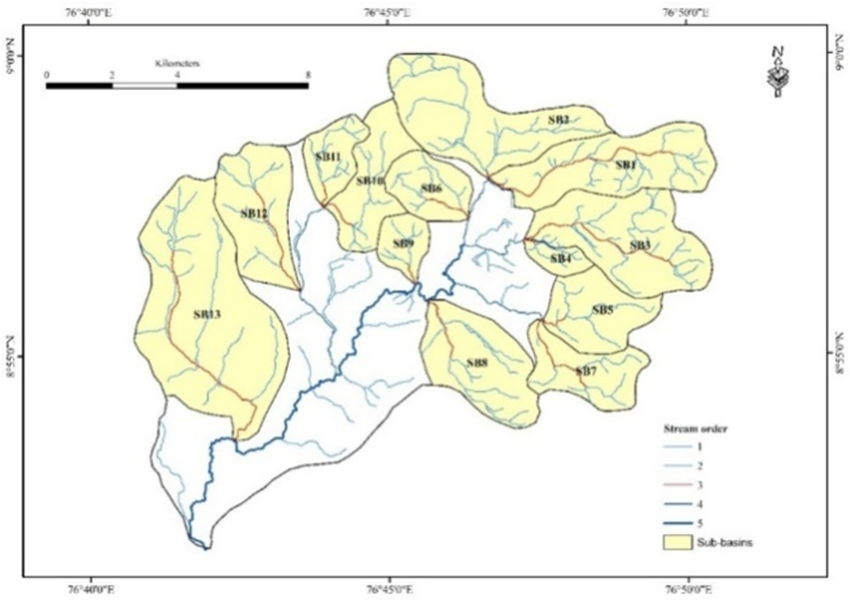
In the present study, Survey of India toposheets, geological maps and different satellite imageries of varying spatial reolution are utilized for making the primary database. As the first step, the topsheet (Scale 1:50000) were geo referenced and contours from the toposheets were digitized to generate the digital elevation model (DEM) of the study area. For morphometric analysis, the drainage system is ordered as per Strahler (1964) classification then the area is divided into 13 sub basins (SB1 to SB13) having 3rd order streams (Figure 4). In addition to that Pallimon watershed itself is considered as an individual basin (PWS). The lineament analysis is also carried out using Landsat 8 (OLI). All basic components for various linear, areal and relief aspect used for the analysis are measured using ARC GIS.
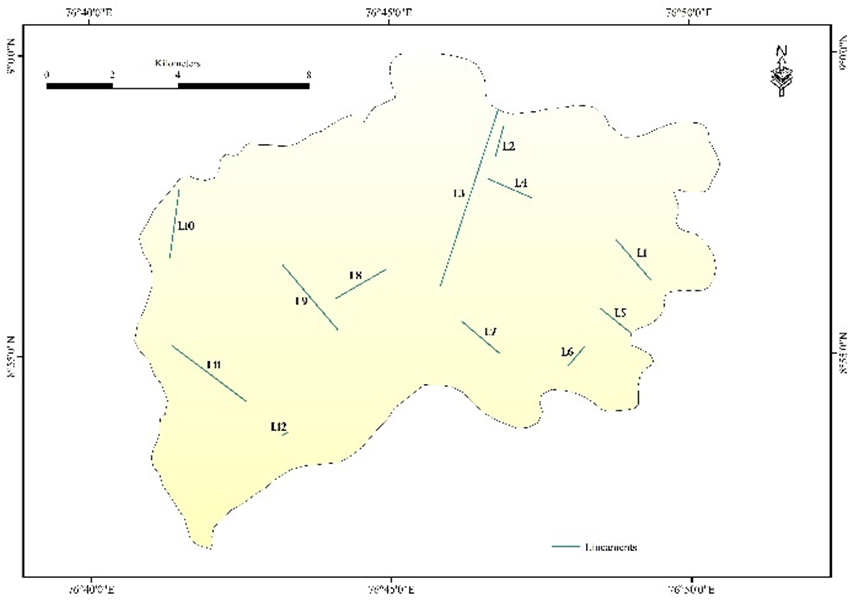
The lineament map of Pallimon water shed is prepared using the Landsat 8 (OLI) image from USGS. In addition to that DEM generated from toposheet is also used for the lineament demarcation in the study area. As per the lineament map prepared 12 lineamnent segments were identified and named as L1 to L12 (Figure 3). The data indicated that majority of the lineament is reflecting to the basement geological trend only ie. NW-SE. However, some of the lineaments are also trending in NE-SW. L3 is the longest lineament falling in the north east of the area and trending in NE-SW.

In the present study the linear, areal and relief aspects of the Pallimon watershed by sub dividing it into 13 sub basins were calculated and anlysed. The data derived for the parametes are listed under Table 1, Table 2 and Table 3. The details description and observation from the same is described under following sub sections.
4.1. Linear Morphometric AspectsThis refers to the preliminary stage of morphometric characterisation of river basins. Linear aspects such as perimeter (P), basin length (Lb), stream order (Nu), stream length (Lu), bifurcation ratio (Rb), and stream length ratio (Rsl)were calculated as a part of the linear morphometric analysis 15, 16. The results of the analysis are shown in Table 1.
The perimeter of the entire PWS is calculated as 63 km, and for the sub-basins, it varies from 5.37 km to 21.24 km (Table 1). The sub-basin with the smallest perimeter is SB4 and SB9, which also possess the lowest basin area (1.45 km2 and 4.32 km2, respectively).
The sub-basin with the largest perimeter is SB13 (21.24 km), which also possesses the largest basin area too (23.39 km2). The basin length, which is the longest section of the river basin is 19.5 km for the entire PWS. The basin length of all the sub-basins is shown in Table 1. The sub-basins with the lowest and the highest basin lengths in PWS are SB10 and SB13, with respective basin lengths of 1.75 km and 8.02 km.
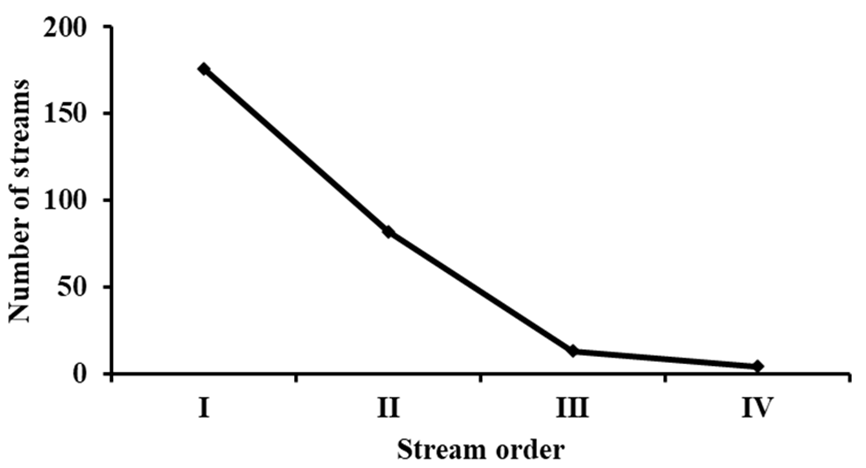
The PWS is found to be a 5th order river,and it encompasses 176, 82, 13, and 4 numbers of 1st order, 2nd order, 3rd order, and 4th order streams, respectively. The statistics of the basin-wise distribution of different order streams in PWS are shown in Table 1.
The SB3 is characterised by 30 streams, among which 23 are 1st order, and 6 are 2nd order streams and SB1 and SB3 are found to be the sub-basins with the highest number of 1st order streams..
In contrast, sub-basin SB4 is characterised by 8 streams which is the lowest among all other sub-basins. The number of 1st order streams is 5 and that of the 2nd order streams is 2. The SB4 possesses the lowest number of 1st and 2nd order streams. It is found that the number of streams is inversely proportional to its stream order (Figure 5).

PWS show wide variations in the stream length of sub-basins as given in Table 1. The sum of all stream lengths in PWS is calculated as 241 km. The sub-basin SB4 is characterised by the lowest stream length of 4.06 km, and SB13 is found to have the highest stream length of 32.57 km.
The Rb values of PWS vary from streams of one order to the next higher-order, indicating the diversity in physiographical conditions in the basin. The average Rb value of PWS is estimated as 3.9, with a lowest Rb value of 2.25 in sub-basin SB4 and the highest value of 4.92 in SB3. Low Rb values indicate the natural drainage system within a homogenous rock 17. Rb values from 2 to 5 are generally characterised by a well-developed drainage system 15. The lower Rb value of the sub-basin SB4, SB5, SB6, SB9 and SB10 can be attributed to its flat topography/ rolling nature, whereas the higher Rb values of SB1, SB2 and SB3 can be related to the structural control of the sub-basin on drainage and the presence of overland flow. The latter generally possess perfectly dissected river systems.
The Rsl values vary according to the slope and topographic features, which affect the discharge and denudational activities in the river basin 18. Based on the order of streams, the Rsl values of streams vary considerably with more stream length in the highest order streams and vice versa.The average ‘Rsl’ value of PWS is estimated as 0.49, with the lowest and highest Rsl values of 0.32 and 1.10 in sub-basins SB3 and SB1 (Table 1). The variation in the ‘Rsl’ values of sub-basins in PWS can be attributed to the effect of geological characteristics in the river channel distribution.
4.2. Areal AspectsThe areal aspects of PWS such as area, drainage density, drainage frequency, length of overland flow, form factor 16, drainage texture 19, constant channel of maintenance 20 and circularity ratio 21 were computed and the observation is as follows.
PWS is measured to have a basin area of 158.15 km2 with the largest area of 23.39 km2 in sub-basin SB13 and the smallest area of 1.45 km2 in sub-basin SB4. The basin areas of all the sub-basins are given in Table 2.
The erosional processes along the channels influence the Dd values of river basins 22. PWS is estimated to have a Dd value of 1.53 km/km2 with the range of Dd values of sub-bsains from 1.39 km/km2 to 2.83 km/km2, as shown in Table 2. The former is reported in sub-basin SB11 and SB13 and the latter in sub-basin SB10. The Dd of the PWS and its 3rd order sub-basins fall under moderate to a well-drained category, representing the changes in Dd values in response to geological characteristics of the basin, including infiltration capacity and the formation resistance to erosional processes of lithologic layers.
Df of the PWS is estimated as 1.74 km-2, and that of the sub-basins vary from 0.86 km-2 to 5.52 km-2 for the sub-basins SB13 and SB4,respectively (Table 2). The Df values increase when the slopes and amount of runoff increase in river basins. The occurrence of flood events is closely related to the drainage density and stream frequency, as they have a positive correlation with the runoff in the basin 17.
The Td value of PWS is estimated as 2.65 km km-4, and that of the sub-basins range from 1.19 to 15.44 km km-4 as given in Table 1. The lowest value is observed in sub-basin SB13 and the highest Td value is found in the sub-basin SB4. According to the Td classification sub-basin with Td values >8, 6-8, 4-6, 2-4, and <2 are categorised as very fine, fine, moderate, coarse, and very coarse groups 19. In PWS, SB4 and SB10 belong to very fine; SB9 to fine; SB1, SB3, SB6, and SB7 to moderate; SB2, SB5, SB8, SB11 and SB12 to coarse, and SB13 to very coarse categories of Td.
The Lf value of PWS is estimated as 0.76 km, which indicates that the runoff travels a lesser distance suggesting a mature stage of geomorphic development. Among the subbasins, the highest Lf value of 0.36 km is observed in the sub-basins SB11 and SB13, while the lowest value of 0.18 km is observed in sub-basins SB4 and SB10 (Table 2).
The higher values of Lg suggest that the rainfall-runoff in SB11 and SB13 travels a longer distance to drain to the channels as compared to other sub-basins 23. In contrast, less rainfall is sufficient for a significant quantity of runoff water to reach the stream channel in sub-basins with smaller Lg values (SB10 and SB4), and hence such areas are highly prone to floods during heavy rains due to lesser infiltration of water 24.
The PWS has an overall ‘Cmt’ value of is 0.66 km. The 3rd order sub-basins of PWS show wide variations in Cmt, with values ranging from 0.35 km in sub-basin SB10 to 0.72 km in sub-basin SB11 and SB13. The low ‘Cmt’ values in sub-basins SB4 and SB10 indicate the effect of structural disturbances in the basin, less permeability of formation material, steep slopes, and higher rainfall-runoff 25. In contrast, the higher values of ‘Cmt’, generally >0.5 km, represent less structural control with reduced rainfall runoff. Sub-basins SB2, SB5, SB7, SB11, SB12 and SB13, fall under this category.
Form factor (Ff) is representative of the shape of a river basin 26. Ff of PWS is estimated as 0.50, and that of sub-basins varies from 0.24 (SB1) to 1.12 (SB10). When the basin is circular, Ff values will be high (>0.50), and the peak discharge will be higher over a short duration. The sub-basins SB2, SB8, SB9, SB10, and SB11 fall under this category.
The circularity of the basin depends on the values of Rc with perfect circles having Rc value 1 and elongated basins have Rc values ranging from 0.4 to 0.5. The latter is a typical characteristic of basins with homogenous geological formations of higher permeability. The ‘Rc’ values depend on factors such as streams length, stream frequency, structural features, land use/land cover, climate pattern, relief, the slope of the terrain, etc 27. The Rc of PWS is estimated as 0.50, and hence the basin falls under the elongated shape category, where the runoff discharge is moderate, and the permeability of the formation is higher. The low, moderate, and high categories of Rc values indicate the youth, mature and old stages of the development of tributaries, respectively 28. The Rc of sub-basins in PWS are estimated to range from 0.40 in sub-basin SB11 to 0.87 in sub-basin SB6. The former falls under the elongated category indicating the mature stage of river basin development, while the latter falls under the circular category indicating the youth stage of river basin development.
4.3. Relief AspectsThe relief aspects of a river basin represent the three-dimensional parameters of the basin, and it depends on the area, volume, and altitude of beds. It refers to the surface elevation as compared to the nearby areas, generally estimated as the difference between the highest and lowest elevation per unit area of the basin 20. The major relief aspects of PWS are shown in Table 3. The other parameters Ruggedness number (Rn) 29 and Dissection index 30 was also computed and the observation are as follows.
Basin relief (R) implies the gradient of channel flow in a river basin and is used to identify the denudational activities in a river basin 18. The ‘R’ value of PWS is estimated as152 m, while the values of sub-basins range from 65 m in SB13 to 129 m in SB3 (Table 3). The low R values of sub-basins and PWS suggest lower flow velocity, which reduces the runoff potential in the area and thereby accelerate the recharge.
In PWS, the average Rr is estimated as 0.01 with the lowest Rr value of 0.01 in sub-basin SB13 and the highest value of 0.06 in sub-basin SB10 (Table 3). The Rr values have a direct correlation with the area and size of drainage basins and sub-basins, which is evidenced by the occurrence of lower ‘Rr’ values in sub-basins with gentle slopes and low relief.
The ‘Rn’ values of sub-basins are shown in Table 3. The ‘Rn’ value of PWS is 0.23, and that of the sub-basins ranges from 0.09 (sub-basin SB13) to 0.29 (subbasin SB3). The lower ‘Rn’ values in the sub-basins are suggestive of the lesser susceptibility of formation materials of the area to erosional activities.
The flat surfaces with negligible vertical erosion are characterised by a DI value of 0 and areas with vertical cliffs or escarpments of hill slopes are characterised by a DI value of 1. The ‘DI’ of PWS is estimated as 0.99, and that of the sub-basins varies from 0.67 in SB5 to 0.93 in SB13 (Table 3). The majority of the 3rd order the sub-basins in the PWS are highly dissected, which is evidenced by the high DI values.
Morphometric analysis of a drainage basin is a quantitative approach for characterising the features of a drainage pattern's surface shape, and it gives valuable information on the region's topography, geological structures, runoff, and hydrogeological properties of the underlying rock. In the present study, various linear, areal and relief aspects of the PWS, such as perimeter (P), basin length (Lb), stream order (Nu), stream length (Lu), bifurcation ratio (Rb), and stream length ratio (Rsl), basin area, drainage density, drainage frequency, drainage texture, length of overland flow, constant channel of maintenance, form factor, circularity ratio and shape index, basin relief, relief ratio, ruggedness number, and dissection index were analysed. The detailed morphometric analysis has been carried out in the Pallimon watershed and its thirteen third-order sub-basins separately.
The drainage pattern of PWS is found to be dendritic, wherein the sub-basins fall under the moderate to well-drained category, indicating the influence of geological characteristics on drainage density. In all the sub basins the number of first-order streams is found to be consistently high in number as compared to other order streams. It may be due to the complex terrain feature of the basin. The major parameters that controll the river basin development are basement geology, structural control, precipitation, nature of formation material, slope, land cover and relief.
Based on the average length of the overland flow of PWS, it is evident that the distance of rainfall-runoff to reach the stream channels is considerably less in the basin, indicating higher susceptibility to flooding. The river basin development is in the mature stage, and the structural control over the river basin development is lesser in most parts of the area, which is evident from the lower constant channel of maintenance values of the sub basins. The western part of PWS is characterised by less structural disturbances and less runoff as evidenced by the higher values of the constant maintenance channel. The relief aspects of PWS indicates that the basin is characterised by high recharge and is less susceptible to soil erosion. The above findings will be useful in delineating groundwater potential zones and formulating a suitable management strategy to manage the groundwater resources in the basin.
The work was financially supported by Kerala State Council for Science, Technology and Environment (KSCSTE) fellowship awarded to Sreeja I.S.Authors take this opportunity to thank the Head of the department, Department of Geology, Kariavattom Campus, University of Kerala and Director, National Institute of Rock Mechanics (NIRM) for the facilities and support provided.
| [1] | Chorley R.J., (1969). Introduction to physical hydrology. Methuen and Co.Ltd., Suffolk. 211. | ||
| In article | |||
| [2] | Javed, A., Khanday, M.Y. and Rais, S. (2011). Watershed prioritization using morphometric and land use/land cover parameters: a remote sensing and GIS based approach. Journal of Geological Society of India., v.78 (1), pp.63-75. | ||
| In article | View Article | ||
| [3] | Ali, U., Ali, S. A., Ikbal, J., Bashir, M. and Fadhl, M., (2018). Soil erosion risk and flood behavior assessment of Sukhnag catchment Kashmir Basin: Using GIS and remote sensing. Journal of Remote Sensing & GIS., v.7, pp.230. | ||
| In article | View Article | ||
| [4] | Farhan, Y. andAnaba, O., (2016). Watershed prioritization based on morphometric analysis and soil loss modeling in Wadi Kerak (Southern Jordan) using GIS techniques. International Journal of Plant & Soil Science., 10(6), 1-18. | ||
| In article | View Article | ||
| [5] | Prabhakar, A.K., Singh, K.K., Lohani, A.K. and Chandniha, S.K., (2019). Study of Champua watershed for management of resources by using morphometric analysis and satellite imagery. Applied Water Science., v.9, pp.127. | ||
| In article | View Article | ||
| [6] | Meshram, S.G. and Sharma, S.K., (2017). Prioritization of watershed through morphometric parameters: a PCA-based approach. Applied Water Science., v.7, pp.1505-1519. | ||
| In article | View Article | ||
| [7] | Prakash, K., Rawat, D., Singh, S., Chaubey, K., Kanhaiya, S. and Mohanty, T., (2019). Morphometric analysis using SRTM and GIS in synergy with depiction: a case study of the Karmanasa River basin, North central India. Applied Water Science., v.9, pp.13. | ||
| In article | View Article | ||
| [8] | Kadam, A.K., Jaweed, T.H., Umrikar, B.N., Hussain, K. and Sankhua, R.N., (2017).Morphometric prioritization of semi-arid watershed for plant growth potential using GIS technique. Modelling Earth System and Environment., v.3, pp.1663-1673. | ||
| In article | View Article | ||
| [9] | Choudhari, P.P., Nigam, G.K., Singh, S.K. and Thakur, S., (2018). Morphometric based prioritization of watershed for groundwater potential of Mula river basin, Maharashtra, India. Geology, Ecology, and Landscapes., v.2(4), pp. 256-267. | ||
| In article | View Article | ||
| [10] | Magesh, N. S., Chandrasekar, N., andSoundranayagam, J. P., (2011). Morphometric evaluation of Papanasam and Manimuthar watersheds, parts of Western Ghats, Tirunelveli district, Tamil Nadu, India: AGIS approach. Environmental Earth Science., 642, pp. 373–381 | ||
| In article | View Article | ||
| [11] | Markose, V. J., Dinesh, A. C. andJayappa, K.S., (2014). Quantitative analysis of morphometric parameters of Kali River basin, southern India, using bearing azimuth and drainage (bAd) calculator and GIS. Environmental Earth Science., 72, pp. 2887-2903. | ||
| In article | View Article | ||
| [12] | Kaliraj, S., Chandrasekar, N. and Magesh, N.S., (2014). Morphometric analysis of the RiverThamirabarani sub-basin in Kanyakumari District, South west coast of Tamil Nadu, India, using remote sensing and GIS. Environmental Earth Science., 7, pp. 1385-1401. | ||
| In article | View Article | ||
| [13] | District geological resource maps, (2006). Map & Cartography Division, Geological Survey of India (GSI). | ||
| In article | |||
| [14] | Strahler, A.N., (1964). Quantitative geomorphology of drainage basin and channel networks. In: V.T. Chow, ed. Handbook of applied hydrology. McGraw Hill Book, New York, pp.4-76. | ||
| In article | |||
| [15] | Strahler, A.N., (1957). Quantitative analysis of watershed geomorphology. Transactions of the American Geophysical Union., v.38, pp.913-920. | ||
| In article | View Article | ||
| [16] | Horton, R.E., (1945). Erosional development of streams and their drainage basins-hydrophysical approach to quantitative morphology. Geological Society of America Bulletin., v.56 (3), pp.275-370. | ||
| In article | View Article | ||
| [17] | Kale, V.S. and Gupta, A., (2001). Introduction to Geomorphology. Orient Longman, New Delhi. | ||
| In article | |||
| [18] | Sreedevi, P.D., Subrahmanyam, K. and Ahmed, S., (2004). The significance of morphometric analysis for obtaining groundwater potential zones in a structurally controlled terrain. Environmental Geology., v.47, pp.412-420. | ||
| In article | View Article | ||
| [19] | Smith, K., (1950). Standards for Grading Textures of Erosional Topography. American Journal of Science, 248, 655-668. | ||
| In article | View Article | ||
| [20] | Schumm, S.A., (1956). Evolution of Drainage Systems & Slopes in Badlands at Perth, New Jersey. Bulletin of the Geological Society of America., 67, pp. 597-646. | ||
| In article | View Article | ||
| [21] | Miller, V., (1953). A Quantitative Geomorphic Study of Drainage Basin Characteristics in the Clinch Mountain Area, Virginia and Tennessee. Project NR 389-402, Technical Report 3, Columbia University, Department of Geology, ONR, New York. | ||
| In article | |||
| [22] | Gregory, K.J. and Walling, D.E., (1973). Drainage Basin. Form and Process: A Geomorphological Approach. Edward Arnold, London. | ||
| In article | |||
| [23] | Chitra, C., Alaguraja, P., Ganeshkumari, K., Yuvaraj, D. and Manivel, M., (2011). Watershed characteristics of Kundah subbasin using remote sensing and GIS techniques. International Journal of Geomatics and Geosciences., v.2(1), pp.311-335. | ||
| In article | |||
| [24] | Olszevski, N., Filho E., Costa L., Schaefer., Souza. and Costa., (2011). Morphology and hydrological aspects of Black River Basin, division of state of Rio de Janeiro and Minas Gerais. Brazilian Journal of Science and Technology., v.35, pp.485-492. | ||
| In article | View Article | ||
| [25] | Sarita, G., (2015). Morphometric Analysis of a Shakkar River Catchment Using RS and GIS. International Journal of u- and e-Service, Science and Technology., v.8(2), pp.11-24. | ||
| In article | View Article | ||
| [26] | Vijith, H. and Satheesh, R., (2006). GIS based morphometric analysis of two major upland sub-watersheds of Meenachil River in Kerala. Journal of the Indian Society of Remote Sensing., v.34(2), pp.181-185. | ||
| In article | View Article | ||
| [27] | Vincy, M.V., Rajan, B. and Pradeepkumar, A.P., (2012). Geographic information system–based morphometric characterization of sub-watersheds of Meenachil river basin, Kottayam district, Kerala, India. Geocarto International., v.27(8), pp.661-684. | ||
| In article | View Article | ||
| [28] | Adhikari S., (2020). Morphometric analysis of drainage basins;A Study of Ghatganga River, Bajhang District, Nepal. The Geographic Base., v.7, pp.127-144. | ||
| In article | View Article | ||
| [29] | Strahler, A.N., (1958). Dimensional analysis applied to fluvially eroded landforms. Bulletin of the Geological Society of America., v.69, pp.279-300. | ||
| In article | View Article | ||
| [30] | Singh, S. and Dubey, A., (1994).Geoenvironmental Planning of Watersheds in Indian. Chugh Publications, Allahabad, pp. 28-69. | ||
| In article | |||
Published with license by Science and Education Publishing, Copyright © 2022 Sreeja I.S., Binoj Kumar R.B., Rajesh Reghunath, Yogendra Singh and Mohammed Noohu Nazeer
 This work is licensed under a Creative Commons Attribution 4.0 International License. To view a copy of this license, visit
http://creativecommons.org/licenses/by/4.0/
This work is licensed under a Creative Commons Attribution 4.0 International License. To view a copy of this license, visit
http://creativecommons.org/licenses/by/4.0/
| [1] | Chorley R.J., (1969). Introduction to physical hydrology. Methuen and Co.Ltd., Suffolk. 211. | ||
| In article | |||
| [2] | Javed, A., Khanday, M.Y. and Rais, S. (2011). Watershed prioritization using morphometric and land use/land cover parameters: a remote sensing and GIS based approach. Journal of Geological Society of India., v.78 (1), pp.63-75. | ||
| In article | View Article | ||
| [3] | Ali, U., Ali, S. A., Ikbal, J., Bashir, M. and Fadhl, M., (2018). Soil erosion risk and flood behavior assessment of Sukhnag catchment Kashmir Basin: Using GIS and remote sensing. Journal of Remote Sensing & GIS., v.7, pp.230. | ||
| In article | View Article | ||
| [4] | Farhan, Y. andAnaba, O., (2016). Watershed prioritization based on morphometric analysis and soil loss modeling in Wadi Kerak (Southern Jordan) using GIS techniques. International Journal of Plant & Soil Science., 10(6), 1-18. | ||
| In article | View Article | ||
| [5] | Prabhakar, A.K., Singh, K.K., Lohani, A.K. and Chandniha, S.K., (2019). Study of Champua watershed for management of resources by using morphometric analysis and satellite imagery. Applied Water Science., v.9, pp.127. | ||
| In article | View Article | ||
| [6] | Meshram, S.G. and Sharma, S.K., (2017). Prioritization of watershed through morphometric parameters: a PCA-based approach. Applied Water Science., v.7, pp.1505-1519. | ||
| In article | View Article | ||
| [7] | Prakash, K., Rawat, D., Singh, S., Chaubey, K., Kanhaiya, S. and Mohanty, T., (2019). Morphometric analysis using SRTM and GIS in synergy with depiction: a case study of the Karmanasa River basin, North central India. Applied Water Science., v.9, pp.13. | ||
| In article | View Article | ||
| [8] | Kadam, A.K., Jaweed, T.H., Umrikar, B.N., Hussain, K. and Sankhua, R.N., (2017).Morphometric prioritization of semi-arid watershed for plant growth potential using GIS technique. Modelling Earth System and Environment., v.3, pp.1663-1673. | ||
| In article | View Article | ||
| [9] | Choudhari, P.P., Nigam, G.K., Singh, S.K. and Thakur, S., (2018). Morphometric based prioritization of watershed for groundwater potential of Mula river basin, Maharashtra, India. Geology, Ecology, and Landscapes., v.2(4), pp. 256-267. | ||
| In article | View Article | ||
| [10] | Magesh, N. S., Chandrasekar, N., andSoundranayagam, J. P., (2011). Morphometric evaluation of Papanasam and Manimuthar watersheds, parts of Western Ghats, Tirunelveli district, Tamil Nadu, India: AGIS approach. Environmental Earth Science., 642, pp. 373–381 | ||
| In article | View Article | ||
| [11] | Markose, V. J., Dinesh, A. C. andJayappa, K.S., (2014). Quantitative analysis of morphometric parameters of Kali River basin, southern India, using bearing azimuth and drainage (bAd) calculator and GIS. Environmental Earth Science., 72, pp. 2887-2903. | ||
| In article | View Article | ||
| [12] | Kaliraj, S., Chandrasekar, N. and Magesh, N.S., (2014). Morphometric analysis of the RiverThamirabarani sub-basin in Kanyakumari District, South west coast of Tamil Nadu, India, using remote sensing and GIS. Environmental Earth Science., 7, pp. 1385-1401. | ||
| In article | View Article | ||
| [13] | District geological resource maps, (2006). Map & Cartography Division, Geological Survey of India (GSI). | ||
| In article | |||
| [14] | Strahler, A.N., (1964). Quantitative geomorphology of drainage basin and channel networks. In: V.T. Chow, ed. Handbook of applied hydrology. McGraw Hill Book, New York, pp.4-76. | ||
| In article | |||
| [15] | Strahler, A.N., (1957). Quantitative analysis of watershed geomorphology. Transactions of the American Geophysical Union., v.38, pp.913-920. | ||
| In article | View Article | ||
| [16] | Horton, R.E., (1945). Erosional development of streams and their drainage basins-hydrophysical approach to quantitative morphology. Geological Society of America Bulletin., v.56 (3), pp.275-370. | ||
| In article | View Article | ||
| [17] | Kale, V.S. and Gupta, A., (2001). Introduction to Geomorphology. Orient Longman, New Delhi. | ||
| In article | |||
| [18] | Sreedevi, P.D., Subrahmanyam, K. and Ahmed, S., (2004). The significance of morphometric analysis for obtaining groundwater potential zones in a structurally controlled terrain. Environmental Geology., v.47, pp.412-420. | ||
| In article | View Article | ||
| [19] | Smith, K., (1950). Standards for Grading Textures of Erosional Topography. American Journal of Science, 248, 655-668. | ||
| In article | View Article | ||
| [20] | Schumm, S.A., (1956). Evolution of Drainage Systems & Slopes in Badlands at Perth, New Jersey. Bulletin of the Geological Society of America., 67, pp. 597-646. | ||
| In article | View Article | ||
| [21] | Miller, V., (1953). A Quantitative Geomorphic Study of Drainage Basin Characteristics in the Clinch Mountain Area, Virginia and Tennessee. Project NR 389-402, Technical Report 3, Columbia University, Department of Geology, ONR, New York. | ||
| In article | |||
| [22] | Gregory, K.J. and Walling, D.E., (1973). Drainage Basin. Form and Process: A Geomorphological Approach. Edward Arnold, London. | ||
| In article | |||
| [23] | Chitra, C., Alaguraja, P., Ganeshkumari, K., Yuvaraj, D. and Manivel, M., (2011). Watershed characteristics of Kundah subbasin using remote sensing and GIS techniques. International Journal of Geomatics and Geosciences., v.2(1), pp.311-335. | ||
| In article | |||
| [24] | Olszevski, N., Filho E., Costa L., Schaefer., Souza. and Costa., (2011). Morphology and hydrological aspects of Black River Basin, division of state of Rio de Janeiro and Minas Gerais. Brazilian Journal of Science and Technology., v.35, pp.485-492. | ||
| In article | View Article | ||
| [25] | Sarita, G., (2015). Morphometric Analysis of a Shakkar River Catchment Using RS and GIS. International Journal of u- and e-Service, Science and Technology., v.8(2), pp.11-24. | ||
| In article | View Article | ||
| [26] | Vijith, H. and Satheesh, R., (2006). GIS based morphometric analysis of two major upland sub-watersheds of Meenachil River in Kerala. Journal of the Indian Society of Remote Sensing., v.34(2), pp.181-185. | ||
| In article | View Article | ||
| [27] | Vincy, M.V., Rajan, B. and Pradeepkumar, A.P., (2012). Geographic information system–based morphometric characterization of sub-watersheds of Meenachil river basin, Kottayam district, Kerala, India. Geocarto International., v.27(8), pp.661-684. | ||
| In article | View Article | ||
| [28] | Adhikari S., (2020). Morphometric analysis of drainage basins;A Study of Ghatganga River, Bajhang District, Nepal. The Geographic Base., v.7, pp.127-144. | ||
| In article | View Article | ||
| [29] | Strahler, A.N., (1958). Dimensional analysis applied to fluvially eroded landforms. Bulletin of the Geological Society of America., v.69, pp.279-300. | ||
| In article | View Article | ||
| [30] | Singh, S. and Dubey, A., (1994).Geoenvironmental Planning of Watersheds in Indian. Chugh Publications, Allahabad, pp. 28-69. | ||
| In article | |||