The most important indicator of the spatial pattern of agricultural development is agricultural productivity. It aids in identifying regions that are performing less or more efficiently than neighbouring regions and identifies the true cause of a region's agricultural backwardness. According to the physio-socio-economic condition of each region, it will be of great assistance in planning the sustainable development of each area. Population pressure on cultivable land is rapidly increasing, resulting in a rising demand for agricultural products. To solve the foodgrains problem, it is always a challenge to increase production per unit area and per unit of time. This paper attempts to assess the relationship between agricultural productivity and food availability at micro scale that is at cluster village (circle) as case study in Junnar. The Junnar Tahsil of the Pune District relies heavily on agriculture and is home to a variety of crops, necessitating agricultural planning for local food availability due to diversity in physical and socio-economic conditions of area. For 2019-20, the Shafis Calories Per Capita Index was utilised to evaluate productivity. In this study, the following ten crops were considered: rice, wheat, jowar, bajara, groundnut, soybean, gramme, sugarcane, onion, and tomato. Consideration was given to rice, wheat, jowar, and bajara for the production of cereal grains. Using geospatial techniques, a choropleth map has now been created. Analysis of the research revealed the spatial dimension of productivity in terms of regions with low, moderate, and high productivity. The trend in the medium and high productivity regions is toward a higher proportion of cash crops and a lower in foodgrains. Changes in cropping patterns are a result of the command area's irrigation facilities. On the basis of the findings, it has been concluded that area with high agriculture productivity of non-food crops are deficit in local food-grain availability and area of low agriculture productivity have high local food availability and this allows for more food diversity required for local food security.
Agricultural productivity is generally defined as the ratio of agricultural outputs to agricultural inputs. Agricultural productivity is not synonymous with fertility. It is commonly used to express the capacity of agriculture in a specific region to produce crops, regardless of whether that capacity is due to natural boundaries or to man's efforts. Productivity is a relative concept when it comes to agricultural efficiency. It has various meanings and has sparked numerous competing interpretations. It is defined as a ratio of output to resources expended separately or collectively, and is considered the overall efficiency of a production system. This term has been used in the context of production.
In reality, production refers to output volume, whereas productivity refers to output in relation to resource utilization. Productivity is commonly defined as a production system's ability to produce more economically and efficiently. Spatio-temporal changes in agricultural productivity and their causal relationship with food availability at the micro scale aid in understanding the area's self-sufficiency. According to one school of thought, food self-sufficiency is critical for low-income countries' food security because food inflation makes it out of reach for ordinary people. Self-sufficiency is used to assess food security. The issue of food availability necessitates a certain level of food production 1. At the same time, food grains are regarded as crucial for household food and nutritional security, and there is no perfect substitute for them 2. The increase in food grain production is not keeping up with the increasing population,as there has been a steady decline in net per capita food grain availability 3. Irrigation availability is critical in reducing negative effects on food availability and agricultural development. Agricultural productivity identifies various areas and their dominance in food grain crop 4. Significant increases in food grain production have not been able to keep up with the growing population, as net per capita food grain availability has been steadily declining 5. When it comes to food consumption in India, rice, wheat, jowar, and bajara are the main sources of energy, accounting for 70-80 percent of most Indians' daily energy intake. In India, agricultural diversification toward high-value crops are growing faster than staple food crops, which has the potential to increase farm income 6. For this reason, the role of green revolution technology in agricultural development is critical, but it creates regional disparities in food grain productivity 7. On the other hand, indicator of food insecurity is a lack of food energy 8. Food production and food avaiability are directly related with agriculture productivity 9.
1.1. Rational of StudyEnvironmental constraints caused by geomorphic conditions, soils, and climate have placed a limit on diverse agricultural productivity. More resources can be used to increase output without increasing productivity. Agricultural productivity can thus be defined as the efficiency with which an agricultural production system uses land, labour, capital, high yielding variety seeds, chemical pesticides, chemical fertiliser, irrigation, and other resources. Agricultural productivity is used to identify and locate areas with a high proportion at the regional level. Food grain availability in India increased significantly from 416 gm per day in 1950-55 to 485 gm per day in 1989-91, from 416 gm per day in 1950-55 to 485 gm per day in 1989-91. Food grain availability had dropped significantly by the 2006-07 season, to 445 gm per day. Computing agricultural productivity of food and non-food crop is used to assess the sufficiency or inadequacy of essential for food availability.
1.2. ObjectivesThe current study focuses on the micro-scale causal relationship between agricultural productivity and food availability. It also analyses productivity regions in the study region by major crops and understands the productivity and food availability pattern of various circles in order to demonstrate the reasons for variations in productivity and food availability in the study area.
1.3. HypothesisThe command area situation boosts agricultural productivity while decreasing food crop area, resulting in less food grain availability at local level.
The current study is based on secondary data gathered from Junnar Tahsil's Talathi offices and the Agriculture Department. For the 2019-20 fiscal year, the Shafis Calories Per Capita Index was used to assess productivity. This study looked at ten crops: rice, wheat, jowar, bajara, groundnut, soyabean, gramme, sugarcane, onion, and tomato. Rice, wheat, jowar, and bajara were the four crops considered for cereal grain production. Finally, a choropleth map was created with GIS software.
Shafi used this method to investigate Uttar Pradesh's agricultural productivity. In the current study, total crop outputs are converted into calories, and the sum of all calories is divided by the total population of each circle. It specifies the number of calories available per person per year. Circle-wise population data from the 2011 census were used to calculate the productivity index.
The calories per capita are calculated with the help of following formula.
 |
Where,
OTC = Outturn of crop
Cal = Calories
With the help of above formula the calories per capita productivity index of each circle was worked out for the years 2019-20.
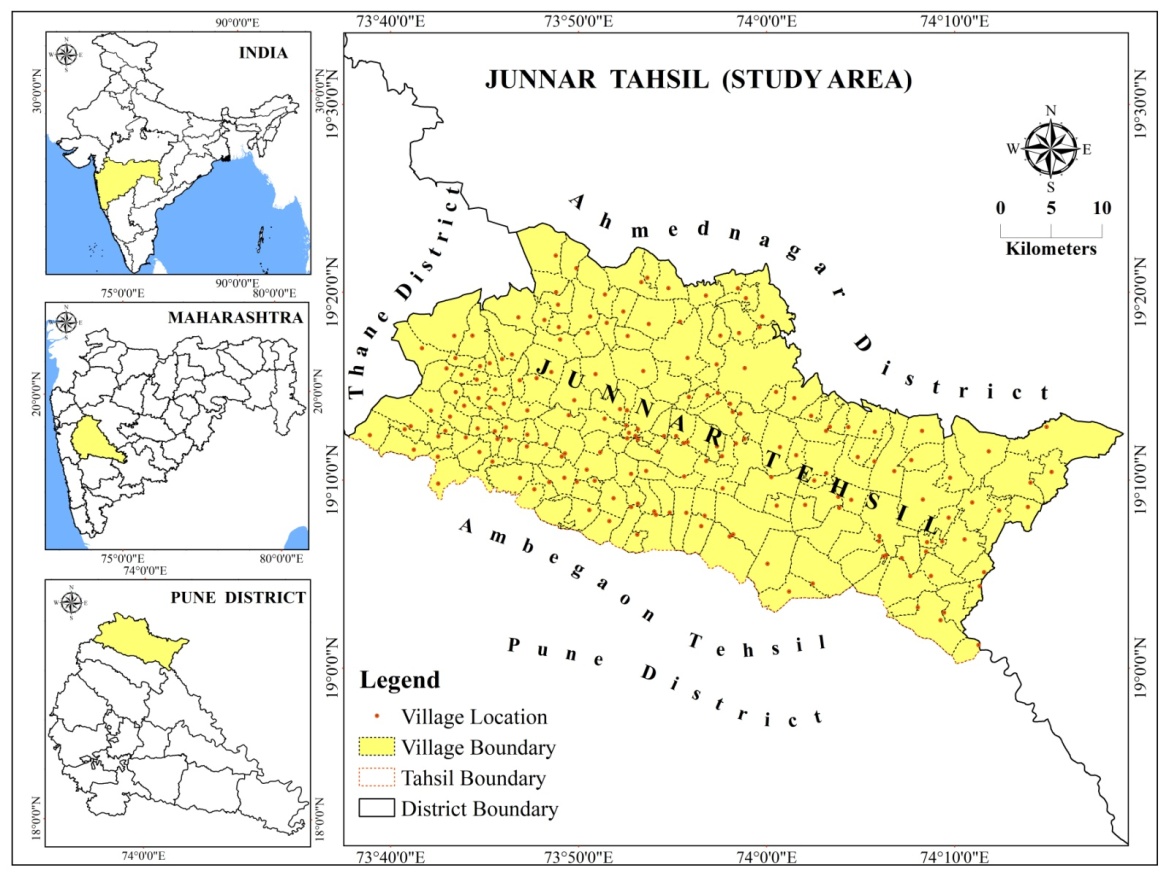
2.1. Study AreaJunnar Tahsil is located in the north part of the Pune district. It occurs in the zone of steep slope having rainfall around 50 to 250 cm. The extent of the Tahsil is 19° 00' to 19° 24' north and 73° 40' to 74° 18' east. The tahsil area is 1579.84 Sq.km. According to 2011 census 183 villages are there in Junnar tahsil. Junnar Tahsil population is 3,99,302. The rural population is more (93.66 %) and urban population is less (6.34 %.) Junnar tahsil. Generally small and domestic industries are lacking in this area. Most of the people engaged in agriculture for their livelihood. Junnar, Nimgaonsava, Otur, Belhe, Aptale, Narayangaon, Vadgaon Anand, Dingore and Rajur are the major nine revenue circles in the Junnar tahsil. Diversity in physical and socio-economic characteristics of study area and its resultant impact on pattern of food availability at local level led to selection of study area.
To measure agricultural productivity ten major crops grown in the Junnar tahsil were considered for the productivity analysis. Agricultural productivity was worked out by shafis Per capita calories method and index values divided into three different categories namely, high, moderate and low based on statistical technique.


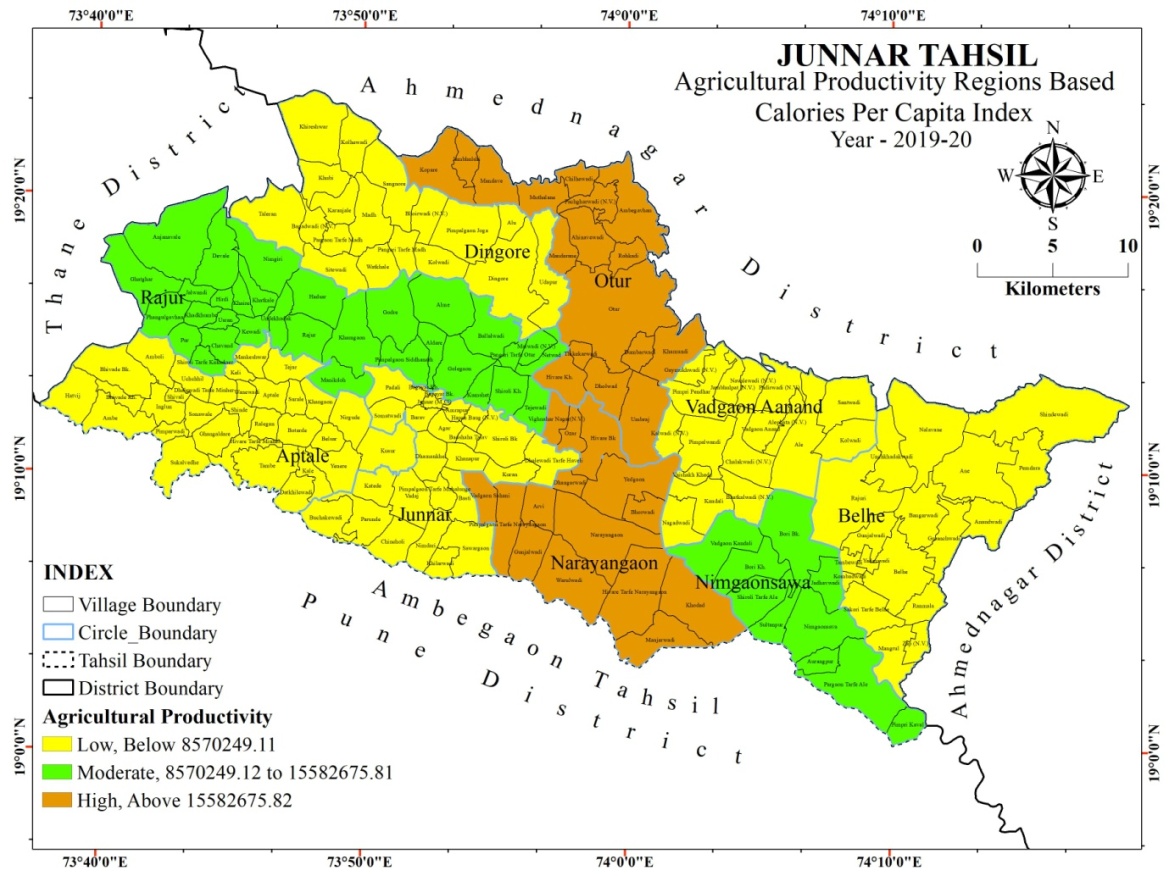
Spatial pattern of agricultural productivity on the basis of Calories per Capita index shows a wide range of variation. Table 1 shows the principal of grading system and Figure 1 reveals regional variation in agricultural productivity.
1. High Productivity Region
Otur and Narayangaon circles appear in this category and cover 20.95 percent net sown area in the tahsil. The calorie value per person of this region is above 15582675.82. These circles have adequate irrigation, High Yielding Variety Seeds, Chemical fertilizer and Pesticides, cash crops like Soyabean, Sugarcane, onion and tomato are the dominant in this region.
2. Moderate Productivity Region
Nimgaonsava and Rajur circles are appear in the moderate category and cover 28.77 percent net sown area in tahsil. The calorie value per person of this region is varies from 8570249.12 to 15582675.81. Moderate productivity has two separate pockets in the tahsil. One pocket lies in western part of the tahsil comprised Rajur circle. Second pocket found in south-east part of tahsil consist circles of Nimgaonsava. Modernization in agriculture, deep soil and less population density are the major components responsible for moderate productivity.
3. Low Productivity Region
Low productivity is found in five circles and covers 50.28 percent net sown area in tahsil. The calories per person of this region are less than 8570249.11 have been categorized under this region. There are four different pockets which registered low productivity. One pocket found in north-west part of Junnar tahsil it includes the Dingore circle. Second pocket lies in south-western part of the tahsil, it includes Aptale circle. Third isolated pocket lies in south part of tahsil, it includes Junnar circle. Fourth isolated pocket lies in North-eastern part of tahsil, it includes Vadgaon Anand and Belhe circles. Low yield per hectare is the basic cause of low productivity.
3.2. Food AvailabilityEvery person required energy for life and its only source for humans is food. According to medical science, the certain quantity of food is necessary for a healthy life. And medical scientists globally recommend having that specific amount of food to live a healthy life, globally; this volume of food is known as RDA (Recommended Dietary Allowances). As change in diet, climate and biological needs of people varies from one country to another, RDAs also show a bit of variation across countries. For India, Recommended Dietary Allowances is suggested by ICMR (Indian Council for Medical Research), New Delhi, based on the nutritive value of food produced in India and biological needs of individuals. According which an Indian must have the following items in the prescribed amount of food items are mandatory to sustain healthy life.
On the basis of ICMR methodology, food availability at the circle level has been calculated from data collected from the peoples. As we know from Table 2 that total food grains (Cereals) requirement for any person is 369.5 grams per day. The ICMR suggests that the standard food grain (cereals) requirement for per year is 134.87 kg for a person. On that account, data have been calculated for total food requirement as per population in each circle. Food production of each circle has seen as food availability in the tahsil and difference of available food and food requirement is food surplus or food deficit.
3.3. Mean Food AvailabilityThe relationship between population and food is whether the actual production of food, as opposed to the potential, can satisfy the requirements and effective demand for it, created by a rapidly growing population. The food problem created by rapid population growth is part of the general problem of over-all agricultural under development. The United Nations generally recognizes that population and food are closely interrelated; even to the extent that population problem has been identified as a food problem. Progress in food production and agricultural development are the essential conditions, together with lower population growth.
Table 3 reveals that agriculturally rich circles such as, Narayangaon, Otur and Nimgaonsava circles show the less food availability except Rajur have high food availability. Whereas, rainfed, hilly and tribal circles such as Belhe, Aptale and Dingore circles have good food availability. Rajur, Belhe, Aptale and Dingore circles have enough food grains or surplus food grains, which are very positive outcome for each circle. Particularly Rajur has highest food surplus (154.63 kg) followed by Aptale circle (143.69 kg), Belhe circle (56.46 kg) and Dingore circle is having least surplus food production which is only 13.63 kg. Junnar, Narayangaon and Vadgaon Anand have observed low productivity because of high density of population. On the other hand Otur and Nimgaonsava circles have less food grains or food deficit because least area under food grain crops. Particularly Otur has observed highest food deficit (-114 kg), followed by Narayangaon circle (-111.79 kg), Junnar circle (-105.05 kg), Nimgaonsava circle (-67.53 kg) and Vadgaon Anand circle (-66.40 kg), Overall, we can say there is deficit food availability in terms of food grain in the study area. The study area has a deficit of food grains, which is -28.66 kg per person in the Junnar tahsil.
3.4. Correlation AnalysisTo prove the hypothesis Pearson correlation technique is used to find out correlation between agricultural productivity and food availability. For establish correlation four variables were carefully chosen. These variables represent the command area and level of agricultural development and mean available food.
The result from Table 4 reveals that out of three predictor variables, one variable are significant with Command Area. Calories Per Capita Index (r = 0.718) is shows the good positive correlation with command area at 0.05 % significant level. The negative but insignificant correlation of command area found with total food available (r = - 0.577) and mean food available (r = - 0.578).
The conclusion after the study of correlation, there is a significant positive correlation of command area and agriculture productivity. But there is insignificant negative correlation between command area and availability of food. The command area affects the level of agriculture development and food availability in the study region. Higher the area under command area resulted into high agriculture productivity and low food availability.
Agriculture productivity in study area influenced due to disparity in irrigation pattern. Part of the study area where rivers spread their distributaries in their lower course is frequently irrigated by canals, resulting in high agricultural productivity. The irrigated land was ideal for cash crops such as vegetables, oil seeds, sugarcane, flowers, and fodder crops. On the other hand, areas in the catchment and rainfed region are best suited for cereal crop and cash crop combinations.
In study area, high agricultural productivity circles such as Narayangaon and Otur and moderate productivity circles such as Nimgaonsava are observed as foodgrains deficit circles. The circles with the lowest agricultural productivity and the least irrigation, namely Belhe, Aptale, and Dingore, were identified as foodgrain surplus regions. The area with low level of agricultural productivity found with more diversity in food grains than high productivity area. So it has been concluded that high level of agricultural productivity at local level need not necessarily contribute more to high food availability.
Cropping patterns in the region should not tilted more towards non-food crop only or food crop only. Mono-cropping of either food or non-food crop need to avoid to bring diversity in local availability. At the same time, crop rotation is required in agriculture for agricultural productivity and nutritional diversity. It is also necessary to bring agriculture diversification which is critical for the long-term development of agriculture and diversity of food availability. Equal attention required towards cultivation of food grains and cash crops in relation to the area available. Conservation of soil fertility must be on priority to have nutritious, diverse and locally produced food.
| [1] | Ramesh Chand, “International Trade, Food Security and the Response to the WTO in South Asian Countries” United Nations University, UNU-WIDER, World Institute for Development Economics Research, Research Paper No. 2006/124, 1-19. | ||
| In article | |||
| [2] | Chand Ramesh, “Demand for Food grains”. Economic and Political Weekly- 42, 2007, 52. | ||
| In article | |||
| [3] | Anil Chandy Ittyerah, “Food Security In India: Issues And Suggestions For Effectiveness”, Indian Institute of Public Administration, New Delhi, 2013, 7-8. | ||
| In article | |||
| [4] | Kale C.N., “Impact of Irrigation on Food Grain Crop Productivity in Western Maharashtra: A Geographical Analysis,” Maharashtra Bhugolshastra Sanshodhan Patrika, ISSN: 0971-6785, Vol. 34, No.2, 2017. 60-75. | ||
| In article | |||
| [5] | Gopalan, C., Ramasastri, B.V., Balasubramaniam, S. C., “Nutritive Value of Indian Foods,” National Institute of Nutrition, Indian Council of Medical Research, Hyderabad, India, 2014, 27-47. | ||
| In article | |||
| [6] | Birthal P.S., Joshi P.K., Roy D. And Thorat A., Diversification in Indian Agriculture towards High-Value Crops: The Role of Smallholders, International Food Policy Research Institute, Washington, DC 20006-1002, USA. 2007, 1-29. | ||
| In article | |||
| [7] | Naima Umar, “Regional analysis of food grain (Cereals and Pulses) productivity: assessing the impact of green revolution in Uttar Pradesh”, International Journal of Applied Research 2019; 5(3): 157-164. | ||
| In article | |||
| [8] | José Graziano da Silva, “The future of food and agriculture – Trends and challenges”. , Food and Agriculture Organization of the United Nations. 2017. 1-10. | ||
| In article | |||
| [9] | Manish Meena, Assessing Food Security In Southern Rajasthan, A Thesis Submitted For The Degree Of Doctor Of Philosophy In Geography, Faculty Of Earth Science, Mohanlal Sukhadia University, Udaipur (Raj.) 313001, 2018, 135-138. | ||
| In article | |||
Published with license by Science and Education Publishing, Copyright © 2022 Ashok Dushing, Ravindra Jaybhaye and Pravin Kokane
 This work is licensed under a Creative Commons Attribution 4.0 International License. To view a copy of this license, visit
http://creativecommons.org/licenses/by/4.0/
This work is licensed under a Creative Commons Attribution 4.0 International License. To view a copy of this license, visit
http://creativecommons.org/licenses/by/4.0/
| [1] | Ramesh Chand, “International Trade, Food Security and the Response to the WTO in South Asian Countries” United Nations University, UNU-WIDER, World Institute for Development Economics Research, Research Paper No. 2006/124, 1-19. | ||
| In article | |||
| [2] | Chand Ramesh, “Demand for Food grains”. Economic and Political Weekly- 42, 2007, 52. | ||
| In article | |||
| [3] | Anil Chandy Ittyerah, “Food Security In India: Issues And Suggestions For Effectiveness”, Indian Institute of Public Administration, New Delhi, 2013, 7-8. | ||
| In article | |||
| [4] | Kale C.N., “Impact of Irrigation on Food Grain Crop Productivity in Western Maharashtra: A Geographical Analysis,” Maharashtra Bhugolshastra Sanshodhan Patrika, ISSN: 0971-6785, Vol. 34, No.2, 2017. 60-75. | ||
| In article | |||
| [5] | Gopalan, C., Ramasastri, B.V., Balasubramaniam, S. C., “Nutritive Value of Indian Foods,” National Institute of Nutrition, Indian Council of Medical Research, Hyderabad, India, 2014, 27-47. | ||
| In article | |||
| [6] | Birthal P.S., Joshi P.K., Roy D. And Thorat A., Diversification in Indian Agriculture towards High-Value Crops: The Role of Smallholders, International Food Policy Research Institute, Washington, DC 20006-1002, USA. 2007, 1-29. | ||
| In article | |||
| [7] | Naima Umar, “Regional analysis of food grain (Cereals and Pulses) productivity: assessing the impact of green revolution in Uttar Pradesh”, International Journal of Applied Research 2019; 5(3): 157-164. | ||
| In article | |||
| [8] | José Graziano da Silva, “The future of food and agriculture – Trends and challenges”. , Food and Agriculture Organization of the United Nations. 2017. 1-10. | ||
| In article | |||
| [9] | Manish Meena, Assessing Food Security In Southern Rajasthan, A Thesis Submitted For The Degree Of Doctor Of Philosophy In Geography, Faculty Of Earth Science, Mohanlal Sukhadia University, Udaipur (Raj.) 313001, 2018, 135-138. | ||
| In article | |||