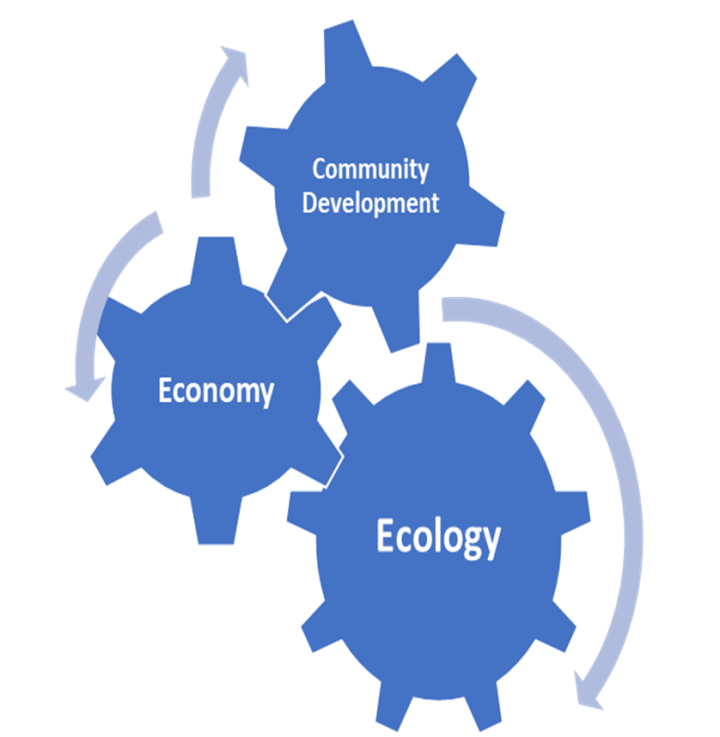
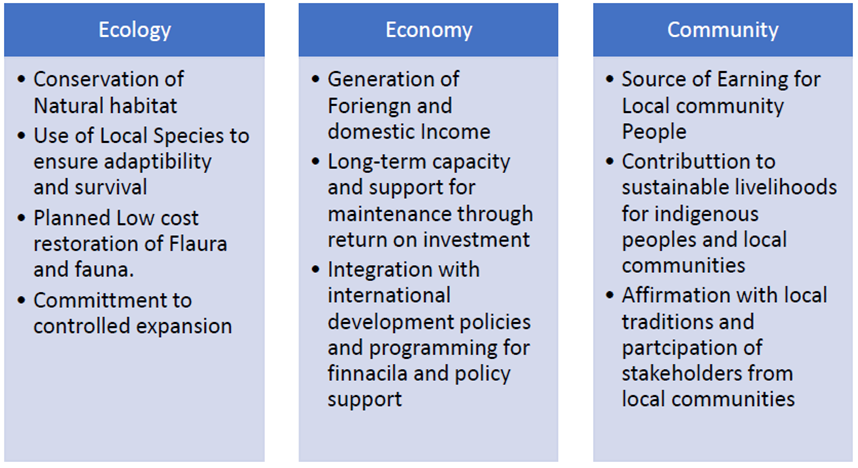
Development must always be sustainable, as development that compromises the ability of future generations to sustain in the longer term would not be appropriate means for the development of any community. When we talk about sustainability, it certainly comprises of the interaction of sustainable environment, sustainable community development along the sustainability of economic resources. Rao Jodha Desert Rock Park in Jodhpur city of India is a perfect example of adaptive use of natural habitat for generation of economic resources resulting in nurturing of the local community with a viable natural environment. The way Rao Jodha Desert Rock Park has developed its assets into a sustainable resource-creating structure is a classic example of how sustainable development must be undertaken by societies economy and organizations. The present study endeavors to analyze how Rao Jodha Desert Rock Park has executed sustainable development solutions. The paper at the end also provides recommendations for further efficient and effective utilization of the resources available in the Jodhpur city on the same lines.
Ecological sustainability and the environment have been a wide topic of interest amongst researchers, academia, and industries. The debate is still ongoing between economic development and environmental sustainability. There have been arguments that economic development will always come at the cost of ecological and environmental decay. However, for the last two decades, governments along with private organizations have been trying to devise mechanisms where environmental sustainability does not pay the price for economic resource development. There are rising concerns about environmental decay in the last few decades. According to Gadgil & Guha; India is eating up renewable soil, water, and animal life sources to achieve economic development goals 1. Out of the 17 sustainable development goals designed by the United Nations Development Programme; decent work and economic growth, industry, innovation, and infrastructure, sustainable cities, and communities are key focuses 2. According to UNESCO, sustainability is harvesting current opportunities with future considerations including the four dimensions to sustainable development – society, environment, culture, and economy 3. In the coming time, development with innovation will be the only way for sustainable economic development.
Sustainability brings a safe and liveable future to everyone. The depletion of resources is minimized in sustainable innovations. Sustainable practices will ensure the use of environmental resources in a way that leads to the conservation of resources for future generations. But sustainability is not only about environment and economy, as generally envisaged, rather it is an interaction of society, ecology, environment, economy, politics, and humanity a well. Wilber’s theory can be utilized in developing sustainable solutions to solve the issues of the environment 4 Sustainable development is not only an enhancement of the human environment protection concept but also is about satisfying the needs of contemporary people by maintaining human society and the ecological environment connection in a way that doesn't result into compromising the ability of future generations to meet their needs. 5
2.1. Social and Economic InclusionEconomic growth is a condition for social inclusion and sustainability 6. Organizations, looking for sustainable solutions, must support the generation by the development of opportunities through inclusive education and decent work. Sustainability requires fostering innovation and resilient infrastructures by creating communities and cities capable of producing and consuming sustainably. Innovations also have to be now social and economic centered 7.
2.2. Environmental ConcernsCaring for the environment by combating climate change and protecting oceans and terrestrial ecosystems focuses on the preservation of flora, fauna in a way that leads to the protection of the environmental resource and improvement in local climatic conditions. Out of four kinds of capital namely natural, human, human-made, and social, natural capital is most importantly must be preserved 8.
Though Environment and development are understood to be inversely proportionate to each other, however, development is imperative. Sustainable development has to be planned within the rules of ecology. At Rao Jodha Park, the experts and the naturalist have all come together to develop this wasteland into a natural habitat. Rao Jodha Desert Rock Park was created in 2006 to restore the natural ecology of a large, rocky wasteland. Rao Jodha Desert Rock Park lies in the footsteps of Mehrangarh fort in Jodhpur city 9. Rao Jodha, the ruler after whom the park and Jodhpur city are named, established the Mehrangarh fort in the middle of the 15th century. The park, a landscape of ancient rhyolite, is a combination of volcanic rocks that were formed around 700 million years ago. The Park extends across 70 hectares – about 170 acres – of rocky land. Here, amidst formidable rocks and arid, thorny desert vegetation lies a remarkable story of an ecological revival 10.
Mehrangarh Museum Trust (MMT) 11 worked with a team guided by the environmentalist and trees aficionado, Pradip Krishen, to ecologically restore the park by painstakingly removing thousands of mesquite (Prosopis juliflora ) shrubs, locally known as “Bavaliya”, an invasive species introduced from Central America that had proliferated among the rocks.
When the project started, the first monumental task was to get rid of the “Bavaliya”. Uprooting or hacking it wasn't working as it was growing back. The other tried solution was stumps of cow dung which failed and proved to be ineffective for this stubborn shrub. Here the MMT and Pradeep Kishan’s team realized that involvement of local people for implementation of traditionally tested knowledge must be sought. The local stonemasons called ‘khandawalias’ whose forefathers had carved out the magnificent Mehrangarh Fort were asked for their expertise and knowledge in the field. They are experts at detecting hidden cracks and crevices in rocks to remove the invasive mesquite. They used their unique skills to root out this invasive alien plant from the hard rocks that made space for other plants to grow. Over the next seven years, they worked carefully to bring back a multitude of other native plant species 12, 13.
September 2014 United Nations Climate Summit it was agreed upon by all governments across the globe that climate change restoration of degraded ecosystems is an auspicious solution 14.
Inside the park, in the carefully restored, sparse yet vibrant vegetation, a multitude of native arid-land species flourish among ancient rocks. We can witness 250 species of native plants, including a large number of arid region lithophytes. The park has several reptile species and over 200 species of birds and is an eBird hotspot 15. Mammals include free-ranging dogs, Indian crested porcupine, and northern or five-striped palm squirrel.
Another challenge was the huge number of resources required. Mehrangarh Museum Trust got funding from various institutions and organizations to carry out this long project which took them seven years to complete. Also, the use of local material has better restoration outcomes as local species/populations are already adapted and are provided with natural habitat, and also decreases potential pollution of the local gene pool 16. And this was an innate part of their restoration plan. One more challenge was the climatic conditions of Jodhpur which gives sustainability to very few plants so the flora chosen had to be the ones that could sustain the extreme temperatures of the Jodhpur City. Jodhpur, being a desert area, has extremes of climates wherein summer months temperatures rise to 45 to 50 degrees. However, this project has substantiated the claim that the impact of climate change on deserts may be overestimated and ignores the adaptive capacity of natural systems to a large range of climatic conditions 17.
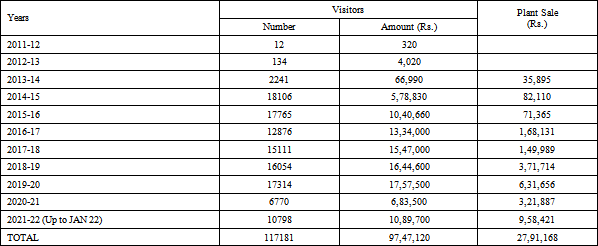
3.2. Community UpliftmentRao Jodha Desert Rock Park restored the natural ecology of this area. Economically this is self-sustaining by generating a source of regular income through tourists vising the interpretation gallery, native plants nursery, and small shop cafe. Its interpretation gallery is the source of attraction amongst naturalists, environmentalists, and tourists throughout the year. Tourists, birdwatchers, photographers, and documentary moviemakers from across the globe visit Rao Jodha Desert Rock Park. Therefore, the park generates income which helps it not only to sustain but also gives employment to and leads to local community upliftment as well. This provides an example of harmonious community upliftment as well 18.
3.3. Cultural AffirmationsConservation and sustainable development must respect the social and cultural traditions of the community and everything should be worked by the local norms. The action plan of Rao Jodha Desert Rock Park considers the improvement and development of both the local people and of the protected area for long-term participation from local stakeholders. Revitalization projects like this can result in optimal outcomes for both nature and culture and substantiate the belief that systems can be redesigned by an emphasis on the incorporation of local and traditional knowledge systems 19.
3.4. Commercial and Economic SustainabilityRao Jodha Park as discussed above is a case of self-sustaining tourism activities which function within the ecological capacity and also contribute to economic prosperity. Financial returns have been assured by introducing a nominal fee of 100 per person for adults, 200 per person for Guided Walk, and 0 Free entry for school students 19. The park strives not only for sustainable development but spreading awareness about the flora and fauna of different landscapes. This park provokes thought amongst visitors to think and support conservation and restoration tourism activities to raise funds for conservation and restoration of biodiversity of flora and fauna that otherwise would be extinct.

The ecological restoration at the Rao Jodha Desert Rock Park has been thoughtfully executed, comprising a set of three areas that deal with Historical aspects, ecological revival & landscape planning of native flora avoiding the ill-advised tree planting that is often carried out under the guise of ‘re-greening’ the desert. The restoration does not regard the arid, rocky terrain, grasslands, and thorn scrub as ‘wasteland’, It recognizes the desert and arid-land vegetation as natural ecosystems in its own right. Rao Jodha Desert Rock Park overcame the challenge of selecting suitable species for revegetation purposes efficiently, which, otherwise is a chased objective for researchers and scientists 22. The park includes a Visitors Center with Interpretation Gallery, a native plant nursery, a small shop, and a cafe. There are four trails (yellow, green, red, and blue trails), about 880 m to 1115 m long, that visitors can take and trained guides and naturalists are also available. Geological Survey of India has declared the Jodhpur welded tuff (Part of Rao Jodha Desert Park) as a National Geological Monument of India Which aims at conservation, preservation, promotion of Geotourism 23. Geotourism is tourism surrounding geological attractions and destinations. historical and cultural sites which are constructed by rocks are considered as the geo-monumental site of archaeological heritage 24. The main aim of this project was sustainable development while safeguarding the integrity of local aesthetics, protecting the environment & making it economically viable to deliver long-term equitable growth which benefits current and future generations. Rao Jodha Park has fulfilled the objective of sustainability by harvesting current opportunities with future considerations including the four dimensions to sustainable development – society, environment, culture, and economy with the help of ecological restoration in an innovative way.
The vision with which Rao Jodha Desert Rock Park was developed can be further fulfilled through environmental awareness programs in public-private partnership so that the local people, tourists, and service providers become self-aware about different environmental issues of the region. Park should have active outreach programs with the schools so that children from an early age are introduced to sustainable ecological projects, continuous wider community engagement programs. More such initiatives for the development, protection and conservation of different eco-tourism destinations should be undertaken by Government, NGOs, Private Organizations, etc. Travel journalists & bloggers too must report environmental & social impacts through social media for greater public cognizance and impact.
The paper is an outcome of continuous unconditional support from Mr. Karni Singh Jasol, Director, Mehrangarh Museum Trust, Jodhpur, Rajasthan.
| [1] | Gadgil, M., & Guha, R., This fissured land: an ecological history of India, University of California Press, 1993, Pp. 03. | ||
| In article | |||
| [2] | https://www.undp.org/sustainable-development-goals accessed on 21st Nov 2021. | ||
| In article | |||
| [3] | https://en.unesco.org/themes/education-sustainable-development/what-is-esd/sd accessed on 2nd Nov 2021. | ||
| In article | |||
| [4] | Wilber, K., A Theory of Everything: An integral vision for business, politics, science and spirituality, Shambhala Publications, 2001. | ||
| In article | |||
| [5] | Liu, Y., Yang, R., Sun, M., Zhang, L., Li, X., Meng, L., ... & Liu, Q. (2022). Regional sustainable development strategy based on the coordination between ecology and economy: A case study of Sichuan Province, China. Ecological Indicators, 134, 108445. | ||
| In article | View Article | ||
| [6] | von Schönfeld KC, Ferreira A. Urban Planning and European Innovation Policy: Achieving Sustainability, Social Inclusion, and Economic Growth? Sustainability. 2021; 13(3): 1137. | ||
| In article | View Article | ||
| [7] | European Commission, Mission-Oriented Research & Innovation in the European Union: A Problem-Solving Approach to Fuel Innovation-Led Growth; European Commission: Brussels, Belgium, 2018. | ||
| In article | |||
| [8] | Goodland, R., The concept of environmental sustainability, Annual review of ecology and systematics, 26(1), 1-24, 1995. | ||
| In article | View Article | ||
| [9] | https://jodhpurtourism.in/rao-jodha-desert-rock-park-jodhpur accessed on 3rd October 2021. | ||
| In article | |||
| [10] | Wilson, Jonathan J., Rocks: about the different kinds of rock inside Rao Jodha Desert Rock Park, Jodhpur, Mehrangarh Museum Trust. 36 pages, 2014. | ||
| In article | |||
| [11] | https://www.mehrangarh.org/ accessed on 21st Dec 2021. | ||
| In article | |||
| [12] | http://www.environment.gov.au/biodiversity/invasive/weeds/publications/guidelines/wons/pubs/prosopis.pdf accessed on 28th December 2021. | ||
| In article | |||
| [13] | Pradip, K., Plant guide to Rao Jodha desert rock park, Mehrangarh Museum Trust, Jodhpur. Aegean Offset Printers, New Delhi, 19, 2011. | ||
| In article | |||
| [14] | Suding, K., Higgs, E., Palmer, M., Callicott, J. B., Anderson, C. B., Baker, M., & Schwartz, K. Z., Committing to ecological restoration, Science, 348(6235), 638-640, 2015. | ||
| In article | View Article PubMed | ||
| [15] | https://ebird.org/hotspot/L1968093 accessed on 28th Dec 2021. | ||
| In article | |||
| [16] | Harris, J. A., Hobbs, R. J., Higgs, E., & Aronson, J., Ecological restoration and global climate change. Restoration Ecology, 14(2), 170-176, 2006. | ||
| In article | View Article | ||
| [17] | Tielbörger, K., & Salguero-Gómez, R., Some like it hot: are desert plants indifferent to climate change, In Progress in botany (pp. 377-400). Springer, Berlin, Heidelberg, 2014. | ||
| In article | View Article | ||
| [18] | Saurabh, M., Rathore, S. S., & Mathur, S. C., Jodhpur, Rajasthan-A Potential Geopark of India, INTACH, pp.242-263, January 2021. | ||
| In article | |||
| [19] | Pretty, J., Interdisciplinary progress in approaches to address social-ecological and ecocultural systems. Environmental Conservation, 38(2), 127-139, 2011. | ||
| In article | View Article | ||
| [20] | https://jodhpurtourism.in/rao-jodha-desert-rock-park-jodhpur accessed on 28th Jan 2022. | ||
| In article | |||
| [21] | Mehran Garh Museum Trust, Statement of Visitors for Rao Jodha Park. | ||
| In article | |||
| [22] | Bochet, E., & García-Fayos, P., Identifying plant traits: A key aspect for species selection in the restoration of eroded roadsides in semiarid environments. Ecological Engineering, 83, 444-451, 2015. | ||
| In article | View Article | ||
| [23] | Dowling, R. K., & Newsome, D. (Eds.), Geotourism. Routledge, 2006. | ||
| In article | |||
| [24] | Saurabh, M., Rathore, S. S., & Mathur, S. C., Jodhpur, Rajasthan-A Potential Geopark of India, INTACH, pp.242-263, January 2021. | ||
| In article | |||
Published with license by Science and Education Publishing, Copyright © 2022 Puja Gehlot and Neelam Kalla
 This work is licensed under a Creative Commons Attribution 4.0 International License. To view a copy of this license, visit
http://creativecommons.org/licenses/by/4.0/
This work is licensed under a Creative Commons Attribution 4.0 International License. To view a copy of this license, visit
http://creativecommons.org/licenses/by/4.0/
| [1] | Gadgil, M., & Guha, R., This fissured land: an ecological history of India, University of California Press, 1993, Pp. 03. | ||
| In article | |||
| [2] | https://www.undp.org/sustainable-development-goals accessed on 21st Nov 2021. | ||
| In article | |||
| [3] | https://en.unesco.org/themes/education-sustainable-development/what-is-esd/sd accessed on 2nd Nov 2021. | ||
| In article | |||
| [4] | Wilber, K., A Theory of Everything: An integral vision for business, politics, science and spirituality, Shambhala Publications, 2001. | ||
| In article | |||
| [5] | Liu, Y., Yang, R., Sun, M., Zhang, L., Li, X., Meng, L., ... & Liu, Q. (2022). Regional sustainable development strategy based on the coordination between ecology and economy: A case study of Sichuan Province, China. Ecological Indicators, 134, 108445. | ||
| In article | View Article | ||
| [6] | von Schönfeld KC, Ferreira A. Urban Planning and European Innovation Policy: Achieving Sustainability, Social Inclusion, and Economic Growth? Sustainability. 2021; 13(3): 1137. | ||
| In article | View Article | ||
| [7] | European Commission, Mission-Oriented Research & Innovation in the European Union: A Problem-Solving Approach to Fuel Innovation-Led Growth; European Commission: Brussels, Belgium, 2018. | ||
| In article | |||
| [8] | Goodland, R., The concept of environmental sustainability, Annual review of ecology and systematics, 26(1), 1-24, 1995. | ||
| In article | View Article | ||
| [9] | https://jodhpurtourism.in/rao-jodha-desert-rock-park-jodhpur accessed on 3rd October 2021. | ||
| In article | |||
| [10] | Wilson, Jonathan J., Rocks: about the different kinds of rock inside Rao Jodha Desert Rock Park, Jodhpur, Mehrangarh Museum Trust. 36 pages, 2014. | ||
| In article | |||
| [11] | https://www.mehrangarh.org/ accessed on 21st Dec 2021. | ||
| In article | |||
| [12] | http://www.environment.gov.au/biodiversity/invasive/weeds/publications/guidelines/wons/pubs/prosopis.pdf accessed on 28th December 2021. | ||
| In article | |||
| [13] | Pradip, K., Plant guide to Rao Jodha desert rock park, Mehrangarh Museum Trust, Jodhpur. Aegean Offset Printers, New Delhi, 19, 2011. | ||
| In article | |||
| [14] | Suding, K., Higgs, E., Palmer, M., Callicott, J. B., Anderson, C. B., Baker, M., & Schwartz, K. Z., Committing to ecological restoration, Science, 348(6235), 638-640, 2015. | ||
| In article | View Article PubMed | ||
| [15] | https://ebird.org/hotspot/L1968093 accessed on 28th Dec 2021. | ||
| In article | |||
| [16] | Harris, J. A., Hobbs, R. J., Higgs, E., & Aronson, J., Ecological restoration and global climate change. Restoration Ecology, 14(2), 170-176, 2006. | ||
| In article | View Article | ||
| [17] | Tielbörger, K., & Salguero-Gómez, R., Some like it hot: are desert plants indifferent to climate change, In Progress in botany (pp. 377-400). Springer, Berlin, Heidelberg, 2014. | ||
| In article | View Article | ||
| [18] | Saurabh, M., Rathore, S. S., & Mathur, S. C., Jodhpur, Rajasthan-A Potential Geopark of India, INTACH, pp.242-263, January 2021. | ||
| In article | |||
| [19] | Pretty, J., Interdisciplinary progress in approaches to address social-ecological and ecocultural systems. Environmental Conservation, 38(2), 127-139, 2011. | ||
| In article | View Article | ||
| [20] | https://jodhpurtourism.in/rao-jodha-desert-rock-park-jodhpur accessed on 28th Jan 2022. | ||
| In article | |||
| [21] | Mehran Garh Museum Trust, Statement of Visitors for Rao Jodha Park. | ||
| In article | |||
| [22] | Bochet, E., & García-Fayos, P., Identifying plant traits: A key aspect for species selection in the restoration of eroded roadsides in semiarid environments. Ecological Engineering, 83, 444-451, 2015. | ||
| In article | View Article | ||
| [23] | Dowling, R. K., & Newsome, D. (Eds.), Geotourism. Routledge, 2006. | ||
| In article | |||
| [24] | Saurabh, M., Rathore, S. S., & Mathur, S. C., Jodhpur, Rajasthan-A Potential Geopark of India, INTACH, pp.242-263, January 2021. | ||
| In article | |||