Soil erosion is the most critical environmental problem in the semi-arid region of the sabarkantha-Aravalli districts of Gujarat state. The present study is carried out on micro-watersheds of Mazum and Vatrak tributaries of the Sabarmati river basin of Gujarat state, west India, having an area of 8638 sq. km. In this paper, the Universal Soil Loss Equation (USLE) model has been used to quantify soil loss in micro watersheds. Five essential parameters such as Runoff-rainfall erosivity factor (R), soil erodibility Factor (K), slope length and steepness (LS), cropping management factor (C), and support practice factor (P) have been used to estimate the soil loss amount in the study area. All of these factors have been calculated using various data sources and data preparation methods. The soil erodibility (K) factor in the study area ranged from 0.46 to 0.93. All essential parameters have been calculated for before-after watershed scenarios. Changes in soil erosion have been estimated after the implementation of micro-watershed development projects under various government schemes. The average annual predicted soil loss ranges between 45 and 230 t/ha/y before implementation and 14.50 and 138 t/ha/y after implementation. Low decreases in soil loss areas (<30%) have been recorded under very slopy undulating and less treated areas. The high rate of decrease (>111%) in soil erosion was found to have a good provision of land treatment with watershed interventions along the watersheds on the main course of the Mazum and Watrak rivers.
Soil erosion is one of the major intimidations to the world affecting economy and agriculture. Soil erosion increases due to human interventions and due to climatic impacts. Reduction in the depth of soil 1 or loss in soil organic matter 2 consequently leads to low agricultural productivity. With the change of environment of the 21st century, these impacts have become more leading as it is expected that the future climate change is going to influence the frequency and magnitude of soil erosion in many ways 3. The erosion of soil is considered a major threat to the environment and causes problems for sustainability and agricultural productivity. 4 indicated that due to the increasing intensity of the the components of hydrological cycle, there will be more intense rainfall events in the upcoming years, and one of the direct influence factors is the change in the erosive nature of rainfall 3. Therefore, soil erosion is a severe environmental problem and according to 5 increased soil erosion leads to loss of nutrients, which results in decreasing agricultural production, and is also responsible for the eutrophication of the water bodies. 6 used USLE and Morgan models to estimate the soil erosion in Himalayan watershed. They reported that the erosion was within the limit as given by the Morgan model and a little higher value by USLE. From the past researches, it is clear that the climate or changing rainfall events have a direct impact on the soil erosion, which will be increasing in the near future. In addition to the high intensity of precipitation, other conditions also play an important role in deciding the rate of soil loss in an area. The type of land use, topography, slope factors, and the type of soil existing in the area also contribute considerably. The research described in this document was carried out with respect to the annual soil erosion rate before and after the implementation of watershed projects in the area of the given watersheds.
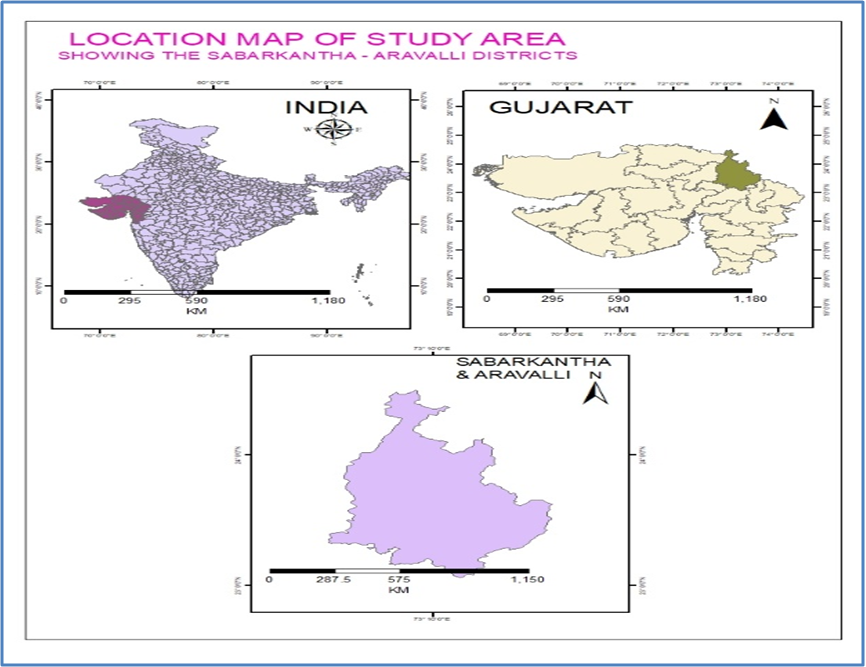
The Present study was conducted at 19 different micro watershed development projects of Sabarkantha and Aravalli districts of Gujarat state. (Figure 1). Latitudinal and longitudinal extent of the basin are between 23.5138°N & 72.7361°E respectively. The maximum temperature of the study area was ranges between 40°C to 42°C and minimum temperature ranges between 9°C to 11°C and the mean relative humidity was approximately 49.6 percent. The average rainfall of study area was 731 mm.
Sabarkantha and Aravalli districts receive much of its rainfall from the south-west monsoon during the period between June to October; its maximum intensity being in the month of July and August. Total rainy days ranges from 20 to 30 days per year. The major land use/land cover scenario of the watershed area include cultivated land, shrub land, forest land, grass land and water bodies. Cultivated land is situated on the steep and undulating slope and mostly, there are conservation measures implemented in different schemes. Sand, loamy and medium black are the three main types of soil found in almost entire districts. Sandy soil is chiefly found in the central part of the district covering mostly Modasa, Meghraj, Malpur, Himmatnagar, Bhiloda and Idar talukas. The loamy soil covers Modasa, Prantij, Himmatnagar, Bhiloda and Malpur talukas and the medium black soil covers Khedbrahma, Vijaynagar, Bayad and Idar talukas. The farming system of the watershed is mixed farming with dominantly cereal crop production. The major crops grown in both upper and lower regions of area are maize, wheat, millet, castor and sorghum. Before implementation of watershed projects under various schemes, steepness of the land, intensive cultivation, and absence of conservation structures as well as deforestation were factors for soil erosion in the study area. As a result of these factors, there were visible erosion features like sheet, rill and gully erosion formation in study area.
2.2. Study MethodData used for evaluation of RUSLE factors in this study were obtained from secondary sources. RUSLE factors were calculated for before watershed and after watershed scenario in the study area. The secondary data for calculation of all factors were collected by questionnaire survey and field observations techniques for after watershed scenario whereas the same were collected by questionnaire and participatory group beneficiary discussions techniques for the before watershed scenario. The soil erosion calculation was carried out manually by equations as there was a limitation of availability of DEM and satellite imaginaries for micro watersheds for before watershed scenario. In present study, the data and analysis for before watershed project implementation scenario and after watershed project implementation scenario are represented and abbreviated as B.W and A.W, respectively.
The average annual soil loss for selected micro watersheds was estimated using RUSLE. The empirical equation RUSLE was proposed by 7 used to calculate average annual soil loss. The soil loss was calculated using the following equation
 |
Where, A is the computed average soil loss over a period selected for R, usually on a yearly basis (t/ha/year), R is rainfall erosivity factor (MJ -mm /ha-hr-yr), K is soil erodibility factor (t/ MJ- hrmm), L is slope length factor (dimensionless), S is slope steepness / gradient factor, C is cover management factor (dimensionless) and P is support practice factor (dimensionless)
R- factor is the rainfall erosivity factor based on rainfall data. 8, 9 developed the relationship between average annual erosion index (R factor) and annual rainfall India based on their analysis of data from 44 stations spread across various rainfall zones of the country.
The relationship is thus:
 |
Where R-Factor is rainfall erosivity factor and P is Average annual rainfall in mm.
In present study, annual rainfall data (in mm) for the 25 years period 1995-2018 for 8 meteorological stations of Sabarkantha and Aravalli Districts were used to compute the R factor. The required missing rainfall data were obtained from local government agencies
The erodibility of a soil is an expression of its inherent resistance properties to particle detachment and transport by rainfall. The K-factor was calculated by using the formula by 7, 10 given as below,
 |
Where, K is soil erodibility (tons/MJ-hrmm), OM is percent organic matter, PI is permeability index, SI is the soil structure index and M is a function of the primary particle size function given by M= (%silt+%very fine sand) * (100-%clay) 10.
In present study, 45 soil samples were collected out of which 27 were from cultivated fields and 18 from uncultivated wastelands. For calculation of K factor by above formula, textural analysis of 45 soil samples was carried out. Accordingly, the samples were heated at 1200C in an oven for 2 days to dry out the moisture content. These were passed through sieves of 2 mm, 0.25 mm and 0.062 mm diameter. To estimate the amount of organic matter present in a soil sample, the weight lost by an oven-dried (120°C) soil sample when it is heated to 400°C was measured by method “ loss of ignition”. As the soil sampling for B.W. scenario is not possible as the implementation of most of the watersheds was started in previous years (i.e before 2009) so for all the projects, the data for soil texture, slope steepness, organic matter content, etc. was collected by joint field visits and questionnaire with the beneficiaries and cross checked by the records of district agricultural department.
The L and S factor (topographic factor) represents the effect of topography on erosion in USLE method. The slope length factor (L) represents the effect of slope length on erosion, and the slope steepness factor (S) represents the influence of slope gradient on erosion. The topographic factor in the present study was therefore computed by using the equation stated by 11, 12.
 |
Where S is the slope steepness in %, λ is slope length in m. Topographic Abney level Clinometer was used to measure field slopes in degrees. Slope length was measured using meter tape. Thereafter, degree slope was converted to percent slope.
C - Factor is the cropping management factor, dimensionless and ranging between 0 and 1 based on different LULC classes. Based on the literature review 13, the C-factor is assigned a value for different crop types grown in study area as per Table 1.
Considering land use land cover and major crops grown in project, the corresponding values of C-factor based on crop type were finalized through joint field visits and questionnaire data.
The P-factor is a supporting conservation practice factor which represents the ratio of soil loss by a support practice to that of straight-row farming up and down the slope. The P-factor was assumed by using the conservation practice of the study area. Values of P factor compiled at ICAR Dehradun centre for Indian conditions 8 have been used for calculating P-factor as shown in Table 2.
The values for P-factor were considered based on the treatments provided in watershed projects for A.W and B.W scenarios. The same for B.W. scenario were considered for the traditional up and down cultivation as there was no treatment before the implementation of projects.
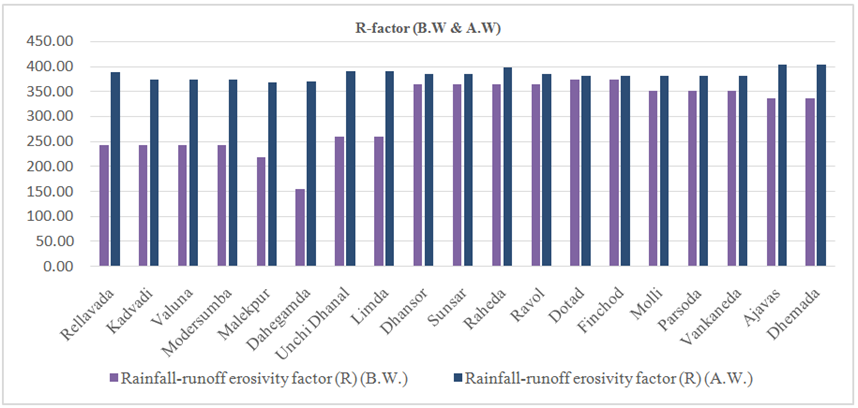
Many studies 6, 14 discovered that the rate of soil erosion in the watershed catchment is much more sensitive to rainfall. The annual rainfall is a prime indicator of change in the rate of soil erosion to illustrate the seasonal distribution of sediment yield. Therefore, in the present study, the average annual rainfall was used for calculation of R factor. The estimated R factor value for B.W ranges from 155.23 to 373.10 and for A.W ranges from 369.18 to 404.09. It is detected that rainfall is high in Dotad and Finchod watersheds for B.W and in Ajwas and Dhemada for A.W as indicated from the results shown in Table 3. The comparative values of R-factor for B.W and A.W have been shown Figure 2.

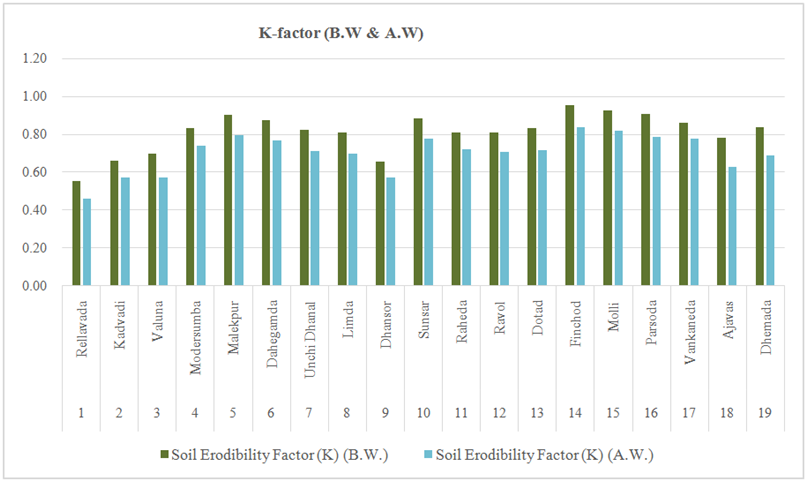
From the results presented in Table 4, the values of K factor are found ranging between 0.55 and 0.96 for B.W and 0.46 and 0.84 for A.W. The lower value of K factor is associated with the soils having lesser permeability, lesser moisture content, etc. The comparative values of K-factor for B.W and A.W have been shown in Figure 3.

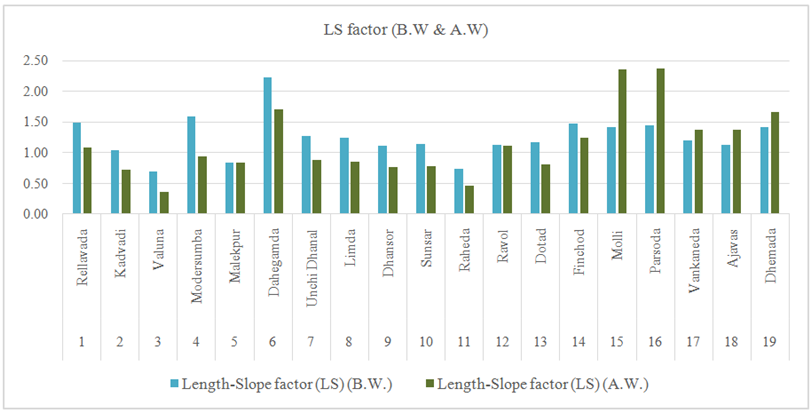
Length-slope factor represents the topographical influence of slope length and slope steepness on erosion process. LS factor was calculated by considering the land gradient and slope steepness. From the analysis and results presented in Table 5, it is observed that the value of LS factor increases in a range of 0.7 to 2.22 for B.W and 0.36 to 2.37 for A.W as the flow accumulation and slope changes over time. The comparative values of LS-factor for B.W and A.W have been shown in Figure 4.

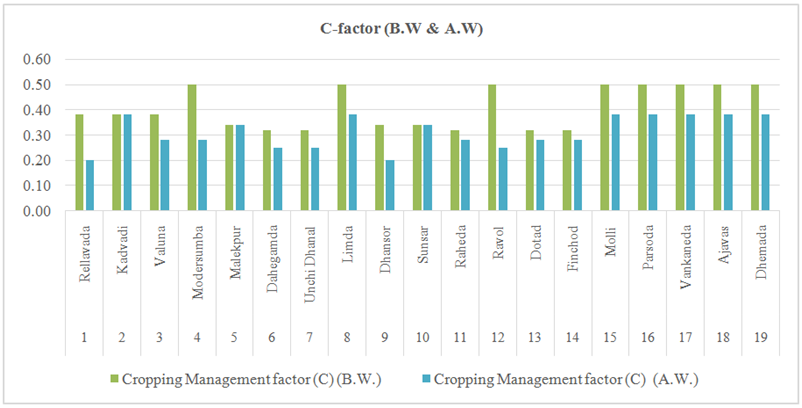
The C-factor values in this study are considered as per the cropping pattern based on LULC classes according to the Table 1 13. The values are assigned for different cropping patterns and varying from 0.32 to 0.50 as presented in Table 6. The comparative values of C-factor for B.W and A.W have been shown in Figure 5.

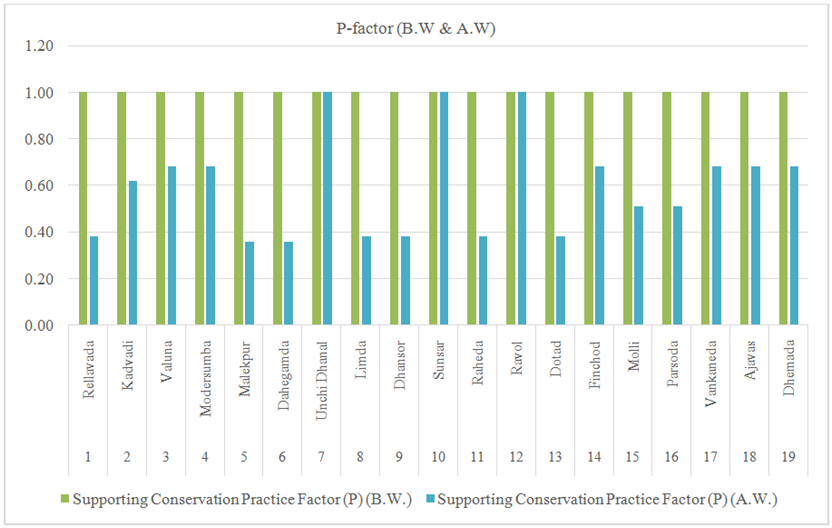
The P factor values representing the effect of various soil and water conservation and support practices implemented in watershed areas are assigned for different classes of LULC in the study area. As it is presumed that there are negligible practices in the watershed area for B.W, the P factor value is assigned as 1 and as per the LULC class for A.W, different values ranging from 0.36 to 1.00 have been assigned as represented in Table 7. The comparative values of P-factor for B.W and A.W have been shown in Figure 6.

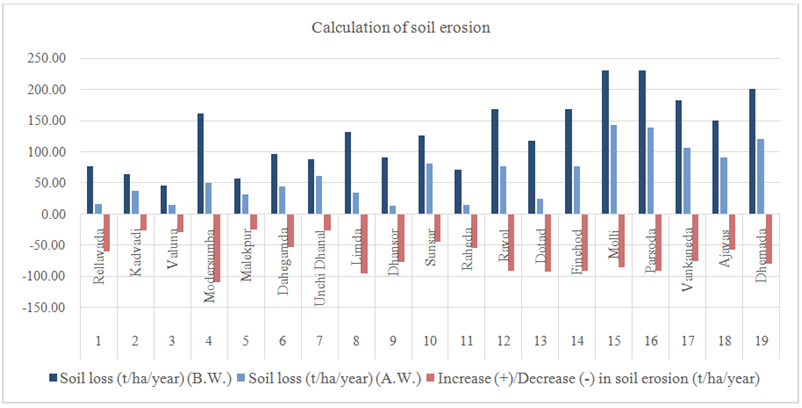
The average annual soil loss for B.W and A.W in the study area was computed using USLE and represented in Table 8. The average annual soil loss values for B.W vary from 45 to 230 t/ha/year whereas for A.W vary from 13 to 143 t/ha/year. The comparative values of soil erosion rate and changes in B.W and A.W have been shown in Figure 7.

The quantitative results of changes in soil loss were divided into five categories as shown in Table 9. Major study area falls within the severe (77.28%) and high erosion category (10.86%) for B.W, where the hilly topography, high land slopes and poor cultivation practices result in severe and high soil erosion. These severe and high erosion category area for A.W scenario reduces to 33.26% (severe) and 36.38% (high), which justifies that various watershed interventions have made the impact in watershed projects implemented in study area. About 9.24% of the study area is under moderate and 2.63% under slight categories for B.W. So, for A.W scenario, the severe area under extreme erosion risk is distributed into low, slight, and moderately high category areas. So, management practices adopted in the areas of the high to extreme risk erosion in order to reduce soil loss have impacted over the years and have become the successful project components to reduce the soil erosion rate.
Results of this study reflect adopting USLE for both before and after project implementation scenarios applied as a simple method to predict soil loss and soil erosion risk and the changes in soil erosion rates in micro watersheds. The methods and results described in this study are valuable for understanding the relationship between soil erosion changes and environmental factors and are also important for land use planning and watershed management to avoid soil erosion. The results obtained from the study are well compatible with other studies carried out in the watersheds of Sabarkantha and Aravalli districts. The results can be used to advice the local central governmental authorities in characterizing the watershed areas for erosion mitigation.
| [1] | D. A. Wardle, R. D. Bardgett, J. N. Klironomos, and H. Seta, “Ecological Linkages Between Aboveground and Belowground Biota,” Science, vol. 304, no. June, pp. 1629-1634, 2004. | ||
| In article | |||
| [2] | G. W. Langdale, L. T. West, R. R. Bruce, W. E. Miller, and A. W. Thomas, “Restoration of Eroded Soil with Conservation Tillage,” Cremlingen, vol. 5, pp. 81-90, 1992. | ||
| In article | |||
| [3] | F. F. Pruski, “Climate-induced changes in erosion during the 21st century for eight U . S . locations,” Water Resour. Res., vol. 38, no. 12, p. 1298, 2002. | ||
| In article | |||
| [4] | T. I. Panel et al., “Climate Change 2007: Impacts, Adaptation, and Vulnerability,” Cambridge University Press, 2007. | ||
| In article | |||
| [5] | M. M. Bakker, G. Govers, R. A. Jones, and M. D. A. Rounsevell, “The Effect of Soil Erosion on Europe‘s Crop Yields,” Ecosystems, vol. 10, no. 3, pp. 1209-1219, 2007. | ||
| In article | |||
| [6] | S. K. Jain, S. Kumar, and J. Varghese, “Estimation of soil erosion for a Himalayan watershed using GIS technique,” Water Resour. Manag., vol. 15, no. 1, pp. 41-54, 2001. | ||
| In article | |||
| [7] | D. C. Renard, K. G., Foster, G. R., Weesies, G. A., McCool, D. K., and Yoder, “Predicting Soil Erosion by Water : A Guide to Conservation Planning With the Revised Universal Soil Loss Equation ( RUSLE ),” in Agriculture Handbook No. 703, USDA Research Service, Washington, DC., 1997. | ||
| In article | |||
| [8] | G. Singh, R. Babu, P. Narain, L. S. Bhushan, and I. P. Abrol, “Soil erosion rates in India,” J. Soil Water Conserv., vol. 47, no. 1, pp. 97-99, Jan. 1992, Accessed: Jan. 19, 2022. | ||
| In article | |||
| [9] | A. M. Dawlatzai, “Estimation of Soil Erosion Based on USLE and GIS in Gardez Basin of Paktya Province, Afghanistan,” Int. J. Environ. Rural Dev., vol. 8, no. 1, pp. 139-149, 2017. | ||
| In article | |||
| [10] | B. Wang, F. Zheng, and Y. Guan, “Improved USLE-K factor prediction: A case study on water erosion areas in China,” Int. Soil Water Conserv. Res., vol. 4, no. 3, pp. 168-176, 2016. | ||
| In article | |||
| [11] | D. K. Mccool, W. H. Wischmeier, and L. C. Johnson, “Adapting the Universal Soil Loss Equation to the Pacific Northwest,” Trans. ASAE, p. 928-934, 1982. | ||
| In article | |||
| [12] | M. N. Admankar and G. K. Patil, “Estimation of soil erosion using USLE and GIS,” Int. J. Recent Technol. Eng., vol. 8, no. 2, pp. 3936-3939, 2019. | ||
| In article | |||
| [13] | P. Panagos, P. Borrelli, K. Meusburger, C. Alewell, E. Lugato, and L. Montanarella, “Estimating the soil erosion cover-management factor at the European scale,” Land use policy, vol. 48, pp. 38-50, 2015. | ||
| In article | |||
| [14] | P. P. Dabral, N. Baithuri, and A. Pandey, “Soil Erosion Assessment in a Hilly Catchment of North Eastern India Using USLE, GIS and Remote Sensing,” Water Resour. Manag. 2008 2212, vol. 22, no. 12, pp. 1783-1798, Mar. 2008. | ||
| In article | |||
Published with license by Science and Education Publishing, Copyright © 2022 Vishalkumar R. Gor and Vinodkumar M. Patel
 This work is licensed under a Creative Commons Attribution 4.0 International License. To view a copy of this license, visit
http://creativecommons.org/licenses/by/4.0/
This work is licensed under a Creative Commons Attribution 4.0 International License. To view a copy of this license, visit
http://creativecommons.org/licenses/by/4.0/
| [1] | D. A. Wardle, R. D. Bardgett, J. N. Klironomos, and H. Seta, “Ecological Linkages Between Aboveground and Belowground Biota,” Science, vol. 304, no. June, pp. 1629-1634, 2004. | ||
| In article | |||
| [2] | G. W. Langdale, L. T. West, R. R. Bruce, W. E. Miller, and A. W. Thomas, “Restoration of Eroded Soil with Conservation Tillage,” Cremlingen, vol. 5, pp. 81-90, 1992. | ||
| In article | |||
| [3] | F. F. Pruski, “Climate-induced changes in erosion during the 21st century for eight U . S . locations,” Water Resour. Res., vol. 38, no. 12, p. 1298, 2002. | ||
| In article | |||
| [4] | T. I. Panel et al., “Climate Change 2007: Impacts, Adaptation, and Vulnerability,” Cambridge University Press, 2007. | ||
| In article | |||
| [5] | M. M. Bakker, G. Govers, R. A. Jones, and M. D. A. Rounsevell, “The Effect of Soil Erosion on Europe‘s Crop Yields,” Ecosystems, vol. 10, no. 3, pp. 1209-1219, 2007. | ||
| In article | |||
| [6] | S. K. Jain, S. Kumar, and J. Varghese, “Estimation of soil erosion for a Himalayan watershed using GIS technique,” Water Resour. Manag., vol. 15, no. 1, pp. 41-54, 2001. | ||
| In article | |||
| [7] | D. C. Renard, K. G., Foster, G. R., Weesies, G. A., McCool, D. K., and Yoder, “Predicting Soil Erosion by Water : A Guide to Conservation Planning With the Revised Universal Soil Loss Equation ( RUSLE ),” in Agriculture Handbook No. 703, USDA Research Service, Washington, DC., 1997. | ||
| In article | |||
| [8] | G. Singh, R. Babu, P. Narain, L. S. Bhushan, and I. P. Abrol, “Soil erosion rates in India,” J. Soil Water Conserv., vol. 47, no. 1, pp. 97-99, Jan. 1992, Accessed: Jan. 19, 2022. | ||
| In article | |||
| [9] | A. M. Dawlatzai, “Estimation of Soil Erosion Based on USLE and GIS in Gardez Basin of Paktya Province, Afghanistan,” Int. J. Environ. Rural Dev., vol. 8, no. 1, pp. 139-149, 2017. | ||
| In article | |||
| [10] | B. Wang, F. Zheng, and Y. Guan, “Improved USLE-K factor prediction: A case study on water erosion areas in China,” Int. Soil Water Conserv. Res., vol. 4, no. 3, pp. 168-176, 2016. | ||
| In article | |||
| [11] | D. K. Mccool, W. H. Wischmeier, and L. C. Johnson, “Adapting the Universal Soil Loss Equation to the Pacific Northwest,” Trans. ASAE, p. 928-934, 1982. | ||
| In article | |||
| [12] | M. N. Admankar and G. K. Patil, “Estimation of soil erosion using USLE and GIS,” Int. J. Recent Technol. Eng., vol. 8, no. 2, pp. 3936-3939, 2019. | ||
| In article | |||
| [13] | P. Panagos, P. Borrelli, K. Meusburger, C. Alewell, E. Lugato, and L. Montanarella, “Estimating the soil erosion cover-management factor at the European scale,” Land use policy, vol. 48, pp. 38-50, 2015. | ||
| In article | |||
| [14] | P. P. Dabral, N. Baithuri, and A. Pandey, “Soil Erosion Assessment in a Hilly Catchment of North Eastern India Using USLE, GIS and Remote Sensing,” Water Resour. Manag. 2008 2212, vol. 22, no. 12, pp. 1783-1798, Mar. 2008. | ||
| In article | |||