Interruption in the connectivity provided by the free-flowing river is the most critical issue threatening the life of migratory fishes. Unlike other rivers of Southern Western Ghats, the Meenachil River does not have any hydroelectric dams. Instead, it has several check dams without fish passages along its course, fragmenting the river into discrete lentic zones hampering fish migration. The present study conducted in the Meenachil River of Southern Western Ghats from 2015 to 2019 documented the different migratory fishes of the river and their abundance during different seasons in correlation to the precipitation pattern of the region. Thirteen fish species under catadromous, anadromous, and oceanodromous migrants belong to seven orders, ten families, and twelve genera were recorded in the study. Monsoon is the only season when the river overflows the check dams, restoring the river’s continuity and lateral connectivity. A significant positive correlation was observed (p=0.59 .p< 0.05) between the rainfall pattern and the abundance of migratory fishes during the study period. The nearly threatened migrants of the river, Anguilla bengalensis recorded the lowest relative abundance of 0.23 and Wallago attu 1.14, respectively. Indiscriminate monsoon catching of the gravid species Labeo dussumeiri and Wallago attu during their spawning migrations upstream using specially designed aerial traps was reported. Other monsoon traps Cheru and Perumkoodu set along the flooded river’s lateral connections targeted the floodplain migrants of the river Heteropneustes fossilis, Channa striata and Channa marulius. Gill net traps were set along the migratory pathways to catch Horabagrus brachysoma, a vulnerable species. The salinity barrier Thanneermukhom Bund in Vembanadu Lake, the confluence zone of the river, prevents the migration of the Anguilla bengalensis, Megalops cyprinoides and Mystus gulio between Meenachil River and the Arabian Sea.
Migration of fishes can be distinguished from other types of movements as it is directed rather than random and occurs seasonally or regularly between two or more segregated habitats involving a considerable portion of the population 1. Fish species tend to migrate within or between rivers and oceans for breeding and non-breeding purposes, which is critical for survival 2, 3. Globally, migratory fish populations are disproportionately threatened compared to other fish groups showing a drastic decline between 1970 and 2016 in tropical and temperate regions 4. Interruptions in the connectivity provided by the free-flowing riverine system are the most critical issue threatening the life history of migratory fishes 5. Many artificial barriers, such as dams, culverts, road crossings, and weirs, can change the flow regime interrupting the connectivity of rivers to the downstream floodplain habitats, impeding migratory fish movement, and reducing their ability to complete their lifecycle 6. Another significant issue is the trapping of gravid migrants during their spawning migrations. As fish migration is a cyclic and predictable phenomenon, the migrants can be easily exploited 7 during their massive migratory trips by indigenous fishermen using skillfully designed species-targeted traps 8.
There are significant information gaps in the knowledge of migratory fish species, particularly from South America, Asia, and Oceania. These gaps are clearly reflected in the Global Register of Migratory Fishes (GROMS) 9. There are several migratory species whose biology, migration time, and stages are poorly understood or completely unknown 10. Unfortunately, knowledge about migratory fish from Western Ghats Rivers is still limited. No such attempts have been documented from the rivers of Kerala except the work conducted by Gopalakrishnan and Klaus 11, which has contributed to strengthening the GROMS. As many of the migratory fishes of the Western Ghats Rivers of Kerala are endemic and the most exploited ones of the river are categorized by IUCN as nearly threatened and vulnerable, an intensive regional survey to document the present ecological status of the migrant fish fauna of the river is crucial for its conservation. The present study is an attempt to explore the migrant fishes of the river, its abundance correlated to seasonal and annual rainfall, and to evaluate the present threats in perspective to conservation.
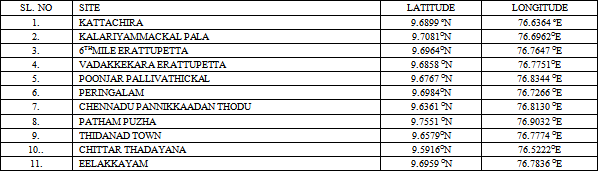
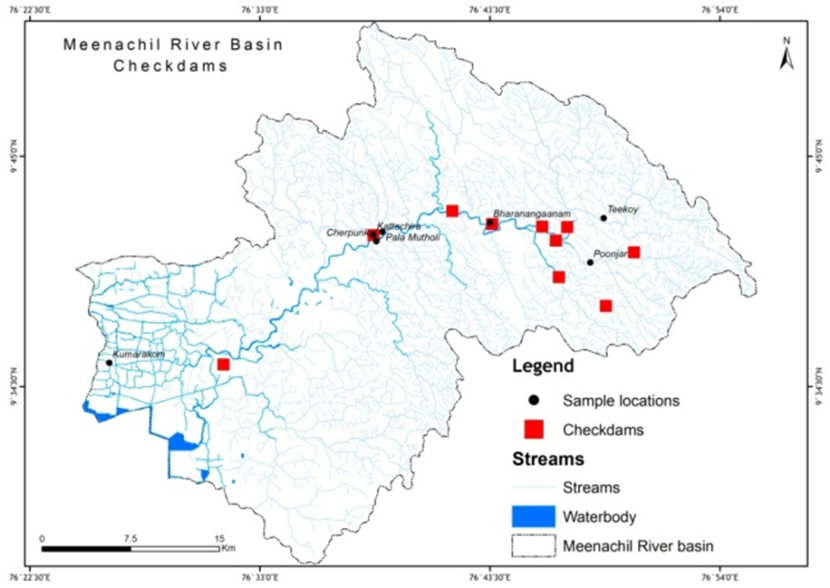
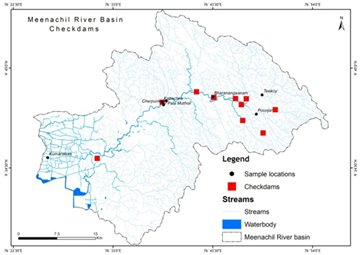
Meenachil River of Southern Western Ghats is a relatively short river in Kerala, 78kms long, with a catchment area of 1272 km2. Its watershed extends from a latitude of 9°25' to 9°55' and longitude of 76°20' to 76°55'. The major tributary originates at Annakunnumudi at an elevation of +922m above MSL. It is among the few rivers of Kerala without a hydropower dam. Nevertheless, the river is interrupted throughout its course by several check dams (Table 1) and the salinity barrier Thanneermukhom Bund in the Vembanadu Lake between the confluence zone of the river and the Arabian Sea. The midstream stretch of the river receives several tributaries linked to the major flood plains (Figure 1).
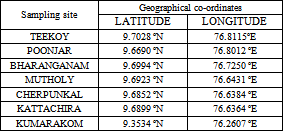
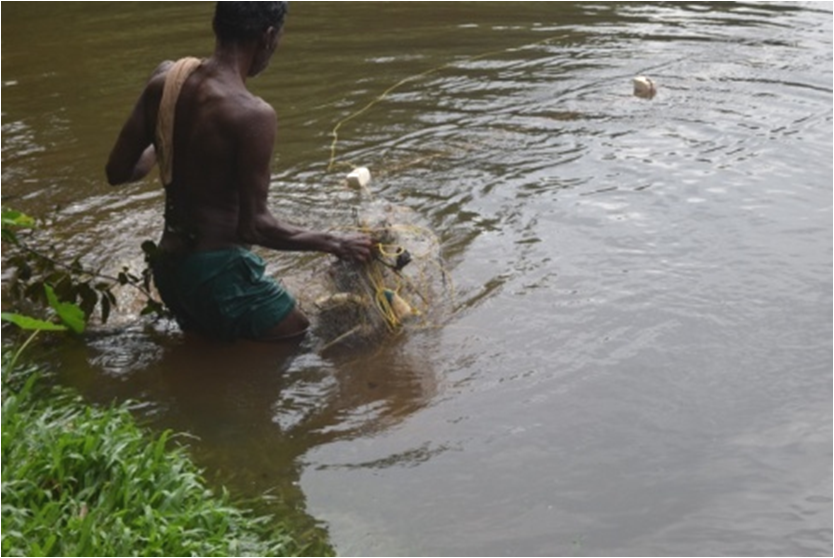
2.2. Sampling MethodSampling was done from the different locations of the upstream, midstream, and downstream (Table 2) stretches of the Meenachil River during the monsoon (June to September), pre-monsoon (February to May), and post-monsoon (October to January) seasons from January 2015 to December 2019. Sampling stations from the midstream and downstream stretches were selected based on the river's lateral connections to the wetlands and low-lying plains. Cast nets, gill nets, bag nets, hooks, and lines were used to collect the fish. Fish collected by the local villagers using specially designed traps during the monsoon seasons were also included in the sampling.
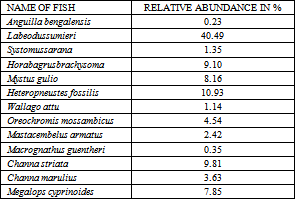
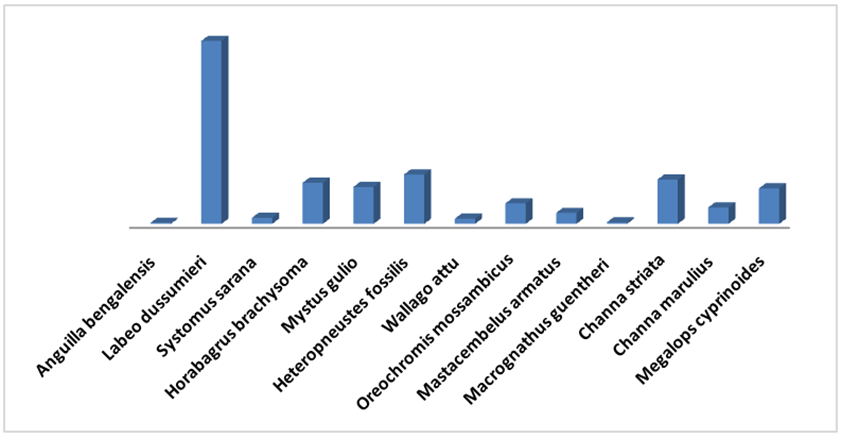
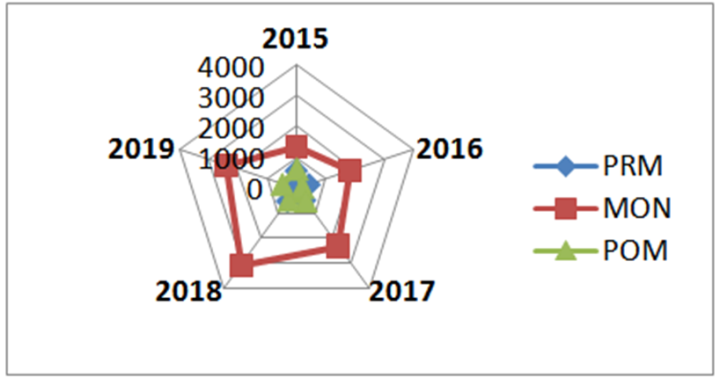
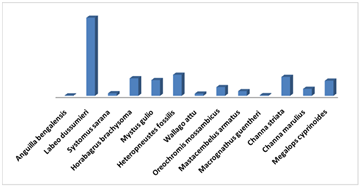
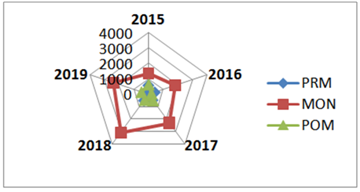
The collected fishes were identified referring to the standard literature by Jayaram 12, Talwar and Jinghran 13. Migratory species were identified according to the norms specified by the Global Register of Migratory Species 9 after Mc Dowal 14. Fishbase 15 and Eschmeyer's Catalog of Fishes 16 were strictly followed to avoid the nomenclatural ambiguity of migratory species. The annual, seasonal, and relative abundance of migratory fishes was documented (Figure 2 and Table 4). The rainfall data (2015 to 2019) for the region was retrieved from the Indian Meteorological Department (IMD) and Climate Research Unit (CRU), Pune.
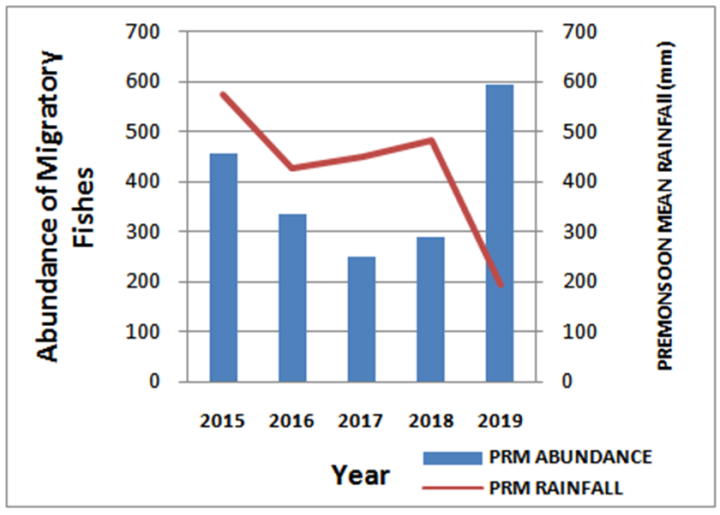
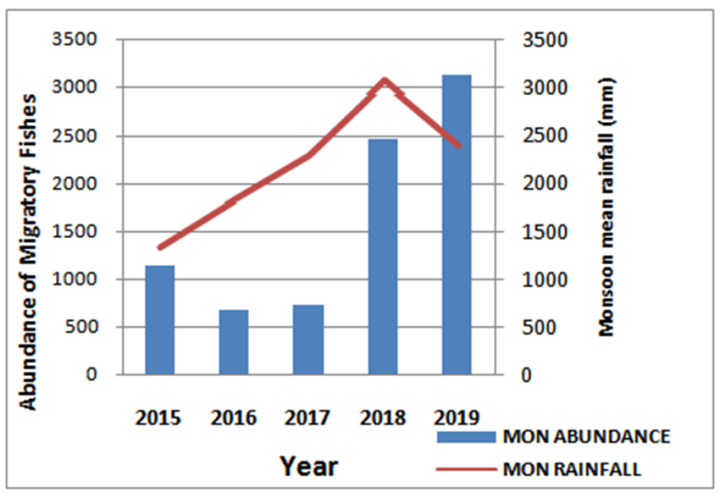
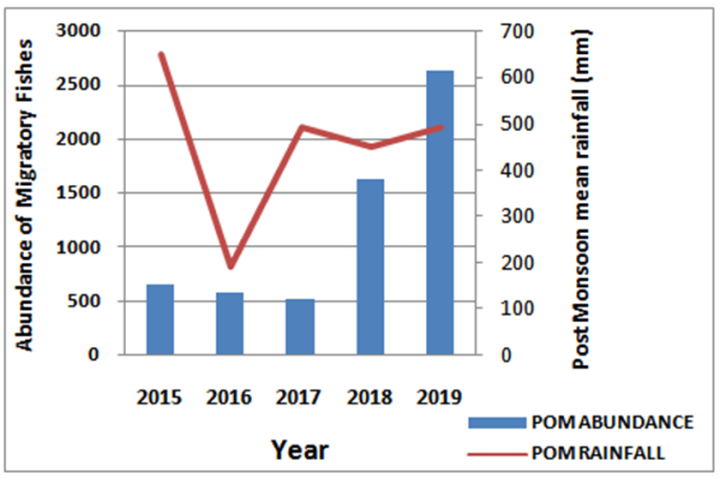
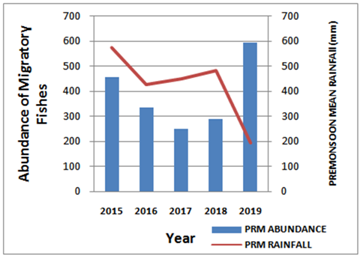
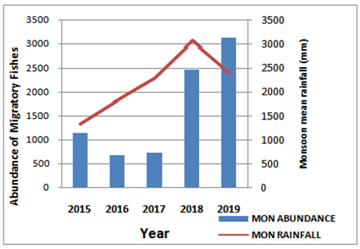
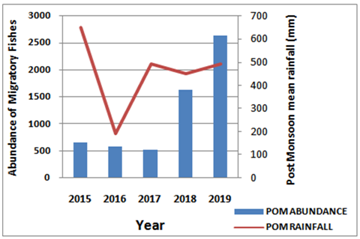
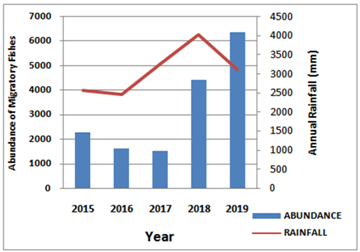
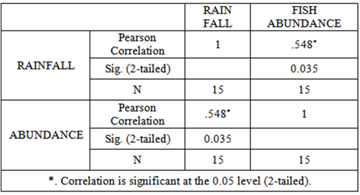
In order to evaluate the association of rainfall trends with the abundance of migratory fishes in the river, a correlation between seasonal rainfall and abundance during the five years was carried out with the help of SPSS software version 29. Climograph (Figure 14 – Figure 16) were prepared in Excel to show the correlation between fish abundance and rainfall during the monsoon, pre-monsoon, and post-monsoon periods.
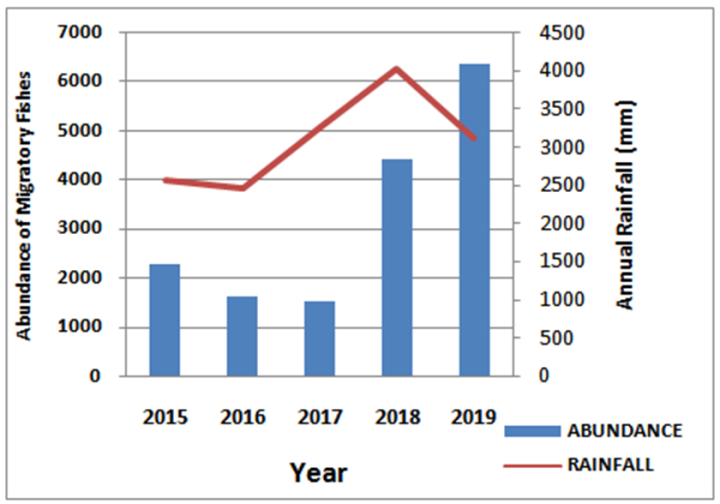
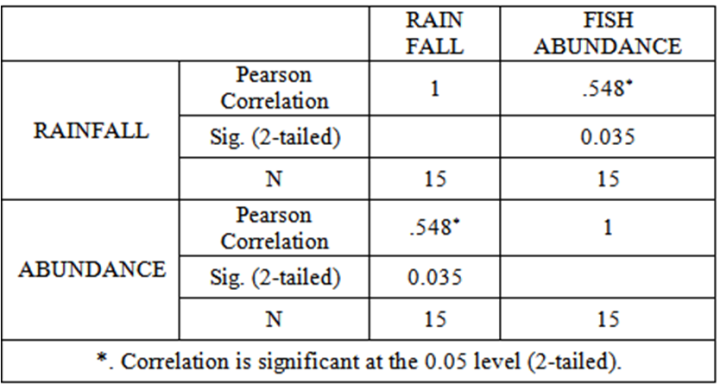
A significant positive correlation was recorded (p=0.59 p < 0.05) between the amount of rainfall and the abundance (Figure 18) of migratory species recorded during the study period. The years from 2015 to 2019 showed variations in abundances correlated to the annual rainfall received in the region (Figure 17). The year 2018, with an extreme flash flood that recorded maximum rainfall followed by the year 2019. 2016 was the year with the lowest rainfall recorded during the study period. The maximum abundance of fish was recorded during the monsoon of the year 2019, and least abundance was recorded during the pre monsoon of 2016 (Figure 13). The lowest relative abundance of 0.23 was recorded for Anguilla bengalensis and 1.14 for the vulnerable species Wallago attu.
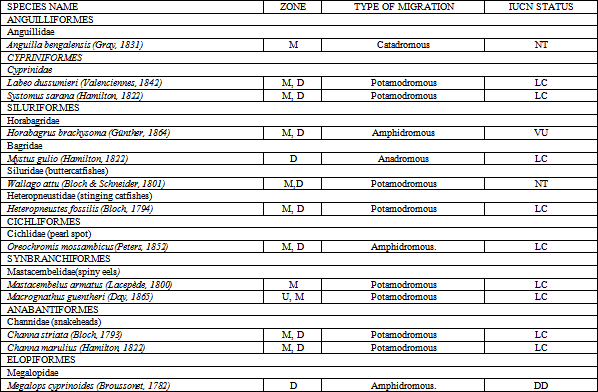
The classification of fish migration followed for this work is in line with GROMS 14. There are approximately 1,100 species of migratory freshwater fish worldwide 17, and these can be divided into three groups based on their ecological migration patterns anadromous species, which move from the sea to freshwater to spawn; catadromous species, which move from freshwater to the sea to breed and spawn, and potamodromous species, which move within the freshwater systems.
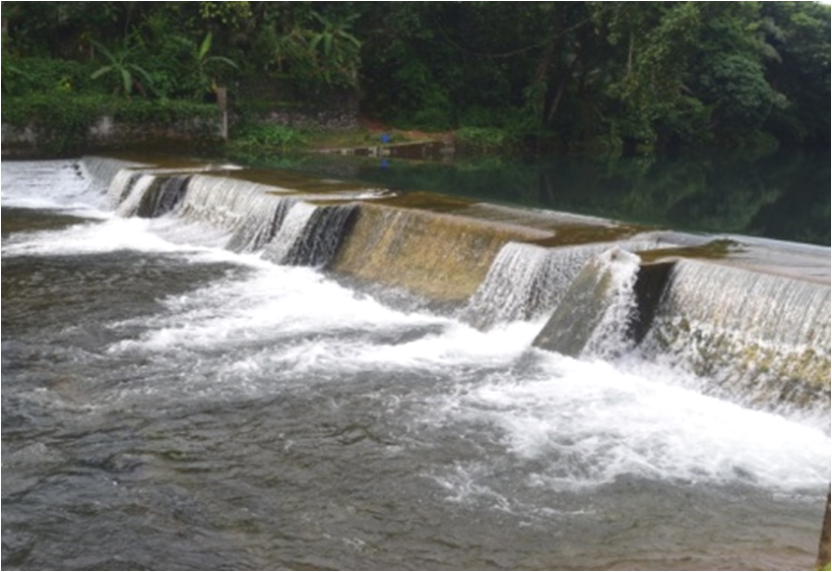
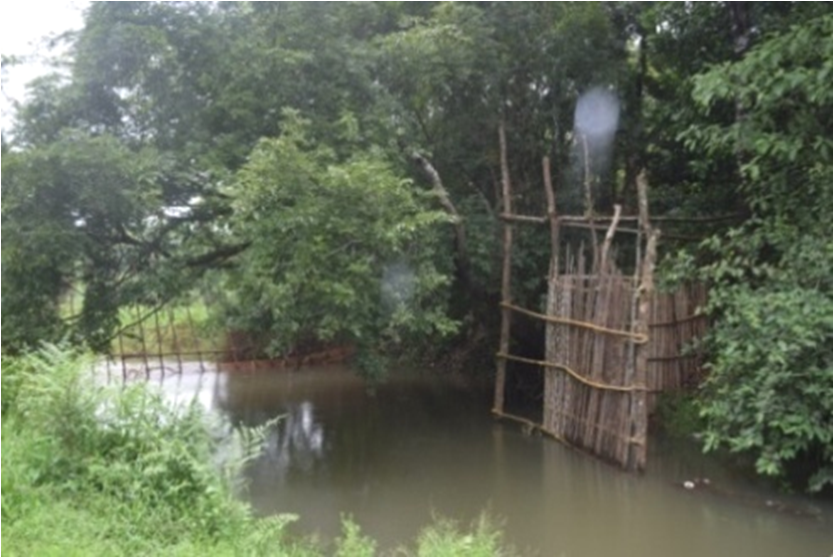
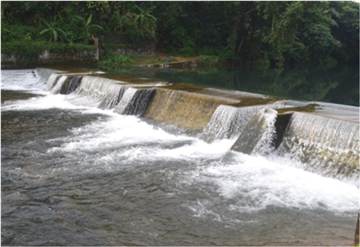
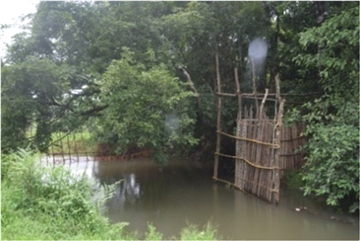
As the different phases of the life cycle of migratory species consist of journeying to the different regions of the river or between the river, the confluence estuarine zone, and the sea, the continuity of flow is a critical factor determining their abundance and survival. Fragmentation of rivers due to different barriers, dams, or check dams without fish passages can interfere with the different life cycle stages of the riverine species 18. Even though the Meenachil River is undammed, the continuity of the river is interrupted by numerous check dams along the river without fish passages (Figure 3 and Figure 4). The recharging of the rain-fed Western Ghats Rivers occurs annually during the monsoon seasons. An increased river discharge during the flood cycles was reported as one among the major factors favoring the spawning migration of fishes 19, 20. Flooding of the river provides favorable spawning and foraging grounds for the adult fishes, which can be correlated to the increased abundance of the migratory fishes documented in 2019 after the extreme flashflood of 2018 occurred in Kerala 8.
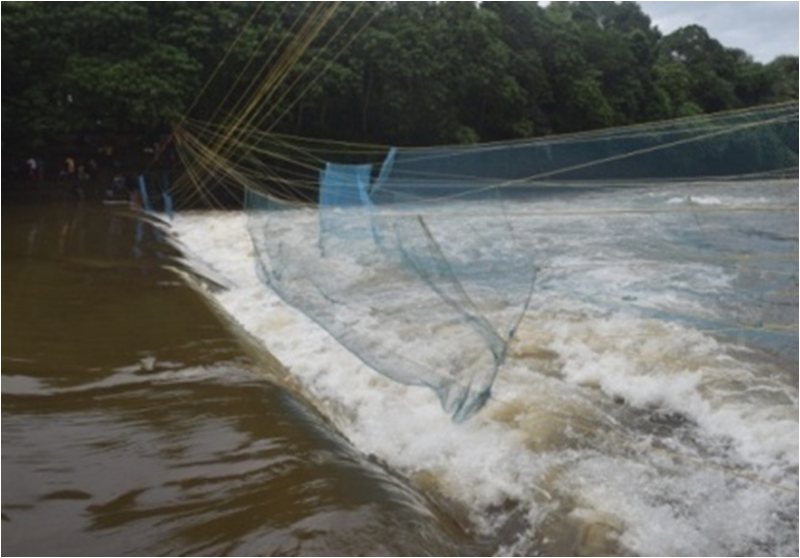
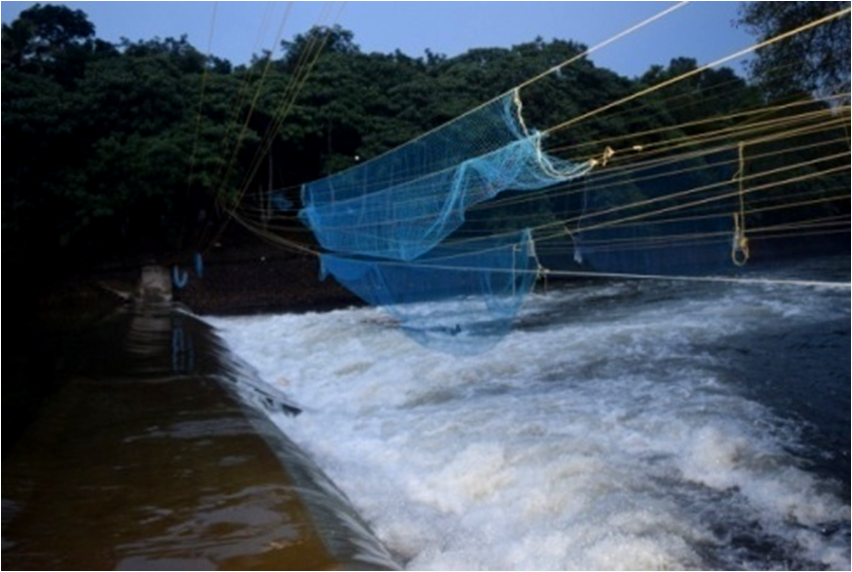
The only season where the Meenachil River restores its continuity is during the monsoon and flooding when the water level overflows the check dams (Figure 4). In addition to the check dams in the river, the Thanneermukkom saltwater barrage, constructed in the river's confluence zone, the Vembanadu Lake to support paddy farming, hinders fish and shellfish migration and reproduction. The barrage prevents access to the catadromous migrant A. bengalensis and the anadromous species, M. cyprinoides, from the estuarine confluence zone to Arabian Sea when it is closed during the pre-monsoon season.
The least abundance of the anadromous, catadromous, and potamodromous migratory fishes of the river documented during the pre-monsoon season (Table 3) reflected the negative impacts of check dams on river flow and continuity, interrupting the journey of the migrants. Anguillid eels are facultatively catadromous, making them vulnerable to a variety of possible dangers at every stage of their life cycle. Dams and weirs are significant obstacles that limit the amount of freshwater habitat that is available, prohibit eels from moving upstream and downstream, or, worse yet, directly kill migrating eels 21, 22. The changing oceanic conditions as a result of climate change also interfere with larval eel migration and the subsequent recruitment of glass eels to continental waters 23, 24. The increase in abundance of the threatened species A. bengalensis after the floods of 2018 and 2019 in the Meenachil River reflected the significance of river continuity for the successful catadromous migration of the species.
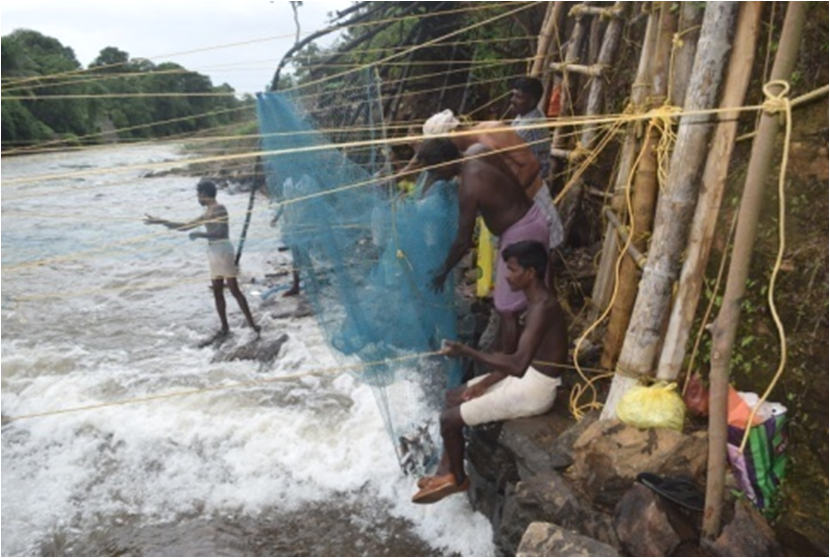
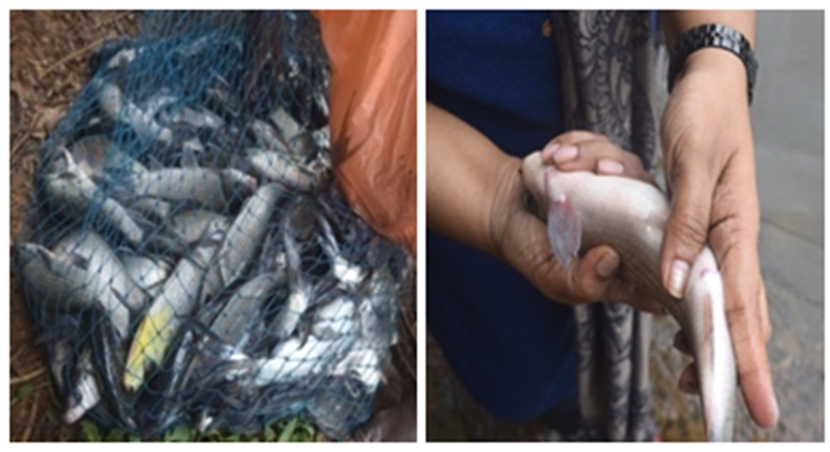
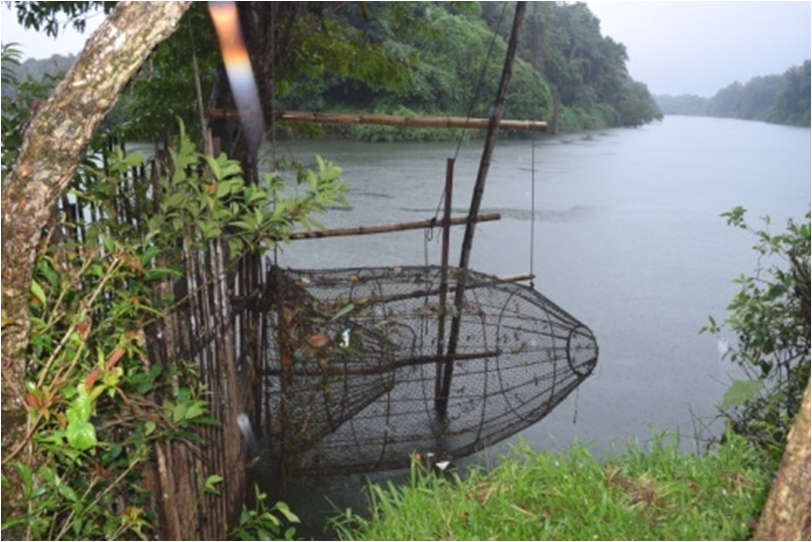
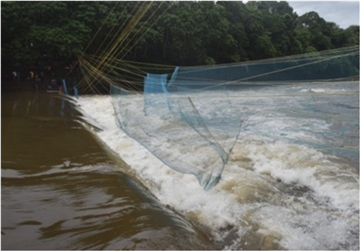
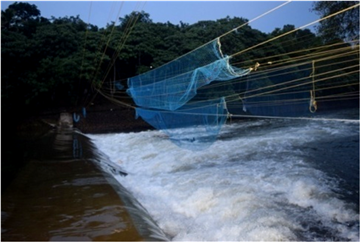
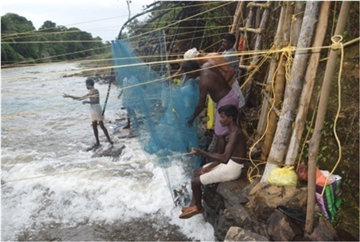
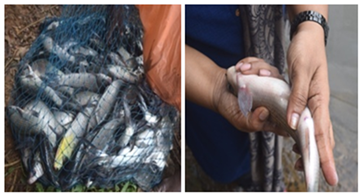
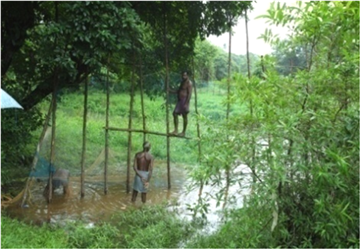
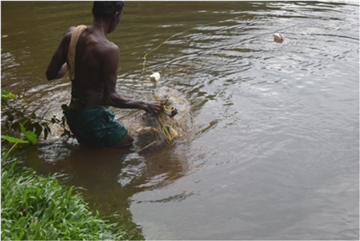
Another factor significantly influenced the abundance of the potamodromous migrants in the Meenachil River was the massive catching of the spawners by the villagers during the monsoon season using species-specific traps. During the first few days of the Southwest-monsoon, the freshwater fishes perform their massive migration upstream from the lower stretches of rivers and inland water bodies to pair and deposit their eggs. In the low-lying plains of Kerala, the fish use the paddy fields linked with the main river through tributaries or artificial canals as their preferred breeding ground. When the paddy fields are sufficiently inundated to allow the eggs to be effectively laid, the fish make their way along these canals. Fishes that actively engaged in this migration include carps (Cyprinidae), catfish (Bagridae and Siluridae), and perches (Cichlidae) 25. The gonad recrudescence and spawning migration of the cyprinid L. dussumieri synchronized with the onset of the southwest monsoon. A serious threat noticed for the cyprinid L. dussumieri in the Meenachil River was the massive capture of the spawners migrating from downstream to upstream during the monsoon. They often jump across the major check dams to reach upstream tributaries for spawning. Skillfully designed traditional traps (Figure 5 – Figure 7) set across the river at the major check dam site promotes the massive hunting of the gravid species 8.
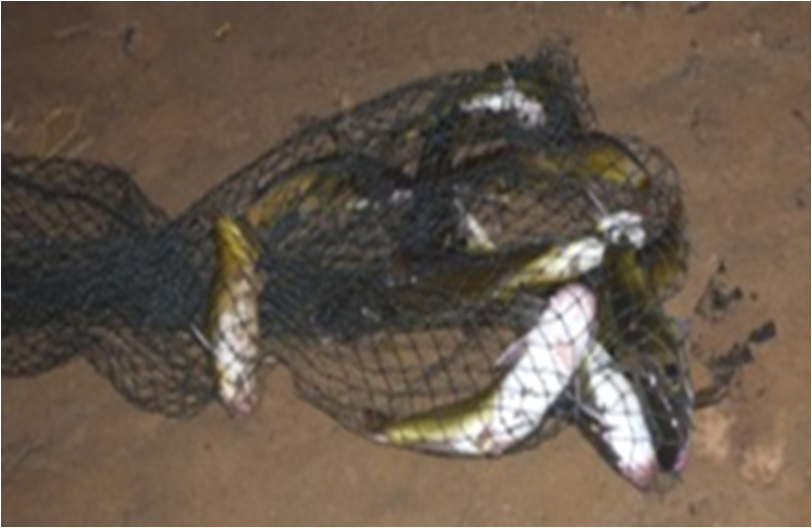
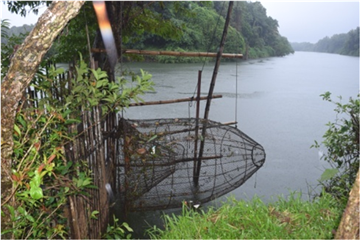
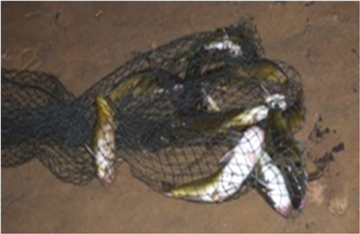
Massive catching of the Silurid species Wallago attu and the Bagrid species H. brachysoma was noticed during their breeding migration using fixed gill net traps (Figure 11 and Figure 12) set along their lateral migratory pathways during the monsoon. H. brachysoma populations have dropped sharply in the rivers of Western Ghats over the past few years 26. It is one of the most significant food and ornamental species exploited in the inland waters of that state. The species could therefore be thought of as a potential “flagship species” that can be exploited to raise the environmental profile of inland biodiversity and serve as a focal point for conservation efforts 27.
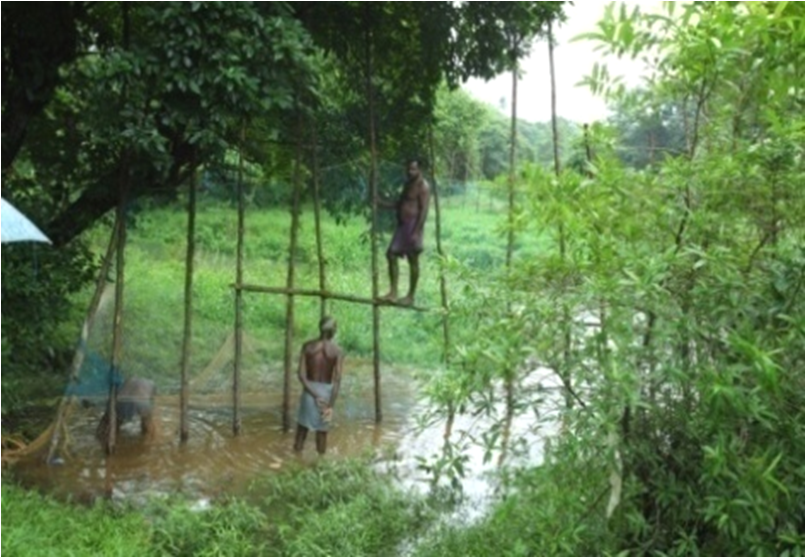
A drastic decline in the number of the giant catfish Wallago attu in the river also needs special mention. Being the most famous and favorite freshwater fish delicacy of Kerala, the overexploited and vulnerable Silurid species are very few in number at present, facing a severe threat as they were caught in the special monsoon traps (Figure 4) set during their lateral breeding migrations 25. Cheru and Perumkoodu set along the flooded river’s lateral connections targeted the floodplain migrants of the river Heteropneustes fossilis, Channa striata and Channa marulius (Figure 8 - Figure 10).
The migratory fishes of the Meenachil River with least relative abundances, A. bengalensis belongs to the nearly threatened and H. brachysoma, endemic to Western Ghats, belongs to the vulnerable categorization of IUCN. L. dussumieri, presently abundant in the Meenachil River, was categorized in 1997 as “endangered” according to IUCN criteria due to its restricted distribution, loss of habitat, over-exploitation, and destructive fishing practices in the “Conservation Assessment Management Plan” workshop for the evaluation of freshwater fishes of India 26, 28. Considering the present overexploitation of the species during its breeding period, strict legal measures have to be implemented to prevent the species, which was currently considered as “LC,” going back to the endangered category. The common species S. sarana and the endemic species M. guentheri although categorized as least concerned by IUCN, showing lower relative abundances in the present study, has to be given regional consideration.
The declining abundance of the above migratory fishes emphasizes the need for executing legal measures for their regional and global conservation. The present study recommends an urgent need for implementing a “no fishing season” in the rivers of Western Ghats during their breeding season with strict restrictions on the massive trapping of spawners during their breeding migrations.
Ensure river-specific policy protections to support the abundance of migratory fish species which includes the following: 1) Allowing rivers to flow more naturally 2) protecting the critical wetlands 3) Ending overfishing and unsustainable sand mining 4) Safeguarding and restoring river connectivity through better planning of dams and other infrastructure, 5) providing proper fish passages or fish ladders 6) Controlling invasive species and 7) through public relations, awareness, and educational efforts such as “World Fish Migration Day” to raise the public knowledge of the migratory freshwater fishes.
Long term research and documentation is needed to understand the fate of migratory freshwater fish and to create workable solutions that restore and safeguard the fishes and their habitats. However, it is abundantly obvious from the fact that many migratory fishes are still in danger and that urgent action must be taken to find and adopt remedies before it is too late. A number of policy documents and other solutions-oriented activities are available which can be used effectively to guide the efforts for the conservation of the migratory fishes.
Authors are grateful to the Principals Dr. Icy. K John, for Mar Thoma College Tiruvalla and Dr Mathew P. Joseph, Catholicate College, Pathanamthitta for providing the necessary work facilities. We are thankful to the “Meenachil Purarjani” for their support throughout the field work. Special thanks to the fishing gear operators Thankakuttan and Saji. Thanks to Jony the local fisherman for helping to document the spawning migration of L. dussumieri and other monsoon traps used for the collection of seasonal migrants of the river.
The author declare that they have no conflict of interest
| [1] | Dingle, H. and Drake, V.A, “What is migration?”, Bioscience. 57, 113-121, February 2007. | ||
| In article | View Article | ||
| [2] | Lucas, M.C. and Baras, E. Migration of Freshwater Fishes, Blackwell Science, Oxford, 2001. | ||
| In article | View Article | ||
| [3] | Brink, K., Gough, P., Royte, J., Schollema, P., and Wanningen, H, From Sea to Source 2.0. Protection and restoration of fish migration in rivers worldwide, World Fish Migration Foundation, 2018. | ||
| In article | |||
| [4] | Deinet, S., Scott-Gatty, K., Rotton, H., Twardek, W.M., Marconi, V., McRae, L., Baumgartner, L.J., Brink, K., Claussen, J.E., Cooke, S.J., Darwall, W., Eriksson, B.K., Garcia de Leaniz, C., Hogan, Z., Royte, J., Silva, L.G.M., Thieme, M.L., Tickner, D., Waldman, J., Berkhuysen, A, The Living Planet Index (LPI) for migratory freshwater fish: Technical Report, World Fish Migration, 2020. | ||
| In article | |||
| [5] | Grill, G., Lehner, B., Thieme, M., Geenen, B., Tickner, D., Antonelli, F., Babu, S., Borrelli, P., Cheng, L., Crochetiere, H., Ehalt Macedo, H., Filgueiras, R., Goichot, M., Higgins, J., Hogan, Z., Lip, B., McClain, M.E., Meng, J., Mulligan, M., Nilsson, C., Olden, J. D., Opperman, J.J., Petry, P., Reidy Liermann, C., Saenz, L., Salinas-Rodriguez, S., Schelle, P., Schmitt, R.J.P., Snider, J., Tan, F., Tockner, K., Valdujo, P.H., van Soesbergen, A., and Zarfl, C, “Mapping the world’s free-flowing rivers”, Nature, 569 (7755), 215-221, May 2019. | ||
| In article | View Article PubMed | ||
| [6] | Winemiller, K.O., McIntyre, P.B., Castello, L., Fluet C,E., Giarrizzo, T., Nam, S., Baird, I.G., Darwall, W., Lujan, N.K., Harrison, I., Stiassny, M.L.J., Silvano, R.A.M., Fitzgerald, D.B., Pelicice, F.M., Agostinho, AA., Gomes, L.C., Albert, J.S., Baran, E., Petrere Jr., M, Zarfl, C., Mulligan, M., Sullivan, J.P., Arantes, C.C., Sousa, L.M., Koning, A. A., Hoeinghaus, D.J., Sabaj, M., Lundberg, J.G., Armbruster, J., Thieme, M.L., Petry, P., Zuanon, J., Torrente Vilara, G., Snoeks, J., Ou, C., Rainboth, W., Pavanelli, C.S., Akama, A., van Soesbergen, A., and Sáenz, L, “Balancing hydropower and biodiversity in the Amazon, Congo, and Mekong”, Science, 351 (6269), 128-129, March 2016. | ||
| In article | View Article PubMed | ||
| [7] | Allan, J.D., Abell, R., Hogan, Z., Revenga, C., Taylor, B.W., Welcomme, R.L., and Winemiller, K, “Overfishing of inland waters”, BioScience, 55, 1041-1051, December 2005. | ||
| In article | View Article | ||
| [8] | Letha, P.C and Manu, O, “Post–flood changes in the fish fauna of Meenachil River, Kerala South India, Journal of Aquatic Biology and Fisheries, 8, 53-61, August 2020. | ||
| In article | |||
| [9] | The Global Resister of Migratory Species (GROMS) www.groms.de. | ||
| In article | |||
| [10] | Larinier, M, Environmental issues, dams and fish migration, FAO Fisheries Technical Paper, 2001, 45-90. | ||
| In article | |||
| [11] | Gopalakrishnan, O. and Riede, K, Some observations on fish migration, with emphasis on tropical waters, 2004. | ||
| In article | |||
| [12] | Jayaram, K.C. 2010. The Freshwater Fishes of the Indian Region.Narendra Publishing House, Delhi. | ||
| In article | |||
| [13] | Talwar, P.K. and Jhingran, A.G, Inland Fishes of India and Adjacent Countries, Oxford-IBH Publishing Co. Pvt. Ltd., New Delhi, 1991, 1158. | ||
| In article | |||
| [14] | McDowall, R.M, Diadromy in Fishes: Migrations between Freshwater and Marine Environments, Croom Helm, London, 1988, 308. | ||
| In article | |||
| [15] | Froese, R., and Pauly, D. FishBase. World Wide Web Electronic Publication, 2020. www.fishbase.org, version (3/2020) | ||
| In article | |||
| [16] | Fricke, R., Eschmeyer, W. N. and Van der Laan, R(eds). Eschmeyer's Catalog Of Fishes: Genera, Species, 2022. http://researcharchive.calacademy.org/research/ichthyology/catalog/fishcatmain.asp. | ||
| In article | |||
| [17] | Katwate, U, Secretive Migrations of Indian Freshwater Fishes, 2020. | ||
| In article | |||
| [18] | Wu, H., Jin, C., Jijun, X., Zeng, G., Lianhai, S., Qiang, L., Zhengjie, Y., Dai, J., Dacong, Y., Liang, J. and Ye, S, “Effects of dam construction on biodiversity: A review”, Journal of Cleaner Production, May 2019. | ||
| In article | View Article | ||
| [19] | Smith, Kimberly G., Joseph C. Neal, and Michael A. Mlodinow. “Shorebird migration at artificial fish ponds in the prairie-forest ecotone of northwestern Arkansas.” The Southwestern Naturalist, 107-113, March 1991. | ||
| In article | View Article | ||
| [20] | Trépanier, S., Rodriguez, M.A and Magnan, P, “Spawning migrations in landlocked Atlantic salmon: time series modelling of river discharge and water temperature effects”, Journal of Fish Biology, 48 (5), 925-936, May 1996. | ||
| In article | View Article | ||
| [21] | Jansen, H.M., Winter, H.V., Bruijs, M.C.M., and Polman, H.J.G, “Just go with the flow? Route selection and mortality during downstream migration of silver eels in relation to river discharge”, ICES Journal of Marine Science, 64, 1437-1443, June 2007. | ||
| In article | View Article | ||
| [22] | Van Der Meer, M, “Eels over the dykes: Trap and transport of silver eels in the Netherlands”, DUPAN/SEG, October 2012. | ||
| In article | |||
| [23] | Baltazar-Soares, M., Biastoch, A., Harrod, C., Hanel, R., Marohn, L., Prigge, E. and Eizaguirre, C, “Recruitment collapse and population structure of the European eel shaped by local ocean current dynamics”, Current Biology, 24 (1), 104-108, December 2014. | ||
| In article | View Article PubMed | ||
| [24] | Pacariz, S., Westerberg, H. and Björk, G, “Climate change and passive transport of E uropean eel larvae”, Ecology of Freshwater Fish, 23 (1), 86-94, May 2014. | ||
| In article | View Article | ||
| [25] | Shaji, C.P. and Laladhas, K.P, “Monsoon floodplain fishery and traditional fishing methods in Thrissur district, Kerala”, Indian Journal of Traditional Knowledge, 12 (1), 102-108, June 2013. | ||
| In article | |||
| [26] | Molur, S. and Walker, S, Conservation Assessment and Management Plan, Workshop Report by Zoo Outreach Organization. CBSG, Indian Edition, Coimbatore, 2001, 100. | ||
| In article | |||
| [27] | Prasad, G., Rajeev, R., Sreeraj, N. and Anvar, A.P.H, Biology, conservation and culture potential of Horabagrus brachysoma, an endangered bagrid catfish from Vembanad Lake, Kerala, (S. India). Sustain Fish 2005. International Symposium on Improved Sustainability of Fish Production Systems and Appropriate Technologies for Utilization. Cochin University of Science and Technology, Kochi, India. Abstract No. WFM.C.08, 2005, 46. | ||
| In article | |||
| [28] | Ponniah, A.G. and Gopalakrishnan, Dr, Endemic Fish Diversity of Western Ghats, 2018. | ||
| In article | |||
Published with license by Science and Education Publishing, Copyright © 2022 Cheriyan P. Letha and Oommen Manu
 This work is licensed under a Creative Commons Attribution 4.0 International License. To view a copy of this license, visit
http://creativecommons.org/licenses/by/4.0/
This work is licensed under a Creative Commons Attribution 4.0 International License. To view a copy of this license, visit
http://creativecommons.org/licenses/by/4.0/
| [1] | Dingle, H. and Drake, V.A, “What is migration?”, Bioscience. 57, 113-121, February 2007. | ||
| In article | View Article | ||
| [2] | Lucas, M.C. and Baras, E. Migration of Freshwater Fishes, Blackwell Science, Oxford, 2001. | ||
| In article | View Article | ||
| [3] | Brink, K., Gough, P., Royte, J., Schollema, P., and Wanningen, H, From Sea to Source 2.0. Protection and restoration of fish migration in rivers worldwide, World Fish Migration Foundation, 2018. | ||
| In article | |||
| [4] | Deinet, S., Scott-Gatty, K., Rotton, H., Twardek, W.M., Marconi, V., McRae, L., Baumgartner, L.J., Brink, K., Claussen, J.E., Cooke, S.J., Darwall, W., Eriksson, B.K., Garcia de Leaniz, C., Hogan, Z., Royte, J., Silva, L.G.M., Thieme, M.L., Tickner, D., Waldman, J., Berkhuysen, A, The Living Planet Index (LPI) for migratory freshwater fish: Technical Report, World Fish Migration, 2020. | ||
| In article | |||
| [5] | Grill, G., Lehner, B., Thieme, M., Geenen, B., Tickner, D., Antonelli, F., Babu, S., Borrelli, P., Cheng, L., Crochetiere, H., Ehalt Macedo, H., Filgueiras, R., Goichot, M., Higgins, J., Hogan, Z., Lip, B., McClain, M.E., Meng, J., Mulligan, M., Nilsson, C., Olden, J. D., Opperman, J.J., Petry, P., Reidy Liermann, C., Saenz, L., Salinas-Rodriguez, S., Schelle, P., Schmitt, R.J.P., Snider, J., Tan, F., Tockner, K., Valdujo, P.H., van Soesbergen, A., and Zarfl, C, “Mapping the world’s free-flowing rivers”, Nature, 569 (7755), 215-221, May 2019. | ||
| In article | View Article PubMed | ||
| [6] | Winemiller, K.O., McIntyre, P.B., Castello, L., Fluet C,E., Giarrizzo, T., Nam, S., Baird, I.G., Darwall, W., Lujan, N.K., Harrison, I., Stiassny, M.L.J., Silvano, R.A.M., Fitzgerald, D.B., Pelicice, F.M., Agostinho, AA., Gomes, L.C., Albert, J.S., Baran, E., Petrere Jr., M, Zarfl, C., Mulligan, M., Sullivan, J.P., Arantes, C.C., Sousa, L.M., Koning, A. A., Hoeinghaus, D.J., Sabaj, M., Lundberg, J.G., Armbruster, J., Thieme, M.L., Petry, P., Zuanon, J., Torrente Vilara, G., Snoeks, J., Ou, C., Rainboth, W., Pavanelli, C.S., Akama, A., van Soesbergen, A., and Sáenz, L, “Balancing hydropower and biodiversity in the Amazon, Congo, and Mekong”, Science, 351 (6269), 128-129, March 2016. | ||
| In article | View Article PubMed | ||
| [7] | Allan, J.D., Abell, R., Hogan, Z., Revenga, C., Taylor, B.W., Welcomme, R.L., and Winemiller, K, “Overfishing of inland waters”, BioScience, 55, 1041-1051, December 2005. | ||
| In article | View Article | ||
| [8] | Letha, P.C and Manu, O, “Post–flood changes in the fish fauna of Meenachil River, Kerala South India, Journal of Aquatic Biology and Fisheries, 8, 53-61, August 2020. | ||
| In article | |||
| [9] | The Global Resister of Migratory Species (GROMS) www.groms.de. | ||
| In article | |||
| [10] | Larinier, M, Environmental issues, dams and fish migration, FAO Fisheries Technical Paper, 2001, 45-90. | ||
| In article | |||
| [11] | Gopalakrishnan, O. and Riede, K, Some observations on fish migration, with emphasis on tropical waters, 2004. | ||
| In article | |||
| [12] | Jayaram, K.C. 2010. The Freshwater Fishes of the Indian Region.Narendra Publishing House, Delhi. | ||
| In article | |||
| [13] | Talwar, P.K. and Jhingran, A.G, Inland Fishes of India and Adjacent Countries, Oxford-IBH Publishing Co. Pvt. Ltd., New Delhi, 1991, 1158. | ||
| In article | |||
| [14] | McDowall, R.M, Diadromy in Fishes: Migrations between Freshwater and Marine Environments, Croom Helm, London, 1988, 308. | ||
| In article | |||
| [15] | Froese, R., and Pauly, D. FishBase. World Wide Web Electronic Publication, 2020. www.fishbase.org, version (3/2020) | ||
| In article | |||
| [16] | Fricke, R., Eschmeyer, W. N. and Van der Laan, R(eds). Eschmeyer's Catalog Of Fishes: Genera, Species, 2022. http://researcharchive.calacademy.org/research/ichthyology/catalog/fishcatmain.asp. | ||
| In article | |||
| [17] | Katwate, U, Secretive Migrations of Indian Freshwater Fishes, 2020. | ||
| In article | |||
| [18] | Wu, H., Jin, C., Jijun, X., Zeng, G., Lianhai, S., Qiang, L., Zhengjie, Y., Dai, J., Dacong, Y., Liang, J. and Ye, S, “Effects of dam construction on biodiversity: A review”, Journal of Cleaner Production, May 2019. | ||
| In article | View Article | ||
| [19] | Smith, Kimberly G., Joseph C. Neal, and Michael A. Mlodinow. “Shorebird migration at artificial fish ponds in the prairie-forest ecotone of northwestern Arkansas.” The Southwestern Naturalist, 107-113, March 1991. | ||
| In article | View Article | ||
| [20] | Trépanier, S., Rodriguez, M.A and Magnan, P, “Spawning migrations in landlocked Atlantic salmon: time series modelling of river discharge and water temperature effects”, Journal of Fish Biology, 48 (5), 925-936, May 1996. | ||
| In article | View Article | ||
| [21] | Jansen, H.M., Winter, H.V., Bruijs, M.C.M., and Polman, H.J.G, “Just go with the flow? Route selection and mortality during downstream migration of silver eels in relation to river discharge”, ICES Journal of Marine Science, 64, 1437-1443, June 2007. | ||
| In article | View Article | ||
| [22] | Van Der Meer, M, “Eels over the dykes: Trap and transport of silver eels in the Netherlands”, DUPAN/SEG, October 2012. | ||
| In article | |||
| [23] | Baltazar-Soares, M., Biastoch, A., Harrod, C., Hanel, R., Marohn, L., Prigge, E. and Eizaguirre, C, “Recruitment collapse and population structure of the European eel shaped by local ocean current dynamics”, Current Biology, 24 (1), 104-108, December 2014. | ||
| In article | View Article PubMed | ||
| [24] | Pacariz, S., Westerberg, H. and Björk, G, “Climate change and passive transport of E uropean eel larvae”, Ecology of Freshwater Fish, 23 (1), 86-94, May 2014. | ||
| In article | View Article | ||
| [25] | Shaji, C.P. and Laladhas, K.P, “Monsoon floodplain fishery and traditional fishing methods in Thrissur district, Kerala”, Indian Journal of Traditional Knowledge, 12 (1), 102-108, June 2013. | ||
| In article | |||
| [26] | Molur, S. and Walker, S, Conservation Assessment and Management Plan, Workshop Report by Zoo Outreach Organization. CBSG, Indian Edition, Coimbatore, 2001, 100. | ||
| In article | |||
| [27] | Prasad, G., Rajeev, R., Sreeraj, N. and Anvar, A.P.H, Biology, conservation and culture potential of Horabagrus brachysoma, an endangered bagrid catfish from Vembanad Lake, Kerala, (S. India). Sustain Fish 2005. International Symposium on Improved Sustainability of Fish Production Systems and Appropriate Technologies for Utilization. Cochin University of Science and Technology, Kochi, India. Abstract No. WFM.C.08, 2005, 46. | ||
| In article | |||
| [28] | Ponniah, A.G. and Gopalakrishnan, Dr, Endemic Fish Diversity of Western Ghats, 2018. | ||
| In article | |||