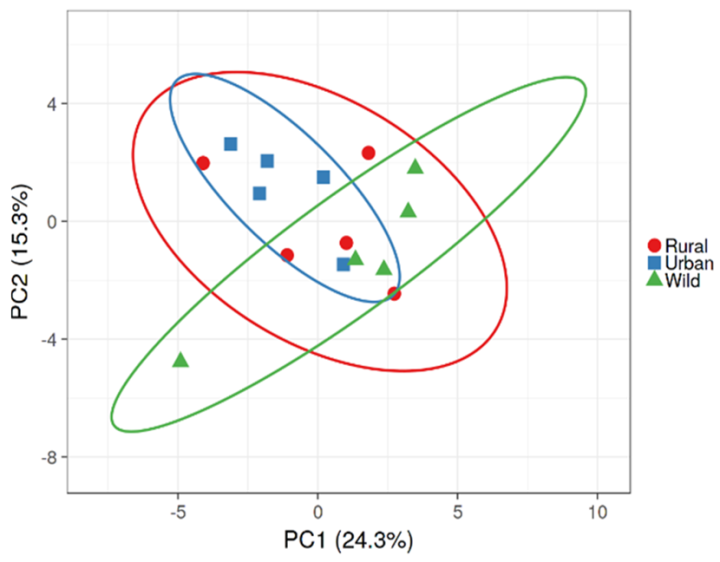
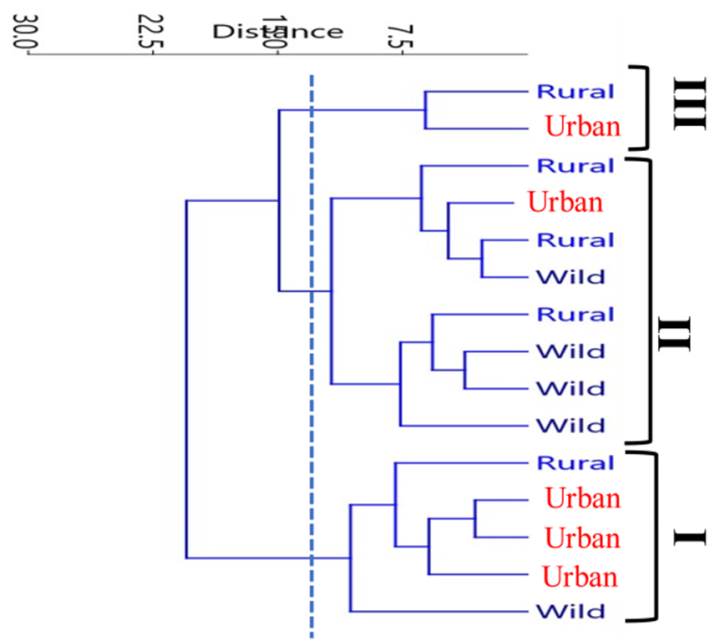
Of the 30 morphological characters, 15 varied markedly among populations from three distinct habitats, namely urban (an urban green space), rural (rural horticultural area), and wild (a national park). Significant differences (n = 225; p< 0.05) were noticed in body length; length and width of the abdomen; length and width of forewings as well as angles 31, 32, and 34; width of hindwing and wing angles H1, H2, and H3; and length and width of the tibia of the hind leg and width of the metatarsus. Among the 15 characters, values of 12 were the highest among the urban bees and included body length, length and width of the abdomen, length of the forewing, width of metatarsus, and forewing venation angles 31, 32, and 34 and hind wing angles H1, H2, and H3. The rural bees were characterized by significantly wide forewing and tibia whereas the wild bees showed significantly long hind wings. Principal component analysis confirmed the association between habitat and morphological characters, with three independent morpho clusters explaining maximum variance in the length and width of hind wing, length of antenna and of proboscis, and forewing venation angle 31 and hind wing angle H2. Cluster analysis also showed that the populations of urban bees were morphologically related to rural bees and were distinct from the wild populations. The study thus highlights the positive influence of urban habitats on the social honey bee species Apis cerana indica and shows that green spaces in cities are not only aesthetically appealing but also confer ecological benefits.
Bees, given their major role as pollinators, are important both economically and ecologically. Nearly three-fourths of all the cultivated crop species depend on insects including bees for pollination, the latter constituting about 25000 bee species representing 11 families. Bees and the plant species they pollinate have evolved together 1, 2. Geographical and ecological variations are the key factors in the evolution of bees 3. Generalist bee species have been reported from diverse habitats ranging from natural forests 4, cultivated fields, deserts 5, grasslands, and wetlands 6, 7 with wide biotic and climatic variations. The biotic factors are mainly the type of vegetation, flowering duration and phenology, and availability of nectar and pollen 8; the abiotic factors include the climate and soil type 8, 9, all influence the pattern of bee colonization in an ecosystem. Bees being obligate floral specialists, their diversity in a landscape also depends on the spatial and temporal distribution of resources required for feeding and nesting.
Anthropogenically induced changes due to fragmentation of natural habitats, changes in land use, intensive agriculture, and urbanization have been the major drivers affecting bee diversity. Nutritional deficit due to the loss of suitable flora 10, 11, in addition to pesticides 12, 13, pathogens, and parasites 14, 15 are reported to be the major causes of a global decline in bee diversity. Although a drastic loss of natural habitat due to urbanization is considered a major threat to global bee diversity 16, recent studies have shown a noticeable positive influence of urban green spaces on bee diversity 17, 18, 19, 20, 21, 22. Creating semi-natural urban green spaces with relatively stable climatic conditions within cities 23, ensuring that foraging resources are free of pesticides, and providing abundant native and exotic flowering plants make for a bee-friendly habitat and can compensate for the loss of natural habitats 22, 24, 25, 26, 27. Managed and cultivated urban lands have become an integrated system of aesthetic and biological importance 21, 28, 29, as they harbour greater diversity of floral species than natural vegetation can 30. Sustainable urban planning, therefore, can regenerate resilient biodiversity and contribute to the protection and conservation of bees 31.
Despite the increasing concern for urban bee diversity and conservation, concrete understanding of how human-induced ecological changes affect bee diversity, especially in the long term, continues to elude us. Urban green habitats can alter the interaction between native plants and bees and thereby influence the morphological and genetic traits and population structure of bee communities 32. Establishing the underlying mechanism of how bees adapt to challenging biotic and abiotic conditions found in urban green spaces can provide useful guidelines for long-term conservation. More specifically, we know very little about how bees respond to anthropogenic changes in flora that affect their feeding and nesting resources. The diversity of such flora is the most important ecological component associated with bee diversity 33.
The dynamic changes in the availability of flowers can affect bees severely 34, 35, 36. In addition, ecological isolation or ecological adaptation in bees can affect population size, nutritional status, morphological characters, reproductive potential, and genetic status of bees—all of which are traceable indicators of the response of bees to different biogeographical conditions 37, 38, 39. Similarly, studies on morphometric variations have confirmed the influence of the environment on bee species. 40, 41. Body size, wings, hind legs, scopal hair, and mouth parts are traceable morphological indicators that are influenced by the habitat 1, 42. Species-specific morphological traits therefore can provide greater understanding of the sensitivity and response of bees to the influencing environmental changes 35, 43. Specific morphological responses are also indictors of the status of health and population stability and provide concrete knowledge useful in habitat management and conservation 44. The advantages – and also challenges – offered by urban green spaces are therefore reflected in such morphological responses of bees 44, 45. The traits that predict positive responses to the urban environment can therefore be used to develop models for in-situ conservation of bees and to enlarge urban biodiversity, because measures aimed at conserving pollinators can benefit the entire urban ecosystem.
Although studies have estimated the rich bee diversity and abundance in urban green spaces, a comprehensive approach to understanding the long-term effect of urbanization on bees is lacking, and data on how bees respond to and cope with anthropogenic changes within their urban habitats are scarce. Assessing the pattern of bee diversity is more important in a developing country such as India with its exponentially increasing urban population and growing urbanization, because sustainable approaches to landscape development can contribute to balancing economic development with biodiversity. The sustainable developmental goals can be achieved by mapping the responses of bees and tracing their potential indicator traits that can predict their success in the changing urban landscapes.
The generalist honey bee species with adaptable plasticity to anthropogenically managed flora are reported to be more abundant in urban habitats than the specialist bee species with narrow adoptability to variations in available flora 21, 27. It was against this background that the present study sought to identify the influence of urban habitats on species-specific morphometric traits of native generalist bee species, Apis cerana indica, a keystone species, to understand the effect of anthropogenically managed semi-natural ecosystem within the otherwise inhospitable expanse that makes up a typical city. To establish the effect of habitat on the morphometric traits of urban A. cerana indica bees, they were compared with the populations of bees from rural and wild habitats. Ecologically relevant changes in morphological traits can be used as indicators in designing management practices for land use over a long term and in setting up sustainable urban green spaces. And because the study focused on a keystone species, its findings can be extended to the conservation of other native urban species of bees that contribute to urban biodiversity.
The bee sampling was done in three geographical areas, characterized as rural, urban, and wild based on the location of hives. The rural area was represented by Doddaballapura (13°18'01.8"N 77°32'19.7"E), a rural district located on the outskirts of Bengaluru. The vegetation of that area included a variety of annual and perennial horticultural crops along with wild (non-cultivated) trees and ground vegetation. The urban area was a 20ha green space (12°56'51.7"N 77°36'27.2"E) – including about one fourth area occupied by offices and a residential complex – located in the heart of Bengaluru city. The vegetation of the urban green space comprised flora including 51 species that were foraging resources for bees, the diverse flora in the urban study area included, wild species and some ornamental trees and fruit trees that served as avenue trees, lawns, many ornamental plants and scattered patches of backyard home gardens consisting of ornamentals, fruit trees, and vegetables 27. The wild area was represented by a preserved national park (12°47'35.2"N 77°34'36.8"E), with dense natural vegetation.
2.2. Sample CollectionThe sample of bees comprised a total of 255 individual bees – foraging worker bees of A. cerana indica – from a total of 15 colonies, five each from the rural, urban, and wild areas, collected using a hand net. Bees from the rural and urban areas were collected from five randomly selected healthy colonies maintained in Newtons beehive boxes whereas those from the wild area were collected from five feral bee colonies spotted in the national park. A total of 30 bees were collected from each bee colony using hand net. The samples from individual colonies were preserved separately in glass bottles contacting 70% alcohol.
2.3. MorphometryThe samples of bees collected from the three distinct habitats were compared in terms of a total of 30 morphometric characters including 20 size parameters, 8 wing angles, and the total number of hamuli on the hind wing. A total of 15 bees from each colony were used for recording the body length and were then dissected and separated into the following body parts: head, tongue, antenna, abdomen, right forewing, right hind wing, and right hind leg. The following measurements were recorded; length of the abdomen, width of the abdomen, length of the head, width of the head, length of the proboscis, length of the antenna, length of the fore wing, width of the forewing, forewing venation (angles 31, 32, 33, 34, 35, and 36), hindwing length, hindwing width, hindwing venation (angles H1, H2, and H3), number of hamuli, length of femur, width of femur, length of tibia, width of tibia, length of metatarsus, and width of metatarsus 3, 46. The length and width of the dissected parts mounted on the clean glass slide were measured using a microscope. The number of hamuli on the hindwing were counted under a magnification of ×4. The dissected forewings and hindwings mounted on slides were scanned using a high-resolution Epson, Perfection V39 scanner (2400 dpi). The cubital index and Hantel index were measured using the scan-photoshop method 47. The six forewing and hindwing venation angles were measured using Image Tool ver. 3.0, a scanned image-processing program. All the measurements were expressed in millimetres except the cubital index and the Hantel index of the forewing and the number of hamuli in the hindwing.
2.4. Statistical AnalysisThe means and standard deviations of the values were calculated separately for each habitat (population). The data were analysed using one-way analysis of variance (ANOVA) with the help of SPSS ver. 22. The differences were considered significant at a p value of 0.05.
The relationship between the populations and the patten of homogeneous clustering between the regional populations were investigated using principal component analysis (PCA) and hierarchical cluster analysis (the Euclidian distance), with the help of SPSS, to identify the possible morpho clusters between the populations from three selected habitats.
The populations from the different habitats differed significantly in terms of their morphology (Table 1), as confirmed through pairwise comparison of the mean values. Populations from the rural and the wild habitats varied significantly in a total of eight morphological characters: abdomen length, forewing length, forewing width, hind wing width, angle H2 of hind wing, angle H3 of hind wing, femur length, and tibia width. Similarly, the populations from the rural and the urban habitats varied significantly in a total of nine morphological characters: body length, abdomen length, abdomen width, angle 31 of forewing, angle 32 of forewing, angle 34 of forewing, angle H1 of hind wing, angle H2 of hind wing, and metatarsus length. The populations from the wild and the urban green space differed even more, varying significantly in terms of as many as 13 morphological features: body length, abdomen length, abdomen width, antenna length, forewing length, forewing width, angle 32 of forewing, angle 34 of forewing, hind wing length, angle H1 of hind wing, angle H3 of hind wing, metatarsus length, and metatarsus width.
On an average, bees from the urban habitat were the longest (10.93±0.54 mm), being significantly longer than those from the rural habitat (10.21±0.67 mm) and also from those from the wild habitat (10.05±0.54 mm). However, there was no significant difference in body length between rural bees and wild bees.
3.2. AbdomenAll the three groups differed significantly (p<0.01) from one another in terms of the length of the abdomen. The abdomen of urban bees was the longest (5.88±0.54 mm); that of the rural bees was intermediate in length (5.44±0.52 mm); and that of the wild bees was the shortest (5.11±0.58 mm).
In terms of the width of the abdomen, once again, the urban bees had the widest abdomen (3.24±0.30 mm), significantly wider (p<0.05) than that in the two other groups, rural and wild, which did not differ significantly between themselves.
3.3. HeadThe three groups showed no significant differences in the size of their heads, either in terms of its length (p = 0.10) or in terms of its width (p = 0.09). On average, the heads were 3 mm square, but slightly wider than longer.
3.4. ProboscisThe three groups showed no significant differences either in the length of the proboscis (approximately 4 mm) or in its width (approximately 0.1–0.3 mm).
3.5. AntennaThe pattern was reversed when it came to the length of the antenna, which was the longest in wild bees (3.69±0.32 mm), intermediate in rural bees (3.60±0.19 mm), and the shortest in urban bees, the differences being significant (p<0.05) between the wild and the urban bees.
3.6. ForewingAll the three populations varied significantly (p<0.05) in the length and the width of the forewing and in three angles of venation. The forewing was the longest in urban bees (8.01±0.15 mm), intermediate in rural bees (7.95±0.17 mm), and the shortest in wild bees (7.84±0.52 mm). However, when it came to the width of the forewing, the rural bees no longer held the intermediate position: they had the widest forewings (2.77±0.11 mm), followed, in that order, by urban bees (2.76±0.11 mm) and wild bees (2.70±0.20 mm). The forewing of the wild bees was significantly narrower (p<0.05) than that of rural and urban bees (p = 0.02 and p = 0.02, respectively).
Among the six measured wing angles, the populations varied significantly (p <0.01) in terms of angles 31, 32, and 34 (angles of venations of the second, third submarginal, and median cells, respectively) but not in terms of the other three (33, 35 and 36). Angle 31 in urban bees (32.88°±4.27°) was significantly (p<0.05) wider than that in rural and wild bees, whereas the latter two did not differ significantly between them.
The pattern was repeated with angle 32 and angle 34, with the urban bees showing the widest angles, significantly wider (p<0.001) than that seen in rural and wild bees.
The three populations did not differ significantly in terms of cubital index or in terms of the Hantel index.
3.7. Hind WingThe hind wing dimensions and the angles of venation also showed significant variations among the three populations. The wild bees had the longest hind wings (5.60±0.14 mm), significantly longer (p<0.01) than those of the urban bees and the rural bees, whereas the latter two groups did not differ significantly in the length of their hind wings.
However, the three groups did not differ significantly either in the width of the hind wing or in the number of hamuli.
However, the three populations differed significantly (p<0.01) in each of the three hind wing angles – H1, H2, and H3 – thereby signifying the variations in the venations of radial and cubital cells of the hind wing. At 82.69°±8.30°, angle H1 was significantly wider (p<0.01) in urban bees than that in rural bees (74.98°±11.00°) or in wild bees (73.25°±13.54°). The same pattern was repeated in angle H2 and angle H3, with the urban bees showing the widest angles.
3.8. Hind LegWhereas the three populations did not differ significantly in terms of femur length, the rural and the wild bees did so (p = 0.04) in terms of femur width, with the femur being wider in rural bees (0.50±0.07 mm) than in wild bees (0.47±0.08 mm).
The pattern observed in femur length and width was repeated in tibia length and width: the three populations showed little difference in terms of the length of the tibia but differed significantly in terms of its width. The rural bees showed the widest tibia (0.86±0.07 mm) whereas in wild bees the tibia was significantly (p = 0.005) narrower (0.81±0.08 mm) than that in urban bees (0.84±0.10 mm).
The three populations showed significant differences (p<0.05) in the length and the width of the metatarsus. The metatarsus was the longest in urban bees (1.84±0.13 mm), significantly longer than that in rural bees or wild bees, and also the widest (0.93±0.08 mm), significantly wider than that in the wild bees.
Morphometrics are an important tool in the classification and characterization of honey bees 48, 49, 50, 51. Morphometric variation is also used in measuring regional variation within a given population 46, 52. The present study compared morphometric traits among three populations of a native social bee species, A. cerana indica, to understand the influence and suitability of an anthropogenically altered habitat, namely a green space within a city: of the three populations, one was from that green space, another was that of rural bees sampled from a village on the outskirts of the city, and the last was that of wild bees sampled from a natural park with pristine vegetation. The mean values of many of the morphometric traits recorded in the present study are in agreement with those reported in earlier studies of regional morphometric variation among A. cerana populations from different parts of India, China, Philippines, Pakistan, Thailand, and Malaysia 46, 53, 54, 55, 56, 57, 58, 59, 60, 61. Members of the population from the urban green space showed significant increases in their body length, abdominal length and width, forewing length, and length and width of the metatarsus compared to the corresponding values for the rural bees and the wild bees. These changes constitute an adaptive response to the flora and the climatic conditions in purpose-built green spaces as a habitat, as against a rural habitat or a forest habitat. The influence of the habitat was also reflected in the significantly longer antenna in the wild bees and the wider tibia and metatarsus in the rural bees recorded in the present study, a result consistent with that of earlier reported results 62.
The significantly longer body and the larger abdomen (length and width) observed in the urban bees mean an overall increase in body size of bees in the urban habitat. Larger worker bees imply more plentiful food supply to the colony and better brood health. Availability of foraging resources predominantly influences body size in bees, which determines their foraging ability and, in turn, the nutritional status of the colony 63, 64. Body length was thus a key indicator of the availability of nutrients in the urban habitat, a positive adaptation to the probably richer fare offered by the mix of exotic and native species of ornamental plants. The increased body size also signifies increased fitness, flight ability and capacity, and successful foraging 65—all of which contribute to greater exploitation of resources found in urban habitats 66, 67. Additionally, the smaller bodies of the wild bees could be due to the higher density of pollinating species and possible interspecific and intraspecific competition for food in the wild. The values recorded in the present study are in agreement with another, also from Bengaluru and also on A. cerana, which reported greater body length (13.1 mm). Similar variations in body length (8.23–9.58 mm) of A. cerana were also reported from north-eastern India 60 and from the plains and hills of southern India 68. On the contrary, a study conducted on Anthophora sp. a species of solitary bees found no variation in body size of bees between urban, suburban, and rural habitats 69.
Head is crucial to sensory reception in bees because it is equipped not only with eyes but also with antennae, a proboscis, and sensory hair—all of which help in locating the sources of nectar and pollen and also serve as gustatory organs in bees. Therefore, measurements of cephalic parts are important for differentiating among bee species as well as for analysing geographical variation in them. The head measurements recorded in the present study are consistent with those of the strains of A. cerana from the hills and plains in southern India and from other locations across India 60, 70.
The antennae in bees constitute an important olfactory organ not only for food but also for chemosensory communication cues associated with maintaining a colony, making the antennae an essential organ for feeding and colony maintenance 71. The length of the antenna recorded in the present study was significantly shorter than that reported by earlier study in A. cerana from different parts of Kashmir that mark a hill range in northern India 72. In the present study, the antennae were significantly longer in the wild bees than in the urban bees or the rural bees, probably because bees in the wild need a more acute sense of perception—an adaptation to the increased environmental disturbance in the wild than what is encountered in rural and urban settlements, especially for bees maintained in boxes 73. Similar observations related to the antennae of A. cerana 74 confirmed the anatomical variation in the species to suit the geographical distribution of foraging sources. Two other sources of significant variation in antenna length are the age and the season – older bees typically have longer antennae than young nursing bees inside the hive do – indicating the importance of temporal differences and seasonal adaptations to the sense of perception in foraging adult bees 75.
Morphometric characters of wings too are associated with changes in the environment and habitat 76. Wing morphology is routinely used in bee taxonomy 49, and wing characters are known to vary a great deal with variations in vegetation and the climate. Brood temperature and nutritional status were found to affect wing length, distances between venations, and the pattern of venation angles 77. Significant differences were noticed in the present study among the bees from urban, rural, and wild locations and were thus an adaptive feature. The significantly longer forewing of the urban bees signifies adaptation to the urban habitat, as does the significantly wider forewing of the rural and urban bees. Earlier studies have also reported similar trends in the forewing angles 31, 32, and 34 indicating the potential of these characters as indicators of adaptation to changes in the geographical and atmospheric factors in the urban area 75, 77. Significant variations in the dimensions of forewing and wing angles in A. cerana bees from southern states of India and also between northern and southern India, in China, and in Pakistan have been reported 46, 57, 58, 59. However, the wing indexes, which are important in identifying bee subspecies and races 49, showed no variation in the present study.
With the hind wing length, a different pattern was seen, the hind wing being significantly longer in wild bees, although wing angles H1, H2, and H3 were wider in urban bees than those in rural and wild bees. The length and width of the hind wing were in line with the corresponding measurements of A. cerana from northern India 46, 57, 59, as well as from southern India 58. However, the number of hamuli showed little variation in the three populations used in the present study, which shows that it is the number of hamuli and not the length of the hind wings that affect flight efficiency, because the significantly shorter hind wings of the urban bees in the present study had little impact on their flight efficiency, an observation also reported by earlier studies 78, 79.
Hind legs in bees are modified to collect pollen and propolis 1. The pollen comb, or corbicula, on the tibia plays an important role in collecting and packing pollen 1, 42. Therefore, the morphological characters of hind legs influence the supply of pollen and propolis to a hive 80. In the present study significantly larger hind leg parts among the urban bees, the longer and wider metatarsus, increase in body size and wing length and width in urban bees confirmed the geographical influence on the morphology of bees ensuring adequate nutrition of the colony that enhance flying ability 42, in addition to their greater ability to collect pollen.
The Principal component analysis (PCA) data further confirmed the distinctive morphological variance among the geographical populations. The first two components of the PCA of the sample means of morphological characters explained 24.3% and 15.3% of the total variance respectively. The three clades observed in the PCA indicated three morpho clusters among the populations. Principal component 1 explained maximum variance in hindwing length and width, proboscis length, and length of the antennae, whereas principal component 2 explained maximum variation in forewing angle 31 and hind wing angle H2. Similarly, the dendrogram drawn based on the Euclidian distance of the morphological parameters was also in agreement with the three clades shown in the PCA (Figure 1). The data points in the dendrogram clusters also indicate the morphological similarity between rural and wild populations and morphological closeness between urban and rural populations (Figure 2). Similar variance in wing angles of bees were reported in A. cerana populations from different regions 55.
Morphometric characters indicated significant variation in 15 of the 30 parameters analysed for populations from three distinct habitats, variations that confirmed the distinctive morphological characters of bees sampled from an urban green space. The urban bees were larger than the rural or the wild bees. The maximum values of body size, abdominal length and width, forewing length, and length and the width of the metatarsus recorded in urban bees confirm the positive influence of urban flora on the morphological characters of the bee population. Discriminant analysis showed three morpho clusters, with apparent variance in venation angles among the populations. Morphometric parameters estimated in the present study suggest that urban green spaces can contribute to the conservation of bee species. Although bees in urban areas are exposed to anthropogenic interventions, the study showed no major adverse influence on the morphological characters of such bees. Similarly, the morpho clusters further confirmed the influence of geographical and vegetational changes on the morphological adaptation seen in bee populations from the three habitats. Sustainable green infrastructures within a city can thus facilitate bee protection and conservation. The findings of the study can provide baseline information for sustainable urban planning to meet ecological as well as aesthetic values.
Not Applicable
The authors declare that there is no conflict of interest.
Not Applicable.
| [1] | Michener, C. D. (1974). The social behavior of the bees. Bilknap press of Harvard University, Cambridge (UK). | ||
| In article | |||
| [2] | Velthius, H.H.W. (1992). Pollen digestion and the evolution of sociality in bees. Bee world, 73(2): 77-89. | ||
| In article | View Article | ||
| [3] | Ruttner, F., Tassencourt, L., & Louveaux, J. (1978). Biometrical-statistical analysis of the geographic variability of Apis mellifera LI Material and methods. Apidologie, 9(4), 363-381. | ||
| In article | View Article | ||
| [4] | Coulson, R. N., Pinto, M. A., Tchakerian, M. D., Baum, K. A., Rubink, W. L., & Johnston, J. S. (2005). Feral honey bees in pine forest landscapes of east Texas. Forest ecology and Management, 215(1-3), 91-102. | ||
| In article | View Article | ||
| [5] | Minckley, R. L., Cane, J. H., Kervin, L., & Yanega, D. (2003). Biological impediments to measures of competition among introduced honey bees and desert bees (Hymenoptera: Apiformes). Journal of the Kansas Entomological Society, 306-319. | ||
| In article | |||
| [6] | Moroń, D., Szentgyörgyi, H., Wantuch, M., Celary, W., Westphal, C., Settele, J., & Woyciechowski, M. (2008). Diversity of wild bees in wet meadows: implications for conservation. Wetlands, 28(4), 975-983. | ||
| In article | View Article | ||
| [7] | Bogusch, P., Heneberg, P., & Astapenková, A. (2020). Habitat requirements of wetland bees and wasps: several reed-associated species still rely on peaty meadows and other increasingly rare wetland habitats. Wetlands Ecology and Management, 28(6), 921-936. | ||
| In article | View Article | ||
| [8] | Free, J. B. (1970). The flower constancy of bumblebees. The Journal of Animal Ecology, 395-402. | ||
| In article | View Article | ||
| [9] | Rodionov, V. V., & Shabarshov, I. A. (1986). The fascinating world of bees. Imported Publication. | ||
| In article | |||
| [10] | Spivak, M., Mader, E., Vaughan, M., & Euliss Jr, N. H. (2011). The plight of the bees. Environmental Science and Technology, 45, 34-38. | ||
| In article | View Article PubMed | ||
| [11] | Goulson, D., Hanley, M. E., Darvill, B., Ellis, J. S., & Knight, M. E. (2005). Causes of rarity in bumblebees. Biological Conservation, 122(1), 1-8. | ||
| In article | View Article | ||
| [12] | Gels, J. A., Held, D. W., & Potter, D. A. (2002). Hazards of insecticides to the bumble bees Bombus impatiens (Hymenoptera: Apidae) foraging on flowering white clover in turf. Journal of Economic Entomology, 95(4), 722-728. | ||
| In article | View Article PubMed | ||
| [13] | Thompson H. M. (2003) Behavioural effects of pesticides in bees-their potential for use in risk assessment. Ecotoxicology 12: 317-30. | ||
| In article | View Article PubMed | ||
| [14] | Higes, M., Martín-Hernández, R., Botías, C., Bailón, E. G., González-Porto, A. V., Barrios, L., ... & Meana, A. (2008). How natural infection by Nosema ceranae causes honeybee colony collapse. Environmental Microbiology, 10(10), 2659-2669. | ||
| In article | View Article PubMed | ||
| [15] | Benaets, K., Van Geystelen, A., Cardoen, D., De Smet, L., de Graaf, D. C., Schoofs, L., & Wenseleers, T. (2017). Covert deformed wing virus infections have long-term deleterious effects on honeybee foraging and survival. Proceedings of the Royal Society B: Biological Sciences, 284(1848), 20162149. | ||
| In article | View Article PubMed | ||
| [16] | Czech, B., Krausman, P. R., & Devers, P. K. (2000). Economic associations among causes of species endangerment in the United States: associations among causes of species endangerment in the United States reflect the integration of economic sectors, supporting the theory and evidence that economic growth proceeds at the competitive exclusion of nonhuman species in the aggregate. BioScience, 50(7), 593-601. | ||
| In article | View Article | ||
| [17] | Matteson, K. C., Ascher, J. S., & Langellotto, G. A. (2008). Bee richness and abundance in New York City urban gardens. Annals of the Entomological Society of America, 101(1), 140-150. | ||
| In article | View Article | ||
| [18] | Ahrne, K., Bengtsson, J., & Elmqvist, T. (2009). Bumble bees (Bombus spp) along a gradient of increasing urbanization. PloS one, 4(5), e5574. | ||
| In article | View Article PubMed | ||
| [19] | Carre, G., Roche, P., Chifflet, R., Morison, N., Bommarco, R., Harrison-Cripps, J., & Vaissiere, B. E. (2009). Landscape context and habitat type as drivers of bee diversity in European annual crops. Agriculture, Ecosystems & Environment, 133(1-2), 40-47. | ||
| In article | View Article | ||
| [20] | Sirohi, M. H., Jackson, J., Edwards, M., & Ollerton, J. (2015). Diversity and abundance of solitary and primitively eusocial bees in an urban centre: a case study from Northampton (England). Journal of Insect Conservation, 19(3), 487-500. | ||
| In article | View Article | ||
| [21] | Bhatta, V. R., & Kumar, A. N. (2020). Native bee diversity and abundance in an urban green space in Bengaluru, India. Journal of Environmental Biology, 41(6), 1536-1541. | ||
| In article | View Article | ||
| [22] | Buchholz, S., Gathof, A. K., Grossmann, A. J., Kowarik, I., & Fischer, L. K. (2020). Wild bees in urban grasslands: urbanisation, functional diversity and species traits. Landscape and Urban Planning, 196, 103731. | ||
| In article | View Article | ||
| [23] | Hall, D. M., Camilo, G. R., Tonietto, R. K., Ollerton, J., Ahrné, K., Arduser, M., … Threlfall, C. G. (2017). The city as a refuge for insect pollinators. Conservation Biology, 31, 24-29. | ||
| In article | View Article PubMed | ||
| [24] | Bates, A. J., Sadler, J. P., Fairbrass, A. J., Falk, S. J., Hale, J. D., & Matthews, T. J. (2011). Changing bee and hoverfly pollinator assemblages along an urban-rural gradient. PloS one, 6(8), e23459. | ||
| In article | View Article PubMed | ||
| [25] | Ollerton, J., Winfree, R., & Tarrant, S. (2011). How many flowering plants are pollinated by animals? Oikos, 120(3), 321-326. | ||
| In article | View Article | ||
| [26] | Harrison, T., & Winfree, R. (2015). Urban drivers of plant-pollinator interactions. Functional Ecology, 29(7), 879-888. | ||
| In article | View Article | ||
| [27] | Bhatta, V. R., & Kumar, A. N. (2021). Survey of bee friendly flowering plants and bee-plant interaction in an urban green space in Bengaluru, India. Journal of Environmental Biology, 42(5), 1330-1337. | ||
| In article | View Article | ||
| [28] | Good, R. (2000). The value of gardening for wildlife-what contribution does it make to conservation? British Wildlife, 12(2), 77-84. | ||
| In article | |||
| [29] | Meurk, C. D., Blaschke, P. M., & Simcock, R. (2013). Ecosystem services in New Zealand cities. Ecosystem services in New Zealand: conditions and trends. Manaaki Whenua Press, Lincoln, 254-273. | ||
| In article | |||
| [30] | Thompson, K., Austin, K. C., Smith, R. M., Warren, P. H., Angold, P. G., & Gaston, K. J. (2003). Urban domestic gardens (I): Putting small-scale plant diversity in context. Journal of Vegetation Science, 14(1), 71-78. | ||
| In article | View Article | ||
| [31] | Manning, A. D., Fischer, J., & Lindenmayer, D. B. (2006). Scattered trees are keystone structures-implications for conservation. Biological conservation, 132(3), 311-321. | ||
| In article | View Article | ||
| [32] | Powell, A. H., & Powell, G. V. (1987). Population dynamics of male euglossine bees in Amazonian Forest fragments. Biotropica, 176-179. | ||
| In article | View Article | ||
| [33] | Roulston, T. A. H., & Goodell, K. (2011). The role of resources and risks in regulating wild bee populations. Annual Review of Entomology, 56, 293-312. | ||
| In article | View Article PubMed | ||
| [34] | Biesmeijer, J. C., Roberts, S. P., Reemer, M., Ohlemüller, R., Edwards, M., Peeters, T., & Kunin, W. E. (2006). Parallel declines in pollinators and insect-pollinated plants in Britain and the Netherlands. Science, 313(5785), 351-354. | ||
| In article | View Article PubMed | ||
| [35] | Davies, K. F., Margules, C. R., & Lawrence, J. F. (2000). Which traits of species predict population declines in experimental forest fragments? Ecology, 81(5), 1450-1461 | ||
| In article | View Article | ||
| [36] | Winfree, R., Aguilar, R., Vázquez, D. P., LeBuhn, G., & Aizen, M. A. (2009). A meta‐analysis of bees' responses to anthropogenic disturbance. Ecology, 90(8), 2068-2076. | ||
| In article | View Article PubMed | ||
| [37] | Henle, K., Davies, K. F., Kleyer, M., Margules, C., & Settele, J. (2004). Predictors of species sensitivity to fragmentation. Biodiversity & Conservation, 13(1), 207-251. | ||
| In article | View Article | ||
| [38] | Cane, J. H., Minckley, R. L., Kervin, L. J., Roulston, T. A. H., & Williams, N. M. (2006). Complex responses within a desert bee guild (Hymenoptera: Apiformes) to urban habitat fragmentation. Ecological Applications, 16(2), 632-644. | ||
| In article | View Article | ||
| [39] | Jauker, F., Diekoetter, T., Schwarzbach, F., & Wolters, V. (2009). Pollinator dispersal in an agricultural matrix: opposing responses of wild bees and hoverflies to landscape structure and distance from main habitat. Landscape Ecology, 24(4), 547-555. | ||
| In article | View Article | ||
| [40] | Fisteag, J. N. (1937). Cercetări Biometrice la Albinele Româneşti (Doctoral dissertation, University of Bucharest). | ||
| In article | |||
| [41] | Milne Jr, C. P., Hellmich, R. L., & Pries, K. J. (1986). Corbicular size in workers from honeybee lines selected for high or low pollen hoarding. Journal of Apicultural Research, 25(1), 50-52. | ||
| In article | View Article | ||
| [42] | Winston, M. L. (1991). The biology of the honey bee. Harvard University Press. | ||
| In article | |||
| [43] | Maebe, K., Hart, A. F., Marshall, L., Vandamme, P., Vereecken, N. J., Michez, D., & Smagghe, G. (2021). Bumblebee resilience to climate change, through plastic and adaptive responses. Global change biology, 27(18), 4223-4237. | ||
| In article | View Article PubMed | ||
| [44] | Williams, N. M., Crone, E. E., T’ai, H. R., Minckley, R. L., Packer, L., & Potts, S. G. (2010). Ecological and life-history traits predict bee species responses to environmental disturbances. Biological Conservation, 143(10), 2280-2291. | ||
| In article | View Article | ||
| [45] | Potts, S. G., Vulliamy, B., Roberts, S., O'Toole, C., Dafni, A., Ne'eman, G., & Willmer, P. (2005). Role of nesting resources in organising diverse bee communities in a Mediterranean landscape. Ecological Entomology, 30(1), 78-85. | ||
| In article | View Article | ||
| [46] | Mattu, V. K., & Verma, L. R. (1984). Morphometric studies on the Indian honeybee, Apis cerana indica F. Effect of seasonal variations. Apidologie, 15(1), 63-74. | ||
| In article | View Article | ||
| [47] | Abou-Shaara, H. F., Draz, K. A., Al-Aw, M., & Eid, K. (2011, September). Simple method in measuring honey bee morphological characters. In Proceedings of 42nd International Apicultural Congress–APIMONDIA in Buenos Aries (Argentina), 21th (p. 222). | ||
| In article | |||
| [48] | Raina, S. K., & Kimbu, D. M. (2005). Variations in races of the honeybee Apis mellifera (Hymenoptera: Apidae) in Kenya. International Journal of Tropical Insect Science, 25(4), 281-291. | ||
| In article | View Article | ||
| [49] | Francoy, T. M., Prado, P. R. R., Gonçalves, L. S., da Fontoura Costa, L., & De Jong, D. (2006). Morphometric differences in a single wing cell can discriminate Apis mellifera racial types. Apidologie, 37(1), 91-97. | ||
| In article | View Article | ||
| [50] | Shaibi, T., Fuchs, S., & Moritz, R. F. (2009). Morphological study of Honeybees (Apis mellifera) from Libya. Apidologie, 40(2), 97-105. | ||
| In article | View Article | ||
| [51] | Rattanawannee, A., Chanchao, C., & Wongsiri, S. (2010). Gender and species identification of four native honey bees (Apidae: Apis) in Thailand based on wing morphometic analysis. Annals of the Entomological Society of America, 103(6), 965-970. | ||
| In article | View Article | ||
| [52] | Mostajeran, M. A., Edriss, M. A., & Basiri, M. R. (2006). Analysis of colony and morphological characters in honey bees (Apis mellifera meda). Pak. J. Biol. Sci, 9(14), 2685-2688. | ||
| In article | View Article | ||
| [53] | Narayanan, E. S., Sharma, P. L., & Phadke, K. G. (1961). Studies on biometry of the Indian bees. III. Tongue length and number of hooks on the hind wings of Apis indica F collected from Madras State. Indian Bee Journal, 23, 1-3. | ||
| In article | |||
| [54] | Sylvester, H. A., Limbipichai, K., Wongsiri, S., Rinderer, T. E., & Mardan, M. (1998). Morphometric studies of Apis cerana in Thailand and the Malaysian peninsula. Journal of apicultural research, 37(3), 137-145. | ||
| In article | View Article | ||
| [55] | Tilde, A. C., Fuchs, S., Koeniger, N., & Cervancia, C. R. (2000). Morphometric diversity of Apis cerana Fabr. within the Philippines. Apidologie, 31(2), 249-263. | ||
| In article | View Article | ||
| [56] | Ken, T., Fuchs, S., Koeniger, N., & Ruiguang, Z. (2003). Morphological characterization of Apis cerana in the Yunnan Province of China. Apidologie, 34(6), 553-561. | ||
| In article | View Article | ||
| [57] | Hepburn, H. R., Radloff, S. E., Verma, S., & Verma, L. R. (2001). Morphometric analysis of Apis cerana populations in the southern Himalayan region. Apidologie, 32(5), 435-447. | ||
| In article | View Article | ||
| [58] | Radloff, S. E., Hepburn, R., & Fuchs, S. (2005). The morphometric affinities of Apis cerana of the Hindu Kush and Himalayan regions of western Asia. Apidologie, 36(1), 25-30. | ||
| In article | View Article | ||
| [59] | Baskaran, M. (2016). Variation in the morphological characters of the Indian honey bee Apis cerana indica (Fabr.) from northern to southern India. Journal of Apicultural Research, 55(3), 221-227. | ||
| In article | View Article | ||
| [60] | Rajkumari, P., Rahman, A., & Bathari, M. (2020). Morphometric and molecular characterization of Eastern honey bee, Apis cerana F. populations in the Northeast Himalayas. Journal of Entomology and Zoology Studies, 8(1), 1273-1280. | ||
| In article | |||
| [61] | Baskaran, M., & Thiyagesan, K. (2013). Biometric studies of the Indian honey bee Apis cerana indica (Fabr.) in the Nagapattinam District, Tamil Nadu, Southern India. Journal of Apicultural Research, 52(2), 15-23. | ||
| In article | View Article | ||
| [62] | Tofilski, A. (2004). DrawWing, a program for numerical description of insect wings. Journal of Insect Science, 4(1). | ||
| In article | View Article | ||
| [63] | Bosch, J., & Vicens, N. (2002). Body size as an estimator of production costs in a solitary bee. Ecological Entomology, 27(2), 129-137. | ||
| In article | View Article | ||
| [64] | T'ai, H. R., & Cane, J. H. (2002). The effect of pollen protein concentration on body size in the sweat bee Lasioglossum zephyrum (Hymenoptera: Apiformes). Evolutionary Ecology, 16(1), 49-65. | ||
| In article | View Article | ||
| [65] | Pyke, G. H. (1978). Optimal foraging in bumblebees and coevolution with their plants. Oecologia, 36(3), 281-293. | ||
| In article | View Article PubMed | ||
| [66] | Pignata, M. I. B., & Diniz-Filho, J. A. F. (1996). Phylogenetic autocorrelation and evolutionary constraints in worker body size of some neotropical stingless bees (Hymenoptera: Apidae). Heredity, 76(3), 222-228. | ||
| In article | View Article | ||
| [67] | Araújo, E. D., Costa, M., Chaud-Netto, J., & Fowler, H. G. (2004). Body size and flight distance in stingless bees (Hymenoptera: Meliponini): inference of flight range and possible ecological implications. Brazilian Journal of Biology, 64, 563-568. | ||
| In article | View Article PubMed | ||
| [68] | Kshirasagar, K. K. (1976). Studies on Indian apidae with special reference to the Indian hive bee apis cerana indica F. | ||
| In article | |||
| [69] | Banaszak-Cibicka, W., Fliszkiewicz, M., Langowska, A., & Żmihorski, M. (2018). Body size and wing asymmetry in bees along an urbanization gradient. Apidologie, 49(3), 297-306. | ||
| In article | View Article | ||
| [70] | El-Aw, M. A. M., Draz, K. A. A., Eid, K. S., & Abou-Shaara, H. F. I. (2012). Measuring the morphological characters of honey bee (Apis mellifera L.) using a simple semi-automatic technique. Journal of American science, 8(3), 558-564. | ||
| In article | |||
| [71] | Crespi, B. J., & Yanega, D. (1995). The definition of eusociality. Behavioral Ecology, 6(1), 109-115. | ||
| In article | View Article | ||
| [72] | Dar, S. A., & Ahmad, S. B. (2017). Morphometric variations and expression of body colour pattern of honeybee, Apis cerana F. in Kashmir. Journal of Entomology and Zoology Studies, 5(4), 364-371. | ||
| In article | |||
| [73] | Akahira, Y., & Sakagami, S. F. (1959). A Biometrical Study on the Japanese Honey Bee, Observations upon Some Populations of Kyushu (Studies on the Japanese Honey Bee, Apis cerana Fabr. IX). Journal of Hokkaido University, 10, 353. | ||
| In article | |||
| [74] | Kumar, N. R., & Sharma, R. (2016). Biodiversity in honey bees: Scanning electron microscopic analysis of antenna of plain and hill populations of Apis cerana F.(Hymenoptera: Apidae). Journal of Entomology and Zoology Studies ,4(5), 05-09. | ||
| In article | |||
| [75] | Antontseva, P. V. (1975). Seasonal changes in external characters of local bees of the Dzhungarskii Alatau (mountains). Temat. Sborn. Nauch. Trud. Alma-Atin I Semipal, Zoovet, Institov, 36, 31-32. | ||
| In article | |||
| [76] | Carneiro, L., Aguiar, C. M. L., Aguiar, W. M., Aniceto, E. S., Nunes, L. A., & Ferreira, V. S. (2019). Morphometric variability among populations of Euglossa cordata (Hymenoptera: Apidae: Euglossini) from different phytophysiognomies. Sociobiology, 66(4), 575-581. | ||
| In article | View Article | ||
| [77] | Tan, K., Bock, F., Fuchs, S., Streit, S., Brockmann, A., & Tautz, J. (2005). Effects of brood temperature on honey bee Apis mellifera wing morphology. Acta Zoologica Sinica, 51(4), 768-771. | ||
| In article | |||
| [78] | Gorb, S. N., & Goodwyn, P. P. (2003). Wing-locking mechanisms in aquatic Heteroptera. Journal of Morphology, 257(2), 127-146. | ||
| In article | View Article PubMed | ||
| [79] | Buchwald, R., & Dudley, R. (2010). Limits to vertical force and power production in bumblebees (Hymenoptera: Bombus impatiens). Journal of Experimental Biology, 213(3), 426-432. | ||
| In article | View Article PubMed | ||
| [80] | Goodman, L. (2003). Form and function in the honey bee. International bee research association. | ||
| In article | |||
Published with license by Science and Education Publishing, Copyright © 2022 Vinutha R Bhatta and Naresh Kumar A
 This work is licensed under a Creative Commons Attribution 4.0 International License. To view a copy of this license, visit
http://creativecommons.org/licenses/by/4.0/
This work is licensed under a Creative Commons Attribution 4.0 International License. To view a copy of this license, visit
http://creativecommons.org/licenses/by/4.0/
| [1] | Michener, C. D. (1974). The social behavior of the bees. Bilknap press of Harvard University, Cambridge (UK). | ||
| In article | |||
| [2] | Velthius, H.H.W. (1992). Pollen digestion and the evolution of sociality in bees. Bee world, 73(2): 77-89. | ||
| In article | View Article | ||
| [3] | Ruttner, F., Tassencourt, L., & Louveaux, J. (1978). Biometrical-statistical analysis of the geographic variability of Apis mellifera LI Material and methods. Apidologie, 9(4), 363-381. | ||
| In article | View Article | ||
| [4] | Coulson, R. N., Pinto, M. A., Tchakerian, M. D., Baum, K. A., Rubink, W. L., & Johnston, J. S. (2005). Feral honey bees in pine forest landscapes of east Texas. Forest ecology and Management, 215(1-3), 91-102. | ||
| In article | View Article | ||
| [5] | Minckley, R. L., Cane, J. H., Kervin, L., & Yanega, D. (2003). Biological impediments to measures of competition among introduced honey bees and desert bees (Hymenoptera: Apiformes). Journal of the Kansas Entomological Society, 306-319. | ||
| In article | |||
| [6] | Moroń, D., Szentgyörgyi, H., Wantuch, M., Celary, W., Westphal, C., Settele, J., & Woyciechowski, M. (2008). Diversity of wild bees in wet meadows: implications for conservation. Wetlands, 28(4), 975-983. | ||
| In article | View Article | ||
| [7] | Bogusch, P., Heneberg, P., & Astapenková, A. (2020). Habitat requirements of wetland bees and wasps: several reed-associated species still rely on peaty meadows and other increasingly rare wetland habitats. Wetlands Ecology and Management, 28(6), 921-936. | ||
| In article | View Article | ||
| [8] | Free, J. B. (1970). The flower constancy of bumblebees. The Journal of Animal Ecology, 395-402. | ||
| In article | View Article | ||
| [9] | Rodionov, V. V., & Shabarshov, I. A. (1986). The fascinating world of bees. Imported Publication. | ||
| In article | |||
| [10] | Spivak, M., Mader, E., Vaughan, M., & Euliss Jr, N. H. (2011). The plight of the bees. Environmental Science and Technology, 45, 34-38. | ||
| In article | View Article PubMed | ||
| [11] | Goulson, D., Hanley, M. E., Darvill, B., Ellis, J. S., & Knight, M. E. (2005). Causes of rarity in bumblebees. Biological Conservation, 122(1), 1-8. | ||
| In article | View Article | ||
| [12] | Gels, J. A., Held, D. W., & Potter, D. A. (2002). Hazards of insecticides to the bumble bees Bombus impatiens (Hymenoptera: Apidae) foraging on flowering white clover in turf. Journal of Economic Entomology, 95(4), 722-728. | ||
| In article | View Article PubMed | ||
| [13] | Thompson H. M. (2003) Behavioural effects of pesticides in bees-their potential for use in risk assessment. Ecotoxicology 12: 317-30. | ||
| In article | View Article PubMed | ||
| [14] | Higes, M., Martín-Hernández, R., Botías, C., Bailón, E. G., González-Porto, A. V., Barrios, L., ... & Meana, A. (2008). How natural infection by Nosema ceranae causes honeybee colony collapse. Environmental Microbiology, 10(10), 2659-2669. | ||
| In article | View Article PubMed | ||
| [15] | Benaets, K., Van Geystelen, A., Cardoen, D., De Smet, L., de Graaf, D. C., Schoofs, L., & Wenseleers, T. (2017). Covert deformed wing virus infections have long-term deleterious effects on honeybee foraging and survival. Proceedings of the Royal Society B: Biological Sciences, 284(1848), 20162149. | ||
| In article | View Article PubMed | ||
| [16] | Czech, B., Krausman, P. R., & Devers, P. K. (2000). Economic associations among causes of species endangerment in the United States: associations among causes of species endangerment in the United States reflect the integration of economic sectors, supporting the theory and evidence that economic growth proceeds at the competitive exclusion of nonhuman species in the aggregate. BioScience, 50(7), 593-601. | ||
| In article | View Article | ||
| [17] | Matteson, K. C., Ascher, J. S., & Langellotto, G. A. (2008). Bee richness and abundance in New York City urban gardens. Annals of the Entomological Society of America, 101(1), 140-150. | ||
| In article | View Article | ||
| [18] | Ahrne, K., Bengtsson, J., & Elmqvist, T. (2009). Bumble bees (Bombus spp) along a gradient of increasing urbanization. PloS one, 4(5), e5574. | ||
| In article | View Article PubMed | ||
| [19] | Carre, G., Roche, P., Chifflet, R., Morison, N., Bommarco, R., Harrison-Cripps, J., & Vaissiere, B. E. (2009). Landscape context and habitat type as drivers of bee diversity in European annual crops. Agriculture, Ecosystems & Environment, 133(1-2), 40-47. | ||
| In article | View Article | ||
| [20] | Sirohi, M. H., Jackson, J., Edwards, M., & Ollerton, J. (2015). Diversity and abundance of solitary and primitively eusocial bees in an urban centre: a case study from Northampton (England). Journal of Insect Conservation, 19(3), 487-500. | ||
| In article | View Article | ||
| [21] | Bhatta, V. R., & Kumar, A. N. (2020). Native bee diversity and abundance in an urban green space in Bengaluru, India. Journal of Environmental Biology, 41(6), 1536-1541. | ||
| In article | View Article | ||
| [22] | Buchholz, S., Gathof, A. K., Grossmann, A. J., Kowarik, I., & Fischer, L. K. (2020). Wild bees in urban grasslands: urbanisation, functional diversity and species traits. Landscape and Urban Planning, 196, 103731. | ||
| In article | View Article | ||
| [23] | Hall, D. M., Camilo, G. R., Tonietto, R. K., Ollerton, J., Ahrné, K., Arduser, M., … Threlfall, C. G. (2017). The city as a refuge for insect pollinators. Conservation Biology, 31, 24-29. | ||
| In article | View Article PubMed | ||
| [24] | Bates, A. J., Sadler, J. P., Fairbrass, A. J., Falk, S. J., Hale, J. D., & Matthews, T. J. (2011). Changing bee and hoverfly pollinator assemblages along an urban-rural gradient. PloS one, 6(8), e23459. | ||
| In article | View Article PubMed | ||
| [25] | Ollerton, J., Winfree, R., & Tarrant, S. (2011). How many flowering plants are pollinated by animals? Oikos, 120(3), 321-326. | ||
| In article | View Article | ||
| [26] | Harrison, T., & Winfree, R. (2015). Urban drivers of plant-pollinator interactions. Functional Ecology, 29(7), 879-888. | ||
| In article | View Article | ||
| [27] | Bhatta, V. R., & Kumar, A. N. (2021). Survey of bee friendly flowering plants and bee-plant interaction in an urban green space in Bengaluru, India. Journal of Environmental Biology, 42(5), 1330-1337. | ||
| In article | View Article | ||
| [28] | Good, R. (2000). The value of gardening for wildlife-what contribution does it make to conservation? British Wildlife, 12(2), 77-84. | ||
| In article | |||
| [29] | Meurk, C. D., Blaschke, P. M., & Simcock, R. (2013). Ecosystem services in New Zealand cities. Ecosystem services in New Zealand: conditions and trends. Manaaki Whenua Press, Lincoln, 254-273. | ||
| In article | |||
| [30] | Thompson, K., Austin, K. C., Smith, R. M., Warren, P. H., Angold, P. G., & Gaston, K. J. (2003). Urban domestic gardens (I): Putting small-scale plant diversity in context. Journal of Vegetation Science, 14(1), 71-78. | ||
| In article | View Article | ||
| [31] | Manning, A. D., Fischer, J., & Lindenmayer, D. B. (2006). Scattered trees are keystone structures-implications for conservation. Biological conservation, 132(3), 311-321. | ||
| In article | View Article | ||
| [32] | Powell, A. H., & Powell, G. V. (1987). Population dynamics of male euglossine bees in Amazonian Forest fragments. Biotropica, 176-179. | ||
| In article | View Article | ||
| [33] | Roulston, T. A. H., & Goodell, K. (2011). The role of resources and risks in regulating wild bee populations. Annual Review of Entomology, 56, 293-312. | ||
| In article | View Article PubMed | ||
| [34] | Biesmeijer, J. C., Roberts, S. P., Reemer, M., Ohlemüller, R., Edwards, M., Peeters, T., & Kunin, W. E. (2006). Parallel declines in pollinators and insect-pollinated plants in Britain and the Netherlands. Science, 313(5785), 351-354. | ||
| In article | View Article PubMed | ||
| [35] | Davies, K. F., Margules, C. R., & Lawrence, J. F. (2000). Which traits of species predict population declines in experimental forest fragments? Ecology, 81(5), 1450-1461 | ||
| In article | View Article | ||
| [36] | Winfree, R., Aguilar, R., Vázquez, D. P., LeBuhn, G., & Aizen, M. A. (2009). A meta‐analysis of bees' responses to anthropogenic disturbance. Ecology, 90(8), 2068-2076. | ||
| In article | View Article PubMed | ||
| [37] | Henle, K., Davies, K. F., Kleyer, M., Margules, C., & Settele, J. (2004). Predictors of species sensitivity to fragmentation. Biodiversity & Conservation, 13(1), 207-251. | ||
| In article | View Article | ||
| [38] | Cane, J. H., Minckley, R. L., Kervin, L. J., Roulston, T. A. H., & Williams, N. M. (2006). Complex responses within a desert bee guild (Hymenoptera: Apiformes) to urban habitat fragmentation. Ecological Applications, 16(2), 632-644. | ||
| In article | View Article | ||
| [39] | Jauker, F., Diekoetter, T., Schwarzbach, F., & Wolters, V. (2009). Pollinator dispersal in an agricultural matrix: opposing responses of wild bees and hoverflies to landscape structure and distance from main habitat. Landscape Ecology, 24(4), 547-555. | ||
| In article | View Article | ||
| [40] | Fisteag, J. N. (1937). Cercetări Biometrice la Albinele Româneşti (Doctoral dissertation, University of Bucharest). | ||
| In article | |||
| [41] | Milne Jr, C. P., Hellmich, R. L., & Pries, K. J. (1986). Corbicular size in workers from honeybee lines selected for high or low pollen hoarding. Journal of Apicultural Research, 25(1), 50-52. | ||
| In article | View Article | ||
| [42] | Winston, M. L. (1991). The biology of the honey bee. Harvard University Press. | ||
| In article | |||
| [43] | Maebe, K., Hart, A. F., Marshall, L., Vandamme, P., Vereecken, N. J., Michez, D., & Smagghe, G. (2021). Bumblebee resilience to climate change, through plastic and adaptive responses. Global change biology, 27(18), 4223-4237. | ||
| In article | View Article PubMed | ||
| [44] | Williams, N. M., Crone, E. E., T’ai, H. R., Minckley, R. L., Packer, L., & Potts, S. G. (2010). Ecological and life-history traits predict bee species responses to environmental disturbances. Biological Conservation, 143(10), 2280-2291. | ||
| In article | View Article | ||
| [45] | Potts, S. G., Vulliamy, B., Roberts, S., O'Toole, C., Dafni, A., Ne'eman, G., & Willmer, P. (2005). Role of nesting resources in organising diverse bee communities in a Mediterranean landscape. Ecological Entomology, 30(1), 78-85. | ||
| In article | View Article | ||
| [46] | Mattu, V. K., & Verma, L. R. (1984). Morphometric studies on the Indian honeybee, Apis cerana indica F. Effect of seasonal variations. Apidologie, 15(1), 63-74. | ||
| In article | View Article | ||
| [47] | Abou-Shaara, H. F., Draz, K. A., Al-Aw, M., & Eid, K. (2011, September). Simple method in measuring honey bee morphological characters. In Proceedings of 42nd International Apicultural Congress–APIMONDIA in Buenos Aries (Argentina), 21th (p. 222). | ||
| In article | |||
| [48] | Raina, S. K., & Kimbu, D. M. (2005). Variations in races of the honeybee Apis mellifera (Hymenoptera: Apidae) in Kenya. International Journal of Tropical Insect Science, 25(4), 281-291. | ||
| In article | View Article | ||
| [49] | Francoy, T. M., Prado, P. R. R., Gonçalves, L. S., da Fontoura Costa, L., & De Jong, D. (2006). Morphometric differences in a single wing cell can discriminate Apis mellifera racial types. Apidologie, 37(1), 91-97. | ||
| In article | View Article | ||
| [50] | Shaibi, T., Fuchs, S., & Moritz, R. F. (2009). Morphological study of Honeybees (Apis mellifera) from Libya. Apidologie, 40(2), 97-105. | ||
| In article | View Article | ||
| [51] | Rattanawannee, A., Chanchao, C., & Wongsiri, S. (2010). Gender and species identification of four native honey bees (Apidae: Apis) in Thailand based on wing morphometic analysis. Annals of the Entomological Society of America, 103(6), 965-970. | ||
| In article | View Article | ||
| [52] | Mostajeran, M. A., Edriss, M. A., & Basiri, M. R. (2006). Analysis of colony and morphological characters in honey bees (Apis mellifera meda). Pak. J. Biol. Sci, 9(14), 2685-2688. | ||
| In article | View Article | ||
| [53] | Narayanan, E. S., Sharma, P. L., & Phadke, K. G. (1961). Studies on biometry of the Indian bees. III. Tongue length and number of hooks on the hind wings of Apis indica F collected from Madras State. Indian Bee Journal, 23, 1-3. | ||
| In article | |||
| [54] | Sylvester, H. A., Limbipichai, K., Wongsiri, S., Rinderer, T. E., & Mardan, M. (1998). Morphometric studies of Apis cerana in Thailand and the Malaysian peninsula. Journal of apicultural research, 37(3), 137-145. | ||
| In article | View Article | ||
| [55] | Tilde, A. C., Fuchs, S., Koeniger, N., & Cervancia, C. R. (2000). Morphometric diversity of Apis cerana Fabr. within the Philippines. Apidologie, 31(2), 249-263. | ||
| In article | View Article | ||
| [56] | Ken, T., Fuchs, S., Koeniger, N., & Ruiguang, Z. (2003). Morphological characterization of Apis cerana in the Yunnan Province of China. Apidologie, 34(6), 553-561. | ||
| In article | View Article | ||
| [57] | Hepburn, H. R., Radloff, S. E., Verma, S., & Verma, L. R. (2001). Morphometric analysis of Apis cerana populations in the southern Himalayan region. Apidologie, 32(5), 435-447. | ||
| In article | View Article | ||
| [58] | Radloff, S. E., Hepburn, R., & Fuchs, S. (2005). The morphometric affinities of Apis cerana of the Hindu Kush and Himalayan regions of western Asia. Apidologie, 36(1), 25-30. | ||
| In article | View Article | ||
| [59] | Baskaran, M. (2016). Variation in the morphological characters of the Indian honey bee Apis cerana indica (Fabr.) from northern to southern India. Journal of Apicultural Research, 55(3), 221-227. | ||
| In article | View Article | ||
| [60] | Rajkumari, P., Rahman, A., & Bathari, M. (2020). Morphometric and molecular characterization of Eastern honey bee, Apis cerana F. populations in the Northeast Himalayas. Journal of Entomology and Zoology Studies, 8(1), 1273-1280. | ||
| In article | |||
| [61] | Baskaran, M., & Thiyagesan, K. (2013). Biometric studies of the Indian honey bee Apis cerana indica (Fabr.) in the Nagapattinam District, Tamil Nadu, Southern India. Journal of Apicultural Research, 52(2), 15-23. | ||
| In article | View Article | ||
| [62] | Tofilski, A. (2004). DrawWing, a program for numerical description of insect wings. Journal of Insect Science, 4(1). | ||
| In article | View Article | ||
| [63] | Bosch, J., & Vicens, N. (2002). Body size as an estimator of production costs in a solitary bee. Ecological Entomology, 27(2), 129-137. | ||
| In article | View Article | ||
| [64] | T'ai, H. R., & Cane, J. H. (2002). The effect of pollen protein concentration on body size in the sweat bee Lasioglossum zephyrum (Hymenoptera: Apiformes). Evolutionary Ecology, 16(1), 49-65. | ||
| In article | View Article | ||
| [65] | Pyke, G. H. (1978). Optimal foraging in bumblebees and coevolution with their plants. Oecologia, 36(3), 281-293. | ||
| In article | View Article PubMed | ||
| [66] | Pignata, M. I. B., & Diniz-Filho, J. A. F. (1996). Phylogenetic autocorrelation and evolutionary constraints in worker body size of some neotropical stingless bees (Hymenoptera: Apidae). Heredity, 76(3), 222-228. | ||
| In article | View Article | ||
| [67] | Araújo, E. D., Costa, M., Chaud-Netto, J., & Fowler, H. G. (2004). Body size and flight distance in stingless bees (Hymenoptera: Meliponini): inference of flight range and possible ecological implications. Brazilian Journal of Biology, 64, 563-568. | ||
| In article | View Article PubMed | ||
| [68] | Kshirasagar, K. K. (1976). Studies on Indian apidae with special reference to the Indian hive bee apis cerana indica F. | ||
| In article | |||
| [69] | Banaszak-Cibicka, W., Fliszkiewicz, M., Langowska, A., & Żmihorski, M. (2018). Body size and wing asymmetry in bees along an urbanization gradient. Apidologie, 49(3), 297-306. | ||
| In article | View Article | ||
| [70] | El-Aw, M. A. M., Draz, K. A. A., Eid, K. S., & Abou-Shaara, H. F. I. (2012). Measuring the morphological characters of honey bee (Apis mellifera L.) using a simple semi-automatic technique. Journal of American science, 8(3), 558-564. | ||
| In article | |||
| [71] | Crespi, B. J., & Yanega, D. (1995). The definition of eusociality. Behavioral Ecology, 6(1), 109-115. | ||
| In article | View Article | ||
| [72] | Dar, S. A., & Ahmad, S. B. (2017). Morphometric variations and expression of body colour pattern of honeybee, Apis cerana F. in Kashmir. Journal of Entomology and Zoology Studies, 5(4), 364-371. | ||
| In article | |||
| [73] | Akahira, Y., & Sakagami, S. F. (1959). A Biometrical Study on the Japanese Honey Bee, Observations upon Some Populations of Kyushu (Studies on the Japanese Honey Bee, Apis cerana Fabr. IX). Journal of Hokkaido University, 10, 353. | ||
| In article | |||
| [74] | Kumar, N. R., & Sharma, R. (2016). Biodiversity in honey bees: Scanning electron microscopic analysis of antenna of plain and hill populations of Apis cerana F.(Hymenoptera: Apidae). Journal of Entomology and Zoology Studies ,4(5), 05-09. | ||
| In article | |||
| [75] | Antontseva, P. V. (1975). Seasonal changes in external characters of local bees of the Dzhungarskii Alatau (mountains). Temat. Sborn. Nauch. Trud. Alma-Atin I Semipal, Zoovet, Institov, 36, 31-32. | ||
| In article | |||
| [76] | Carneiro, L., Aguiar, C. M. L., Aguiar, W. M., Aniceto, E. S., Nunes, L. A., & Ferreira, V. S. (2019). Morphometric variability among populations of Euglossa cordata (Hymenoptera: Apidae: Euglossini) from different phytophysiognomies. Sociobiology, 66(4), 575-581. | ||
| In article | View Article | ||
| [77] | Tan, K., Bock, F., Fuchs, S., Streit, S., Brockmann, A., & Tautz, J. (2005). Effects of brood temperature on honey bee Apis mellifera wing morphology. Acta Zoologica Sinica, 51(4), 768-771. | ||
| In article | |||
| [78] | Gorb, S. N., & Goodwyn, P. P. (2003). Wing-locking mechanisms in aquatic Heteroptera. Journal of Morphology, 257(2), 127-146. | ||
| In article | View Article PubMed | ||
| [79] | Buchwald, R., & Dudley, R. (2010). Limits to vertical force and power production in bumblebees (Hymenoptera: Bombus impatiens). Journal of Experimental Biology, 213(3), 426-432. | ||
| In article | View Article PubMed | ||
| [80] | Goodman, L. (2003). Form and function in the honey bee. International bee research association. | ||
| In article | |||