sciepub.com
 Quick Submission

Parental Participation on Academic Performance and Graduation of Male Students: A Case Study of A University in Western Region of Kenya
Mettoh J. Hellen1, , Khamasi W. Jeniffer2, Kisilu M. Kitainge3
1P.O. Box 1031-30300, Kapsabet, Kenya
2P. O. Box 657-10100, Nyeri, Kenya
3P. O. Box1125-30100, Eldoret, Kenya
Abstract
The aim of this study was to investigate ways in which parental participation affects academic performance and graduation of male students from a university in Western region of Kenya. The objective of this study was to investigate ways in which parental participation affects academic performance and graduation of male university students. This qualitative study was informed by relativist ontology and constructivist epistemology. Case study was the methodology adopted while phenomenology was the theoretical perspective that informed the study. Unstructured interviews and journal keeping were used in data collection. Six participants were engaged in the study and since the study was purposive, the assistance from male hostels caretaker’s office was sought to help identify the participants who met the target. Ethical considerations were observed throughout the study. Data was analyzed thematically and the results were presented as reported by the respondents with the aid of thematic networks. The study findings revealed that there was poor communication between parents and their sons where participants perceived their parents as frustrating in the sense that they were subjugating, heartless, they left them to survive on their own and that they were disappointing. In conclusion, parental participation in this study was found to be wanting. Parents ought to be concerned with issues affecting their sons so that they can offer genuine support and understanding. Parents also ought to have open forums with the university administration to enable them have close monitoring of the students’ academic affairs. The recommendations of the study would provide the university management and stakeholders with vital information on the need to set time frame for completion of studies. The findings and recommendations of this study would also add to existing reference for future researchers and readers.
Keywords: male students, university, parental participation, academic performance and graduation
Copyright © 2016 Science and Education Publishing. All Rights Reserved.Cite this article:
- Mettoh J. Hellen, Khamasi W. Jeniffer, Kisilu M. Kitainge. Parental Participation on Academic Performance and Graduation of Male Students: A Case Study of A University in Western Region of Kenya. World Journal of Social Sciences and Humanities. Vol. 2, No. 3, 2016, pp 93-101. http://pubs.sciepub.com/wjssh/2/3/2
- Hellen, Mettoh J., Khamasi W. Jeniffer, and Kisilu M. Kitainge. "Parental Participation on Academic Performance and Graduation of Male Students: A Case Study of A University in Western Region of Kenya." World Journal of Social Sciences and Humanities 2.3 (2016): 93-101.
- Hellen, M. J. , Jeniffer, K. W. , & Kitainge, K. M. (2016). Parental Participation on Academic Performance and Graduation of Male Students: A Case Study of A University in Western Region of Kenya. World Journal of Social Sciences and Humanities, 2(3), 93-101.
- Hellen, Mettoh J., Khamasi W. Jeniffer, and Kisilu M. Kitainge. "Parental Participation on Academic Performance and Graduation of Male Students: A Case Study of A University in Western Region of Kenya." World Journal of Social Sciences and Humanities 2, no. 3 (2016): 93-101.
| Import into BibTeX | Import into EndNote | Import into RefMan | Import into RefWorks |
At a glance: Figures
1. Introduction
Parental participation in this context is the influence from parents that was perceived by the male students to negatively affect their academic performance. While education is important, academic performance is paramount to a student's life [1]. While there is a good deal of research on what happens inside schools [2, 3, 4, 5], little attention is paid to parental participation, and how these concerns impact on the academic performance and graduation of male university students especially in Kenya.
Parents play a key role in the academic performance of their children [6]. Besides, the school administration and other stakeholders through Parents Teachers Association-PTA and local meetings should sensitize parents on their responsibility in their children’s education to avoid putting the entire blame on teachers when their children fail to perform well in schools [7].
Indeed paying fees is not enough and parents ought to focus on their input on the academic performance of their children and particularly their sons before they can point a finger at teachers. Adults have also failed to provide models of maturity [8]. Students who drop out often feel that teachers, administrators, and others are not interested in them [9].
A lot has been said about the girl child in Kenya as supported by some writers who argue that earlier on, efforts were directed to the empowerment of the girl child who was going through a lot of gender discrimination and while that was happening, the boy child was being disadvantaged [8]. The challenges facing the boy child have been identified as lack of guidance and counseling …weak family institutions, corporal punishment and negative parental attitude [10].
When children especially sons do realize that the father is not bothered in their wellbeing, they tend to adopt a non-caring attitude on important matters affecting their lives like academic work. The more parents are involved in their children’s learning, the higher the performance and that this position holds true for all types of parental involvement in their children’s learning and for all types and ages of students through their examples and assistance [6]. Parenting is often taken as a mother-led dance; yet in situations where both parents are not responsible for the wellbeing of their children, problems are likely to emerge [11]. Educators are encouraged to create a positive school environment for learners to feel at home while in school in such a way that they can openly discuss what prevents them from performing to the required standards [12]. Hence, the involvement of parents would allow the school to seek assistance from relevant authorities to provide the necessary intervention. In addition, as a child is born the family becomes the first school and forms the medium through which children integrate themselves into the society [13]. It is important for educators to monitor closely the behavior and academic performance of their learners so that they can offer support services as required. When parents are involved in their children’s education at home, they do better in schools [14].
Over time, educators have frequently pointed out the critical role of the home and family environment in determining school success and that the earlier in a child’s educational process parental involvement begins, the more powerful the effects will be [15]. This is true since students whose parents are closely present in their academic life are known to be great achievers. Another observation is that learners who have experienced cases of death, divorce, separation or abuse of substance at their homes have negative academic performance which results in undue anxiety that triggers emotional problems and long-term distress resulting in poor academic performance [3]. Besides, if a learner is an orphan or his/her parent is terminally ill, the learner will have problems coping with schoolwork and this result in poor academic performance [2].
The civilizing efforts of our predecessors created models of maturity in men and while these efforts were not always successful, and often were tainted with hypocrisy, they did produce many men who were responsible [16]. Parental involvement is also important because it acknowledges their importance in the lives of their children, providing a vehicle for building a collaborative problem-solving structure and increasing the opportunity for all students to learn in school [17]. Socio-economic status of students and their families also show moderate to strong relationship with academic performance even though it is nearly impossible to predict academic performance using socio-economic status [18]. Caring and knowledgeable adults can establish a climate of trust and support that make youth know someone is paying attention [19]. Once a student learns that someone is paying attention to his academic performance, chances are that the student will strive to improve. Parents are found not to be available for their children partly because of their busy schedule and the fact that children spend most of their time in school [20].
Parents’ expectations encourage their children to pursue goals with hard work, enhance self-efficacy and nurture good study habits, yet high parental expectations and unwillingness to accommodate alternatives could result in counterproductive anxiety in their children [21]. As noted earlier, parents have abandoned old cultural responsibilities, leaving the young no inspirational goals and the result is that youth is no longer a stage of life but a ‘refuge’ from the now entangled and obscured path to maturity, Bly (1996) cited in [22]. All these have led to confusion for the youth, a generation on hold as without sufficient external guidance or internal resources with which to take stock and mature, it is not surprising that adolescence; an age that originally meant for growing up has become a permanent peer culture of the cool, a rejection of the grown-up [23].
2. Materials and Methods
2.1. Qualitative Research ApproachThe design of this study is qualitative. According to some researchers, qualitative research lacks objectivity [24] while others believe that qualitative inquiry demands precision, systemic and careful attention to details [25]. The design of this study, therefore, was largely informed by Richards’ thoughts.
2.2. Relativist Ontology PhilosophyOntologically the study applied relativist perspective on the six participants. The researcher engaged the participants in their natural settings as relativist perspectives also take a subjective view that knowledge is constructed as people interact [25].
2.3. Constructivist Epistemology PhilosophySocial constructionist philosophical position takes a critical stance towards the taken-for-granted issue and trying to open it up for discussion [26]. Besides, the perspective that guides interventions with men and boys is social constructivism [27]. It was in line with this advice that the study engaged relativist ontology and constructivist epistemology.
2.4. Theoretical PerspectiveThe researcher adopted phenomenology in this study. Phenomenology requires us to engage with phenomena in the world and letting the experience of the phenomena speak to people and encourage them to explore their experiences [28]. Therefore there was need for male university students who perform poorly and had not graduated within the stipulated period of time to confront the situations in which they found themselves. When people confront their situations, they discover in it the obstacles to their humanization and a call to struggle against them [29]. As a phenomenologist, the researcher collected and analyzed data in ways that did not prejudice the subjective character of the participants through unstructured interviews in which she only asked open-ended questions.
2.5. Case Study MethodologyThe study adopted case study methodology.
The six cases of the study were learning at a university in the Western region of Kenya, and the researcher considered them as multiple cases [30, 31] within the broader case, the university. The cases were multiple because they all took varied courses within/or from different schools in the same university. The researcher also engaged multiple cases because the objectives of the study and the research questions did not seek to understand male students as individuals [32] but rather as students at a university in the Western region of Kenya.
2.6. Selection of ParticipantsThe study considered accessible cases [33] and targeted extreme cases [34]. Inspite of possible limitations in resources, it is advised that if multiple candidates are qualified to serve as cases, the larger the number you study, the better [35]. The more cases an individual study, the lesser the depth in any single case [33]. Limiting the number of cases to the point where the incremental contribution of cases is only marginal (four to ten cases) is suggested, Eisenhardt, cited in [26]. Therefore, sampling in this study was largely informed by Eisenhardt thoughts where the researcher focused on six cases to make it possible to carry out an in-depth study on every single case.
2.7. Data Collection InstrumentsData was collected using unstructured interviews and a journal was kept throughout the data collection period.
2.8. Unstructured InterviewsThe researcher probed the participants deeply through unstructured interviews, and they described their experiences in their words [35].
2.9. Journal KeepingTo be able to construct meaning in the words and statements made by the participants before putting it down in a journal, the researcher had to be extra conscious. This meant the researcher had to approach the objectives of the study and research questions from the constructivist point of view, as knowledge and knowing are socially constructed [31].
2.10. Ethical ConsiderationsThe researcher used the following pseudonyms; Msema Kweli, Msema Yote, Roho Safi, Patikana, Rare Case and McSmiler as hidden identity of the participants is advocated [36]. The choice to indicate the location of the study as, the Western region of Kenya was purely an ethical concern as the participants may not have had the willingness to participate in the study if their identity was not protected.
2.11. Data Analysis and PresentationAnalytic technique called thematic analysis [37] was adopted by the researcher.
Analysis Stage A: Reduction of the Text on Effects of Parental Participation
The researcher began the analysis of data by reducing it.
Step 1: Coding the Collected Data
In this thematic analysis the reduction of data involved breaking down the junk of the data at hand with the aid of a coding framework. The mode of coding that the researcher adopted was according to the salient issues that arose in the study as shown in Table 1.


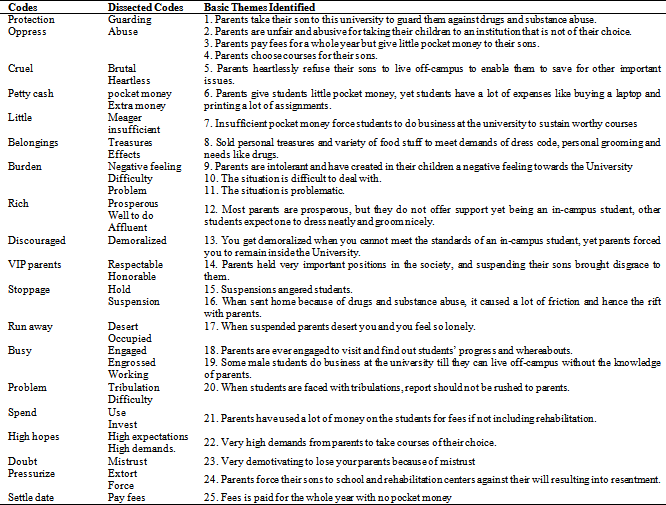


Step 2: Identifying Themes for Parental Participation
The identification of themes for parental participation was done through abstracting them from the coded text to get basic, organizing and finally global theme as shown in Table 2.


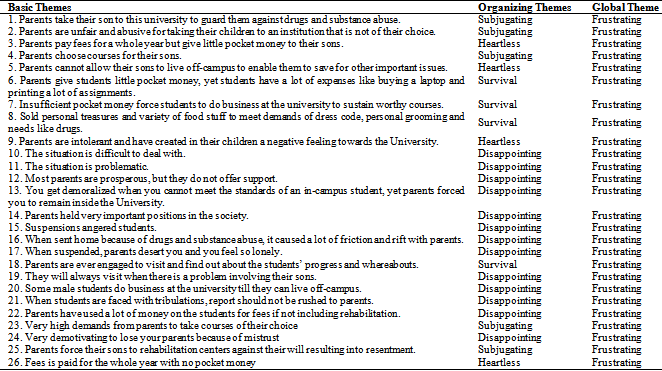


 Download as
Step 3: Construction of Thematic Networks for Parental Participation
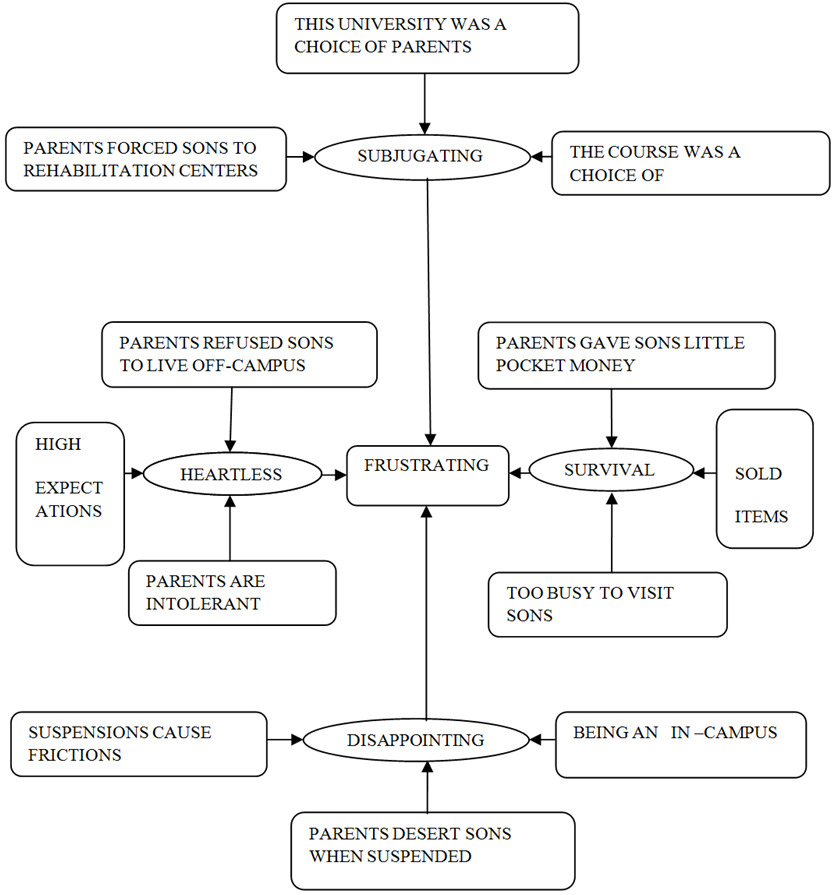
In this step themes were developed as units of analysis from the coded text. The researcher looked at codes to identify themes based on this first objective. Themes were arranged from basic, organizing and finally the researcher came up with a global theme. This culminated into web-like networks referred to as thematic networks as shown in Figure 1.
Analysis Stage B: Exploration of the Text
Interviews yielded invaluable and rich information on ways in which parental participation affected academic performance and graduation of male university students. The exploration of the text by the researcher entailed interpretation and discussion of thematic networks.
Step 4: Interpretation and Discussion of Thematic Networks for Parental Participation
When the participants were asked on ways in which parental participation has affected their academic performance and graduation, the following global theme emerged; parents were frustrating. The organizing themes that emerged were; parents were subjugating, heartless, left their sons to survive on their own and that they were disappointing.
According to the male students, their parents were frustrating in the sense that they were subjugating, heartless, they left their sons to survive on their own and that they were disappointing. The organizing theme for parents subjugating their sons is backed by rich information from the interviews which portrayed parents as rigid when dealing with their sons. These parents did not create room where they could learn what their sons appreciated and what they disliked. To attest to this claim, Msema Kweli claimed that he wanted to study abroad but his mother did not only refuse him to go and study abroad but she also refused him to study at the University of his choice within the capital city. As such he just hated to be in the current university. Msema Yote also asserts that when he was heavily abusing drugs and substances, his parents did not offer him with a shoulder to lean on for social-spiritual support and guidance. Besides, they also gave him little pocket money and being in the current University and his former University was actually the choice of his parents. Furthermore, Roho Safi argues that he was taken through a series of rehabilitations without his consent with no success. Rare Case on his part claims that social aspects kept most of them in the university. For instance, religious reasons and supposed protection from drugs and substance abuse. This for him also made school a prison as his parents did not provide him with basic items, leading to finishing school be seen as indefinite.
The study also found out that male students may have lacked internal resources for maturity because they missed external guidance as parents in this study seemed not to have offered adequate guidance and counseling. Instead, they forced their sons to rehabilitation and into this institution against their will as Patikana says,
“I needed their support, my parents forced me for rehabilitation against my will, I felt that I needed counselling not a rehabilitation Center, where I met core drug addicts. I felt bad and took alcohol while I was in for rehabilitation. The alcohol was brought in by core drug addicts who sneaked out.”
As earlier indicated, without sufficient external guidance or internal resources with which to take stock and mature, it is not surprising that adolescence (an age originally meant for growing up) has become a permanent peer culture of the cool and a rejection of the grown-up [38]. Besides, when parents are involved in their children’s education, they do better in schools [14]. The study also found out that the participants perceived their parents as subjugating since they forced them to take courses against their will in a university that was never of their choice as McSmiler says,
“Aaaaa madam! Initially it was not easy being here and it took me a lot of pain to adjust of being forced by my parents to come to this institution. Adjusting does not mean that I am doing anything constructive but I have just adjusted to stay here for the sake of my parents.”
Therefore, the study established that where there was no understanding between parents and their children, academic performance was affected as evident in this study.
The organizing theme for parents being heartless is backed by invaluable information from the interviews. The participants were dissatisfied with the way their parents had no feelings for them by being hard. This is supported by Msema Kweli who contends that each time he asked his parents to allow him to reside at off-campus so that he could save money for other important concerns, they denied him. Msema Yote also argues that when his parents learnt that he was taking alcohol in high school, they took him to an up-country Christian school. Little did they know that they were introducing him to marijuana, besides an extension of alcohol. He also claimed that one cannot live in a society where parents alone are involved. This is in agreement with social learning theory [29]. That is, learning at home, at school, and in the community is necessary for creating, shaping and maintaining behavior patterns later in life [40].
Roho Safi also claims that, ideally his parents forced him into drugs and substance abuse by being over demanding through their high expectations and pressure to perform. He further said that peers who were using drugs in high school introduced them to him by arguing that, ‘to be able to trans-night especially during exams’ where initially they registered good results but as they got addicted, they got less and less interested in academic work. Roho Safi further observed that under the influence of drugs and substances, one could not concentrate on anything. Patikana also feels that his parents were heartless since they left him alone after circumcision and after joining the university. He also points out that they expected responsibility from him but substance abuse overcame his manhood and placed him where he is today at 28 years old, 3rd year but in his 9th year at the University (as he covered his mouth with hand and shook his head as an element of self-pity).
The study also found out that the situation of the male students proved difficult to deal with since parents did not seem to have created an open forum where they could share important issues with their sons as supported by (excerpts from the researcher’s journal, May 18th, 2015).
“Some parents clear a year’s fees on yearly basis even if their sons were exceeding the expected years at the university, yet they left them with little pocket money, and they did not offer guidance”
Besides, the hostel where these parents paid for their sons is that termed as for the children of the
“most affluent members of the society”
as noted in the (excerpts from the researcher’s journal May, 18th, 2015).
Some of the challenges facing the boy child as earlier identified were found to be lack of guidance and counseling … weak family institutions, corporal punishment, and negative parental attitude [10]. This confirms Rare Case’s expression when he said,
“Whenever I asked my dad to allow me to be an off-campus student to meet academic financial obligations, he told me, ‘is money your bother? I have paid fees, eat at the cafeteria and sleep in the hostel.’ I resorted to eating and sleeping as my dad retorted.”
This study therefore noted that, when a student decides to eat and sleep at the university instead of focusing on his academic work, such a learner may not perform and graduating cannot be expected. When parents are involved in their children’s learning, the higher the performance and that this position holds true for all types of parental involvement in their children’s learning in all levels and ages [6]. The study also found out that the respondents were exposed to what they termed as frustrations from parents which rendered their academic work to be of lesser priority. Ironically, a case, where parents pay the university fees without expecting value for their money is questionable according to the reflective notes in the researcher’s journal that claims,
“Parents seemed interested only in protecting their sons from the menace they could have been causing in the society.”
(excerpts from the journal, May 18, 2015).
This study relates well with the claim that parents have abandoned old cultural responsibilities, leaving the young no inspirational goals and the result is that youth is no longer a stage of life but a ‘refuge’ from the now entangled and obscured path to maturity. All these have led to confusion for the youth, a generation on hold [22]. Besides the study found out that the parents were also heartless as they did not allow their sons to live off-campus yet they could not meet the demands of an in-campus student despite the fact that their parents were financially stable. For the male students, being an in-campus without meeting the standards of an in-campus student especially the dress code was very shameful. The study also revealed that parents were heartless as they paid dearly for fees but hardly left the male students with enough pocket money even if they had soap as Rare Case says,
“Of what use was I to be an in-campus student where I led a miserable life when everybody knows that being an in-campus student, one has to lead a luxurious life; but I did not have a laptop, I lacked money for printing assignments and for other academic concerns besides clothes to make me meet the in-campus students’ dress code.”
The organizing theme for parents leaving their sons to be survivors is backed by valuable information from the interviews. When parents failed to support their sons especially when they were capable, the sons felt hurt and were forced to look for other alternatives to survive. Besides when parents did not listen to the concerns of their children, lack of cooperation and unfavorable environment at home made children suffer in silence and this affected their academic performance and graduation as supported by Roho Safi who maintains that when his parents sent him little pocket money for fear that he could use the money on drugs, he did business in his former university involving the selling of drugs that negatively affected his academic performance. He further affirms that the situation was very frustrating especially being a son to a VIP. However, he claims that although his parents have currently styled up, he is not about to complete his undergraduate degree (scratched head). Msema Yote insists that little pocket money made him to engage in business involving the selling of personal items and being a drug peddler in his former university. According to him, the situation drowned him into abuse of marijuana and heavy drinking that made him clash with the administration, and this was followed by a series of suspensions that made him to be taken for rehabilitation, which hindered his academic progress and graduation. McSmiler also points out that he had been a very good child since he was born but he believes that being the 1st born has made things worse between him and his parents who had extremely high expectations from him. For him, the society expects a boy to be perfect and to obey orders without questioning. Rare Case also explains that each time he wanted to start a business project his dad told him, to finish with schooling first. This made him to view school as a burden and got fed up with it. He further points out that he wanted to marry and at the same time sell tree seedlings but his dad told him to concentrate on his education first as business could lead to leaving school, yet he was not given full support and this made him to hate school.
The study found out that parents play a big role in the academic success of their children. Parents ought to get in touch with their children mainly through their examples and assistance [6]. Parents sent their children to the University and failed to monitor their progress by appearing to be too busy as Msema Kweli states,
“My father is ever busy with his endless travels that he has no time for me. He is a VIP in the government you know! He is very stable financially yet I am very unstable financially; and rarely does he travel upcountry where I live with my mother nor does he come to the university to make a follow up on my academic progress.”
It is also indicated that parents are not available for their children partly because of their busy schedule [20]. On the other hand, this study found out that conflicts at home and cases of separation and divorce made the male students to perform poorly as Patikana says,
“Separation of my parents made them not to have close monitoring of my academic performance. I requested them to come to school because some course units were disturbing me. They did not listen and this affected my academic performance and graduation a great deal.”
It is observed that learners who have experienced cases of death, divorce, separation or abuse of substance at their homes have negative academic performance. The result is undue anxiety that triggers emotional problems and long-term distress resulting in poor academic performance [3]; [2]. The study also revealed that parents had very high expectations and demands on their sons that compelled them to abuse drugs to be able to trans-night. Parents’ expectations encourage their children to pursue goals with hard work, enhance self-efficiency and nurture good study habits, but high parental expectations and unwillingness to accommodate alternatives could result in counterproductive anxiety in their children [21]. The participants confessed that their parents were indeed well abled financially yet they had left them to survive on their own at the university by selling personal effects to meet their demands like printing of assignments, photocopying, buying of laptops and to meet the students’ dress code. Msema Kweli says,
“I sell a variety of food stuff to meet demands of dress code. I am even able to live off-campus without the knowledge of my parents who are ever engaged to check on my wellbeing. I also take my peers out for relaxation in good hotels using profits made from my business.”
The organizing theme for parents being disappointing is backed by a lot of information from the interviews that depict parents as not being close to their sons as Msema Kweli contends that his parents were never bothered to know about his well-being, and forcing him to be an in-campus student was so disappointing. Besides, Roho Safi feels that since his father holds an important position in the society, it is a disgrace to him when the son is suspended. He further claims that suspensions made his parents to suspend his university education for more than two years pushing his graduation far. McSmiler points out that it was very demotivating and disappointing to lose parents because of mistrust where his parents did not believe that he only hated the course but not the university and education in general. Misunderstandings between parents and their son sons caused more harm than good as noted in the researcher’s journal excerpt.
“Quarrels from parents during suspensions left the male students who were addicts, to drink endlessly”
(Journal excerpts, May 19th, 2015).
Parents involvement is paramount because it acknowledges their importance in the lives of their children, providing a vehicle for building a collaborative problem-solving structure and increasing the opportunity for all students to learn in school [17]. The study found out that when parents fail to offer appropriate guidance and support to their children, these children will fail to see sense even in that which affects their lives as Rare Case says,
“For me finishing school with frustrations from my parents was irrelevant, burdensome and meaningless. In my second generation at the university, my brother took over the payment of my school fees and also supported me and concentration on my academic work started.”
The study found out that the parents' concern seemed to have been for their sons to eat and sleep well at the university now that they did not bother to provide for academic needs. This interfered with academic performance and graduation of the male students. Some of these parents may have realized that when they gave their sons money, they messed with it. The participants felt that their parents were very disappointing especially when they were suspended since they became angry with them, leading to a lot of friction which finally resulted in parents deserting them as Msema Yote asserts,
“When I was sent home because of drugs and substance abuse, it caused frictions with parents who even deserted me making me feel so lonely. You see, madam some people do not know what it feels like to be under alcohol but when my parents started empathizing with me, I stopped being arrogant and I am now busy fighting addiction which has actually ruined my academics and general well-being.”
The parents were also found to be unfair and abusive for taking their children to university that was not of their choice. Parents chose university for their children to guard them against drugs and substance abuse as claimed by the participants who felt that their parents forcefully removed them from the universities of their choice or did not allow them to be enrolled at the universities where they had been admitted. McSmiler has this concerning the same,
“I fail exams not because I am poor academically but because I do not feel comfortable here”
The study also reveals that for rehabilitation exercise to succeed there must be a lot of willingness from the affected person, but force, as parents were found to use, should not be the case as it leads to resentment as witnessed. Majority of the participants had been in and out of the rehabilitation centers without change because they were taken there without their consent. Parents just took their sons for rehabilitation without considering if the center followed the 12 steps of the healing process. Roho Safi says:
“If the process did not entail the 12 steps, then it was useless according to the participants who had many times been in and out of rehabilitation. There is no need to take your child for rehabilitation in centers that do not provide 12 steps of healing as no healing will ever be achieved.”
When a learner’s welfare is not catered for, the mind of such a learner gets destabilized and room for academic concentration declines especially in a situation where one feels that there is no support in an area that directly touches on their general wellbeing. Parents were ever engaged to visit and find out about their sons’ progress and whereabouts, and could always visit when a problem was already in place as Patikana contends,
“When my parents deserted me I got lost in other activities at the university like partying and substance abuse. This affected my academic performance. When my parents came to the university to visit the Academic Dean, my performance started improving.”
As earlier indicated, both parents should be involved in the academic success of their children [6]. On the other hand, the school administration and other stakeholders through Parents Teachers Association (PTA) and local meetings should sensitize parents on their responsibility in their children’s education to avoid putting entire blame on teachers when their children fail to perform well in schools [7]. Students whose parents monitor their academic work closely are great achievers and when male university students involve themselves in drugs and substance abuse, they perceive their academic performance as of no significant importance as noted in the researcher’s journal.
“Engaging in drugs and substance abuse could have rendered these male students most wanted by law enforcing officers and that their parents could actually have been hiding them.”
(Journal excerpts, May 20th, 2015).
Therefor parental support is paramount in academic performance and graduation of the male students.
3. Summary of the Major Findings Based on the Objective of the Study
Parents did not create room for dialogue with their sons, they acted in ways that were hurting and they did not offer guidance and counselling to them.
4. Conclusions
On the basis of the findings of this study, the following conclusions were made: Parental participation on academic performance and graduation of male university students was wanting in that, poor communication between parents and their sons on matters especially those touching on the academic life of their sons, negatively affected academic performance and graduation of the male students. The participants perceived their parents as frustrating in the sense that they were subjugating, heartless, they left them to survive on their own and that they were disappointing. Parents forced their opinion in the course preference and the university where their sons were to be enrolled besides taking them for rehabilitation before consulting them. This was met with a lot of resistance by the male students and this resistance did not only affect the male students’ academic performance but it also affected their graduation negatively. Even though parents were paying dearly to ensure that their sons enjoyed the luxury of being an in-campus and especially in the most expensive hostel termed as ‘that of the children of the most affluent members of the society,’ their sons did not appreciate as they seemed to have wanted freedom above anything else especially now that they were engaging in drugs and substance abuse.
Besides, critical examination of the failure by parents to provide their sons with money for laptops and other necessities as claimed by the participants could have meant that the participants’ state of addiction also made them sell their laptops alongside other personal effects forcing their parents to limit their pocket money. Where parents were paying school fees without expecting notable progress from their sons could have implied that they were trying to protect their children from the menace they could have been causing in the society as a result of drugs and substance abuse. Their sons could also have been most wanted by the police officers and that the university could have been a hiding place for them. This conclusion was arrived at especially where the sons were also cooperating to stay at the university even if they were not making notable academic progress.
5. Recommendations
1. Parents ought to be concerned with issues affecting their sons so that they can offer genuine support and understanding before peers take over.
2. Parents ought to avoid being over demanding in academic performance as pressure compels children to resort to drugs and substances unnecessarily.
3. Parents ought to have open forums with the university administration so as to have a close monitoring of the students’ academic and social affairs.
4. It is ideal for parents to explore other options on how they can give assistance to their sons like guidance and counseling other than confining them into a learning institution where their lives could be getting worse yet parents assume that the institution is safe for their sons.
5. Parents ought to be concerned when their children are not performing but are very willing to continue staying at the university.
6. The study acts as an eye opener to parents on the need to be close to their children.
Acknowledgement
I give glory to God for his inspiration and care throughout the writing of this thesis. I appreciate my family members: Isaac Kipyego Mettoh; Hansen Kiprotich Yego, Isaac Junior Kiplimo Yego, Isabel Jeptoo Mettoh, Immaculate Jemeli Mettoh and Hazenaah Kiprono Yego for constantly reminding me in hard times that ‘there is no gate that the Lord knows not.’ I extend my gratitude to my supervisors Prof. Wanjiku J. Khamasi and Dr. Kisilu M. Kitainge for they bore all the bother and crap and gave this piece of work a shape it did not have at the beginning. I thank the University of Eldoret for the opportunity given to me to study in the institution. I appreciate the Government officers for the authority given to me to carry out this research. I give thanks to the university in the western region of Kenya for giving me the opportunity to conduct the study in the institution. Special thanks go to the research participants for trusting me.
Statement of Competing Interests
The authors have no competing interests.
List of Abbreviations
VIP: Very Important Person
References
| [1] | Eysenck, M., & Derakshan, N, European Psychologist, 2009, 14, 168-175. | ||
 In article In article | View Article | ||
| [2] | Karande, S., & Kulkarni, M,. Poor School Performance. The Indian Journal of Pediatrics. Vol. 75, 961-967. 2005. | ||
| In article | View Article | ||
| [3] | Adell, M. A, Strategies for improving performance in adolescents. Madrid: Piramide, 2002. | ||
| In article | |||
| [4] | Saiduddin, J, Factors Affecting Achievement at Junior High School on the Pine Ridge Reservation. Spain: Ohio State University, 2003. | ||
| In article | |||
| [5] | Berg, L.E, Child Development. (6thed). Boston: Allyn and Bacon, 2003. | ||
| In article | |||
| [6] | Ondieki, L. G, A master’s thesis on the study of parental involvement in preschoolers’ academic work in Dandora Educational Zone of Nairobi County, Kenya, University of Nairobi, 2012. | ||
| In article | |||
| [7] | Mwihaki, J, Parents’ socio-economic characteristics and students’ academic performance in the kenya certificate of secondary education: The case of Kalama Division, Machakos District, 2013. | ||
| In article | |||
| [8] | Mwangi, J, Why most boys are not becoming men. Nairobi, Kenya. Asaph Office Publications, 2012. | ||
| In article | |||
| [9] | Grobe, T., Niles, J., & Weinstein, E, Helping all youth succeed: Building youth development systems in our communities. Boston: Commonwealth Corporation, 2001. | ||
| In article | |||
| [10] | Gakinya, T. W, Challenges and their effect on the boy child education in Kieni East. Research project submitted to the school of humanities and social sciences. Kenyatta University, 2013. | ||
| In article | |||
| [11] | Doucet, A, Do men mother? Fathering, care, and domestic responsibility. Toronto: ON. University of Toronto Press, 2006. | ||
| In article | |||
| [12] | Saiduddin, J, Factors Affecting Achievement at Junior High School on the Pine Ridge Reservation. Spain: Ohio State University, 2003. | ||
| In article | |||
| [13] | Gichaga, S. N., Kerre, R. M., Mwaura, P. N., & Onoko, E. A, Secondary Christian Religious education. Book 4. (2nded). Nairobi: Kenya Literature Bureau, 2014. | ||
| In article | |||
| [14] | Utah Education Association, Parental Involvement Strongly Impacts Student Achievement, New Research Finds, 2001. Available at http://www.wnh. Edu/docs/Conway. [Accessed Dec, 2. 2015]. | ||
| In article | |||
| [15] | Olatoye, R.A., & Ogunkola, B.J, Parental Involvement, Interest in Schooling and Academic Achievement of Junior Secondary School Students in Ogun State, Nigeria. College Teach, 2008. Available at: www.cluteinstitute.com Methods Styles J. 4(8): 33-39. [Accessed Nov, 12. 2015]. | ||
| In article | |||
| [16] | Standfield, P, Horse Opera:The Strange History of the 1930s Singing Cowboy.Urbana: University of Illinois Press, 2002. | ||
| In article | PubMed | ||
| [17] | Banks, J. A., & Banks, C. A. M, Multicultural Education: Issues and perspectives, (6thed). USA: John Wiley & Sons. Inc, 2007. | ||
| In article | |||
| [18] | Sirin, S. R, Socioeconomic status and academic achievement: A meta analytic review of research. Review of Educational Research, 75(3), 417-453, 2005. | ||
| In article | View Article | ||
| [19] | James, D., & Jurich, S. (Eds.), More things that do make a difference for youth: A compendium of evaluations of youth programs: Vol.ll, 1999.Washington, DC: American Youth Policy Forum. Retrieved from www.aypf. org/publications/compendium/comp. Jonstone. [Accessed Oct.10,2015] | ||
| In article | |||
| [20] | NACADA, The role of parents in prevention and control of Alcohol and drug abuse among their children in Nairobi, 2010. | ||
| In article | |||
| [21] | June, L, Affordances and constraints of Immigrant Chinese Parental Expectations on Children’s school Performance. Journal of Educational Research. Vol. 49: 198-200, 2003. | ||
| In article | |||
| [22] | Cross, G, Men to Boys. The meaning of modern immaturity. New York:Colombia University Press, 2008. | ||
| In article | |||
| [23] | Cote, J, Arrested Adulthood:The Changing Nature of Maturity and Identity. New York: New York University Press, 2000. | ||
| In article | |||
| [24] | Gillham, B, Case study research methods. London: Continuum, 2000. | ||
| In article | PubMed | ||
| [25] | Richards, K, Qualitative inquiry in TESOL. New York:Palgrave Macmillan, 2003. | ||
| In article | View Article | ||
| [26] | Eriksson, P. & Kovalainen, A, Qualitative methods in business research. London. Sage Publications Ltd, 2008. | ||
| In article | View Article | ||
| [27] | Kimmel, M, The gendered society. Oxford: Oxford University Press, 2000. | ||
| In article | |||
| [28] | Crotty, M, The foundations of social research. Australia: Allan and Unwin pty Ltd, 1998. | ||
| In article | |||
| [29] | Frere, P, Pedagogy of the oppressed. Penguin: Harmondsworth, 1972a. | ||
| In article | PubMed | ||
| [30] | Ong'ondo, O. C, Pedagogical Practice and Support of Student Teachers During the Practicum. Deutschland, Lambert Academic Publishers, 2010. | ||
| In article | |||
| [31] | Ruto-Korir, R. C, Preschool Teachers' Beliefs of Developmentally Appropriate Educational Practice: Unpublished Ph.D thesis. University of Pretoria, 2010. | ||
| In article | |||
| [32] | Stacy, M. C., & Miles L, Qualitative Health Research. justifying knowledge, justifying methods, taking Action: Epistemologies, Methodologies, and methods in qualitative research, 2007, 17: 1316. | ||
| In article | |||
| [33] | Cresswell, J.W, Qualitative inquiry and research design.Choosing among fiveapproaches. (3rd ed.). Thousand Oaks, CA: Sage, 2007. | ||
| In article | |||
| [34] | Patton, M.Q, Qualitative research and evaluation methods (3rd ed.). Thousand Oaks, CA Sage publishing, 2002. | ||
| In article | |||
| [35] | Fontana, A., & Frey, J, The interview. From neutral stance to political involvement. In N. Denzin & Y. Lincoln (Eds). The sage handbook of qualitative research. (3rd ed). 695-728. Thousand Oaks, CA. Sage, 2005. | ||
| In article | |||
| [36] | Polonski, M. J. &Waller, D.S, Designing and Managing a Research Project. A Business Student’s Guide. California: Sage publications, Inc, 2005. | ||
| In article | |||
| [37] | Attride-stirling, J, Thematic Networks: An analytic tool for qualitative research; London: Sage Publications, vol. 1(3): 385-405. (2001) 1:3, 2001. | ||
| In article | |||
| [38] | Cote, J, Arrested Adulthood:The Changing Nature of Maturity and Identity. New York: New York University Press, 2000. | ||
| In article | |||
| [39] | Bandura, A, Exercise of human agency through collective efficacy. Current Directions in Psychological Science, 9, 75-78. (6), 2000. | ||
| In article | |||
| [40] | Maundeni, T, The Boy Child and HIV/AIDS in Botswana: A Neglected Issue in Research and Practice. Pula: Botswana Journal of African Studies Vol. 18 no. 1, 2004. | ||
| In article | |||
 CiteULike
 Mendeley
 StumbleUpon
 Delicious
 Facebook
 Twitter
 LinkedIn