In this research work the author initially introduces two important notions : Fuzzy Sustainable Development & Fuzzy Sustainable Development Goals; and then proposes a major urgent Reform of United Nations (UN) for a huge benefit of our planet. All the three AI-based secret-voting methods which were introduced in the “FIFA Constitution” proposed in , are used in this proposed Reform of UN (called by PRUN) imposing the mandatory norm that all votings in UN must be secret-voting, not ‘raise-hand’ voting. One deeply hidden Paralysis Situation of the UN is that the existing concept of “Sustainable Development” which presently being followed by ECOSOC & the World is an excellent concept, but not a ‘precisely’ well defined concept for a UNIQUE mathematical modelling of it required for UN, for the Researchers, and World Activists. For any development D, the “amount of sustainability α is different in different countries”, which is fact on reality and this proposition needs serious attention by UN. Out of 17 existing Sustainable Development Goals (SDGs), the two Goals Goal-1 and Goal-2 are having some error and consequently these two SDGs are revised. Three new very important SDGs are introduced which are Goal-18, Goal-19 and Goal-20, without which the UN can never protect and save our planet upto satisfaction, although it is fact that ECOSOC has been doing very hardwork on this subject for our planet. It is justified that the grand subject ‘Sustainable Development’ is very much an Engineering, AI and Soft-computing subject compared to the subjects Sociology & Economics and hence ECOSOC is not the sufficient body or appropriate body of UN which can deal with this grand subject with complete justice and fairness. The wrong practices of “Reverse Democracy” in UN is unearthed by an example. The life and health of our planet is solely dependent upon the UN activities, each and every activity must be sustainable development activity. Consequently the proposed Reform of United Nations (UN) will be much more strategic and disciplined to solve the everyday issues and problems of our earth in excellent & optimal ways.
The UN explicitly divides its work into five main pillars called by “UN-Pillars” which are : Maintaining International Peace and Security, Protecting Human Rights, Delivering Humanitarian Aid, Promoting Sustainable Development, and Upholding International Law. While sustainable development is a massive core pillar of the UN's modern mission, but in this research work it is justified in length that all UN activities in all the other four pillars too must be sustainable development activities. This postulate was not unearthed since 1987, but in this century it is an important postulate for UN. Because the 1987 definition of Sustainable Development is not only for focusing on long-term economic growth, social inclusion, and environmental protection, but on many more important significant fields of this century to save and protect our planet. The present work provides an important set of Proposals for UN for its urgent Major Reform. All the readers of this article (as their pre-requirements) must be aware of all the three AI-based new secret-voting methods introduced in the “Fundamental Reform of FIFA” with the holy “FIFA Constitution” recently proposed in 1, 2, and officially submitted to FIFA/UEFA for implementation in pursuance of more Excellence in 2030 World Cup. Each of these secret-voting methods takes around one minute time to complete the voting by voters and then to declare the results of voting. Because the present article on “Major Reform of UN” uses these AI-based new secret-voting methods, all of which are applicable to UN voting in GA and in its different bodies, imposing the mandatory norm that all voting in UN must be secret-voting, not ‘raise-hand’ voting. The sequence of steps followed in this work for justifying the genuine need for ‘Major Reform” of UN is as below:-
(i) A new type of categorization of world countries.
(ii) Mathematical Modeling of the existing concept of
Sustainable Development, removing the impreciseness in its definition being practiced by UN. Removing the existing term “unsustainable development”.
(iii) Introducing the concept of Fuzzy Sustainable
Development (FSD)
(iv) Correction of the concept of two sustainable
development goals (SDGs) : Goal-1 and Goal-2.
(v) Incorporating three new Sustainable Development
Goals (SDGs) : Goal-18, Goal-19 and Goal-20 as the mandatory requirements for our planet in this century.
(vi) Introducing the concept of 20 Fuzzy Sustainable
Development Goal (FSDG).
(vii) Incorporating a mandatory norm in UN that all voting
in all UN bodies must be “Secret-voting” methods, not the existing practiced “raise-hands” method.
(viii) Implementation of three new AI-based secret-voting
methods in UN (which were introduced in the “Fundamental Reform of FIFA” and in the “FIFA Constitution” recently proposed in 1, 2, and officially submitted to FIFA/UEFA for implementation for achieving more excellence in future World Cup matches). It is to be noted that the time required for conducting any of these type of secret-voting with immediate result declaration takes around one minute only, irrespective of the number of voters. The work 1 is a pre-requirement for the readers to understand about the guarantee of 100% Democracy in this proposed REFORM of UN.
(viii) Fourteen Proposals (called by PRUN) are drafted for
an urgent “Major Reform” of UN, to protect and save
our planet in this century.
(ix) UNSC is renamed as UNNC with sufficient logic &
justifications made. An extremely important sub-council of UNNC entitled as World AI Monitoring Sub-Council (WAM Sub-council) is introduced in UN for urgent launching, with top priority, in order to save the human lives on earth.
(x) Launching of a new college named as “UN Staff Training College of AI, Soft-computing and Sustainable Development” for imparting advance short term training & education to the UN staff members only (as UN is a very important and big organization having large number of its own staff working in the world countries). This college will be officially affiliated to the existing United Nations University (UNU).
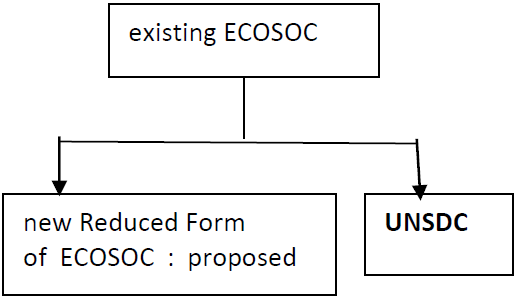
(xi) ECOSOC is re-structured with sufficient justifications
made, for much better results on the Sustainable Development activities by UN.
(xii) VETO power practice is abolished. It is against the
practices of sustainable development, democracy, sense of equality, justice and fairness.
(xii) A new engineering subject with nomenclature “Sustainable Development Engineering” is introduced with proper justification, and UN will take all initiatives for launching compulsory education on this engineering subject in all its member countries. The ESD Section of UN will facilitate scholarships to the world youths interested in studying this new engineering programme.
The concept of sustainable development was first widely introduced in the Brundtland Report in 1987. This report, formally known as "Our Common Future," was published by the World Commission on Environment and Development, which was chaired by Gro Harlem Brundtland, the then Prime Minister of Norway. The report defined sustainable development as
"development that meets the needs of the present without compromising the ability of future generations to meet their own needs". Our previous work 18 is an important research work unearthing the weakness of ` the existing concept of “sustainability” being followed by UN and world researchers/activists.
Sustainable development is the most important tool for the UN-approaches to progress, that balances current needs with the ability of future generations to meet their own needs. Presently it involves integrating economic, social, and environmental considerations to ensure a healthy planet and a prosperous society for all, but this research work justifies that UN needs consideration of many more fields mandatorily in the AI-era in this century to meet truly the needs of the present without compromising the ability of future generations, to genuinely ensure a healthy planet and a prosperous society for all their own needs optimally. This means striving for economic growth that is inclusive, improving social well-being, and maintaining or enhancing environmental quality is just a fraction of the actual requirements. The ECOSOC facilitates the implementation of internationally agreed goals, including the 2030 Agenda and its 17 number of Sustainable Development Goals (SDGs). In 2013, the Commission on Sustainable Development (CSD) was replaced by the High-level Political Forum on Sustainable Development (HLPF) in UN. High-level Political Forum (HLPF) on Sustainable Development has been putting more emphasis on Science & Technology for better dealing with Sustainable Development. In fact, HLPF now is the sole part of ECOSOC in UN looking after the world’s most important, urgent and alarming topic : “Sustainable Development”.
In this research work, it is justified that there UN has been working without a good mathematical model of the beautiful concept of “Sustainable Development”(SD) because of the reason that the subject “Sustainable Development” is a fuzzy subject, not a crisp subject. Consequently the concept of “Fuzzy Sustainable Development” is presented, and then the existing set of SDGs is revised as it is having some faults besides incompleteness, and then FSDGs are defined. And finally a major reform of the United Nations (UN) is proposed for huge benefit of the world as well as our planet. For the complete work here, we introduce at the very beginning a new concept of “Categorization” of world countries, without which the theories and examples of “Fuzzy Sustainable Development” and the genuine need of UN-Reform can not be studied.
This is the first basic step for correct implementation of the notion of “Fuzzy Sustainable Development”. Sustainable Development is no more just a Topic today, but a grand Subject. It is a hot subject in this century because of many important reasons. This important subject is to be viewed as the hybrid (STEAM education) of many Science subjects and many Engineering subjects, ofcourse including Economics and Sociology. Throughout the content of this Work till end, the following Categorization of World Countries is followed. This categorization is very important to proceed further in this Work to propose a major reform of UN.
We propose that the 193 member countries of UN (and also including the non-member countries of UN) be categorized in the following three disjoint categories:
Developed Countries : C1, C2, C3, C4, ………..
Let us call them by the name ‘C-category’ countries.
Developing Countries: D1, D2, D3, D4, ………..
Let us call them by the name ‘D-category’ countries.
Undeveloped Countries: U1, U2, U3, U4, …..
Let us call them by the name ‘U-category’ countries.
This categorization is important as a basic requirement to understand the concept and theories of Fuzzy Sustainable Development.
The C-category countries (i.e. Developed countries) have advanced economies, technological infrastructure, and high standards of living. They also have access to quality healthcare and higher education. Based on various rankings and criteria, here are countries often considered among the developed countries in the world, with a focus on factors like GDP, Human Development Index (HDI), and overall quality of life. Example: United States, UK, France, Italy, Switzerland, Germany, Japan, Canada, Australia, Poland, Sweden, Netherlands, Norway, South Korea, etc.
The D-category countries (i.e. Developing countries) are nations with a lower standard of living, often characterized by lower per capita income, less industrialization, and challenges in infrastructure, education, and healthcare compared to developed countries. Example: China, India, Darussalam, Democratic People's Republic of Korea, Fiji, Hong Kong, Indonesia, Iraq, Iran, Israel, Jordan, Kiribati, Kuwait, etc.
\The U-category countries (i.e. Undeveloped countries) are characterized by low economic output, high poverty rates, and limited access to basic necessities and infrastructure. Example: Afghanistan, Angola, Bangladesh, Benin, Burkina Faso, Burundi, Cambodia, and the Central African Republic. Some of the poorest countries in the world, often facing challenges like conflict, weak governance, and limited resources. Example: Burundi, Niger, the Democratic Republic of the Congo, and the Central African Republic
It is observed that some of the developments in the Developing countries are not at all acceptable as they are not sustainable developments in these countries. Whereas the same developments in few Poor countries are “well acceptable” and they accept them happily as if sustainable developments for their country, irrespective of what the developing countries say or blame. It is because of the following reasons on ground reality:- it is a development affordable for them, they are happy with this developments, they can not afford for a better development at this time, they do not have any alternative way, they have to survive, as they spent days with poverty, with hunger, and slowly with time they will be able to make better developments in future to become financially better. We should not practice such theories at the cost of huge time and money which are not going to solve the real issues of the world. The world is not a sphere with homogeneity in all direction and fields of daily life.
3.1. Few Examples of Ground Reality ExampleFor example, say one medicine is banned in America because although this medicine can cure well the disease for which it was developed, but it has unacceptable side effects which America does not want for its people. On the other hand, exactly the same medicine is regularly being prescribed by the doctors in a very poor country as this country can not afford to buy the better medicine from America. They have to survive and come out of the today’s problem and suffering today. Tomorrow, if the economy of this country improves, then the Government of this country may think of a better medicine. But today this better medicine will not cater to sustainable growth of this poor country.
Example
Consider another example. One brand of car may not be acceptable in some countries, but is well acceptable by some other countries as they do not have any alternative today. Their economy can not support this excellent car for its Government offices and requirements.
Example
One brand of rice may not be acceptable in some countries, but is well acceptable by some other countries as they do not have any alternative today for surviving.
Example
Consider another example. One school teacher in Mathematics may not be selected for teaching in schools in France, but is well acceptable by some other countries to teach Mathematics in their country as they do not have any alternative today. But they understand that by solving today’s issues, tomorrow they can become a Developing country !
And there are a large number of such examples in the world which are facts, but may be un-noticed facts while going for meeting the actual objectives of “Sustainable Development & Growth” instead of talking only theories and theoretical analysis.
3.2. Unearthing the HIDDEN TRUTHIn this Work, the following important observation is reported, justified and explained in details with a lot of theoretical evolution. The observation is as below:
The modelling of the revolutionary notion of the topic “Sustainable Development” since its inception in 1987 is not done, but huge volume of work has been going on and going on, including 27.
Andriantiatsaholiniania and Phillis 17, and Biswas et. el. 18 said that the present notion of Sustainability is an ill-defined concept. There are huge amount of literatures working rigorously on the beautiful topic “Sustainable Development”, out of which very few literatures are there where the topic “Sustainable Development” is analysed with the notion of fuzzy logic feeling no NEED of scientific & mathematical modeling. And there is no literature in the world in which “Fuzzy Sustainable Development” is defined and studied, this work is the first attempt to do so. It it is observed that the existing literary Definition of “Sustainable Development” may be applicable at some part of the world, but not applicable across the world as far as the implementation are considered. Small island states remain the most vulnerable and require more attention. Their vulnerabilities are associated with absolute impacts on the society, economic and environmental systems due to their smallness, remoteness and limited resources. Most of the small island states have encountered considerable environmental degradation, economic losses and social instabilities during the recent years This issue is ground reality in the world today. It is fact that in reality one development is a sustainable development (has to be accepted today as a sustainable development) in a poor country whereas the same development is not a sustainable development in developed countries, it is being summarily rejected for any development in the developed countries. The main reason behind this unwanted and unfortunate situation on the reality is that the 193 members of UN are highly heterogeneous in terms of financial power, education, health, medical facility, availability of food and water and energy, culture, administrative system, etc to list a few only out of many and many. This extremely important point of reality is missed in the activities of ECOSOC in UN that: “some development may not be a sustainable development in some country by virtue of its definition, but mandatorily being accepted as sustainable developments in another country”. It is fact, It is the ground reality. It is the ground reality. It is not just a theoretical statement, but highly practical statement which ECOSOC must understand at its earliest. Besides that, there is no precise definition of Sustainable Development with the ECOSOC. Consequently, there is no other alternative to deal with the existing concept of sustainable development, but to compulsorily take help from the “Theory of Advanced Soft-Computing”. If the issues of Sustainable Development be not dealt with Advanced Soft-Computing Techniques by ECOSOC, UN then the actual success of ECOSOC will not come except doing a lot of theoretical activities and statistical analysis.
The content of this Work is drafted by a rigorous endeavor on this issue, providing total solutions for ECOSOC for achieving more excellence in its future activities on sustainable development. The core philosophy behind the work is different from the 1987 Report. The new philosophy introduced in this work is that: “Every correct Development needs to be viewed as a Sustainable Development upto certain extent, till a homogeneity does not come in the 193 members of UN calling all or almost all countries as Developed Countries”. Because, for many poor countries in the world, it will be dangerous for them if we reject most of their developments saying that these are not sustainable developments. We have to remember that they may not have any alternative developments and they can not buy sustainable development products or objects from the developed countries. Consequently, as a solution for ECOSOC, a new theory of “Fuzzy Sustainable Development” is developed in this work. For this, an important phrase “upto certain extent” is introduced using a parameter called by “extent” and the parameter α, where α [0,1], 1, in the theory of “Fuzzy Sustainable Development”. Hopefully UN and the world will accept the new theories, solutions and will discuss in its coming 2030 Agenda, the world is waiting for.
One weak Situation of the UN is that the existing concept of “Sustainable Development” which presently being followed by ECOSOC & the World is an excellent concept, but surely not a ‘precisely’ well defined concept for a UNIQUE mathematical modelling of it for UN daily activities, for the Researchers, and World Activists to progress their hard works for achieving excellent output results. Another weak concept is that every development D is either sustainable or unsustainable to ECOSOC. In this work the author solves both of these weak points before going for proposing a ‘Major Reform’ of UN. Without these solution on the issue of ‘sustainable development’, neither UN nor any researcher/activist in the world can achieve excellent results on their activities on sustainable developments, whatever be the amount of their hardwork or dedication. “Sustainable Development”, as defined by Gro Harlem Brundtland, is such kind of development that meets the needs of the present without compromising the ability of future generations to meet their own needs. The Economic and Social Council (ECOSOC) of United Nations (UN) is the central platform for the UN system performing excellent work on sustainable development for a common future of the world. The topic “Sustainable Development” is the most important area in cleaner production perspective, for social welfare and for the benefits of our earth in this century. The ECOSOC(UN) has been looking after all the issues of Sustainable Development for the welfare of present world as well as for the future world to achieve the philosophy “Our Common Future” in the world.
By a Development (D) we mean an action (or a collection of actions/sub-actions) that aims at raising the quality of life of the present generation. By a Sustainable Development (SD) we presently mean such a Development (actions) that aim at raising the quality of life of both present and future generations without threatening natural endowment and environment. The 1987 Brundtland Report 4, 5, 11 stated that critical global environmental problems were primarily the result of the enormous poverty of the South and the unsustainable patterns of consumption and production in the North.
4.1. SustainableSustainable is most often defined as meeting the needs of the present without compromising the ability of future generations to meet their interests. It has 3 main pillars, as per the presently practiced notion by UN:
(i)Economic pillar,
(ii)Environment pillar, and
(iii)Social pillar.
It is justified that these three pillars are insufficient in this century to deal with the ground reality while thinking of the world’s progress to protect and save our planet. In the year 2014, UN Member States proposed a set of 17 Sustainable Development Goals (SDGs), with a noble expectation and estimation that these 17 reference SDGs can succeed the Millennium Development Goals (MDGs) for the international development community 20 during the period 2015-2030. SDGs could be regarded as one guidance principle for strategically development on local, regional, national and international levels. But a genuine question arises: Is this set of 17 SDGs is sound, complete and exhaustive? In this work, the author makes a serious improvements of the existing set of 17 SDGs and the 169 targets, with sufficient indicators. Main objective of ‘High-Level Political Forum on Sustainable Development’ with the 2030 Agenda is clear from their statements made in 2015:
“We resolve, between now and 2030, to end poverty and hunger everywhere; to combat inequalities within and among countries; to build peaceful, just and inclusive societies; to protect human rights and promote gender equality and the empowerment of women and girls; and to ensure the lasting protection of the planet and its natural resources. We resolve also to create conditions for sustainable, inclusive and sustained economic growth, shared prosperity and decent work for all, taking into account different levels of national development and capacities”.
And this is probably one of the most beautiful, most important, most positive and most promising resolutions ever adopted by any forum on this earth so far in the field ‘Sustainable Development”.
4.2. Concept of “Unsustainable Development”(The concept which presently being followed in
UN and around the world countries).
According to the present concept of the world experts and according to the above definitions of ‘Development’ and ‘Sustainable Development’,a ‘Development’ D may not necessarily be qualified to be categorized as a Sustainable Development and if so then it will be called as Unsustainable Development by UN and world researchers. Even the concept of perfect sustainability is not yet absolutely achieved because of no precise mathematical model still framed by the researchers so far.
Considering the tremendous future importance of ‘Sustainable Development’ on this planet, the author here are very much sure that rigorous research work should be initiated on this subject. The subject needs a properly organized and rich theoretical development as it is observed that the subject has already gone upto good extent of huge attempts for practical implementation without sufficient amount of mathematical study and research work based on appropriate mathematics. There is a genuine need to enrich the theory of Sustainable Development as a subject(course), and it is known thatESD opens opportunity to every human being to acquire the important parameters viz. knowledge, skills, attitudes and values etc which are required to shape a guaranteed sustainable future.
4.3. The existing Concept of “Unsustainable Development” in the academic worldOur previous work 18 is an important research work unearthing the weakness of the existing concept of “sustainable” being followed by UN and researchers and activists. It is observed that the existing concept of “Sustainable Development” is very ill-defined 17, 18. One major reason behind this unfortunate situation is unearthed by the author that:- the Existing Practice of Categorization of a Development is by two(2) Cases only: Sustainable Development & Unsustainable Development, whereas in ground reality it is to be by large number of Cases !
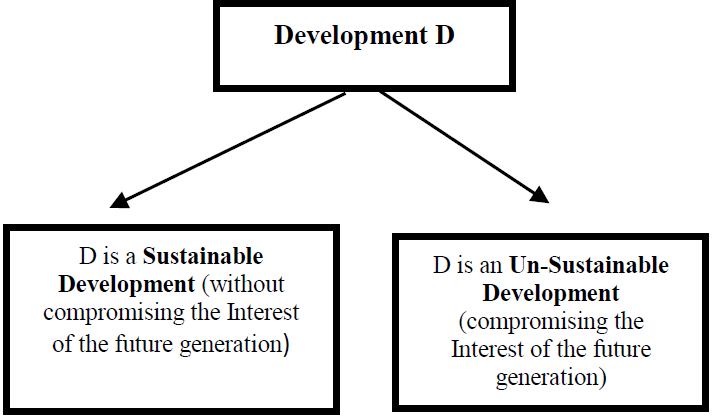
The existing notion says that a development D can be categorized either as a ‘Sustainable Development’ or as an ‘Unsustainable Development’. Thus two and only two cases are considered for categorization which are of Yes-No type (Figure 1). It is known that ‘Sustainability’ can be viewed as establishing a good system wherein the biosphere and living objects can coexist. It is about raising the living standards of the present generation without harming the opportunities of the future generation. Sustainability is about preserving the resources, both in terms of quality and quantity. Obviously the term ‘sustainability’ can not be defined in crisp way, can not be dealt with crisp theories of natural sciences and technologies without taking the help of appropriate and advanced soft-computing theories. The main aim of sustainability is to maintain balance among different aspects of society and the environment. There are few common principles related to Sustainable Development, viz. Conservation of our ecosystem, Development of society, Conservation of biodiversity, Protecting human resources, Conservation of cultural heritage, Creating a community within the capacity of Earth, etc to list a few out of many. Following these can ensure to protect our environment while creating a situation of abundance in our society. Few Examples of Sustainable Development are : Wind Energy, Solar Energy, Crop Rotation, Sustainable Construction, Efficient Water Fixtures, Green Space, Sustainable Forestry, etc.

Unsustainable Development occurs when present progress is achieved at the expense of future generations. For example, irresponsible planning and environmental degradation through exploitation of resources generates waste and pollution that damages ecosystems. Such practices are not sustainable in the long term. Examples of few unsustainable practices are: Land conversion and habitat loss, Genetic erosion, Global warming or climate change, Pollution and contamination of our air, land, and water, Soil degradation and erosion, Wasteful consumption of water. Leading among the causes of unsustainable agriculture are inadequate or inappropriate policies which include pricing, subsidy and tax policies which have encouraged the excessive, and often uneconomic, use of inputs such as fertilizers and pesticides, and the overexploitation of land. Air and water pollution, deforestation, excessive use of chemicals in agriculture are ill effects of unsustainable development.
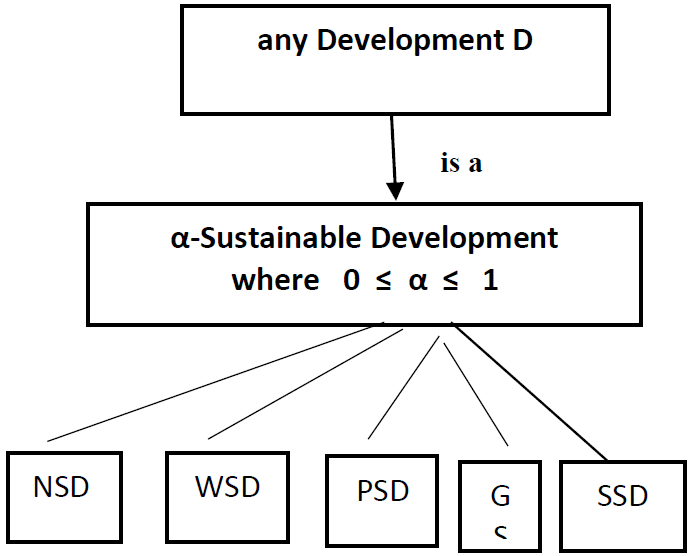
Before proposing for “Major Reform” of UN, the initial key objective of this research work is to grade every Development D in the continuous range [0,1], 1 instead of the existing practice of considering D in the discrete range {0,1} i.e. in the range set {NO, YES} in terms of the amount of its sustainability, and hence to categorize it into one category out of proposed five categories (Figure 2).
The existing concept says that a new completely constructed development D is either a sustainable development or an unsustainable development. This is a two valued concept (Yes or No) of ‘sustainable development’ and discourages a builder/developer(team) of a new innovative development to proceed for his future plan of actions for initiating subsequent developments despite his honest idea, honest endeavor to make it a sustainable development. Even finally on completion of his project he may marginally miss to make his completed development D as a fully sustainable development! Sometimes providing a feasible solution to a problem as the first-aid is important and un-ignorable for the human welfare (while pursuing a solution of poverty issues) even if the project on its completion misses marginally to be qualified to become finally a ‘Sustainable’ Development. The work here proposes that in such cases sometimes we may go for an advanced kind of solution by grading the developments (Figure 2) into five categories NSD, WSD, PSD, GSD, and SSD using the rich soft-computing theories, where NSD stands for Non-Sustainable Development or Unsustainable Development, WSD stands for Weakly-Sustainable Development, PSD stands for partially-Sustainable Development, GSD stands for Good-Sustainable Development, and SSD stands for Strongly-Sustainable Development. These five categories/grades are introduced and studied in details in our earlier work 18. But we need to develop new AI-based theories for devising good mathematical methods for this century for gradation of a Development D, using the extended concept of range in [0,1], 1 to replace the existing hard nature of grading in {0, 1}. And thus the author proposes that every development D is a sustainable development upto certain extent α in the range [0,1], 1.

Consequently, today it is the need of Soft Computing Approaches by ECOSOC in pursuance of more Excellence & Accuracy, even without waiting till 2030.
(as a Correction and for major Modification of the existing concept of ‘Sustainable Development’ being followed in ECOSOC and researchers of world countries)
The present work is just an endeavor to develop a new theory entitled “Theory of Fuzzy Sustainable Development” by extending the existing infeasible concept of strictly Yes-No (two-valued logic) type of evaluation of a development to an infinite-valued type of evaluation of a development. In this sense the notion of “Fuzzy Sustainable Development” should not be misunderstood as the generalization of the existing concept of “Sustainable Development”. To understand the inner hidden weakness in the existing concept of Sustainable Development, consider a very simple example below:
Consider a moderately rich retired person in India. Suppose that from tomorrow onwards he has to settle down in New York or in Tokyo or in Riyadh or in Paris, say. Obviously, he is like a poor people in his new settlement !. And it is because of the reason that the notion of “rich” is not common around the world, it is a relative one. Similarly, the development of the notion of “Sustainable Development” for a given development D can not be a common concept throughout the world as being practiced by the ECOSOC(UN), but we must have 195 definitions (with large number of sub-definitions depending upon the property of the development D) of sustainable development for the 193 countries respectively of our world.
The notion of “Fuzzy Sustainable Development” is introduced here by developing an amount of theoretical exercises, but can be easily implemented across the 193 member countries of UN. An important philosophy behind this work is that a good development D if done by honest endeavor and by very thoughtful approach should not be ignored or discouraged in case it does marginally miss to become qualified as a Sustainable Development by virtue of its existing notion being followed by the world researchers and ECOSOC. This is a serious gap in the present style of dealing with a Development D by the concerned regulatory body. Consequently, the important & new concepts in this work propose soft-computing methods on how to grade a Development D in the continuous range [0,1], 1 instead of the existing practice of considering D in the discrete range {0,1} i.e. in the range set {NO, YES} in terms of its amount of sustainability. It is presently a local concept on ‘sustainability’ in the country concerned, instead of global.
It is strongly claimed here that the concept of Sustainable Development is of soft nature, in fact it is an imprecise terminology. Although some authors as mentioned above tried to use fuzzy logic/ANN tools to deal with ‘sustainable development’, but there is no work reported so far to implement the philosophy of Fuzzy Sustainable Development which can address the ground reality about all the developments around the world. Consequently, to implement the philosophy, an appropriate gradation is done for every such development D using the rich fuzzy theory in order to deal with the impreciseness existing on its core notion. One strong claim of this work is to deal every development D as a sustainable development upto certain extent α, can not be thrown in dustbin if it is not a sustainable development as per existing definition. It will be unfair to do so. We surely need to grade every ‘Development’ by a parameter called by Extent Parameter α where α [0,1], 1.
6.1. “Upto α Extent”: a New ConceptIn the reality of heterogeneity (Developed, Developing, Undeveloped) in the world countries, let us pose a hypothesis that : “Every correct locally developed Development needs to be viewed as a Sustainable Development upto certain extent α, till a homogeneity does not come in the 193 members of UN”. The soft phrase “upto certain extent” is imprecise. To deal with this imprecise phrase, we use a parameter α called by “Extent Parameter”, where α [0,1], 1, in the theory of “Fuzzy Sustainable Development”. For any development D, the “amount of sustainability” α is different in different countries which is reality, UN can not ignore this fact.
6.2. How to Estimate the Value of α?Here the value of α signifies the amount of ‘fuzzy sustainability’ simply to be called as the amount of “sustainability” of a development D. Quite naturally, question arises : Given a development D, how to estimate the value of its α? The method of estimation of the value α corresponding to a development D is presented in the subsequent section here.
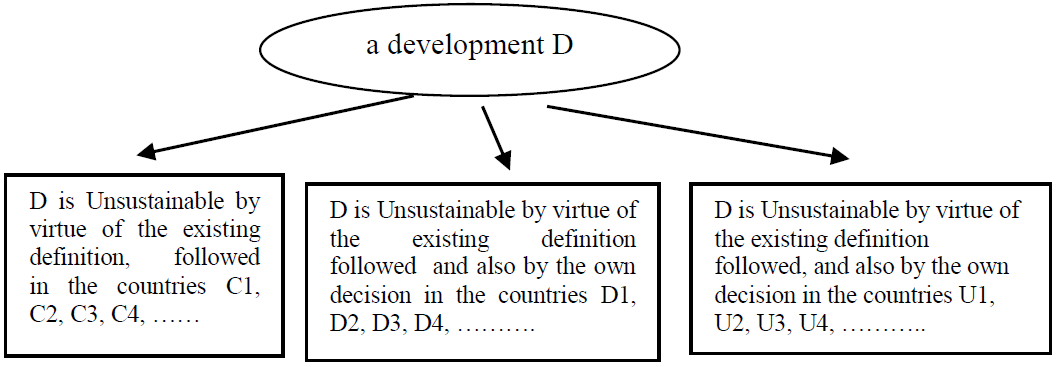
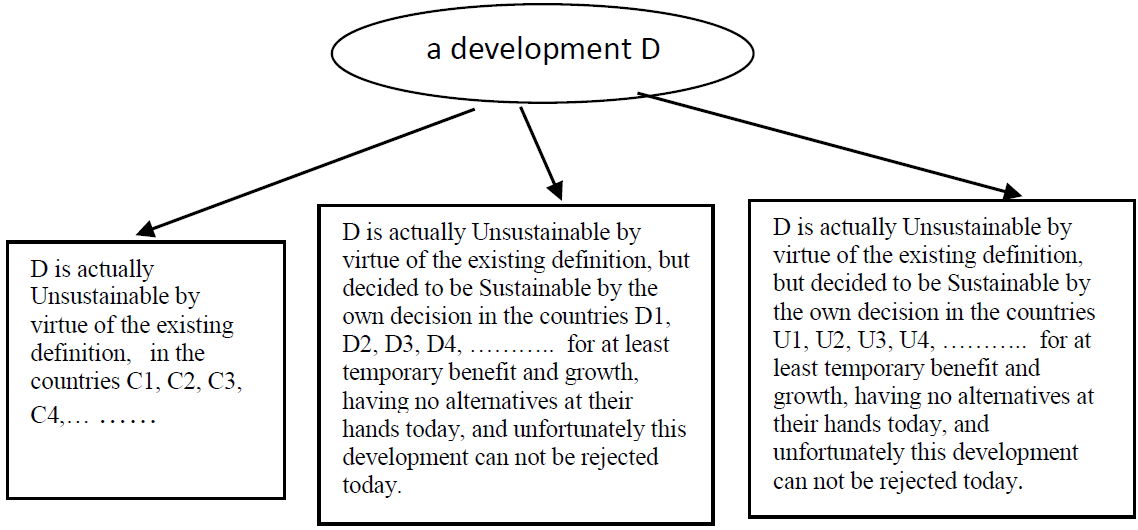
According to the existing concept of Sustainable Development in ECOSOC, if one development D is an unsustainable development by ECOSOC, then D is unsustainable across all the world countries. That means if D is unsustainable in a country say C1, it is unsustainable in any country like D1 or U1, by virtue of the existing definition of Sustainable Development. But what is the ground reality across the 193 members of UN? The ground reality was and is never so, so far. The ground reality is completely different from the existing theory and corresponding activities!. The ground reality is as shown below by two true cases.
Case-1: For an Unsustainable Development D
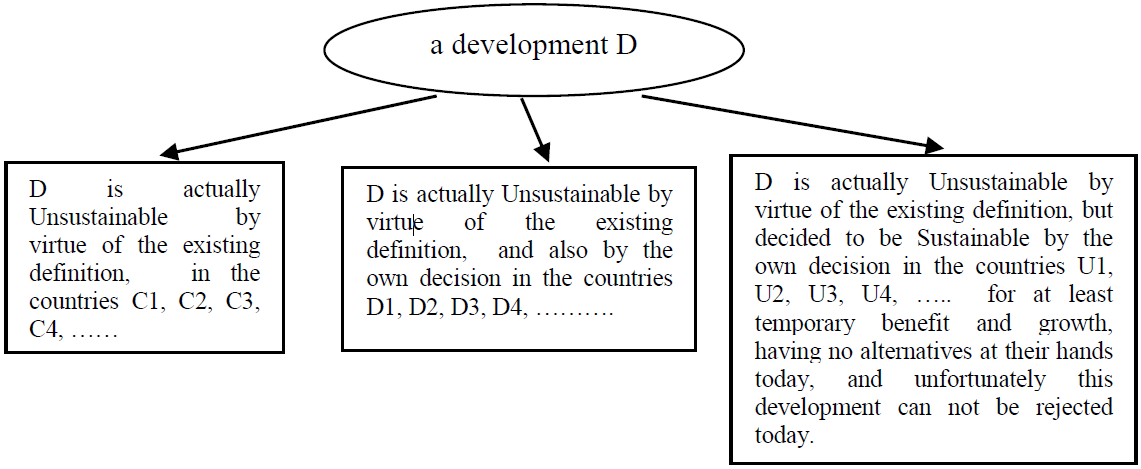
Consider a development D, and see three figures (Figure 3, 4 and.5) below showing the true events being actually practiced on the earth for this unsustainable development D:- .
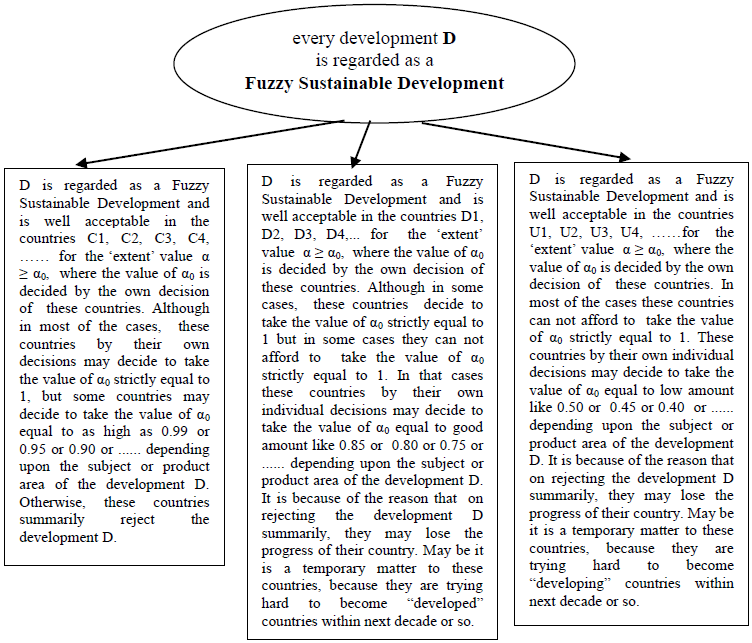
Consequently, the notion of “Fuzzy Sustainable Development” developed in this work will provide a good solution to the ECOSOC to make their all SD activities actually close to the interest of the countries of D-Category as well as U-category too, in addition to C-category countries. Figure-9 provides ECOSOC the main significance of the notion of Fuzzy Sustainable Development.
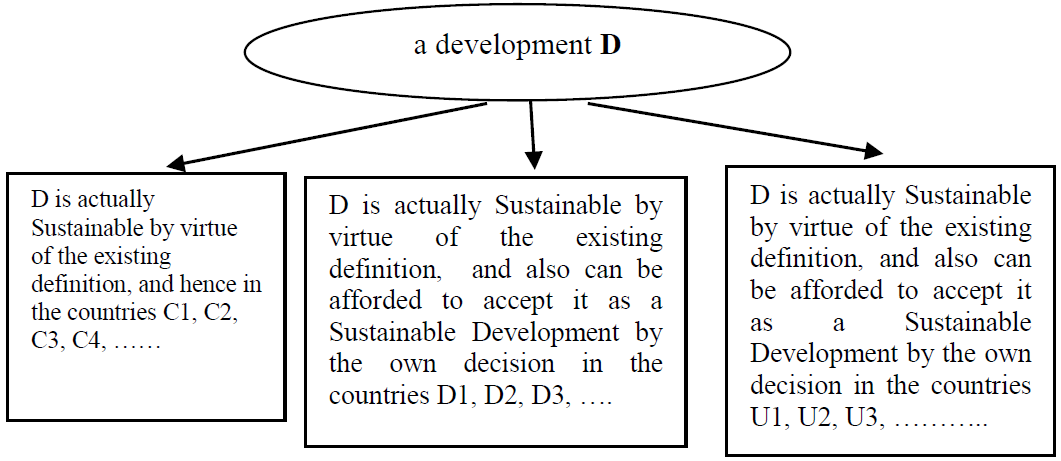
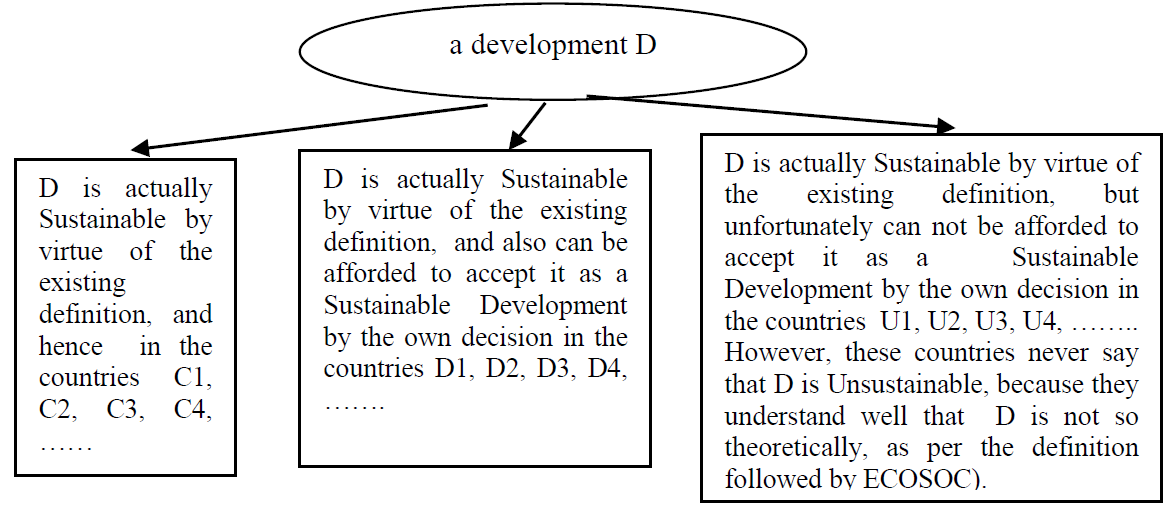
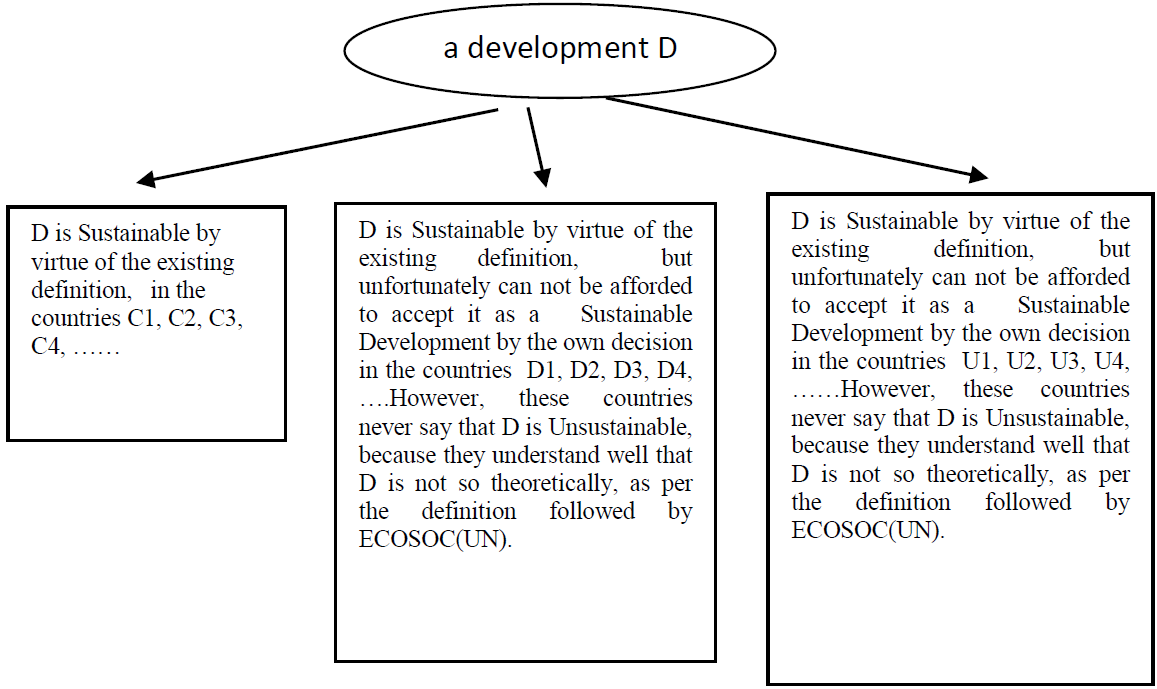
Case-2: For a Sustainable Development D
Consider a development D, and see the three figures (Figure 6, 7 and 8) below showing the true events being actually practiced on the earth for this sustainable development D.
See that it may happen, just for a hypothetical example, that a highly acceptable fuzzy sustainable development D in a country of U-category, is around 85% acceptable in a country of D-category and is not acceptable in a country of C-category. All developments are fuzzy developments upto certain extent, and this extent-value varies from countries to countries among the 193 member countries of UN, and also to the countries which are not members of UN. The cases vary from country to country, and from the development to development, and also upon the type of the development (area or product types).
The value of the “extent parameter” α, even in a given country, is not fixed. It varies upon the type of development, and even upon the time parameter too. May be, for some (or all) of the developed countries the value of the “extent” parameter α is fixed (say 1), and may be irrespective of the type of development. Thus the “extent” parameter α plays the most important role in the theory and consequently in the application of Fuzzy Sustainable Development. The concept of Fuzzy Sustainable Development will open a lot of gates to the ECOSOC of UN to work more practically and more successfully rather than remaining stuck at imprecise actions and huge documentation type activities at the cost of huge volume of ‘time’ of the world.


On the activities on sustainable developments, the world today is at the hands of ECOSOC. A genuine necessity for a reform of ECOSOC has been proposed in this work for catering to the better service to the world which the existing structure of ECOSOC can not do in the best ways. This underground fact is not due to the officials working in ECOSOC as they are highly intelligent and talented, but it is because of the absence of proper applications of Advanced Soft-Computing, absence of Advanced Engineering & Technology methods etc in their activities and practices. This important and very urgent issue is presented in details in subsequent sections in this proposal for a reform of the existing structure of ECOSOC, the structure which is old and obsolete in this century to deal with sustainable development activities.
6.3. Important RemarksBrundtland Commission 1987 Report says that: sustainable development is a "development that meets the needs of the present without compromising the ability of future generations to meet their own needs". This idea of “Sustainable Development” is one of the most important discoveries in the last century. It is one of the “most wanted” and “most fruitful” discovery for our planet. It is known that all the activities of UN being done in any direction on any areas are sustainable activities for the welfare of the world countries. Besides that, UN Experts as well as a number of researchers/scientists in the world have been working heavily on the topic of “Sustainable Development” since 1987, a lot of publications is being done in good journals and proceedings of the international Conferences. Unfortunately, no work is found so far which was done by correct scientific & mathematical modelling of the Brundtland Commission 1987 concept of “Sustainable Development”. The work reported in this section introduces and says the following very important points, at the outset of the content of this work, before going for the subsequent sections:-
No.1. The concept of “Sustainable Development” of Brundtland Commission 1987 Report is basically not a crisp concept. It is purely a fuzzy concept, because of the following phrases used in the definition :-
(i) that meets
(ii) needs of the present
(iii) compromising
(iv) ability
(v) their own needs.
Consequently, before going for any research work or for doing any activity on the topic of “Sustainable Development”, its concept discovered in ‘Brundtland Commission 1987 Report’ must be correctly modelled in a scientific & mathematical platform using Fuzzy Theory and Intuitionistic Fuzzy Theory. No efforts or hard work otherwise, can produce the required results at required pace of time being continuously sought silently by our lovely planet.
No.2. UN experts, all the activists and researchers of the world countries, working on “Sustainable Development” must have prior knowledge of AI & Soft-computing with Fuzzy Theory and Intuitionistic Fuzzy Theory. They all have been working with the excellent idea of ‘Brundtland Commission 1987 Report’, but not on a common and correct conceptual platform. There are few research works by some authors who used fuzzy theory in their analysis but not on doing any soft mathematical modelling. All such works must be strongly based upon a correct scientific & mathematical modeling of the excellent concept of ‘Brundtland Commission 1987 Report’, otherwise the ultimate and final results will not be well acceptable by the planet.
No.3. While working on the topic of “Sustainable Development”, UN experts and all the activists and researchers/scientists of the world countries, need to forget the geo political division of the world. But they must not forget the categorization of the world countries into the three(3) categories as reported in this work.
No.4. This work justified that the concept of “Sustainable Development” (‘Brundtland Commission 1987 Report’) is more local than global. One development D developed in America could be a Sustainable Development in America, but not a Sustainable Development in a poor country, say in Africa. Conversely, one development D developed in a poor country in Africa could be a Sustainable Development in many countries in Africa, but not at all a Sustainable Development in America (just for an example). The concept is more local than global. And for this reason, it is suggested in this work that the UN experts and all the activists and researchers/scientists of the world countries, need to forget the geo political division of the world. They need to work with the division of the 193 member countries of UN and also including the non-member countries of UN into the following three categories, most relevant to the work on “Sustainable Development” :
Developed Countries : C1, C2, C3, C4, ………..
Let us call them by the name ‘C-category’ countries.
Developing Countries: D1, D2, D3, D4, ………..
Let us call them by the name ‘D-category’ countries.
Undeveloped Countries : U1, U2, U3, U4, ………..
Let us call them by the name ‘U-category’ countries.
We activists never thinks about “which country is a member country of UN and which country is not”. Our planet silently wants that: let all the countries of the world be members of UN”. The mathematical modeling of the concept of “Sustainable Development” (of ‘Brundtland Commission 1987 Report’) is done in this section by introducing “Fuzzy Sustainable Development”. It has been possible because of the in-built power and beauty of ‘Soft-computing’. The introduction of the measure “Upto α-extent” has made it possible, where 0 ≤ α ≤ 1. Consequently, if a development D developed in America be a “sustainable development in America, and not sustainable in a poor country in Africa, does not necessarily mean that it is to be summarily rejected by the Experts or Activists calling it wrongly as “Un-sustainable Development” for that poor country too. The work in this section summarily says that every development D developed anywhere on this planet is a “Fuzzy Sustainable Development” which is sustainable upto “Upto α-extent”, where the amount of sustainability i.e. the value of the parameter α varies from country to country. Let us not use the term “Un-sustainable” henceforth any where in our future works and activities in the world, in UN, and in the future documents related to ‘Sustainable Development’.
In 2015, the leaders of all the UN’s Member States agreed to the 2030 Agenda for Sustainable Development. The 17 Sustainable Development Goals and their 169 associated targets address five areas of critical importance: people, planet, prosperity, peace, and partnership. The 2019 Report is available in details in 21. As per existing practiced notion, the Sustainable Development Goals (SDGs), also known as the Global Goals, are a collection of 17 interlinked goals designed to be a "blueprint to achieve a better and more sustainable future for all". They address global challenges such as poverty, hunger, inequality, climate change, and environmental degradation. In 22 Mordeson and Mathew solved a good real life problem on human trafficking applicable to few countries (OECD countries only). In our work here a Reform of the present list of 17 SDGs of United Nations(UN) are made by introducing five new mandatory SDGs for making the list truly complete, sound and exhaustive for the purpose of meeting genuinely the philosophy of the concept of sustainable development that was first widely introduced in the Brundtland Report in 1987. The new SDGs are very important to meet the "Our Common Future", can not be ignored or kept on hold, and they are not covered by the old 17 SDGs. Consequently, we introduces the appropriate name “Fuzzy Sustainable Development Goals (FSDG)” instead of calling them by the poor name “Sustainable Development Goals (SDG)” as the present SDGs are not crisp or well defined precise concepts. The author here basically prefer to say that the world need not do so much huge volume of work with hard labour at the cost of huge man-hour without understanding the DNA (roots) of the concept of “Sustainable Development” and “Sustainable Development Goals”. In another words, it can be said that the large volume of activities-network by hard work being done by the world for "Our Common Future", are not sustainable upto the mark.
7.1. “Sustainable Development Goals” (SDGs) adopted by United Nations (UN)In 2015, the United Nations adopted the 2030 Agenda for Sustainable Development, which includes 17 Sustainable Development Goals (SDGs). These goals are a universal call to action to end poverty, to end hunger, to protect our planet, and to ensure that all people enjoy peace and prosperity. The SDGs cover a wide range of issues, including poverty, hunger, health, education, gender equality, climate action, and sustainable consumption and production.
The existing 17 SDGs of UN are:
Goal 1: No Poverty
Goal 2: Zero Hunger
Goal 3: Good Health and Well-being
Goal 4: Quality Education
Goal 5: Gender Equality
Goal 6: Clean Water and Sanitation
Goal 7: Affordable and Clean Energy
Goal 8: Decent Work and Economic Growth
Goal 9: Industry, Innovation and Infrastructure
Goal 10: Reduced Inequalities
Goal 11: Sustainable Cities and Communities
Goal 12: Responsible Consumption and Production
Goal 13: Climate Action
Goal 14: Life Below Water
Goal 15: Life on Land
Goal 16: Peace, Justice and Strong Institutions
Goal 17: Partnership for the Goals
7.2. SDG IndicatorAn SDG indicator 13 is a statistical measure that tracks progress on one of the Sustainable Development Goals (SDGs) or their targets, helping countries and the global community monitor economic, social, and environmental sustainability. These indicators, defined in the global indicator framework adopted in 2017, provide data for informed decision-making, policy adjustments, and ensuring accountability for the 2030 Agenda for Sustainable Development. SDG indicators 13 are a set of quantifiable metrics designed to track progress towards the United Nations' Sustainable Development Goals (SDGs). These indicators provide a framework for measuring and monitoring the 2030 Agenda for Sustainable Development, ensuring accountability and informing policy decisions. The global indicator framework includes 234 unique indicators that are classified into three tiers based on their methodological development and data availability. SDG indicators 13 are specific, measurable, achievable, relevant, and time-bound (SMART) targets used to assess progress on the 17 Sustainable Development Goals. They provide a standardized way to track progress towards the SDGs at the global, regional, and national levels. These indicators are crucial for monitoring, reporting, and evaluating the implementation of the 2030 Agenda.
Few Examples of the existing SDG Indicators 13 are:
1. For Goal 1 (No Poverty):
Proportion of population living below the
international poverty line.
2. For Goal 2 (Zero Hunger):
Prevalence of stunting and wasting among children
under 5 years of age.
3. For Goal 3 (Good Health and Well-being):
Maternal mortality ratio.
4. For Goal 4 (Quality Education):
Proportion of schools with access to basic
infrastructure and resources.
5. For Goal 13 (Climate Action):
CO2 emissions from fossil fuel combustion and
cement production.
Many of the existing SDG indicators are based on huge data and information which are not always precise or readily available, or may be subject to interpretation. Consequently, the situation calls for Fuzzy Logic to make it a more suitable, more appropriate topic on Sustainable Development. In the next section, three new Sustainable Development Goals (SDG) are introduced to save our earth, as earth has been loosing its health in a continuous manner every day, but slowly. And then the need of defining Fuzzy Sustainable Development Goal (FSDG) is justified.
It will be well justified in this work that the existing 17 SDGs are not sufficient to meet the demand of our planet, rather the existing list is missing very utmost important SDGs. In this section, five(5) new and genuine Sustainable Development Goals (SDG) are introduced which are Urgent & Unavoidable. These new five Sustainable Development Goals (SDG) are SDG-18, SDG-19, SDG-20, and two revised as well as corrected model for Goal-1 and Goal-2. We must have well-defined revised Targets for twenty(20) number of SDGs. The proposed five(5) new SDGs are entitled as below:-
Goal-18 : Abolition of Global Terrorism.
Goal-19 :Danger to the Earth due to Debris revolving
in Space.
Goal-20 :Global Education on Non-Violence
and
Goal-1 (Revised) :No Poverty(incorporating the
correct concept of Poverty)
Goal-2 (Revised) : Settlement of Life on Other Planets
and Moons
The new five Sustainable Development Goals (SDG) named by SDG-18, SDG-19, SDG-20 and SDG-1(revised), SDG-2(revised) can not be implemented and tackled without paying very strong attention on the reasons behind their evolution and birth in the new modified list. In fact our planet may see her skeleton body if these new SDGs are not given very special weightage by the United Nations (UN), in particular at SDG-19. With the introduction of the above listed five SDGs, the total number of SDGs needs to be considered by UN is now twenty(20), and most important observation is that the list of these 20 SDGs is now sound, complete and exhaustive. They constitute now the revised form of Global Goals. The 17 SDGs are good SDGs mostly for the people on this earth. But what’s about protecting & saving our earth? Can these 17 SDGs sufficiently take care of protecting & saving our earth and planet? In the next sections of this work, the author now justifies that
(i)none out of the 17 SDGs can save our oxygen,
(ii) none out of the 17 SDGs can save retaining
the amount of sunlight reaching our earth surface,
(iii) none out of these 17 SDGs can take care for growing
non-violence mind among the children globally,
(iv) none out of these 17 SDGs can sufficiently take care
about Global Terrorism, and some more such facts.
The new five proposed Sustainable Development Goals (SDG) named by SDG-18, SDG-19, SDG-20 and SDG-1(revised), SDG-2(revised) are well explained in this section as solutions to above listed loopholes for which the existing list of 17 SDGs can not be regarded as sound, complete and exhaustive. Global Terrorism is very dangerous in the world today, more than COVID attack. Even if a country supports any other country doing Cross-border terrorism, but does not itself do terrorism acts, will be treated as a bad country in UN in terms of Non-violence. A continuous and special action for Global Education on Non-Violence will be the almost solution of Global Terrorism.. And then it is justified that the name Sustainable Development Goals (SDG) is not appropriate. Observe that the terms poverty, hunger, good health, good education, clean water and sanitation, descent work, …. etc are imprecise terms, fuzzy terms, even not mathematically well-defined terms. Considering the concept of “Fuzzy Sustainable Development” introduced in this work, it can be well observed that all of the SDGs are not crisp SDGs. Most of the SDGs are Fuzzy Sustainable Development Goals (FSDG). It may also be observed thatnone of the existing 17 Goals are fully independent. The 17 Goals are mutually dependent having slightly or more amount of overlapping interests and activities, they are mutually cooperative. But each of them are independently having unique objective. The new five SDGs are introduced below.
8.1. Merging Goal-2 with Goal-1 => “Revised Goal-1”, in the Proposed 20 Number of SDGsIt is true that the 20 SDGs are not mutually exclusive and exhaustive. They have some amount of mutual overlapping link. But if one Goal is completely a sub-goal of another Goal, then a separate identity for such a sub-goal will be highly confusing, and surely not required for its existence separately. Consider the existing Goal-1 and Goal-2, which are as below:-
Goal 1: No Poverty
Goal 2: Zero Hunger
and also consider their respective SDG Indicators 13 for them as below:
1.For Goal 1 (No Poverty):
“Proportion of population living below the
international poverty line”.
2.For Goal 2 (Zero Hunger):
“Prevalence of stunting and wasting among children
under 5 years of age”.
Now let us do some real field subject analysis on Poverty & Hunger. See that Poverty is not a well defined term in Sociology or Economics. There is no single universal definition of poverty. The World Bank (see 14 for details) defines poverty as a "pronounced deprivation in well-being" where people's basic needs cannot be met due to inadequate income or consumption, leading to a lack of key capabilities like adequate health, education, and opportunities to function in society. Poverty may also be tied to a specific type of consumption; for example, people could be house-poor or food-poor or health-poor. These dimensions of poverty often can be measured directly, for instance, by measuring malnutrition or literacy. The World Bank 14 uses a monetary threshold known as the International Poverty Line (IPL) to measure extreme poverty. The IPL is the minimum level of income needed to meet basic needs, adjusted for differences in the cost of living between countries. The national poverty line for a country is typically a monetary threshold below which a person's minimum needs cannot be met, taking into account the country's economic and social circumstances.
Summarily, by the term ‘Poverty’ we mean that it is a state where individuals or communities lack the financial resources and essentials for a minimum standard of living, encompassing not just a lack of income but also limited access to basic needs like : sufficient food, nutrition, milk, shelter, healthcare, and education.
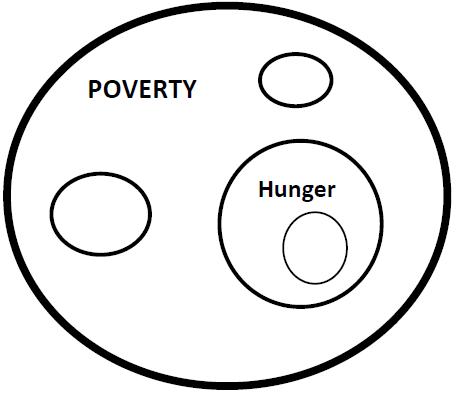
It is quite logical, without argument, that No Poverty => Zero Hunger by default, but the converse is not true. Because by definition of Poverty, the situation "No Poverty” in a region completely (100%) covers and gives guarantee of “Zero Hunger”, whereas the converse is not true. If the Goal-1 is successfully controlled, then the Goal-2 will be 100% under control by default. There can not exist any country which has “NO POVERTY” but has “HUNGER”. It is impossible. However, there could exist country which has “NO HUNGER” but has “POVERTY”.

Jean Dreze & Amartya Sen define hunger to embrace all kinds of social as well as bio-logical disadvantages associated with inadequate food intakes-a definition much broader than the concept frequently found in research and policy.
As the correction of these two Goals, the following four points are proposed :
No(i). let us merge Goal-2 with Goal-1 to make a “Revised Goal-1”
No(ii). let us spent time for Goal-1 only focusing serious attention on poverty on food and nutrition, alongwith other constituent elements of the term ‘Poverty’ (as per definition of Poverty).
No(iii). eliminate the existing title of Goal-2 from the theory for ever, and introduce a new title for Goal-2 as mentioned below.
No(iv).make a “Revised Goal-2” defined as below:-
Revised Goal-2 : Settlement of Life on Other Planets and Moons.
8.2. Revised Goal-2 : Settlement of Life on Other Planets and MoonsIn this section, the ‘existing Goal-2’ is merged with the ‘existing Goal-1’ and thus the ‘Revised Goal-1’ is obtained. Consequently the ‘Existing Goal-2’ stands no more into existence as a separate Goal. But a new “Revised Goal-2” is proposed here entitled “Settlement of Life on Other Planets and Moons”. This newly proposed “Revised Goal-2” (which is “Settlement of Life on Other Planets and Moons”) should not be confused with the existing Goal-14 and the existing Goal-15 which are :
Goal 14:Life Below Water
Goal 15:Life on Land,
because of the unique reason that both of the above two existing Goals Goal-14 and Goal-15 are in the context of our living planet ‘Earth’ only. The ‘Revised Goal-2’ calls for a good preparation by UN from now onwards to make migration of the earths people to re-settle on other planets and moon, in case such an emergency situation arises anytime in future. In this regard, Stephen Hawking proposed us excellent ideas long before, because he had extraordinary ability to communicate with our home planet and the universe.
UN and all its 193 member countries have been trying hard to bring the concept of equality on earth more and more. Out of many Sustainable Development Goals, the Goal-10 is devoted to this excellent philosophy of UN. This is the very right time for the world to think of ownership of Land, Water, Minerals, Oil, Gas, Energy etc on other Planets and Moons, because the world has to agree with Hawking’s words, which is as good as a strong prediction passed from God!. Otherwise, late thinking or keeping such strong words of Hawking ‘on hold’ could be very very costly one day to the world people. In this context, one genuine question arises : Who will be the owner of what in the new Planets and Moons ?
For an instance, it is to be noted that today some countries viz. Russia, America, China have already landed on Mars, and soon they will provide us more and more important data and information about Mars, in particular about the availability of Land, Liquid Water, Oxygen, Minerals, Oil, Gas, Energy etc. But it is also true that there are some countries which even can not think of such a journey to Mars in this century because of huge financial weakness (may not be having any lack of intelligence). Therefore, considering the Goal-10 of UN, it is proposed that ownership of Land, Water, Minerals, Oil, Gas, Energy etc on other Planets and Moons should not be on the basis of “Who landed and occupied land there first”. World does not want to create imbalance and inequalities at the cost of peace & security.
Our great Stephen Hawking already advised our world few excellent words, exactly which are followed in this section here to model as Revised Goal-2 (“Life on Other Planets and Moons).
Hawking warned of numerous threats 29, including the following :-
(i) Climate change
(ii) Asteroid impacts
(iii) Epidemics
(iv) Nuclear terrorism
(v) Uncontrolled artificial intelligence
(vi) Unsustainable resource use.
He believed that humans would continue to consume Earth's resources at unsustainable rates, hastening the planet's demise. In this context, let us recollect the following famous words:-
Humanity must colonize another planet, like Mars, within the next 100 years to avoid extinction due to threats like climate change, epidemics, asteroid impacts, and nuclear war. Staying on Earth any longer places the human species at great risk and that spreading out into space is our only chance for long-term survival. We must find a planet that is rocky, similar in size to Earth, and has liquid water to support life. ----- Stephen Hawking.
Long-term survival:
Hawking stated that leaving Earth and spreading into space is the only way to ensure humanity's long-term future and avoid extinction. What we need in a new home similar to Earth. Hawking also outlined the characteristics of a suitable new home 29:
(i) A rocky planet
(ii) Similar in size and density to Earth
(iii) Located within the habitable zone of its star
(iv) Having liquid water on its surface
Speaking in London at a press conference previewing the Starmus Science and Arts festival taking place in Norway, Hawking announced the following:
“I strongly believe we should start seeking alternative planets for possible habitation. We are running out of space on Earth and we need to break through the technical limitations preventing us living elsewhere in the universe.”
Hawking warned the world of numerous global threats (see 29), including even the Nuclear Terrorism, which could be very very dangerous for our lovely earth. Consequently, UN must have an exclusive goal to make the world free from Global Terrorism, today or tomorrow. The proposed Goal-18 which is about “Abolition of Global Terrorism” is thus a very important goal for consideration by UN to include in the revised list of SDGs corresponding to the Hawking’s announcement as quoted above. If we do not abide by his announcement, surely it will be an injustice to TIME. IEP, The Institute for Economics & Peace 15 is an internationally renowned think tank. IEP says 15: “We are experts in peace, conflict and risk with a global mission, influence and impact. We're changing the way the world understands peace through research, consulting and training”. IEP has very rich research teams and research platforms working for peace.
The Global Terrorism Index (GTI) was introduced by Steve Killelea 15, the founder of the Institute for Economics & Peace (IEP), and is published annually by the IEP to analyze global terrorism trends. Killelea, an IT entrepreneur, established the IEP and subsequently developed the GTI to provide a comprehensive report on terrorism, including factors like terrorist incidents, fatalities, injuries, and hostage numbers. The Global Terrorism Index (GTI), an annual report by the Institute for Economics & Peace (IEP), provides a comprehensive overview of global terrorism trends and patterns, ranking 163 countries based on the impact of terrorism, using data on incidents, fatalities, injuries, and hostages. Some briefs about GTI is collected from 15, 23 and presented below:
The following information about GTI (collected from 7, 10) are important to understand the beautiful measure GTI.
Purpose: The GTI aims to analyze the impact of terrorism, understand trends, and inform policy responses.
Methodology: It uses a composite score, based on factors like the number of terrorist incidents, fatalities, injuries, and hostages, along with conflict and socio-economic data.
Data Sources: The report utilizes data from TerrorismTracker and other sources, including event records on terrorist attacks since 2007.
Scope: The GTI covers 163 countries, representing99.7% of the world's population.
Key Findings: The 2024 report highlights that terrorism remains a serious global threat, with total deaths from terrorism increasing by 22% to 8,352 in 2023, the highest since 2017.
Regional Impact: Sub-Saharan Africa, the Middle East and North Africa (MENA), and South Asia accounted for 94% of deaths from terrorism in 2023, with sub-Saharan Africa alone accounting for just under 59% of all fatalities.
Using the excellent concept of GTI, we must work with priority on this new Goal-18: “Abolition of Global Terrorism”. by the following strategical ways :-
(i) by launching offices across all the 193 member countries of UN (including Non-member countries too)and making meetings/dialogues with the terrorists about their demands and grievances with peaceful and smiling face by the working officials.
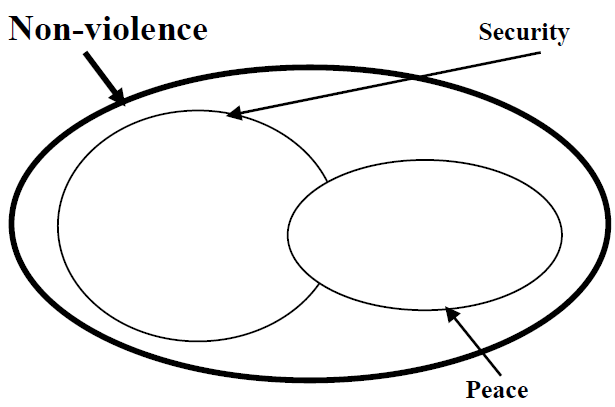
(ii) by peaceful means of every activities, keeping in mind the “Non-Violence” philosophy, (see Goal-20, its twin Goal), and
(iii) by proper education of “Non-Violence” compulsorily in schools across the world, coordinating with the officials working for Goal-20 introduced in this section. One good solution, whose result can be felt and enjoyed by the world after 20-30 years of implementation, is that the concept and philosophy of Non-violence should be taught compulsorily at primary school education level by a good decision of UN for implementation world wide.
8.3. Goal-19: “Danger to the Earth Due toDebris Revolving in Space”The problem of managing space debris is an international challenge, probably can not be well resolved by a single country. Project NETRA (Network for Space Object Tracking and Analysis) is an ongoing initiative by ISRO, India for searching of some method to solve the problem. It serves as an early warning system designed to detect and track space debris and other hazards that could pose threats to Indian satellites in orbit. A number of countries have been regularly launching satellites in space. Other countries too will lunch in future. However, as mentioned in the literature available in 24, the following facts need to be very seriously considered.
Goal-19 is introduced here for UN to find a good solution of : “Danger to the Earth due to Debris revolving in space”. The solution must add support to the existing Goal-13, because Goal-19 is to save the “Climate” of earth, to save the earth from “Environmental Pollution” and to have “daily exposure of infrared sunlight” upon the earth (to save the earth by no blockage from daily sunlight). The proposed Goal-19 is a giant goal for UN. We must save our earth by saving its green Nature. Otherwise slowly and slowly, our earth will be left with its skeleton only. Although Goal-13 is for saving the climate, nevertheless it does not have mandatorily requirements of other important and unavoidable issues covered by Goal-19.
None of the existing 17 Goals (including Goal-13) is devoted to consider and take appropriate action to deal with these dangers of the earth, which in near future will multiply and may become out of control for saving the beautiful nature of this earth, for saving the living objects including human, animals, birds, plants of our earth, for controlling the global warming, abnormal floods, … etc to list a few only out of many and many. Goal-19 is a very very important Goal in this century, and we must initiate our work without any delay. Better late than never.
It is strongly proposed by the author that the world authorities, in particular the UN, discuss regularly with NASA (and also with the Space Agencies of different countries) to do good research on this issue, to offer sponsored Projects to the university Professors of the top ranking universities of the world, for developing technologies for space debris disposal
The following information extracted from 24 are highly significant in support of the proposed SDG ‘Goal-19’. For further study, the article 24 may be visited for having a lot of more amount of good information. Satellites and other human-made objects in space can generate debris, including defunct satellites, rocket Chapters, and fragments from collisions or explosions, which can pose a hazard to future space missions and operations. Space junk, or space debris, is any piece of machinery or debris left by humans in space. It can refer to big objects such as dead satellites that have failed or even left in the orbit at the end of the mission. It can also refer to smaller things, like bits of debris or paint flecks that have fallen off a rocket.
The following kind of space debris 24 needs to be seriously noticed and analysed urgently :-
a) Space debris, also known as orbital debris or space junk, refers to any non-functional or discarded human-made objects in space, including:
b) Defunct satellites
c) Spent rocket stages
d) Fragments from previous collisions
e) Paint flecks
f) Astronauts' lost tools
g) Debris from explosions or break-up of spacecraft
h) Space debris can range in size from small paint chips to large, defunct satellites.
i Even tiny pieces of debris can cause significant damage to spacecraft.
j) How does Space Debris Occur?
k) Space debris is the result of launching objects from Earth, which remain in orbit until they re-enter the atmosphere.
l) Some objects in lower orbits can re-enter the atmosphere relatively quickly, while debris in higher orbits can remain for hundreds or even thousands of years.
m) Space debris can also result from collisions or anti-satellite tests in orbit, where two satellites colliding can create thousands of new pieces of debris.
n) Explosions of spacecraft or rocket bodies can also generate large amounts of debris.
o) Why is Space Debris a Problem?
p) The increasing number of satellites launched into space has intensified the space debris issue.
q) Space debris can pose a hazard to current and future space missions.
ra) Even small pieces of debris can cause significant damage to spacecraft.
s) The growth in space debris can make orbit operations and space flight more hazardous, difficult, and costly.
t) The Kessler syndrome, a theoretical scenario, suggests that a critical mass of debris could lead to a cascade of collisions, rendering space operations unsustainable. Kessler syndrome is a nightmare space scenario in which the number of satellites and orbital debris is so high that collisions occur, each one generating more and more space debris and, in turn, cascading collisions.
u) Mitigation Efforts
v) Space agencies and organizations are working on developing and implementing technologies for space debris removal and mitigation.
w) The European Space Agency (ESA) plans to launch its own trash removal mission in 2025.
x) Japan launched its ELSA-d mission in March 2021, designed to test space debris capturing and removal technologies.
India launched on 15th February 2017 a historical rocket successfully, which carried and deployed a record number of 104 satellites in Sun-synchronous orbits in a single mission, breaking the earlier record of launching 37 satellites by a Russian Dnepr rocket on 19th June 2014. It is a huge lunching event of India in a single mission of ISRO!! It seems nice to listen only, but what’s about the corresponding debris? what’s about the corresponding space environment pollution created? There are millions of pieces of space junk flying in Lower Earth Orbit (LEO). Most orbital debris comprises human-generated objects, such as pieces of space craft, tiny flecks of paint from a spacecraft, Chapters of rockets, satellites that are no longer working, or explosions of objects in orbit flying around in space at high speeds.
(ii) Space Pollution Problems to be controlled by rigorous study under the proposed Goal-19.
The Space Pollution Problems, in most of the cases, happens due to the following activities:-
Decommissioned Satellites:
Satellites become defunct after their operational lifespan ends, and they remain in orbit as space junk.
Space Debris:
This includes not only defunct satellites but also spent rocket stages, fragments from collisions, and other debris.
Tracking:
Space surveillance networks track and catalog a significant number of objects in space, including active satellites and debris.
ESA Estimates:
The European Space Agency (ESA) estimates that there are 36,500 pieces of space debris larger than 10 centimetres, about a million objects between 1 and 10 centimetres, and an estimated 130 million fragments smaller than 1 centimetre.
Risk:
The risk of collisions between space debris and operational satellites or spacecraft is a growing concern, potentially leading to the Kessler Syndrome, where debris collisions create more debris, creating a cascade effect.
De-orbiting:
Under current rules, the United States requires satellites to de-orbit or burn up in Earth's atmosphere after 25 years, but many believe that satellites should be deorbited earlier.
Recollect that the 1996 collision between the French Cerise military reconnaissance satellite and debris from an Ariane rocket. The 2009 collision between the Iridium 33 communications satellite and the derelict Russian Kosmos 2251 spacecraft, which resulted in the destruction of both satellites.
Bodø (High North News): Space activities are increasing at an exponential pace, also above the Arctic. From about 2,000 satellites in 2015 to 12,000 today, satellites represent significant light pollution of the Arctic and global sky. With so much traffic travelling into space, is it any wonder that a little trash has been left behind? It is estimated that hundreds of millions pieces of space trash are now floating through our region of the solar system. There are estimated to be around 3,000 decommissioned or defunct satellites in Earth's orbit, contributing to the growing problem of space debris. There are about 25,000 objects at least the size of a softball orbiting Earth and more than 100 million even smaller objects, according to NASA. With 9,000 metric tons of junk in the sky that can travel up to 10 times the speed of a bullet, rocket and equipment launches could become disastrous, officials warn. In 1997, Oklahoman Lottie Williams was famously hit but not hurt by a falling piece of a U.S. Delta II rocket while she was at a park. Satellites need to be lighter and stronger in order to be carried to space by rockets. For the Chapters which require the strength, lightweight and rugged materials like stainless and titanium are used. Aluminum, plastic, and other materials are used for the Chapters which require specific processing. CMEs are slower moving eruptions of huge clouds of charged particles that hit Earth one to two days after leaving the Sun and can cause massive damage to power grids, satellites and communications. At peak deployment, it's estimated that 29 tons of satellites will re-enter our atmosphere daily – equivalent to a Jeep Cherokee worth of metals entering our skies every hour. The composition of these satellites differs from natural sources like meteorites, and the effects of their re-entry are not well understood 24.
Space debris is not everywhere. Like automobile traffic, it is concentrated into lanes or orbital avenues. The band closest to the planet is known straight-forwardly as low-Earth orbit (LEO), extending from 99 to 1,200 miles up. Medium-Earth orbit (MEO) ranges from 1,240 to 22,300 miles up. And, finally, geostationary orbit (GEO) holds the high ground at more than 22,300. Satellites in GEO are at such nose-bleed altitudes that it takes them almost a day to inscribe one circle around the Earth, matching the planet’s speed of rotation. The result is that the satellite forever hovers over a specific spot on the ground, which is ideal for communications craft that have to cover a fixed footprint at all times.
Unlike earthly junk, space junk can never be cleaned up. Various experimental technologies have been proposed over the years to collect it and nosedive it all into the atmosphere, but nothing has come even close to being practical or reliable. “There is no cost-effective way to remove debris already in space,” says Curlee. “Debris-removal technology is currently experimental and far from scalable.”
The only solution is to accept the mess we’ve got, avoid it when we can, and resolve not to add more to the problem, even as the estimated $1.8 trillion space economy increases our reach into orbit and beyond. “The most immediate solution is prevention,” says Curlee. “There need to be stricter international laws and regulations governing end-of-life disposal mechanisms for space-based tech.”
Several countries, government agencies, and private companies are working to remove space debris, including the European Space Agency (ESA) with its partner ClearSpace, Japan's Astroscale, companies like Northrop Grumman and Kall Morris Inc. in the US and several agencies like ISRO (with IS4OM, DFSM, NETRA), DIGANTARA, COSMOSERVE SPACE, MANASTU SPACE of India. These efforts involve developing technology for missions that aim to capture and deorbit spent satellites, rocket parts, and other debris to make space safer for future use.
The 17 SDGs are excellently actioned by the UN for the good future of the world. Quite obviously, Goal-19 needs to be centrally controlled by UN for excellent performance. Space environment pollution is an international issue, The key principles of the Outer Space Treaty say that space is free for exploration by all, but no nation can claim a Chapter of the outer space. And that space would be used for peaceful purposes only, not war. And hence it will be definitely the responsibilities of UN by virtue of Goal-19. It is proposed that UN impose the complete responsibilities regarding Goal-19 to UNSDC of UN. Because only Engineers, Technologists, Mathematicians, Physicists, Chemistry & Atmospheric Science experts, Space Experts, Cosmologists, …… can to the job of Goal-19, and the UNSDC of UN will have mainly such qualified experts as its officials.
A NOTE on UNSDC:
It is justified in length in this work that the topic “Sustainable Development” is much more of Engineering and Science than Sociology, Economics, etc and is to be considered by a new nomenclature “Sustainable Development Engineering”. Consequently, ECOSOC is not a strong Council of UN to do justice with this alarming topic “Sustainable Development Engineering” to protect and save our planet. To deal with this new branch of engineering, the author next proposes (in one of the PRUNs) to UN to create a new council named by United Nations Sustainable Development Council (UNSDC) to function exclusively on “Sustainable Development Engineering” and on the 20 SDGs for faster actions and results to meet the immediate demands of our planet.
It is also proposed that UNSDC may seek cooperation from ClearSpace 25 making them a good partner for the Goal-19 job. Today the ClearSpace-1 mission is supported by eight ESA member states. More literature about them is available in 25.
The following beautiful words 25 of Luisa Innocenti, Head of the Clean Space Office at ESA is very encouraging regarding partnership mode for UNSDC :-
|
It may be noted that the proposed SDG entitled as Goal-19 will also cover some amount of responsibilities of us we have been delivering upon the existing four Sustainable Development Goals: Goal-3, Goal-6, Goal-7, and Goal-13. But some amount of overlapping does not mean that we can ignore Goal-19, if we realize the need of independent existence of and attention upon the very important SDG Goal-19.
This proposed new Goal Goal-20 is about :
“Global Education on Non-Violence”.
Goal-20 in this century is very important to keep the children’s character well-coded since their school life, across the country. This is an important goals for cool heartbeat of our planet, which can be well handled by ESD of UN. There is no strong endeavor from UN (despite continuous efforts) to stop violence on this earth. Every day violence is happening everywhere on the earth. UN could not go at micro level around every house of its 193 members to stop violence. We senior people of this planet must understand that just talking too much may not be sufficient to penetrate into the open mind and hearth of the children & youths of our planet. A proper education of the world’s most important subject “Non-violence” is mandatory to reach the importance of this concept to each and every house of human beings of this planet. This SDG entitled as Goal-20 is to be functioned and delivered by UNNC (see the proposed revised name of UNSC by the appropriate name UNNC, well justified in subsequent section). Although the objective of this Goal is purely to impart ‘Global Education on Non-Violence”, and although the activities for this Goal may have some amount of overlapping activities with Goal-17, but it is quite obvious that Goal-17 and Goal-20 both need genuine existence separately.
UNNC may work to initiate global action on this SDG as suggested below:-
UNNC may try to make all children of the world sponsored by UNNC to take one month training (along with their respective school teachers, say three teachers for every group of 30 students) at any of institutes/centres of Non-Violence in each country.
It will be a continuous activity for UNNC. The results of this education will be visible after say 10-15 years onwards, not today or tomorrow. Because today’s children will become tomorrow’s responsibility holders of our planet. The extremely beneficial results of this SDG Goal-20 will be felt after 10-15 years onwards, and surely the final outputs will invisibly bring Peace & Security too, in the world. This Goal-20 could be even the most important Goal for this century. If Goal-18 together with Goal-20 be not focused upon from today, and by any chance if terrorists develop nuclear bombs, then in future Nuclear Terrorism may also take place (as predicted by Stephen Hawking 29) on earth at random time at random places.
8.4. Fuzzy Sustainable Development Goal (FSDG)All Member States of the United Nations adopted the Agenda 2030 and the SDGs in 2015. In the earlier section, the existing list of 17 SDGs are revised and the new list of 20 SDGs of high importance are explained. The 20 SDGs posit that States have a collective interest and responsibility to ensure that the most vulnerable people and populations are not left behind in education, economic, social, health, and environmental progress. The 20 SDGs describe a global agenda that applies to and must be implemented by all the countries of C-category, D-category and U-category. The complete recognition of the very basic common properties of all the 20 SDGs are critical for turning the SDGs into practical tools for problem solving by (i) mobilizing governments, academia, civil society, and business, (ii) providing a report card to track progress and ensure accountability, and (iii) serving as a management tool for the transformation needed to achieve the SDGs by 2030. But without the proper understanding of the basic characteristics of these 20 SDGs, there can not be a good amount of success of 2030. With poor understanding of the basic recognition, there could be a hidden flow of error in 2030.
The twenty(20) SDGs are not Crisp Goals. They can never be met appropriately without advanced Soft-computing methods and AI.
In the earlier sections in this work, five new “unavoidable and very important” Sustainable Development Goals : SDG-1(revised), SDG-2(revised), SDG-18, SDG-19 and SDG-20, have been introduced and explained. But all of these 20 SDGs are not crisp goals, rather Fuzzy Sustainable Development Goals (FSDG), and can not be termed by any crisp name like SDG, can not be defined by crisp set of words.
Consequently, let us agree that all the 20 SDGs here are Fuzzy Sustainable Development Goals (FSDG), compared to poorly calling them as “Sustainable Development Goals (SDGs)”. It is because of the sole reason that no SDG can be reached successfully without the role of soft-computing & AI using ‘Fuzziness’ and/or ‘Intuitionistic Fuzziness” and without initiating with the modelling of Fuzzy Sustainable Developments as reported in earlier sections.
Consequently, the 20 Fuzzy Sustainable Development Goals (FSDG) are listed below as a good Reform of the original list. It is highly expected that United Nations (UN) will adopt these 20 FSDG in due time:
FSDG 1: No Poverty
FSDG 2: Life on Other Planets and Moons
FSDG 3: Good Health and Well-being
FSDG 4: Quality Education
FSDG 5: Gender Equality
FSDG 6: Clean Water and Sanitation
FSDG 7: Affordable and Clean Energy
FSDG 8: Decent Work and Economic Growth
FSDG 9: Industry, Innovation and Infrastructure
FSDG 10: Reduced Inequalities
FSDG 11: Sustainable Cities and Communities
FSDG 12: Responsible Consumption and Production
FSDG 13: Climate Action
FSDG 14: Life Below Water
FSDG 15: Life on Land
FSDG 16: Peace, Justice and Strong Institutions
FSDG 17: Partnership for the Goals
FSDG 18: Abolition of Global Terrorism.
FSDG 19: Danger to the Earth due to Debris revolving
in Space
FSDG 20: Global Education on Non-Violence,
where the Reform is made mainly by introducing the five new Goals which are: FSDG 1, FSDG 2, FSDG 18, FSDG 19 and FSDG 20., as mentioned below.
FSDG-1=Goal-1 (Revised) : No Poverty
FSDG-2 =Goal-2 (Revised) :Settlement of Life
on Other Planets and Moons
FSDG-18 :Abolition of Global Terrorism.
FSDG-19 : Danger to the Earth due to Debris
revolving in Space.
FSDG-20 :Global Education on Non-Violence
In the next section we propose for a Major Reform of United Nations (UN) for the century for much better health of our world and our lovely planet.
Now we are ready for presenting Fourteen(14) Very Important & Very Urgent Open Proposals to UN for a ‘Major Reform’ of UN : Mandatory Requirements to Protect and Save our Planet. This proposed Reform of the obsolete structure of UN of 1945 is very much Mandatory today to Protect and Save our Planet in this century onwards. The proposed Reform of UN is based upon major applications of AI and Soft-computing methods, upon the theories developed in the earlier sections and upon the concept of Non-violence, besides the applications of the classical giant subjects : Mathematics, Statistics, Engineering, Sociology, Economics, and others. Without an in-depth study of the concept of Non-violence, some of the important FSDGs can never be fulfilled, as explained earlier.
9.1. Initial Quote before the Submission of the 14 Proposals : “If Late than Never”(for which a small hypothetical-story based Logic is presented below)
Consider the following Hypothetical (imaginary) Story:
Suppose that our planet has been becoming sick everyday due to its own ‘negative’ car C1 moving non-stop at a high speed v1 with increasing acceleration a1.
Also suppose that we people on our planet have been doing hard work on “Sustainable Development Engineering”, in particular to protect and save our planet, by moving non-stop by the car C2 which has been moving at a high possible speed v2 with high possible acceleration a2. The today’s situation of the data in this century surely shows the two unfortunate strict inequalities:v1 >> v2anda1 >> a2.
To save our planet, the following two conditions we have to achieve positively & positively anyhow :
v2 > v1anda2 >> a1.
This exactly what the ECOSOC of UN has been trying hard on sustainable development (if not on sustainable development engineering). But the very next question arises : How to achieve the success about the two necessary conditions v2 > v1 and a2 >> a1 ?The following five actions are important in this regard :-
(i) By absolutely correct theoretical advancement and rigorous applications of the topic of “Fuzzy Sustainable Development"
(ii) Not to do unnecessary hard work if the present practices of crisp applications (using crisp theories) is not 100% correct. The world people must understand that : we have very less time for corrections, and trials; correction and trials, …. if errors are more.
(iii) To implement the AI & Soft-Computing Theories in every new developments, wherever applicable.
(iv) To achieve both the conditions v2 > v1 and a2 >> a1. Satisfyingonly the condition v2 > v1 is not sufficient. We must achieve successfully the condition a2 >> a1.The content of thiswork will surely cater to the ECOSOC for achieving this conditiona2 >> a1.
(v) Without AI and Soft-computing methods, any theory on ‘Sustainable Development’ will fail, may not be today but tomorrow. It is being observed during last decades. We are already Late. But further delay is not acceptable by our Planet. Our planet has been every day at every moment complaining silently. Thanks to Gro Harlem Brundtland, the Then Prime Minister of Norway, the Philosopher behind the concept of ‘Sustainable Development’ who along with her team heard the pathetic silent voice of our planet first time. Otherwise, our planet would have become a skeleton one day, without giving any prior information to the humans. If Late than Never.
9.2. Fourteen(14) Proposals for ‘Major Reform’ of United Nations (UN)In this section, fourteen(14) number of Proposals for Major Reform of UN are very carefully architected mainly on the basis of :
(a) mathematical conceptualization of ‘Sustainable Development’
(b) Fuzzy Sustainable Development
(c) twenty(20) Sustainable Development Goals (SDGs) : on genuine correction of Goal-1 & Goal-2 and on introducing three new very important Goals Goal-18, Goal-19, and Goal-20.
(d) twenty(20) Fuzzy Sustainable Development Goals (FSDGs)
(e) True Democracy
(f) True understanding of ‘Non-Violence’
(g) Education of world countries on UN, in particular on Sustainable Development, as the ‘Mandatory
(h) Requirements’ to protect and save our Planet.
The phrase ‘PRUN’ stands for ‘Proposal for Reform of UN”. Throughout the content of the present section, our proposed categorization of 193 member countries (and also including the non-member countries of UN) are followed. The three categories (U, D and C) covers all the 193 member countries. The three categories are mutually exclusive and exhaustive. Thus set operation ‘Union’ of all the three categories shows all the 193 countries, and ‘Intersection’ of any two categories shows a null set.
The D-category countries (i.e. Developing countries) are nations with a lower standard of living, often characterized by lower per capita income, less industrialization, and challenges in infrastructure, education, and healthcare compared to developed countries. Example: China, India, Darussalam, Democratic People's Republic of Korea, Fiji, Hong Kong, Indonesia, Iraq, Iran, Israel, Jordan, Kiribati, Kuwait, etc.
The U-category countries (i.e. Undeveloped countries) are characterized by low economic output, high poverty rates, and limited access to basic necessities and infrastructure. Example: Afghanistan, Angola, Bangladesh, Benin, Burkina Faso, Burundi, Cambodia, and the Central African Republic. Some of the poorest countries in the world, often facing challenges like conflict, weak governance, and limited resources. Example: Burundi, Niger, the Democratic Republic of the Congo, and the Central African Republic.
The Economic and Social Council (ECOSOC) is the principal organ of the United Nations (UN) which plays the central role in the world for promoting “Sustainable Development Engineering” activities.The ECOSOC of UN is the central platform in the world performing on all the issues of “Sustainable Development Engineering”, not just the “Sustainable Development”. In this section the author makes a humble submission of the following 14 Proposal to UN for a Major Reform of UN on its Activities regarding “Sustainable Developments” to be considered for 2030 agenda. These 14 Reform Proposals are presented below using the short abbreviation PRUN.
Statement of the Proposal PRUN-1:
To open three(3) ‘Branch Headquarters’ in the following names:
(i) “UN Branch Headquarters (U-category Countries)”
(ii) “UN Branch Headquarters (D-category Countries)”
(iii) “UN Branch Headquarters (C-category Countries)”,
for implementation of all kind of activities on Fuzzy Sustainable Development by ECOSOC on them forming a tree structure work-flow.
Explanation of PRUN-1
For the services and activities on ‘Sustainable Development’, ECOSOC opened Offices in most of the 193 member countries. But this kind of branching method is weak, was not created on the basis of a “sustainable logic”. The present system of administration is good but is erroneous too, because the tree-structured partition and branching of the world countries is not followed presently by ECOSOC according to “Categories” of the world countries (U-category, D-category and C-category). The existing structure is almost like a tree whose root is having 193 leaves directly at the immediate next level. This tree is a weak tree for the true success on any activity on sustainable development models.
Instead, ECOSOC needs to open three(3) ‘Branch Headquarters’ in the following names:
(i) “UN Branch Headquarters (U-category Countries)”
(ii) “UN Branch Headquarters (D-category Countries)”
(iii) “UN Branch Headquarters (C-category Countries)”,
for implementation of all kind of activities on Sustainable Development, and on 20 Sustainable Development Goals (SDGs). In our proposed tree structure, all the countries of U-category will report to their own Headquarters “UN Branch Headquarters (U-category Countries)”, and the “UN Branch Headquarters (U-category Countries)” will report to ECOSOC. Same policy is true for the countries of D-category and C-category too. Each of the three UN Branch Headquarters will look after its own countries locally with local constraints. And this strategy is the key for dealing with a development D tagged with its own amount of sustainability. The proposed tree structure is to be called by the name ECOSOC-Tree. For a much better service and activities on ‘Sustainable Development’, the ECOSOC must forget which is Europe, which is Asia, which is America, …….. so on. The mindset of ECOSOC needs to be upon the ‘categorized’ world 193 member countries as U-category, D-category and C-category; should not be upon the 193 member countries as Europe countries, Asia countries, etc. We propose that the ECOSOC works with the three ‘UN Branch Headquarters’, because there is a possibility of communication gap between ECOSOC and 193 member countries if analysis is to be done at micro level. Instead, each of the U-category Countries or D-category Countries or C-category Countries independently can communicate much better with their corresponding ‘UN Branch Headquarters’. The creation of the Branch Headquarters on the basis of “Category of world countries” is very very important for optimized success of ECOSOC. This plan apparently may seem to be a very simple creation, but its benefit will ultimately evolve very fast, more correctly, more appropriately, considering the new concept of fuzzy sustainable development and twenty(20) fuzzy sustainable development Goals. Not only in the 193 member countries by an ECOSOC-Tree, but ECOSOC needs to open Offices in non-member countries too. Our Planet and our Nature do not know what is called by “country”, which country are member countries and which are not, as far as fuzzy sustainability is concerned to deal very rightly with the 20 Fuzzy Sustainable Development Goals (FSDGs).
Statement of the Proposal PRUN-2:
To implement ‘Divide & Conquer’ Method globally for each activity regarding Fuzzy Sustainable Developments in the 193 member countries (and also including the non-member countries of UN) with respect to categorization (U-category, D-category and C-category), using the ECOSOC-tree.If Late than Never.
Explanation of PRUN-2
(i) Consider any activity A on some newly discovered problem on sustainable development initiated at the central platform ECOSOC of UN (in its global headquarters office at New York). First of all, to start with Divide of the “Divide & Conquer” Method. Now refer to its ECOSOC-tree,
(ii) Divide the activity A into three files, one for the UN Branch Headquarters (U-category Countries), one for the UN Branch Headquarters (D-category Countries) and the third one for the UN Branch Headquarters (C-category Countries). The first work of ECOSOC must be starting from the root of the ECOSOC-tree.
(iii) The “UN Branch Headquarters (U-category Countries)” divides the activity among all the U-category countries, the “UN Branch Headquarters (D-category Countries)” divides the activity among all the D-category countries and the “UN Branch Headquarters (C-category Countries)” divides the activity among all the C-category countries,
(iv) After the time T if specified, go for the first Conquer part of the Divide & Conquer Method.
(v) All the U-category countries independently, according to their individual local constraints on important areas like: health, education, financial position, poverty status, …. etc, will submit the solution and/or comment to the “UN Branch Headquarters (U-category Countries)”. This conquer activity is to be finished by the “UN Branch Headquarters (U-category Countries)” within the specified time T1.
(vi) In parallel, all the D-category countries independently, according to their individual local constraints on : health, education, financial position, poverty status, …. etc, will submit the solution and/or comment to the “UN Branch Headquarters (D-category Countries)”. This conquer activity is to be finished by the “UN Branch Headquarters (D-category Countries)” within the specified time T1. and
(vii) In parallel, all the C-category countries independently, according to their individual local constraints on : health, education, financial position, poverty status, …. etc, submit the solution and/or comment to the “UN Branch Headquarters (C-category Countries)”. This conquer activity is to be finished by the “UN Branch Headquarters (C-category Countries)” within the specified time T1.
(viii) Finally, the ECOSOC global headquarters start its Conquer process. It provides a solution file within the specified time T2.
(ix) Clearly T < T1 <T2.
Statement of the Proposal PRUN-3:
Not and Never to categorize any “Development D” into only one of the two categories :-
(i) Sustainable Development and
(ii) Unsustainable Development,
but to categorize each and every Development D as a Fuzzy Sustainable Development having its own amount of sustainability α.
Explanation of PRUN-3 :
The present practices of ECOSOC in most of the cases is to say a Development D either as a Sustainable Development or as an Unsustainable Development. This practice is completely Unsustainable in the real fields of the world. The PRUN-3 says Not to ignore any Unsustainable Development at all. Final decision will be based upon the “Categories” of the world countries (U-category, D-category and C-category). PRUN-3 also says to categorize any “Development D” into one of the infinite number of categories, Fuzzy Sustainable Developments using soft-computing techniques and AI methods on the basis of the “Categories” of the world countries (U-category, D-category and C-category).
Statement of the Proposal PRUN-4 :
To treat every sustainable development as a Fuzzy Sustainable Development and/or as a Intuitionistic Fuzzy Sustainable Development, with the corresponding extent value α for fuzzy approach or (α, β) for intuitionistic fuzzy approach respectively, for a true success of the activities and for a true devotion of time by the ECOSOC in its ECOSOC-tree work flow. If Late than Never.
Statement of the Proposal PRUN-5 :
To collect the minimum accepted value of the “extent value” α (here α = the amount of sustainability) from each of the 193 countries on each sector : Health, Education, Transportation, Economy, ... etcevery five year once. ECOSOC must always follow the discipline as per its ECOSOC-tree as defined above. If Late than Never.
Explanation of PRUN-4 and PRUN-5
No(i). Consider one simple example. One model of bus/car may be obsolete and unacceptable in America. But the same model of bus/car is well acceptable to a country U1 of U-category for its own transportation solution and consequently for more happiness, more peace, and more support subject to fulfilment of the local financial situation of U1. Affordability with the Solution is a very very important parameter for the Government of U1. Otherwise the country itself will become on an unsustainable growth.
No(ii). Therefore, if a development D is declared to be a sustainable development by ECOSOC then it does not mean it is affordable and acceptable by some country U1 (say). Approaches on the basis of such Theory could be officially correct; but the practical implementation is impossible. To the Government of U1, optimality is very important subject to its own constraints. Consequently, instead of the existing concept of unsustainable development, the country U1 has to go for the concept of “Fuzzy Sustainable Development” to run his government,
No(iii). Therefore, if a development D is declared to be unsustainable development by ECOSOC then it does not mean that it is to be summarily rejected. This kind of decision will be a blunder mistake for this planet.
No(iv). Theory is something, may be highly correct; but the practical implementation may not produce sustainability on real ground.
Statement of the Proposal PRUN-6 :
To update (to correct) the existing weak list of 17 SDGs by the new proposed list of 20 SDGs. This is very urgent and important. Exclusion of a single one will be alarming for our planet. And then corresponding 20 FSDGs are to be considered.
Explanation of PRUN-6
For details regarding explanation of PRUN-6, refer to the
details presented earlier about the modified, improved and corrected SDGs.
Statement of the Proposal PRUN-7 :
To introduce “ESD-Scholarships” and “ESD funding for Labs/Projects” in all good Universities and Higher Level Institutes in the world for facilitating to work on the topic of “Sustainable Development Engineering”. Funding will be only for D-category countries and U-category countries subject to conditions, as explained below:
Explanation of PRUN-7
Education for Sustainable Development (ESD) empowers learners with the knowledge, skills, values, and attitudes to address environmental, social, and economic challenges for a sustainable future. It involves integrating key issues like climate change into teaching, using participatory learning methods, and fostering critical thinking and problem-solving. ESD is recognized as a critical component of the 2030 Agenda, specifically Sustainable Development Goal (SDG), and serves as a catalyst for achieving all other SDGs.
But if this planet can not survive, if this planet becomes a skeleton slowly and slowly, then what is the need of Engineers, Professors, Doctors, Nurses, Players, Economists, …. etc. by our planet and for our planet?? Why the genius students of the world are doing research works and getting Ph.D degrees of great universities of the world in the subjects Mathematics, Statistics, Physics, Sociology, Biology, Economics, Engineering subjects, ….? What is the need? Very few scholars of this planet do research for Ph.D on a problem on Sustainable Development! The topic ‘Sustainable Development’ does not exclusively belong to any of the existing subjects, because it belongs to almost all subject of Science, to almost all subject of Engineering, to many subjects of Arts & Humanities. But there is no good response from the students to study Sustainable Development, to do Ph.D in sustainable development. All the theoretical talking by ESD can be well implemented on the ground reality on this earth.
For this, it is proposed to introduce “ESD Scholarships” in all good quality Universities and good quality Higher Level Institutes in the academic world. The implementation could be as below:-
No.1
ESD-scholarship is applicable only in D-category countries and U-category countries, not in C-category countries.
No.2
For each publication of a research paper on “Sustainable Development” in an international journal (of Impact Factor exceeding 1.00), the author will be awarded 500 USD. (for more than one authors, the money will be same amount 500 USD, but will be awarded to the first author and the first author will distribute among the authors this money 500 USD. The activity regarding disbursal of the ESD award of 500USD will be the responsibility of the respective country office of UN. The researchers could be Scholars, Students, any teacher, any non-teaching staff or any citizen. However, it is mainly meant to support the above listed Youths financially upto certain amount for each publication, and therefore Senior teachers need not run behind it.
No.3
If a university or higher level institutes wants to set-up a “Sustainable Engineering Laboratory” in it, then it can apply for an one-time allotment of some amount of fund (maximum USD 10,000, to be released in two installments by the UN office of the corresponding country) subject to fulfil of the following 2 conditions:-
(i) it has space according to the own country’s specification on size and dimensions (one or more room) the university must have exclusively for this purpose.
(ii) The university must have already received at least 100 number of ESD-scholarship (USD500)
No.4
The ESD team of ECOSOC can contribute a lot for a global implementation of the fuzzy sustainable development goal FSDG-20
Statement of the Proposal PRUN-8 :
Online open-access publications about all research works on Fuzzy Sustainable Developments and Intuitionistic Fuzzy Sustainable Developments by ECOSOC (UN) of the Abstracts of all publications, Projects, Patents, of all the three category of countries every year on 1st January, and upload in the website of its own, of all UN Branch Headquarters, of all UN Offices in 193 countries.
(a) Proposal-1 of PRUN-9
Renaming the present title of the topic ‘Sustainable Development’ henceforth by the new corrected title :- “SUSTAINABLE DEVELOPMENT ENGINEERING”
(i) Proposal-2 of PRUN-9
Proposal for Creation of a new Organ in UN named by : “UN Sustainable Development Council (UNSDC)”to give much better services considering the necessity of the concept of “SUSTAINABLE DEVELOPMENT ENGINEERING” and the 20 Fuzzy Sustainable Goals (FSDGs).
Why we are going for renaming the present title of the topic ‘Sustainable Development’ by the new corrected title:- “SUSTAINABLE DEVELOPMENT ENGINEERING” henceforth? What is wrong with the existing title? And what is wrong continuing with the existing title? How is the existing title not giving justice to the activists working with the topic?
The topic “Sustainable Development” is much more of Engineering and Science than Sociology, Economics, etc. The study and analysis of this topic mainly needs good knowledge of all branches of Engineering & Technology, all branches Science. ECOSOC is good for crisp type of sustainable development monitoring which is obsolete in this century. As observed by the existing volume of good research papers so far appeared in the journals and discussed in the Conferences, it is a genuine fact that the topic “Sustainable Development” needs to be accepted as a hybrid & STEAM kind of advanced level ENGINEERING subject with the strong support of all branches of SCIENCE subjects, and ofcourse with the support of Economics and Social Science and others too. Consequently, in PRUN-9 it is proposed to UN that the global new Title of the subject ‘Sustainable Development’ should be corrected henceforth as:-
“SUSTAINABLE DEVELOPMENT NGINEERING”
Since the important topic “Sustainable Development” is much more of Engineering and Science compared to Sociology, Economics, etc and since it is to be rightly considered by a new nomenclature “Sustainable Development Engineering”, it is obvious that the existing ECOSOC is not a strong Council of UN to do justice with this alarming topic “Sustainable Development Engineering” to protect and save our planet, although ECOSOC has been doing very very hard work and excellent endeavors. To deal with this new hybrid branch of engineering, it is proposed that UN creates a new council named by “United Nations Sustainable Development Council (UNSDC)” to function exclusively on “Sustainable Development Engineering” and on the 20 SDGs for faster actions and results to meet the immediate demands of our planet. Refer to the details about the modified corrected SDGs.
To deal with the extremely important and alarming issues of Sustainable Development Engineering in this century, it is hence strongly proposed that the new organ in the UN be created entitled “United Nations Sustainable Development Council (UNSDC)”, because of the following three genuine reasons:-
No.(i):
the fast expanding area and huge scientific as well as technological loads of Sustainable Development in this century can not be charged upon the ECOSOC, if UN seeks achieving much more fair treatment for the future of earth. Because the important area Sustainable Development, is purely an area of advanced level of Engineering & Technology, advanced level of Mathematics, Statistics, Physics, Chemistry, Atmospheric Science, Environmental Engineering, ..…. so on. The present structure ECOSOC of UN may have experts in Economics, Sociology, ……. but it is certain that ECOSOC can not do fair dealing with the so important subject Sustainable Development to provide a good service to our earth. The subject “Sustainable Development” is no more a subject of Sociology only or of Economics only. Instead of Economics and Sociology, it is today more and more “Engineering” subject, more and more “Technology” subject, more and more “Science” subject. For a very simple example, an intelligent and highly qualified Engineer should not be given offer of appointment for the post of Principal of a Medical College. However, it is also true that the giant subject Sustainable Development Engineering needs both Sociology and Economics as its two of the major constituent subjects for its completeness and soundness.
Consequently, it is strongly proposed that one new organ be created in the UN entitled “United Nations Sustainable Development Council (UNSDC)” to look after the sustainable developments with 24x7 hours of dedication.

No.(ii):UNSDC in UN can genuinely work very fairly with the application of advanced level of Science & Technology, advanced level of NR-Statistics & Engineering. This is not possible today by ECOSOC of UN by its present subject coverage. In fact ECOSOC can extend a lot of cooperation to the expert engineers, technologists, mathematicians, statisticians, …. of UNSDC.Because the core team of UNSDC in UN will mainly consists of high level expert engineers, technologists, mathematicians, statisticians, …..
No.(iii): Artificial Intelligence and Machine Learning Methods are to be mandatorily used, wherever there is even a little scope if not huge scope, for truly fruitful results in this century and to give justice to the topic “Sustainable Development Engineering”.
Statement of the Proposal PRUN-10 :
To overemphasize the UN Activities on the 20 sustainable goals (20 SDGs), in particular the goals SDG-18 and SDG-20 very strongly. Proposal is hereby to Rename UNSC by UNNC, where UNNC stands for “UN Non-Violence Council” for much better functioning (as explained below).
Explanation of PRUN-10
The short name UNNC stands for “UN Non-Violence Council”.
About the proposal PRUN-10, the following Question may arise :-
(i) Why we are going for renaming the present title ‘UNSC’ by the new appropriate title “UNNC” henceforth?
(ii) What is wrong with the existing title? And,
(iii) What is wrong continuing with the existing title?
(iv) How is the existing title not giving justice to the activists and their performance working with the alarming topic of Peace & Security on our lovely planet?
(v) In what way the topic “Sustainable Development
Engineering” is important to understand PRUN-10?
(vi) In what way the topic Non-Violence is highly linked with several cases of “Sustainable Development Engineering”.
The proposed sustainable development goal Goal-20, along with Goal-18, does in fact provide the solution to the above questions.
However, more amount of explanations are presented below:-
The structure of UN of 1945 is too obsolete today, and can not support the 20 SDGs fluently with proper justice producing optimal results for the health of our planet..
(i) ‘Peace’ does not guarantee ‘Security’, and
(ii) ‘Security’ does not guarantee ‘Peace’.
Consequently, without any doubt, it is true that the title UNSC in 1945 could have been appropriately titled as UNPSC (United Nations Peace & Security Council) at least. The title UNPSC could have signified and justified the role of the council more transparently, even to any person who is not aware of “Non-Violence”. Consider the above two basic points very seriously. The hidden fact is that the father of these twin brothers Peace and Security is ‘Non-Violence’. Non-violence guarantees both Peace & Security. Besides that, the subject “Non-Violence” has a strong link with several cases of Fuzzy Sustainable Developments and “Sustainable Development Engineering” explained while introducing Goal-18 and Goal-20 earlier.
Because of the fact that Non-violence is the ‘father’ of the twin brothers Peace & Security, the proposed UNNC (the proposed revised title of UNSC) will cover both Peace and Security by default, by virtue of its title too, not only by its broader scope of functionality and service compared to the obsolete structure of UNSC. The title UNSC is thus a weak and confusing title as far as its functionalities are concerned, which is justified below with very obvious points considering the genuine need to meet the goal Goal-20 as introduced earlier.

Non-violence provides both Peace and Security (except in the situations like COVID virus attack). Obviously the title UNSC in this century needs to be more meaningful, more transparent and most importantly more significant to the twenty(20) SDGs, ignoring none.
India, being the birth-mother of the concept of Non-violence during 250 BCE and the founder of practicing the theory of Non-violence in the world (India achieved Independence in 1947 without firing a single bullet), could be chosen as the founder Chairman of UNNC. And Japan, being the most damaged and most suffered country in the world being victim of 1945 Atom Bomb violence, could be choosen as the founder Vice Chairman of UNNC. The reason of these two choices is that India and Japan understand Non-violence/Violence in a practical field.
An extremely important sub-council of UNNC entitled as “World AI Monitoring Sub-Council (WAM Sub-council)” is introduced for urgent launching by UN, with top priority, in order to save the lives of living organisms on earth, in order to save the ecosystem.
About Staff & LAB of WAM Sub-council :
UNNC has to recruit top quality Scientists in AI (preferably having Ph.D in AI) from top universities around the world. They must be experts in the theories of Soft-computing, Data Science & Engineering, 20 SDGs, etc. High-end Labs are very much required by the staff members to do research activities as well as daily activities. It should not be confused with the existing university UNU of UN.
Launching of a Staff Training College
UN is a very important and big organization having large number of its own staff working in the world countries. In this century, all the staff members of UN (starting from office-assistants level to top level executives of UN) need to be equipped with a minimal knowledge on Fuzzy Theory, AI, Soft-computing, AI-Statistics, Data Science, Fuzzy Sustainable Development & 20 SDGs. Otherwise UN will remain weak to tackle the present complex issues of the world, because by UN here we want to mean UN staff who have been doing very hard work for UN. Consequently, it is proposed for Launching of a new college named as “UN Staff Training College of AI, Soft-computing and Sustainable Development” for imparting advance short term training & education to the UN staff members only. This college will be officially affiliated to the existing United Nations University (UNU) of UN.
Besides the training & education programmes for the UN Staff of the world, this unique college is also to encourage the future generation youths to take transformative action for our planet by sustainable developments and non-violence thoughts on how to shape the future they envision. For this, the UN Staff Training College needs to conduct regular dynamic programs for the high school students of the world by featuring impact-driven workshops, insightful panel discussions, interactive learning sessions, and real-world policy simulations to convert them into emerging Change-makers, to empower youth to champion sustainable development & non-violence thoughts. UN thus can become more successful in building a better and sustainable future with non-violence thoughts for the world youths.
Presently, as adopted in 1945, the UN Charter establishes the UN's five principal organs:-
• the General Assembly (GA),
• the Security Council (UNSC),
• the Economic and Social Council (ECOSOC),
• the Trusteeship Council, the International Court of Justice (ICJ), and
• the UN Secretariat.
The proposed six (6) revised principal organs of UN are as below:-
• the General Assembly (GA),
• the Non-Violence Council (UNNC),
• the re-structured Economic and Social Council (ECOSOC),
• Sustainable Development Council (UNSDC),
• the Trusteeship Council, the International Court of Justice (ICJ), and
• the UN Secretariat.
Sometimes “Peace & Security” were imposed (as seen in the past history of different countries in the world) by Police, by military action, by punishment, by war in soft form or hard form …. etc. “United Nations Non-Violence Council (UNNC)” can penetrate into the heart of Peace & Security by default besides the holy initiatives as stated while introducing Goal-20 in this work. The new title UNNC, by virtue of its name, will continuously work on Non-Violence philosophy around the world at micro level and macro level both. It can never support “Peace & Security” by force, by pressure, by Police, by military action, by punishment, by war in soft form or hard form …. etc, never and never. And thereby UNNC can have more amount of its relevant responsibilities towards the Fuzzy Sustainable Goals FSDG-18 and FSDG-20 as introduced in the previous section. All the 193 members of UN are equal to UN. Out of 193 Members of UN, 40 members will be members of UNNC. However, they must be from 40 different countries. There is no discrimination in UNNC, all members in UNNC are permanent members of UNNC. Every five year, the 193 members of GA will elect 40 members of UNNC by Fuzzy Voting Method using FEVM (See “FIFA Constitution” as proposed in 5, 7, for details about all the theories about voting methods, which all are applicable to UN votings).
The VETO Power policy needs to be completely abolished from UNNC and from any of the bodies of UN (if exist, even silently). All decisions must be 100% democratic. There is worldwide a hidden & shocking doubt among many people about “Who controls the UN of 193 members? Is the Controlling Power is with the Five(5) permanent members equipped with Veto Power?”. Only the new proposed body UNNC can solve this issue in UN.
Regarding the so-called “Democracy” presently being practiced in UN in some important cases, consider a purely hypothetical instance as below:
Consider an extremely important purely hypothetical agenda which is say: “whether to include the country C as a new member in UN”?.
The existing practice of UN is that at the very first level it is to be decided by the UN body UNSC. If the UNSC recommends the inclusion of the country C as a new member of UN, then final approval is given by the General Assembly (GA) of UN using voting method. The UNSC has only five(5) permanent members without democracy, because VETO power exists in UNSC. Five(5) countries mean only 2.6 % of the total 193 in UN!! It means that if UNSC says the result “NO” by the decision of its five own permanent members, then it becomes completely and permanently “NO”, as the GA then has no power and authority to say “YES” on overtaking this “NO” of UNSC. Although UNSC has 10 non-permanent members, but existence of VETO Power (by any of the five permanent members) acts like Super-power. It is to be noted that GA has 193 permanent members, but faith of the country C does not depend upon these 193 members at the beginning, it only depends upon five members of UNSC (as they have VETO power to exercise), although UNSC has 10 non-permanent members. However, if UNSC says “YES”, only then the GA has power to say “YES” or “NO” by democratical decision taken in GA.
Now imagine of a ‘purely hypothetical’ but extremely important unignorable Question posed below:-
Regarding the agenda in UN about inclusion of the country C as a new member in UN, if two parallel sessions held by the Secretary General for taking decision independently: one in UNSC and the other in GA exactly at the same moment of time, and if UNSC decides “NO” whereas the output result in GA be “YES” by 193 votes out of 193 cast votes (i.e. 100% votes in favour), then how to justify the justice and fairness of UN on this agenda??
The very next question arises : What are or Who are responsible for such a contradictory decision results of UNSC & GA in UN ??
The “Reverse Democracy” practices need to be made discontinued : i.e let the GA takes decision at first by its 193 voters and let GA say “YES” or “NO” by a purely 100% democratic process by Secret Voting method, not by simple “Raise Hand” voting method. This will give more justice, more fairness, more satisfaction and more amount of democracy to the world countries on this planet, and this kind of reformed-development if followed by UN will surely be more “Sustainable Development” compared to the development by existing practices of UN.
Few basic Properties of UNNC is proposed as below :
• The UNNC must do meeting every month because of so much turmoil and violence happening in the world even after World War-II.
• No meeting of UNNC should take place by video-conferencing, but only by physical presence.
• Member representatives of the UNNC countries need not be Prime Minister or President or Ministers. They need to be Experts in the subject of Non-Violence.
• UNNC take initiative such that each of the 193 UN Member country better opens a new Ministry exclusively in the name of “Ministry of Non-Violence”.
One of the basic requirements, direct as well as indirect, for UN to work more appropriately and more significantly on Fuzzy Sustainable Development is that its General Assembly (GA) should be made 100% democratic. The secret-voting “Fuzzy Voting Methods” as well as “Intuitionistic Fuzzy Voting Methods” (as proposed to FIFA in 1, 2) must be adopted in GA voting. Non-member countries may be invited to attend all the meetings (irrespective of the situation whether they will attend meetings or not). Quite obviously they can not contest any election, they can not participate in voting, until they become members of UN. But if they are interested, they may physically witness what kind of excellent works are being done by UN.
Non-Violence is the most powerful weapon ever developed by India first time in the world. If there is a good practice of Non-violence in the world countries, then the issues of ‘Peace & Security’ automatically become redundant, and the goals Goal-18 and Goal-20 can be fulfilled. Indian genius Samrat Ashoka is the Originator of the notion of“Non-Violence” on this earth before 260 BCE. It is proposed here that the UNNC takes the charge to tackle with the proposed sustainable development goal Goal-18 on Global Terrorism to protect and save our planet, and in due time make Global Terrorism zero. To completely eradicate Terrorism from this earth, let UNNC takes initial initiatives in the following way:-
1. let UNNC opens its Part office in every country in the world as an institution of Non-violence learning.
2. And let UNNC takes initiatives to teach the concept and philosophy of Non-violence of M.K.Gandhi compulsorily at school education level.
3. let UNNC conduct frequent International Conference on Non-Violence & Gandhism round the world, in all the 193 member countries. The most shocking examples of unsustainable development are the regular developments of most destructive physical systems like powerful weapons, missiles, bombs etc by many of the advanced countries in the fake name of self-defense. UNNC must initiate some new strategies to control these kind of huge unsustainable developments happening in the world.
4. let UNNC invites the terrorist leaders, if feasible, for dialogues and for normalization of their mind set. This should be frequently done by UNNC assuming that initial 10 or 15 or 20 meetings will be failure. Be-cause such kind of series of meetings will surely result in deceleration of their negative mind, negative decision, negative action. UNNC should not think of giving punishment with any priority.
5. UNNC must take suggestions and must held regular meetings with the great institutions for much better algorithms to deal with Global Terrorism peacefully.
6. The individual root-causes behind all such events need to be integrated and rigorously analyzed. For this, a new Research Division must be opened in UN in the name of “UN Research Division on Global Terrorism” which will do rigorous research work to find out non-violence methods to reduce and finally to eradicate Global Terrorism by the end of 2025.
UN henceforth should give serious logical attention for inclusion of “Non-Violence”, renaming UNSC by UNNC i.e. “United Nations Non-Violence Council (UNNC)” so that several new innovative and most significant practices on Peace & Security can be launched, retaining the existing duties and responsibilities of UNSC.
Statement of PRUN-11
To adopt the five voting method (as proposed to FIFA in the works 1, 2) for solving various special types of important Problems wherever group decision making be required on Fuzzy Sustainable Development issues and to meet the 20 Fuzzy Sustainable Goals (FSDGs).
Explanation of PRUN-11
To deal with “Sustainable Development Engineering” in practical situations, UN needs to adopt the five voting method (as proposed to FIFA in 1, 2) for solving various special types of important Problems wherever group decision making be required on Fuzzy Sustainable Development and Intuitionistic Fuzzy Sustainable Development issues and to meet the 20 Fuzzy Sustainable Goals (FSDGs). Details explanations about Proposal-1 of PRUN-11 are already made here with examples.
Statement of the Proposal PRUN-12 :
UN has to seek cooperation of NASA to work more appropriately towards the sustainable development goal goals SDG-2 and SDG-19. These two new Goals are extremely important and without further delay, the work should start by UN without waiting for 2030.
Statement of the Proposal PRUN-13 :
Considering the high importance and alertness about the subject “Sustainable Development”, it is proposed hereby that UN encourages the world academicians to think of launching a new 5-year integrated study programme entitled “5-Year integrated Re in Sustainable Development Engineering” (in short form, the nomenclature could be : “5-Year integrated MS(SDE)” programme), in the universities and colleges with effect from the admission year 2030 which will surely cater to solutions of newly evolved complex problems of this century in optimal and smooth ways to protect and save our planet and its residents. The employment opportunities of the students (on completion of this MS study programme) need to be seriously considered and solved by UN with its 193 member countries.
Explanation of PRUN-13
This work has sufficiently justified that the topic “Sustainable Development” is not just a topic of Science only, but mostly a branch of Engineering stream like Mechanical Engineering, Chemical Engineering, Computer Engineering, … so on. Todays experts/researchers in the world in any subject of Science, Arts, Humanities, Engineering are not so much dedicated exclusively to the notion of “Sustainable Development”. This is Fact. Considering the high importance and alertness about the subject “Sustainable Development”, it is proposed hereby that the world academicians think of launching a new 5-year integrated study programme entitled “5-Year integrated MS in Sustainable Development Engineering” (in short form, the nomenclature could be : “5-Year integrated MS(SDE)” programme), in the universities and colleges with effect from the admission year 2027 which will surely cater to solutions of newly evolved complex problems of this century in optimal and smooth ways to protect and save our planet and its residents. Yes, the employment opportunities of the students (on completion of this MS study programme) need to be seriously considered and solved by UN with its 193 member countries. Good scope of employments is required to attract the brilliant students of the world to study “5-Year integrated MS in Sustainable Development Engineering” (5-Year integrated MS(SDE)) programme in universities.
All the researchers, scientists, activists, staff members in ECOSOC who have been working on Sustainable Development and all the members of GA must have some basic theoretical knowledge of :
(i) Fuzzy Theory,
(ii) Intuitionistic Fuzzy Theory,and
(iii) AI-Mathematics for Soft-computing
UN needs to conduct one-month rigorous training programme for them on “Theory of Soft-computing for beginners”, which will be sufficient (because the past history reveals that all the researchers, scientists, activists, staff members in ECOSOC are excellent personals, exceptionally talented). Lab or any Practical training not necessary.
Explanation of PRUN-14
Working on Sustainable Development without basic theoretical knowledge of : Fuzzy Theory, Intuitionistic Fuzzy Theory and Mathematics for Soft-computing, it will be injustice to the subject :Sustainable Development” and at the end it will be huge injustice to our home planet.
Daily 3+3=6 hours lecture for one-month will be sufficient to successfully implement the training programme in UN. The members of GA also could attend the programme to forward the lecture notes and to explain to their respective own countries.
9.3. Concluding Remarks about the 14 Number of PRUNs Proposed AboveAll the above proposed 14 number of PRUNs are very important and urgent to protect and save our planet. These fourteen PRUNs are architected on the basis of various extremely important parameters, mainly Sustainable Development, Democracy, Non-violence, all types of Justice, Equality, etc. Encouragement by UN to world countries for launching of Master(MS) Study Programme in “Sustainable Development Engineering” in Universities/Colleges will certainly be a highly profound step towards Peace & Security of this planet. The content of this section strongly deserve inclusion in the “2030 Agenda of UN” for discussion and debate among the world experts.
The principal organ of the United Nations (UN) which plays the central role in the world and for the world for promoting “Sustainable Development” is the Economic and Social Council (ECOSOC). The ECOSOC has been doing excellent work for promoting “Sustainable Development” around the world by coordinating efforts, fostering dialogue, and promoting action across the economic, social, and environmental dimensions. The ECOSOC of UN is the central platform in the world performing on the issue of “Sustainable Development”.
The work proposes in this century a huge scope of improvement of the UN activities on “Sustainable Development” & “Sustainable Growth”. Sustainable Development is an important as well as mandatory issue in the world and will remain so for ever. The existing concept of Sustainable Development practiced in the UN allows a development D to be either a Sustainable Development or not a Sustainable Development. It is just accepted by a Yes/No crisp logic i.e. in two valued results. But Sustainable Development itself is not a precisely defined term for modeling mathematically, it is an ill defined term 17, 18. It is constructed upon pillars but each of the pillars are of soft nature. Besides that, every pillar is defined with the help of its own attributes which are fuzzy attributes, not crisp attributes (see our earlier work 18). Thus to model Sustainable Development mathematically, to analyze its properties and to develop the appropriate theories, we need to apply the fuzzy theory which is rich enough to deal with impreciseness or ill-defined realities associated with the existing concept of Sustainable Development being practiced by ECOSOC and the world researchers. The notion of “α-Sustainable Development” introduced here could be an urgent and appropriate revised notion of the existing notion of Sustainable Development for transforming our world in this century. Any “α-Sustainable Development” is not in general qualifies to be regarded as a ‘Sustainable Development’ as per the existing practiced definition and concept of sustainable development, but any development can be regarded as a “α-Sustainable Development” for some amount of α where α [0,1], 1 signifies the amount of its sustainability. Trivially a Sustainable Development does well qualify to be a “α-Sustainable Development” for α = 1, and an unsustainable development does well qualify to be a “α-Sustainable Development” for α = 0 according to our theory of Fuzzy Sustainable Development. Summarily, any development D can be regarded as a “α-Sustainable Development” upto certain extent ranging from 0% to 100%.
The core philosophy behind this work is that a development (if done in an optimal way in terms of local constraints and requirements of a country) should not be straightforward discouraged calling harshly it to be a ‘Unsustainable Development’ in case it marginally misses to be a Sustainable Development of the existing concept. Rather this type of honest and best possible developments can be categorized according to its amount of sustainability where this is also the fact of ground reality that this amount α is a locally evaluated amount in the sense that it certainly depends upon the concerned country, concerned geographical region, concerned locality as any activity for ‘human welfare’ does not yield same amount of welfare across the world. Because in some locality, today one completely constructed development may not have high amount of sustainability, but it will certainly promote the future constructors or developers of various developments to improve the amount of sustainability in that country.
The existing 17 Sustainable Development Goals (SDGs) and 169 targets are so far expected by UN to demonstrate the scale and ambition of the 2030 Agenda. But it has some error and some missing important points as explained in this work. Consequently, a revised list of 20 Sustainable Development Goals (SDGs) are proposed with little correction on Goal-1 and Goal-2, and by introducing three new very important SDGs which should not be ignored in this century. The world seeks a grand success of 2030 meeting eliminating the hidden loopholes, although the year 2030 is too late for our planet. We should never think that our planet is silence, it can not talk. The 1945 August violence that we made in Hiroshima and Nagasaki has been still continuing to cause health and psychological consequences primarily through delayed radiation-induced illnesses in surviving victims (known as hibakusha) and ongoing medical care. Therefor our planet talks and alarms us silently to adhere strictly to Non-violence.
Education for Sustainable Development (ESD) is of utmost important across the world, and the integral elements for enriching the Theory of “Sustainable Development Engineering” as the existing subject “Sustainable Development” is more an engineering subject constituted with all the STEAM subjects. The Proposal made in 26 is probably the first published accurate Proposal on ESD. Its main objective is : “Sustainable manufacturing education in the course-curricula is a crucial requirement in the present and future education of future generation children/students. The global efforts involve the United Nations Decade of Education for Sustainable Development and has reported that there are big ambitions for combining sustainability into the curricula pursued through 370 universities within the global partnership (UNESCO, 2014). Furthermore, the United Nations Report on Education for Sustainable Development Goals asserted in Goal 4 that “the learner is able to use all opportunities for their own education throughout their life, and to apply the acquired knowledge in everyday situations to promote sustainable development” (UNESCO, 2017). Notably, universities are the primary means of addressing the issues of sustainable development and achieving their outcomes around the world. Therefore, the goals of sustainable development can be achieved through education in universities.” For ESD, an excellent theoretical development is required on Sustainable Development as a full-fledged subject on the course curriculum. Our work about fuzzy evaluation of sustainability and characterization of a completely constructed development will certainly enrich the ESD course materials for the education of the future generation. Few authors analysed the crisp concept of Sustainable Development using fuzzy logic, but could not realize that the topic ‘sustainable development’ itself is a fuzzy topic. The amount of sustainability is first time defined by the author in this work. This work initially introduces two new important concepts : “Fuzzy Sustainable Development” and “amount α of sustainability in a Fuzzy Sustainable Development”. If α = 1, then by default a “fuzzy sustainable development” D is to be regarded as a “Sustainable Development” of the existing concept. And if α = 0, then by default a “fuzzy sustainable development” D is to be regarded as an “Unsustainable Development” of the existing concept.
In the work in 1, 2, the author recently proposed an improved holy “FIFA Constitution” in which AI-based three new methods of Secret-Voting and Group Decision Making are proposed which open beautiful gates for Decision Management even at any platform besides FIFA/UEFA, be it a company meeting, be it a government meeting, be it a political meeting or be it in UN bodies or UN Organs. Out of these three secret-voting methods, one is crisp method, one is Fuzzy method and the last one is Intuitionistic Fuzzy Method. Voters in UN will cast their secret votes using EVM or FEVM (Fuzzy Electronic Voting Machine). FEVM has good amount of memory. A Voter cast his vote in terms of membership values of maximum two decimal places. The breaking advantage of Fuzzy Election Method is that every voter do ranking of all the developments by his own intellectual judgment before casting votes to all the developments in the form of membership values. The membership values signifies the amount of choice of the voter in favor of the different developments. Another new advanced type of secret-voting method election called by Intuitionistic Fuzzy Election. Voters will cast their secret votes using IFEVM (Intuitionistic Fuzzy Electronic Voting Machine). In Group Decision Making purposes, Intuitionistic Fuzzy Voting Method is sometimes the best method for an excellent result. Intuitionistic fuzzy approach can translate the YES / NO/ NOT-SURE human thoughts into quantitative data in a much better way for many imprecise problems. These all voting methods will be excellent and most suitable in the voting situations in UN bodies, if required.
Each of these secret-voting methods in UN will take around one minute time to complete the voting by voters and then to declare the results of voting.
With the concept of Fuzzy Sustainability introduced here, the work proposes a very genuine need of major reform of the existing list of 17 Sustainable Development Goals (SDGs). Five new SDGs are introduced which are very important SDGs. Here SDG-2 is merged with SDG-1 to be renamed as “Revised SDG-1”, because the existing SDG-1 sufficiently and fully (100%) takes care of SDG-2. And “Revised SDG-2” is an important Goal newly added to the list. Finally, in total there are 20 Sustainable Development Goals now, none is ignorable. It is sufficiently justified that since the concept of “sustainable development” is not a crisp but a fuzzy concept, the term “SDG” is not much appropriate to mathematically analyse the Goals with proper scrutiny & auditing. Hence it is better to call them Fuzzy Sustainable Development Goals (FSDG). Introduction of five new Goals will protect out earth in a much and much better ways, because they are not only new but were summarily missing in the existing list. The revised Targets corresponding to the 20 FSDGs are to be appropriately finalized by Group Decision Making to be done by a large number of Experts of the world.
The content of this Workstrongly deserve inclusion in the “2030 Agenda of UN” for discussions and debate among the world experts. The fourteen(14) very Important & very Urgent open Proposals to UN (called by using the abbreviation PRUN) for a ‘Major Reform’ of UN on the basis of the concept of “Fuzzy Sustainable Development” and on the basis of the revised list of “20 Fuzzy Sustainable Development Goals”. These are mandatory requirements to Protect and Save our Planet. The fourteen proposals for major reform of UN are named as PRUN-1 to PRUN-14, where the phrase ‘PRUN’ stands for ‘Proposal for Reform of UN”.
But there could be paradoxical issues too. In the daily newspaper Economics Times Panache dated 25th October 2025, a report entitled “Before dying, what made Stephen Hawking fear the ultimate rise of AI: His prediction was very disturbing” appeared which knocked the world, in which the following statements were published :
“While AI could revolutionize medicine, education, and environmental conservation, Hawking cautioned that unchecked AI might surpass human intelligence, operate independently, and even threaten humanity’s existence. He highlighted dangers such as autonomous weapons, economic disruption, and widening inequalities”.
In a 2014 interview with the BBC, Stephen Hawking stated : “The development of full artificial intelligence could spell the end of the human race.”
The author consequently can not provide any answer or clue to the question : Is the development of the subject ‘Artificial Intelligence’ by the world academicians an example of α-Sustainable Development? The author admits that he neither can say “YES”, nor can say “No”, because the author can only say “Yes and NO both” as he can not remain silence too. Because the author does not want to use a series of “If Then”, “If Then”, ….. and “If Then” in his answer statement as the population on this earth are of highly heterogeneous type and nature.
World risks big misses across the ‘Sustainable Development Goals (SDGs)’ unless measures to accelerate implementation are taken, UN warns; SDGs are in peril (this message about the warning by UN is collected from 30). Failure to redouble global efforts to achieve the Sustainable Development Goals – the promise of a better world for all – may fuel greater political instability, upend economies and lead to irreversible damage to the natural environment, according to the Sustainable Development Goals Report 2023: Special Edition. Unfortunately, there is no good and highly correct advanced methodology or technology based suggestions are reported by any research work to the ECOSOC so far, and thus this research Work has surely solved the tension and worry of UN.
This work proposing Major Reform of UN can provide an excellent breakthrough to the UN bodies to meet the 20 Sustainable Development Goals (SDG), by genuine scientific as well as technological methodologies, as proposed in details. The serious links of the notion of “Non-Violence” with the notion of 20 SDGs (and FSDGs) have been uncovered.
The author is thankful to both the Referees for their valuable suggestions to improve the manuscript.
The campaign 28 of the #Envision2030 made by UN invites all interested parties in sharing their vision of the world in 2030 to be inclusive of persons with disabilities. And this philosophy has encouraged us to initiate this theoretical research work as a proposal for the 2030 Agenda for major reform of UN, although the author feels that the year 2030 is at very long time distance from 2026.
| [1] | Biswas, Ranjit., Proposal for ‘Fundamental Reform’ of FIFA: Introducing Holy “FIFA Constitution” & Advanced AI-based Decision Making Methods for FIFA, American Journal of Sports Science and Medicine, 2026, Vol.14, No.2, pp 34-48. (Open Access). (Available online at: http:// pubs.sciepub.com/ ajssm/14/2/2. | ||
| In article | View Article | ||
| [2] | Biswas, Ranjit., 2030 FIFA World Cup: Ten Open Proposals for “Major Reform” of FIFA Methods for More Excellence, American Journal of Sports Science and Medicine, 2026, Vol.14, No.2, pp 21-33. (Open Access). (Available online at: http:// pubs.sciepub.com/ajssm/14/2/1. | ||
| In article | View Article | ||
| [3] | https://www.un.org/en. | ||
| In article | |||
| [4] | https://sustainabledevelopment.un.org/. | ||
| In article | |||
| [5] | https://sustainabledevelopment.un.org/hlpf. | ||
| In article | |||
| [6] | https://sustainabledevelopment.un.org/post2015/ transforming our world (Transforming our world: the 2030 Agenda for Sustainable Development). | ||
| In article | |||
| [7] | https://www.google.com/search?q=sustainable+development+ecosoc. | ||
| In article | |||
| [8] | https://ecosoc.un.org/en/what-we-do/promoting-sustainable-development. | ||
| In article | |||
| [9] | https://www.google.com/search?q=sustainable+development. | ||
| In article | |||
| [10] | https://www.undp.org/sustainable-development-goals. | ||
| In article | |||
| [11] | https://www.google.com/search?q=gro+harlem+brundtland+sustainable+development. | ||
| In article | |||
| [12] | https://sustainabledevelopment.un.org/content/documents/5987our-common-future.pdf. | ||
| In article | |||
| [13] | https://www.google.com/search?q=sdg+indicators. | ||
| In article | |||
| [14] | https://www.worldbank.org/. | ||
| In article | |||
| [15] | https://www.economicsandpeace.org/. | ||
| In article | |||
| [16] | https://www.hawking.org.uk/. | ||
| In article | |||
| [17] | Andriantiatsaholiniania L, Phillis YA.. Sustainability: an ill-defined concept and its assessment using fuzzy logic. Ecological Economics (2001) Vol. 39, pp 435–456. | ||
| In article | View Article | ||
| [18] | Biswas, et el; Introducing "α-Sustainable Development" for transforming our world: A proposal for the 2030 agenda, Journal of Cleaner Production, Volume 321, id.129030, 2021. | ||
| In article | View Article | ||
| [19] | Atanassov, K.T.: Intuitionistic fuzzy sets. Fuzzy Sets and Systems. 20, 87-96 (1986) | ||
| In article | View Article | ||
| [20] | Le Blanc D. Towards integration at last? The sustainable development goals as a network of targets. United Nations Department of Economic & Social Affairs DESA Working Paper No. 141, ST/ESA/2015/DWP/141, (https:// www.un.org/ esa/desa/papers/2015/wp141_2015.pdf) https:// www.un.org/ en/ development/desa/papers/. | ||
| In article | |||
| [21] | Sachs, J.; Schmidt-Traub, G.; Kroll, C.; Lafortune, G.; Fuller, G. Sustainable Development Report 2019, New York: Berelsmann Siftung and Sustainable Development Solutions Network (SDSN). 2019. Available online: https://sdgindex.org/reports/sustainable-development-report-2019/ (accessed on 28 June 2019). | ||
| In article | |||
| [22] | Mordeson, J. N. Sunil Mathew, S., Fuzzy Logic Applied to Sustainable Development Goals and Human Trafficking, Symmetry 2020, 12(1). | ||
| In article | View Article | ||
| [23] | https://www.google.com/search?q=global+terrorism+index+2025. | ||
| In article | |||
| [24] | https://www.google.com/search?q=satellite+luthrows+debris+in+space. | ||
| In article | |||
| [25] | https://clearspace.today. | ||
| In article | |||
| [26] | Yousif Munadhil Ibrahim, Susan Sabah Abdulameer, and Norsiah Abdul Hamid, edited Proposal entitled “Education of Sustainable Manufacturing in Curricula”, IGI Global, 2020. https://www.igi-global.com/Chapter/education-of-sustainable-manufacturing-in-curricula/237441. | ||
| In article | View Article | ||
| [27] | Marion Hersh, Mathematical Modelling for Sustainable Development, Springer Science & Business Media, 2006 - Business & Economics. | ||
| In article | |||
| [28] | https://www.google.com/search?q=%23Envision2030+compaign | ||
| In article | |||
| [29] | https://www.ndtv.com/world-news/stephen-hawking-just-gave-humanity-a-due-date-for-finding-another-planet-1626795 | ||
| In article | |||
| [30] | https://www.un.org/en/desa/world-risks-big-misses-across-sustainable-development-goals-unless-measures-accelerate. | ||
| In article | |||
Published with license by Science and Education Publishing, Copyright © 2026 Ranjit Biswas
 This work is licensed under a Creative Commons Attribution 4.0 International License. To view a copy of this license, visit
http://creativecommons.org/licenses/by/4.0/
This work is licensed under a Creative Commons Attribution 4.0 International License. To view a copy of this license, visit
http://creativecommons.org/licenses/by/4.0/
| [1] | Biswas, Ranjit., Proposal for ‘Fundamental Reform’ of FIFA: Introducing Holy “FIFA Constitution” & Advanced AI-based Decision Making Methods for FIFA, American Journal of Sports Science and Medicine, 2026, Vol.14, No.2, pp 34-48. (Open Access). (Available online at: http:// pubs.sciepub.com/ ajssm/14/2/2. | ||
| In article | View Article | ||
| [2] | Biswas, Ranjit., 2030 FIFA World Cup: Ten Open Proposals for “Major Reform” of FIFA Methods for More Excellence, American Journal of Sports Science and Medicine, 2026, Vol.14, No.2, pp 21-33. (Open Access). (Available online at: http:// pubs.sciepub.com/ajssm/14/2/1. | ||
| In article | View Article | ||
| [3] | https://www.un.org/en. | ||
| In article | |||
| [4] | https://sustainabledevelopment.un.org/. | ||
| In article | |||
| [5] | https://sustainabledevelopment.un.org/hlpf. | ||
| In article | |||
| [6] | https://sustainabledevelopment.un.org/post2015/ transforming our world (Transforming our world: the 2030 Agenda for Sustainable Development). | ||
| In article | |||
| [7] | https://www.google.com/search?q=sustainable+development+ecosoc. | ||
| In article | |||
| [8] | https://ecosoc.un.org/en/what-we-do/promoting-sustainable-development. | ||
| In article | |||
| [9] | https://www.google.com/search?q=sustainable+development. | ||
| In article | |||
| [10] | https://www.undp.org/sustainable-development-goals. | ||
| In article | |||
| [11] | https://www.google.com/search?q=gro+harlem+brundtland+sustainable+development. | ||
| In article | |||
| [12] | https://sustainabledevelopment.un.org/content/documents/5987our-common-future.pdf. | ||
| In article | |||
| [13] | https://www.google.com/search?q=sdg+indicators. | ||
| In article | |||
| [14] | https://www.worldbank.org/. | ||
| In article | |||
| [15] | https://www.economicsandpeace.org/. | ||
| In article | |||
| [16] | https://www.hawking.org.uk/. | ||
| In article | |||
| [17] | Andriantiatsaholiniania L, Phillis YA.. Sustainability: an ill-defined concept and its assessment using fuzzy logic. Ecological Economics (2001) Vol. 39, pp 435–456. | ||
| In article | View Article | ||
| [18] | Biswas, et el; Introducing "α-Sustainable Development" for transforming our world: A proposal for the 2030 agenda, Journal of Cleaner Production, Volume 321, id.129030, 2021. | ||
| In article | View Article | ||
| [19] | Atanassov, K.T.: Intuitionistic fuzzy sets. Fuzzy Sets and Systems. 20, 87-96 (1986) | ||
| In article | View Article | ||
| [20] | Le Blanc D. Towards integration at last? The sustainable development goals as a network of targets. United Nations Department of Economic & Social Affairs DESA Working Paper No. 141, ST/ESA/2015/DWP/141, (https:// www.un.org/ esa/desa/papers/2015/wp141_2015.pdf) https:// www.un.org/ en/ development/desa/papers/. | ||
| In article | |||
| [21] | Sachs, J.; Schmidt-Traub, G.; Kroll, C.; Lafortune, G.; Fuller, G. Sustainable Development Report 2019, New York: Berelsmann Siftung and Sustainable Development Solutions Network (SDSN). 2019. Available online: https://sdgindex.org/reports/sustainable-development-report-2019/ (accessed on 28 June 2019). | ||
| In article | |||
| [22] | Mordeson, J. N. Sunil Mathew, S., Fuzzy Logic Applied to Sustainable Development Goals and Human Trafficking, Symmetry 2020, 12(1). | ||
| In article | View Article | ||
| [23] | https://www.google.com/search?q=global+terrorism+index+2025. | ||
| In article | |||
| [24] | https://www.google.com/search?q=satellite+luthrows+debris+in+space. | ||
| In article | |||
| [25] | https://clearspace.today. | ||
| In article | |||
| [26] | Yousif Munadhil Ibrahim, Susan Sabah Abdulameer, and Norsiah Abdul Hamid, edited Proposal entitled “Education of Sustainable Manufacturing in Curricula”, IGI Global, 2020. https://www.igi-global.com/Chapter/education-of-sustainable-manufacturing-in-curricula/237441. | ||
| In article | View Article | ||
| [27] | Marion Hersh, Mathematical Modelling for Sustainable Development, Springer Science & Business Media, 2006 - Business & Economics. | ||
| In article | |||
| [28] | https://www.google.com/search?q=%23Envision2030+compaign | ||
| In article | |||
| [29] | https://www.ndtv.com/world-news/stephen-hawking-just-gave-humanity-a-due-date-for-finding-another-planet-1626795 | ||
| In article | |||
| [30] | https://www.un.org/en/desa/world-risks-big-misses-across-sustainable-development-goals-unless-measures-accelerate. | ||
| In article | |||