This paper explores a life-altering condition that has derailed a promising trajectory toward scholarly glory, financial triumph, and possibly multiple Nobel Prizes: unchecked curiosity. Through a cautionary tale disguised as a scientific memoir, the author recounts how a fateful encounter with a newspaper article — and later, a lawn sprinkler — launched three decades of unconventional research, culminating in the publication of a delightfully unexpected book. The implications are clear: curiosity may not kill you, but it can gently nudge your life into wildly unpredictable orbits.
There’s a famous saying that “curiosity killed the cat.” What it doesn’t say is that curiosity can also gently sabotage a perfectly respectable chemist's career path —turning them into a part-time cosmologist, an amateur galaxy modeler, and a full-time practitioner of “what-if” daydreaming. What began as a quiet, orderly academic life soon spiraled — quite literally — into pursuits well beyond the walls of the chemistry lab. This is the story of how I drifted from molecular bonds to gravitational ones, driven not by funding or fame, but by curiosity. And along the way, I found beauty in spirals, patterns in darkness, humanity’s spiral evolution and possibly the only book on the planet that links cosmic structure to lawn care equipment — all at the cost of becoming the possible world's richest Nobel laureate lottery mogul.
Roughly twenty five years ago, I was engaging in the sacred post-dinner ritual of couch-based recovery. I picked up the local newspaper — not out of intellectual thirst, but because I had already read the back of the cereal box. Somewhere in the science section, a modest little article mentioned that only 5% of the universe is made up of observable matter. The remaining 95%? A mysterious, invisible combination of dark matter and dark energy.
Now, this 95-to-5 ratio wasn’t new to me. But for some reason — perhaps due to the peculiar mental clarity that only arrives when your digestive system is fully occupied — I paused. “If this is true,” I thought, “what kind of universe are we living in?” That was the moment curiosity leapt from the shadows and latched onto my brain.
Within days, I was sketching equations, wondering how this dark majority might interact with the small slice of the universe we can see. After about two years intense brain work, this curiosity led to the development of the Dark Matter Field Fluid Model — a mouthful of a theory that, surprisingly, could describe the evolution of the Earth–Moon system with uncanny accuracy using only present-day observational data 1. No speculative history. No hand-wavy assumptions. No fudge factors. I first presented it at the American Physical Society’s Division of Particles and Fields meeting in 2004 at the University of California, Riverside.
To be perfectly clear, no one asked me to do this. Especially not my colleagues in the chemistry department, who likely assumed I had taken a particularly long lunch break and never returned. But I wasn’t finished.
One quiet and sunny afternoon, while walking through a residential area and watching a two-armed rotating sprinkler watering lawn, I was mesmerized by the pattern of the water. A perfect pair of spirals danced across the grass, arching outward in graceful, predictable curves. “That looks a lot like a spiral galaxy,” I muttered to myself — and in that moment, curiosity struck again. Harder this time.
That inspiration led to the birth of the ROTASE model — short for Rotating Two-Arm Sprinkler Emission model 2. It might sound like a lawn care manual, but it’s actually a new way of modeling galactic structure. Along with a fresh set of spiral equations, the model allowed me to recreate the structure of most (if not all) spiral galaxies with astonishing precision. What once looked like chaotic beauty now seemed like a natural consequence of elegant physics.
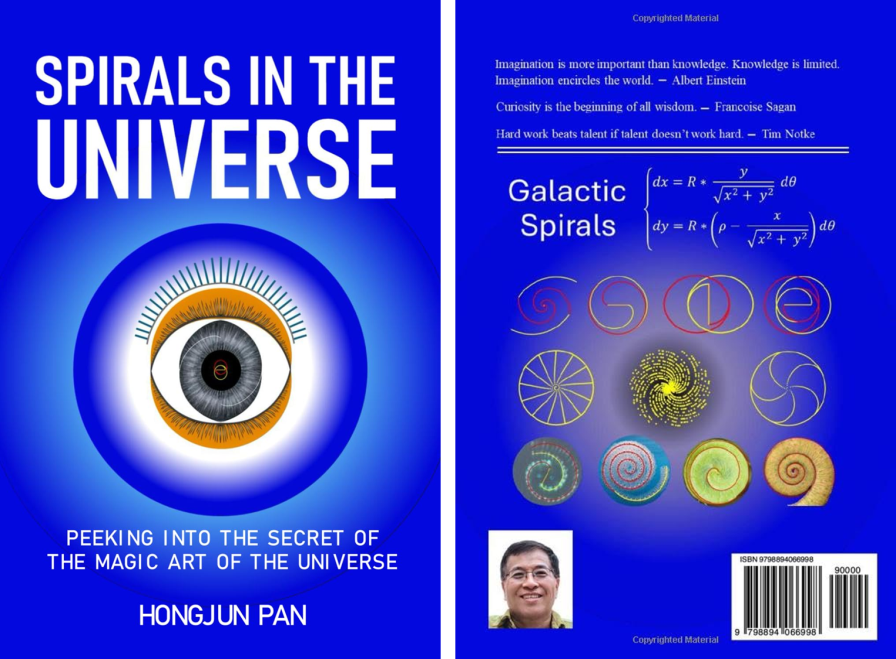
And because curiosity rarely arrives in moderation, I continued. I began to see spirals not just in galaxies, but in Earth’s ecosystems, biological growth, and even patterns in human civilization. All these ideas ultimately found their way into a book titled Spirals in the Universe: Peeking into the Secret of the Magic Art of the Universe, available on Amazon. Figure 1 shows the front and back covers of the book; The profile of the central “special eye” on the front cover is actually an elegant, double 8-shaped, double spiral-ring pattern of the galaxy NGC 1079 with chain-link spiral arm crossings, an ornate artwork of nature. I proposed the term “chain-link spiral arm crossings” to describe the specific style in which spiral arms cross each other in double-ring galaxies.

This book explores natural spirals across cosmic galaxies, Earth’s ecosystems, the artistic portrayal of spirals, and the spirally evolving nature of human society. It is intended for curious minds from diverse backgrounds — those who find joy in the beauty of natural spirals.
Writing the book was not unlike tending a growing spiral itself — each chapter expanded outward, from galaxies to garden plants to social systems. What surprised me most was how naturally the themes connected. Patterns that had once seemed isolated—like the way galaxies and hurricanes form or the distribution of plant leaves and flower petals — now felt like cousins in a vast, cosmic family. Some friends and early readers found it strange, others inspiring. A few asked me if I had finally retired from chemistry completely. I politely assured them I was just taking the scenic route.
Now, here's where things get complicated. I often joke with myself — because no one else will listen — that I am a chemist, but I must have an extraordinary IQ to have come up with these two extraordinary models that even astronomy experts could not think of, yet which align beautifully with observational data. If I had stayed on track of chemistry, I could have achieved greatness. If only curiosity hadn’t lured me away, perhaps I would have made groundbreaking discoveries in chemistry and become a three-time Nobel laureate. Maybe I’d have mastered the stock market, become a lord of investing —Warren Buffett would have heeded my words — and earned enough to buy a two-arm sprinkler to water my lawn with spiral water lines from which my spiral muse first appeared. Or maybe I’d have invented a lottery-winning algorithm and casually picked up a jackpot or six.
But no. Instead, I pursued cosmic spirals, modeled dark matter, and wrote a book that few investment bankers are likely to read.
Do I regret it? Not at all.
Because alongside all the alternative lives I might have lived, there is the very real one I did. I followed a question into the unknown and returned with something meaningful — not a prize or a fortune, but a new way of seeing the universe. That, to me, is enough.
So, dear reader, beware: curiosity is more powerful than it looks. It may not ruin your life in the traditional sense — but it might gleefully reroute it into an unexpected intellectual jungle, filled with spirals, stars, and sprinkler metaphors.
And if you're lucky — like me — you’ll end up with a book, a head full of questions, and a heart full of happiness with no regrets.
| [1] | Pan, H. The Evolution of the Earth-Moon System Based on the Dark Matter Field Fluid Model. International Journal of Physics, 2021, 9(6), 286-307. | ||
| In article | |||
| [2] | Pan, H. Spirals and Rings in Barred Galaxies by the ROTASE Model, International Journal of Physics, 2021, 9(6), 286-307. | ||
| In article | View Article | ||
Published with license by Science and Education Publishing, Copyright © 2025 Hongjun Pan
 This work is licensed under a Creative Commons Attribution 4.0 International License. To view a copy of this license, visit
http://creativecommons.org/licenses/by/4.0/
This work is licensed under a Creative Commons Attribution 4.0 International License. To view a copy of this license, visit
http://creativecommons.org/licenses/by/4.0/
| [1] | Pan, H. The Evolution of the Earth-Moon System Based on the Dark Matter Field Fluid Model. International Journal of Physics, 2021, 9(6), 286-307. | ||
| In article | |||
| [2] | Pan, H. Spirals and Rings in Barred Galaxies by the ROTASE Model, International Journal of Physics, 2021, 9(6), 286-307. | ||
| In article | View Article | ||