sciepub.com
 Quick Submission

Evaluation of Solid Waste towards Sustainable Facilities Management

1Department of Geography and Meteorology, Faculty of Environmental Sciences, Enugu State University of Science and Technology, PMB 01660, Agbani, Enugu, Nigeria
2Department of Mechanical Engineering, Sustainable Infrastructure Services Group - Akwa Ibom State University, PMB 1167, Uyo, Nigeria
Abstract
Waste generated from healthcare activities usually comprise a broad variety of materials ranging from used needles, syringes, to soiled dressings. This list also includes body parts, diagnostic samples, blood, chemicals, pharmaceuticals, medical devices and radioactive materials. In the education sector too, solid waste management has become a topical issue necessitating prompt attention and appraisal. Educational waste basically are categorised into recyclable, general and biodegradable waste forms. This study presents evaluation of solid waste issues towards achieving sustainable facilities management (FM) success in the Nigeria built environment. In this investigation, structured surveys were directed to the building services, estate, and environmental management experts as well as facilities managers operating within these targeted sectors: hospitals and universities (schools) to collect solid waste management data. Issues that influence and support good sustainable FM regarding waste management practices were also sought in the administered surveys. A functional unit size of 100m2 within the investigated facilities was considered in each case as a common basis for comparisons with the achievable results between the studied hospitals and schools. The outcomes from these studies and recommendations for best practices in future examinations are presented.
Keywords: education, environment, facilities management, healthcare, waste form
Copyright © 2016 Science and Education Publishing. All Rights Reserved.Cite this article:
- Esara E.E, Okon B.B.. Evaluation of Solid Waste towards Sustainable Facilities Management. World Journal of Environmental Engineering. Vol. 4, No. 1, 2016, pp 19-22. http://pubs.sciepub.com/wjee/4/1/3
- E.E, Esara, and Okon B.B.. "Evaluation of Solid Waste towards Sustainable Facilities Management." World Journal of Environmental Engineering 4.1 (2016): 19-22.
- E.E, E. , & B.B., O. (2016). Evaluation of Solid Waste towards Sustainable Facilities Management. World Journal of Environmental Engineering, 4(1), 19-22.
- E.E, Esara, and Okon B.B.. "Evaluation of Solid Waste towards Sustainable Facilities Management." World Journal of Environmental Engineering 4, no. 1 (2016): 19-22.
| Import into BibTeX | Import into EndNote | Import into RefMan | Import into RefWorks |
At a glance: Figures
1. Introduction
Facilities management experts in recent times are gradually experiencing challenges due to the daily waste generation from the facilities users. All over the world, facilities (buildings) impact upon every facet of human existence – from work, play and housing, they provide the basic infrastructure and few are aware of how they are developed and operated. The facilities operators within the healthcare and education sectors are usually very many in number and their activities often bring about huge amount of solid waste generation. Accordingly, Shah [10] maintained that facilities are playing a greater role in human lives, affecting society and the environment as a whole. Issues such as work–life balance, climate change, water shortages and human rights have all been front page news over the past few years [9]. Awareness of the waste management issues have been raised alongside the impacts on buildings and the desire from individuals and businesses to look for alternatives.
Pursuant to addressing issues related to waste management and its negative impacts, [2, 10] studies in FM have documented similar stand points in this case. Against this background, [16] have also submitted that suitable management of huge volume of waste (recyclable) could yield more saving to the exploitation of virgin raw materials. This could be achievable in sustainable FM where the operators are fully aware of the negative environmental impacts of unsustainable waste management culture and the need to cultivate sound waste management practices for sustainability accomplishment. Sustainability and FM strategies regarding waste management impacts are substantial topics in their own perspectives [5, 10, 15] and these have been covered in detail through a number of research projects. This development has been in recognition of the major impacts both sustainability and FM have towards achieving eco-efficiency scheme within the building infrastructure [7, 8]. There is no doubt that the overall impression in this study is centred on the actualisation of the sustainable development goals. Therefore, sustainable development represents a process and a framework for redefining social progress and redirecting economies to enable all people to meet their basic needs and improve their quality of life, while ensuring that the natural systems, resources and diversity upon which they depend are maintained and enhanced, both for their benefit and for that of future generations [10, 15].
2. The FM Goal in Waste Management
The FM professionals in this context are significant drivers within the private and public organisations aimed to reduce costs, promote efficiency and improve performance against an increasing complexity of organisational models and the application of new technologies. Shah, [10] and Pitt, [8] noted that FMs are acknowledged as the major contributors to the bottom line with an increased recognition of the importance of quality and robust processes, be it risk management or cost reduction associated with waste management strategies. In other words, the FMs perception however is being widely considered in this case as a service for cost reduction in waste management as opposed to a strategic discipline capable of driving organisations to provide real value. For this reason, hospitals and schools are increasingly embracing integrated facilities management (IFM) services as an effective way of minimising enterprise resources toward the operation and maintenance of critical building (facilities) systems [1] for economic gains.
3. Waste Management Challenges in Facilities - 21st Century Scenario
Waste cannot be eliminated completely from that built environment as long as its production and other waste generation activities continue. It must therefore be properly managed in a way to minimise the risk to human health, comfort and thereby reduce its negative impact on the environment. The major challenge of waste management in hospitals and schools is not only how to maintain a clean and pleasant environment but also curbing the long term environmental health effects arising from waste as a consequence of the activities of several facilities users [5, 8, 13]. Several researchers have maintained that another way to actively respond to waste management challenges in the 21st century is the integration of green growth management approach. Within the built environment, the green growth model is now commonplace in sustainable FM development. Green buildings (facilities) could be described as that which promote the reduction of harmful effects to man and the environment as a whole [22, 23]. This sustainability model (green growth) has been the beacon for FM towards sustainable development success.
The green growth practice is capable of maintaining the economic expansion necessary for enhancing the quality of life in this context. This practice [14] puts forward that it will simultaneously minimise pressure on the available resources consumption, thereby improving the eco-efficiency within FM activities. The green growth model in sustainable FM has been proven effective in promoting engineering sustainability. This paradigm in waste management fosters eco-efficiency of building/facilities services development by creating more value with fewer resources and less impact of waste generation. FM and its associated waste generated challenges are enormous necessitating attention by building (facilities), estate management and environmental management experts vis- a- vis green growth ethos. It is an established fact by these authors [19, 21, 22] that several benefits have resulted from the integration of green growth model in waste management as an engineering sustainability measure within the framework of FM pursuit.
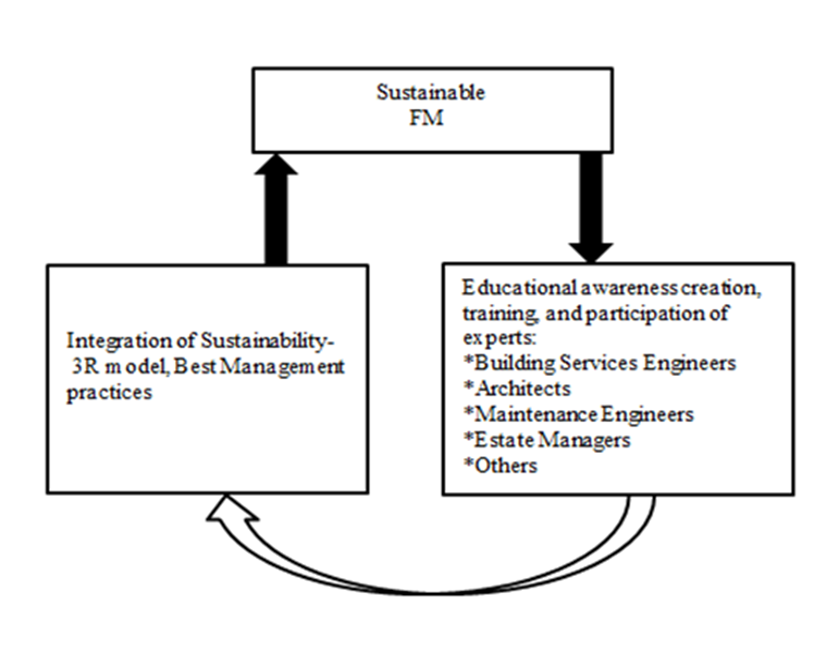
Notwithstanding, [21] further noted that there still remains a demand for more advancement in waste management issues as the current practices require re-modeling strategy. In recent times, other proactive measures adopted include: the 3R concept of reduce, reuse and recycling waste. Also, eco-efficiency ideals, incorporation of public–private partnership drive and the integration of environmental educational awareness in waste management challenge for the attainment of best practices in FM are vigorously pursued. [20] study revealed that since hospitals and schools are social infrastructure provided by the government as social services, then, government-related agencies (including legislators) should be involved in making laws to address poor waste management practices in these facilities towards sustainable development attainment. This was accordingly noted as a way of curbing the disposal of harmful waste in the environment and reducing pollution threats, thus contributing to the mitigation of climate change as these activities emanate from the unsustainable activities of facilities users [10]. Government must determine frameworks for both economic and environment-related issues in respect of waste activities in FM expansion since these are the major elements impeding the achievement of sustainable development. A typical of sustainable FM framework for waste management activities is shown in Figure 1.

 Download as
It becomes inevitable that waste management drive should integrate education and training which are essential for professionals, students as well as other facilities users, to appreciate the opportunities, threats and need to understand, focus and ultimate commitment to the advancement, promotion of waste recycling benefits. Opportunities also abound for proper management of solid waste in facilities as this development is capable of creating job outlets thereby saving more energy that could have been expended on the production of virgin raw materials for use.
4. Research Methodology
In this study, a two stage methodology was adopted. These are literature search and surveys administration. The literature review was aimed at identifying the issues relating to waste activities in FM. Also, surveys through emails and mail post media were employed in getting data from the hospitals and educational sectors facilities in Akwa Ibom State (AKS), Nigeria. The overall aim was to gain more understanding of building services, estate and facilities management professionals regarding waste generated from the investigated facilities and associated management practices generally. The survey was considered as the most appropriate method of objectively examining the level of waste generating activities and the experts’ opinions toward sustainability in FM. This study adopted Stroud, [12] model as contained in eqn. (1) for data analysis, Table 1 and Table 2. Percentage evaluation (PE) as applied in this study;
 | (1) |
5. Data Collection
The survey information sought for waste data from the hospitals and educational sectors in Akwa Ibom State. The various waste forms generated within these case studies alongside the size of investigated facilities were considered. This study administered a total of 100 surveys, 50 each to both hospitals and educational sectors facilities. However, 32 responded from the participating hospitals and 28 from the educational sector. Other information associated with management practices in these facilities toward sustainability in FM are also addressed.
6. Results and Discussion
The outcomes of this investigation are presented in Table 1 and Table 2. Further analyses regarding the achievable data are presented in the subsequent sections of this paper. This study revealed that waste generated from the healthcare activities usually comprises a broad variety of materials ranging from used needles, syringes, to soiled dressings as contained in Table 1. The list includes body parts, diagnostic samples, blood, chemicals, pharmaceuticals, medical devices and radioactive materials [17].


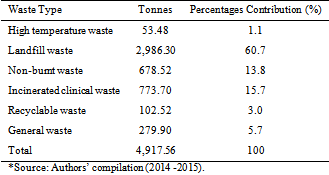


In this study also, healthcare sector waste management data are categorised into six waste streams as indicated in Table 1. High temperature waste accounts for slightly more than 1% of the overall statistics within the healthcare sector. This is a small volume of waste generated compared to the other waste streams. Landfill waste from the data is above 60% in this order. The non-burnt waste contributes less than 14% of the total waste stream. Also, the incinerated clinical waste within this category is below 16%. The recyclable waste stream is 3% of the overall waste produced by the healthcare sector. The general waste statistics contributes almost 6% of the entire waste produced in this phase of the study, Table 1. This result is a true reflection of the fact that most of the investigated hospitals are associated with disposable materials. Non-burnt and incinerated waste (equipment and tools) are within this category of waste that must be treated with extra care [4]. It is apparent that some waste generated by the healthcare sector are either only suitable for high temperature incineration, or non-recyclable in nature. Renowned researchers [11, 17] have also remarked that some waste forms are recyclable, landfill, non-burnt materials or regarded as general waste from a number of products. The equipment and appliances when no longer in a serviceable condition are considered as waste and are characterised with the toxic substances emission, as shown in Table 1. Waste generated from the healthcare sector due to poor management is capable of producing harmful effects to humans and the environment. In the course of this investigation, waste management activities in the education sector are presented in Table 2.


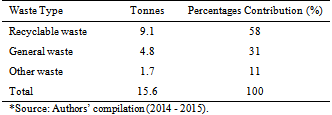


Specifically, only three classes of waste activities were identified. There is no doubt that the percentage contribution of recyclable waste is almost 60% of the total waste produced from the education sector. Interestingly, it indicates a huge volume of this waste is recyclable and could be put back into use thereby saving the exploitation of virgin raw materials [5, 16]. Table 2 also reveal that the percentage contribution of general waste is a little above 30% of the entire waste stream. Obviously, this suggests that general waste is comprised of either segregated or non-segregated materials. Considering such an amount of waste produced by the education sector, a proper management system is desired. From this indication, it can be appreciated that it is necessary to effectively manage waste at the generation point as certain amounts could be made recyclable upon proper segregation. In essence, the other waste represents a contribution of slightly above 10%, expressing a mix between the biodegradable (grasses), compostable and other waste substances. There is no strong indication of the existence of landfill waste from this sector based on the acquired information. Studies finding from [3, 18] are similar to this result in managing waste activities within the education sector. Waste management policy generally in this sector is tailored towards reducing, reusing, and recycling options. The recyclable waste consists of glass, plastics, packaging papers, items of furniture and toners. This list also includes chemical bottles, drinks with food cans and containers, lighting bulbs, construction and miscellaneous waste [10, 16].
7. Conclusion and Recommendations
The study reviews different waste streams within the hospitals and educational sectors. In this study, the achievable results of findings demonstrate variations in each case due to the associated aim and objectives within its scope. In addition, this paper presented and discussed the aim of study, background literature and questionnaire outcomes on FM within Akwa Ibom State, Nigeria. From a thorough literature search and interactions with some FM experts, various waste streams were identified and subsequently addressed. It is hoped that this outcome is able to provide a suitable platform for future studies on solid waste management in pursuit of the 21st Century sustainable FM challenges.
Acknowledgement
The authors hereby acknowledge the invaluable support and cooperation of the management and staff of the investigated hospitals and schools in Akwa Ibom State, Nigeria during the course of this research.
References
| [1] | Abbas, E., Daniel, S., Roberto, V., Gordon L. and Shah, S. (2010). Barriers and commitment of facilities management profession to the sustainability agenda. Journal of Building and Environment, 45, pp. 58-64. | ||
 In article In article | View Article | ||
| [2] | Agwu, M.O. (2012). Issues and challenges of solid waste management practices in Port Harcourt city, Nigeria – a behavioural perspective, Journal of Social and Management Sciences pp.2156-1540. | ||
| In article | |||
| [3] | Coyle, L. and Turner, C. (2008). Waste and Resources Action Programme, Materials change for better environment, United Kingdom. | ||
| In article | |||
| [4] | Hall, A. G. (2008), Greening Healthcare: 21st Century and Beyond. Front Health Service Manage, 25, 1, pp. 37-43. | ||
| In article | PubMed | ||
| [5] | Holmes, J. (1995). The UK Waste Management Industry. Institute of Waste Management, Northampton, United Kingdom. | ||
| In article | |||
| [6] | OECD, (2009). Organisation for Economic Co-operation and Development. The Economics of Climate Change Mitigation: Policies and Options for Global Action beyond 2012, Paris. | ||
| In article | |||
| [7] | Petts, J. and Eduljee, G. (1994). Environmental Impact Assessment for Waste Treatment and Disposal Facilities. Wiley Chichester, United Kingdom. | ||
| In article | |||
| [8] | Pitt, M. (2005). Trend in Shopping Centre Waste Management. Facilities 23, 11/12. pp. 522-533. | ||
| In article | View Article | ||
| [9] | Sabol, L. (2008). Measuring Sustainability for Existing Buildings. The power of process in the built environment. IFMA, World Workplace. | ||
| In article | |||
| [10] | Shah, S., (2007). Practice for Facilities Manager. Blackwell Publishing, Oxford, United Kingdom. | ||
| In article | View Article | ||
| [11] | Slater, D. (1995). Integrated Pollution Control and Waste Minimisation. The Royal Society of Chemistry, Cambridge, United Kingdom. | ||
| In article | |||
| [12] | Stroud, K. A. (2010). "Engineering Mathematics". Fifth Edition, Industrial Press Incorporated, New York, USA. | ||
| In article | |||
| [13] | Uwa, M. S. (2014). Environmental Impact of Waste Generated From Vocational Sector In Uyo. Book of Proceedings, Annual Conference of Environmental Management Association of Nigeria, pp. 81-90. | ||
| In article | |||
| [14] | WBCSD (2000). World Business Council for Sustainable Development Eco-Efficiency Facilities: Available Internet: Creating More Value with Less Impact. | ||
| In article | |||
| [15] | WCED, (1987), World Commission on Environment and Development- Our Common Future, 42, p.427, World Commission on Environment and Development, United Nations. | ||
| In article | |||
| [16] | WRAP, (2011), Waste and Resources Action Programme, United Kingdom. | ||
| In article | |||
| [17] | WMP, (1995), Waste Management Planning: Principles and Practice. Department of Environment, London, United Kingdom. | ||
| In article | |||
| [18] | WW, (2005), Waste Watch, Resource Management in the Education Sector, United Kingdom. | ||
| In article | |||
| [19] | OECD, (2003), Organisation for Economic Co-operation and Development: Environmentally Sustainable Buildings – Challenges and Policies, Publications, Paris. | ||
| In article | |||
| [20] | OECD, (2009), Organisation for Economic Co-operation and Development: Green Growth Strategy – Beyond the Crisis: Discussion Paper for the Consultation with the OECD Liaison Committee, Paris | ||
| In article | |||
| [21] | Girouard, N. (2011), Green Growth Strategy. Global Green Growth Summit Seoul, 2020, Paris. | ||
| In article | |||
| [22] | ESCAP, (2006), Economic and Social Commission for Asia and the Pacific: Sustainable Infrastructure in Asia. Overview and Proceedings Seoul Initiative Policy Forum on Sustainable Infrastructure, Republic of Korea. | ||
| In article | |||
| [23] | Eco Homes, (2003), Sustainable Homes. A Guide to Eco Homes, an Environmental Assessment Method for Homes. Innovation and Good Practice Programme, United Kingdom. | ||
| In article | |||
 CiteULike
 Mendeley
 StumbleUpon
 Delicious
 Facebook
 Twitter
 LinkedIn