Green Chemistry metrics provide quantitative approaches for evaluating the environmental performance of chemical reactions, but their interpretation can be challenging when considered independently. This laboratory activity was designed to integrate the interconversion of benzoic acid derivatives with the calculation and critical interpretation of Green Chemistry metrics in an undergraduate Organic Chemistry Laboratory II course. Students investigated alternative synthetic pathways involving benzoic acid derivatives, including phenyl benzoate, benzamide, benzoyl chloride, and benzoic anhydride, and examined both synthesis and hydrolysis reactions. Experimental data were used to calculate percent yield, atom economy, carbon efficiency, and E-factor for comparison of the different reaction pathways. The activity provided opportunities for students to examine the trade-offs among reaction yield, material efficiency, and waste generation when evaluating alternative synthetic routes. The comparison also illustrated that no single Green Chemistry metric is sufficient to describe the overall sustainability of a chemical transformation; practical considerations such as the reagent hazards, reaction conditions, processing requirements, and the potential value and recovery of starting materials may also influence the assessment. This activity provides an integrated approach for connecting organic reaction chemistry with quantitative Green Chemistry concepts and for encouraging students to evaluate chemical transformations using multiple complementary criteria.
Carboxylic acids and their derivatives, which contain an acyl group, are important functional groups found in a wide range of chemicals, pharmaceuticals, and food products. Benzoic acid is used as an intermediate in the production of fragrances and as a preservative in cosmetic products 1 2 3 4. Benzoyl chloride and benzoic anhydride are used as precursors in the pharmaceutical industry and as chemical intermediates in the production of dyes, perfumes, and photographic chemicals. Phenyl benzoate and benzamides exhibit various biological and pharmaceutical activities, including antimicrobial, analgesic, anti-inflammatory, anticancer, and cardiovascular properties 5. Phenyl benzoate and benzamides can be prepared from benzoyl chloride via Schotten–Baumann reactions 6. Benzamide can also be prepared by the ammonolysis of benzoic acid using ammonia 7 8.
Fischer esterification is an acid-catalyzed reaction between a carboxylic acid and an alcohol to form an ester 9 10. Hydrolysis of carboxylic acid derivatives yields the corresponding carboxylic acids. These reactions are important in various industrial processes 11. They are involved in the production of biofuels, soaps through saponification, and food additives, as well as in the treatment of industrial waste and sludge.
Chemical reactions conducted in laboratories and industrial processes can have environmental impacts associated with resource consumption, energy use, waste generation, and the use of hazardous substances. With growing concerns about global warming and greenhouse gas emissions, incorporating Green Chemistry into chemistry education can help students understand how chemical reactions and processes can be designed to reduce hazardous waste and improve the safety and efficiency of chemical production. Such knowledge is increasingly relevant to addressing challenges associated with environmental sustainability.
Green Chemistry was formally introduced by Paul Anastas and John Warner in the 1990s as an approach to designing chemical products and processes that reduce or eliminate the use and generation of hazardous substances 12 13 14 15. The goal of Green Chemistry is to minimize the environmental and health impacts associated with chemical products and processes. The environmental performance and sustainability of chemical processes can be evaluated using Green Chemistry metrics, which provide quantitative measures and indicators of resource use, waste generation, and other aspects of environmental performance 16 17 18 19. Over the past decades, numerous metrics have been proposed to encourage chemists to consider more sustainable approaches to chemical synthesis and to reduce waste. Selected Green Chemistry metrics are reviewed in Table 1.
The chemical and pharmaceutical industries play important roles in daily life and contribute substantially to economic development. Therefore, Green Chemistry has become an increasingly important component of chemistry education 20 21 22. Integrating Green Chemistry concepts into both classroom and laboratory instruction can provide students with opportunities to recognize the environmental implications of chemical products and processes and to consider approaches for reducing their environmental impact.
The aim of this work is to develop an undergraduate laboratory activity that integrates the interconversion of benzoic acid derivatives with the application of Green Chemistry metrics. The specific objectives are:
• To introduce the interconversion of benzoic acid derivatives through different organic reaction pathways and examine factors that influence their reactivity.
• To provide students with opportunities to calculate and interpret selected Green Chemistry metrics for evaluating and comparing different synthetic routes to benzoic acid derivatives.
• To provide opportunities for students to relate reaction performance, chemical reactivity, and Green Chemistry metrics when evaluating different synthetic routes.
• To illustrate the importance of considering multiple Green Chemistry metrics when assessing the sustainability of chemical reactions.
Learning Outcomes
After completing the laboratory activity, students were able to:
• Describe the interconversion of benzoic acid derivatives through different reaction pathways.
• Relate the structures of benzoic acid derivatives to their relative reactivity.
• Calculate selected Green Chemistry metrics, including percent yield, E-factor, atom economy, and carbon efficiency,using experimental data.
• Interpret Green Chemistry metrics calculated from experimental data.
• Compare alternative synthetic routes to benzoic acid derivatives using multiple Green Chemistry metrics.
• Discuss the advantages and limitations of using multiple Green Chemistry metrics to assess the sustainability of synthetic routes.
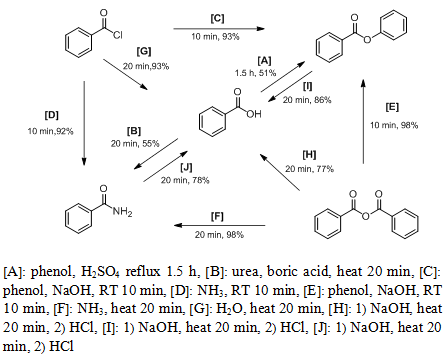
Ten interconversion reactions involving benzoic acid and its derivatives were performed by 15 second-year undergraduate students enrolled in Organic Chemistry Laboratory II during the 2024-2025 academic year. The laboratory activity was conducted during a single 3-h laboratory period, followed by the calculation of selected Green Chemistry metrics. Students worked in three groups of five, with each student performing a pair of reactions: Reactions A and B, C and I, D and G, E and H, or F and J. The experimental data obtained by students performing the same pair of reactions within each group were pooled for subsequent analysis.
All reactions produced solid products that could be isolated by vacuum filtration. Fischer esterification (Reaction A) was performed using a reflux apparatus, whereas the other reactions were conducted with heating on a hot plate. Detailed experimental procedures for all 10 reactions are provided in the Supporting Information-Instructor Resources. Structural characterization data for the products, including IR, 1H NMR, and 13C NMR spectra, are also provided in the “Product Characterization Data” section of the Supporting Information-Instructor Resources.
During the laboratory activity, students could readily observe the formation or transformation of the reaction products through visible changes and simple qualitative tests:
• Reaction A: Formation of phenyl benzoate via Fischer esterification was indicated by precipitation of a solid product when the reaction mixture was poured into ice water, while the starting materials remained soluble.
• Reaction B: Formation of benzamide by ammonolysis of benzoic acid was indicated by the basicity of the reaction mixture, as confirmed using red litmus paper.
• Reactions C and D: Conversion of benzoyl chloride to phenyl benzoate or benzamide, respectively, was indicated by the transformation of the liquid starting material into solid products.
• Reactions E and F: Conversion of benzoic anhydride to phenyl benzoate or benzamide, respectively, was observed through melting of the reaction mixture during heating followed by re-solidification as the products formed.
• Reactions G-J: Formation of benzoic acid by hydrolysis of the corresponding starting materials was confirmed by testing the aqueous product solution with blue litmus paper, which indicated an acidic solution.
2.2. HarzardStudents were required to wear disposable gloves and avoid contact of chemicals with the skin, eyes, and clothing. Reactions requiring heating were performed on a hot plate; therefore, heat-resistant laboratory gloves were also required when handling heated apparatus and reaction vessels. Although no unusual hazards were associated with the overall laboratory activity, benzoyl chloride, NaOH, HCl, H2SO4, and ammonia solutions required careful handling because of their potential to cause skin irritation, burns, or eye damage. Benzoyl chloride is corrosive and should be handled in a fume hood. Detailed information on the hazards associated with all chemicals used in the experiments and the recommended safety precautions is provided in Table S1 of the Supporting Information-Instructor Resources. All hazardous waste generated during the experiments was collected in appropriately labeled waste containers, as shown in Figure S1 of the Supporting Information-Student Handout.
The interconversion experiments demonstrated the markedly different reactivities of benzoic acid and its derivatives. As summarized in Figure 1, phenyl benzoate, benzamide, and benzoic acid could be prepared from different starting materials through alternative synthetic routes. Reactions involving benzoyl chloride and benzoic anhydride generally proceeded more rapidly and with higher yields than those using benzoic acid as the starting material. In particular, benzoyl chloride and benzoic anhydride readily underwent nucleophilic acyl substitution under relatively mild conditions, whereas conversion of benzoic acid required activation of the carboxyl group, such as acid catalysis in Fischer esterification.
The hydrolysis experiments further illustrated the differences in reactivity among carboxylic acid derivatives. Benzoyl chloride underwent hydrolysis readily under mild conditions, whereas the hydrolysis of benzoic anhydride and phenyl benzoate required basic conditions followed by acidification to obtain benzoic acid. Hydrolysis of benzamide proceeded less readily under the experimental conditions and resulted in lower yields. Overall, the experimental results were consistent with the general reactivity order of carboxylic acid derivatives: acyl chlorides > acid anhydrides > esters > amides > carboxylic acids.
The interconversion experiments provided students with an opportunity to examine the different reactivities of benzoic acid derivatives through alternative synthetic pathways. The observed differences in reaction conditions, reaction times, and yields provided a basis for subsequent analysis using Green Chemistry metrics. The activity incorporated multiple metrics, including E-factor, atom economy (AE), and carbon efficiency (CE), to compare alternative synthetic routes and consider the trade-offs involved in evaluating their sustainability. Detailed reaction conditions and reaction times are provided in the Supporting Information-Instructor Resources, while the individual experimental yields are provided in the Supporting Information-Raw Data.

To evaluate the alternative synthetic routes from a Green Chemistry perspective, four metrics were considered: percent yield, E-factor, atom economy, and carbon efficiency. These metrics provide complementary information on product formation, waste generation, material efficiency, and carbon efficiency, respectively.
E-factor is a simple metric for evaluating waste generation in chemical processes. It represents the mass of waste generated relative to the mass of product obtained. Depending on the calculation convention and the purpose of the assessment, E-factor can be reported with or without water. Water is often excluded when it is used primarily as a solvent or processing medium, whereas its inclusion may be appropriate when it is consumed as a stoichiometric reactant. In Reaction G, water was included in the E-factor calculation because it functioned as a stoichiometric reactant rather than solely as a solvent. A lower E-factor indicates less waste generated per unit mass of product.
Atom economy describes the extent to which the atoms of the stoichiometric reactants are incorporated into the desired product. A higher AE indicates that a greater proportion of the reactant mass is theoretically incorporated into the desired product, resulting in less material being theoretically converted into stoichiometric byproducts.
Carbon efficiency represents the percentage of carbon from the carbon-containing reactants that is retained in the desired product. A higher CE indicates a greater proportion of the carbon atoms from the reactants is incorporated into the desired product.
To illustrate the calculation of the Green Chemistry metrics, Reaction D was selected as a representative example. In this reaction, benzoyl chloride reacts with ammonia to produce benzamide, and the calculation of each metric is demonstrated step by step below.
Reaction D: Benzoyl chloride (MW = 140.57 g mol-¹, 2.42 g, 17.22 mmol, 1.0 equiv) was reacted with ammonia (MW = 17.03 g mol-¹, 1.75 g, 102.76 mmol, 6.0 equiv) to afford benzamide (MW = 121.14 g mol-¹, 1.92 g, 15.85 mmol).
C6H5COCl+2NH3 → C6H5CONH2 + (NH4Cl)
For the atom economy calculation, the stoichiometric amounts in the balanced equation were used. Thus, 2 equivalents of NH3 were used in the calculation, although 6.0 equivalents were used experimentally.
Percent yield = (15.85/17.22) × 100 = 92%
E factor = (2.42+1.75-1.92)/1.92 = 1.17
AE = [121.14/(140.57 + (2×17.03))] × 100 = 69.37%
CE = [(15.85x7C)/(17.22x7C)]x100 = 92.04%
Detailed calculations for all reactions are provided in the Supporting Information-Metrics Calculation. This worked example illustrates that the four metrics provide different information about the same reaction and should therefore be interpreted collectively.
The calculated percent yield, E-factor, atom economy, and carbon efficiency for the interconversion reactions of benzoic acid and its derivatives are summarized in Table 2. The data presented in Table 2 were selected from the 2024-2025 academic year based on the highest experimental yields obtained for each reaction.
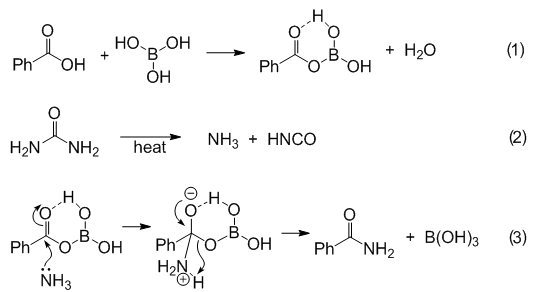
A relatively complex reaction, the preparation of benzamide via ammonolysis (Reaction B), is described here. The proposed mechanism for the formation of benzamide is shown in Scheme 1.
In Eq. 1, benzoic acid reacts with boric acid to form a boron-containing intermediate that may serve as an activated acylating species. This proposed activation is consistent with reported boron-mediated amidation chemistry 23. Upon heating, urea decomposes to release ammonia and isocyanic acid (Eq. 2). Nucleophilic attack by ammonia at the carbonyl carbon then forms a zwitterionic tetrahedral intermediate. The oxygen anion subsequently collapses to reform the carbonyl group, accompanied by cleavage of the C-O bond to form benzamide and regenerate boric acid (Eq. 3).
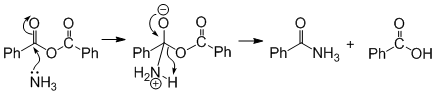
In Eq. 3, nucleophilic attack by ammonia on the boron-benzoate ester forms a zwitterionic tetrahedral intermediate, similar to the intermediate formed by nucleophilic attack of ammonia on the carbonyl carbon of benzoic anhydride, as shown in Scheme 2. The oxygen anion then collapses to reform the carbonyl group, accompanied by cleavage of the C-O bond to form benzamide and benzoic acid. The resulting benzoic acid reacts with excess NH3 to form ammonium benzoate.


For the benzoic acid-boric acid route described above, excess ammonia was included in the E-factor calculation as waste because it was added experimentally but was not incorporated into the desired product. In contrast, excess ammonia was not included in the atom economy calculation because AE is based on the ideal stoichiometric equation rather than on the quantities of reagents actually used in the experiment.
As shown in Table 2, among the methods used to prepare phenyl benzoate (Reactions A, C, and E), Reaction C, which uses benzoyl chloride as the starting material, showed a combination of high reaction yield, low waste generation, and relatively high carbon efficiency. It gave a percent yield of 93%, an E-factor of 1.27, an atom economy of 84.46%, and a carbon efficiency of 63.23%. The relatively high atom economy of Reaction C indicates that a large proportion of the reactant atoms is theoretically incorporated into the desired product, whereas the carbon efficiency indicates the proportion of carbon from the reactants retained in the product. Reaction C also had the lowest E-factor and the highest carbon efficiency among the three routes. Although the percent yield was slightly lower than that of Reaction E, the difference may be attributable to experimental variation. Reaction A had a slightly higher atom economy than Reaction C; however, its longer reaction time represents an additional process consideration when comparing the alternative routes.
A similar trend was observed in the synthesis of benzamide (Reactions B, D, and F). Reaction D, using benzoyl chloride as the starting material, gave a percent yield of 92%, an E-factor of 1.17, an atom economy of 69.37%, and a carbon efficiency of 92.04%. The high percent yield and low E-factor indicate high product formation with relatively low waste generation. Although Reaction D gave a high yield, its atom economy was moderate (69.37%), indicating that a portion of the reactant mass is theoretically converted into stoichiometric byproducts rather than incorporated into the desired product. In contrast, the high carbon efficiency (92.04%) indicates that most of the carbon atoms from the carbon-containing reactants were retained in the desired product. Compared with Reactions B and F, Reaction D showed a combination of high yield, low E-factor, and high carbon efficiency, while its moderate atom economy illustrates that high reaction yield and carbon efficiency do not necessarily correspond to high atom economy. These results further illustrate that no single Green Chemistry metric is sufficient to comprehensively assess the environmental performance of a synthetic route.
The three benzamide synthesis routes also presented different advantages and limitations. Reaction B, starting from benzoic acid, used a less reactive starting material but required activation of the carboxylic acid and resulted in a lower yield. Reaction D, using benzoyl chloride, proceeded rapidly under mild conditions and provided a high yield and low E-factor, but its atom economy was moderate, and benzoyl chloride requires careful handling because of its corrosivity and high reactivity. Reaction F, using benzoic anhydride, also provided a route to benzamide but required different reaction conditions and exhibited a different Green Chemistry metric profile from Reaction D. Thus, comparison of Routes B, D, and F illustrates that the advantages of one route may be accompanied by limitations in other aspects of reaction performance, material efficiency, or safety.
A comparison of the hydrolysis reactions of benzoyl chloride (Reaction G) and benzoic anhydride (Reaction H) illustrated a trade-off among the Green Chemistry metrics. Reaction G gave a higher yield and carbon efficiency, whereas Reaction H showed a lower E-factor and higher atom economy. For the atom economy calculation of Reaction H, one equivalent each of NaOH and HCl was included, corresponding to the stoichiometric amounts used in the reaction, because neither reagent was used in excess. Although the E-factor for Reaction G was higher than that of Reaction H, the calculation for Reaction G included water. Because E-factor is a mass-based metric, including water can substantially increase the calculated value, even though water is generally associated with lower hazards than many organic solvents and hazardous reagents. Therefore, whether water is included or excluded should be clearly stated when comparing E-factors. In addition, although Reaction G had a lower atom economy, it proceeded without a subsequent acidification step. In contrast, the basic hydrolysis in Reaction H required subsequent acidification with HCl to obtain free benzoic acid, increasing reagent use and adding an additional processing step.
The comparison of Reactions G and H also illustrates that the route with the most favorable value for one Green Chemistry metric may not necessarily be the most favorable when reaction conditions and additional processing requirements are considered. Beyond the calculated metrics, reagent hazards and reaction conditions should also be considered when evaluating the overall sustainability of these routes. Benzoyl chloride is highly reactive and corrosive and therefore requires careful handling and appropriate safety precautions. In contrast, Reaction H requires the additional use of HCl for acidification, introducing an additional hazardous reagent and processing step. Thus, the overall sustainability of a synthetic route cannot be determined solely from Green Chemistry metrics but should also consider reagent hazards, reaction conditions, waste generation, and potential risks to users and the environment.
The practical sustainability of the synthetic routes may also depend on the value of the starting materials and the potential for material recovery. For example, benzoyl chloride and benzoic anhydride may have higher economic value as starting materials than benzoic acid, and their use may therefore involve different economic considerations despite their favorable reactivity and reaction performance. In contrast, the recovery of benzoic acid from phenyl benzoate (Reaction I) and benzamide (Reaction J) provides an additional consideration when comparing the hydrolysis routes, as the recovered benzoic acid can potentially be reused as a starting material in subsequent experiments.
It is important to emphasize that the purpose of the hydrolysis reactions in this laboratory activity is not to recommend the preparation of benzoic acid from more highly functionalized derivatives as a practical synthetic route. In a real laboratory setting, route selection would also depend on factors such as the cost, availability, stability, and value of the starting materials and products. Thus, converting a potentially more valuable or less stable derivative into benzoic acid would not necessarily represent a meaningful preparative strategy. Rather, the hydrolysis reactions were included to provide a common chemical framework for examining the reactivity of benzoic acid derivatives and illustrating the strengths and limitations of Green Chemistry metrics. This distinction reinforces that favorable Green Chemistry metrics alone do not establish the practical value or overall sustainability of a synthetic transformation.
Among the Green Chemistry metrics considered in this activity, each metric provides a distinct perspective on reaction performance. Percent yield reflects the amount of product obtained relative to the theoretical yield, atom economy evaluates the incorporation of reactant atoms into the desired product, carbon efficiency indicates the proportion of carbon from the reactants retained in the desired product, and E-factor reflects waste generation. Thus, these metrics capture different aspects of a reaction and may lead to different assessments of the same synthetic route.
When the synthetic routes in Figure 1 are compared using these metrics, no single route is favored across all criteria. Routes using benzoyl chloride or benzoic anhydride generally provided favorable reaction performance and carbon efficiency, whereas other routes may offer advantages in atom economy or waste reduction. Therefore, route selection should consider the combined results of percent yield, atom economy, carbon efficiency, and E-factor, together with reaction conditions, reagent hazards, and additional processing requirements. This comparison provides students with an opportunity to consider the trade-offs among alternative synthetic routes and to evaluate both quantitative metrics and practical factors when assessing their overall performance.
The pre-test and post-test results are provided in the Supporting Information-Raw Data. The post-test results revealed several challenges in applying Green Chemistry metrics. Most students correctly calculated percent yield when the reaction involved a 1:1 stoichiometric relationship between reactant and product, whereas only 40% correctly calculated percent yield when one mole of reactant produced two moles of product. Students also showed uncertainty about whether water and reagents used for neutralization should be included in the calculations. Difficulties were also observed in calculating carbon efficiency, particularly in accurately counting the carbon atoms in carbon-containing reactants. Errors in E-factor calculations were associated with incomplete consideration of acids, bases, and other reagents used during the reactions. Overall, approximately 40–60% of the students correctly calculated the Green Chemistry metrics in the post-test.
These observations indicate that the interconversion experiments provide a useful context for practicing stoichiometric analysis and applying multiple Green Chemistry metrics to different reaction scenarios. The different reaction pathways also provide opportunities to examine how reagent selection, reaction conditions, and stoichiometry influence the calculated metrics. However, the observed difficulties highlight the need for clear guidance on reaction stoichiometry, reagent inclusion, carbon counting, and the calculation and interpretation of Green Chemistry metrics. Detailed calculation procedures, worked examples, and guidance on these aspects are provided in the Supporting Information-Instructor Resources.
This laboratory activity provided an integrated approach for examining the interconversion of benzoic acid and its derivatives and for applying Green Chemistry metrics to alternative synthetic routes. The results demonstrated that differences in starting materials, reaction conditions, and reagent requirements were associated with differences in reaction performance and Green Chemistry metrics. Comparison of the routes revealed trade-offs among percent yield, E-factor, atom economy, and carbon efficiency, illustrating that no single metric is sufficient to evaluate a synthetic route. The activity further emphasized that the practical sustainability of a synthetic transformation should also consider factors such as starting-material value, reagent hazards, reaction conditions, additional processing requirements, and potential material recovery. Thus, the activity provides an opportunity for students to connect organic reaction chemistry with Green Chemistry principles and to critically evaluate alternative synthetic pathways using multiple metrics and practical considerations.
The author would like to thank the Department of Chemistry, Faculty of Engineering, Rajamangala University of Technology Isan, Khon Kaen Campus, and the organic chemistry laboratory students for their support of this research. ChatGPT (OpenAI) was used to assist with English-language editing, manuscript organization, and refinement of the presentation. The author reviewed and verified all AI-assisted content and takes full responsibility for the accuracy, interpretation, and final content of the manuscript.
The authors don’t have any conflict of interest.
This work did not receive any funding from any source.
| [1] | Johnson, W., Bergfeld, W. F., Belsito, D. V., Hill, R.A., Klaassen, C. D., Liebler, D. C., Marks, J. G., Shank, R. C., Slaga, T. J., Synder, P. W. and Andersen, F. A, "Safety Assessment of Benzyl Alcohol, Benzoic Acid and its Salts, and Benzyl Benzoate," Int Toxicol, 36 (3). 5-30. Nov./Dec.2017. | ||
| In article | View Article PubMed | ||
| [2] | Wang, L., Wang, C., Peng, Y., Zhang, Y., Liu, Y., Liu, Y. and Yin, Y, "Research Progress on Anti-stress Nutrition Strategies in Swine," Animal Nutrition, 13 (1). 342-360. Apr.2023. | ||
| In article | View Article PubMed | ||
| [3] | Pais, J. P., Magalhães, M., Antoniuk, O., Ivete Barbosa, I., Freire, R., Pires, D., Valente, E., Testa, B., Anes, E. and Constantino, L, "Benzoic Acid Derivatives as Prodrugs for the Treatment of Tuberculosis," Pharmaceuticals, 15 (8). 1118–1127. Sep.2022. | ||
| In article | View Article PubMed | ||
| [4] | Verma, K. A., Kumar, N., Shukla, S. A Comprehensive Review on Benzoic Acid and Its Derivatives. Available: https:// ijcrt.org/ papers/IJCRT2408455.pdf. | ||
| In article | |||
| [5] | Asif, M, "Pharmacological Potential of Benzamide Analogues and their Uses in Medicinal Chemistry," Mod Chem Appl, 4 (4). 1–10. Nov.2016. | ||
| In article | View Article | ||
| [6] | Kumar, K.; Sharm, M. K. AIM: TO PERFORM THE SYNTHESIS OF BENZAMIDE FROMBENZOYL CHLORIDE. Available: https://www.globalconference. info/ chapters_pdf/ Book_Draft_ 16.pdf. | ||
| In article | |||
| [7] | Gohil, C. J. and Noolvi, M. N, "Solvent-Free Synthesis of Amide: A Novel Technique of Green Chemistry," Asian J Pharm Clin Res, 14 (5). 99–102. May.2021. | ||
| In article | View Article | ||
| [8] | Charville, H. Direct Amide Formation Between Carboxylic Acids and Amines: Mechanism and Development of Novel Catalytic Solutions, Durham e-Theses. Available: http:// etheses.dur.ac.uk/ 3416/. | ||
| In article | |||
| [9] | Tearavarich, R, "Preparation of Benzocaine via Fischer Esterification and Determination of Sun Protection Factor (SPF) by Simple Ultraviolet Spectrophotometry for the Undergraduate Organic Chemistry," Orbital: Eclectron J. Chem. 202x, In press. | ||
| In article | |||
| [10] | Tearavarich, R, "Accelerated Esterification by Domestic Microwave for the Undergraduate Organic Chemistry," Orbital: Electron J Chem, 17 (4). 393–396. Jun.2025. | ||
| In article | View Article | ||
| [11] | Heravi, M. M., Zargarani, D., Shoar, R. H. and Khaleghi, S, "Hydrolysis of amides to carboxylic acids using phthalic anhydride under microwave irradiation and solvent-free conditions," J Chem Res, 2005 (2). 119–120. Feb.2005. | ||
| In article | View Article | ||
| [12] | Anastas, P. and Eghbal, N, "Green Chemistry: Principles and Practice," Chem Soc Rev, 39 (1). 301-312. Nov.2010. | ||
| In article | View Article PubMed | ||
| [13] | Rao, T. R., Afreen., Srilaxmi, B, "Green Analytical Chemistry: A Comprehensive Review of Eco-Scale, Greenness Metrics, and Sustainability Approaches," J Drug Deliv Ther, 15(4). 179-182. Apr.2025. | ||
| In article | View Article | ||
| [14] | Collins, T. J, Green Chemistry, Macmillan Encyclopedia of Chemistry, Simon and Schuster-Macmillan, [E-book] Available: green-chemistry-macmillan-ency-gc.pdf. | ||
| In article | |||
| [15] | O’ Neil, N. J., Scott, S., RElph, R. and Ponnusamy, E, "Approaches to Incorporating Green Chemistry and Safety into Laboratory Culture," J Chem Educ, 98 (1). 84-91. Jan.2021. | ||
| In article | View Article | ||
| [16] | Karim, S., Saw, H. M. and Ting, Y, "Evaluation of green chemistry metrics for sustainable recycling of platinum group metals from spent automotive catalysts via bioleaching," Green Chem, 26 (7). 4112-4126. Mar.2024. | ||
| In article | View Article | ||
| [17] | Constable, D. J. C., Curzonsb, A. D. and Cunningham, V. L, "Metrics to ‘green’ chemistry—which are the best? ," Green Chem, 4 (6). 521-527. Oct.2002. | ||
| In article | View Article | ||
| [18] | Hudson, R., Daniel Leaman, D., Kawamura, K. E., Esdale, K. N., Glaisher, S., Bishop, A. and Kat, J. L, "Exploring Green Chemistry Metrics with Interlocking Building Block Molecular Models," J Chem Educ, 93 (4). 691-694. Apr.2016. | ||
| In article | View Article | ||
| [19] | Abdussalam-Mohammeda, W., Alia, A. Q. and Errayes, A. O, "Green Chemistry: Principles, Applications, and Disadvantages," Chem Methodol, 4 (4). 408-423. Jul.2020. | ||
| In article | View Article | ||
| [20] | Braun, B., Charney, R., Clarens, A., Farrugia, J., Kitchens, C., Lisowski, C., Naistat, D. and O’Neil, A, "Green Chemistry in the Curriculum," J Chem Educ, 83 (8). 1126-1129. Aug.2006. | ||
| In article | View Article | ||
| [21] | Duarte, R. C. C., Ribeiro, M. G. T. C. and Machado, A. A. S. C, "Reaction Scale and Green Chemistry: Microscale or Macroscale, Which Is Greener?," J Chem Educ, 94 (9). 1255-1264. Sep.2017. | ||
| In article | View Article | ||
| [22] | Armstrong, L. B., Rivas, M. C., Zhou, Z., Douskey, M. C. and Baranger, A. M., "Behind the Scenes of Teaching Green: An Iterative Approach to Curriculum Design and Implementation in the General Chemistry Laboratory," J Chem Educ, 101 (8). 3264-3275. Aug.2024. | ||
| In article | View Article | ||
| [23] | Ishihara, K., Ohara, S., Yamamoto, H, "3,4,5-Trifluorobenzeneboronic Acid as an Extremely Active Amidation Catalyst," J Org Chem, 61 (13). 4196-4197. Jun.1996. | ||
| In article | View Article PubMed | ||
Published with license by Science and Education Publishing, Copyright © 2026 Ruchanok Tearavarich
 This work is licensed under a Creative Commons Attribution 4.0 International License. To view a copy of this license, visit
http://creativecommons.org/licenses/by/4.0/
| [1] | Johnson, W., Bergfeld, W. F., Belsito, D. V., Hill, R.A., Klaassen, C. D., Liebler, D. C., Marks, J. G., Shank, R. C., Slaga, T. J., Synder, P. W. and Andersen, F. A, "Safety Assessment of Benzyl Alcohol, Benzoic Acid and its Salts, and Benzyl Benzoate," Int Toxicol, 36 (3). 5-30. Nov./Dec.2017. | ||
| In article | View Article PubMed | ||
| [2] | Wang, L., Wang, C., Peng, Y., Zhang, Y., Liu, Y., Liu, Y. and Yin, Y, "Research Progress on Anti-stress Nutrition Strategies in Swine," Animal Nutrition, 13 (1). 342-360. Apr.2023. | ||
| In article | View Article PubMed | ||
| [3] | Pais, J. P., Magalhães, M., Antoniuk, O., Ivete Barbosa, I., Freire, R., Pires, D., Valente, E., Testa, B., Anes, E. and Constantino, L, "Benzoic Acid Derivatives as Prodrugs for the Treatment of Tuberculosis," Pharmaceuticals, 15 (8). 1118–1127. Sep.2022. | ||
| In article | View Article PubMed | ||
| [4] | Verma, K. A., Kumar, N., Shukla, S. A Comprehensive Review on Benzoic Acid and Its Derivatives. Available: https:// ijcrt.org/ papers/IJCRT2408455.pdf. | ||
| In article | |||
| [5] | Asif, M, "Pharmacological Potential of Benzamide Analogues and their Uses in Medicinal Chemistry," Mod Chem Appl, 4 (4). 1–10. Nov.2016. | ||
| In article | View Article | ||
| [6] | Kumar, K.; Sharm, M. K. AIM: TO PERFORM THE SYNTHESIS OF BENZAMIDE FROMBENZOYL CHLORIDE. Available: https://www.globalconference. info/ chapters_pdf/ Book_Draft_ 16.pdf. | ||
| In article | |||
| [7] | Gohil, C. J. and Noolvi, M. N, "Solvent-Free Synthesis of Amide: A Novel Technique of Green Chemistry," Asian J Pharm Clin Res, 14 (5). 99–102. May.2021. | ||
| In article | View Article | ||
| [8] | Charville, H. Direct Amide Formation Between Carboxylic Acids and Amines: Mechanism and Development of Novel Catalytic Solutions, Durham e-Theses. Available: http:// etheses.dur.ac.uk/ 3416/. | ||
| In article | |||
| [9] | Tearavarich, R, "Preparation of Benzocaine via Fischer Esterification and Determination of Sun Protection Factor (SPF) by Simple Ultraviolet Spectrophotometry for the Undergraduate Organic Chemistry," Orbital: Eclectron J. Chem. 202x, In press. | ||
| In article | |||
| [10] | Tearavarich, R, "Accelerated Esterification by Domestic Microwave for the Undergraduate Organic Chemistry," Orbital: Electron J Chem, 17 (4). 393–396. Jun.2025. | ||
| In article | View Article | ||
| [11] | Heravi, M. M., Zargarani, D., Shoar, R. H. and Khaleghi, S, "Hydrolysis of amides to carboxylic acids using phthalic anhydride under microwave irradiation and solvent-free conditions," J Chem Res, 2005 (2). 119–120. Feb.2005. | ||
| In article | View Article | ||
| [12] | Anastas, P. and Eghbal, N, "Green Chemistry: Principles and Practice," Chem Soc Rev, 39 (1). 301-312. Nov.2010. | ||
| In article | View Article PubMed | ||
| [13] | Rao, T. R., Afreen., Srilaxmi, B, "Green Analytical Chemistry: A Comprehensive Review of Eco-Scale, Greenness Metrics, and Sustainability Approaches," J Drug Deliv Ther, 15(4). 179-182. Apr.2025. | ||
| In article | View Article | ||
| [14] | Collins, T. J, Green Chemistry, Macmillan Encyclopedia of Chemistry, Simon and Schuster-Macmillan, [E-book] Available: green-chemistry-macmillan-ency-gc.pdf. | ||
| In article | |||
| [15] | O’ Neil, N. J., Scott, S., RElph, R. and Ponnusamy, E, "Approaches to Incorporating Green Chemistry and Safety into Laboratory Culture," J Chem Educ, 98 (1). 84-91. Jan.2021. | ||
| In article | View Article | ||
| [16] | Karim, S., Saw, H. M. and Ting, Y, "Evaluation of green chemistry metrics for sustainable recycling of platinum group metals from spent automotive catalysts via bioleaching," Green Chem, 26 (7). 4112-4126. Mar.2024. | ||
| In article | View Article | ||
| [17] | Constable, D. J. C., Curzonsb, A. D. and Cunningham, V. L, "Metrics to ‘green’ chemistry—which are the best? ," Green Chem, 4 (6). 521-527. Oct.2002. | ||
| In article | View Article | ||
| [18] | Hudson, R., Daniel Leaman, D., Kawamura, K. E., Esdale, K. N., Glaisher, S., Bishop, A. and Kat, J. L, "Exploring Green Chemistry Metrics with Interlocking Building Block Molecular Models," J Chem Educ, 93 (4). 691-694. Apr.2016. | ||
| In article | View Article | ||
| [19] | Abdussalam-Mohammeda, W., Alia, A. Q. and Errayes, A. O, "Green Chemistry: Principles, Applications, and Disadvantages," Chem Methodol, 4 (4). 408-423. Jul.2020. | ||
| In article | View Article | ||
| [20] | Braun, B., Charney, R., Clarens, A., Farrugia, J., Kitchens, C., Lisowski, C., Naistat, D. and O’Neil, A, "Green Chemistry in the Curriculum," J Chem Educ, 83 (8). 1126-1129. Aug.2006. | ||
| In article | View Article | ||
| [21] | Duarte, R. C. C., Ribeiro, M. G. T. C. and Machado, A. A. S. C, "Reaction Scale and Green Chemistry: Microscale or Macroscale, Which Is Greener?," J Chem Educ, 94 (9). 1255-1264. Sep.2017. | ||
| In article | View Article | ||
| [22] | Armstrong, L. B., Rivas, M. C., Zhou, Z., Douskey, M. C. and Baranger, A. M., "Behind the Scenes of Teaching Green: An Iterative Approach to Curriculum Design and Implementation in the General Chemistry Laboratory," J Chem Educ, 101 (8). 3264-3275. Aug.2024. | ||
| In article | View Article | ||
| [23] | Ishihara, K., Ohara, S., Yamamoto, H, "3,4,5-Trifluorobenzeneboronic Acid as an Extremely Active Amidation Catalyst," J Org Chem, 61 (13). 4196-4197. Jun.1996. | ||
| In article | View Article PubMed | ||