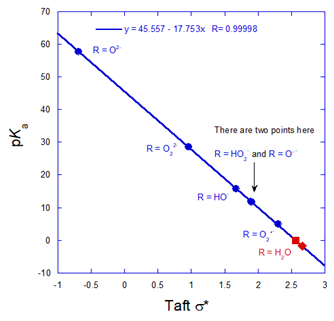
Water (HOH), hydroxyl radical (HO•), hydroxide ion (HO−), hydrogen peroxide (HHO2), hydroperoxyl radical HO2• hydroperoxide anion HO2− and hydronium ion (HH2O+) are all water related species and are environmentally important. The corresponding acid -base couples are represented as HOH/OH−, HO•/O•−, HO−/O2−, HHO2/, HO2•/ O2•-, HO2−/ O22− and H3O+/H2O. Therefore, the corresponding conjugate bases are hydroxide ion OH−, mono oxygen radical anion O•−, oxide dianion O2−, hydroperoxide anion HO2−, peroxyl radical anion O2•-, peroxide dianion O22− and H2O respectively. The acid-base properties are well characterized by treating the pKa data with Taft σ* values of the corresponding conjugate bases of these couples using Taft linear free-energy relationship (LFER). Positive Taft ρ* value of 17.7 indicates that electron withdrawing species facilitate the deprotonation and vice-versa. The present study is a good class-room exercise for both undergraduate and graduate advanced physical-organic chemistry level.
Water is an inorganic molecule with the molecular formula H2O. It is a translucent, tasteless, odorless, and colorless substance. It is the main component of Earth's streams, lakes, and oceans and the fluids of all known living organisms, in which it acts as a universal solvent. Water, being a polar molecule with a dipole moment of 1.8546 D, undergoes strong intermolecular hydrogen bonding. Therefore, it contributes largely to its physical and chemical properties. It is an essential beverage for all known forms of life. Due to its presence in all organisms, its chemical stability, its worldwide abundance, and its strong polarity relative to its small molecular size, water is often referred to as the "universal solvent" 1, 2. In the present work the pKa data of different acid-base couples of the species of water is collected and shown to obey Taft LFER.
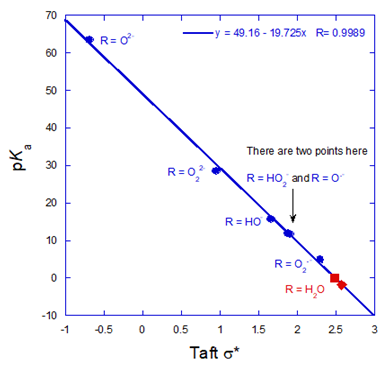
KaleidaGraph is used to draw the straight-line graphs. Taft σ* values and pKa values are from different sources or if not available are estimated. The pKa of Hydroxide ion was also determined by DFT method. It came out to be 63.44. The Quantum mechanical calculations were performed using Gaussian 09 3 program. The G4 method 4 was utilized to determine the Gibbs free energy for the reaction:
OH-  O2− + H+
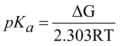
The G4 is a high-accuracy composite ab initio quantum chemical method 5 developed by Pople’s group. It makes use of geometries and thermochemical corrections calculated at B3LYP/6-31G (2df,p) level, a highest-level single point calculation at CCSD(T) (Coupled Cluster with Single and Double excitations and perturbative Triple excitations) instead of QCISD(T) (Quadratic Configuration Interaction with Single and Double excitations and perturbative Triple excitations) level, and addition of extra polarization functions in the largest-basis set MP2 calculations. It is an improvement of G3X. After finding the Gibbs free energy (using G4 method) of the reactants and products pKa was determined using the formula
ΔG = −2.303 RT log Ka
Or
In the following table 1 different acid-base couples of water species along with their pKa values and Taft σ* values are presented.
Various water related species are explained as follows:
The abondance of water is already explained in the introduction. Hydroxyl radical can be denoted as •OH or HO• is short lived species with a half-life of less than a second 13. As a short-lived species, it plays an important role in radical chemistry 14. The self-dissociation of a water molecule in liquid water is the fundamental event in acid-base chemistry, determining the pH of water. The hydroxide ion is naturally produced from water by the self-ionization reaction 2H2O  H3O+ + OH− 15. The concentrations of H3O+ and OH− are each close 10−7 mole/L. So, the pH at equilibrium will be 7.00. Hydrogen peroxide is a chemical compound with the molecular formula H2O2. It is a non-planar molecule with book-like structure shown by IR spectroscopy 16. Hydrogen peroxide is about 1000 times stronger acid than water 17. The hydroperoxyl radical is the protonated form of superoxide with the molecular formula
  . This species plays an important role in the atmosphere and as a reactive oxygen species in cell biology 18. It is an angular molecule 19. It can exist in equilibrium with its conjugate base peroxide radical anion
  with a pKa of 4.88 12. Hydroperoxide anion is a negatively charged molecular species with molecular formula
 . Its estimated pKa is 28.5 20.
And lastly about hydronium ion (HH2O)+. There is lot of discussion about the structure of hydrated proton. Three main structures for the aqueous proton have experimental support: the first one is Eigen cation, is a tetrahydrate, H3O+(H2O)3, the second one Zundel cation, is a dihydrate, H+(H2O)2, and the third one Stoyanov cation, an expanded Zundel cation, is hexahydrate, H+(H2O)2(H2O)4 21 22. In fact, one of the authors (VJ) have shown that the proton is a tetrahydrate (H9O4)+ from the entropy change of hydration of a proton 23. The structure of the tetrahydrate could be as shown below:
|
At 25C, the pKa of H3O+ is approximately 0.0 24. The values commonly given for pKa of H3O+ in water solution are 0 or −1.74. The former is based on the activity of the solvent in a dilute solution (in this case, water) is 1, while the latter uses the value of the concentration of water in the pure liquid of 55.5 M. Silverstein has shown that -1.74 is thermodynamically unsupportable 25. The disagreement comes from the ambiguity that to define pKa of H3O+ in water, H2O has to act simultaneously as a solute and the solvent. The IUPAC has not given an official definition of pKa that would resolve this ambiguity. On the other hand, Silverstein has shown that Ballinger and Long's experimental results 26 support a pKa of 0.0 for the aqueous proton 27. Neils and Schaertel provide added arguments for a pKa of 0.0 28. Figure 1 is the Taft plot.

Water can act as either an electron-donating group (EDG) or an electron-withdrawing group (EWG), depending on how it is attached and the chemical context 7. As a Hydroxy Group (–OH) it has both the effects. When water is attached to a molecule as a hydroxy group (–OH), such as in alcohols or phenols, it exerts two opposing electronic effects. Oxygen is highly electronegative, so it pulls electron density through sigma bonds. If the oxygen lone pair can overlap with a π system (e.g., in Phenol), it donates electron density by resonance. So, which effect dominates? In aliphatic alcohols (e.g., methanol): the inductive electron-withdrawing effect dominates. In aromatic systems (e.g., phenol): the resonance electron-donating effect dominates, making the –OH group an activating substituent. Water itself is best described as a Lewis electron donor because oxygen donates a lone pair. However, when present as an –OH substituent, it can be electron withdrawing by induction and electron donating by resonance. The dominant effect depends on the molecular environment. As a conclusion, the classification of the hydroxyl group (–OH), and by extension water-derived substituents, as both inductively withdrawing and resonance donating is well established in organic chemistry 7.
Using the value of pKa = 63.44 for the equilibrium OH-  O-2 + H+ obtained by DFT method did not change the trends in the Taft plot (Figure 2) indicating that our calculation by DFT is correct.

Red square is by taking pKa of water as 0.00 and red diamond with -1.74. In either case the Taft σ* of water did not change much. The two values change by a difference of 0.10. The positive Taft σ* value of water indicates that water is an electron withdrawing in nature. But it is known that in the formation of hydronium ion it is electron donating.
The authors are grateful to the Centre for High Performance Computing (CHPC), Cape Town, South Africa, for their generous allocation of supercomputer time.
We don’t have any conflict of interest.
This work did not receive any funding from any source.
| [1] | “Water Q & A: Why is water the “universal solvent”. Water Science School. , . 20 June 2019. from the original on 6 February 2021. Retrieved 15 January 2021. | ||
| In article | |||
| [2] | “4.1: Water, the Universal solvent”. Chemistry Libre Texts. 9 August 2017. Retrieved 14 January2026. | ||
| In article | |||
| [3] | M. J. Frisch, G. W. Trucks, H. B. Schlegel, G. E. Scuseria, M. A. Robb, J. R. Cheeseman, G. Scalmani, V. Barone, B. Mennucci, G. A.Petersson, H. Nakatsuji, M. Caricato, X. Li, H. P. Hratchian, A. F. Izmaylov, J. Bloino, G. Zheng, J. L. Sonnenberg, M. Hada, M. Ehara, K. Toyota, R. Fukuda, J. Hasegawa, M. Ishida, T. Nakajima, Y. Honda, O. Kitao, H. Nakai, T. Vreven, J. A. Montgomery Jr, J. E. Peralta, F. Ogliaro, M. Bearpark, J. J. Heyd, E. Brothers, K. N. Kudin, V. N. Staroverov, R. Kobayashi, J. Normand, K. Raghavachari, A. Rendell, J. C. Burant, S. S. Iyengar, J. Tomasi, M. Cossi, N. Rega, J. M. Millam, M. Klene, J. E. Knox, J. B. Cross, V. Bakken, C. Adamo, J. Jaramillo, R. Gomperts, R. E. Stratmann, O. Yazyev, A. J. Austin, R. Cammi, C. Pomelli, J. W. Ochterski, R. L. Martin, K. Morokuma, V. G. Zakrzewski, G. A. Voth, P. Salvador, J. J. Dannenberg, S. Dapprich, A. D. Daniels, O . Farkas, J. B. Foresman, J. V. Ortiz, J. Cioslowski, D. J. Fox, Gaussian 09, Revision E.01 2009 (Gaussian, Inc.: Wa | ||
| In article | |||
| [4] | Ariana Yett, Paul R. Rablen, A., G4 approach to computing the Hammett substituent constants σp, σm, σ−, σ+, and , J. Phy. Org. Chem., 2023, 36, 49-62. | ||
| In article | View Article | ||
| [5] | Curtis, L. A., Redfern, P. C., Raghavachari, K., and Pople, J. A., “Gaussian-4 theory.” The Journal of Chemical Physics, 2007, 126, 084108. | ||
| In article | View Article PubMed | ||
| [6] | Robert W. Taft Jr., “Polar and Steric Substituent Constants for Aliphatic and o-Benzoate Groups,” J. Am. Chem Soc., 1952, 74, 3120–3128, and Jinhua Zhang, Thomas Kleinöder, and Johann Gasteiger, J. Chem. Inf. Model. 2006, 46, 2256-2266. | ||
| In article | View Article | ||
| [7] | March's Advanced Organic Chemistry, Michael B. Smith and Jerry March 8th ed., Wiley, 2020. | ||
| In article | |||
| [8] | R. Sanjeev and V. Jagannadham, Resonance, (Journal of Science Education, Indian Academy of Sciences, Bangalore), pKa of H2 (2026, in press). | ||
| In article | |||
| [9] | George V. Buxton, Clive L. Greenstock, W. Phillips Helman, Alberta B. Ross, J. Phys. Chem. Ref. Data, 1988, 17, 513–886. | ||
| In article | View Article PubMed | ||
| [10] | Lange’s Handbook of Chemistry, Section 9.1, By John A. Dean, 15th Edition, 1999, McGraw-Hill, INC, New York. | ||
| In article | |||
| [11] | https://en.wikipedia.org/wiki/Hydrogen_peroxide. | ||
| In article | |||
| [12] | Bielski, Benon H. J., Cabelli Diane E., Arudi, Ravindra L., and Ross, Alberta B. . J. Phys. Chem. Ref. Data., 1985, 14, 1041–1091. | ||
| In article | View Article | ||
| [13] | Isaksen, I. S. A., and S. B. Dalsøren, "Getting a better estimate of an atmospheric radical". Science., 2011, 331, 6013, 38-39. | ||
| In article | View Article PubMed | ||
| [14] | Finlayson-Pitts, Barbara J., and Pitts James N., Chemistry of the Upper and Lower Atmosphere. Academic Press., 2000, ISBN 978-0-12-257060-5. | ||
| In article | |||
| [15] | Geissler, P. L., Dellago, C., Chandler, D., Hutter, J., and Parrinello, M. "Autoionization in liquid water". Science, 2001, 291 (5511), 2121–2124. | ||
| In article | View Article PubMed | ||
| [16] | Giguère P. A., "Molecular association and structure of hydrogen peroxide". Journal of Chemical Education, 1983, 60 (5): 399–401. | ||
| In article | View Article | ||
| [17] | Greenwood, N. N. and Earnshaw A, Chemistry of the Elements (2nd ed.) Butterworth-Heinemann, 1977, P 633-637. | ||
| In article | |||
| [18] | Heard, Dwayne E., and Pilling, Michael J., "Measurement of OH and HO2 in the Troposphere". Chemical Reviews., 2003,103 (12): 5163–5198. | ||
| In article | View Article PubMed | ||
| [19] | Liskow, Dean H., Schaefer, Henry F. III, and Bender, Charles F., "Geometry and electronic structure of the hydroperoxyl Radical". J. Am. Chem Soc., 1971, 93 (25): 6734–7. | ||
| In article | View Article | ||
| [20] | Frederick G. Bordwell, “Equilibrium Acidities in Dimethyl Sulfoxide Solution,” Acc. Chem. Res., 1988, 21(12), 456–463. | ||
| In article | View Article | ||
| [21] | Reed, C. A., "Myths about the proton. The nature of H+ in condensed media". Acc. Chem. Res., 2013, 46 (11): 2567–2575. | ||
| In article | View Article PubMed | ||
| [22] | Silverstein, Todd P., "The aqueous proton is hydrated by more than one water molecule: Is the hydronium ion a useful conceit?". J. Chem. Educ., 2014, 91 (4): 608–610. | ||
| In article | View Article | ||
| [23] | V. Jagannadham and S. Steenken, One-electron reduction of nitrobenzenes by α-hydroxyalkyl radicals via addition/elimination. An example of an organic inner-sphere electron-transfer reaction. J. Am. Chem. Soc., 1984, 106, 6542, for detailed information please visit page 6549 directly for this reference. | ||
| In article | View Article | ||
| [24] | Meister Erich, Willeke Martin, Angst Werner, Togni Antonio, and Walde Peter, "Confusing Quantitative Descriptions of Brønsted-Lowry Acid-Base Equilibria in Chemistry Textbooks – A Critical Review and Clarifications for Chemical Educators". Helv. Chim. Acta., 2014, 97 (1): 1–31. | ||
| In article | View Article | ||
| [25] | Silverstein, T. P., and Heller, S.T., "pKa Values in the Undergraduate Curriculum: What Is the Real pKa of Water?". J. Chem. Educ., 2017, 94 (6): 690–695. | ||
| In article | View Article | ||
| [26] | Ballinger, P. and Long, F.A., "Acid Ionization Constants of Alcohols. II. Acidities of Some Substituted Methanols and Related Compounds". J. Am. Chem. Soc., 1960, 82 (4): 795–798. | ||
| In article | View Article | ||
| [27] | Silverstein, T. P. "The aqueous proton is hydrated by more than one water molecule: Is the hydronium ion a useful conceit?". J. Chem. Educ., 2014, 91 (4): 608–610. | ||
| In article | View Article | ||
| [28] | "What is the pKa of Water". University of California, Davis. 2015-08-09. Archived from the original on 2016-02-14. Retrieved 2022-04-03. | ||
| In article | |||
Published with license by Science and Education Publishing, Copyright © 2026 V. Jagannadham, Sanjeev Rachuru and D. A. Padmavathi
 This work is licensed under a Creative Commons Attribution 4.0 International License. To view a copy of this license, visit
http://creativecommons.org/licenses/by/4.0/
This work is licensed under a Creative Commons Attribution 4.0 International License. To view a copy of this license, visit
http://creativecommons.org/licenses/by/4.0/
| [1] | “Water Q & A: Why is water the “universal solvent”. Water Science School. , . 20 June 2019. from the original on 6 February 2021. Retrieved 15 January 2021. | ||
| In article | |||
| [2] | “4.1: Water, the Universal solvent”. Chemistry Libre Texts. 9 August 2017. Retrieved 14 January2026. | ||
| In article | |||
| [3] | M. J. Frisch, G. W. Trucks, H. B. Schlegel, G. E. Scuseria, M. A. Robb, J. R. Cheeseman, G. Scalmani, V. Barone, B. Mennucci, G. A.Petersson, H. Nakatsuji, M. Caricato, X. Li, H. P. Hratchian, A. F. Izmaylov, J. Bloino, G. Zheng, J. L. Sonnenberg, M. Hada, M. Ehara, K. Toyota, R. Fukuda, J. Hasegawa, M. Ishida, T. Nakajima, Y. Honda, O. Kitao, H. Nakai, T. Vreven, J. A. Montgomery Jr, J. E. Peralta, F. Ogliaro, M. Bearpark, J. J. Heyd, E. Brothers, K. N. Kudin, V. N. Staroverov, R. Kobayashi, J. Normand, K. Raghavachari, A. Rendell, J. C. Burant, S. S. Iyengar, J. Tomasi, M. Cossi, N. Rega, J. M. Millam, M. Klene, J. E. Knox, J. B. Cross, V. Bakken, C. Adamo, J. Jaramillo, R. Gomperts, R. E. Stratmann, O. Yazyev, A. J. Austin, R. Cammi, C. Pomelli, J. W. Ochterski, R. L. Martin, K. Morokuma, V. G. Zakrzewski, G. A. Voth, P. Salvador, J. J. Dannenberg, S. Dapprich, A. D. Daniels, O . Farkas, J. B. Foresman, J. V. Ortiz, J. Cioslowski, D. J. Fox, Gaussian 09, Revision E.01 2009 (Gaussian, Inc.: Wa | ||
| In article | |||
| [4] | Ariana Yett, Paul R. Rablen, A., G4 approach to computing the Hammett substituent constants σp, σm, σ−, σ+, and , J. Phy. Org. Chem., 2023, 36, 49-62. | ||
| In article | View Article | ||
| [5] | Curtis, L. A., Redfern, P. C., Raghavachari, K., and Pople, J. A., “Gaussian-4 theory.” The Journal of Chemical Physics, 2007, 126, 084108. | ||
| In article | View Article PubMed | ||
| [6] | Robert W. Taft Jr., “Polar and Steric Substituent Constants for Aliphatic and o-Benzoate Groups,” J. Am. Chem Soc., 1952, 74, 3120–3128, and Jinhua Zhang, Thomas Kleinöder, and Johann Gasteiger, J. Chem. Inf. Model. 2006, 46, 2256-2266. | ||
| In article | View Article | ||
| [7] | March's Advanced Organic Chemistry, Michael B. Smith and Jerry March 8th ed., Wiley, 2020. | ||
| In article | |||
| [8] | R. Sanjeev and V. Jagannadham, Resonance, (Journal of Science Education, Indian Academy of Sciences, Bangalore), pKa of H2 (2026, in press). | ||
| In article | |||
| [9] | George V. Buxton, Clive L. Greenstock, W. Phillips Helman, Alberta B. Ross, J. Phys. Chem. Ref. Data, 1988, 17, 513–886. | ||
| In article | View Article PubMed | ||
| [10] | Lange’s Handbook of Chemistry, Section 9.1, By John A. Dean, 15th Edition, 1999, McGraw-Hill, INC, New York. | ||
| In article | |||
| [11] | https://en.wikipedia.org/wiki/Hydrogen_peroxide. | ||
| In article | |||
| [12] | Bielski, Benon H. J., Cabelli Diane E., Arudi, Ravindra L., and Ross, Alberta B. . J. Phys. Chem. Ref. Data., 1985, 14, 1041–1091. | ||
| In article | View Article | ||
| [13] | Isaksen, I. S. A., and S. B. Dalsøren, "Getting a better estimate of an atmospheric radical". Science., 2011, 331, 6013, 38-39. | ||
| In article | View Article PubMed | ||
| [14] | Finlayson-Pitts, Barbara J., and Pitts James N., Chemistry of the Upper and Lower Atmosphere. Academic Press., 2000, ISBN 978-0-12-257060-5. | ||
| In article | |||
| [15] | Geissler, P. L., Dellago, C., Chandler, D., Hutter, J., and Parrinello, M. "Autoionization in liquid water". Science, 2001, 291 (5511), 2121–2124. | ||
| In article | View Article PubMed | ||
| [16] | Giguère P. A., "Molecular association and structure of hydrogen peroxide". Journal of Chemical Education, 1983, 60 (5): 399–401. | ||
| In article | View Article | ||
| [17] | Greenwood, N. N. and Earnshaw A, Chemistry of the Elements (2nd ed.) Butterworth-Heinemann, 1977, P 633-637. | ||
| In article | |||
| [18] | Heard, Dwayne E., and Pilling, Michael J., "Measurement of OH and HO2 in the Troposphere". Chemical Reviews., 2003,103 (12): 5163–5198. | ||
| In article | View Article PubMed | ||
| [19] | Liskow, Dean H., Schaefer, Henry F. III, and Bender, Charles F., "Geometry and electronic structure of the hydroperoxyl Radical". J. Am. Chem Soc., 1971, 93 (25): 6734–7. | ||
| In article | View Article | ||
| [20] | Frederick G. Bordwell, “Equilibrium Acidities in Dimethyl Sulfoxide Solution,” Acc. Chem. Res., 1988, 21(12), 456–463. | ||
| In article | View Article | ||
| [21] | Reed, C. A., "Myths about the proton. The nature of H+ in condensed media". Acc. Chem. Res., 2013, 46 (11): 2567–2575. | ||
| In article | View Article PubMed | ||
| [22] | Silverstein, Todd P., "The aqueous proton is hydrated by more than one water molecule: Is the hydronium ion a useful conceit?". J. Chem. Educ., 2014, 91 (4): 608–610. | ||
| In article | View Article | ||
| [23] | V. Jagannadham and S. Steenken, One-electron reduction of nitrobenzenes by α-hydroxyalkyl radicals via addition/elimination. An example of an organic inner-sphere electron-transfer reaction. J. Am. Chem. Soc., 1984, 106, 6542, for detailed information please visit page 6549 directly for this reference. | ||
| In article | View Article | ||
| [24] | Meister Erich, Willeke Martin, Angst Werner, Togni Antonio, and Walde Peter, "Confusing Quantitative Descriptions of Brønsted-Lowry Acid-Base Equilibria in Chemistry Textbooks – A Critical Review and Clarifications for Chemical Educators". Helv. Chim. Acta., 2014, 97 (1): 1–31. | ||
| In article | View Article | ||
| [25] | Silverstein, T. P., and Heller, S.T., "pKa Values in the Undergraduate Curriculum: What Is the Real pKa of Water?". J. Chem. Educ., 2017, 94 (6): 690–695. | ||
| In article | View Article | ||
| [26] | Ballinger, P. and Long, F.A., "Acid Ionization Constants of Alcohols. II. Acidities of Some Substituted Methanols and Related Compounds". J. Am. Chem. Soc., 1960, 82 (4): 795–798. | ||
| In article | View Article | ||
| [27] | Silverstein, T. P. "The aqueous proton is hydrated by more than one water molecule: Is the hydronium ion a useful conceit?". J. Chem. Educ., 2014, 91 (4): 608–610. | ||
| In article | View Article | ||
| [28] | "What is the pKa of Water". University of California, Davis. 2015-08-09. Archived from the original on 2016-02-14. Retrieved 2022-04-03. | ||
| In article | |||