Tomato is a self-pollinating crop and relatively easy to cross, producing around 25-50 seeds per fruit. Despite its ease of crossing, specific periods and conditions for crossing tomatoes remained undocumented in Nigeria. Therefore, there is a need to investigate the appropriate period and time for crossing tomatoes with an acceptable percentage fruit set under contrasting conditions for a tomato breeding program. It is also vital to understand the nature and magnitude of genetic variability for various traits under hot dry and wet humid conditions. Screen house experiments were conducted in a completely randomized design with three repetitions under dry hot (37.18oC/28.65oC and 19.27%) and wet humid (29.71oC/24.53oC and 75.13%) conditions in the year 2022 to develop eight sets of F1, BCP1 and BCP2 crosses. Eight traits were recorded on five plants for days to flowering, number of pollinated flowers, number of fruits set, percentage fruits set, number of aborted flowers, days to maturity, number of seeds per fruit and number of fruits without seeds. The results revealed significant mean squares and high genotypic variance compared to environmental variance under both conditions for all studied traits, suggesting high genetic variability for the traits. High broad-sense heritability was recorded for all traits, showing that environmental factors have less influence on the expression of these traits. BCP1 and BCP2 crosses flowered early and produced the highest number of fruits set, percentage fruits set, number of seeds per fruit, but had minimum number of aborted flowers and number of fruits without seeds under wet humid conditions because of low day and night temperatures compared to F1 crosses under dry hot conditions. Number of pollinated flowers shows a highly significant positive correlation at genotypic and phenotypic levels with number of fruits set, percentage of fruit set and number of aborted flowers. Based on the results of the study, it is recommended to cross tomatoes in wet humid (September) conditions to achieve a higher percentage of fruits set, number of seeds per fruit, with a minimum number of aborted flowers and fruits without seeds. However, early morning pollination should be avoided under wet humid conditions due to the inability of the flowers to release sufficient pollen because of high humidity.
Tomato (Solanum lycopersicum Mill.) belongs to the family Solanaceae, genus Lycopersicon, sub-family Solanoideae and tribe Solaneae 1. All tomato species are diploid (2n=24). Tomato is a self-pollinating crop. The flowers are bright yellow, ebracteate, chasmogamous, pentamerous, and bisexual with regular pistils enveloped by a solid tube formed by the stamen (1.5-2cm) and usually grow opposite or between leaves. Anthers are bright yellow surrounding the style with an elongated sterile tip. Tomato is very rich in lycopene, beta-carotene, flavonoids, vitamins, minerals, essential amino acids, sugars, dietary fibres and fruits are consumed fresh in salads or cooked in sauces, soup and fish or meat dishes 2 and processed into tomato soup, sauces, chilli sauces, ketchup, powder, flakes, juice, pulp, purée, paste and pickled.
Tomato is a perennial but is usually grown and cultivated as an annual plant in an open field or under a greenhouse in tropical and temperate climates. It requires a relatively cool and dry climate for high yield and premium fruit quality. Despite its widespread cultivation across different climatic agro-ecologies, heat stress due to high temperature was major abiotic stress that caused bud drop, abnormal flower growth, poor pollen formation, poor inflorescence and pollen viability, ovule abortion and reduced carbohydrate content in tomato 3. The reproductive stage is found to be more vulnerable to heat stress than the vegetative stage in tomato 4. This situation needs the development of tomato cultivar(s) tolerant to high temperature stress in high-temperature prone environments. Tomato is relatively easy to cross with an average of 25-50 seeds per fruit. However, climatic conditions such as high temperature and relative humidity affect anther and pollen development and their function in tomato flowers, thereby reducing a reduction in percentage fruit set. 5 found that the optimum temperatures for tomato fruit set are between 25oC and 30oC during the photoperiod and 20oC during the dark period, and an increase of 2oC- 4oC over the optimal temperature which adversely affects gamete development and inhibits the ability of pollinated flowers to develop into fruits 6, 7, 10. 9, 34 observed that a relative humidity range of 50%–70% is optimal for tomato pollination while increasing humidity to 90% increases pollen susceptibility to heat stress, thereby reducing fruit set. High relative humidity greater than 70% increases pollen adhesion within the anthers, which reduces pollen release. In contrast, relative humidity greater than 70% sustained for more than 24 hours increases flower abscission, whereas higher night humidity only limits flower opening 10. 10 also observed low relative humidity coupled with high temperatures causes the drying of stigma which impairs pollen receptivity. 11 found that an increase in relative humidity between 60% and 70% improves pollen and fertilization in tomato compared to relative humidity of 30% to 40% relative humidity. 12 observed that out of 115 flowers crossed between Akungba x NG/AA/SSEP/09/042 tomato accessions, 87 crosses produced matured fruits, while 28 crosses aborted under humid conditions. 13 observed reductions in fruit set, pollen viability, pollen germination, and increased bud abscission rates under heat stress from field and controlled greenhouse environments. The size and shape of floral buds were affected in eleven tomato cultivars under heat stress, showing poor pollen germination, stigma exertion, curled petals and causing the sepals and petals to open earlier than under normal conditions 14. Similarly, 15 reported a significant decreased in fruit set by 71.5% and 68.3% under greenhouse (30.0/26.2oC and 77.6/97.2% RH) and open field (31.50/28.88oC and 66.72/77.82% RH) conditions, respectively. The genotypic coefficient of variation and phenotypic coefficient of variation are useful for determining the amount of variability present among the genotypes. Heritability is the proportion of genetic variance to the total variance, which helps in determining the influence of environmental factors on the expression of the trait and the extent to which improvement is possible after selection 16. The specific period and conditions for crossing tomatoes remained undocumented in Nigeria. Therefore, there is a need to investigate the appropriate period for crossing tomatoes with an acceptable percentage of fruit setting under contrasting conditions for a tomato breeding program. The study was conducted to identify the best period and conditions for crossing tomatoes using heat tolerant and susceptible tomato genotypes and to determine the nature and magnitude of variability and heritability under dry hot and wet humid conditions.
The experiments were conducted at the National Horticultural Research Institute, Bagauda station, Kano screen house (11.562078N; 8.38762E with an altitude of 506m) in the Sudan Savannah using three repetitions in the year 2022. The tomato accessions were introduced from Gene Bank Gatersleben of the Leibniz Institute of Plant Genetics and Plant Crop Research, Gatersleben, Germany. Brief descriptions of the tomato accessions are given in Table 1. The experimental materials comprised six heat-tolerant tomatoes (Red cherry, Yamal, VFN 8-9760, West Virginia Acc 36, West Virginia Acc 70 and Wisniowe) and five heat susceptible tomatoes (Jablonelistnyj, Alpatieva (tree-shaped), Bonny best, Best of all and Carminviolett) were crossed in the screen house to developed eight sets of F1, BCP1 and BCP2 crosses. The seeds of the parents were sown in trays using coco peat media on 18th December 2021 and transplanted on 20th January 2022 to develop F1 crosses, while parents and F1 seeds were staggered and sown between 18-22nd June 2022 and transplanted into plastic buckets on 19th July 2022 to developed BCP1 and BCP2 crosses. The crossing of parents to develop F1 crosses was carried out for 7 weeks between 2nd March to 20th April 2022 (Dry hot season), while crossing to develop BCP1 and BCP2 crosses was conducted between 30th August to 18th October 2022 (Wet humid season). The instruments used for both emasculation and pollination activities are shown in Figure 1. Emasculation was carried out in the evening (4 p.m.) by choosing unopened flower buds with pale green petals about 2-3 days away from opening. The corolla and anther cone that covered the stigma were carefully removed using sharp-pointed forceps, leaving only the calyx, ovary, and style. Pollination was carried out the next day after emasculation, early in the morning (Between 7 am and 12 pm). Pollen was collected from the dehiscent poricidal anther of male flowers using an electric brush to force the pollen to shed through the apical pores onto a black glass, and the stigma was carefully dipped into the pool of pollen. Pollinated flowers were tagged using thread and the date was recorded. Forceps, scissors and black glass were sterilized using Alcohol to avoid contamination of pollen from one cross to another. Progressive enlargement of the ovary was observed for successful pollinations. All opened flowers were removed from the female plants to reduce competition and improve the source and sink for the developing fruits. Matured fruits were harvested, and seeds were extracted and fermented for 1 to 2 days depending on the temperature to allow the mucilage around the seeds to dissolve and separate. The seeds were washed, rinsed with clean water and dried at room temperature. Data were collected on average days to flowering, number of pollinated flowers, number of fruits set per plant, percentage fruit set, number of aborted flowers, number of seeds per fruit and number of fruits without seeds. Estimates of the genotypic coefficient of variation (GCV) and phenotypic coefficient of variation (PCV) were estimated according to 17 and classified according to 18 as follows: low = 0-10%, moderate = 10-20% and high = 20% and above. Heritability was calculated according to 17 and categorized according to 16 as follows: low = 0-30%, moderate = 30-60% and high = 60% and above. Day and night temperatures, along with relative humidity were recorded using a temperature and humidity meter (Brann Meter, UK) (Table 2). Data were analyzed for genetic analysis using a variability package (version 0.1.0) in R studio, while ANOVA and phenotypic and genotypic correlations were performed using STAR (version 2.0.1) 36 and Meta-R (version 6.0) 33, respectively. The analysis for the GGE biplot was done using the metan package in R (version 1.18.0) 35.
Mean squares showed highly significant (P ≥ 0.001) differences for all traits measured among P1, P2, F1, BCP1 and BCP2 tomato genotypes under dry hot and wet humid conditions (Table 3). The genotypic variance was higher than the environmental variance for all traits across both conditions (Table 3). The phenotypic coefficient of variation values was higher than the genotypic coefficient of variation, for all traits under study (Table 3). The relative difference observed between PCV and GCV values was minimal across the conditions for days to flowering, number of pollinated flowers, percentage fruit set and days to maturity. Broad sense heritability values were high for all traits (≥60%) across the dry hot and wet humid conditions (Table 3).

The mean performance of the parents for the days to flowering ranged from 25 to 40.50 days across dry hot and wet humid conditions, respectively (Table 4). The Bonny best took 40.50 days to flower, whereas West Virginia Acc 63 and Wisniowe flowers on 25.00 days across the conditions. West Virginia Acc 63 recorded minimum days to maturity, while Bonny took a long time to mature among parents across dry hot and wet humid conditions (Table 4). The results among the parents also revealed that the number of seeds per fruit and number of fruits without seeds were high and low in wet humid conditions compared to dry hot conditions. The BCP1 and BCP2 crosses in wet humid conditions flower earlier than F1 crosses under dry hot conditions (Table 4). It was observed that the number of successful fruits set after pollination, percentage fruits set were higher under wet humid conditions compared to dry hot conditions. A higher number of aborted flowers were observed among F1 crosses under dry hot and their values were higher than the overall mean (34.48), while the minimum number of aborted flowers was recorded for the backcrosses under wet humid conditions. The results across dry hot and wet humid conditions (Table 4) indicate that the F1, BCP1 and BCP2 crosses were medium for days to maturity. Backcrosses under wet humid conditions recorded the highest and lowest number of seeds per fruit and number of fruits without seed, respectively. F1 crosses recorded minimum number of seeds per fruit and maximum number of fruits without seeds under dry hot conditions (Table 4).
Results for genotypic and phenotypic correlation coefficients revealed that the estimates of genotypic correlations were higher than their corresponding phenotypic correlations under hot dry and wet humid conditions. Under both dry hot and wet humid conditions, number of pollinated flowers showed highly significant positive correlation (Table 5 and Table 6) at genotypic and phenotypic levels with number of fruits set (0.97 and 0.97), percentage fruit set (0.96 and 0.94). Furthermore, significant positive correlations under both conditions were recorded between the number of pollinated flowers and number of aborted flowers with values of 0.95 and 0.95 at genotypic and phenotypic levels, respectively. Days to maturity revealed a highly significant negative association with the number of seeds per fruit at genotypic and phenotypic levels under hot dry and wet humid conditions (Table 5 and Table 6).


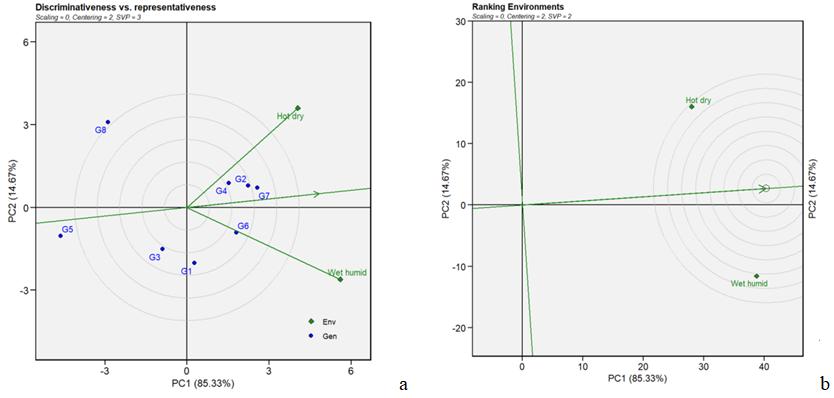
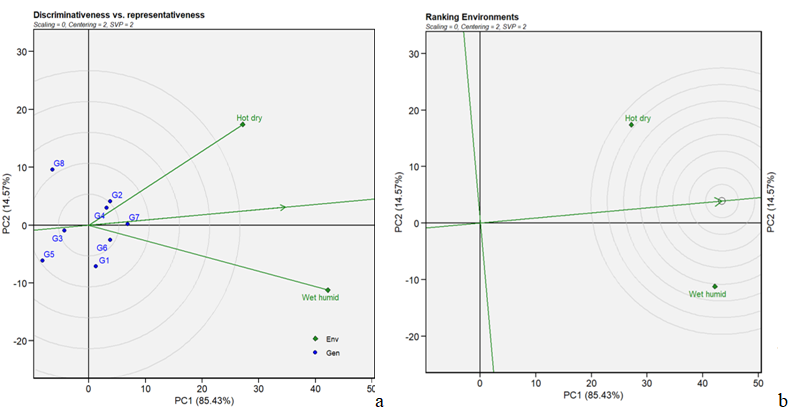
The results of the GGE biplot show that the first two principal components (PC1 and PC2) explained 100% of the total variation of the standardized data for both discriminativeness and representativeness and ranking environments (Figure 2 and Figure 3). The results of the GGE biplot for the hybrids and backcrosses also revealed that wet humid was most discriminating and representativeness having a longer vector, smaller angle and closer to Average-Environment axis (AEA) compared to dry hot environment (Figure 2 and Figure 3).
The mean squares of the Analysis of variance of the studied traits showed highly significant (P ≥ 0.001) differences among the tomato genotypes under dry hot and wet humid conditions. The significance reveals the presence of substantial and significant variability among genotypes selected for the study which can be exploited through selection. Similar findings were reported by 19 for days to flowering and percentage fruit set and 20 for percentage fruit set, while 12 observed significant mean squares for days to flowering among three sets of crosses under ambient temperature of 27oC to 30oC and relative humidity of 60 to 70%. 15 also observed significant variation among tomato genotypes for percentage fruit set and fruit number per plant under dry heat stress and humid conditions. The genotypic coefficient of variation and phenotypic coefficient of variation are crucial parameters for studying the nature and magnitude of variability of different traits, which are prerequisites for any crop improvement. The higher genotypic variance than the environmental variance for all traits across both conditions reveals a minor influence of environmental factors and a greater contribution of genetic variance to the total variation. Therefore, the traits could be considered and exploited for selection in earlier generations under both conditions. Moreover, higher phenotypic coefficient of variation values than the genotypic coefficient of variation indicates a strong influence of environmental factors on the expression of the traits under study. The results confirmed the findings of 21 and 12. The minimal relative difference observed between PCV and GCV values reveals least of the environmental factors affecting the expression of these traits. Hence selection could be applied in an early segregating population to improve the traits. 12 reported minimum values of PCV and GCV for day to flowering. Higher Broad sense heritability values recorded for all traits across the dry hot and wet humid conditions show that both conditions have less influence on the expression of the traits, therefore the traits were heritable and can be improved by simple selection under dry hot and wet humid conditions. 22 observed a high broad sense heritability for number of flowers, number of fruits and percentage fruit set, while 20 observed high broad sense heritability of percentage fruit set under high temperature and relative humidity. 23 also reported related results of higher genotypic variance, PCV and broad sense heritability for number of fruits and percentage fruit set under the daily temperature of 35.2oC and relative humidity of 91%.
The results of the mean performance exhibited a wide range of diversity among P1, P2, F1, BCP1 and BCP2 tomato genotypes for the studied traits under dry hot and wet humid conditions. Significant variations observed for most traits shows the feasibility of making crosses and selection under both conditions. The number of seeds per fruit and number of fruits without seeds were high and low in wet humid conditions compared to dry hot conditions because of relatively low day and night temperatures and high relative humidity. The BCP1 and BCP2 crosses in wet humid conditions flower earlier than F1 crosses under dry hot conditions. 24 recorded minimum days to flowering of BCP1 and BCP2 crosses among three sets of crosses under average day and night of 27.6 and 15.1°C, respectively. It was observed that number of successful fruits set after pollination, percentage fruits set were higher under wet humid conditions compared to dry hot conditions due to the relatively low day and night temperatures and high relative humidity as indicated in Table 2. Similar findings were reported by 25 for days to maturity, fruit set and number of fruits and 20 for percentage fruit set under high temperature and relative humidity for F1, BCP1 and BCP2 crosses. A higher number of aborted flowers observed in F1 crosses under dry hot was because of high temperature and very low relative humidity. Backcrosses under wet humid conditions recorded the highest and low number of seeds per fruit and number of fruits without seed, respectively. This was attributed to the low day and night temperatures coupled with high relative humidity recorded within the period of making the crosses (September to October). 26 reported a minimum number of aborted flowers among hybrids under relative humidity of 75% with maximum and minimum temperatures of 28.6°C and 12.8°C, respectively.
Correlation provides information regarding associations among various traits and allows the selection of genotypes having desirable traits simultaneously 27, 32. Sufficient knowledge about the magnitude and degree of association between the number of pollinated flowers, fruit set, percentage of fruit set, number of aborted flowers, number of seeds per fruit, and number of fruits without seeds would assist the breeder in the decision-making process for the simultaneous improvement of more than one trait when crossing tomatoes in a breeding program. Significant positive phenotypic correlation between traits shows that they can be predicted from each other, while genotypic correlation provides a measure of genetic association that will determine whether the relationship will be passed on to the offspring or not. Results for genotypic and phenotypic correlation coefficients revealed that the estimates of genotypic correlations were higher than their corresponding phenotypic correlations under hot dry and wet humid, indicating strong genetic association between the traits studied, while their phenotypic expression was hindered by temperature and relative humidity effects. These results corroborated with the findings of 28 who observed higher genotypic correlations than phenotypic correlations for days to flowering, number of fruits per plant, and number of seeds per fruit. The significant positive correlations observed between number of pollinated flowers and these traits indicate that number of fruit set and percentage fruit set under both conditions will increase with an increase in number of pollinated flowers. Furthermore, significant positive associations recorded between number of pollinated flowers and number of aborted flowers, indicating that the greater number of flowers pollinated, the number of abortions also increases. Therefore, crossings should be carried out within 5 to 7 weeks for a better fruit set. 29 reported a significant correlation between fruit set, number of fruits per plant and number of flowers per plant. The highly significant negative correlation between days to maturity and number of seeds per fruit indicates that as days to maturity increases the number of seeds per fruit will be reduced under dry hot conditions, as observed in Bonny Best and its crosses during the conduct of the trials. 30 recorded highly significant negative associations at genotypic and phenotypic levels between days to maturity and number of seeds per fruit.
Genotype and Genotype x environment biplot is a powerful graphical display of GGE interaction which can be used to identify the most performing environments and the environment(s) that exhibit more information about discrimination and selection among tomato hybrids and backcrosses in the testing environmental conditions. The first two principal components (PC1 and PC2) explained 100% of the total variation of the standardized data for discriminativeness and representativeness and ranking environments (Figure 2 and Figure 3), indicating the high complexity of the relationships among the measured traits under both dry hot and humid wet. The results of the GGE biplot (Figure 2 and Figure 3) for the hybrids and backcrosses revealed that wet humid conditions was most discriminating and representativeness having a longer vector, smaller angle and closer to Average-Environment axis (AEA) compared to dry hot conditions, indicating wet humid environment was an ideal condition for crossing tomatoes for higher percentage fruit set and number of seeds per fruit. 31 selected the best genotypes based on discriminativeness and representativeness of the GGE biplot for percentage fruit set among heat tolerant and heat sensitive tomato genotypes under natural heat stress.
The results indicated the presence of adequate and significant variability among the accessions, which could be harnessed through selection under dry hot and wet humid conditions. High heritability was observed for the traits, showing a lesser influence of the environment on their expression. The correlation results revealed that the number of fruits set, percentage fruit set and number of aborted flowers under dry hot and wet humid conditions will increase with an increase in number of pollinated flowers. The highly significant positive correlations recorded between number of pollinated flowers and number of aborted flowers, as the number of flowers pollinated increased, the number of abortions also increased. Therefore, crossings should be carried out within 5 to 7 weeks for a better fruit set. It is recommended that tomatoes should be crossed in wet humid (September) conditions for a better number of fruits set, maximum percentage fruits set, number of seeds per fruit with a minimum number of aborted flowers and number of fruits without seeds. However, early morning pollination should be avoided under wet humid conditions due to the flower's inability to release pollen because of high humidity.
The authors are grateful to the Gene Bank Gatersleben of the Leibniz Institute of Plant Genetics and Plant Crop Research, Gatersleben, Germany, for providing us with the tomato accessions. I also greatly appreciate contributions of Miftahu Muhammad Shu’aibu for his assistance during the conduct of the study.
| [1] | Taylor, I.B. Biosystematics of the tomato. In: Atherton, J. and Rudich, G. (eds). The Tomato Crop. A Scientific Basis for Improvement. Chapman & Hall, New York. 1986. | ||
| In article | View Article | ||
| [2] | Shankara, N., Joep, V.L., Marja, G., Martin, H., and Barbara, V.D. Cultivation of tomato: Production, Processing and Marketing. Netherlands: Digigrafi, Wageningen. 2005. | ||
| In article | |||
| [3] | Hazra, P., Samsul, H.A., Sikder, D. and Peter, K. V. Breeding tomato (Lycopersicon Esculentum Mill) resistant to high temperature stress. International Journal of Plant Breeding, 1(1):31‐40, 2007. | ||
| In article | |||
| [4] | Zinn, K.E., Tunc-Ozdemir, M., and Harper, J.F. Temperature stress and plant sexual reproduction: Uncovering the weakest links. J. Exp. Bot, 61, 1959–1968, 2010. | ||
| In article | View Article PubMed | ||
| [5] | Camejo D., Rodriguez P., Morales A.M., Amico J.M., Torrecillas A. and Alarcon J.J. High temperature effects on photosynthetic activity of two tomato cultivars with different susceptibility. Journal of Plant Physiology, 162:281-289, 2005. | ||
| In article | View Article PubMed | ||
| [6] | Peet M.M., Willits D.H. and Gardner R.G. Response of ovule development and post pollen production processes in male-sterile tomatoes to chronic, sub-acute high temperature stress. Journal of Experimental Botany, 48:101-111, 1997. | ||
| In article | View Article | ||
| [7] | Sato, S., Peet, M.M. and Gardner, R.G. Formation of parthenocarpic fruit, undeveloped flowers and aborted flowers in tomato under moderately elevated temperatures. Science Horticulture, 90:243–254, 2001. | ||
| In article | View Article | ||
| [8] | Firon, N., Shaked, R., Peet, M.M, Phari, D.M., Zamskı, E., Rosenfeld, K., Althanand, L. and Pressman, N.E. Pollen Grains of Heat Tolerant Tomato Cultivars Retain Higher Carbohydrate Concentration Under Heat Stress Conditions. Science Horticulture, 109:212–217, 2006. | ||
| In article | View Article | ||
| [9] | Peet, M., Sato, S., Clément, C. and Pressman, E. (2002). Heat stress increases sensitivity of pollen, fruit and seed production in tomatoes (Lycopersicon esculentum Mill.) to non-optimal vapor pressure deficits. Int. Hortic. Congr.: Environ. Stress Hortic Crop, 618, 209–215, 2002. | ||
| In article | View Article | ||
| [10] | Karapanos, I.C., Mahmood, S. and Thanopoulos, C. (2008). Fruit set in solanaceous vegetable crops as affected by floral and environmental factors. Eur. J. Plant Sci. Biotechnol. 2, 88–105, 2008. | ||
| In article | |||
| [11] | Huang, Y., Li, Y. and Wen, X. The effect of relative humidity on pollen vigor and fruit setting rate of greenhouse tomato under high temperature condition. Acta Agric. Boreali-Occident. Sin. 11, 1–20, 2011. | ||
| In article | |||
| [12] | Gbadamosi, A. E., Osekita, O.S., Ajayi, A.T., Ajileye, O.D. and Okere, A. U. Intra-Specific Crosses in Tomato (Solanum Lycopersicon L.) for Improvement of Fruit Quality: A Strategy for Enhanced Food Security. International Journal of Innovative Research and Development; 10(2): 142- 151, 2021. | ||
| In article | View Article | ||
| [13] | Miller, G., Beery, A., Singh, P.K., Wang, F., Zelingher, R., Motenko, E. and Michael, L. Contrasting processing tomato cultivars unlink yield and pollen viability under heat stress. biorxiv preprint, 2021.. | ||
| In article | View Article | ||
| [14] | Bollier, N., Micol-Ponce, R., Dakdaki, A., Maza, E., Zouine, M., Djari, A., Bouzayen, M., Chevalier, C., Delmas, F., Gonzalez, N. and Hernould, M. Various tomato cultivars display contrasted morphological and molecular responses to a heat wave. biorxiv preprint, 2022. | ||
| In article | View Article PubMed | ||
| [15] | Ayenan, M.A.T., Danquah, A., Hanson, P., Asante, I.K. and Danquah, E.Y. Tomato (Solanum lycopersicum L.) Genotypes Respond Differently to Long-Term Dry and Humid Heat Stress. Horticulturae. 8, 118. 2022. | ||
| In article | View Article | ||
| [16] | Robinson, H. F., Comstock, R. E. and Harvey, P. H. Estimates of heritability and degree of dominance in corn. Agronomy Journal, 41: 353-359, 1949. | ||
| In article | View Article | ||
| [17] | Singh, R.K. and Chaudhary, B.D. Biometrical methods in quantitative genetic analysis. Kalyani Publishers, New Delhi, 135-140, 1985. | ||
| In article | |||
| [18] | Shivasubramanian, S. and Menon, M. Heterosis and inbreeding depression in rice. Madras Agricultural Journal, 60: 1139, 1973. | ||
| In article | |||
| [19] | Hamisu, H. S., S. G. Ado, M. Y. Yeye, I. S. Usman, S. O. Afolayan, M. G. Bala, A. Usman, J. J. Yaduma, B. A. Idris, M. Y. Gwammaja, S. M. Muhammad, A. H. Hudu, A. U. Idris, Y. D. Giginyu and J. I. Aliyu. Genetic Studies of Agronomic and Physiological Traits in Tomato (Lycopersicon lycopersicum Mill.) Under Heat Stress Conditions. American Journal of Experimental Agriculture, 13(6):1-8, 2016. | ||
| In article | View Article | ||
| [20] | Florido-Bacallao, M., Lara-Rodríguez, R.M., Plana-Ramos, D., Amalia Álvarez-Gil, M. Studies of gene action and heritability of the percentage of fruiting in tomato, cultivar Nagcarlang under conditions of heat stress. Cultivos Tropicales, 42(1): 1819-4087, 2021. | ||
| In article | |||
| [21] | Amrutha, V., Shanija, S., Beena, R., Nithya, N., Jaslam, M.P.K., Soni, K.B. and Viji, M.M. Population structure analysis and marker trait association in selected set of Indian tomato (Solanum lycopersicum L.) varieties under high temperature condition. Genetic Resources and Crop Evolution, 1–25, 2021. | ||
| In article | View Article | ||
| [22] | Panthee, D. R., Kressin, J. P., & Piotrowski, A. Heritability of Flower Number and Fruit Set under Heat Stress in Tomato. Hort Science horts, 53(9), 1294-1299, 2018. | ||
| In article | View Article | ||
| [23] | Amrutha, V. and Beena R. Eco-physiological screening and genetic diversity analysis of tomato genotypes in response to summer heat. Research Square, 1- 19, 2023. | ||
| In article | |||
| [24] | Longjam, M., Hazra, P., Hazra, S., Biswas. V. and Chattopadhyay, A. Gene action for yield components and fruit quality characters of tomato genotypes possessing mutant genes through generation mean analysis. Vegetable Science, 48 (1): 22-29, 2021. | ||
| In article | View Article | ||
| [25] | Somraj, B., Reddy, R.V.S.K., Reddy, K.R., Saidaiah, P. and Reddy, M.T. Generation means analysis of yield components and yield in tomato (Solanum lycopersicum L.) under high temperature conditions. Journal of Pharmacognosy and Phytochemistry, 7(6): 1704-1708, 2018. | ||
| In article | |||
| [26] | Ene, C.O., Abtew, W.G., Oselebe, H.O., Ozi, F.U., Ogah, O., Okechukwu, E.C. and Chukwudi, U.P. Hybrid Vigor and Heritability Estimates in Tomato Crosses Involving Solanum lycopersicum × S. pimpinellifolium under Cool Tropical Monsoon Climate. International Journal of Agronomy, Volume 2023, 17 pages, 2023. | ||
| In article | View Article | ||
| [27] | Ali, M.A., Nawab, N.N., Abbas, A., and Sajjad, M. Evaluation of selection criteria in Cicer arietinum L. using correlation coefficients and path analysis. Australia journal of crop Science, 3: 65 70, 2009. | ||
| In article | |||
| [28] | Ravinsh, K.M., Singh, A.K. and Alka, Sai, A. Correlation and path analysis in tomato (Solanum lycopersicum L.) for yield and yield contributing traits. Journal of Pharmacogn Phytochem, 9(3):1684-1687, 2020. | ||
| In article | View Article | ||
| [29] | Pravallika, R.N. and Parveen, S. (2023). Evaluation of Growth and Pollen Viability (Fertility) in Relation to Fruit Set among Five Varieties of Tomato. International Journal of Environment and Climate Change, 13 (6). 88-94, 2023. | ||
| In article | View Article | ||
| [30] | Kumar, C. and Singh, D. A Correlation and Path Analysis Studies of Quantitative and Qualitative Traits in Tomato. Int. J. Curr. Microbiol. App. Sci, 7(4): 2230-2238, 2018. | ||
| In article | View Article | ||
| [31] | Chapagain T.R., Shrestha A.K., Sharma M.D., Tripathi K.M., and Srivastva A. Evaluation and characterization of tomato (Solanum lycopersicum L.) genotypes using path coefficient, GGE biplot and cluster analyses under natural heat stress. International Journal of Horticulture, 10(6): 1-10, 2020. | ||
| In article | View Article | ||
| [32] | Aghughu, O. Provenance variation in Acacia Senegal (L.) Wild. (Gum Arabic) in Nigeria. An unpublished Ph.D. thesis Department of Plant Science, Ahmadu Bello University, Zaria. (2001). | ||
| In article | |||
| [33] | Gregorio Alvarado, Marco López, Mateo Vargas, Angela Pacheco, Francisco Rodríguez, Juan Burgueño, and José Crossa. META-R (Multi-Environment Trial Analysis with R). User’s manual, 2016. | ||
| In article | |||
| [34] | Harel, D., Fadida, H., Slepoy, A., Gantz, S., and Shilo, K. (2014). The Effect of Mean Daily Temperature and Relative Humidity on Pollen, Fruit Set and Yield of Tomato Grown in Commercial Protected Cultivation. Agronomy, 4(1), 167–177, 2014. | ||
| In article | View Article | ||
| [35] | Olivoto T, Lúcio A.D. “metan: An R package for multi‐environment trial analysis.” Methods in Ecology and Evolution, 11(6), 783-789, 2020. | ||
| In article | View Article | ||
| [36] | STAR, version 2.0.1. Biometrics and Breeding Informatics, PBGB Division, International Rice Research Institute, Los Baños, Laguna. 2014. | ||
| In article | |||
Published with license by Science and Education Publishing, Copyright © 2026 Hamisu H.S., Ishiyaku M.F., Mohammed S.M., Umar L.M., Abdulmalik. M.M., Umeh P.P., Yakasai A.S., Sa’idu G., Hudu M., Kala A.I., Abdullahi A.K and Yakub A.M.
 This work is licensed under a Creative Commons Attribution 4.0 International License. To view a copy of this license, visit
http://creativecommons.org/licenses/by/4.0/
This work is licensed under a Creative Commons Attribution 4.0 International License. To view a copy of this license, visit
http://creativecommons.org/licenses/by/4.0/
| [1] | Taylor, I.B. Biosystematics of the tomato. In: Atherton, J. and Rudich, G. (eds). The Tomato Crop. A Scientific Basis for Improvement. Chapman & Hall, New York. 1986. | ||
| In article | View Article | ||
| [2] | Shankara, N., Joep, V.L., Marja, G., Martin, H., and Barbara, V.D. Cultivation of tomato: Production, Processing and Marketing. Netherlands: Digigrafi, Wageningen. 2005. | ||
| In article | |||
| [3] | Hazra, P., Samsul, H.A., Sikder, D. and Peter, K. V. Breeding tomato (Lycopersicon Esculentum Mill) resistant to high temperature stress. International Journal of Plant Breeding, 1(1):31‐40, 2007. | ||
| In article | |||
| [4] | Zinn, K.E., Tunc-Ozdemir, M., and Harper, J.F. Temperature stress and plant sexual reproduction: Uncovering the weakest links. J. Exp. Bot, 61, 1959–1968, 2010. | ||
| In article | View Article PubMed | ||
| [5] | Camejo D., Rodriguez P., Morales A.M., Amico J.M., Torrecillas A. and Alarcon J.J. High temperature effects on photosynthetic activity of two tomato cultivars with different susceptibility. Journal of Plant Physiology, 162:281-289, 2005. | ||
| In article | View Article PubMed | ||
| [6] | Peet M.M., Willits D.H. and Gardner R.G. Response of ovule development and post pollen production processes in male-sterile tomatoes to chronic, sub-acute high temperature stress. Journal of Experimental Botany, 48:101-111, 1997. | ||
| In article | View Article | ||
| [7] | Sato, S., Peet, M.M. and Gardner, R.G. Formation of parthenocarpic fruit, undeveloped flowers and aborted flowers in tomato under moderately elevated temperatures. Science Horticulture, 90:243–254, 2001. | ||
| In article | View Article | ||
| [8] | Firon, N., Shaked, R., Peet, M.M, Phari, D.M., Zamskı, E., Rosenfeld, K., Althanand, L. and Pressman, N.E. Pollen Grains of Heat Tolerant Tomato Cultivars Retain Higher Carbohydrate Concentration Under Heat Stress Conditions. Science Horticulture, 109:212–217, 2006. | ||
| In article | View Article | ||
| [9] | Peet, M., Sato, S., Clément, C. and Pressman, E. (2002). Heat stress increases sensitivity of pollen, fruit and seed production in tomatoes (Lycopersicon esculentum Mill.) to non-optimal vapor pressure deficits. Int. Hortic. Congr.: Environ. Stress Hortic Crop, 618, 209–215, 2002. | ||
| In article | View Article | ||
| [10] | Karapanos, I.C., Mahmood, S. and Thanopoulos, C. (2008). Fruit set in solanaceous vegetable crops as affected by floral and environmental factors. Eur. J. Plant Sci. Biotechnol. 2, 88–105, 2008. | ||
| In article | |||
| [11] | Huang, Y., Li, Y. and Wen, X. The effect of relative humidity on pollen vigor and fruit setting rate of greenhouse tomato under high temperature condition. Acta Agric. Boreali-Occident. Sin. 11, 1–20, 2011. | ||
| In article | |||
| [12] | Gbadamosi, A. E., Osekita, O.S., Ajayi, A.T., Ajileye, O.D. and Okere, A. U. Intra-Specific Crosses in Tomato (Solanum Lycopersicon L.) for Improvement of Fruit Quality: A Strategy for Enhanced Food Security. International Journal of Innovative Research and Development; 10(2): 142- 151, 2021. | ||
| In article | View Article | ||
| [13] | Miller, G., Beery, A., Singh, P.K., Wang, F., Zelingher, R., Motenko, E. and Michael, L. Contrasting processing tomato cultivars unlink yield and pollen viability under heat stress. biorxiv preprint, 2021.. | ||
| In article | View Article | ||
| [14] | Bollier, N., Micol-Ponce, R., Dakdaki, A., Maza, E., Zouine, M., Djari, A., Bouzayen, M., Chevalier, C., Delmas, F., Gonzalez, N. and Hernould, M. Various tomato cultivars display contrasted morphological and molecular responses to a heat wave. biorxiv preprint, 2022. | ||
| In article | View Article PubMed | ||
| [15] | Ayenan, M.A.T., Danquah, A., Hanson, P., Asante, I.K. and Danquah, E.Y. Tomato (Solanum lycopersicum L.) Genotypes Respond Differently to Long-Term Dry and Humid Heat Stress. Horticulturae. 8, 118. 2022. | ||
| In article | View Article | ||
| [16] | Robinson, H. F., Comstock, R. E. and Harvey, P. H. Estimates of heritability and degree of dominance in corn. Agronomy Journal, 41: 353-359, 1949. | ||
| In article | View Article | ||
| [17] | Singh, R.K. and Chaudhary, B.D. Biometrical methods in quantitative genetic analysis. Kalyani Publishers, New Delhi, 135-140, 1985. | ||
| In article | |||
| [18] | Shivasubramanian, S. and Menon, M. Heterosis and inbreeding depression in rice. Madras Agricultural Journal, 60: 1139, 1973. | ||
| In article | |||
| [19] | Hamisu, H. S., S. G. Ado, M. Y. Yeye, I. S. Usman, S. O. Afolayan, M. G. Bala, A. Usman, J. J. Yaduma, B. A. Idris, M. Y. Gwammaja, S. M. Muhammad, A. H. Hudu, A. U. Idris, Y. D. Giginyu and J. I. Aliyu. Genetic Studies of Agronomic and Physiological Traits in Tomato (Lycopersicon lycopersicum Mill.) Under Heat Stress Conditions. American Journal of Experimental Agriculture, 13(6):1-8, 2016. | ||
| In article | View Article | ||
| [20] | Florido-Bacallao, M., Lara-Rodríguez, R.M., Plana-Ramos, D., Amalia Álvarez-Gil, M. Studies of gene action and heritability of the percentage of fruiting in tomato, cultivar Nagcarlang under conditions of heat stress. Cultivos Tropicales, 42(1): 1819-4087, 2021. | ||
| In article | |||
| [21] | Amrutha, V., Shanija, S., Beena, R., Nithya, N., Jaslam, M.P.K., Soni, K.B. and Viji, M.M. Population structure analysis and marker trait association in selected set of Indian tomato (Solanum lycopersicum L.) varieties under high temperature condition. Genetic Resources and Crop Evolution, 1–25, 2021. | ||
| In article | View Article | ||
| [22] | Panthee, D. R., Kressin, J. P., & Piotrowski, A. Heritability of Flower Number and Fruit Set under Heat Stress in Tomato. Hort Science horts, 53(9), 1294-1299, 2018. | ||
| In article | View Article | ||
| [23] | Amrutha, V. and Beena R. Eco-physiological screening and genetic diversity analysis of tomato genotypes in response to summer heat. Research Square, 1- 19, 2023. | ||
| In article | |||
| [24] | Longjam, M., Hazra, P., Hazra, S., Biswas. V. and Chattopadhyay, A. Gene action for yield components and fruit quality characters of tomato genotypes possessing mutant genes through generation mean analysis. Vegetable Science, 48 (1): 22-29, 2021. | ||
| In article | View Article | ||
| [25] | Somraj, B., Reddy, R.V.S.K., Reddy, K.R., Saidaiah, P. and Reddy, M.T. Generation means analysis of yield components and yield in tomato (Solanum lycopersicum L.) under high temperature conditions. Journal of Pharmacognosy and Phytochemistry, 7(6): 1704-1708, 2018. | ||
| In article | |||
| [26] | Ene, C.O., Abtew, W.G., Oselebe, H.O., Ozi, F.U., Ogah, O., Okechukwu, E.C. and Chukwudi, U.P. Hybrid Vigor and Heritability Estimates in Tomato Crosses Involving Solanum lycopersicum × S. pimpinellifolium under Cool Tropical Monsoon Climate. International Journal of Agronomy, Volume 2023, 17 pages, 2023. | ||
| In article | View Article | ||
| [27] | Ali, M.A., Nawab, N.N., Abbas, A., and Sajjad, M. Evaluation of selection criteria in Cicer arietinum L. using correlation coefficients and path analysis. Australia journal of crop Science, 3: 65 70, 2009. | ||
| In article | |||
| [28] | Ravinsh, K.M., Singh, A.K. and Alka, Sai, A. Correlation and path analysis in tomato (Solanum lycopersicum L.) for yield and yield contributing traits. Journal of Pharmacogn Phytochem, 9(3):1684-1687, 2020. | ||
| In article | View Article | ||
| [29] | Pravallika, R.N. and Parveen, S. (2023). Evaluation of Growth and Pollen Viability (Fertility) in Relation to Fruit Set among Five Varieties of Tomato. International Journal of Environment and Climate Change, 13 (6). 88-94, 2023. | ||
| In article | View Article | ||
| [30] | Kumar, C. and Singh, D. A Correlation and Path Analysis Studies of Quantitative and Qualitative Traits in Tomato. Int. J. Curr. Microbiol. App. Sci, 7(4): 2230-2238, 2018. | ||
| In article | View Article | ||
| [31] | Chapagain T.R., Shrestha A.K., Sharma M.D., Tripathi K.M., and Srivastva A. Evaluation and characterization of tomato (Solanum lycopersicum L.) genotypes using path coefficient, GGE biplot and cluster analyses under natural heat stress. International Journal of Horticulture, 10(6): 1-10, 2020. | ||
| In article | View Article | ||
| [32] | Aghughu, O. Provenance variation in Acacia Senegal (L.) Wild. (Gum Arabic) in Nigeria. An unpublished Ph.D. thesis Department of Plant Science, Ahmadu Bello University, Zaria. (2001). | ||
| In article | |||
| [33] | Gregorio Alvarado, Marco López, Mateo Vargas, Angela Pacheco, Francisco Rodríguez, Juan Burgueño, and José Crossa. META-R (Multi-Environment Trial Analysis with R). User’s manual, 2016. | ||
| In article | |||
| [34] | Harel, D., Fadida, H., Slepoy, A., Gantz, S., and Shilo, K. (2014). The Effect of Mean Daily Temperature and Relative Humidity on Pollen, Fruit Set and Yield of Tomato Grown in Commercial Protected Cultivation. Agronomy, 4(1), 167–177, 2014. | ||
| In article | View Article | ||
| [35] | Olivoto T, Lúcio A.D. “metan: An R package for multi‐environment trial analysis.” Methods in Ecology and Evolution, 11(6), 783-789, 2020. | ||
| In article | View Article | ||
| [36] | STAR, version 2.0.1. Biometrics and Breeding Informatics, PBGB Division, International Rice Research Institute, Los Baños, Laguna. 2014. | ||
| In article | |||