The oxygen reduction reaction (ORR) is fundamental to fuel cells and metal–air batteries. However, its practical value depends on a mechanistic detail that cannot be resolved by ordinary voltammetry: whether oxygen is reduced directly by four electrons to hydroxide, or by two electrons to hydroperoxide. This article presents an accessible rotating ring–disk electrode experiment that makes this branching process directly observable. Oxygen reduction is measured on a platinum disk in oxygen-saturated 1 M potassium hydroxide solution at five different rotation rates. At the same time, a concentric glassy-carbon ring collects and re-oxidises the hydroperoxide leaving the disk. The Levich and Koutecký–Levich analyses of the disk currents illustrate mass transport control and the extraction of kinetic information, while the potential-resolved hydroperoxide yield and the average number of transferred electrons are obtained from the ratio of ring and disk currents. The measurements reveal a predominantly four-electron pathway (n ≈ 3.4–3.9), alongside a parallel two-electron route whose contribution (approximately 10–30% hydroperoxide) increases towards the onset potential. The mean Tafel slope is approximately 83 mV per decade, which means that a tenfold increase in the magnitude of the kinetic current requires an overpotential change of approximately 83 mV within the fitted region. Its intermediate value between the commonly discussed ~60 and ~120 mV per decade regimes is consistent with coverage- and potential-dependent ORR kinetics on Pt, and it should not be assigned to a single elementary rate-determining step. Beyond the numbers, the experiment demonstrates why the ring is indispensable: it transforms an abstract concept into a measurable quantity that students can interpret from a plot. Furthermore, it distinguishes between reliable and unreliable observables (the ratio-based electron number and hydroperoxide yield versus absolute diffusion coefficients and electron numbers from slope analysis). An open-source analysis workflow lowers the barrier to adoption. This approach is suitable for advanced physical, analytical or inorganic chemistry courses, linking a key electroanalytical technique to a reaction of central importance in electrochemical energy conversion.
The electrochemical reduction of molecular oxygen is one of the most significant reactions in modern energy technology. It determines the performance of the cathode in both hydrogen fuel cells and metal–air batteries, and the slowness of this reaction is the main reason why these devices still rely on scarce platinum-group catalysts 1. For teaching purposes, this reaction is appealing because it links a fundamental electroanalytical technique to a societal and curricular priority — renewable energy conversion — while offering students exposure to genuine mechanistic complexity 2.
This complexity has a simple core. In an alkaline solution, oxygen can follow two competing pathways. The desired four-electron pathway reduces it directly to hydroxide:
O₂ + 2 H₂O + 4 e- → 4 OH-,
whereas the two-electron pathway stops at hydroperoxide:
O₂ + H₂O + 2 e- → HO₂- + OH-.
The hydroperoxide route wastes half of the available electrons and releases a species that corrodes carbon supports and polymer membranes. Therefore, knowing how strongly the reaction branches towards hydroperoxide and how this branching changes with potential is essential to any accurate characterisation of an ORR catalyst.
The standard hydrodynamic tool taught in laboratories is the rotating disk electrode (RDE). By forcing convection, it produces steady, reproducible mass transport, which can be described quantitatively using the Levich and Koutecký–Levich equations. It is also widely used to introduce students to electrode kinetics 2, 6. A Koutecký–Levich analysis can even provide an apparent number of electrons transferred. However, this value is derived from the slope of a line and provides no information about where hydroperoxide is formed. Furthermore, for a gas-phase reactant, it can be distorted when the diffusion-limited plateau is not clearly established 3, 5. In short, the RDE cannot see the intermediate.
The rotating ring–disk electrode (RRDE) removes this blind spot. A second concentric electrode surrounds the disk and is held at a potential where any hydroperoxide swept outwards by the rotation is immediately re-oxidised. The ring current thus provides a direct, potential-resolved report of the hydroperoxide leaving the disk. It was precisely this capability that enabled the ORR pathway to be quantified in foundational catalyst studies 4, and it continues to underpin modern selectivity measurements 7. This article aims to introduce this capability to teaching laboratories by presenting an accessible RRDE experiment on platinum in 1 M KOH that is analysed using open-source software. This experiment renders the two- versus four-electron branching visible, thereby teaching both the technique and the critical evaluation of electrochemical data.
Measurements were taken using a rotating ring–disk assembly comprising a platinum disk (geometric disk area A = 0.196 cm²) and a glassy carbon (GC) ring (RRDE Pt-GC 3.109.4080, Metrohm; RRDE rotator 80608, Metrohm). This assembly was immersed in 1 M KOH, which was prepared using analytical-grade pellets and ultrapure water. The electrolyte was saturated with oxygen by bubbling prior to each run and was kept saturated with oxygen during measurement. An Ag/AgCl electrode (3 M KCl) served as the reference electrode, and a platinum wire served as the counter electrode. All potentials quoted below are referenced to this Ag/AgCl electrode. The assembly's collection efficiency was taken as N = 0.25 (the manufacturer's value; an experimentally determined value of 0.23 is also available and is discussed in Section 4.3). The experimental collection efficiency N was determined using the [Fe(CN)₆]³⁻/[Fe(CN)₆]⁴⁻ redox couple: N = 0.23 (23%). In addition to the O₂-saturated measurements, background linear-sweep voltammograms (LSVs) were recorded in the same 1 M KOH electrolyte after purging with N₂ for approximately 10 minutes. These N₂ measurements provide the non-ORR disk and ring background under comparable conditions and were used to assess and correct contributions not originating from oxygen reduction, where appropriate.
2.2. Voltammetric MeasurementsCathodic LSVs of the disk were recorded at rotation rates of 500, 900, 1300, 2100 and 2500 rpm using a bipotentiostat (PGSTAT 204 with BA module from Metrohm). The ring was held at a constant potential (0.2 V vs. Ag/AgCl) selected for hydroperoxide oxidation during this process. Disk and ring currents were acquired simultaneously as a function of disk potential. Preliminary repeat measurements at an identical rotation rate revealed a progressive decrease in the GC-ring current during consecutive LSV scans. This indicates a time-dependent change in the electrochemical response of the glassy carbon ring. To minimise this systematic drift, the RRDE was removed from the cell after each LSV run, after which the electrode surface was gently cleaned with a fine, lint-free cloth moistened with a water/isopropanol solution before the subsequent measurement. This cleaning procedure was applied consistently throughout the rotation-rate series. The scan rate was 0.05 V s⁻¹, and the cathodic scan direction ran from 0.5 V to −1.5 V vs. Ag/AgCl (3 M KCl), corresponding to +1.48 V to −0.52 V vs. RHE (converted using the pH of the 1 M KOH solution, pH ≈ 14).
2.3. Data Processing and AnalysisRaw currents were smoothed using a Savitzky–Golay filter with a 15-point window and a third-order polynomial. The ring background was then removed by subtracting the mean ring current over a fixed potential window prior to the ratio analysis. All evaluations — the two- and three-dimensional current plots, Levich and Koutecký–Levich regressions, potential-resolved hydroperoxide yield and electron number, and Tafel analysis — were performed using the rotating ring–disk module of the open-source SpectroElectroChem Suite 10. The hydrodynamic evaluation used an oxygen concentration of 6.0×10⁻⁴ mol L−1 (equivalent to 6.0×10⁻⁷ mol cm-3) and a kinematic viscosity of 0.010 cm² s-1 for the electrolyte.
2.4. Working EquationsAt a mass-transport-limited disk, the current follows the Levich equation,
IL = 0.62 n F A D2/3 ν−1/6 C ω1/2 (1)
in which n is the number of electrons, F the Faraday constant, D and C the diffusion coefficient and bulk concentration of oxygen, the kinematic viscosity, and ω the angular rotation rate. In the mixed kinetic–diffusion region the inverse currents add according to the Koutecký–Levich equation,
1/ID = 1/Ik + 1/(B ω1/2), B = 0.62 n F A D2/3 ν−1/6 C (2)
so that a plot of 1/ID against 1/√ω is linear, with intercept 1/Ik giving the kinetic current. The unique contribution of the ring is the direct evaluation of the branching. With the collection efficiency N (a fixed geometric and hydrodynamic property of the electrode assembly; here N = 0.25), the mean number of electrons and the hydroperoxide yield follow from the simultaneous disk and ring currents,
n = 4 |ID| / (|ID| + IR/N) (3)
X HO₂⁻ = 200 (IR/N) / (|ID| + IR/N) (4)
Equations (3) and (4) use the magnitude of the cathodic disk current and the anodic ring current; they imply the useful internal check n = 4 − X/50, linking the two ring-derived quantities. Finally, the kinetic (charge-transfer) current is separated from mass transport before the Tafel analysis,
jk = j · jL / (jL − j), η = a + b log|jk| (5)
where j and jL are the measured and diffusion-limited current densities, jk the mass-transport-corrected kinetic current density, η the overpotential, and b the Tafel slope.
The oxygen diffusion coefficient can, in principle, be obtained from the slope m of the Levich plot. Rearrangement of Eq. (1) gives
D = [m ν¹ᐟ⁶ / (0.62 n F A C)]³ᐟ². (6)
This calculation is meaningful only when a genuine diffusion-limited plateau is present and n, C, and ν are independently known. The exchange current density j₀ follows from the Tafel relation by extrapolation to zero overpotential η = 0. For η = a + b log|jk|,
j₀ = 10−a/b. (7)
For a simple one-step electrode reaction, an apparent heterogeneous rate constant k0 may formally be estimated from
k0 = j₀ / (n F C). (8)
However, for the multistep ORR, this expression does not define a unique standard heterogeneous rate constant. Any value derived in this way is only an apparent kinetic descriptor, depending on the assumed number of electrons, reactant concentration, reference potential and the validity of the Tafel extrapolation.
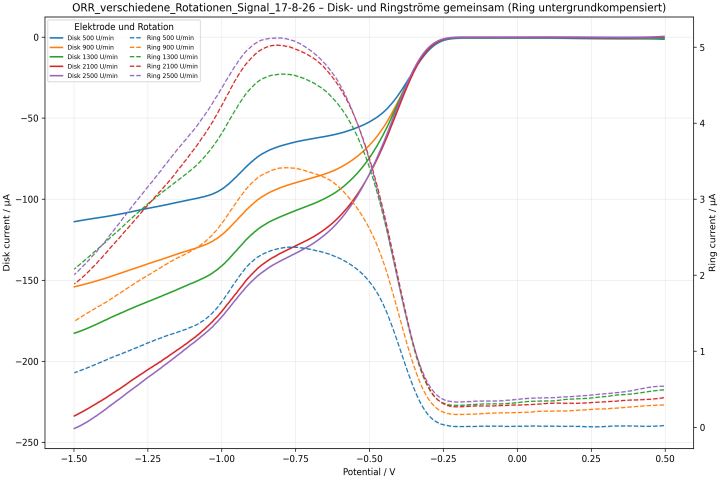
Figure 1 shows the disk and ring responses across all rotation rates. As expected for a convection-fed reduction, the cathodic disk current (solid curves, left axis) grows in magnitude with rotation rate. The ring current (dashed curves, right axis) has a bell-shaped profile: it increases as hydroperoxide formation becomes significant, reaches a maximum near −0.8 V and then decreases again towards more negative disk potentials. The magnitude of the ring current maximum increases systematically with rotation rate, which is consistent with enhanced hydrodynamic transport of a soluble disk product to the ring. At more negative disk potentials, the declining ring response despite an increasing disk current is consistent with a smaller fraction of hydroperoxide escaping the disk region. For example, this could be due to further reduction at Pt becoming increasingly important. Therefore, the disk reports the overall oxygen reduction rate, whereas the ring selectively reports the fraction of the soluble intermediate that reaches and reacts at the ring.
The disk current shows two discernible regions rather than a single ideal diffusion plateau. This shape is consistent with potential-dependent changes in the ORR pathway, but it should not be regarded as definitive proof of two sequential two-electron steps. RRDE data provide more direct mechanistic evidence: the bell-shaped ring current, which is assigned to the oxidation of hydroperoxide transported from the disk, reaches a maximum near −0.8 V. At more negative disk potentials, the ring current decreases while the disk current continues to increase. This is consistent with a smaller fraction of HO₂⁻ escaping from the disk region because further reduction at Pt becomes increasingly important. Therefore, the simultaneous evolution of the disk and ring currents supports the idea of potential-dependent competition between hydroperoxide formation, hydroperoxide escape and further reduction 3, 4. At the most negative potentials, the continued rise in the disk current may also be due to hydrogen evolution and should not be interpreted solely in terms of ORR.

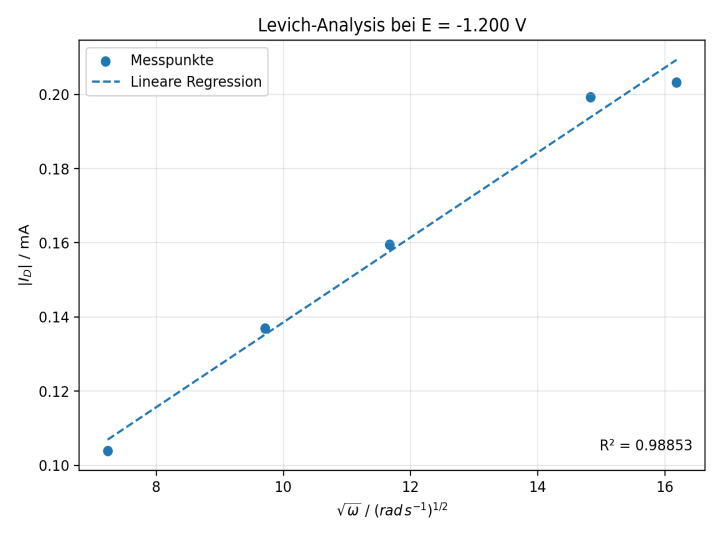
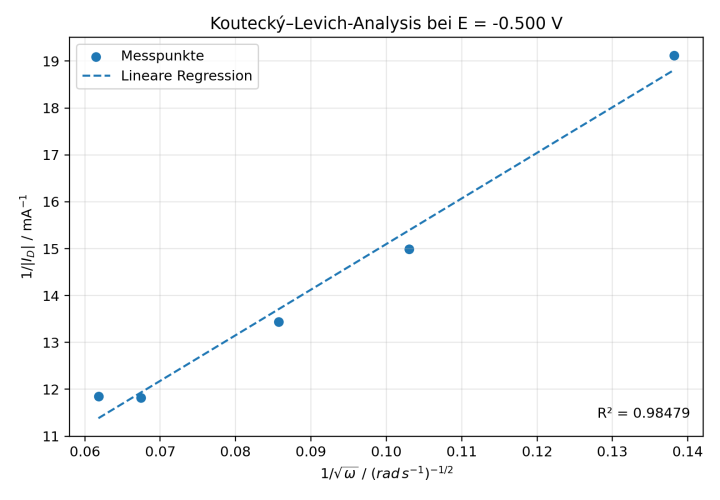
In the transport-controlled region at −1.2 V, the disk current scales linearly with the square root of the rotation rate (see Figure 2), and the Levich line passes close to the origin (R² = 0.989). This confirms that the current is mass-transport limited. At −0.5 V, in the mixed kinetic–diffusion region, the Koutecký–Levich plot of 1/ID against 1/√ω is also linear (R² = 0.985; see Figure 3). Its slope reflects the mass-transport coefficient B, while its intercept reflects the kinetic current (Eq. (2)).


Using the oxygen concentration stated in Section 2.3 (C(O₂) = 6.0 × 10⁻⁷ mol cm⁻³), the Levich slope at −1.20 V (m ≈ 1.14 × 10⁻⁵ A (rad s⁻¹)-1/2) together with n = 4, A = 0.196 cm² and ν = 0.010 cm² s⁻¹ gives D ≈ 2.6 × 10⁻⁶ cm² s⁻¹ from Eq. (6). This value differs substantially from commonly tabulated oxygen diffusion coefficients (≈ 2 × 10⁻5 cm² s⁻¹), and more importantly, a fully developed diffusion-limited plateau is not reached in the present voltammograms. Therefore, D should be treated as an apparent diagnostic parameter Dapp rather than an accurate experimental determination of D(O₂).
The intercept of the Koutecký–Levich plot at −0.5 V (1/Ik ≈ 5.4 mA⁻¹) gives a kinetic current of Ik ≈ 0.19 mA. This corresponds to a kinetic current density of jk = Ik/A ≈ 0.95 mA cm⁻². As Ik exceeds every disk current measured at this potential (52–85 µA), the extrapolation is internally consistent. However, like the apparent diffusion coefficient discussed above, jk is a potential-specific apparent kinetic parameter rather than a rotation-independent constant.
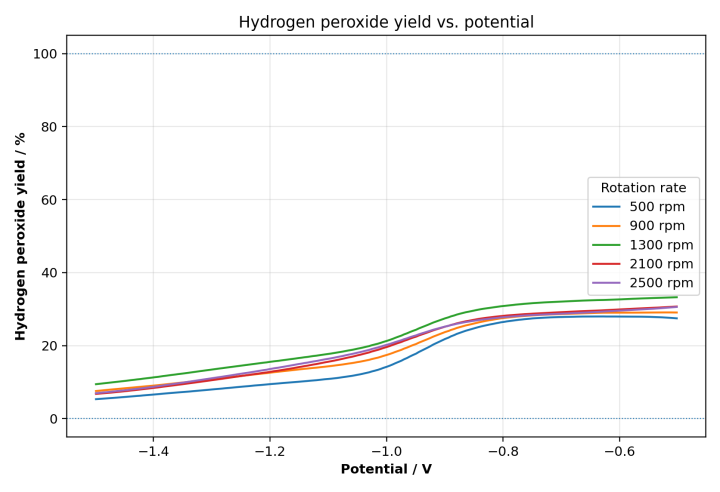
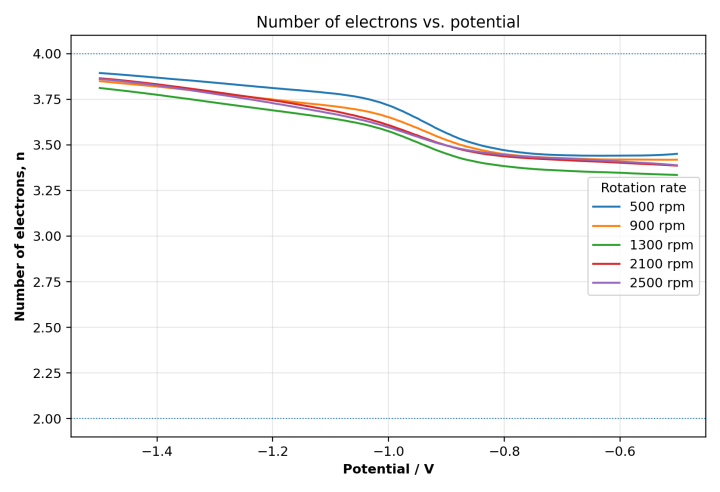
3.3. Hydroperoxide Yield and Electron NumberThe ring converts these currents into mechanistically informative quantities. The hydroperoxide yield (Figure 4) decreases from approximately 30% at less negative potentials to around 10% at the strongly negative end of the analysed range. Correspondingly, the mean electron number (Figure 5) increases from n ≈ 3.4 at −0.5 V to n ≈ 3.9 at −1.5 V. The two curves obey the expected relation n = 4 − X/50 (with X in percent), and together they describe a predominantly four-electron reduction, accompanied by a parallel two-electron route; the four-electron reduction becomes more significant at more negative potentials. Importantly, although the absolute ring current increases markedly with rotation rate, the X(HO₂⁻) (E) and n(E) curves for the different rotation rates nearly coincide. Thus, the increased ring current primarily reflects enhanced mass transport rather than a monotonic change in ORR selectivity.
This relation is an exact algebraic identity between Eqs. (3) and (4), not an independent measurement. Defining S as the total, S = |ID| + IR/N, n = 4|ID|/S, and X = 200(IR/N)/S (X in %), and using the fact that |ID| = S − IR/N, we can conclude that n = 4 − 4(IR/N)/S = 4 − X/50. This therefore serves as a built-in consistency check with transparent limits: X = 0% gives n = 4 (pure four-electron reduction); X = 100% gives n = 2 (pure two-electron reduction); and X = 50% gives n = 3. A measured pair (n, X) that violates this equation signals a processing or rounding inconsistency rather than new chemistry.


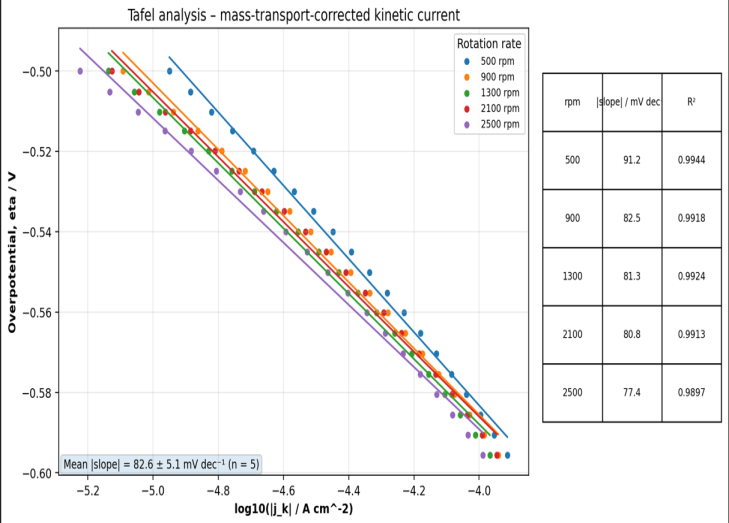
After mass-transport correction, the kinetic current densities produced well-defined Tafel lines for each rotation rate (see Figure 6). The slopes cluster tightly between 77 and 91 mV per decade, with a mean of 82.6 ± 5.1 mV per decade. This indicates uniform charge-transfer kinetics across the measurement series. Tafel analysis separates the potential dependence of charge-transfer kinetics from mass-transport effects, quantifying how strongly the kinetic current responds to overpotential. The Tafel slope b represents the change in overpotential required for a tenfold increase in the kinetic current density. Thus, a mean value of 82.6 mV per decade means that approximately 83 mV of additional overpotential is required to increase the kinetic current density by one order of magnitude within the fitted region. As this value lies between the ~60 and ~120 mV per decade limits often discussed for ORR on platinum, it is compatible with a more complex ORR mechanism that depends on coverage and potential. However, it should not be used alone to identify a unique rate-determining elementary step. The 60/120 mV per decade framework and its mechanistic origin for ORR on platinum are set out in references 13, 14. The corresponding mechanism in alkaline media is reviewed in reference 15, and microkinetic analysis in reference 16 makes explicit the general caution against reading a single Tafel slope as one elementary rate-determining step.

The present Tafel plot deliberately omits a numerical k⁰. The ordinate in Figure 6 is based on electrode potential versus Ag/AgCl rather than on a rigorously defined ORR overpotential referenced to the equilibrium potential. Consequently, using the fitted intercept directly in Eq. (7) would not produce a physically meaningful exchange current density (j₀). Furthermore, since the ORR is a multistep, strongly irreversible reaction, conversion of an extrapolated j₀ into a k⁰ using Eq. (8) would produce only a model-dependent apparent quantity. To make a defensible determination would require a clearly defined equilibrium potential, a Tafel fit expressed as η = E − Eeq, and explicit kinetic assumptions. For the present educational experiment, the Tafel slope itself is therefore the more robust kinetic descriptor.
The heart of the experiment lies in the comparison a student can make between the results obtained using the disk alone and those obtained using the disk and ring together. While a pure RDE measurement analysed by Koutecký–Levich can provide an apparent or averaged electron number, it does not directly quantify the soluble hydroperoxide intermediate. The RRDE, on the other hand, delivers n as a continuous function of potential and an explicit hydroperoxide yield. This means that the branching is constrained directly by simultaneous disk and ring currents. Ratio-based quantities in Eqs. (3) and (4) are less sensitive than Levich-derived absolute parameters to uncertainties in oxygen concentration and the overall current scale, provided the collection efficiency is known and the ring reaction is quantitative. However, they are not immune to ring passivation, an unsuitable ring potential or an incorrect N value.
4.2. What the Data Say about ORR on Platinum in Alkaline MediaThe picture is chemically coherent within the limitations of the present experiment. Platinum predominantly follows the four-electron ORR pathway over the investigated range. Meanwhile, the measured n value decreases and the hydroperoxide fraction increases towards less negative disk potentials. This trend is consistent with a larger fraction of soluble HO₂⁻ escaping further reduction at the disk under these conditions. The Tafel slope near 83 mV per decade lies between the limiting values often discussed for ORR on platinum, and is consistent with reports in the literature for platinum in alkaline media 8, 9. As Tafel slopes depend on surface state, potential window, reference conversion and transport correction, this value should be interpreted as an experimental kinetic descriptor rather than being assigned to a unique elementary rate-determining step.
4.3. Critical Reading of the DataThe experiment is equally valuable as a lesson in what electrochemical numbers can and cannot support. Four features deserve explicit discussion in class. First, the ring is made of glassy carbon, for which hydroperoxide oxidation can be sensitive to both the surface state and kinetics. Second, a geometric collection efficiency does not guarantee quantitative electrochemical detection by itself: if the ring reaction is incomplete, the hydroperoxide yield is underestimated and n is overestimated. Therefore, the ring potential, pretreatment, stability during a measurement series and the method used to determine N should be reported explicitly. It is an instructive exercise to compare the manufacturer value (0.25) with an experimentally determined value (0.23). Third, an increase in the absolute ring current with the rotation rate is expected due to enhanced transport to the ring. The near-superposition of the derived n(E) and XHO₂⁻(E) curves is a more relevant test of the consistency of selectivity.
Fourth, no clean four-electron diffusion plateau is established within the accessible window. Towards −1.5 V, the disk current continues to rise, presumably because additional cathodic processes, including hydrogen evolution, begin to overlap the ORR. Consequently, absolute quantities extracted from hydrodynamic slopes are unreliable, even when the plots appear linear.
Two further limitations concern the analysis framework itself rather than ring detection. First, the Levich expression used here is the conventional high-Schmidt-number approximation (the Schmidt number, Sc = ν/D, is a dimensionless number describing the ratio of kinematic viscosity to mass diffusivity). For dissolved oxygen in an aqueous electrolyte, the Schmidt number is usually much greater than one, so this approximation is generally appropriate. However, in the present experiment, a much larger practical uncertainty arises from the absence of a well-defined diffusion plateau, as well as from the assumed values of C(O₂), ν and n. This is why the diffusion coefficient extracted in Section 3.2 is reported only as Dapp.
The second limitation, which is more significant, arises as soon as the flat platinum disk used here is replaced by a particle-modified or composite electrode — precisely the situation encountered when the technique is applied to candidate catalysts (Section 4.4). Koutecký–Levich analysis assumes a smooth, uniformly active disk. On nanoparticle-modified electrodes, the transport-limited current reflects the geometric area, whereas the electroactive area differs. The ratio Aact/Ageo (ψ) governs the outcome: for ψ ≠ 1, the rate constants returned by a Koutecký–Levich analysis are apparent rather than true values. ψ > 1 inflates the inferred kinetics, and ψ < 1 depresses them 11, 12. Consequently, merely enlarging the active surface area — for example, by using smaller particles at a fixed loading — can imitate enhanced electrocatalysis, despite no chemical catalysis occurring 12. The same caution applies to RRDE branching analysis: when the disk is a porous composite rather than a flat metal, hydroperoxide escapes only after transport through the porous layer. This means that the ring current no longer maps cleanly onto the disk selectivity, so a quantitative two- versus four-electron split becomes unreliable 11. The flat Pt disk used here deliberately avoids these effects, which is one reason why it is a good teaching benchmark. However, students should understand that the clear interpretation demonstrated in this experiment is specific to the idealised electrode and does not necessarily apply to real catalyst layers.
4.4. Classroom Deployment and ExtensionsThe complete measurement and analysis can be implemented in an advanced laboratory course without the need for proprietary evaluation software. A robust teaching protocol should include an N₂ background measurement, verification of the ring detection potential using a hydroperoxide standard and a brief check of ring stability before students interpret selectivity. Natural extensions include contrasting a platinum disk with a bare glassy carbon disk, comparing alkaline with acidic electrolytes, or screening student-prepared catalysts. In each case, the ring retains the branching information.
In the case of screening a student-prepared catalyst in particular, the caveats of Section 4.3 regarding apparent kinetics at particle-modified electrodes should be made explicit so that students can learn to distinguish genuine catalytic improvement from artefacts driven merely by electroactive area or porosity.
The rotating ring–disk electrode converts an abstract concept of the oxygen reduction pathway into measurable quantities. When applied to platinum in 1 M KOH, the present experiment reveals a predominantly four-electron reduction with a potential-dependent hydroperoxide branch (n ≈ 3.4–3.9, with approximately 5–30% hydroperoxide) and a mean Tafel slope of around 83 mV per decade. As expected from hydrodynamic transport, the absolute disk and ring currents increase with rotation rate, whereas the ratio-derived n(E) and hydroperoxide-yield curves remain comparatively close across the rotation series. Equally importantly, the experiment provides robust, ratio-based observables alongside hydrodynamic quantities that become unreliable when their prerequisites are not met. With its open, reproducible analysis workflow, the experiment provides a compact framework for teaching RRDE methodology and the critical evaluation of electrochemical data.
1. Why does the magnitude of the disk current increase as the rotation rate increases?
Increasing the rotation rate decreases the thickness of the hydrodynamic diffusion layer, thereby increasing the flux of dissolved oxygen to the disk surface. According to the Levich equation, the diffusion-limited current is proportional to the square root of the angular rotation rate, IL ∝ ω1/2. Thus, a larger cathodic disk current is expected at higher rotation rates.
2. What additional information does an RRDE experiment provide compared with an ordinary rotating disk electrode (RDE)?
An RDE measures the total current resulting from oxygen reduction, but cannot distinguish directly between the two-electron and four-electron ORR pathways. In an RRDE experiment, however, the hydroperoxide produced at the disk is transported to the ring, where it is oxidised. Therefore, the ring current provides direct information about hydroperoxide formation, allowing the hydroperoxide yield and the average number of transferred electrons to be calculated as functions of disk potential.
3. Why does the ring current increase with an increasing rotation rate, despite the calculated hydroperoxide yield changing only slightly?
A higher rotation rate increases the transport of both O₂ to the disk and soluble hydroperoxide from the disk towards the ring. Consequently, the absolute ring current increases. However, the hydroperoxide yield is calculated from the ratio of the ring and disk currents. Therefore, if the ORR selectivity itself remains approximately unchanged, the calculated hydroperoxide yield and electron number will remain similar at different rotation rates.
4. What does an average electron-transfer number of n = 3.5 mean? Does an individual O₂ molecule accept 3.5 electrons?
No, the value is an average resulting from parallel reaction pathways. Some O₂ molecules undergo four-electron reduction to form OH⁻, while others follow a two-electron pathway to form HO₂⁻. Therefore, an intermediate value such as n = 3.5 reflects a mixture of these pathways rather than a reaction involving the transfer of 3.5 electrons to an individual molecule.
5. Derive the relationship between the hydroperoxide yield and the average electron-transfer number. What electron-transfer number is expected for a hydroperoxide yield of 25%?
The RRDE equations for the average electron-transfer number and the hydroperoxide yield are
n = 4|ID| / (|ID| + IR/N) (N: collection efficiency)
and
XHO₂⁻ = 200(IR/N) / (|ID| + IR/N). (200 = 2 × 100%; the factor 2 reflects the ratio of four to two transferred electrons)
Defining S = |ID| + IR/N gives
n = 4|ID|/S.
Since |ID| = S – IR/N,
n = 4[1 − (IR/N)/S].
From the expression for the hydroperoxide yield,
(IR/N)/S = XHO₂⁻ /200.
Therefore,
n = 4 − 4 XHO₂⁻/200 = 4 − XHO₂⁻/50.
Thus, the factor 50 is not an empirical constant; it results directly from 200/4.
For XHO₂⁻ = 25%,
n = 4 − 25/50 = 3.5.
Therefore, a hydroperoxide yield of 25% corresponds to an average electron-transfer number of n = 3.5.
6. Why is a background measurement in N₂-purged KOH useful?
After the removal of dissolved O₂, currents that are not related to oxygen reduction can be measured. These include capacitive currents and other electrochemical background contributions at the disk and ring. Therefore, the N₂ measurement helps to identify and, where appropriate, correct contributions that do not originate from the ORR.
7. What information can be obtained from a Koutecký–Levich plot that cannot be obtained directly from a Levich plot?
The Levich equation describes the mass-transport-limited current. The Koutecký–Levich treatment, however, separates the kinetic and mass-transport contributions using the equation 1/ID = 1/Ik + 1/(Bω¹/²). The intercept of a plot of 1/ID versus 1/√ω gives 1/Ik, enabling the estimation of the kinetic current Ik even when the measured current is influenced by mass transport.ere, B = 0.62 n F A D2/3 ν−1/6 C.
8. Why should the diffusion coefficient obtained from the present Levich experiment be treated with caution?
A reliable determination of D(O₂) requires a genuine diffusion-limited plateau, as well as independently known values of oxygen concentration, viscosity, and electron number. In the present experiment, the disk current does not reach a well-defined four-electron diffusion plateau. At strongly negative potentials, additional cathodic processes, including hydrogen evolution, may contribute to the measured current. Therefore, the diffusion coefficient calculated from the Levich slope should be regarded as an apparent diagnostic value (Dapp) rather than an accurate experimental determination of D(O₂).
9. What does a Tafel slope of approximately 83 mV per decade mean experimentally?
It means that, within the fitted potential region, an additional overpotential of around 83 mV is needed to multiply the magnitude of the kinetic current density by ten. The Tafel slope therefore characterises the strength of the response of the charge-transfer rate to electrode potential.
10. Can the measured Tafel slope of approximately 83 mV per decade be assigned to one specific rate-determining step of the ORR?
Not unambiguously. The ORR on platinum involves adsorbed intermediates and potential-dependent surface coverage, and is therefore a multistep reaction. The measured value lies between the commonly discussed values of around 60 and 120 mV per decade. While it is useful as an experimental kinetic descriptor, it should not be interpreted as evidence for one unique elementary rate-determining step in isolation.
11. Why is the collection efficiency N required for calculating the hydroperoxide yield?
Only a fraction of the hydroperoxide produced at the disk reaches the ring. The collection efficiency N describes this fraction for the RRDE geometry. Therefore, when relating the measured ring current to the amount of hydroperoxide generated at the disk, it must be divided by N. Using an incorrect value of N introduces a systematic error into the calculated hydroperoxide yield and electron number.
12. Which of the following results would provide stronger evidence for a change in ORR selectivity with rotation rate: an increasing ring current or a systematic change in X(HO₂⁻)?
The hydroperoxide yield,

is more informative because it relates the ring current IR to the total ORR disk current ID. Consequently, much of the common effect of increasing mass transport on ID and IR is cancelled in this ratio. Thus, if the ring current increases with rotation rate while the calculated XHO₂⁻(E) curves remain nearly unchanged, the most reasonable interpretation is: More hydroperoxide reaches the ring per unit time because the overall ORR rate and hydrodynamic transport have increased, but the fraction of oxygen following the two-electron pathway has not changed substantially. In contrast, if XHO₂⁻ systematically increased, for example from 10% at 500 rpm to 25% at 2500 rpm at the same disk potential, this would indicate that the relative contribution of the two-electron pathway itself changes with rotation rate. This is why the near-superposition of the XHO₂⁻(E) and n(E) curves is more informative about selectivity than the increase in absolute ring current.
In one sentence:
An increasing ring current alone does not demonstrate increased hydroperoxide selectivity, because it can simply result from enhanced hydrodynamic mass transport; a systematic change in the ratio-derived hydroperoxide yield would provide much stronger evidence for a genuine change in ORR selectivity.
The author declares no competing interests.
| [1] | Gasteiger, H. A., Kocha, S. S., Sompalli, B., Wagner, F. T. “Activity benchmarks and requirements for Pt, Pt-alloy, and non-Pt oxygen reduction catalysts for PEMFCs.” Applied Catalysis B: Environmental, 56 (1–2). 9–35. 2005. | ||
| In article | View Article | ||
| [2] | Li, C., Zheng, Q., Xiang, Q., Yu, L., Chen, P., Gao, D., Liu, Q., He, F., Yu, D., Liu, Y., Chen, C. “Multielectron electrode reaction kinetics with RDE and RRDE: an advanced electrochemical laboratory experiment.” Journal of Chemical Education, 98 (9). 3026–3031. 2021. | ||
| In article | View Article | ||
| [3] | Bard, A. J., Faulkner, L. R. Electrochemical Methods: Fundamentals and Applications, 2nd ed. John Wiley & Sons, New York, 2001. | ||
| In article | |||
| [4] | Paulus, U. A., Schmidt, T. J., Gasteiger, H. A., Behm, R. J. “Oxygen reduction on a high-surface area Pt/Vulcan carbon catalyst: a thin-film rotating ring-disk electrode study.” Journal of Electroanalytical Chemistry, 495 (2). 134–145. 2001. | ||
| In article | View Article | ||
| [5] | Treimer, S., Tang, A., Johnson, D. C. “A consideration of the application of Koutecký–Levich plots in the diagnoses of charge-transfer mechanisms at rotated disk electrodes.” Electroanalysis, 14 (3). 165–171. 2002. | ||
| In article | View Article | ||
| [6] | Borkar, V. T. “Teaching the tenets and applications of hydrodynamic voltammetry using an inexpensive, user-friendly, hands-on setup with a rotating platinum electrode in aqueous solution.” Journal of Chemical Education, 98 (9). 2959–2963. 2021. | ||
| In article | View Article | ||
| [7] | Olean-Oliveira, A., Hasnain, N., Čolić, V. “Determining the Faradaic efficiency and selectivity using a rotating ring-disk electrode at low and intermediate rotation rates: example of the oxygen reduction reaction on carbon materials.” ACS Electrochemistry, 1 (9). 1878–1883. 2025. | ||
| In article | View Article | ||
| [8] | Géniès, L., Faure, R., Durand, R. “Electrochemical reduction of oxygen on platinum nanoparticles in alkaline media.” Electrochimica Acta, 44 (8–9). 1317–1327. 1998. | ||
| In article | View Article | ||
| [9] | Zhong, G., et al. “Effect of experimental operations on the limiting current density of oxygen reduction reaction evaluated by rotating-disk electrode.” ChemElectroChem. 2020. | ||
| In article | View Article | ||
| [10] | Habekost, A., “SpectroElectroChem Suite: open-source software for spectroelectrochemical and rotating ring–disk analysis” (version 6.0). | ||
| In article | |||
| [11] | Compton, R. G., Sokolov, S. V. “Electrochemistry needs electrochemists: ‘goodbye to rotating discs.’” Journal of Solid State Electrochemistry, 28 (3–4). 1041–1047. 2024. | ||
| In article | View Article | ||
| [12] | Masa, J., Batchelor‑McAuley, C., Schuhmann, W., Compton, R. G. “Koutecký–Levich analysis applied to nanoparticle modified rotating disk electrodes: electrocatalysis or misinterpretation?” Nano Research, 7 (1). 71–78. 2014. | ||
| In article | View Article | ||
| [13] | Sepa, D. B., Vojnović, M. V., Damjanović, A. “Reaction intermediates as a controlling factor in the kinetics and mechanism of oxygen reduction at platinum electrodes.” Electrochimica Acta, 26 (6). 781–793. 1981. | ||
| In article | View Article | ||
| [14] | Damjanović, A., Brusić, V. “Electrode kinetics of oxygen reduction on oxide‑free platinum electrodes.” Electrochimica Acta, 12 (6). 615–628. 1967. | ||
| In article | View Article | ||
| [15] | Ramaswamy, N., Mukerjee, S. “Fundamental mechanistic understanding of electrocatalysis of oxygen reduction on Pt and non‑Pt surfaces: acid versus alkaline media.” Advances in Physical Chemistry, 2012. 491604. 2012. | ||
| In article | View Article | ||
| [16] | Shinagawa, T., Garcia‑Esparza, A. T., Takanabe, K. “Insight on Tafel slopes from a microkinetic analysis of aqueous electrocatalysis for energy conversion.” Scientific Reports, 5. 13801. 2015. | ||
| In article | View Article PubMed | ||
Published with license by Science and Education Publishing, Copyright © 2026 Achim Habekost
 This work is licensed under a Creative Commons Attribution 4.0 International License. To view a copy of this license, visit
http://creativecommons.org/licenses/by/4.0/
This work is licensed under a Creative Commons Attribution 4.0 International License. To view a copy of this license, visit
http://creativecommons.org/licenses/by/4.0/
| [1] | Gasteiger, H. A., Kocha, S. S., Sompalli, B., Wagner, F. T. “Activity benchmarks and requirements for Pt, Pt-alloy, and non-Pt oxygen reduction catalysts for PEMFCs.” Applied Catalysis B: Environmental, 56 (1–2). 9–35. 2005. | ||
| In article | View Article | ||
| [2] | Li, C., Zheng, Q., Xiang, Q., Yu, L., Chen, P., Gao, D., Liu, Q., He, F., Yu, D., Liu, Y., Chen, C. “Multielectron electrode reaction kinetics with RDE and RRDE: an advanced electrochemical laboratory experiment.” Journal of Chemical Education, 98 (9). 3026–3031. 2021. | ||
| In article | View Article | ||
| [3] | Bard, A. J., Faulkner, L. R. Electrochemical Methods: Fundamentals and Applications, 2nd ed. John Wiley & Sons, New York, 2001. | ||
| In article | |||
| [4] | Paulus, U. A., Schmidt, T. J., Gasteiger, H. A., Behm, R. J. “Oxygen reduction on a high-surface area Pt/Vulcan carbon catalyst: a thin-film rotating ring-disk electrode study.” Journal of Electroanalytical Chemistry, 495 (2). 134–145. 2001. | ||
| In article | View Article | ||
| [5] | Treimer, S., Tang, A., Johnson, D. C. “A consideration of the application of Koutecký–Levich plots in the diagnoses of charge-transfer mechanisms at rotated disk electrodes.” Electroanalysis, 14 (3). 165–171. 2002. | ||
| In article | View Article | ||
| [6] | Borkar, V. T. “Teaching the tenets and applications of hydrodynamic voltammetry using an inexpensive, user-friendly, hands-on setup with a rotating platinum electrode in aqueous solution.” Journal of Chemical Education, 98 (9). 2959–2963. 2021. | ||
| In article | View Article | ||
| [7] | Olean-Oliveira, A., Hasnain, N., Čolić, V. “Determining the Faradaic efficiency and selectivity using a rotating ring-disk electrode at low and intermediate rotation rates: example of the oxygen reduction reaction on carbon materials.” ACS Electrochemistry, 1 (9). 1878–1883. 2025. | ||
| In article | View Article | ||
| [8] | Géniès, L., Faure, R., Durand, R. “Electrochemical reduction of oxygen on platinum nanoparticles in alkaline media.” Electrochimica Acta, 44 (8–9). 1317–1327. 1998. | ||
| In article | View Article | ||
| [9] | Zhong, G., et al. “Effect of experimental operations on the limiting current density of oxygen reduction reaction evaluated by rotating-disk electrode.” ChemElectroChem. 2020. | ||
| In article | View Article | ||
| [10] | Habekost, A., “SpectroElectroChem Suite: open-source software for spectroelectrochemical and rotating ring–disk analysis” (version 6.0). | ||
| In article | |||
| [11] | Compton, R. G., Sokolov, S. V. “Electrochemistry needs electrochemists: ‘goodbye to rotating discs.’” Journal of Solid State Electrochemistry, 28 (3–4). 1041–1047. 2024. | ||
| In article | View Article | ||
| [12] | Masa, J., Batchelor‑McAuley, C., Schuhmann, W., Compton, R. G. “Koutecký–Levich analysis applied to nanoparticle modified rotating disk electrodes: electrocatalysis or misinterpretation?” Nano Research, 7 (1). 71–78. 2014. | ||
| In article | View Article | ||
| [13] | Sepa, D. B., Vojnović, M. V., Damjanović, A. “Reaction intermediates as a controlling factor in the kinetics and mechanism of oxygen reduction at platinum electrodes.” Electrochimica Acta, 26 (6). 781–793. 1981. | ||
| In article | View Article | ||
| [14] | Damjanović, A., Brusić, V. “Electrode kinetics of oxygen reduction on oxide‑free platinum electrodes.” Electrochimica Acta, 12 (6). 615–628. 1967. | ||
| In article | View Article | ||
| [15] | Ramaswamy, N., Mukerjee, S. “Fundamental mechanistic understanding of electrocatalysis of oxygen reduction on Pt and non‑Pt surfaces: acid versus alkaline media.” Advances in Physical Chemistry, 2012. 491604. 2012. | ||
| In article | View Article | ||
| [16] | Shinagawa, T., Garcia‑Esparza, A. T., Takanabe, K. “Insight on Tafel slopes from a microkinetic analysis of aqueous electrocatalysis for energy conversion.” Scientific Reports, 5. 13801. 2015. | ||
| In article | View Article PubMed | ||