Lercanidipine is a synthetic antihypertensive drug belongs to the dihydropyridines chemical class. Antihypertensive drugs often require long term usage for controlling blood pressure and to prevent cardiovascular risk. Drugs that possess secondary amine functional group are prone to nitrosation and form nitrosamine drug substance related impurities (NDSRI). Nitrosamine impurities are known to cause carcinogenicity in humans and required to be controlled in pharmaceuticals. The present work describes rapid 5.0 minute liquid chromatography mass spectrometry method for the detection and quantitation of potential genotoxic Nitrosamine impurity N-nitroso-des-methyl-lercanidipine impurity D (NNLD) in the Lercanidipine active pharmaceutical ingredient. The developed method validated as per ICH Q2(R2) guideline and shown excellent selectivity, linearity (r2 0.9957), accuracy (average % recovery 90 to 111 %) and precision (%RSD < 8%). The Limit of Detection (LOD) was 0.17 ppm and Limit of quantification was established at 0.5 ppm relative to 5mg per mL Lercanidipine test concentration.
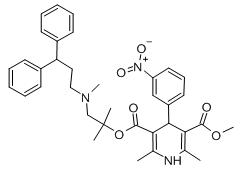
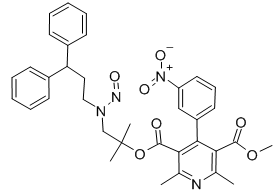
Lercanidipine(LD) chemically called 5-O-[1-[3,3-diphenylpropyl(methyl)amino]-2-methylpropan-2-yl] 3-O-methyl 2,6-dimethyl-4-(3-nitrophenyl)-1,4-dihydropyridine-3,5-dicarboxylate is a synthetic antihypertensive drug belongs to the dihydropyridines chemical class 1 2 3. Hypertension is chronic disease and requires long term treatment with anti-hypertensive drugs 4. Drugs and their impurities that possess secondary amine functional group are prone to nitrosation and form Nitrosamine drug substance related impurities (NDSRI) 5 6 7 8 9. Nitrosamine impurities are known to cause carcinogenicity in humans and are required to be controlled and monitored at trace levels in pharmaceuticals 10 11. Lercanidipine related impurity referred as Dehydro lercanidipine is prone to nitrosation and form Nitrosamine related impurity called N-nitroso-des methyl-lercanidipine impurity D (NNLD). The acceptable intake value proposed by European medicines agency (EMEA) as per appendix-1 EMA/42261/2025/Rev. 13 updated on 24-JUN-2026 is 100ng/day for NNLD 12 calculated using Carcinogenic potency categorization approach 13. The maximum recommended daily dose (MDD) for LD is 20mg 2. Based on MDD the specification limit for NNLD is 5 µg/g (ppm).
The objective of the current study is to develop and validate reliable Liquid chromatography coupled with triple quadrupole mass spectrometric (LC-MS/MS) analytical method for the trace level detection and quantitation of N-nitroso-desmethyl-lercanidipine impurity D (NNLD) in Lercanidipine drug substance.
Literature survey revealed few analytical methods for Lercanidipine and its metabolites in biological fluids using LC-MS/MS technology 14 15 16 17. Few more methods are reported for Lercanidipine and its related impurities in active pharma ingredients and dosage forms using liquid chromatography coupled with UV detection techniques 18 19 20. To the best of our knowledge no methods were available for the detection and quantitation of NDSRI impurities in Lercanidipine. The current paper presents novel LC-MS/MS (ESI+Ve MRM mode) validated method with shorter run time of 5 minutes for the detection and quantitation of NNLD in active pharmaceutical ingredient at a detection limit of 0.17 ppm relative to 5 mg/mL LD in test solution.
LC-MS grade solvents methanol, acetonitrile, HPLC grade water purchased from Honeywell local suppliers. Ammonium formate and formic acid were purchased from Merck local suppliers. Lercanidipine (LD) Active pharmaceutical ingredient (API) N-nitroso-desmethyl-lercanidipine impurity D (NNLD) (Rotamers) were provided as gift samples from Svak life sciences, Hyderabad India.


Ultra high performance liquid chromatographic system combined with triple quadrupole Quattro Premier XE mass spectrometer from Waters Corporation, Milford, MA 01757, was used for experiments. Data acquired and processed using Mass Lynx version 4.1 software. Data processed using Spectrus® 2025 2.1 software from ACD/Labs (Company of Revvity Inc, USA).
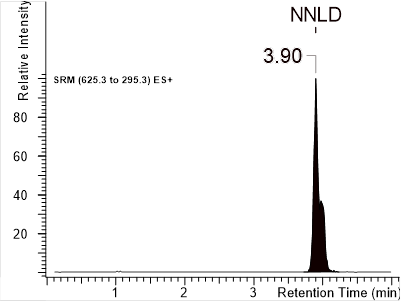
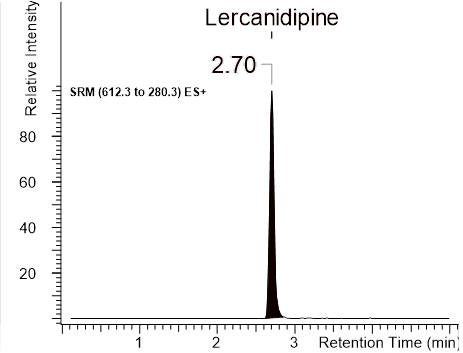
Separation of impurity NNLD from the Lercanidipine achieved on HyPURITY C18(50mm length, 4.6mm id and 5µM particle size) from Thermo Fisher scientific. The retention times were 2.70 minutes for LD and 3.95 minutes for NNLD. Mass spectrometer operated in electro spray positive ionization mode (ESI+ve). Analytes were subjected to mass fragmentation and Multiple reaction monitoring mode (MRM) used for signal acquisition and quantitation. Detailed LC-MS conditions were described in Table 1.
0.5 mg/mL Impurity stock solution prepared by dissolving impurity NNLD in methanol with the aid of sonication. Further dilutions were made using 50:50%v/v water: methanol as diluent to prepare working standard solutions in the concentration range of 10 to 130% of the specification limit i.e. 5 ppm relative to 5 mg/mL Lercanidipine in test solutions. The absolute concentration of NNLD range from 2.5 ng/mL to 32.6 ng/mL.
5 mg/mL Lercanidipine test solution prepared by dissolving and diluting LD active pharmaceutical ingredient (hydrochloride salt) with 50:50%v/v water: methanol as diluent using sonication. Accuracy and precision solutions were prepared by spiking appropriate volumes of NNLD impurity working standard solutions.
Lercanidipine and its NDSRI impurity NNLD are hydrophobic in nature, hence method development trials started on C18 column chemistry with different pH buffers (0.1% formic acid, 5mM Ammonium formate and formic acid, 5 mM Ammonium acetate) and using acetonitrile as organic modifier. Good chromatographic resolution greater than 3.0 achieved with 5mM Ammonium formate buffer with 0.2% formic acid buffer. This separation allows to divert high concentration of Lercanidipine API into waste to prevent contamination of MS detector. This buffer also shown good ionization for NNLD impurity and thereby giving good sensitivity. Gradient, column temperature, flow rate parameters were further optimized to reduce runtime and better peak shape. Mass spectrometric parameters were optimized through tuning experiments by injecting NNLD impurity solution and systematically varying instrumental settings. NNLD Precursor ion (m/z 625) subjected to fragmentation with different collision energies and observed stable and intense fragments observed at 30.0 eV collision energy. Most intense fragments; m/z 295 and m/z167 were selected as Quantifier and qualifier ions respectively.
Note: NNLD standard used is a mixture of two rotamers and observed shoulder peak due to rotamer and considered for quantification


The developed method validated in accordance with ICHQ2(R2) guideline 21. Specificity, linearity, accuracy, Precision, Intermediate precision, LOQ, LOD, range parameters were evaluated and all the validation results are well within the acceptable limits.
Specificity for the method was established by injecting and comparing diluent, LD drug substance matrix solution and LD drug substance solution spiked with NNLD impurity. No interference was observed at selected MRM transitions (m/z 625 to m/z295) in the blank and drug matrix at the retention time of NNLD. In addition, Quantifier(m/z295) to qualifier (m/z167) are well with in ± 30% deviation from the ratios established for standards covering the range of 10% to 120% of specification limit (0.5ppm to 6.0 ppm relative 5 mg/mL LD).
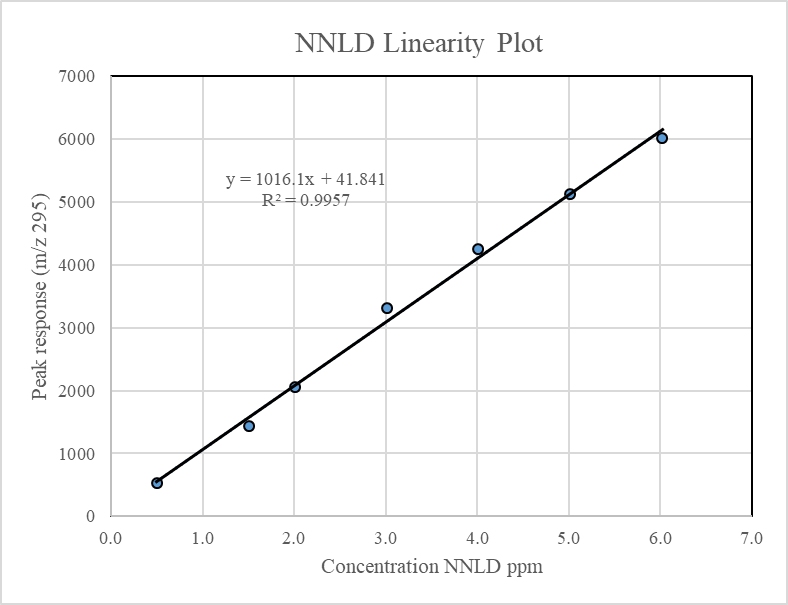
The correlation between quantifier ion response (m/z 295) and concentration was evaluated using a series of NNLD impurity solutions prepared from the stock solution. Linearity was assessed across seven concentration levels, ranging from 0.5 ppm (10% of LOQ) to 6.0 ppm (120% of the specification limit), relative to 5 mg/mL LD in the test solution. The calibration curve demonstrated excellent linearity over this range, with results summarized in Table 2.

Method reliability was checked by performing recovery studies. NNLD impurity stock solution was spiked at different concentration levels (10%, 50%, 100%, 120% of the specification limit) into the 5 mg/mL LD test solution and %recovery for NNLD calculated. Accuracy and Method precision was studied using 6 replicate preparations of spiked solution at 10% and 100% levels of the specification limit. Accuracy at 50% and 120% levels was studied using 3 replicate preparations.
Intermediate precision was checked at 100% level using 6 replicate preparations done by different analyst on different day. The overall %RSD (n=12) less than 10% indicates method repeatability on different days with different analysts.
The average %recovery values between 90% to 111% across all the levels indicates method was accurate enough to quantify NNLD impurity from drug substance test solutions from 0.5 ppm to 6.0 ppm relative to 5 mg/mL Lercanidipine.
The %relative standard deviation (%RSD) for the NNLD content in 6 replicate preparations at 10% and 100% levels was less than 8% indicated good method repeatability. Accuracy and precision results were reported in Table 3.
The developed analytical method was linear and accurate in the range of 2.5 ng/mL to 30 ng/mL of NNLD impurity absolute concentration and 0.5 ppm to 6 ppm relative to 5 mg/mL LD in drug substance solutions.
The limit of quantification (LOQ) for the developed method was found 0.5 ppm relative to 5 mg/mL LD in test solution with signal to noise ratio greater than 10 for NNLD peak with acceptable accuracy and precision. The limit of detection (LOD) with signal to noise ratio greater than 3 was established at 0.17 ppm. At 0.17 ppm concentration level NNLD signal can be detected and differentiated from baseline noise.
Solution stability was evaluated for 24 hours at 10°C by keeping solutions in amber glass vials. The relative %change in NNLD content is less than 12% compared to initial results. This indicates solutions were stable for 24 hours at 10°C with light protection.
The method validation results indicate that the developed method can be successfully applied for the detection and quantitation of Nitrosamine related impurity: N-nitroso-des methyl-lercanidipine impurity D (NNLD) in Lercanidipine drug substance batches. The developed method with shorter run time (5.0 minutes) reduces resource consumption and enhances productivity during routine quality control testing of lercanidipine drug substance.
The Authors are thankful to the Andhra University College of Pharmaceutical Sciences, Visakhapatnam, Andhra Pradesh, India, for their support in conducting this experimental work. We also acknowledge Svak Life Sciences, Hyderabad, Telangana, India, for providing the drug substance and NDSRI impurity as gift samples.
| [1] | Lercanidipine, PubChem Compound Database, National Center for Biotechnology Information (NCBI). [Online]. Available: https://pubchem.ncbi.nlm.nih.gov/compound/Lercanidipine (pubchem.ncbi.nlm.nih.gov). [Accessed July. 9, 2026]. | ||
| In article | |||
| [2] | McClellan, K.J.; Jarvis, B. Lercanidipine. A Review of its Use in Hypertension. Drugs. 60, 1123–1140, September 2000. | ||
| In article | View Article PubMed | ||
| [3] | C. Borghi, "Lercanidipine in Hypertension," Vascular Health and Risk Management, 1(3), pp. 173–182, September 2005. | ||
| In article | |||
| [4] | W.S. Yoo, "Long-term therapy of hypertension," Korean Journal of Internal Medicine, 10(2), pp. 79–86, July 1995. | ||
| In article | View Article PubMed | ||
| [5] | R.C. Cioc, C. Joyce, M. Mayr, and R.N. Bream, "Formation of N-Nitrosamine Drug Substance Related Impurities in Medicines: A Regulatory Perspective on Risk Factors and Mitigation Strategies," Organic Process Research & Development, 27(10), pp. 1736–1750, October 2023. | ||
| In article | View Article | ||
| [6] | K.M. Manchuri, M.A. Shaik, V.S.R. Gopireddy, N. Sultana, and S. Gogineni, "Analytical Methodologies to Detect N-Nitrosamine Impurities in Active Pharmaceutical Ingredients, Drug Products and Other Matrices," Chemical Research in Toxicology, 37(9), pp. 1456–1483, September 2024. | ||
| In article | View Article PubMed | ||
| [7] | D. Aishwarya, V.R. Dhampalwar, N. Pallaprolu, and R. Peraman, "Nitrosamine drug substance-related impurities (NDSRIs) in pharmaceuticals: Formation, mitigation strategies, and emphasis on mutagenicity risks," Pharmaceutical Research, 42(4), pp. 547–578, April 2025. | ||
| In article | View Article PubMed | ||
| [8] | J. Schlingemann, M.J. Burns, D.J. Ponting, C. Martins Avila, N.E. Romero, M.A. Jaywant, G.F. Smith, I.W. Ashworth, S. Simon, C. Saal, and A. Wilk, "The landscape of potential small and drug substance related nitrosamines in pharmaceuticals," Journal of Pharmaceutical Sciences, 112(5), pp. 1287–1304, May 2023. | ||
| In article | View Article PubMed | ||
| [9] | N. Sharma, R. Patel, T. Bothara, S. Jain, and R.P. Shah, "Modified NAP test: A simple and responsive nitrosating methodology for risk evaluation of NDSRIs," Journal of Pharmaceutical Sciences, 112(5), pp. 1333–1340, May 2023. | ||
| In article | View Article PubMed | ||
| [10] | International Council for Harmonisation of Technical Requirements for Pharmaceuticals for Human Use (ICH), ICH M7(R2) Guideline on Assessment and Control of DNA Reactive (Mutagenic) Impurities in Pharmaceuticals to Limit Potential Carcinogenic Risk, Final Version, adopted 03 April 2023. | ||
| In article | |||
| [11] | J. Fahrer and M. Christmann, "DNA Alkylation Damage by Nitrosamines and Relevant DNA Repair Pathways," International Journal of Molecular Sciences, 24, Article 4684, March 2023. | ||
| In article | View Article PubMed | ||
| [12] | European medicines agency(EMA): Appendix 1: Acceptable intakes established for N-nitrosamines last updated 24 Jun-2026. Reference Number: EMA/42261/2025 Rev.13. | ||
| In article | |||
| [13] | N.L. Kruhlak, M. Schmidt, R. Froetschl, S. Graber, B. Haas, I. Horne, S. Horne, S.T. King, I.A. Koval, G. Kumaran, A. Langenkamp, T.J. McGovern, T. Peryea, A. Sanh, A. Siqueira Ferreira, L. van Aerts, A. Vespa, and R. Whomsley, "Determining recommended acceptable intake limits for N‑nitrosamine impurities in pharmaceuticals: Development and application of the Carcinogenic Potency Categorization Approach (CPCA)," Regulatory Toxicology and Pharmacology, 150, 105640, 2024. | ||
| In article | View Article PubMed | ||
| [14] | V.A.P. Jabor, E.B. Coelho, D.R. Ifa, P.S. Bonato, N.A.G. dos Santos, and V.L. Lanchote, "Enantioselective determination of lercanidipine in human plasma for pharmacokinetic studies by normal-phase liquid chromatography-tandem mass spectrometry," Journal of Chromatography B: Analytical Technologies in the Biomedical and Life Sciences, 796(2), pp. 429–437, November 2003. | ||
| In article | View Article PubMed | ||
| [15] | I.I. Salem, J. Idrees, J.I. Al Tamimi, and P. Farina, "Selective and rapid liquid chromatography-mass spectrometry method for the determination of lercanidipine in human plasma," Journal of Chromatography B: Analytical Technologies in the Biomedical and Life Sciences, 803(2), pp. 201–207, April 2004. | ||
| In article | View Article PubMed | ||
| [16] | X.B. Li, F.G. Shi, X.J. He, L.Y. Jian, and L. Ding, "A rapid and sensitive LC-MS/MS method for determination of lercanidipine in human plasma and its application in a bioequivalence study in Chinese healthy volunteers," Journal of Pharmaceutical and Biomedical Analysis, 128, pp. 67–72, October 2016. | ||
| In article | View Article PubMed | ||
| [17] | A. Alvarez-Lueje, S. Pujol, J.A. Squella, and L.J. Núñez-Vergara, "A selective HPLC method for determination of lercanidipine in tablets," Journal of Pharmaceutical and Biomedical Analysis, 31(1), pp. 1–9, February 2003. | ||
| In article | View Article PubMed | ||
| [18] | J. Fiori, R. Gotti, C. Bertucci, and V. Cavrini, "Investigation on the photochemical stability of lercanidipine and its determination in tablets by HPLC-UV and LC-ESI-MS/MS," Journal of Pharmaceutical and Biomedical Analysis, 41(1), pp. 176–181, April 2006. | ||
| In article | View Article PubMed | ||
| [19] | M. Gümüştaş, S. Şanlı, N. Şanlı, and S.A. Özkan, "Determination of pKa values of some antihypertensive drugs by liquid chromatography and simultaneous assay of lercanidipine and enalapril in their binary mixtures," Talanta, 82(4), pp. 1528–1537, September 2010. | ||
| In article | View Article PubMed | ||
| [20] | S. Mehta, S. Singh, and K. Chikhalia, "A fast, stability-indicating, and validated liquid chromatography method for the purity control of lercanidipine hydrochloride in tablet dosage form," Scientia Pharmaceutica, 82(2), pp. 327–340, April–June 2014. | ||
| In article | View Article PubMed | ||
| [21] | International Council for Harmonisation of Technical Requirements for Pharmaceuticals for Human Use (ICH), ICH Q2(R2): Validation of Analytical Procedures, ICH Harmonised Guideline, Final Version, adopted 1 November 2023. | ||
| In article | |||
Published with license by Science and Education Publishing, Copyright © 2026 Vijayalakshmi Atla, Dr A. Krishnamanjari Pawar, Bothsa Guru Naidu, K. Laxmi Chandana and K. Sri Padma
 This work is licensed under a Creative Commons Attribution 4.0 International License. To view a copy of this license, visit
http://creativecommons.org/licenses/by/4.0/
This work is licensed under a Creative Commons Attribution 4.0 International License. To view a copy of this license, visit
http://creativecommons.org/licenses/by/4.0/
| [1] | Lercanidipine, PubChem Compound Database, National Center for Biotechnology Information (NCBI). [Online]. Available: https://pubchem.ncbi.nlm.nih.gov/compound/Lercanidipine (pubchem.ncbi.nlm.nih.gov). [Accessed July. 9, 2026]. | ||
| In article | |||
| [2] | McClellan, K.J.; Jarvis, B. Lercanidipine. A Review of its Use in Hypertension. Drugs. 60, 1123–1140, September 2000. | ||
| In article | View Article PubMed | ||
| [3] | C. Borghi, "Lercanidipine in Hypertension," Vascular Health and Risk Management, 1(3), pp. 173–182, September 2005. | ||
| In article | |||
| [4] | W.S. Yoo, "Long-term therapy of hypertension," Korean Journal of Internal Medicine, 10(2), pp. 79–86, July 1995. | ||
| In article | View Article PubMed | ||
| [5] | R.C. Cioc, C. Joyce, M. Mayr, and R.N. Bream, "Formation of N-Nitrosamine Drug Substance Related Impurities in Medicines: A Regulatory Perspective on Risk Factors and Mitigation Strategies," Organic Process Research & Development, 27(10), pp. 1736–1750, October 2023. | ||
| In article | View Article | ||
| [6] | K.M. Manchuri, M.A. Shaik, V.S.R. Gopireddy, N. Sultana, and S. Gogineni, "Analytical Methodologies to Detect N-Nitrosamine Impurities in Active Pharmaceutical Ingredients, Drug Products and Other Matrices," Chemical Research in Toxicology, 37(9), pp. 1456–1483, September 2024. | ||
| In article | View Article PubMed | ||
| [7] | D. Aishwarya, V.R. Dhampalwar, N. Pallaprolu, and R. Peraman, "Nitrosamine drug substance-related impurities (NDSRIs) in pharmaceuticals: Formation, mitigation strategies, and emphasis on mutagenicity risks," Pharmaceutical Research, 42(4), pp. 547–578, April 2025. | ||
| In article | View Article PubMed | ||
| [8] | J. Schlingemann, M.J. Burns, D.J. Ponting, C. Martins Avila, N.E. Romero, M.A. Jaywant, G.F. Smith, I.W. Ashworth, S. Simon, C. Saal, and A. Wilk, "The landscape of potential small and drug substance related nitrosamines in pharmaceuticals," Journal of Pharmaceutical Sciences, 112(5), pp. 1287–1304, May 2023. | ||
| In article | View Article PubMed | ||
| [9] | N. Sharma, R. Patel, T. Bothara, S. Jain, and R.P. Shah, "Modified NAP test: A simple and responsive nitrosating methodology for risk evaluation of NDSRIs," Journal of Pharmaceutical Sciences, 112(5), pp. 1333–1340, May 2023. | ||
| In article | View Article PubMed | ||
| [10] | International Council for Harmonisation of Technical Requirements for Pharmaceuticals for Human Use (ICH), ICH M7(R2) Guideline on Assessment and Control of DNA Reactive (Mutagenic) Impurities in Pharmaceuticals to Limit Potential Carcinogenic Risk, Final Version, adopted 03 April 2023. | ||
| In article | |||
| [11] | J. Fahrer and M. Christmann, "DNA Alkylation Damage by Nitrosamines and Relevant DNA Repair Pathways," International Journal of Molecular Sciences, 24, Article 4684, March 2023. | ||
| In article | View Article PubMed | ||
| [12] | European medicines agency(EMA): Appendix 1: Acceptable intakes established for N-nitrosamines last updated 24 Jun-2026. Reference Number: EMA/42261/2025 Rev.13. | ||
| In article | |||
| [13] | N.L. Kruhlak, M. Schmidt, R. Froetschl, S. Graber, B. Haas, I. Horne, S. Horne, S.T. King, I.A. Koval, G. Kumaran, A. Langenkamp, T.J. McGovern, T. Peryea, A. Sanh, A. Siqueira Ferreira, L. van Aerts, A. Vespa, and R. Whomsley, "Determining recommended acceptable intake limits for N‑nitrosamine impurities in pharmaceuticals: Development and application of the Carcinogenic Potency Categorization Approach (CPCA)," Regulatory Toxicology and Pharmacology, 150, 105640, 2024. | ||
| In article | View Article PubMed | ||
| [14] | V.A.P. Jabor, E.B. Coelho, D.R. Ifa, P.S. Bonato, N.A.G. dos Santos, and V.L. Lanchote, "Enantioselective determination of lercanidipine in human plasma for pharmacokinetic studies by normal-phase liquid chromatography-tandem mass spectrometry," Journal of Chromatography B: Analytical Technologies in the Biomedical and Life Sciences, 796(2), pp. 429–437, November 2003. | ||
| In article | View Article PubMed | ||
| [15] | I.I. Salem, J. Idrees, J.I. Al Tamimi, and P. Farina, "Selective and rapid liquid chromatography-mass spectrometry method for the determination of lercanidipine in human plasma," Journal of Chromatography B: Analytical Technologies in the Biomedical and Life Sciences, 803(2), pp. 201–207, April 2004. | ||
| In article | View Article PubMed | ||
| [16] | X.B. Li, F.G. Shi, X.J. He, L.Y. Jian, and L. Ding, "A rapid and sensitive LC-MS/MS method for determination of lercanidipine in human plasma and its application in a bioequivalence study in Chinese healthy volunteers," Journal of Pharmaceutical and Biomedical Analysis, 128, pp. 67–72, October 2016. | ||
| In article | View Article PubMed | ||
| [17] | A. Alvarez-Lueje, S. Pujol, J.A. Squella, and L.J. Núñez-Vergara, "A selective HPLC method for determination of lercanidipine in tablets," Journal of Pharmaceutical and Biomedical Analysis, 31(1), pp. 1–9, February 2003. | ||
| In article | View Article PubMed | ||
| [18] | J. Fiori, R. Gotti, C. Bertucci, and V. Cavrini, "Investigation on the photochemical stability of lercanidipine and its determination in tablets by HPLC-UV and LC-ESI-MS/MS," Journal of Pharmaceutical and Biomedical Analysis, 41(1), pp. 176–181, April 2006. | ||
| In article | View Article PubMed | ||
| [19] | M. Gümüştaş, S. Şanlı, N. Şanlı, and S.A. Özkan, "Determination of pKa values of some antihypertensive drugs by liquid chromatography and simultaneous assay of lercanidipine and enalapril in their binary mixtures," Talanta, 82(4), pp. 1528–1537, September 2010. | ||
| In article | View Article PubMed | ||
| [20] | S. Mehta, S. Singh, and K. Chikhalia, "A fast, stability-indicating, and validated liquid chromatography method for the purity control of lercanidipine hydrochloride in tablet dosage form," Scientia Pharmaceutica, 82(2), pp. 327–340, April–June 2014. | ||
| In article | View Article PubMed | ||
| [21] | International Council for Harmonisation of Technical Requirements for Pharmaceuticals for Human Use (ICH), ICH Q2(R2): Validation of Analytical Procedures, ICH Harmonised Guideline, Final Version, adopted 1 November 2023. | ||
| In article | |||