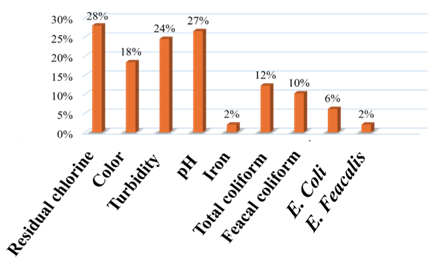
Water is essential to life and must meet specific standards to ensure its quality. The main objective of this study was to assess the quality of public water supply in the Gontougo and Bounkani regions of Côte d’Ivoire. A total of 50 water samples were collected from seven localities across both regions for physicochemical and bacteriological analysis. Classical physicochemical parameters were measured using electrochemical, nephelometric, and spectrophotometric methods, while microbiological analysis was performed using membrane filtration techniques. Results revealed that residual chlorine, turbidity, iron, and pH levels exceeded recommended standards, alongside the presence of microbial contaminants such as coliforms, Escherichia coli (E. coli), and Enterococcus faecalis (E. faecalis). Non-compliance rates were 28%, 27%, 24%, and 2% for residual chlorine, pH, turbidity, and total iron, respectively. For bacteriological parameters, 22% of samples contained coliforms, 6% E. coli, and 2% E. faecalis. Tap water consumption in the Gontougo and Bounkani regions poses potential health risks to the population.
Water is essential to human life and plays a critical role in well-being, safety, social development, and food production. It is a fundamental nutritional requirement, accounting for approximately 70% of the human body mass 1. However, water quality is just as important as quantity. Water can act as a vector for potentially harmful agents and thus become a source of disease [Amin, 2008]. According to the World Health Organization (WHO), 80% of diseases affecting the global population are directly linked to water quality 2. Each year, diarrheal diseases cause the death of 1.8 million people, 90% of whom are children under the age of five. In 98% of these cases, the deaths are attributed to poor drinking water quality combined with inadequate sanitation conditions 3.
Sustainable Development Goal (SDG) Target 6 aims to ensure universal access to safe drinking water and sanitation by 2030, alongside sustainable water resource management. Despite significant progress, results remain uneven. Over 30% of the global population still lacks access to basic domestic drinking water services 4. In sub-Saharan Africa, approximately 32% of the population—nearly 418 million people did not have access to basic drinking water in 2022, with marked disparities between urban and rural areas 5. In Côte d’Ivoire, national coverage for drinking water reached 79.96% in urban areas and 57.03% in rural areas in 2023 6, 7.
Health surveillance of drinking water is therefore essential to ensure water quality and protect consumer safety 4. It contributes to public health by promoting improvements in water supply in terms of quality, quantity, physical accessibility, coverage, affordability, and continuity, complementing the quality control measures implemented by water suppliers 4.
The objective of this study was to conduct sanitary surveillance of public water supply systems in the Gontougo and Bounkani regions.
The equipment used in this study included: a photometer (Wagtech® 7100 se, UK); a pH meter with probe (Hach®, France); a turbidimeter (Hach®, France); a conductivity meter with probe (Hach®, France); a filtration manifold (Sartorius®, Germany); a water bath (J.P. Selecta®, Barcelona); a uv sterilizer; a benchtop autoclave (J.P. Selecta®, Barcelona). Ice packs, 47 mm diameter filtration membranes, petri dishes, standard laboratory glassware was also used.
2.2. ReagentsAll reagents used were of analytical grade. The chemical reagents from the Wagtech® brand (United Kingdom) included reagent tablets for nitrates, nitrites, ammonium, chlorides, residual chlorine; manganese, aluminum, fluorides, organic matter and iron. EDTA, NET, Sulfuric Acid, Phenolphthalein of Sigma-Aldrich® (US) and Distilled Water were used. The microbiological reagents consisted of the following culture media: Rapid’E.coli 2 Agar (Bio-Rad®, France), Bile Esculin Azide (Bio-Rad®, France), and Thiosulfate Neomycin Agar (Bio-Rad®, France).
2.3. SamplingSampling was carried out randomly. A total of 50 water samples were collected across the different localities (Table 1). At each water point, two types of samples were collected: one 1000 mL sample for physicochemical analysis, and one 500 mL sample for microbiological analysis. The water samples were stored in a cooler with ice packs (maintained at 4°C to 8°C) and kept away from light during transport 10.
The physicochemical parameters of the water samples, including pH, electrical conductivity, and turbidity, were analyzed according to standardized AFNOR protocols 8, 9, 10, 11.
The nitrates, nitrites, ammonium, chlorides, manganese, Aluminium, Fluorides, Organic Matter and iron were analyzed as follows. For each compound tested, a 10 mL aliquot of the water sample was collected and transferred into an analysis tube. A reagent tablet specific to the compound of interest was then added to the sample. The tablet was thoroughly crushed and mixed using a glass stirring rod to ensure complete dissolution. The prepared sample was subsequently placed in a photometer. The program corresponding to the target compound was selected, and the absorbance measurement was taken at a wavelength of 520 nm. The total hardness and alkalinity was determined by titrimetry. Total coliforms, feacal coliforms, E. coli, E. faecalis, and sulfite-reducing anaerobes were analyzed. The water filtration procedure for microbiological analysis includes several steps, starting with the filtration of the water sample through a membrane, followed by the transfer to a culture medium. The media were then incubated for 18 to 24 hours, and the bacteria were counted 12, 13. Statistical analyses were carried out 12.
The results of the physico-chemical and bacteriological analyses of tap water are presented in Table 2. From a physico-chemical standpoint, the tap water was weakly mineralized, with an average conductivity of 158.9 ± 64.89 µS/cm and a slightly acidic mean pH of 6.45 ± 0.65. Comparison with Ivorian standards revealed that several parameters including residual chlorine, turbidity, iron content, and pH did not comply with regulatory limits. Microbiologically, the analysis of public water supply samples revealed the presence of microbial indicators such as total coliforms, E. coli, and Enterococcus species. Maximum recorded concentrations reached 1600 CFU/100 mL for total coliforms, 916 CFU/100 mL for E. coli, and 435 CFU/100 mL for E. faecalis.
Across the regions investigated, an overall non-compliance rate of 25% was recorded. The physicochemical and bacteriological parameters contributing to these non-conformities (Figure 1) included residual chlorine (28%), pH (27%), turbidity (24%), iron (2%), total coliforms (12%), E. coli (6%), and E. faecalis (2%).
Public water supply systems in the Gontougo and Bounkani regions exhibited a 25% non-compliance rate with Ivorian drinking water standards. Most of the observed non-conformities were related to physicochemical parameters, with residual chlorine, turbidity, temperature, iron, and pH being the most frequently implicated.
s, which serve as a decision-support tool, were compile In our study, tap water temperatures ranged from 24.9°C to 31°C. Nearly 98% of the samples exceeded the recommended threshold of 25°C set by the Ivorian standard. These elevated values are likely influenced by ambient temperature conditions 14. Although water temperatures above 25°C do not pose a direct health risk, they may alter the organoleptic properties of drinking water 1.
Regarding pH, values recorded in public supply water ranged from 5.7 to 7.8, with 27% of samples falling outside the acceptable range due to acidity. While acidic water generally does not affect consumer health directly, it can lead to the leaching of heavy metals from corroded metallic pipes, thereby compromising water quality and posing a potential health hazard 15.
Turbidity was non-compliant in 24% of the samples, likely due to the presence of particles such as clay, silt, fine organic and inorganic matter, and plankton. Trace elements like iron were found in 2% of the samples at non-compliant levels, possibly due to inadequate filtration.
Elevated residual chlorine levels were observed in 28% of the samples, which may be attributed to excessive chlorination during water treatment. While disinfection is essential, controlling chlorine dosage remains critical to avoid adverse effects 16.
Microbiological non-conformities were more pronounced, particularly concerning fecal contamination indicators such as total coliforms, feacal coliforms, E. coli, and E. faecalis. Most water samples were contaminated with these microorganisms, despite Ivorian standards prohibiting any presence of fecal indicator bacteria in drinking water 17. Tap water showed a 16% non-compliance rate for total coliforms, including 16% for feacal coliforms, 7% for E. coli, and 2% for E. faecalis.
The presence of these pathogens exposes local populations to waterborne diseases.
These finding d into a report submitted to the health authorities of the district.
| [1] | Bakayoko AB, Gbagbo T, Kpaibe S, Claon J, Sackou K. Qualité physico-chimique et bactériologique des eaux de consommation à Boguédia de 2014 à 2018. Rev Ivoir Sci Technol. 2022; (1): 65–75. | ||
| In article | |||
| [2] | Amin NC, Lekadou KS, Attia AR, et al. Qualité physico-chimique et bactériologique des eaux d’adduction publique de huit communes en Côte d’Ivoire. J Sci Pharm Biol. 2008; 9(1): 22–31. | ||
| In article | |||
| [3] | Organisation mondiale de la Santé. Stratégies pour la gestion sans risque de l’eau de boisson destinée à la consommation humaine. 64e Assemblée mondiale de la Santé. 2011. Report No: A64/24. | ||
| In article | |||
| [4] | Organisation mondiale de la Santé. Directives de qualité pour l’eau de boisson. 4e éd. Intégrant le premier additif. Genève; 2017. p. 307–447. | ||
| In article | |||
| [5] | UNICEF. L’Afrique doit accélérer considérablement les progrès en matière d’eau, d’assainissement et d’hygiène. 2022. | ||
| In article | |||
| [6] | Berte I. ONEP eau potable pour tous: efforts consentis pour l’atteinte des ODD 6 en Côte d’Ivoire. Abidjan; 2023. 21 p. | ||
| In article | |||
| [7] | Koita M. L’alimentation en eau potable des populations du Gontougo et du Bounkani: état des lieux et perspectives. 2013. 113 p. | ||
| In article | |||
| [8] | AFNOR. FD T90-520: Water quality – Technical guide for sampling for sanitary monitoring in application of the Public Health Code [Internet]. Saint-Denis La Plaine: French Standardization Association; 2005 [cited 2025 May 14]. | ||
| In article | |||
| [9] | AFNOR. NF T90-008: Water quality – Determination of pH [Internet]. Saint-Denis La Plaine: French Standardization Association; 2001 [cited 2025 May 14]. | ||
| In article | |||
| [10] | AFNOR. NF EN 27888: Water quality – Determination of electrical conductivity [Internet]. Saint-Denis La Plaine: French Standardization Association; 1994 [cited 2025 May 14]. | ||
| In article | |||
| [11] | AFNOR. NF EN ISO 7027-1: Water quality – Determination of turbidity – Part 1: Quantitative methods [Internet]. Saint-Denis La Plaine: French Standardization Association; 2016 [cited 2025 May 14]. | ||
| In article | |||
| [12] | Seki TO, Yapo TW, Kpaibe SAP, et al. Caractérisation physicochimique et microbiologique des eaux de puits à usage de boisson à Aboisso (sud-est de la Côte d’Ivoire). Int J Biol Chem Sci. 2024; 18(1): 311–25. | ||
| In article | View Article | ||
| [13] | Gbagbo GAT, Bakayoko AB, Agbessi TK, et al. Physicochemical and bacteriological characterisation of domestic drinking water sources in M'pody village (Côte d’Ivoire) during the four seasons of 2020. Int J Water Res Environ Eng. 2025; 17(2): 27–39. | ||
| In article | |||
| [14] | Maoudombaye T, Ndoutamia G, Seid AM, Ngakou A. Étude comparative de la qualité physico-chimique des eaux de puits, de forages et de rivières consommées dans le bassin pétrolier de Doba au Tchad. Larhyss J. 2015; 24: 193–208. | ||
| In article | |||
| [15] | Chabot-Gregoire J. Recharge des eaux souterraines dans la région des Laurentides et de la MRC Les Moulins. Mémoire de sciences de la terre. 2022. 166 p. | ||
| In article | |||
| [16] | Tampo L, Ayah M, Kodom T, et al. Impact de la demande en chlore et de la chloration sur la désinfection des eaux de puits des quartiers de Lomé: cas des quartiers de Démakpoé et d’Agbalépédogan (Togo). J Appl Biosci. 2014; 75: 6272–81. | ||
| In article | View Article | ||
| [17] | WHO. Guidelines for drinking-water quality. WHO Chron. 2011; 38(4): 1048. | ||
| In article | |||
Published with license by Science and Education Publishing, Copyright © 2025 Kpaïbé Sawa André, Dakouo Guei Jokebed, Yao Jean Simon, Som Sié, Sackou Kouakou Julie and Amin N’cho Christophe
 This work is licensed under a Creative Commons Attribution 4.0 International License. To view a copy of this license, visit
http://creativecommons.org/licenses/by/4.0/
This work is licensed under a Creative Commons Attribution 4.0 International License. To view a copy of this license, visit
http://creativecommons.org/licenses/by/4.0/
| [1] | Bakayoko AB, Gbagbo T, Kpaibe S, Claon J, Sackou K. Qualité physico-chimique et bactériologique des eaux de consommation à Boguédia de 2014 à 2018. Rev Ivoir Sci Technol. 2022; (1): 65–75. | ||
| In article | |||
| [2] | Amin NC, Lekadou KS, Attia AR, et al. Qualité physico-chimique et bactériologique des eaux d’adduction publique de huit communes en Côte d’Ivoire. J Sci Pharm Biol. 2008; 9(1): 22–31. | ||
| In article | |||
| [3] | Organisation mondiale de la Santé. Stratégies pour la gestion sans risque de l’eau de boisson destinée à la consommation humaine. 64e Assemblée mondiale de la Santé. 2011. Report No: A64/24. | ||
| In article | |||
| [4] | Organisation mondiale de la Santé. Directives de qualité pour l’eau de boisson. 4e éd. Intégrant le premier additif. Genève; 2017. p. 307–447. | ||
| In article | |||
| [5] | UNICEF. L’Afrique doit accélérer considérablement les progrès en matière d’eau, d’assainissement et d’hygiène. 2022. | ||
| In article | |||
| [6] | Berte I. ONEP eau potable pour tous: efforts consentis pour l’atteinte des ODD 6 en Côte d’Ivoire. Abidjan; 2023. 21 p. | ||
| In article | |||
| [7] | Koita M. L’alimentation en eau potable des populations du Gontougo et du Bounkani: état des lieux et perspectives. 2013. 113 p. | ||
| In article | |||
| [8] | AFNOR. FD T90-520: Water quality – Technical guide for sampling for sanitary monitoring in application of the Public Health Code [Internet]. Saint-Denis La Plaine: French Standardization Association; 2005 [cited 2025 May 14]. | ||
| In article | |||
| [9] | AFNOR. NF T90-008: Water quality – Determination of pH [Internet]. Saint-Denis La Plaine: French Standardization Association; 2001 [cited 2025 May 14]. | ||
| In article | |||
| [10] | AFNOR. NF EN 27888: Water quality – Determination of electrical conductivity [Internet]. Saint-Denis La Plaine: French Standardization Association; 1994 [cited 2025 May 14]. | ||
| In article | |||
| [11] | AFNOR. NF EN ISO 7027-1: Water quality – Determination of turbidity – Part 1: Quantitative methods [Internet]. Saint-Denis La Plaine: French Standardization Association; 2016 [cited 2025 May 14]. | ||
| In article | |||
| [12] | Seki TO, Yapo TW, Kpaibe SAP, et al. Caractérisation physicochimique et microbiologique des eaux de puits à usage de boisson à Aboisso (sud-est de la Côte d’Ivoire). Int J Biol Chem Sci. 2024; 18(1): 311–25. | ||
| In article | View Article | ||
| [13] | Gbagbo GAT, Bakayoko AB, Agbessi TK, et al. Physicochemical and bacteriological characterisation of domestic drinking water sources in M'pody village (Côte d’Ivoire) during the four seasons of 2020. Int J Water Res Environ Eng. 2025; 17(2): 27–39. | ||
| In article | |||
| [14] | Maoudombaye T, Ndoutamia G, Seid AM, Ngakou A. Étude comparative de la qualité physico-chimique des eaux de puits, de forages et de rivières consommées dans le bassin pétrolier de Doba au Tchad. Larhyss J. 2015; 24: 193–208. | ||
| In article | |||
| [15] | Chabot-Gregoire J. Recharge des eaux souterraines dans la région des Laurentides et de la MRC Les Moulins. Mémoire de sciences de la terre. 2022. 166 p. | ||
| In article | |||
| [16] | Tampo L, Ayah M, Kodom T, et al. Impact de la demande en chlore et de la chloration sur la désinfection des eaux de puits des quartiers de Lomé: cas des quartiers de Démakpoé et d’Agbalépédogan (Togo). J Appl Biosci. 2014; 75: 6272–81. | ||
| In article | View Article | ||
| [17] | WHO. Guidelines for drinking-water quality. WHO Chron. 2011; 38(4): 1048. | ||
| In article | |||