Spectroelectrochemistry is a two-dimensional analytical method combining electrochemical methods, such as cyclic voltammetry (CV), with spectroscopic techniques. It can be used to determine the chemical and physical properties of electroactive species in situ during a potential scan. Potential-dependent measurements of redox-active processes on electrode surfaces can be obtained by observing changes in absorption and emission, or changes in the vibration behaviour of the molecules under investigation. Two informative applications of spectroelectrochemistry are electrochemiluminescence (ECL) and surface-enhanced Raman spectroscopy (SERS) . In ECL, co-reagents react with [Ru(bpy)₃]²⁺ — the molecule that has been most extensively studied in relation to ECL — to produce light emission . Co-reagents can be either oxidising or reducing agents . ECL is used to determine the concentration of co-reagents quantitatively, for example in pharmaceuticals . SERS (surface-enhanced Raman scattering) delete is a spectroscopic technique in which Raman scattering signals from nanomaterials (typically Ag or Au) are amplified. This amplification is caused by localised surface plasmons, which are collective vibrations of surface electrons that lead to strong local amplification of the electromagnetic field near the nanostructure. It is also caused by chemical interactions between molecules and nanometal surfaces . Nanoparticles (and thus SERS) can simply be generated electrochemically by applying first positive and then negative potentials to an Au or Ag electrode in an electrolyte solution (between 0 and 1.3 V and back for Au and between -0.3 and 0.5 V and back for Ag). After the anodic potential scan, nanostructures form during subsequent delete cathodic potential control when the metal is reduced from its oxidised state on the surface. This leads to a significant enhancement of the Raman effect: EC-SERS (electrochemically induced SERS) . ECL with reductive and oxidative co-reagents and cathodic EC-SERS are both classic spectroscopic methods. This article focuses on two novel electrochemical methods that have recently emerged: co-reagent-free ECL and EC-SOERS (electrochemically induced surface-enhanced oxidative Raman spectroscopy). Furthermore, we demonstrate that low-cost copper can be used to generate both co-reagent-free ECL and SERS.
Educational relevance and pedagogical delete objectives
This article introduces two advanced spectroelectrochemical techniques with clear potential for chemistry education: co-reagent-free electrochemiluminescence (ECL) and electrochemically induced surface-enhanced oxidative Raman spectroscopy (EC-SOERS). By combining electrochemical and spectroscopic methods, these techniques offer a contemporary, interdisciplinary approach to the study of redox processes and molecular behaviour at electrode interfaces.
This work is particularly valuable for educators as it:
• demonstrates how complex analytical methods can be made accessible through low-cost materials, enabling implementation in teaching laboratories;
• bridges fundamental concepts from physical, analytical and materials chemistry, promoting a deeper conceptual understanding;
• enourages inquiry-based learning through experiments that are both relevant to research and adaptable for students’ education.
By showcasing presentation innovative yet educationally feasible methods, this article contributes to the development of modern chemistry curricula and supports the integration of real-world research into teaching practice.
Potentiostat: STATECL from Metrohm/DropSens, using Dropview 8400 software.
SPE for Raman measurements: DRP-220 Au as working electrode: Metrohm/DropSens
Raman Spectrometer: AvaRaman (785 nm laser with a power output of 500 mW and a Raman probe RPB 785 from Inphotonics): Avantes with Avasoft 8.16 software and Spectragryph from Dr Menges.
Raman cell for SPE: Metrohm/DropSens.
Eppendorf pipette, 100 l.
Evaluation software: QtiPlot Data Analysis and Scientific Visualisation (https://www.qtiplot.com/).
Chemicals:
Tris(2,2'-bipyridyl)ruthenium(II) chloride hexahydrate: TCI T1655 (0.1 mmol)
HClO4(1 mmol/L)
Copper sulphate solution (10 mmol/L)
ECL without an additional co-reagent
An interesting case of a mechanistic system is ECL on gold electrodes without the addition of an external co-reagent [8]. During the anodic scan, an oxide layer forms on the gold surface and [Ru(bpy)₃]²⁺ is oxidised to form [Ru(bpy)₃]³⁺ in HClO₄. When the potential is reversed (i.e. during the cathodic scan), the gold oxide is reduced again, regenerating metallic gold.
This results in a reaction between the gold from the reduced 'AuO' (this is not a stoichiometric compound) and the [Ru(bpy)₃]³⁺ from the oxidised [Ru(bpy)₃]²⁺, which ultimately leads to the formation of the excited state [Ru(bpy)₃]²⁺* and subsequent emission of the characteristic luminescence around 600 nm. The underlying mechanism can be understood as the electrocatalytic effect of the gold surface, whereby the gold acts as a functional co-reagent.
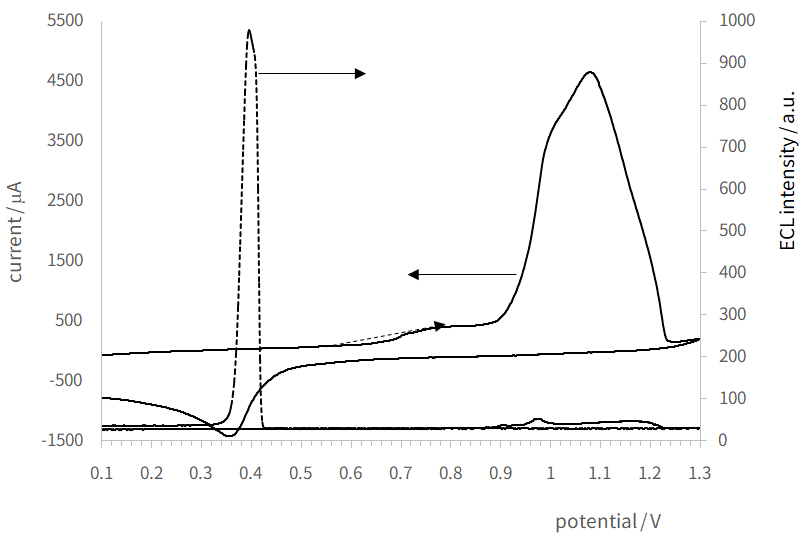
Figure 1 shows the cyclic voltammogram (CV) and co-reagent-free ECL at an Au electrode. In the anodic scan, Au is oxidised from approximately 0.9 V and [Ru(bpy)₃]²⁺ from 1.0 V. At approximately 0.9 V, a slight ECL is also detected, resulting from the reaction between 'AuO' and [Ru(bpy)₃]²⁺. During the reverse scan, the reduction of the anodically formed 'AuO' starts at approximately 0.5 V in the cyclovoltammogram, followed by strong, narrow ECL around 0.4 V. (The same can be observed on an Ag electrode. Here, the cathodic ECL begins at approximately -0.05 V.)
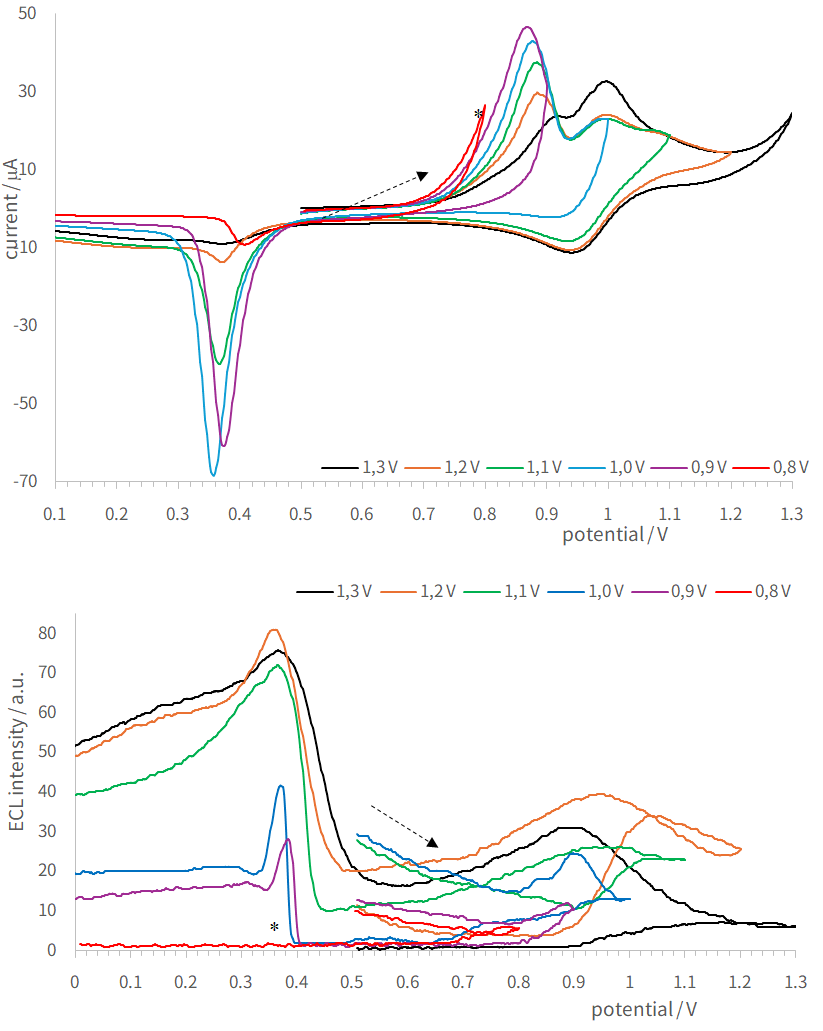
To verify the simultaneous involvement of both [Ru(bpy)₃]²⁺ and 'AuO' in cathodic ECL, the reverse potential was systematically varied during cyclic voltammetry (CV) (see Figure 3). A solution of 0.1 mmol/L [Ru(bpy)₃]²⁺ in 1 mmol/L HClO₄ was used. The CV clearly shows the two anodic processes: the oxidation of Au at ~0.9 V (vs. Ag/AgCl) and the oxidation of [Ru(bpy)₃]²⁺ to [Ru(bpy)₃]³⁺ at ~1.0 V. In the subsequent cathodic scan, two characteristic reduction peaks appear: one at ~0.95 V (reduction of [Ru(bpy)₃]³⁺ to [Ru(bpy)₃]²⁺) and one at ~0.35 V (reduction of the formed 'AuO' to metallic Au).
Gradually lowering the reverse potential from 1.3 V to 0.8 V enables the ECL phenomenon to be described more precisely in the cathodic reverse scan. Initially, the intensity of the 'AuO' reduction peak at 0.35 V increases from a reversal potential of 1.3 V to 1.0 V. At a reversal potential of 1 V, the amount of 'AuO' is therefore greatest, as can be seen in the CV at the maximum cathodic current peak at 0.35 V. At lower reversal potentials, the cathodic peak decreases again because less 'AuO' is formed by the oxidation of Au (see Figure 3, top ‘*’). No cathodic ECL occurs here (Figure 3, bottom '*'). Conversely, the ECL signal is at its maximum at 1.3 – 1.1 V (Figure 3, bottom) because the concentration of [Ru(bpy)₃]²⁺ is then at its highest. This is evident from the high negative current peak of [Ru(bpy)₃]²⁺/[Ru(bpy)₃]³⁺ at 0.9 V. Clearly, the concentrations of both ‘AuO’ and [Ru(bpy)₃]²⁺ are maximised at 1.2 V, resulting in the highest ECL intensity.


The solvent plays an important role in the co-reagent-free ECL mechanism, as the comparison between KCl and HClO₄ electrolytes shows that cathodic ECL is about ten times more intense in KCl than in HClO₄.
Lu et al. 8 and Zu and Bard 9 explain the exact mechanism of ECL in chloride-containing solutions on an Au surface. According to their work, gold is partially converted into solution (e.g. as [AuCl₄]⁻) in the presence of chloride under anodic conditions. This leads to the partial dissolution of the gold surface, exposing new active centres — an effect that enhances the ECL intensity.
This mechanism demonstrates that, in chloride-containing solution, the electrochemical dissolution and reconstitution of the gold surface plays a crucial role in the efficiency of cathodic ECL. The combination of metal dissolution in the presence of chloride and the redox chemistry of [Ru(bpy)3]2+is a prerequisite for the electrochemiluminescent process on gold (Au) without a co-reagent.
The rough reaction scheme describes these partial reactions 8.
Au + [Ru(bpy)3]2+→ Au+ + [Ru(bpy)3]3+ (1)
Au+ + e− → Au-NP (2)
[Ru(bpy)3]3+ + Au-NP → [Ru(bpy)3]2+∗ + Au+ (3)
[Ru(bpy)3]2+∗ → [Ru(bpy)3]2+ + hν (600 nm) (4)
At about 1 V Au and [Ru(bpy)3]2+ are oxidised forming Au+ (probably an Au-chloro complex) and [Ru(bpy)3]3+ (equation 1). During cathodic scanning at around 0.4 V (vs. Ag/AgCl) Au+ is reduced and Au particles (Au-NP) are formed (equation 2). These Au-NP react with [Ru(bpy)3]3+, producing the excited state [Ru(bpy)₃]²⁺* (Equation 3).The radiative decay of the excited [Ru(bpy)₃]²⁺* to the electronic ground state results in light emission – the characteristic electrochemiluminescence at 600 nm (Equation 4).
The concept of co-reagent-free ECL broadens our understanding of the ECL technique and opens up new possibilities for developing co-reagent-free ECL systems, which could lead to the creation of simple light sources. It will be necessary to investigate whether the semi-noble metal coppelectrochemically induced surface-enhanced oxidative Raman spectroscopyer is also suitable for this purpose (see below).
Electro-Chemically Surface Enhaced Oxidative Raman Spectroscopy: EC-SOERS
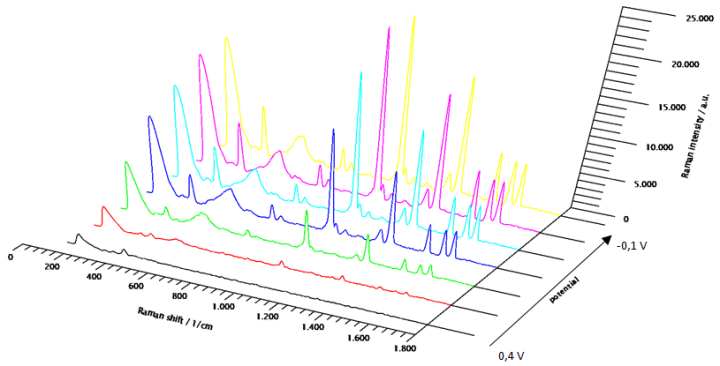
Figure 3 shows the formation of the classic cathodic (or reductive) EC-SERS spectrum of [Ru(bpy)₃]²⁺ between 0.4 V and -0.1 V on an Ag electrode. Under these conditions, so-called 'hot spots' form preferentially – these are locally on the nanostructured metal surface with high electromagnetic field strength. These hot spots are crucial for significantly amplifying the Raman scattering signal of the adsorbed molecules.


An unusual phenomenon is EC-SERS at oxidative potentials: EC-SOERS. Unlike the classic EC-SERS effect, signal amplification occurs during an anodic (oxidative) potential scan.
This seems counterintuitive, however, since at positive potentials, the Ag metal oxidises and, in the presence of chloride, is passivated by the formation of AgCl. This leads to a loss of SERS activity. Passivation means that AgCl prevents direct contact between the silver surface and the electrolyte. As AgCl is an electrical insulator, ion transfer (Ag⁺ and Cl⁻) is restricted. Consequently, surface plasmons do not form due to limited electron transport through the layer to the surface. However, this only applies to relatively high chloride concentrations of >0.01 mmol/L.
According to Hernández et al. 10, 11 the EC-SOERS process for a silver electrode proceeds as follows: During the anodic potential scan, silver (Ag) is oxidised to silver cations (Ag⁺) in the presence of chloride ions (Cl⁻), which react to form a layer of silver chloride (AgCl) on the surface. The concentration of chloride ions plays a central role in the occurrence of the EC-SOERS effect. If the chloride concentration is too high, the formation of a dense AgCl layer leads to the surface becoming passivated, which prevents further Ag⁺ ions from being released from the silver surface (see above). At low chloride concentrations (<0.001 mol/L), however, the AgCl layer is more porous, allowing Ag⁺ ions to be released and adsorbed on the AgCl crystals. This adsorption leads to significant amplification of the Raman signal. The authors based their interpretation on various analytical methods, including electron microscopy, X-ray photoelectron spectroscopy (XPS) and dark-field microscopy, which clearly identified the formed AgCl and the adsorbed Ag⁺ species.
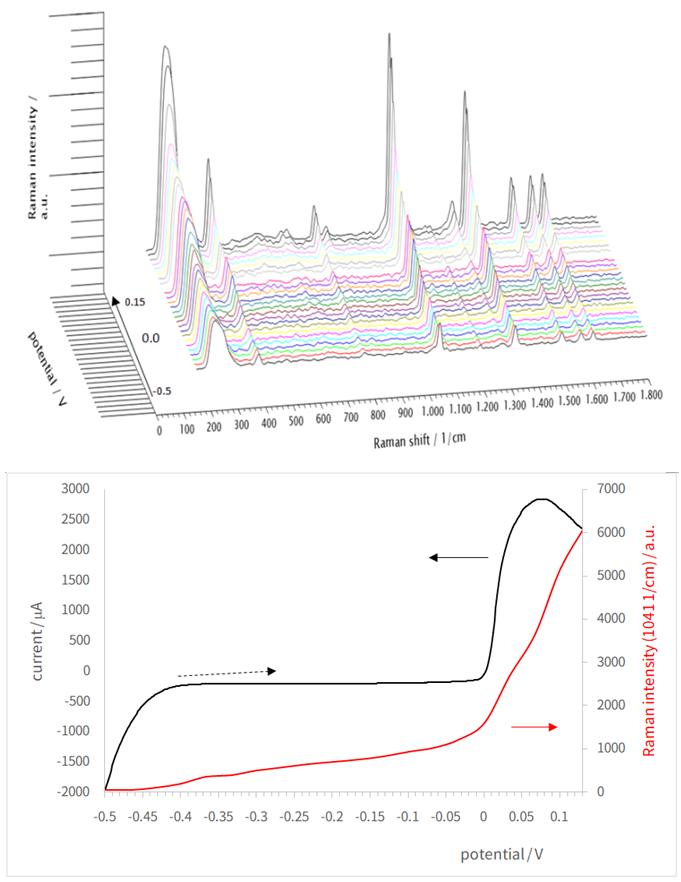
Figure 4 shows the SOERS Raman spectrum of [Ru(bpy)₃]Cl₂ (0.0001 mol/L) for an anodic potential scan from -0.5 V to 0.15 V, with the increase in Raman intensities during the scan clearly visible from approximately 0 V: EC-SOERS.
ECL and SERS on a copper electrode
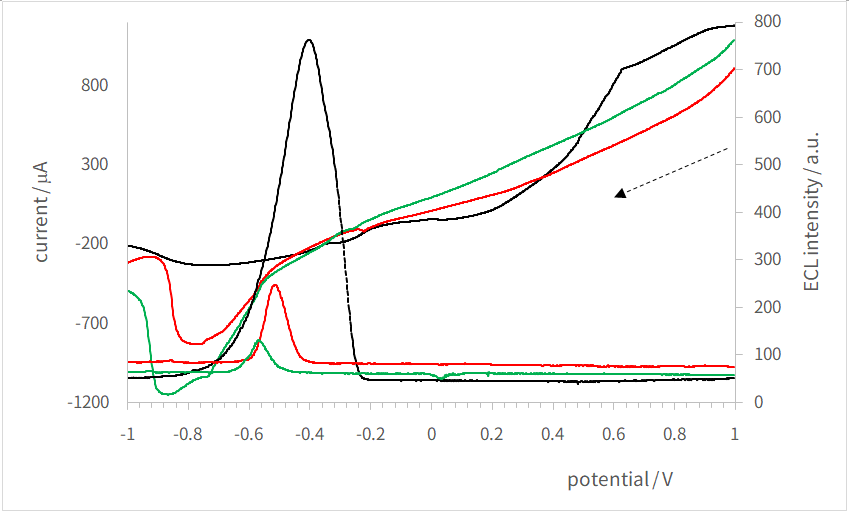
To the best of our knowledge, this is the first time that co-reagent-free ECL has been observed on a copper electrode. To demonstrate this, we electrolysed copper from a copper sulphate solution (10 mmol/L) for three different durations (10, 20, and 40 seconds) at -0.7 V onto an Au-SPE electrode. We then carefully cleaned the electrode by washing it several times with distilled water. After adding the [Ru(bpy)₃]²⁺Cl₂ solution (0.1 mmol/L), we performed linear sweep voltammetry from 1 V to -1 V. Figure 5 shows the results.
At a low electrolysis time, the reduction peak of CuO begins at approximately -0.2 V and is flat. The corresponding ECL intensity is high (black curves). At a higher electrolysis time, the reduction peak becomes deeper while the ECL intensity decreases and shifts to a lower potential (green curves). This may be because only a small, fine-grained copper surface is formed at low electrolysis times, and copper nanoparticles can be formed in the reverse scan at about -0.2 V that can react much faster with [Ru(bpy)₃]²⁺ than the bulky copper formed by longer electrolysis times.
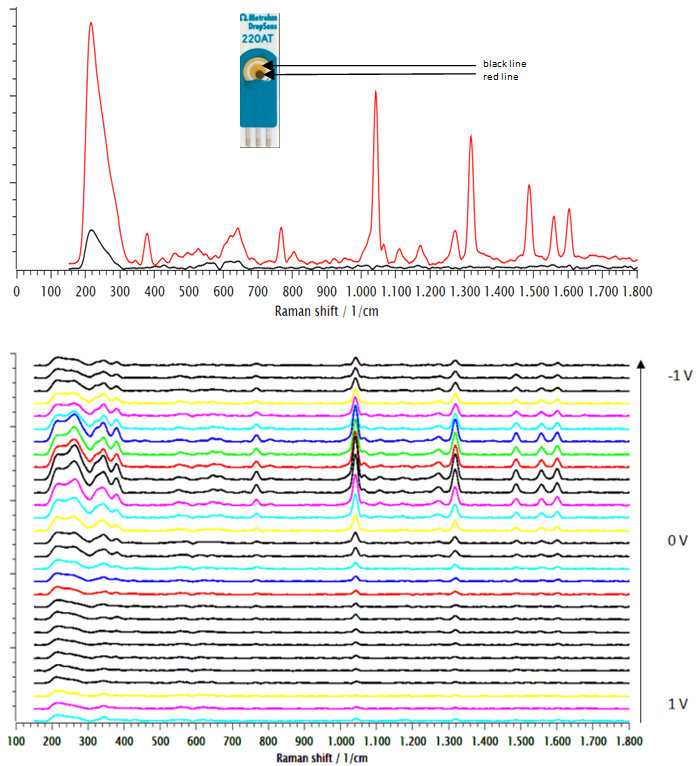
The formation of copper nanoparticles can be verified using Raman spectroscopy (see Figure 6). We prepared an Au-SPE with a pinhole in the adhesive strip and deposited copper onto it via electrolysis for 10 seconds. After removing the adhesive strip, we washed the electrode with acetone and water before performing Raman spectroscopy on two different parts of the SPE: the gold part and the electrolysis space. As can clearly be seen, the Raman spectrum of [Ru(bpy)₃]²⁺ is orders of magnitude more intense in the electrolysed area. This can also be seen in the potential-dependent cathodic scan from 1 V to -1 V, where the Raman signal begins to increase at around -0.2 V.
These experiments demonstrate that co-reagent-free ECL and EC-SERS can both be produced on a copper electrode 12.


This work highlights two unconventional spectroelectrochemical experiments and demonstrates their practical accessibility with simple instrumentation. First, we showed that [Ru(bpy)3]2+ can produce intense cathodic ECL on Au (and Ag) without any added co-reagent: during the anodic scan Au and [Ru(bpy)3]2+ are oxidised, and on reversal the reduction of the transient Au oxide generates Au nanoparticles that react with [Ru(bpy)3]3+ to yield the excited emitter and a narrow ECL band around 600 nm; the ECL amplitude is markedly enhanced in chloride media.
We further mapped classic cathodic EC-SERS of [Ru(bpy)3]2+ on Ag (0.4 to −0.1 V) and EC-SOERS, an anodic SERS amplification that arises when a porous AgCl layer forms at suitably low chloride activity, enabling Ag+ adsorption on AgCl microcrystals and strong field enhancement during positive scans.
Finally, we provide, to our knowledge, the first evidence that both co-reagent-free ECL and EC-SERS can be generated on copper: Cu deposition (−0.7 V, 10–40 s) onto Au-SPEs yields high ECL at short deposition times, consistent with the in situ formation of Cu nanoparticles near −0.2 V; Raman mapping confirms strongly amplified signals within the electrolysed spot. Taken together, these results expand our understanding of the mechanisms underlying ECL/SERS and suggest that low-cost electrode materials could be used for teaching and research in analytical electrochemistry.
Outlook: Several quantitative studies are now required. (i) We must evidently prove that the ECL does not result from a reaction with physically dissolved oxygen. (ii) Kinetic and structure–function analyses of co-reagent-free ECL should decouple the roles of transient surface oxides, nanoparticle size and halide activity, using potential-step protocols, time-resolved ECL and in situ Raman, and SEM techniques, to report absolute ECL efficiencies, stability and reproducibility. (iii) The generality of co-reagent-free ECL should be tested across luminophores and electrode materials (e.g. Cu, Ag and Au alloys), including chloride-free electrolytes, in order to delineate surface-catalytic versus halide-assisted pathways. (iv) For copper, optimisation of deposition time/potential, oxide control and halide identity should produce robust, regenerable SERS/ECL substrates and enable the sensing of analytes on the same platform. Finally, combined ECL–Raman experiments conducted under identical potential programmes could directly link photon output to molecular fingerprints. This would enable mechanism-anchored calibration strategies relevant to analytical applications and laboratory teaching modules.
| [1] | A. J. Bard (Hrsg.), Electrogenerated Chemiluminescence, Marcel Dekker, New York, 2004. | ||
| In article | View Article | ||
| [2] | S. Schlücker, S. (Ed.). Surface Enhanced Raman Spectroscopy, Analytical, Biophysical and Life Science Applications, Wiley-VCH, Weinheim, 2011. | ||
| In article | View Article | ||
| [3] | M. M. Richter, Chem. Rev. 2004, 104, 3003. | ||
| In article | View Article PubMed | ||
| [4] | J-P. Choi, A. J. Bard, Analytica Chimica Acta 2005, 541, 143. | ||
| In article | View Article | ||
| [5] | A. Habekost, World J. Chem. Educ. 2024, 12, 68. | ||
| In article | View Article | ||
| [6] | A. Habekost, World J. Chem. Educ. 2016, 4, 107. | ||
| In article | |||
| [7] | D. Martin-Yerga, A. Perez-Junquera, M.B. Gonzalez-Garcia, J.V. Perales-Rondon, A., Heras, A. Colina, D. Hernandez-Santos, P. Fanjul-Bolado, Electrochim. Acta 2018, 264, 183. | ||
| In article | View Article | ||
| [8] | X. Lu, D. Liu, J. Du, H. Wang, Z. Xue, X. Liu, X. Zhou, Analyst 2012, 137, 588–594. | ||
| In article | View Article PubMed | ||
| [9] | Y. Zu, A. J. Bard, Anal. Chem. 2000, 72, 3223. | ||
| In article | View Article PubMed | ||
| [10] | S. Hernandez, M. Perez-Estebanez, W. Cheuquepan, J. V. Perales-Rondon, A. Heras, A. Colina, Anal. Chem. 2023, 95, 16070. | ||
| In article | View Article PubMed | ||
| [11] | S. Hernandez, K. Wonner, P. Hosseini, P. Cignoni, A. Heras, A. Colina, K. Tschulik, Anal. Chem. 2015, 87, 7772–7780. | ||
| In article | |||
| [12] | M. Perez-Estebanez, W. Cheuquepan, A. Heras, A. Colina, App. Surf. Sci. 2024, 654, 159442. | ||
| In article | View Article | ||
Published with license by Science and Education Publishing, Copyright © 2025 Achim Habekost
 This work is licensed under a Creative Commons Attribution 4.0 International License. To view a copy of this license, visit
http://creativecommons.org/licenses/by/4.0/
This work is licensed under a Creative Commons Attribution 4.0 International License. To view a copy of this license, visit
http://creativecommons.org/licenses/by/4.0/
| [1] | A. J. Bard (Hrsg.), Electrogenerated Chemiluminescence, Marcel Dekker, New York, 2004. | ||
| In article | View Article | ||
| [2] | S. Schlücker, S. (Ed.). Surface Enhanced Raman Spectroscopy, Analytical, Biophysical and Life Science Applications, Wiley-VCH, Weinheim, 2011. | ||
| In article | View Article | ||
| [3] | M. M. Richter, Chem. Rev. 2004, 104, 3003. | ||
| In article | View Article PubMed | ||
| [4] | J-P. Choi, A. J. Bard, Analytica Chimica Acta 2005, 541, 143. | ||
| In article | View Article | ||
| [5] | A. Habekost, World J. Chem. Educ. 2024, 12, 68. | ||
| In article | View Article | ||
| [6] | A. Habekost, World J. Chem. Educ. 2016, 4, 107. | ||
| In article | |||
| [7] | D. Martin-Yerga, A. Perez-Junquera, M.B. Gonzalez-Garcia, J.V. Perales-Rondon, A., Heras, A. Colina, D. Hernandez-Santos, P. Fanjul-Bolado, Electrochim. Acta 2018, 264, 183. | ||
| In article | View Article | ||
| [8] | X. Lu, D. Liu, J. Du, H. Wang, Z. Xue, X. Liu, X. Zhou, Analyst 2012, 137, 588–594. | ||
| In article | View Article PubMed | ||
| [9] | Y. Zu, A. J. Bard, Anal. Chem. 2000, 72, 3223. | ||
| In article | View Article PubMed | ||
| [10] | S. Hernandez, M. Perez-Estebanez, W. Cheuquepan, J. V. Perales-Rondon, A. Heras, A. Colina, Anal. Chem. 2023, 95, 16070. | ||
| In article | View Article PubMed | ||
| [11] | S. Hernandez, K. Wonner, P. Hosseini, P. Cignoni, A. Heras, A. Colina, K. Tschulik, Anal. Chem. 2015, 87, 7772–7780. | ||
| In article | |||
| [12] | M. Perez-Estebanez, W. Cheuquepan, A. Heras, A. Colina, App. Surf. Sci. 2024, 654, 159442. | ||
| In article | View Article | ||