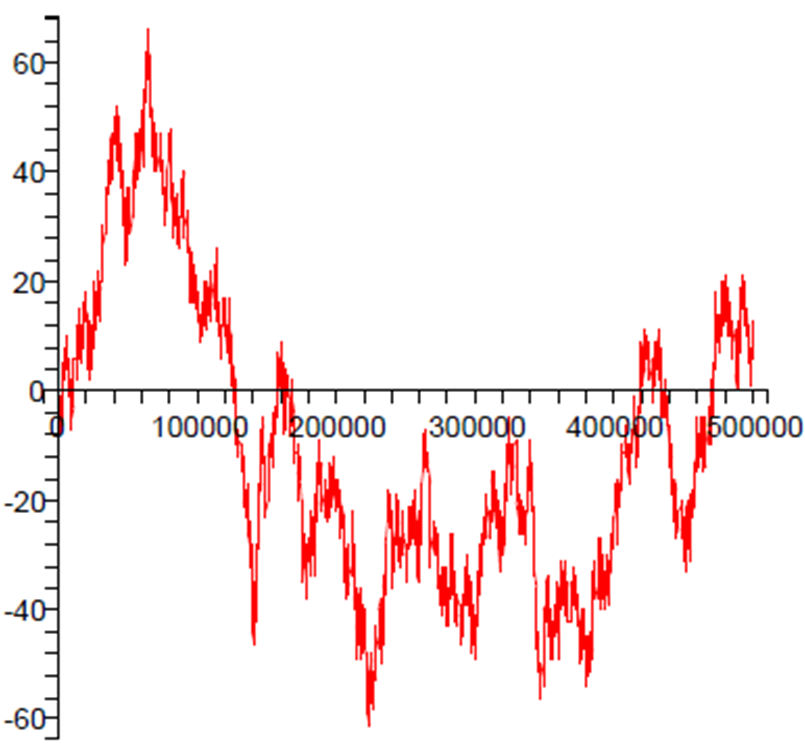
We investigate here the Oldenburger-Kolakoski sequence  with K1=1. In the first part, we give some expressions of the discrepancy function δ(n) representing the difference between 2s and 1s in K1K2…Kn. The discrepancy could be interpreted as a perturbation of a certain equilibrium. Our main result is a necessary and sufficient condition for the existence of the asymptotic density. In the last section, we present an algorithm to generate the sequence terms and a formula for the term Kn.
The Kolakoski sequence  with
with  defines the unique infinite word
  which does not change by the Run Length Encoding operator
  It starts like this: 122112122122112... Many questions asked by Kimberling 2 about this sequence, are still open. For example, it is conjectured by Keane 1 that asymptotically, there is as many one’s as two’s, which means that the limiting density of 2s is
  Other information in concern with this sequence can be found in the Sloane’s OEIS 3.
We now introduce some definitions and notation.
We let  and
and  denote respectively the run-length encoding operator, defined by the following example,
  and its inverse. The Kolakoski infinite
  word can be seen at the same time as a fixed point of
  and of
  for
for  The density of 2s in
  is given by
 |
We define the successive partial sums by
 |
and
 |
We will use the following cardinals  and
and  are respectively the numbers of 1s and 2s in
  and
and  with
with 

 having respectively the same parity than
For instance,
 = is the number of 2s in
  with even indices.
 is the number of 1s in
  with even index and odd partial sum.
 is the number of 2s in
  with even index j, odd partial sum
  and even
The discrepancy function  represents the difference between the number of 2s and the number of 1s in the word
  It can be expressed as follows
 |
Proposition 1.
 |
 |
 |
Proof. If we replace  by
by  in the expression of
  use the fact that
 |
we get
 |
 |
 |
From here, we conclude that if the limiting density  exists and is not
  then the discrepancies
  and
and  should have the same sign for large enough n.
In this section, we will consider the integers n such that  are even
Proposition 2.
 |
 |

Proposition 3.
 |
 |
Proposition 4.
 |
 |
The proof of these propositions is based on the identity  where we replace
  by
by  and
and 
The discrepancy function can be seen as perturbation of some equilibrium. Hence, 
 and
and  are three perturbations of three equilibriums and there is no reason they will have same sign. The change of the sign of the discrepancy means that if the density
  has a limit, it will be
Let  and
and  be the respective densities of
  and
and  in
in 
Proposition 5.
 |
 |
In particular,
 |
Proof. Using the definition of the 2s density, we have
 |
but 
thus
 |
If we assume that the asymptotic density exist and  , then, as a subsequence, we should have
  and consequently
 |
On the other hand
 |
By the same, we will have
 |
which gives the condition
 |
A natural way to generate the sequence  is the one based on a first integration using the inverse run-length encoding operator
  The blue ones create ones while the red ones create twos. The blue twos will generate blocs of two ones and the red twos will give blocs of two twos.
 |
 |
To make the algorithm faster, we will use the third integration defined by  This is illustrated as follows
 |
 |
For  the multi-run generated by
  after three integrations, will depend on the parity of
 and
and  Its length will be
We can improve the speed of the algorithm with the  integration but the computations become complex.
 |
 |
So, with  if we know
  we can generate
  where
where 
Lemma 6. For every 
 |
 |
Proof. By definition, we have
 |
replacing n by  we get
  and
and  Using the expression of
  given above, the difference yields to
 |
If we replace again n by  the first identity becomes
 |
which yields to
 |
and finally gives
 |
Proposition 7. Let  and p the unique integer such that
 |
If we assume known the terms  then, using the recursive formulas above, we can compute
  and
and  and predict the word generated by
  represented by the number
  after three integrations. The difference
  gives the position and the following value of
 |
Where  is a number which depends on the parity of

 and
and  as illustrated by the table below.
The question about the existence of the limiting density is still unanswered. We just replaced it by an equivalent one concerning the density of even twos. The expressions of the discrepancy presented here show the complexity of Kolakoski sequence and justify why the answer to Keane conjecture is not easy. We believe that is not possible to have an explicit expression of the  term
term  All one can do, is to find
  from some previous terms
  with
with  as small as possible. We proved that
  improving the former result
  In the end, the advantage of the algorithm used to generate
  is that, it could be easily generalized and made faster and faster.
The author would like to express his gratitude to the referees for their careful reading of the manuscript and for giving me some of their precious time. I also thank some of my friends for fruitful discussions.
| [1] | Keane and C. Series (eds.), Ergodic Theory, Symbolic Dynamics and Hyperbolic Spaces, Oxford University Press, 1991, pp. 35-70. | ||
| In article | |||
| [2] | C.Kimberling,http://faculty.evansville.edu/ck6/integer/index.html. | ||
| In article | View Article | ||
| [3] | N. J. A. Sloane, The On-line Encyclopedia of Integer Sequences, published electronically at http://oeis.org. | ||
| In article | View Article | ||
Published with license by Science and Education Publishing, Copyright © 2018 Abdallah Hammam
 This work is licensed under a Creative Commons Attribution 4.0 International License. To view a copy of this license, visit
http://creativecommons.org/licenses/by/4.0/
This work is licensed under a Creative Commons Attribution 4.0 International License. To view a copy of this license, visit
http://creativecommons.org/licenses/by/4.0/
| [1] | Keane and C. Series (eds.), Ergodic Theory, Symbolic Dynamics and Hyperbolic Spaces, Oxford University Press, 1991, pp. 35-70. | ||
| In article | |||
| [2] | C.Kimberling,http://faculty.evansville.edu/ck6/integer/index.html. | ||
| In article | View Article | ||
| [3] | N. J. A. Sloane, The On-line Encyclopedia of Integer Sequences, published electronically at http://oeis.org. | ||
| In article | View Article | ||