 OPEN ACCESS
  PEER-REVIEWED
A Double Inequality for the Harmonic Number in Terms of the Hyperbolic Cosine
Da-Wei Niu1, , Yue-Jin Zhang1, Feng Qi2, 3, 4
1College of Information and Business, Zhongyuan University of Technology, Zhengzhou City, Henan Province, China
2College of Mathematics, Inner Mongolia University for Nationalities, Tongliao City, Inner Mongolia Autonomous Region, China
3Department of Mathematics, College of Science, Tianjin Polytechnic University, Tianjin City, China
4Institute of Mathematics, Henan Polytechnic University, Jiaozuo City, Henan Province, China
Abstract
In the paper, the author present an inequality for bounding the harmonic number in terms of the hyperbolic cosine.
Keywords: Inequality, Euler-Mascheroni constant, Harmonic number, Hyperbolic cosine
Turkish Journal of Analysis and Number Theory, 2014 2 (6),
pp 223-225.
DOI: 10.12691/tjant-2-6-6
Received November 03, 2014; Revised December 03, 2014; Accepted December 11, 2014
Copyright © 2013 Science and Education Publishing. All Rights Reserved.Cite this article:
- Niu, Da-Wei, Yue-Jin Zhang, and Feng Qi. "A Double Inequality for the Harmonic Number in Terms of the Hyperbolic Cosine." Turkish Journal of Analysis and Number Theory 2.6 (2014): 223-225.
- Niu, D. , Zhang, Y. , & Qi, F. (2014). A Double Inequality for the Harmonic Number in Terms of the Hyperbolic Cosine. Turkish Journal of Analysis and Number Theory, 2(6), 223-225.
- Niu, Da-Wei, Yue-Jin Zhang, and Feng Qi. "A Double Inequality for the Harmonic Number in Terms of the Hyperbolic Cosine." Turkish Journal of Analysis and Number Theory 2, no. 6 (2014): 223-225.
| Import into BibTeX | Import into EndNote | Import into RefMan | Import into RefWorks |
1. Introduction
The harmonic number  is defined as
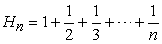 |
and it has the following close connections with the Euler-Mascheroni constant  :
:
 |
and
 |
where  is the digamma function which is the logarithmic derivative of the classical Euler gamma function
 |
The harmonic number  has interesting applications in many areas of mathematics, such as number theory, special functions, and combinatorics. For example, Lagarias proved that the Riemann hypothesis is equivalent to the statement that
 |
for  , where
  denotes the sum of the divisors of n.
In [20], Paule and Schneider obtained the identity
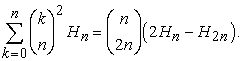 |
In [2], Alzer presented the inequality
 |
for  , where the constants
  and
and  are the best possible. In [5], Batir gave an inequality
 |
This double inequality was refined in [4] by replacing  by 1. It also inspired Mortici to construct a sequence
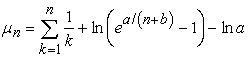 |
in [15], which converges to more quickly.
For more information on the harmonic number  , please refer to [2,6-19,21-26] and plenty of references therein.
In this paper, we will establish a new double inequality for bounding the harmonic number  in terms of the hyperbolic cosine.
Our main result may be stated as the following theorem.
Theorem 1.1. For all positive integers  , we have
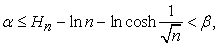 | (1.1) |
where the constants  and
and  are the best impossible.
2. Lemmas
In order to prove Theorem 1.1, we need the following lemmas.
Lemma 2.1 ([[3], p. 384]). Let  and
and  be integers, for
  , we have
 |
where
 |
Lemma 2.2 ([10, 22]). For  , we have
 | (2.1) |
3. Proof of Theorem 1.1
Now we are in a position to prove our Theorem 1.1.
Let
 |
A direct differentiation yields
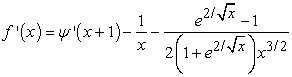 |
and
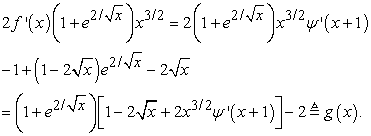 |
By virtue of inequalities (2.1) and
 |
we acquire
 |
for  . This implies that
  and that
  is increasing on
  .
.
By the asymptotic expansion
 |
as  in [[1], p. 259] and the well-known formula
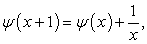 | (3.1) |
we easily find
 |
as  . Hence, it follows that
 |
Taking into account that  is increasing on
  reveals
 | (3.2) |
Combining (1), (3.1), and (3.2) concludes that the double inequality (1.1) holds for all  and that the bounds
  and
and  in (1.1) are the best impossible. The proof of Theorem 1.1 is complete.
References
| [1] | M. Abramowitz and I. A. Stegun (Eds), Handbook of Mathematical Functions with Formulas, Graphs, and Mathematical Tables, National Bureau of Standards, Applied Mathematics Series 55, 10th printing, Washington, 1972. | ||
 In article In article | |||
| [2] | H. Alzer, Inequalities for the harmonic numbers, Math. Z. 267 (2011), no. 1-2, 367-384. | ||
| In article | CrossRef | ||
| [3] | H. Alzer, On some inequalities for the gamma and psi functions, Math. Comp. 66 (1997), no. 217, 373-389. | ||
| In article | CrossRef | ||
| [4] | H. Alzer, Sharp inequalities for the harmonic numbers, Expo. Math. 24 (2006), no. 4, 385-388. | ||
| In article | CrossRef | ||
| [5] | N. Batir, Some new inequalities for gamma and polygamma functions, J. Inequal. Pure Appl. Math. 6 (2005), no. 4, Art. 103. | ||
| In article | |||
| [6] | C.-P. Chen, Inequalities for the Euler-Mascheroni costant, Appl. Math. Lett. 23 (2010), no. 2, 161-164. | ||
| In article | CrossRef | ||
| [7] | C.-P. Chen, Sharpness of Negoi's inequality for the Euler-Mascheroni constant, Bull. Math. Anal. Appl. 3 (2011), no. 1, 134-141. | ||
| In article | |||
| [8] | C.-P. Chen and C. Mortici, New sequence converging towards the Euler-Mascheroni constant, Comp. Math. Appl. 64 (2012), no. 2, 391-398. | ||
| In article | CrossRef | ||
| [9] | D. W. DeTemple, A quicker convergence to Euler's constant, Amer. Math. Monthly 100 (1993), no. 5, 468-470. | ||
| In article | |||
| [10] | B.-N. Guo and F. Qi, Two new proofs of the complete monotonicity of a function involving the psi function, Bull. Korean Math. Soc. 47 (2010), no. 1, 103-111. | ||
| In article | CrossRef | ||
| [11] | B.-N. Guo and F. Qi, Sharp bounds for harmonic numbers, Appl. Math. Comput. 218 (2011), no. 3, 991-995. | ||
| In article | CrossRef | ||
| [12] | B.-N. Guo and F. Qi, Sharp inequalities for the psi function and harmonic numbers, Analysis (Berlin) 34 (2014), no. 2, 201-208. | ||
| In article | CrossRef | ||
| [13] | E. A. Karatsuba, On the computation of the Euler constant, Numer. Algor. 24 (2000), no. 1-2, 83-97. | ||
| In article | CrossRef | ||
| [14] | W.-H. Li, F. Qi, and B.-N. Guo, On proofs for monotonicity of a function involving the psi and exponential functions, Analysis (Munich) 33 (2013), no. 1, 45-50. | ||
| In article | CrossRef | ||
| [15] | C. Mortici, A quicker convergence toward the constant with the logarithm term involving the constant e, Carpathian J. Math. 26 (2010), no. 1, 86-91. | ||
| In article | |||
| [16] | C. Mortici, Improved convergence towards generalized Euler-Mascheroni constant, Appl. Math. Comput. 215 (2010), no. 9, 3443-3448. | ||
| In article | CrossRef | ||
| [17] | C. Mortici, New approximations of the gamma function in terms of the digamma function, Appl. Math. Lett. 59 (2010), no. 1, 97-100. | ||
| In article | CrossRef | ||
| [18] | C. Mortici, On new sequences converging towards the Euler-Mascheroni constant, Comput. Math. Appl. 59 (2010), no. 8, 2610-2614. | ||
| In article | CrossRef | ||
| [19] | T. Negoi, A faster convergence to Euler's constant, Math. Gaz. 83 (1999), no. 498, 487-489. | ||
| In article | |||
| [20] | P. Paule and C. Schneider, Computer proofs of a new family of harmonic number identities, Adv. Appl. Math. 31 (2003), no. 2, 359-378. | ||
| In article | CrossRef | ||
| [21] | F. Qi, Complete monotonicity of functions involving the q-trigamma and q-tetragamma functions, Rev. R. Acad. Cienc. Exactas Fís. Nat. Ser. A Math. RACSAM. 109 (2015), in press. | ||
| In article | CrossRef | ||
| [22] | F. Qi, R.-Q. Cui, C.-P. Chen and B.-N. Guo, Some completely monotonic functions involving polygamma functions and an application, J. Math. Anal. Appl. 310 (2005), no. 1, 303-308. | ||
| In article | CrossRef | ||
| [23] | F. Qi and Q.-M. Luo, Complete monotonicity of a function involving the gamma function and applications, Period. Math. Hungar. 69 (2014), no. 2, 159-169. | ||
| In article | CrossRef | ||
| [24] | A. Sîntǎmǎrian A generalization of Euler's constant, Numer. Algor. 46 (2007) no. 2, 141-151. | ||
| In article | CrossRef | ||
| [25] | M. B. Villarino, Ramanujan's harmonic number expansion into negative powers of a triangular num- ber, J. Inequal. Pure Appl. Math. 9 (2008), no. 3, Art. 89. | ||
| In article | |||
| [26] | R. M. Young, Euler's constant, Math. Gaz. 75 (1991), 187-190. | ||
| In article | CrossRef | ||

 CiteULike
 Mendeley
 StumbleUpon
 Delicious
 Facebook
 Twitter
 LinkedIn
 Print
Print