In this work a new theory called by ‘Object Theory’ (or ‘Theory of Objects’) is introduced in Pure Mathematics. It is explained that the classical Number Theory is a particular instance of the ‘Object Theory’ corresponding to the region R. Although this is purely a theoretical work, but this theory is expected to cater to Mathematics and all branches of STEM including AI, Data Science, modern Statistics, Soft computing etc in a new direction.
This is purely a theoretical work on ‘objects’. Throughout in this paper, by the term ‘object’ we mean element of a set. The work initiates a new theory called by “Object Theory” (or Theory of Objects), and then it is justified that the existing ‘Number Theory’ is a special instance of ‘Object Theory’. The present era is the era of AI in this century. The introduction of ‘Object Theory’ is done here with the expectation that it could add a new topic to ‘Pure Mathematics’ and could supplement theories and models to the activities in AI and Data Science. The population data in modern statistics are mostly unstructured or semi-structured. The set of objects of such population could be like: a collection of 1000 drawings of the beautiful Tajmahal (one of the seven wonders of the world) by 1000 school students, a collection of 50 X-ray images of last two years of a tuberculosis patient in a hospital, a collection of 100 satellite pictures of a earthquake effected region, a collection of 1000 sounds of sun captured from a close distance of 10,000 km from sun, etc. These kind of objects are dealt with and analyzed by the scientists at various relevant labs in the world. But the author feels that the subject Pure Mathematics could play more amount of mathematical roles to the AI analysts and statistical analysts. With this objective, a new theory called by Theory of Objects is introduced in this work.
Example 1.1
Consider the finite set S = { +, - } of two objects which are operation symbols ‘+’ and ‘-‘ and a binary operation ‘*’ called ‘multiplication’ defined over it by the following four rules:-
+ * + = +
- * - = +,
+ * - = -
- * + = -
It can be observed that (S, *) forms an abelian group, with the identity element ‘+’.
Example 1.2
Consider the finite set S of five boys of different ages who are: Smith (age = 14 years), Robert (age = 3 years), Wang (age = 12 years), Thomas (age = 15 years) and Fang (age = 5 years).
Define the binary ‘Addition’ operation  over the set S such that
  a, b
a, b  S, a
S, a b = the boy between a and b of elder or equal age.
Define the binary ‘Multiplication’ operation * over the set S such that  a, b
a, b  S, a * b = the boy between a and b of younger or equal age. It can be observed that both (S,
 ) and (S,
 ) form semigroups.
The present work is sequel to the work 1 in which a new algebraic structure ‘Region’ is introduced. Therefore, in the next section a brief presentation about ‘region’ is made from 1 first of all, for a quick visit.
Consider a list of key algebraic structures in Algebra which are: Semi Group, Group, Ring, Integral Domain, Module, Field, Linear Space, Algebra over a field and Extensions, Associative algebra over a field, Division Algebras, Euclidian Hurwitz Algebra, Cayley–Dickson algebra, Clifford Algebra, Quaternion Algebra, universal algebra, etc. For the purpose of frequent uses of these algebraic structures in this work, let us call this list by the name “Key List’. For details about the algebraic structures of the Key List and about the classical Number Theory, one could see 14, 15 19, 20, 21, 22 23, 24, 25, 26 27, 28, 29, 30 31, 32, 33, 34 35, 36, 37, 38 39, 40, 41, 42.
It is justified in length and established by several examples in 1 that the existing huge volume of algebraic structures in the subject “ALGEBRA” is incomplete to validate many elementary frequently practiced algebraic computations like: square or cube (or nth power) of an algebraic expression, frequently practiced few identities, Cross-Multiplication rule, and many more. None of the algebraic structures of the Key List (as defined above) can validate these computations by their respective definitions and by virtue of their respective properties, except the newly introduced algebraic structure ‘region’. Even an important, very useful and most frequently used Cross-Multiplication rule can not be validated by any individual member of the Key List. The minimal platform required for practicing elementary algebra is the region algebra, not any algebra member of the Key List.
An algebraist can define an infinite number of new algebraic structures. The objective behind the work 1 is not just for the sake of defining a new algebraic structure, and is not to increase the volume of literature of Algebra unnecessarily; but to recognize and identify a major gap of the giant subject ‘Algebra’ lying hidden so far in the existing vast literature of it, and then to fix the gap.
Although the above statements seem to be unimaginable, but this genuine fact is revealed in 1 in details. The following examples (borrowed from 1) highlight the serious structural gaps in Algebra:-
Example 2.1
Consider a very simple instance from elementary algebra, a type which is very frequently used by the secondary school students and ofcourse by the world researchers, is the equality (identity) I of following type:
 =
= 
where x, y are in an algebraic structure A (assume that the name of the algebraic structure A is not known at this moment) and a, b are two members (scalars) of some known field F.
We would like to say that this beautiful and simple identity is not valid i.e. ‘can not be verified’ in a Group, Ring, Integral Domain, Field, Linear Space, F-Algebra, Associate Algebra, Division Algebra, Normed Division Algebra, Cliffored Algebra, Cayley Algebra, Cayley–Dickson algebra or in any existing standard brand of algebraic structure alone of the Key List in general, by virtue of their respective definitions and independently owned properties.
See the justification presented below, about this identity I.
Justification
It is because of the reason that:
(1). since division operations are involved in both LHS and RHS expressions of I, the unknown algebraic structure A can not be a ‘F-algebra’ by virtue of its definition and independently owned properties.
(2). next, if it is not a ‘F-algebra’ then let us check whether it could be a division algebra D (remembering that every field is also a division algebra).
(i) the LHS expression  of I can be well written to be equal to the expression
 (x*y-1) in the division algebra D,
(ii) but next the expression 
 (x*y-1) can’t be written to be equal to the expression (a
 x) *
x) * in the division algebra D, by virtue of the definition and own properties of “division algebra”.
[although, it is true that in the division algebra D, by virtue of its definition and owned properties, (a x) *
x) * can be written equal to the expression
  ].
].
Consequently, in a division algebra D, the expression  can not be accepted in general to be equal to
  , by virtue of its definition and own properties. This is a great failure of Division Algebra, whereas the identity(equality) of type I are very frequently being used by the mathematicians.
Out of all the existing recognized algebras of the Key List, none can prove (i.e validate) the above identity/equality, cross-multiplication rule!! This is a serious setback of the existing volume of literature of the subject ‘Algebra’.
Fortunately the set R of real numbers satisfies some additional interesting properties, remaining unknown so far, beyond the properties of it possessed by virtue of the definition and properties of the algebraic structure division algebra. And that is the hidden reason why the mathematics has not been facing any problem and have not been getting any incorrect final results or contradictory results in R, while applying the above type of identities I in mathematics, exercises and computations in science subjects or engineering subjects or in any STEAM subject.
Example 2.2
With exactly the same argument as in Example 2.1 above, it can be observed that if an algebraic equality (in fact it is an identity) J of type given by
 |
happens to be a valid identity (i.e. can be computed and verified) in an algebraic structure A where x, y  A, a and b being members (scalars) of some given field F, then it can be observed that each of the following five statements are true:-
a. A is not a group, or a ring, or integral domain or module, field, linear space, etc by virtue of their respective definitions and independently owned properties.
b. A is not an ‘algebra over a field F’ (F-algebra) by virtue of its definition and independently owned properties.
c. A is not an ‘associative algebra over a field’ by virtue of its definition and independently owned properties.
d. A is not a ‘Division Algebra’ by virtue of its definition and independently owned properties.
e. A is not any standard existing brand of algebraic structure or of any standard extension, by virtue of its definition and independently owned properties.
Undoubtedly, if the above identity named by J (and also the identities of Example 2.1) can not be validated by any existing algebraic structure A or existing extensions, then our giant subject “Algebra” must identify: “Who is this unknown algebraic structure A in whom these identities are valid by virtue of their respective definition and independently owned properties?” Otherwise the subject Algebra will remain as a subject having few serious gaps.
Consider few more examples presented below:-
Example 2.3
The following type of simple computation of ‘Cross-Multiplication’ C of elementary algebra like:
if  =
= 
then 
 x
x t =
t = 
 y
y z (and conversely), where x, y, z, t are in an algebraic structure A (the name of this algebraic structure A is not known at this moment) and a, b, c, d are the members (scalars) of some given known field F, ‘can not be verified’ (i.e. can not be validated) in general in any algebraic structure of the Key List, just by virtue of their respective definitions and independently owned properties. The justification in brief regarding this very popular ‘Cross-Multiplication’ property C is presented below:-
Justification:
(1). since division operations are involved in both LHS and RHS expressions, A can not be a ‘F-algebra’ by virtue of its definition and independently owned properties.
(2). in the next step, if it is not a ‘F-algebra’ then let us check whether it could be a division algebra D (remembering that every field is also a division algebra). Then the following are fact by virtue of the definition and independently owned properties of division algebra:
Suppose that the given equality  =
=  being considered here is in the algebraic structure A which is a “division algebra”.
Then, we have from this equality that the equality 
 =
= 
 is also valid in the division algebra A. Upto this point, there is no issue.
But after this step, the mathematics is blocked and can not proceed further for any next step in the division algebra A. Because this can not yield the next step of the computation expected to be as below

 x
x t =
t = 
 y
y z
z
in the division algebra A just by virtue of its definition and its independently owned properties of the algebraic structure ‘division algebra’.
Example 2.4
It can also be seen that this type of simple square identity I like:
 =
=  (where
  =
=  and
and  =
=  )
)
(where x, y, z, t are in an algebraic structure A (the name not known at this moment, what is the name of this algebraic structure) and a, b, c, d are members (scalars) of some field F) ‘can not be verified’ (i.e. can not be validated) in general in any algebraic structure of the Key List, just by virtue of their respective definitions and independently owned properties.
Then, the immediate questions that arose in mind are:-
• “What is the minimal algebraic structure which can validate the above examples?” Or
• “What could be the minimal algebraic structure in which the above type of identities like I or the above type of cross multiplication results like C, etc are valid?”. Or
• “In what minimal algebraic structure, the above type of identities like I or the above type of cross multiplication results like C, etc can be verified?”.
Note carefully that, in the above four examples we are talking about identities, square of an algebraic term, cross-multiplication etc which are very frequently used and very importantly used in computations by the students and researchers in mathematics, statistics, science subjects, engineering subjects etc since past centuries.
An algebraist can not answer what is this unknown algebraic structure A in the above four examples. He must answer a unique name of an algebraic structure, because of the reason that these type of examples are of tremendous practices by the students and mathematicians in their daily computational works and activities. Is it a Group?, or Ring? or Integral Domain, Field, Extension of Field?, or Linear Space, F-Algebra, Associate Algebra, Division Algebra, Normed Division Algebra, Cliffored Algebra, Cayley Algebra, Cayley–Dickson algebra or any standard algebraic structure (assuming that division by zero element is not allowed), etc??. For a possible answer, because of non-availability from the existing huge volume of algebraic structures of the subject ‘Algebra’, the algebraist has to think of a permutation/combination of the various existing algebraic structures (and their extensions) to discover a possible result. But, he might seek to make a unique identity for this algebraic structure A (a minimal algebraic structure A) to define it in an independent and atomic way, as the algebraists did the same earlier to define ring, field, division algebra,.... etc instead of doing a permutation/combination; because ‘Algebra’ must be sound and complete in this sense. Consequently there a genuine need to identify this minimal algebraic structure, which is hidden so far, un-discovered far, for practicing the giant subjects elementary algebra and higher algebra more appropriately. And hence the region structure is introduced in 1. For details, one could see 1 which is an open-access publication. ‘Region’ is the most practiced algebra in school/college education, research, scientific and engineering calculations, etc. In the work 1, it is established that ‘Region’ is the minimal algebra to study science, mathematics, engineering, and other areas. None of the existing algebraic structure has this capability. A quick visit to the definition of Region is presented below from 1:
2.1. The ‘minimal’ and ‘most useful’ Algebraic Structure in the Subject AlgebraIt is very important to note the adjective word minimal used here, as explained in 1. We call this new algebraic structure by “Region”.
Region
Consider a non-null set A with three binary operators  , * and
  defined over it such that for a given field (F, +,.), the following fourteen(14) conditions are satisfied:-
A,  ) is an abelian Group with respect to addition:
(1) if x, y, z  A then (x
 y)
y) z = x
z = x (y
(y z).
z).
(2)  0A
0A  A such that x
 0A = x = 0A
 x,
x,  x
x A.
A.
(3) if x A,
A,  y
y A such that x
 y = 0A = y
 x.
x.
(4)  x, y
x, y  A, x
A, x y = y
y = y x.
x.
(A, *) forms an Abelian Group (excluding the element 0A) with respect to multiplication:
(5) if x, y, z  A then (x
 y)
y) z = x
z = x (y
(y z).
z).
(6)  1A
1A  A such that x
 1A = x = 1A
 x,
x,  x
x A.
A.
(7) if x A,
A,  y
y A such that x
 y = 1A = y
 x.
x.
(8)  x, y
x, y  A, x
A, x y = y
y = y x.
x.
Distributive Properties:
(9)  x, y, z
  A then
(i) x (y
(y z) = (x
 y)
y) (x
(x z).
z).
(ii) (x y)
y) z = (x
 z)
z) ( y
( y z).
z).
Scalar Multiplication:
(10) Scalar multiplication of x ∈ A by element k ∈ F, denoted by k x is to be in A,
(11) k (m
(m x) = (k.m)
 x, where x ∈ A, and k, m ∈ F.
(12) k (x
(x  y) = k
 x
x  k
k y,
y,
where x, y ∈ A, and k, m ∈ F.
(13) (k + m)  x = k
x = k x
x  m
m x,
x,
where x ∈ A, and k, m ∈ F.
Compatibility with the scalars of the field F:
(14) A satisfies the property of “Compatibility with the scalars of the field F”,
i.e. (k x) * (m
 y) = (k.m)
 (x*y)
(x*y)
 k, m
k, m  F and
F and  x, y
x, y  A.
A.
Then the algebraic structure (A,  , *,
, *,  ) is called a Region over the field (F, +,.).
If there is no confusion, we may simply use the notation A to represent the region (A,  , *,
, *,  ), for brevity. It may be observed that if (A,
  , *,
, *,  ) be a Region over the field (F, +,.), then (A,
  , *) is a field and (A,
  ,
,  ) is a linear space over the field (F, +,.). However, being a field as well as a linear space does not suffice to become a region.
Consider a non-null set A with three binary operators  , * and
  defined over it such that for a given field (F, +,.), the following three(3) conditions are satisfied:-
(i) (A,  , *) forms a field,
(ii) (A,  ,
,  ) forms a linear space over the field
(F, +,.), and
(iii) A satisfies the property of “Compatibility
with the scalars of the field F”,
i.e. (k x) * (m
 y) = (k.m)
 (x*y)
(x*y)
 k, m
k, m  F and
F and  x, y
x, y  A.
A.
Clearly a region is not just a division algebra only, but having a lot of amounts of more mathematics in it. A division algebra, in general, is not a region. However, one could try to view a region by permutation/combination of some of the existing classical algebraic structures in other ways. For instance, the following two theorems follow directly from the axioms (definition).
Theorem 2.1
Let (A, ⊕, *, ·) be a Region over a field F. Then the following are true:
1. (A, ⊕, *) is a commutative field,
2. (A, ⊕, ·) is a vector space over F,
3. (k·x)*(m·y) = (km)·(x*y).
Theorem 2.2
Every Region is a commutative division F-algebra.
Consider the following interesting simple problem on Algebraic Computations.
Problem 2.1.
Obtain an expression for x in terms of y and t from the following equation in the real region (A, ,
, ,
, ):
):
3 x* y = 2
 y
y 3
3 t ,
t ,
where x , y ( 0A), t
  A.
A.
Solution: We have the following equation in the region A:
3 x * y = 2
 y
y 3
3 t
t
Using the properties of region, we then can write

 (3
(3 x*y) =
 (2
(2 y
y  3
3 t)
t)
or, 
 (x*y) =


or, 1F (x*y) =
 y
y 

 t
t
or, x*y = 
 y
y 1F
1F  t
t
or, x*y = 
 y
y t
t
or, ( x*y)*y -1 =  *y -1
*y -1
or, x * ( y * y -1) = 
 ( t * y -1)
or, x*1A = 
 ( t * y -1)
or, x =  , which is the solution.
An Interesting Analysis about the above solution
Let us analyze now the solution to the above Problem 2.1. For this, we begin our analysis with an element of imagination with the following two points:-
Point (i): It is mentioned in the problem statement that the algebraic structure A is a region. But, let us imagine a situation that the identity of the algebraic structure A in the above Problem 2.1 is “unknown” to us at this moment, and also let us accept that
Point (ii): let us also accept that the solution steps presented above are well valid and correct in this “unknown” algebraic structure A.
Now, in the above solution steps we see that:-
There are few steps which are allowed by virtue of the definition and properties of ‘vector space’, and there are few steps which are allowed by virtue of the definition and properties of ‘division algebra’. It is obvious that a ‘division algebra’ can not give license to all the steps of the above mentioned solution-method by virtue of its own definition and independently owned properties (for example, ‘compatibility with scalars’ is not a licensed step in division algebra, even not the commutative property).
Consequently, considering the validity of “all the involved operations collectively” in the steps of the above mentioned solution-method, it is now obvious that this unknown algebraic structure A of this Problem 2.1 has to be at minimum a ‘region’, not less (i.e. not a Division Algebra, not any of the existing standard algebraic structures listed in the Key List). Otherwise, the above problem can not be solved for x in the algebraic structure A, showing a gap in the subject “ALGEBRA”. There must be a unique identity of A, because the existing subject Algebra (with all its existing algebraic structures and extensions) fails by its existing vast rich literature to solve the above Problem 2.1 !!! And this unique minimal algebra A is “Region”.
In this section, we do more amount of characterizations about the minimal algebraic structure region.
In our work here, we use the following notations fluently:
R = set of all real numbers, R+ = set of all positive real numbers, R- = set of all negative real numbers, R≥0 = set of all non-negative real numbers.
2.2. The Region RR: a Very Useful RegionLet R be the set of real numbers, ‘+’ be the ordinary addition operator in R and ‘.’ be the ordinary multiplication operator in R. Consider the field ( R,+,.) of real numbers, and the linear space (R,+,.) over the field (R,+,.). Then the algebraic system (R,+,. ,.) forms a region over the outer field (R,+ ,.).
This region (R,+ ,. ,.) plays a very important role in our daily life computations, in particular in school level elementary algebra. The content of the syllabus and corresponding instructions at school level algebra is based on the platform of this region (R,+,. ,.), not on the platform of any standard algebraic structure like groups, rings, integral domains, fields, linear spaces, algebra over a field, associative algebra over a field, division algebra or any existing algebraic structure. Let us name this region (R,+,. ,.) in short by the word “RR”. The region RR is the most useful region in all the branches of Mathematics, Statistics, Science, Engineering etc i.e. in all STEM subjects.
(i) its inner field is (R,+,.),
(ii) its outer field is also (R,+,.),
(iii) all the three multiplication operators are same, and
(iv) all the three addition operators are same.
2.3. Real RegionA region (A,  , *,
, *, ) over the field ( F, +,.), is called a Real Region if its outer field F is the classical field R of real numbers.
Example 2.2.1
The regions RR, C are examples of real region.
In Region Algebra, the characteristic of a region A denoted char (A) is defined to be the smallest number of times one must use its multiplicative identity 1A in a sum to get the additive identity element 0A. A region is said to have characteristic zero if this sum never reaches the additive identity. For example, for the region RR we have Char (RR) = 0.
2.4. Partitioned RegionConsider a real region A = (A, ,*,
,*, ). Suppose that A forms a chain with respect to a total order relation (say, denoted by the notation ‘
 ’). Then the real region A is called a chain region with respect to the total order relation ‘
 ’.
’.
A real region A = (A, ,*,
,*, ) is called a Partitioned Region if the following conditions are satisfied:
(i). A is an infinite region,
(ii). A is a chain region with respect to a total order relation ‘ ’, and
(iii). the characteristic of A is zero.
Here A is called a ‘partitioned region’ because of the fact that it induces a partition PA of the region A into three mutually disjoint non-null sets denoted by A+, A- and {0A} such that
(i). A+ = { a: a  A and 0A < a}
(ii). A- = { a: a  A and a < 0A}.
Clearly,  a
a  A+, ~a
  A- and
  b
b  A-, ~b
  A+.
A+.
(Note: It may be recalled from the properties of the chain that: a < b iff a ≤ b and a ≠ b, where “≤” is the total order relation of the chain A, and similarly a > b iff b ≤ a and b ≠ a).
The partition PA, once made, is regarded as an absolute partition of the region A corresponding to its total order relation ‘ ’ in the sense that this partition generates the sign of every object of the complete region A, positive or negative, which will remain absolute throughout the complete literature henceforth. However for a different type of total order relation defined over the region A we will get a different partition of A. But the set {0A} is common to all such possible partitions of A.
Consider an infinite region A = (A, ,*,
,*, ). The extended region of the region A is the region itself with all its infinity objects, if any. The infinity objects are not basically the core member of the region A. For the RR region and the C region, the concept of infinity is known to us. Infinity is not an element of the set R of real numbers. Instead, the real line extends infinitely in both the directions, leading to positive infinity (+
 ) and negative infinity (-
 ) which are included in the extended real number system, but not included in R. An analogous concept gives the notion of Complex infinity. It is like a complex number ( 4, 15) with infinite magnitude and an undefined argument. The most common representation is Riemann Sphere where all infinite paths are wrapped around a sphere. At this point of time we do not consider any method about ‘how to find out all the infinity objects of an infinite region’. Even for the present work, we do not need to study the existing advanced theories of infinities so far developed in Mathematics. However for a partitioned region the method is rather easier about considering the concept of infinity as mentioned below, and in this work all-through, whenever the notion of infinity is to be used, we must consider only those regions which are partitioned regions.
Consider a partitioned region A = (A, ,*,
,*, ). If we now include two more objects +
 A and -
 A in A as two permanent guests, then the set AE = A
  {+
{+ A, -
A, - A} is the ‘extended region’ of the region A.
The two guest objects + A and -
 A are called infinities, and are defined as below:
(i) + A =
A =  where
where  (≠0A) is any positive object of the partitioned region A, and
(ii) - A =
A =  where
where  (≠0A) is any negative object of the partitioned region A.
The extended region of the partitioned region A is denoted by the notation AE. However, if there is no confusion then we may use the notation A itself to denote the extended region of A. Note that an extended region is not a region. For a partitioned region, it is just a superset of the set A containing two more objects.
But whenever we say that ‘A is an extended region’, it will simply mean that A is a region with all its infinities as permanent guests. At this stage we do not explore to study whether there are more infinities other than the two guest objects + A and -
 A for a partitioned region.
An extended region AE may also be called as ‘extended real region’ if the corresponding region A is a real region.
For the region C, there are many infinities to be included into it to call it an extended region. For example  a, b
a, b  R, the object a+ib is an infinity object for C if either a or b or both are the infinity object of the region R. The extended region of C is denoted by the notation CE. Further future study on the topic of extended region will make the literature richer. However, in our work here we use the case of the extended region of a partitioned region only.
Before going to introduce “Theory of Objects”, few definitions are developed over the structure region.
3.1. 2-to-1 Bijective MappingConsider two non-null sets X and Y. A function
f: X  Y is said to be a ‘2-to-1 Bijective Mapping’ if
(i) f is onto, and
(ii)  y
y  Y,
Y,  two and only two distinct (not same)
elements x1 and x2 in X such that
f(x1) = y = f(x2).
For example, the function f: R-{0} R+ given by f(x) = x2 is a 2-to-1 Bijective Mapping. But the function
g: R R+ given by g(x) = x2 is not a 2-to-1 Bijective Mapping.
Consider a partitioned region A = (A, ,*,
,*, ) with respect to the total order relation ‘
 ’. Then A forms a Region Space if the following conditions are satisfied:
(i) A is an extended region
(i.e. A is a region and two infinities are also included to it as permanent guests).
(ii) A is a normed complete metric space with respect to a norm ║.║ and the corresponding induced metric ρ(x, y) = ║x~y║, (i.e. ║x║ = ρ(x, 0A)).
(iii) The norm ║.║ is a 2-to-1 bijective mapping from
A – {0A} to R+.
3.3. Complete RegionA real region which forms a region space is called a “complete region”.
We will introduce later that by a complete region, we will always mean one-dimensional complete region (1-D complete region).
For instance, the region RR is a complete region with respect to the crisp order relation “Less Than or Equal To” denoted by the notation “≤” and the metric ρ(x, y) = ║x - y║ = |x-y|, where the norm is the classical norm defined over R.
Consider a partitioned complete region A = (A, ,*,
,*, ). The three sets of the partition of a region are denoted by A+, A- and {0A} where A is a chain region with respect to a total order relation ‘
 ’.
’.
The elements of A+ are said to be positive objects and the elements of A- are said to be negative objects. The object 0A is neither in A+ nor in A-, and so we say that the object 0A is neither a positive object nor a negative object. The attribute of being positive or negative is called the sign of the object, and the object 0A is not considered to have a sign of its own.
A line can be drawn on plain paper on which one point may be fixed to be the location for the zero object 0A, with all positive objects of A having their respective locations to the right and all negative objects of A having their respective locations to the left of the zero object 0A. The term ‘location’ will be more clear soon. Thus the ‘positive direction’ of the line can be called to be XA-axis and the ‘negative direction’ of the line can be called to be XA1-axis. And the line which the objects of the complete region A is considered to lie upon is called the Object Linear Continuum Line for the complete region A (see Figure 5.1).

Thus, any point on the Object Linear Continuum Line of the complete region A is called an object point of A.
It is already mentioned earlier that, We use the following notations in our work here:
A+ = set of all positive objects of the complete region A, = set of all negative objects of the complete region A,
Let us use the following notation too:
A≥0 = set of all non-negative objects of the complete region A.
For developing a Object Line over a region A, it must be a region space. Consider the object linear continuum line and the corresponding XA-axis. Since the region A is complete, there are no "points missing" from it (inside or at the boundary). Since A is a chain, every object of A has a unique address on this object linear continuum line and conversely i.e. corresponding to every address (point) on this ‘object linear continuum line’ (see Figure 5.1) there is a unique object of the region A. This property is called “Completeness Property” of this complete region A.
Consider a point x on the X-axis of the object linear continuum line corresponding to the region space A. Then for an infinitesimal small positive object ∆x of the region A, the point (x ∆x) will be at a distance ║∆x║ from the point x along the positive direction of X-axis and the point (x ~ ∆x) will be at a distance ║∆x║ from the point x along the negative direction of X-axis. By distance between two objects x and y lying upon the XX1 Object Linear Continuum Line of the complete region A, we mean the corresponding metric distance ρ(x,y) of the normed complete metric space A.
The distance of a positive object xA from the origin is  = ρ(xA, 0A) = xa, and consequently the distance of a negative object ~xA from the origin is -xa (on imposing minus sign for convention). For example, see a collection of consecutive equi-spaced points on the object line as shown in the Figure 5.2 below.

The term ‘equi-spaced’ in the caption of Figure 5.2 is well understood in the sense of the corresponding metric (or norm) of the complete region A, i.e. for any real integer r, ρ(r 1A, (r+1)
 1A) = constant (independent of r), in the complete region A by virtue of the beautiful property of ‘Homogeneity’ possessed by the metric ρ.
The following theorems follow directly from the above constructions:-
Theorem 5.1
(i) For every positive object x of the region space A,
x = ║ x ║ 1A
1A
(ii) For every negative object x of the region space A,
x = ~║ x ║ 1A
1A
Theorem 5.2
The unit element 1A of the region space A is at the distance 1 (real integer) on the right side of the zero element 0A on the object linear continuum line of A.
Theorem 5.3
The positive object x of the region space A is located at a distance ║ x ║ from the zero element 0A on the right side of 0A on the object linear continuum line, and the negative object x is located at a distance ║ x ║ from the zero element 0A on the left side of 0A,
Since A = (A, ,*,
,*, ) is a complete (normed complete metric space), there are no "points missing" from it (inside or at the boundary). Since A is a chain, every object of A has a unique address on this Object Linear Continuum Line XA1XA; and conversely i.e. corresponding to every address (point) on this Object Linear Continuum Line XA1XA there is a unique object of the region A.
Example 5.1
If we choose the region A to be the RR region (see Example 2.4 presented earlier) which is a partitioned region with respect to the crisp order relation “Less Than or Equal To” denoted by the notation “≤”, and if we choose ║x║ = |x| in RR, where ρ(x, y) =║x-y║= |x-y|, then it can be observed that the X-axis of the region calculus is the classical X-axis popularly used by us in the Cartesian coordinate system in Geometry.
This section introduces a new theory called by the “Theory of Objects”. And then it will be shown that the classical “Theory of Numbers” is a special case of the “Theory of Objects”.
6.1. ‘Prime Objects’ and ‘Composite Objects’In our school mathematics, we speak about ‘prime numbers’ and ‘composite numbers’. They are members of the set R of real numbers. A prime number (or a prime) is a natural number greater than 1 that has no positive divisors other than 1 and itself. A natural number greater than 1 that is not a prime number is called a composite number. The two numbers 0 and 1 are neither prime nor composite. In the Theory of Objects, the prime numbers and composite numbers are basically prime objects and composite objects respectively corresponding to the particular region R. In this subsection we introduce the notion of ‘prime object’ and ‘composite object’ in any arbitrary region A = (A, ,*,
,*, ). We consider here simple regions only, not necessarily the complete regions. First of all we introduce the notion of ‘bachelor set’ in a given region, and then we use the notion of bachelor set to define the concept of ‘exact division’ in a bachelor set.
Let A be a region. A subset B of the region A is called a ‘bachelor set’ in A if
(i). 1A  B, 0A
B, 0A  B and
B and
(ii).  x (≠ 1A)
  B , x-1
  B.
B.
A bachelor set can never be a null set because the smallest bachelor set in a region A is the singleton {1A}. Also, it is obvious from the above definition that the self-inverse objects (like an element x, where x2 = 1A) other than 1A of the region A are not the members of any bachelor set of A. Clearly A itself can not be a bachelor set in A.
Any subset S of a bachelor set B in the region A is also a bachelor set in A if 1A  S.
S.
It can be verified that if B is a bachelor set in a region A, then the set
 = {y: y = x-1 where x
  B}
B}
is also a bachelor set in A. This set  is called the ‘conjugate bachelor’ of the bachelor set B in the region A.
Clearly, conjugate of the conjugate of B is B itself. The union of two bachelors in A need not be a bachelor in A, but the intersection of two bachelors will be a bachelor in A.
For every bachelor set B in A, B
 = {1A }.
If B and C are two bachelors in the region A, then the conjugate of (B C) =
C) = 

 . If B =
  , then the only case is that B =
  = {1A}.
Example 6.1
Consider the region RR. Obviously the following are true in RR:
(i). the set N of natural numbers is a bachelor set in the region RR.
(ii). The set M = {1, 1/2, 1/3, 1/4, 1/5, 1/6, 1/7, 1/8, …} i.e the set { m: m = 1/n, n  N, where N is the set of natural numbers} is a bachelor set in the region RR.
(iii). The set L = {1, 78.261, 9287, 83.5} is also a bachelor set in the region RR.
Example 6.2
The set R+ of all positive real numbers is not a bachelor set in the region RR.
Theorem 6.1
If the set B of cardinality n is a bachelor set in the region A, then B has 2n-1 number of distinct sub-bachelors.
Proof:
For n = 1, the result is true because the only possibility is that B = {1A}.
Now consider the case n > 1. The two trivial sub-bachelors are {1A} and B. The cardinality of the set B–{1A} is (n-1) which is having 2n-1 number of subsets including the null set and the set B–{1A} itself. Adding the common element 1A to each of these 2n-1 subsets will create 2n-1 number of bachelor sets of A, being all the sub-bachelors of B. Hence proved.
There are four types of division operations in region algebra 1. We introduce here the operation of ‘Exact Division’ in a bachelor set in the region A, which is a kind of division of an element of a bachelor set B by another element of the same bachelor set B.
Let B be a bachelor set in the region A. Consider two objects x, y  B. We say that the object x exactly divides the object y in B, denoted by the notation “x |B y”, if
  z
z  B such that
  = z holds good in the region A.
In another words, we say that the object x exactly divides the object y in B, denoted by the notation “x |B y”, if y*x-1 B.
B.
The notation “|B” signifies the operation of ‘exact division’ in the bachelor set B of the region A = (A, ,*,
,*, ), and the notation “ |B ” signifies the operation “can not exactly divide” in B.
The following results are straightforward.
Theorem 6.2
(i) x |B x  x
x  B.
B.
(ii) 1A |B x  x
x  B.
B.
(ii) for x ≠ y, if x |B y then y |B x, where x, y  B.
B.
Proof:
(i). Since 1A B, we have x*x-1
 B. Hence proved.
(ii). Obvious.
(iii). if x |B y then we have y*x-1 B.
B.
Therefore (y*x-1)-1 B, which means x*y-1
 B. Hence Proved.
Theorem 6.3
It may happen that for a given pair of objects x, y in a bachelor B in a region A, neither x |B y nor y |B x.
Proof:
Consider a bachelor C in the region A where x, y are in C and x |C y (such that  = z). Now consider the set B = C – {z}.
Clearly B is a bachelor in the region A, where both x and y are in a bachelor B but neither x |B y nor y |B x. Hence proved.
We introduce now the notion of ‘Composite Objects’ and ‘Prime Objects’ in a region with respect to a bachelor set B of it.
‘Composite Object’
Let B be a bachelor set of a region A. An object x  B is called a ‘Composite Object’ in B, if
  p, q
p, q  B – {1A} such that x = p*q in A.
‘Prime Object’
An object x  B – {1A} is called a ‘Prime Object’ in B if x is not a composite object in B.
It is obvious that prime numbers are special cases of prime objects, composite numbers are special cases of composite objects. It may be noted that any composite or prime object in B must be a member of B. By virtue of the construction here, there is no reason to check whether the element 0A and the self-inverse elements (other than 1A) of the region A are ‘prime’ or ‘composite’ or ‘neither prime nor composite’ in any bachelor set in the region A, as they can not be members of any bachelor set in A. However, 1A is the only element in any bachelor B which is neither a prime object nor a composite object. For every other object x (i.e. if x ≠1A) in B, x is by default either a prime object or a composite object. Thus the following theorem is straightforward.
Theorem 6.4
There can not be any object x in the bachelor B in the region A which is both prime and composite.
If may be noted here that an object x may be prime in a bachelor B of a region A, but may not be so in another bachelor C of the same region A, even if x  B, C both.
Thus, for a given region, the property of prime, composite and ‘neither prime nor composite’ is dependent upon the concerned bachelor set, and they must be members of the concerned bachelor set. For a given bachelor set, checking an object of a region whether prime or composite or ‘neither prime nor composite’ with respect to this bachelor set is an invalid issue if the object itself be not a member of the bachelor set.
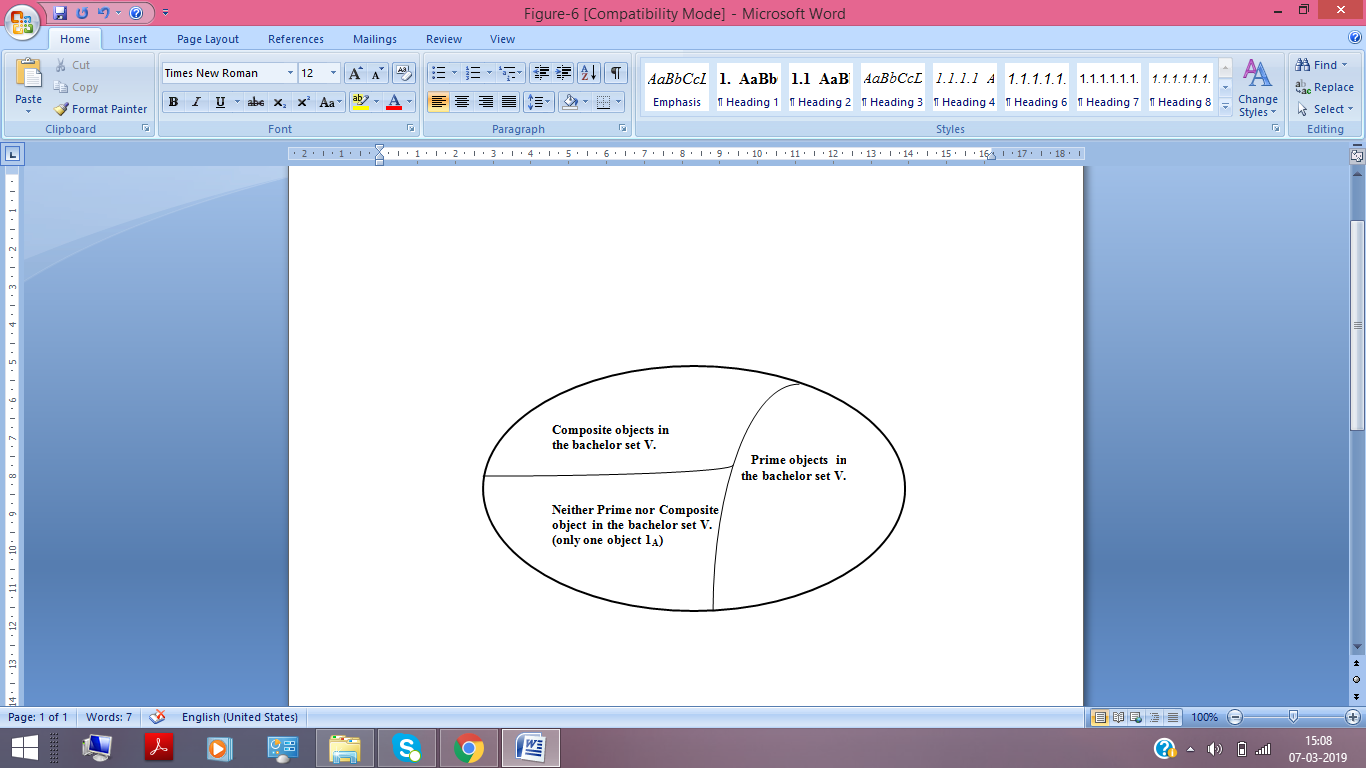
For a bachelor set V in a region A, an important partition of the set V can be made into three subsets: the set of Prime objects in V, the set of Composite objects in V, and the set of neither Prime nor Composite objects in V, as shown in Figure 6.1. This is a partition of the bachelor set V because there can not be any object in the set V which is both a prime object and a composite object simultaneously in V.

The following theorem is now straightforward.
Theorem 6.5
If x is a prime (composite) object in a bachelor B of a region R then x-1 is a prime (composite) object in the conjugate bachelor  , and conversely.
We present below examples of the notion of prime objects and composite objects in a bachelor set in a region.
Example 6.3
Consider the region RR. Consider the bachelor set N of the region RR where N = {1, 2, 3, 4, 5, 6, 7, 8, …} = the set of natural numbers.
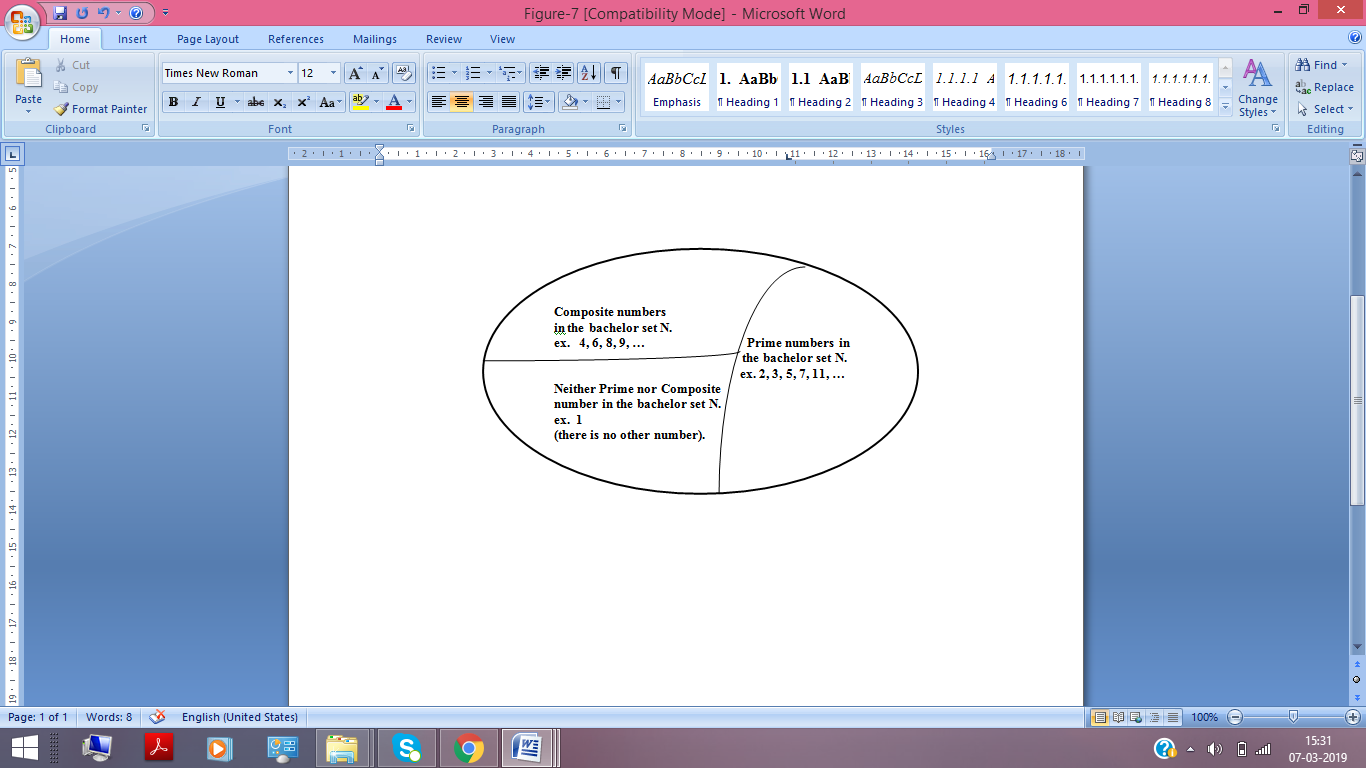
Clearly, the members 4, 6, 8, 9, 10, 12, 14,.…. are composite objects of the bachelor N here in the region RR; and the members 2, 3, 5, 7, 11, 13,.… are prime objects of the bachelor N in RR. Actually these are popularly known as ‘composite numbers’ and ‘prime numbers’ respectively in the existing literature of the classical ‘Theory of Numbers’. There can not be any object in the bachelor N which is both prime and composite. It is known to us that a prime number (or a prime) is a natural number greater than 1 that has no positive divisors other than 1 and itself. A natural number greater than 1 that is not a prime number is called a composite number.
And 1 is the only object in the bachelor N which is neither a prime object nor a composite object (see Figure 6.2). There is no object in the bachelor N which is both prime and composite object. In fact this is a very much known result in the existing classical ‘Theory of Numbers’ that the integer 1 is neither a prime number nor a composite number.

Another example of prime and composite objects is given below.
Example 6.4
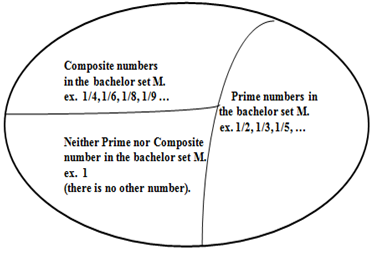
Consider the region RR. Consider the bachelor set M of the region RR where M = {1, 1/2, 1/3, 1/4, 1/5, 1/6, 1/7, 1/8, …} = { m: m = 1/n, n  N, where N is the set of natural numbers}. Clearly, the members 1/4, 1/6, 1/8, 1/9, 1/10, 1/12,..… are composite objects of the bachelor M here in the region RR; and the members 1/2, 1/3, 1/5, 1/7, 1/11, 1/13,..… are prime objects of M in RR (see Figure 6.3). And 1 is the only object in the bachelor M which is neither a prime object nor a composite object. There is no object in the bachelor M which is both prime and composite.
Example 6.5
Consider the bachelor L = {1, 78.261, 9287, 83.5} of the region RR. Clearly, the members 78.261, 9287, 83.5 are prime objects in the bachelor L; there does not exist any composite object in L. And 1 is the only object in the bachelor L which is neither prime object nor composite object. There can not be any object in any bachelor which is both prime and composite (which may be verified to be true for the bachelor L here).
The above mentioned examples show that the classical prime numbers (in the existing classical ‘Theory of Numbers’) are particular case of prime objects in the region RR with respect to its bachelor set N. It may be noted that the notion of prime objects and composite objects are defined over any region, need not necessarily be in a complete region.

History is regarded to be one of the greatest source of energy which encourages for new thoughts. For a quick visit to the history of numbers, one could see 4, 5, 6, 7 8, 9, 10, 11. First of all let us re-visit in very brief the history of the imaginary number i.
7.1. History of the Imaginary Number i in BriefIn the existing mathematics i is the only imaginary number. But imaginary number i wasn’t instantly created, instantly accepted by the mathematicians. It took several centuries to convince certain mathematicians to accept this new number i, and people now use i in everyday mathematics. History (see ( 5, 6, 7, 12, 13) says that the imaginary number i (or the concept of the square root of a negative number) was generally not accepted, understood, or used in mainstream mathematics for roughly 200 to 300 years after its first significant appearances in the mid-16th century. Gerolamo Cardano (1545) and Rafael Bombelli (1572) first encountered and documented the manipulation of imaginary numbers (calling them "sophistic" or "più di meno") while solving cubic equations. But the mathematicians treated them as useless or fictitious. René Descartes coined the term "imaginary" in 1637, intending it to be a derogatory label. The concept did not become widely accepted until Leonhard Euler introduced the symbol i for the square root of the negative number -1 in the year around 1777, and later Carl Friedrich Gauss formalized the geometric interpretation of complex numbers (see ( 2, 3) in the early 19th century. Therefore, from Bombelli's formalization in 1572 to Euler's adoption in the late 1700s, the concept of the imaginary number i spent over two centuries (about almost 300 years) in a "limbo" of skepticism. In other words, the number i was not accepted for about 300 years by the mathematicians as an useful concept for Number Theory.
Today i has huge applications and very important applications in STEAM subjects. For example, it is used in studying various kinds of infinite series, to study that every polynomial equation has a solution if complex numbers are used, and there is a large list to mention the application domains of i in mathematics. Besides that, engineers use i it to study stresses on beams and to study resonance, complex numbers are used to study the flow of fluid around objects like water flowing around a pipe, complex numbers are used in electric circuits, and help in transmitting radio waves, etc. Thus it is a revolutionary issue that i was created and accepted to be an essential element to enrich the subject mathematics. The surviving record of history of mathematics says that people were trying to use imaginary number even in 1st century. In 50 A.D., Heron of Alexandria studied the volume of an impossible section of a pyramid. But the problem then arose while facing to compute the value of  , and consequently he gave up his attempt. After that for a very long time, none took interest to deal with imaginary number, although it wasn’t for a lack of trying. In around 1500 A.D., the peculiar issue of computing square roots of negative numbers was reconsidered. Formulas for solving 3rd and 4th degree polynomial equations were discovered, and people realized that the necessity of work with square roots of negative numbers is genuine to proceed further for extension of the subject mathematics. In 1545 the first major work with imaginary numbers was the book entitled Ars Magna by Girolamo Cardan, in which he solved the equation x(10-x) = 40 and found the answer 5
 . Although he successfully found the answer, but he did not like imaginary numbers to be included in mathematics as an element for study. Rather his comment about such solution was “as subtle as it would be useless”, and referred to working with the imaginary numbers as a kind of “mental torture.” Most of the mathematicians supported Cardan for nearly one century years of time!. It is Rene Descartes who introduced the standard form a
 b
b for complex numbers in 1637 A.D. But, it is again a fact that Descartes too didn’t like complex numbers in mathematics. However Euler in 1777 used the symbol i to stand for √-1, writing the complex number a
 b
b in the form a+ib which seems to be now easier to the mathematicians. Argand in 1806 proposed how to plot complex numbers in a plane, and thereafter this plane is being called by ‘Argand Plane’. In 1833, Hamilton proposed to express complex numbers as pairs of real numbers, like as the complex number a+bi to be expressed as (a,b). Although this idea was simple but it made the topic more popular and useful in a easy manner. It took several genius mathematicians such as Weierstrass, Schwarz, Dedekind, Holder, Poincare, Eduard, Burnet, Cauchy, Niels Henrik Able, Mobius, to name a few only out of many, to work several years to convince the world to accept complex numbers.
In the Theory of Objects, a new concept of ‘imaginary object’ is introduced. It is observed that the classical concept of ‘imaginary numbers’ (or, complex numbers) are just one particular instance of the notion of ‘imaginary objects’. Although the birth of the ‘imaginary numbers’ took place long before, but interestingly it is observed now that the same happened out of a very particular ‘region’, not out of a set or out of any algebraic structure of Key List!!. It is explained that by virtue of their respective definitions and independently owned properties, no algebraic structure alone of the Key List can produce a sound theory on the prime numbers, composite numbers, imaginary numbers and complex numbers.
7.2. Philosophy Behind the Initiatives Taken for Introducing the “Theory of Im-Numbers”The basic philosophy introduced in the Theory of Objects is that the status ‘imaginary’ is purely local with respect to the region concerned. According to this philosophy, one object could be imaginary with respect to one set, and may not be imaginary with respect to another set.
This could be realized by an example of our social life. See that a person Mr.P may be a ‘guest’ for a family F1 but could be well a ‘core member’ of another family F2 in our human society!. The status of ‘guest’ for Mr.P is thus here is thus with respect to the family F1 (the status ‘guest’ being a recognition for Mr.P local to the family F1). At the same time the status of Mr.P as a ‘core family member’ is also a local issue with respect to another family F2 but not with respect to the family F1. In the family F2, the person Mr.P is not guest.
For another example, a person may be a ‘foreigner’ in one country C1, but he is very well a true citizen of another country C2! The status of ‘foreigner’ is thus local property with respect to the country C1, and similarly the status of ‘bonafide citizen’ is also a local issue with respect to the other country C2. Thus every country in this world has the concept of ‘bonafide’ citizen, and the concept of ‘foreigner’ with respect to its local properties and constitutions.
With the same philosophy in mind, in our work in the “Theory of Objects” it is shown that 8i is an imaginary object for the set R but not so for the set C of complex numbers. In “Theory of Objects” here, a new concept is introduced that the set of complex numbers C itself has its own imaginary objects.
Austrian-British philosopher Ludwig Wittgenstein, one of the greatest philosopher of the 20th century, said that: “There is no such thing as doing mathematics without a philosophy of mathematics”. Even Einstein also said: “Pure mathematics is, in its way, the poetry of logical ideas”.
In our work in the next sections, two imaginary objects e and w are unearthed for the set C and then a new theory called by the ‘Theory of Compound Numbers’ is developed in mathematics. In fact it is shown here that every complete region has at least one imaginary object.
7.3. “Imaginary Objects” and “Complex Objects”In this section we introduce the notion of ‘imaginary objects’ of a region. However, we will also see here that a region A may or may not have imaginary object. A region even may have more than one imaginary objects too. Imaginary objects of a region A are not members of A and so they are called ‘imaginary’ with respect to the concerned region A only (i.e. it is purely a local characteristics property with respect to the region concerned). An imaginary object of a region A could be core member of some other regions (other than A). Consequently, a core member of a region A could be imaginary object of some other region(s). Just imagine an analogous concept that a person Mr. P may be a stranger to a family, but he is a core member of another family. And similarly a person Mr. P may be the core family member of a family but he may be a stranger to many families. Thus an object of a region A could be an imaginary object of another region B, but can not be an imaginary object of the same region A itself. Every region has its own set of imaginary objects (if exist). This set could be null set too for a region. Two sets of imaginary objects corresponding to two distinct regions may be disjoint or overlapping.
Consider an extended region AE of the region A = (A, ,*,
,*, ). For the region A, any member of the set A is called a “real object” of the region A.
We present here an important set of two conditions called by ‘Qualification Conditions’ which are to be fulfilled in order to have guarantee that there exists at least one Imaginary Object of a Region A.
Valid Expression in a Region
Let E1(x) and E2 (x) be two single variable expressions valid in the region A. In mathematics we say that an expression is regarded to be a valid expression in a region A if it can be computed in A with the valid operations of A, assuming the inclusion of two infinities in A. Thus for a valid expression E(x), every computed value of E(x) for any x of A must be in the extended region of A.
Constant Expression in a Region
Let E(x) be a single variable expression valid in the region A. Then an expression like E(x)  a, where a is a given real object of A, is called a constant expression in A.
We define here two necessary conditions to be fulfilled for existence of an Imaginary Object of a region A.
Consider two distinct valid expressions E1(x) and E2 (x) in the extended region of A. Then we say that the region A has an ‘imaginary object’ if the following two conditions are fulfilled:
(i). at least one of the two expressions E1(x) and E2 (x) is not a constant expression in the region A, and
(ii). the equality (not identity) E1(x) = E2(x) is not satisfied by any element of the extended region of A.
These two conditions are called ‘Qualification Conditions’ corresponding to the pair of distinct expressions E1(x) and E2 (x) which are necessarily to be fulfilled for possible existence of an imaginary object of the region A.
We may choose infinite number of pairs of expressions for E1(x) and E2 (x) over a given region A. But there is no method described here for choosing two appropriate expressions for E1(x) and E2 (x) which can offer us or guarantee us the existence of at least one imaginary object of the region A. At present let us do the exercise by trial and failure to explore the possibility of the existence of at least one imaginary object of the region A.
For example, if we choose two distinct expressions f(x) = 2x+3 and g(x) = 7 then the pair of functions f and g satisfies the condition(i) of the ‘qualification conditions’ in the region R, but does not satisfy the condition(ii).
If we choose two distinct expressions f(x) = x+3 and g(x) = x+7 then the pair of functions f and g satisfies the condition(i) of the ‘qualification conditions’ in the region R, but does not satisfy the condition(ii) because the infinity objects of the extended region of R satisfy the equation f(x) = g(x).
However, if we choose two distinct expressions f(x) = x2+4 and g(x) = 0, then the pair of expressions f and g satisfies both the conditions of the ‘qualification conditions’ in the region R.
Consider the region C. If we choose f(z) = 5z+3 and g(z) = 9+3i then the pair of distinct functions f and g satisfies the condition(i) of the ‘qualification conditions’ in the region C, but does not satisfy the condition(ii). But if we choose f(z) = 5+3i and g(z) = 9+3i then the pair of these distinct functions f and g does not satisfy the condition(i) of the ‘qualification conditions’ in the region C.
If we choose two distinct expressions f(z) = z+3i and g(z) = z+7i then the pair of functions f and g satisfies the condition(i) of the ‘qualification conditions’ in the region C, but does not satisfy the condition(ii) because many of the infinity objects of the extended region of C satisfy the equation f(z) = g(z).
Now let us suppose that i is an imaginary object of the region A coming out of the equation E1(x) = E2(x) where E1(x) and E2 (x) are two valid distinct expressions in the extended region of A satisfying the above two conditions. Then we accept that both E1(i) and E2(i) can be computed satisfying the equality E1(i) = E2(i).
Suppose that E1(i) = E2(i) = a (say). Here a is obviously a member of the region A, but i is not a member of the region A.
Let us designate this imaginary object i of A to be an atomic imaginary object. Then any expression E(i, x1, x2, x3, …., xn) with respect to the operations  ,*,
,*, of the region A over its outer field F is called a “complex object” of the region A if the value of E(i, x1, x2, x3, …., xn) is not a member of the extended region of A, where the variables x1, x2, x3, …., xn assume objects from A. There may exist nil or one or more number of atomic imaginary object in a region A, and corresponding to every imaginary object (if exists) there exists a set of complex objects of the region A.
It may be noted here that by definition (as stated and explained above) we can only realize about the existence of an imaginary object of a region A if exists, but we can not trace its identity immediately. Because an imaginary object of a region A is not a member of A, and consequently we do not know where we can search it from, where it has come from. It is fact that on this issue we officially know nothing beyond the boundary of the set A at this stage. It is an open problem to us at this moment for further study and research on this issue.
Example 7.1
Consider the region RR. If we take E1(x)  x2 +1 and E2(x)
  2x - 1, then E1(x) and E2(x) are distinct satisfying both the conditions of the ‘Qualification Conditions’. Therefore, there exists at least one imaginary object of RR.
If we take E1(x)  x2 +1 and E2(x)
  0, then in this case too we observe that both the ‘Qualification Conditions’ are fulfilled. This guarantees that the RR region does have at least one imaginary object.
But, by the above examples, we are not sure here whether there exist only finite number of imaginary objects or infinite number of imaginary objects for the region RR.
Example 7.2
Consider the region RR. Let us take two distinct expressions E1(x)  3/(x-1) and E2(x)
  3/(x-4). Then we can not conclude from this example whether there exists at least one imaginary object of the region RR, although both E1(x) and E2(x) are valid expressions E1(x) and E2 (x) in the extended region of RR. It is in fact because of the reason that the condition(ii) of the ‘Qualification Conditions’ is not fulfilled here.
Example 7.3
Consider the region RR. Let us take E1(x)  3/(x-1) and E2(x)
  7/(x-4). Then we can not conclude from this example whether there exists at least one imaginary object of the region RR.
Example 7.4
Consider the simple trivial region ( Z2, ,. ,.) where Z2 = {0, 1},
  is the “addition modulus 2” operator and ‘.’ is the ‘multiplication modulus 2’ operator of real numbers. We see that if we consider the two expressions E1(x)
  2x+1 and E2(x)
  0 in the region ( Z2,
 ,. ,.) , then we observe that the ‘Qualification Conditions’ are fulfilled here. Therefore, there exists at least one imaginary object of this region Z2.
However, if we take E1(x)  x2 +1 and E2(x)
  0 then it does not help us to know the existence of any imaginary object of Z2. It is in fact because of the reason that the condition (ii) of the ‘Qualification Conditions’ is not fulfilled here for Z2.
The following theorem is thus obvious.
Theorem 7.1
Every complete region has at least one imaginary object.
7.4. Im-numbers and Imaginary Numbers: Rim and CimInstead of any region A = (A, ,*,
,*, ), let us consider now a particular region RR. Since RR is a complete region, its characteristic is zero. Therefore according to the Theorem 7.1. it has at least one imaginary object. In the Theory of Objects, let us call these imaginary objects of the region RR by a special name ‘imaginary numbers’.
But now there arises a conflict (of title) because of the fact that the existing ‘Theory of Numbers’ has also a notion of ‘imaginary numbers’. To avoid confusion between the existing concept of ‘imaginary numbers’ and our notion of ‘imaginary numbers’ for the particular region RR, we will henceforth call our new notion of ‘imaginary numbers’ by the abbreviated term ‘im-numbers’. It is obvious that all the imaginary numbers are im-numbers, but at this moment we can not answer whether the converse is true or not. In other words, we can not answer to the question: “Is there any im-number which is missing in the imaginary numbers? The reason behind the evolution of such a kind of doubt will be clear here.
We call the im-numbers for the set of real numbers R by the term R-im or rim (in short). The existing ‘Theory of Numbers’ says that i (=  ) is a rim.
Similarly, if there exist ‘imaginary objects’ of the region C of complex numbers then we will call each of them by the term C-im or cim (in short).
For a given object z of a region A, if  x
x  A such that x2 = z then we say that x is a real square root object (or, simply may be called ‘square root’) of the object z, denoted by the notation
  = x.
= x.
An object of a region A may have nil or more number of real square roots. Clearly 0A is the only objects for which the object itself is the square root of itself. However 1A may have more than one square roots which are 1A and ~1A.
Example 7.5
Consider the region RR. Clearly the object 9 of RR has a square root and the object -9 does not have any square root. Hence -9 has at least one imaginary square root. It implies that the region RR does have at least one imaginary object.
For a given object z of a region A, if  x
x  A such that xn = z then we say that x is a real nth root object (or, simply may be called ‘nth root’) of the object z denoted by
  , where n is a positive integer.
An object may have nil or more number of real nth roots. In case, for a given z the equation xn = z is not satisfied by any x  A, then we say that z has at least one ‘imaginary nth root’; and at the same time we understand the existence of at least one ‘imaginary object’ of the region A.
For an arbitrary region A, knowing about the ‘possible existence’ of some imaginary objects of it is not a straightforward task. Consequently, knowing the ‘identities’ of the imaginary objects of it (if exist) is also not a straightforward task, unlike knowing the imaginary objects of the region RR which is a particular case. Nevertheless, according to our Theory of Objects there is no guarantee at this stage that: “the set of all imaginary objects of the region RR is exactly equal to the set of complex numbers”. It is an open problem now for us. However it is now guaranteed that the classical set C of complex numbers is a subset of the set of all imaginary objects of the region RR.
Consider a region A. For two objects x and y of the region A, the logarithm of an object x to the base y is denoted by the notation logy(x) which is the real number b such that yb = x. We will discuss the issue for x = 0A or for y = 0A later on. We could see that if A and B are two distinct complete regions, then the real numbers like  (i.e. logarithm of the object 4A to the base 2A) and
  are not equal. The objects like 4A , 4B etc. are introduced later here.
In this section we discover a new concept termed as “Compound Numbers”: which is another new direction unearthed in the classical ‘Theory of Numbers’.
Consider the two distinct expressions f(x)  x2 + 1 and g(x)
  0. Clearly f and g satisfy the qualification conditions. There is no x in the region RR (set R) which satisfies the equation f(x) = g(x). It indicates that there is at least one rim in R.
It is in fact well known to everybody that R has one rim which is i (=  ). At this moment we will not debate on the issue “How many distinct atomic rims R does have of kind i”, unless we do further work on it. As in the existing literatures on the classical Theory of Numbers, there is one and only one atomic rim which is i, of course along with infinite number of other rims of kind (a+ib).
Now let us go for the following analysis very carefully:
The analysis is done with the help of examples.
Consider the region C. Consider the function f: C → C given by
f(z) = (|z|2 + 2) + 3i.
Consider another function g: C → C given by
g(z) = 1 + 3i.
Both f and g are functions of complex variable. It is obvious that f(z) is not a constant expression. It outputs different results for different values of z in general. Now, it may be observed that there is no object z of the region C which satisfies the equation f(z) = g(z). Thus the pair of expressions f(z) and g(z) satisfies the ‘Qualification Conditions’ which are necessarily to be fulfilled for possible existence of an imaginary object of the region C. Consequently, it indicates that there is at least one imaginary object (cim) in C. Say e is one atomic cim in C generated from the above equation f(z) = g(z). It means that e is an imaginary object of C for which the equality f(e) = g(e) = z0 holds good, where z0  C. And hence we define this imaginary object e for the region C to be such that |e| = i.
Clearly e does not belong to C (analogous to the statement that: i does not belong to R). Therefore e can not be written in the form of e = a+ib where a, b are real numbers. The notion of rim i has provided the mathematicians a unique scope to solve any real equation of type f(x) = g(x) where both f(x) and g(x) are simultaneously not constant functions with unequal values. Similarly the notion of cim e has provided the scope to solve a complex equation of above type f(z) = g(z) where both f(z) and g(z) are simultaneously not constant functions with unequal values.
Both i and e are philosophically discovered in a common way. See that on executing an operation over i the result happens to be in R, and similarly on executing an operation over e the result happens to be in C. Because square of i is in R and modulus of e is in C.
Let us now solve the following problem to show an application of e in Mathematics.
Problem 8.1
Solve the complex equation
|f(z)|2 +z = g(z),
where f(z) = (4+3i)z+(3-5i) and g(z) = z-1.
If we solve this complex equation, we get one of its roots given by z = z1 + e z2,
where z1 =  and z2 =
  .
.
It is to be noted that i is an im-member of the region R, not of the region C. And similarly e is an imaginary member of the region C, not of the region R. Thus for the real objects z1 and non-zero z2 of C, if e is one cim of C then the object d = (z1 + e z2) is not a member in C, i.e. d is not a real object of C (this situation is analogous to the case where for x1 and non-zero x2 of R, the object d = (x1 + i x2) is not a member in R). Such an object d = (z1 + e z2) is a complex object of the region C and is called by the term compound number in C.
A cim or a compound number of C is not a core member of C. It has taken birth by virtue of the definition of ‘imaginary object of a region’ as defined earlier here.
Problem 8.2
Next let us consider another example as below.
Consider the region C. Consider the function f: C → C given by
f(z) = z + arg(z).
Consider another function g: C → C given by
g(z) = 2z.
Both f and g are functions of complex variable. It is obvious that f(z) is not a constant expression. It outputs different results for different values of z in general. Similarly g(z) is also not a constant expression as it outputs different results for different values of z. Now, it may be observed that there is no object z of the region C which satisfies the equation f(z) = g(z). Thus the pair of expressions f(z) and g(z) satisfies the ‘Qualification Conditions’ which are necessarily to be fulfilled for possible existence of an imaginary object of the region C. Consequently, it indicates that there is at least one more imaginary object (cim) in C. Say w is the cim in C generated from the above equation f(z) = g(z). It means that w is an imaginary object of C for which the equality f(w) = g(w) = z0 holds good, where z0  C. Clearly w does not belong to C (analogous to the statement that: e does not belong to C, i does not belong to R), but z0 is obviously a member of the region C. Therefore w can not be written in the form of w = a+ib where a, b are real numbers. Thus the notion of cim e has provided the scope to solve here the complex equation of type f(z) = g(z).
It is to be noted that i is an im-member of the region R, not of the region C. And similarly w is an imaginary member of the region C, not of the region R. Thus for the real objects z1 and non-zero z2 of C, if w is one cim of C then the object d = (z1 + w z2) is not a member in C, i.e. d is not a real object of C (this situation is analogous to the case where for x1 and non-zero x2 of R, the object d = (x1 + i x2) is not a member in R). Such an object d = (z1 + w z2) is a complex object of the region C and is another example of compound number in C.
The cim w or the compound number of C is not a core member of C. It has taken birth by virtue of the definition of ‘imaginary object of a region’.
8.1. Two Parts of a Compound NumberLet us consider the imaginary object e of the region C. Consider a compound number d = (z1 + e z2) of the region C. Here the complex number z1 is a real object of C and is called the ‘complex part’ of the compound number d; and the complex number z2 is also a real object of C and is called the ‘imaginary part’ of the compound number d.
Similarly let us consider the imaginary object w of the region C and a corresponding compound number d = (z1 + w z2) of the region C. Here the complex number z1 is a real object of C and is called the ‘complex part’ of the compound number d; and the complex number z2 is also a real object of C and is called the ‘imaginary part’ of the compound number d. If d = (9+2i) + w(3-8i) is a compound number of the region C then the complex number (9+2i) is the ‘complex part’ of d and the complex number (3-8i) is the ‘imaginary part’ of d. Both the ‘complex part’ and ‘imaginary part’ of a compound number are complex numbers. As a trivial case the ‘complex part’ of the cim w is (0+i0) and the ‘imaginary part’ is (1+i0). Corresponding to every atomic cim, there exist infinite number of compound numbers.
In general, suppose that R1, R2, R3, ….., Rn are n number of regions. A region may or may not have imaginary object. Even if a region Ri has an imaginary object, we need to explore how many more imaginary objects does Ri have. If ei is an imaginary object of the region Ri and if a, b are real objects of Ri then (a + b ei) is a complex object of the region Ri. However, for the particular region C, its complex objects are called by compound numbers.
8.2. No Confusion about the ‘existence’ of CimIf x is in R then the equation x2 + 1 = 0 is not satisfied by any x of R and thus there may exist one or more solutions of this equation in the form of x = x1 + i x2 which are ‘imaginary objects’ of the region R in the Theory of Objects (which we call as complex numbers in our classical Number Theory). The equation f(z) = g(z) where f(z) = (|z|2 + 2) + 3i and g(z) = 1 + 3i can not be solved for z in C. This situation leads to the existence of at least one cim. Consequently, it is to be very carefully noted that searching for x from R for satisfying the equation x2 + 1 = 0 and searching for z satisfying the equation f(z) = g(z) where f(z) = (|z|2 + 2) + 3i and g(z) = 1 + 3i are basically same type of problems in Mathematics. Only difference is that these two searching problems are to be executed on two different platforms (two different regions). In the first case we do search for real numbers x and y from the jurisdiction R only, whereas in the second case we do search for a complex number z from the jurisdiction C only. We must be careful about our boundary of the concerned region while searching for solutions of valid equations in that region. Thus, there is no confusion in the existence of at least one atomic cim of C, but its further characterization are to be done in future research work.
History says that after the discovery of the rim i for the set R of numbers, a new number system took birth which is the set C of complex numbers. The giant C came into existence by the birth of one object which is i for R. It is to be philosophically viewed that the existing notion of ‘complex numbers’ is with respect to its base-root which is ‘real numbers’. Also for an example, see that ‘5i’ is an imaginary number to the set R, not to the set C!. To the set C, the number ‘5i’ is a core family-member having 100% degree of belongingness in C. It is to be clearly understood that the issue of ‘imaginary’ or ‘complex’ is an relative issue, but local to the concerned region. One object may be a core family (not an imaginary object) to a region A, but it could be an imaginary object to another region B (not a core family member)!.
The set R of real numbers is conceptualized first, and later by the discovery of i the mathematicians discovered the birth of the classical set C of complex numbers. In an analogous way we claim that picking-up the region C and by the discovery of the cim e (and other atomic cims, if exist of C) has led to the discovery of a new set of numbers. Let us call this new set by the set of “Compound Numbers” denoted by E which is corresponding to the imaginary object e. Our immediate need is to discover the fundamental operations on E (like additions, multiplications, etc.) and then to study E as a possible algebra, and more. It is obvious that E forms a group with respect to the binary operator ‘+’ defined as below:
for the compound numbers d1 = z11 + e z12 and d2 = z21 + e z22 of E, define (d1 + d2) by:
d1 + d2 = (z11+ z21) + e (z12 + z22),
which is obviously a compound number in E.
It may be observed that the philosophy behind the birth of i and e is almost analogous. The following table will show a comparative information about the birth and growth of i and e.
Unearthing the cim w has led to the discovery of another new set of numbers. Let us call this new set by the set of “Compound Numbers” denoted by W which is corresponding to the imaginary object w. Our immediate need is to discover the fundamental operations on W (like additions, multiplications, etc.) and then to study W as a possible algebra, and more. It is obvious that W forms a group with respect to the binary operator ‘+’ defined as below:
for the compound numbers d1 = z11 + w z12 and d2 = z21 + w z22 of W, define (d1 + d2) by:
d1 + d2 = (z11+ z21) + w (z12 + z22),
which is obviously a compound number in W.
In the “Theory of Objects”, the two sets E and W of Compound Numbers introduced here are just at their own infant stage, but undoubtedly they are two new sets of numbers discovered here. With a rigorous amount of research work on the two sets E and W of numbers, it will surely take its own shape in future to update the existing classical “Theory of Numbers”. Without giving further justifications, we claim that there are possibly many more sets of numbers (besides the two sets E and W of numbers) yet to be unearthed.
In today’s AI era of this century, most of the complex data being analysed by the researchers are unstructured or semi-structured data, not the data of R or Rn. Consequently, the collected data are not always from R or Rn, but various types of objects. Todays AI-analysts need more support from Pure Mathematics to deal with unstructured or semi-structured data in their everyday analysis and research activities. The “Theory of Objects” is initiated to cater to today’s requirements in the AI-era in this century. “Theory of Objects” corresponding to the particular region R generates the classical “Theory of Numbers”. Some portions of this work were earlier reported in 16, 17 but this work is an extended and improved version. Studying the Theory of Objects using fuzzy numbers and fuzzy logic 18 will be our future research work.
The imaginary number i (or the concept of the square root of a negative number) was generally not accepted, understood, or used in mainstream mathematics for roughly 200 to 300 years since its first significant appearances in the mid-16th century. Gerolamo Cardano (1545) and Rafael Bombelli (1572) first encountered and documented the manipulation of imaginary numbers (calling them "sophistic" or "più di meno") while solving cubic equations. But the mathematicians treated them as useless or fictitious. René Descartes coined the term "imaginary" in 1637, intending it to be a derogatory label. The concept did not become widely accepted until Leonhard Euler introduced the symbol i for the square root of the negative number -1 in the year around 1777, and later Carl Friedrich Gauss formalized the geometric interpretation of complex numbers in the early 19th century. Therefore, from Bombelli's formalization in 1572 to Euler's adoption in the late 1700s, the concept spent over two centuries (about almost 300 years) in a "limbo" of skepticism. Austrian-British philosopher Ludwig Wittgenstein, one of the greatest philosopher of the 20th century, said that: “There is no such thing as doing mathematics without a philosophy of mathematics”. Even Einstein said: “Pure mathematics is, in its way, the poetry of logical ideas”. This century is the era of Artificial Intelligence and Quantum Computing. It is expected that in due time the “Theory of Objects and Im-numbers” will play good roles in Mathematics, Statistics, Engineering branches, Medical Science, Data Science, Artificial Intelligence and Superintelligence in the era of AI in this century.
The author is indebted to the Referees for giving valuable suggestions for corrections and improvement of the first version and the second version of the manuscript.
| [1] | Biswas, Ranjit., The existing huge volume of algebraic structures in the subject “ALGEBRA” has few serious hidden gaps and needs fixing in order to validate many of the elementary and important frequently practiced algebraic computations, Indonesian Journal of Mathematics and Analysis, 2026, Vol.1, 35–69 (Open Access) () | ||
| In article | |||
| [2] | Dixon, G.M., Division Algebras: Octonions Quaternions Complex Numbers and the Algebraic Design of Physics. Kluwer Academic Publishers, Dordrecht, 2010. | ||
| In article | |||
| [3] | Rudin, Walter., Real and Complex Analysis. McGraw Hills Education, India, 2006. | ||
| In article | |||
| [4] | Apostol, Tom M., Introduction to Analytic Number Theory. Springer-Verlag. Heidelberg Berlin, 1976. | ||
| In article | View Article | ||
| [5] | Bourbaki, Nicolas., Elements of the History of Mathematics. Springer-Verlag, Berlin, 1994. | ||
| In article | |||
| [6] | Boyer, Carl B. and Merzbach, Uta C., A History of Mathematics, 3rd Edition. John Wiley & Sons, Hoboken, New Jersey, 2011. | ||
| In article | |||
| [7] | Cajori, Florian., A History of Elementary Mathematics – With Hints on Methods of Teaching. Read Books. UK, 2010. | ||
| In article | |||
| [8] | Edwards, Harold M., Fermat's Last Theorem: a Genetic Introduction to Algebraic Number Theory. Graduate Texts in Mathematics. Springer-Verlag. New York, 2000. | ||
| In article | |||
| [9] | Fraenkel, A., Bar-Hillel, Y., and Lev., Foundations of Set Theory. North Holland, Amsterdam, 1973. | ||
| In article | |||
| [10] | Hardy, G.H., Wright, Edward M., Roger Heath-Brown, Silverman, Joseph. and Wile, Andrew., Introduction to the Theory of Numbers. (6th Edition) Oxford University Press, UK, 2008. | ||
| In article | |||
| [11] | Rosen, Kenneth H., Elementary Number Theory (6th ed.). Pearson Education. US, 2010. | ||
| In article | |||
| [12] | Nahin, Paul J., An Imaginary Tale: The Story of √−1, Princeton University Press, ISBN 978-0691127989, retrieved 20 April 2011. | ||
| In article | |||
| [13] | Robbins, Herbert. and Courant, Richard., What is Mathematics?: An Elementary Approach to Ideas and Methods. Second edition, Oxford University Press, New York, 1986. | ||
| In article | |||
| [14] | Acheson, David., The Calculus Story: A Mathematical Adventure, First Edition, Oxford University Press, UK, 2017. | ||
| In article | |||
| [15] | Baron, Margaret E. (2003). The origins of the infinitesimal calculus. Dover Publications, Inc., Mineola, New York. | ||
| In article | |||
| [16] | Biswas, Ranjit., Birth of Compound Numbers, Turkish Journal of Analysis and Number Theory. Vol. 2(6). pp 208-219, 2014. | ||
| In article | View Article | ||
| [17] | Biswas, Ranjit., Region Algebra, Theory of Objects & Theory of Numbers, International Journal of Algebra, Vol. 6 (28) 2012 page 1371-1417. | ||
| In article | |||
| [18] | Biswas, Ranjit., Is ‘Fuzzy Theory’ An Appropriate Tool For Large Size Problems?. in the book-series of SpringerBriefs in Computational Intelligence. Springer. Heidelberg, 2016. | ||
| In article | View Article | ||
| [19] | Bourbaki, Nicolas., Elements of Mathematics: Algebra I. New York: Springer-Verlag, 1998. | ||
| In article | |||
| [20] | Boyer, Carl B., History of Analytic Geometry. Dover Publications, Inc., Mineola, New York, 2004. | ||
| In article | |||
| [21] | Boyer, Carl B., The History of the Calculus and Its Conceptual Development. Dover Publications, Inc., Mineola, New York, 1959. | ||
| In article | |||
| [22] | Copson, E.T., Metric Spaces. Cambridge University Press, 1968. | ||
| In article | View Article | ||
| [23] | Davenport, H., The Higher Arithmetic, Cambridge University Press, 2008. | ||
| In article | View Article | ||
| [24] | Herstein, I. N., Topics in Algebra. Wiley Eastern Limited. New Delhi, 2001. | ||
| In article | |||
| [25] | Hungerford, T., Algebra, Graduate Texts in Mathematics, Vol. 73, Springer-Verlag, New York, 1974. | ||
| In article | View Article | ||
| [26] | Jacobson, N., Basic Algebra I. 2nd Ed., W. H. Freeman & Company Publishers, San Francisco, 1985. | ||
| In article | |||
| [27] | Jacobson, N., Basic Algebra II. 2nd Ed., W. H. Freeman & Company Publishers, San Francisco, 1989. | ||
| In article | |||
| [28] | Jacobson, N., The Theory of Rings. American Mathematical Society Mathematical Surveys. Vol.I. American Mathematical Society. New York, 1943. | ||
| In article | View Article | ||
| [29] | Lang, Serge., Undergraduate Algebra. (3rd ed.). Berlin, New York: Springer-Verlag, 2005. | ||
| In article | |||
| [30] | Leonard E. Dickson, History of the Theory of Numbers (Vol-1), Washington Carnegie Institution of Washington, 1919. | ||
| In article | |||
| [31] | Leonard E. Dickson, History of the Theory of Numbers (Vol-2), Washington Carnegie Institution of Washington, 1920. | ||
| In article | |||
| [32] | Leonard E. Dickson, History of the Theory of Numbers (Vol-3), Washington Carnegie Institution of Washington, 1923. | ||
| In article | |||
| [33] | Ore, Øystein., Number theory and its history, New York, McGraw-Hill Book Co. 1948 | ||
| In article | |||
| [34] | Reyes, Mitchell., The Rhetoric in Mathematics: Newton, Leibniz, the Calculus, and the Rhetorical Force of the Infinitesimal. Quarterly Journal of Speech. Vol. 90. 159-184, 2004. | ||
| In article | View Article | ||
| [35] | Sardar, Ziauddin., Ravetz, Jerry., Loon, Borin Van Loon., Introducing Mathematics. Icon Books Ltd, London, 2015 Reprint edition. | ||
| In article | |||
| [36] | Silverman, Joseph H., A Friendly Introduction to Number Theory, Pearson Education, 2001. | ||
| In article | |||
| [37] | Simmons, G. F., Introduction to Topology and Modern Analysis. McGraw Hill, New York, 1963. | ||
| In article | |||
| [38] | Stillwell, John., Elements of Number Theory, Springer-Verlag New York, 2010 | ||
| In article | |||
| [39] | Van der Waerden and Bartel Leendert., Algebra. Springer-Verlag, New York, 1991. | ||
| In article | View Article | ||
| [40] | Vinogradov, I.M., Elements of Number Theory (reprint of the 1954 ed.). Mineola, NY: Dover Publications. Mineola, New York, 2003. | ||
| In article | |||
| [41] | Waerden, Bartel Leenert Van der., Algebra. Springer-Verlag, New York, 1991. | ||
| In article | |||
| [42] | Watkins, J. J., Number theory: a historical approach, Princeton University Press, 2013. | ||
| In article | |||
Published with license by Science and Education Publishing, Copyright © 2026 Ranjit Biswas
 This work is licensed under a Creative Commons Attribution 4.0 International License. To view a copy of this license, visit
http://creativecommons.org/licenses/by/4.0/
This work is licensed under a Creative Commons Attribution 4.0 International License. To view a copy of this license, visit
http://creativecommons.org/licenses/by/4.0/
| [1] | Biswas, Ranjit., The existing huge volume of algebraic structures in the subject “ALGEBRA” has few serious hidden gaps and needs fixing in order to validate many of the elementary and important frequently practiced algebraic computations, Indonesian Journal of Mathematics and Analysis, 2026, Vol.1, 35–69 (Open Access) () | ||
| In article | |||
| [2] | Dixon, G.M., Division Algebras: Octonions Quaternions Complex Numbers and the Algebraic Design of Physics. Kluwer Academic Publishers, Dordrecht, 2010. | ||
| In article | |||
| [3] | Rudin, Walter., Real and Complex Analysis. McGraw Hills Education, India, 2006. | ||
| In article | |||
| [4] | Apostol, Tom M., Introduction to Analytic Number Theory. Springer-Verlag. Heidelberg Berlin, 1976. | ||
| In article | View Article | ||
| [5] | Bourbaki, Nicolas., Elements of the History of Mathematics. Springer-Verlag, Berlin, 1994. | ||
| In article | |||
| [6] | Boyer, Carl B. and Merzbach, Uta C., A History of Mathematics, 3rd Edition. John Wiley & Sons, Hoboken, New Jersey, 2011. | ||
| In article | |||
| [7] | Cajori, Florian., A History of Elementary Mathematics – With Hints on Methods of Teaching. Read Books. UK, 2010. | ||
| In article | |||
| [8] | Edwards, Harold M., Fermat's Last Theorem: a Genetic Introduction to Algebraic Number Theory. Graduate Texts in Mathematics. Springer-Verlag. New York, 2000. | ||
| In article | |||
| [9] | Fraenkel, A., Bar-Hillel, Y., and Lev., Foundations of Set Theory. North Holland, Amsterdam, 1973. | ||
| In article | |||
| [10] | Hardy, G.H., Wright, Edward M., Roger Heath-Brown, Silverman, Joseph. and Wile, Andrew., Introduction to the Theory of Numbers. (6th Edition) Oxford University Press, UK, 2008. | ||
| In article | |||
| [11] | Rosen, Kenneth H., Elementary Number Theory (6th ed.). Pearson Education. US, 2010. | ||
| In article | |||
| [12] | Nahin, Paul J., An Imaginary Tale: The Story of √−1, Princeton University Press, ISBN 978-0691127989, retrieved 20 April 2011. | ||
| In article | |||
| [13] | Robbins, Herbert. and Courant, Richard., What is Mathematics?: An Elementary Approach to Ideas and Methods. Second edition, Oxford University Press, New York, 1986. | ||
| In article | |||
| [14] | Acheson, David., The Calculus Story: A Mathematical Adventure, First Edition, Oxford University Press, UK, 2017. | ||
| In article | |||
| [15] | Baron, Margaret E. (2003). The origins of the infinitesimal calculus. Dover Publications, Inc., Mineola, New York. | ||
| In article | |||
| [16] | Biswas, Ranjit., Birth of Compound Numbers, Turkish Journal of Analysis and Number Theory. Vol. 2(6). pp 208-219, 2014. | ||
| In article | View Article | ||
| [17] | Biswas, Ranjit., Region Algebra, Theory of Objects & Theory of Numbers, International Journal of Algebra, Vol. 6 (28) 2012 page 1371-1417. | ||
| In article | |||
| [18] | Biswas, Ranjit., Is ‘Fuzzy Theory’ An Appropriate Tool For Large Size Problems?. in the book-series of SpringerBriefs in Computational Intelligence. Springer. Heidelberg, 2016. | ||
| In article | View Article | ||
| [19] | Bourbaki, Nicolas., Elements of Mathematics: Algebra I. New York: Springer-Verlag, 1998. | ||
| In article | |||
| [20] | Boyer, Carl B., History of Analytic Geometry. Dover Publications, Inc., Mineola, New York, 2004. | ||
| In article | |||
| [21] | Boyer, Carl B., The History of the Calculus and Its Conceptual Development. Dover Publications, Inc., Mineola, New York, 1959. | ||
| In article | |||
| [22] | Copson, E.T., Metric Spaces. Cambridge University Press, 1968. | ||
| In article | View Article | ||
| [23] | Davenport, H., The Higher Arithmetic, Cambridge University Press, 2008. | ||
| In article | View Article | ||
| [24] | Herstein, I. N., Topics in Algebra. Wiley Eastern Limited. New Delhi, 2001. | ||
| In article | |||
| [25] | Hungerford, T., Algebra, Graduate Texts in Mathematics, Vol. 73, Springer-Verlag, New York, 1974. | ||
| In article | View Article | ||
| [26] | Jacobson, N., Basic Algebra I. 2nd Ed., W. H. Freeman & Company Publishers, San Francisco, 1985. | ||
| In article | |||
| [27] | Jacobson, N., Basic Algebra II. 2nd Ed., W. H. Freeman & Company Publishers, San Francisco, 1989. | ||
| In article | |||
| [28] | Jacobson, N., The Theory of Rings. American Mathematical Society Mathematical Surveys. Vol.I. American Mathematical Society. New York, 1943. | ||
| In article | View Article | ||
| [29] | Lang, Serge., Undergraduate Algebra. (3rd ed.). Berlin, New York: Springer-Verlag, 2005. | ||
| In article | |||
| [30] | Leonard E. Dickson, History of the Theory of Numbers (Vol-1), Washington Carnegie Institution of Washington, 1919. | ||
| In article | |||
| [31] | Leonard E. Dickson, History of the Theory of Numbers (Vol-2), Washington Carnegie Institution of Washington, 1920. | ||
| In article | |||
| [32] | Leonard E. Dickson, History of the Theory of Numbers (Vol-3), Washington Carnegie Institution of Washington, 1923. | ||
| In article | |||
| [33] | Ore, Øystein., Number theory and its history, New York, McGraw-Hill Book Co. 1948 | ||
| In article | |||
| [34] | Reyes, Mitchell., The Rhetoric in Mathematics: Newton, Leibniz, the Calculus, and the Rhetorical Force of the Infinitesimal. Quarterly Journal of Speech. Vol. 90. 159-184, 2004. | ||
| In article | View Article | ||
| [35] | Sardar, Ziauddin., Ravetz, Jerry., Loon, Borin Van Loon., Introducing Mathematics. Icon Books Ltd, London, 2015 Reprint edition. | ||
| In article | |||
| [36] | Silverman, Joseph H., A Friendly Introduction to Number Theory, Pearson Education, 2001. | ||
| In article | |||
| [37] | Simmons, G. F., Introduction to Topology and Modern Analysis. McGraw Hill, New York, 1963. | ||
| In article | |||
| [38] | Stillwell, John., Elements of Number Theory, Springer-Verlag New York, 2010 | ||
| In article | |||
| [39] | Van der Waerden and Bartel Leendert., Algebra. Springer-Verlag, New York, 1991. | ||
| In article | View Article | ||
| [40] | Vinogradov, I.M., Elements of Number Theory (reprint of the 1954 ed.). Mineola, NY: Dover Publications. Mineola, New York, 2003. | ||
| In article | |||
| [41] | Waerden, Bartel Leenert Van der., Algebra. Springer-Verlag, New York, 1991. | ||
| In article | |||
| [42] | Watkins, J. J., Number theory: a historical approach, Princeton University Press, 2013. | ||
| In article | |||