sciepub.com
 Quick Submission

Frontal Sinus Fracture Management in The Endoscopic Surgery Era; A case report and Review of Literature
Mazen Almasri1, , Ebtesam Aljerb2, Hanan Shanab3
1Umm Alqura University, King Abdulaziz Medical City, National Guard Hospital / Jeddah, Saudi Arabia
2Saudi Board of Oral Maxillofacial Surgery, Ministry of Health, Saudi Arabia
3Saudi Board of Oral Maxillofacial Surgery, King Abdulaziz Medical City, (National Guard Hospital / Jeddah), Saudi Arabia
Abstract
Frontal bone fractures and frontal sinus outflow tract (FSOT) disruption usually approached through open reduction and internal fixation of the sinus wall with obliteration of the (FSOT) using different materials to aid in sealing the cavity away off the brain. However, in the last decades there has been an increasing trend toward preserving the intact mucosa at the sinus and the tract through the use of drug eluting stents. In our report, we present a case of an 18 years old male patient treated via open reduction and internal fixation of a displaced anterior frontal bone fracture with endoscopic tract stenting, that provided eluting corticosteroid (Kenalog) as anti-inflammatory medication of intermittent release.
Keywords: frontal bone, fracture, sinus outflow tract, sinus stent endoscope, steroid
Copyright © 2015 Science and Education Publishing. All Rights Reserved.Cite this article:
- Mazen Almasri, Ebtesam Aljerb, Hanan Shanab. Frontal Sinus Fracture Management in The Endoscopic Surgery Era; A case report and Review of Literature. Oral Surgery, Oral Medicine, Oral Radiology. Vol. 3, No. 2, 2015, pp 25-28. http://pubs.sciepub.com/oral/3/2/1
- Almasri, Mazen, Ebtesam Aljerb, and Hanan Shanab. "Frontal Sinus Fracture Management in The Endoscopic Surgery Era; A case report and Review of Literature." Oral Surgery, Oral Medicine, Oral Radiology 3.2 (2015): 25-28.
- Almasri, M. , Aljerb, E. , & Shanab, H. (2015). Frontal Sinus Fracture Management in The Endoscopic Surgery Era; A case report and Review of Literature. Oral Surgery, Oral Medicine, Oral Radiology, 3(2), 25-28.
- Almasri, Mazen, Ebtesam Aljerb, and Hanan Shanab. "Frontal Sinus Fracture Management in The Endoscopic Surgery Era; A case report and Review of Literature." Oral Surgery, Oral Medicine, Oral Radiology 3, no. 2 (2015): 25-28.
| Import into BibTeX | Import into EndNote | Import into RefMan | Import into RefWorks |
At a glance: Figures
1. Introduction
The frontal bone is an important component of the facial skeleton since it links the cranium to the face. The frontal bone injuries commonly associated with other injuries to the skull, orbits, midface, and the overlying soft tissue [1, 2]. Thus, treating a frontal sinus fracture is considered a challenge to the maxillofacial surgeons requiring multidisciplinary evaluation and planning to avoid early or late complications such as cerebrospinal fluid (CSF) leaks, meningitis, brain abscesses, sinusitis, mucoceles, mucopyoceles and osteomyelitis [2, 3]. With the advanced technology in imaging and endoscopic instrumentation of the craniofacial procedures, more accurate diagnosis has been provided with increasing emphasis on preserving a “safe sinus” to restore function and ventilation especially among younger patients.
2. Case Report
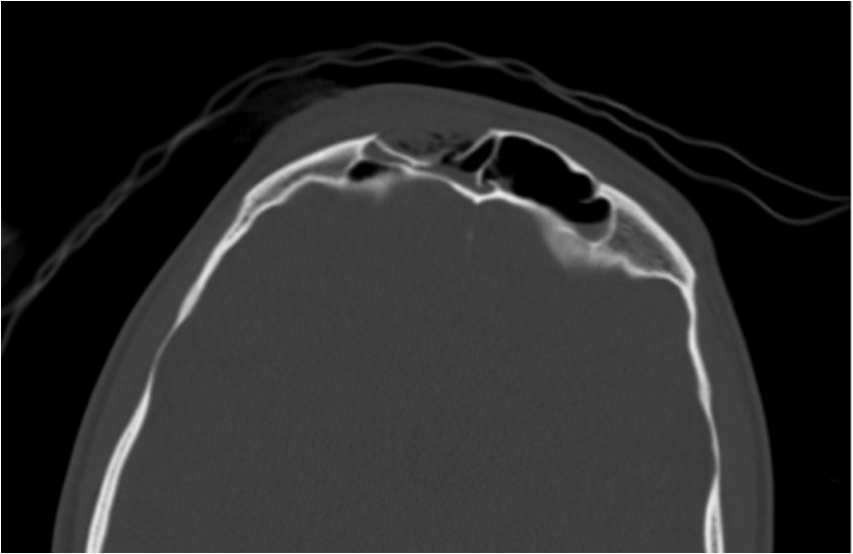
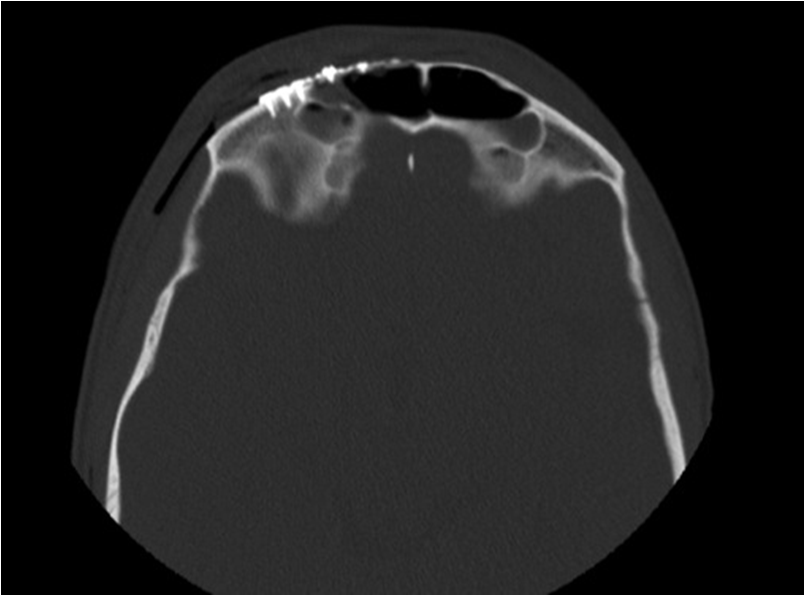
An 18 years old male patient presented to King Abdulaziz Medical City (KAMC) in Jeddah, in squeal to motor vehicle accident (MVA). The patient is not known to have any chronic medical illness, allergy, nor history of loss of consciousness. Upon clinical and radiographic investigations he was found to have anterior frontal sinus wall fracture with moderate forehead depression and minimal epistaxis. The eye examination was insignificant, and no rhinorrhea was detected neither forehead paresthesia (Figure 1). After reviewing the patient’s laboratory investigations, the patient was consented for open reduction and internal fixation of the anterior table of frontal bone using microplates and screws in addition to plan placing a Kenalog eluting stent of the FSOT by the rhinology/ rhinoscopy team to aid in preserving the sinus function.

 Download as

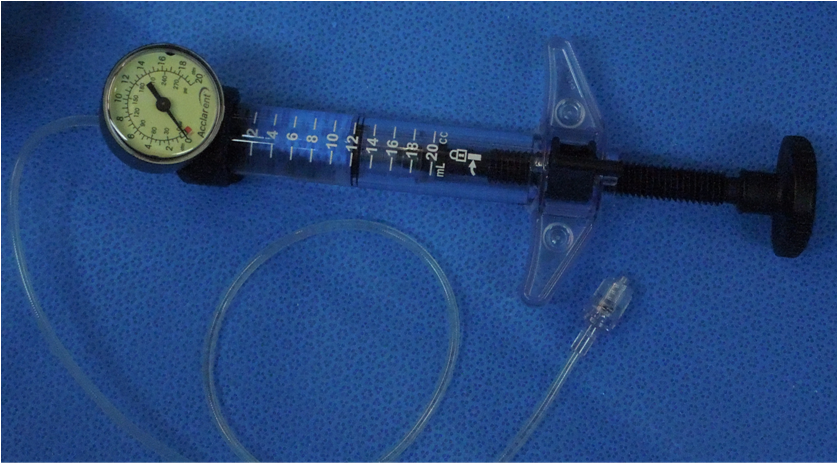
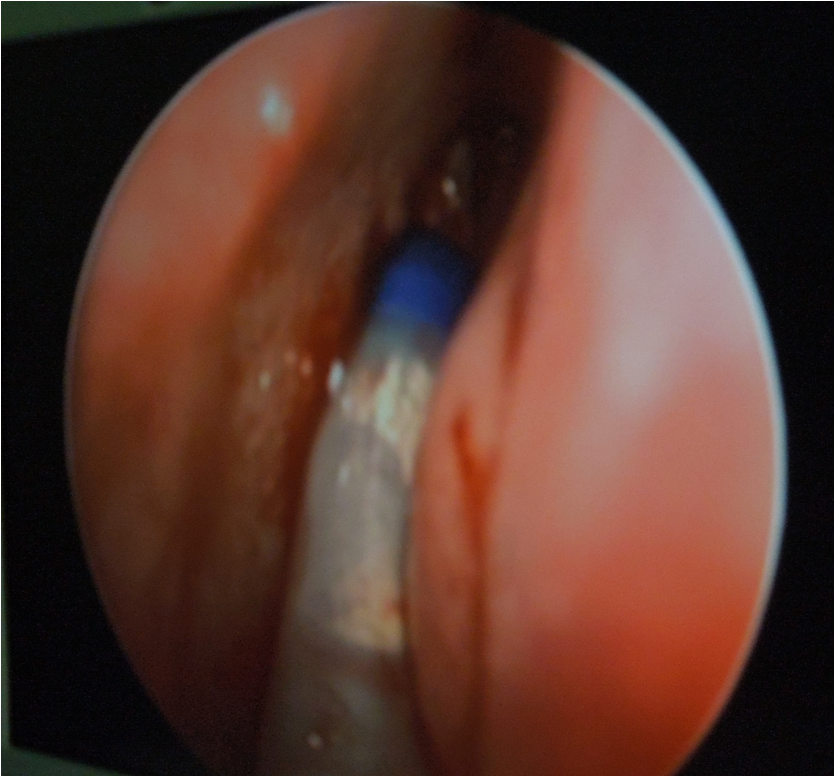
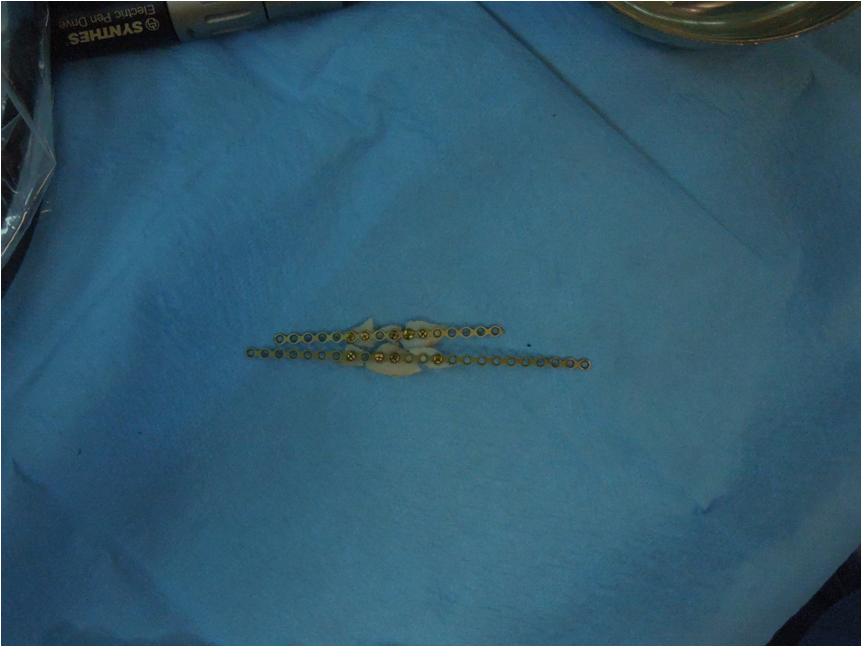
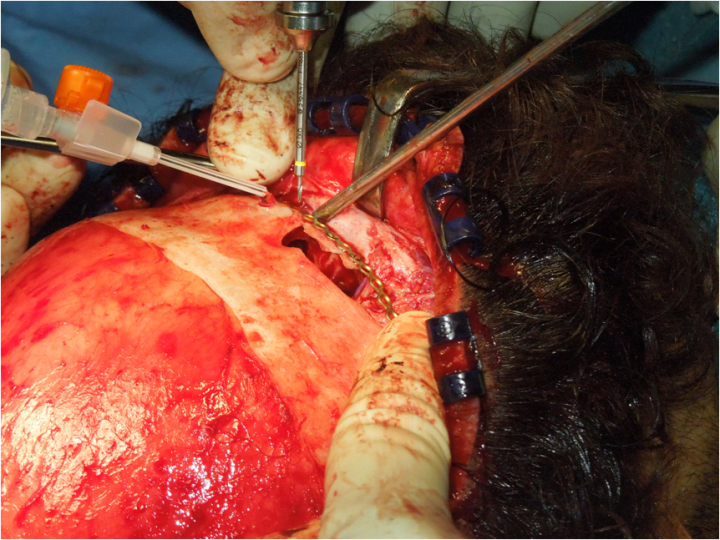
In the operating room, the patient was placed in 15 degrees reverse Trendelenberg supine position, the monitors were installed, and an orotrcaheal intubation was accomplished. The patient prepped and draped in the routine fashion and local anesthesia of 2% Lidocaine with 100:000 epinephrine concentration was injected at the coronal / frontal incision site. A coronal incision was attempted, Ryne’s clips inserted, and the coronal flap was reflected to expose the fractures at the anterior table of frontal bone. All the comminuted bony pieces were collected and oriented in an outside table to be used later on for reconstructing the anterior table. The comminuted pieces were fixated together using microplates then preserved in normal saline. Then, the ENT rhinoscopy team evaluated the FSOT through nasal endoscopy, which found to be damaged and obstructed. After careful attempts the tract was reopened and a stent was inflated then left in situ. The Silastic stent has Kenalog intermittent drug eluting criteria aiming to reduce the chances of future fibrosis (Figure 2, Figure 3). Thereafter, reconstruction of the anterior table was established using 2 pieces of 1.5mm microplates and screws (Figure 4, Figure 5). Next, copious irrigation using normal saline was performed, hemostasis was confirmed, Jackson Pratt (JP) suction drain was inserted and primary closure was achieved in layers.
 Download as
 Download as
 Download as
 Download as
The patient immediate follow up visits were uneventful, and 4 weeks later the ENT team removed the stent. Follow up visits continued for 12 months with satisfactory esthetic and functioning results (Figure 6).
 Download as
3. Discussion
Frontal sinuses usually asymmetrical bilateral cavities and in small percentage of people could be unilateral or not existed [1]. The nasofrontal duct (NFD) is a misnomer anatomical term because of the lack of the tubular appearance of the duct in almost 80% of the cases, so it was replaced with better term, the frontal sinus outflow tract (FSOT). Anatomically, the FSOT includes the frontal infundibulum, frontal sinus ostium and frontal recess just inferior to the ostium [1, 3].
Fractures of the frontal sinus represent 5-15% of all fractures of facial skeleton [2, 3, 4]. However, in Saudi Arabia it ranges between 1.8 to 22%, commonly seen in male adults of 20 to 40 years of age and mainly caused by motor vehicle accidents [2, 4]. The anterior table frontal sinus fracture (AFSF) is the most common type of frontal sinus fractures mostly involving the FSOT, reaching the ethmoids, and medial side of superior orbital rim. CT scan is considered to be the gold standard to investigating the cranial injuries having the sagittal images to be superior over the coronals [1, 2]. However, the FSOT integrity should be confirmed intraoperatively, either by nasal endoscopy or clinically by examining the flow using saline, methylene blue dye, radiopaque dye, and/ or Indigo Carmine. Suspected injuries of FSOT should be identified and managed properly as it can lead to obstruction of the tract drainage system, impairment of the mucosal function and sinus aeration, accumulation of mucous secretion and subsequently lead to the formation of mucocele and mucopyocele.
With the advancing technology and instrumentation in the surgical field, it is not uncommon of aiming toward conservative approaches over invasive maneuvers. The treatment always based on the complexity and degree of the osseous displacement, the FSOT involvement and the intracranial conditions (CSF leak and dural tear). The choice of observation is considered in case of minimally displaced AFSF with intact FSOT and no CSF leak, as it turns the objectives toward cosmetic goals. While surgical treatment is indicated in displaced (more than a table width) or comminuted frontal bone fractures with considerations toward sinus obliteration and canalization [1, 3]. The surgical plan is designed according to the degree of injuries and involvement of the FSOT. Hence, due to the rarity of the cases, controversies do exist between obliterations versus preservation and sinus stenting.
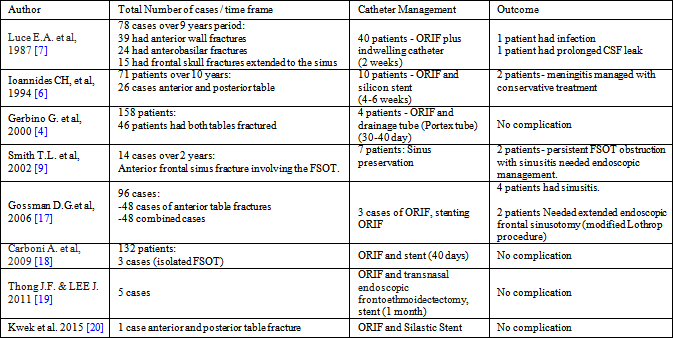
Ioannides et al was the first to apply the drainage system technique for sinus preservation using stents aiming to restore the sinus function and ventilation [6]. The results were promising but the major drawback was the postoperative restenosis after stent removal due to granulation and fibrosis [3, 7, 8]. Afterword, more attempts took place and improving stenting materials, criterion, removal strategy, and involved medications such as triamcinolone, dexamethasone, and doxycyclin took place and started showing better outcomes along the years (Table 1). Especially that such stents can be easily followed up clinically by the use of nasoscope and radiographically using cephalomeric images and CT scans when compared to the obliterated sinuses that can be misleading and present further necrosis of the obliterate materials, sinusitis, or infection [9, 10, 11]. Such stents can be of bioabsorbable characteristic that can be left in situ or removed in 3-6 weeks [13, 14, 15]. Placement of the stents can be in association with the coronal incision that is a favorable environment to examine and place such stents, or it can be placed endonasally via Draf type 2 (Frontosinusotomy) or three (modified Lothrop procedure), or through transcutaneous lateral nasal approach [16]. Postoperatively, systemic antibiotic for 10-21 days, nasal decongestant, saline sprays and sinus precaution instructions are commonly prescribed as needed. [12, 15, 16].
Table 1. Reported cases of frontal sinus fracture and simultaneous outflow tract catheterization. (ORIF: open reduction and internal fixation, CSF: cerebrospinal fluid)


)


4. Conclusion
In the endoscopic surgery era, more conservative management and approaches should be considered when managing frontal sinus injuries especially in younger patients where better healing is a factor of better healing and RTA is still a major threat in areas over another. Hence, using endoscopy for assessing such injuries and management in coordination with a Rhinology/ ENT team might improve the quality of care to such patients. However, long-term follow up is still needed to confirm the functioning sinuses.
Acknowledgment
The authors would like to thank Dr. Essam Alzumaiti and Dr Talal Andejani (ENT Rhinology team, KAMC- Jeddah), Dr Bandar Alharbi (Dentistry – Head of Department), Dr. Abdullah Jawharji (OMFS resident, KAMC), and Dr. Abdulaziz Alghamdi (OMFS-resident, KAMC), for their continuous support toward the maxillofacial reconstruction cases. Furthermore, our deep gratitude to the administration of King Abdulaziz Medical City, KAMC (National Guard Hospital / Jeddah) for their usual cooperation toward advancing the health care in Saudi Arabia.
References
| [1] | Fonseca R.J., Barber H.D, Powers M.P, Frost D.E. Evaluation and Management of Frontal Sinus Injuries. Oral and Maxillofacial Trauma. Fourth edition; 2013:471-490. | ||
 In article In article | |||
| [2] | Almasri Mazen. Severity and Causality of Maxillofacial trauma in the Southern region of Saudi Arabia, Saudi Dental Journal. 2013;(25):107-110 | ||
| In article | |||
| [3] | Gerbino G, Roccia F, Benech A, Caldarelli C: Analysis of 158 frontal sinus fractures: Current surgical management and complications. J Craniomaxillofac Surg. 2000; (28):133-139, | ||
| In article | View Article PubMed | ||
| [4] | Almasri Mazen, Amin D, AboOla A. F, Shargawi J. Maxillofacial Fractures in Makka City in Saudi Arabia; an 8-year Review of Practice. American Journal of Public Health Research. 2015; (3):2: 56-59. | ||
| In article | |||
| [5] | Abdullah W.A, Al-Mutairi K, Al-Ali Y, Al-Soghier A, Al-Shnwani A. Patterns and Etiology of Maxillofacial Fractures in Riyadh City, Saudi Arabia. The Saudi Dental Journal. 2013; (25)1:33-38. | ||
| In article | View Article PubMed | ||
| [6] | Ioannides CH, Fereihofer HP, Friens J. Fractures of The Frontal Sinus: a Rationale of Treatment. Br J Plastic Surg.1993;(46): 208-214. | ||
| In article | View Article | ||
| [7] | Luce EA: Frontal Sinus Fractures: Guidelines to Management. Plast Reconstr Surg.1987;(80): 500-508. | ||
| In article | View Article PubMed | ||
| [8] | Rohrich RJ, Hollier LH. Management of frontal sinus fractures. Changing concepts. Clin Plast Surg. 1992; 19(1):219-232. | ||
| In article | PubMed | ||
| [9] | Smith TL, Han JK, Loehrl TA, Rhee JS. Endoscopic Management of The Frontal Recess in Frontal Sinus Fractures: a Shift in The Paradigm? Laryngoscope 2002; (112): 784-790. | ||
| In article | View Article PubMed | ||
| [10] | Donald PJ, Ettin M. The Safety of Frontal Sinus Fat Obliteration When Sinus Walls Are Missing. Laryngoscope. 1986; (96): 190 -193. | ||
| In article | View Article | ||
| [11] | Chadwell, J.S, Gustafson, L.M, Tami, T.A. Toxic Shock Syndrome Associated With Frontal Sinus Stents. Otolaryngol. Head Neck Surg. 2001; (124):573-574. | ||
| In article | View Article PubMed | ||
| [12] | Beule AG, Scharf C, Biebler KE, et al. Effects of topically applied dexamethasone on mucosal wound healing using a drug-releasing stent. Laryngoscope. 2008; (118): 2073-2077. | ||
| In article | View Article PubMed | ||
| [13] | Marple BF, Smith TL, Han JK, Jampel H.D, Stambaugh J.W, MugglinA.S. Advance II: a prospective, randomized study assessing safety and efficacy of bioabsorbable steroid-releasing sinus implants. Otolaryngol Head Neck Surg. 2012;(146)6:1004-1011. | ||
| In article | View Article PubMed | ||
| [14] | Huvenne W, Zhang N, Tijsma E, Hissong B, Huurdeman J, Holtappels G, Claeys S MD, Cauwenberge P.V, Nelis H, Coenye T, Bachert C.Pilot study using doxycycline releasing stents to ameliorate post-operative healing quality after sinus surgery. Wound Repair Regen. 2008; (16): 757-767. | ||
| In article | View Article PubMed | ||
| [15] | Catalano PJ, Thong M, Weiss R, Rimash T. The Micro Flow Spacer: A Drug-Eluting Stent for The Ethmoid Sinus. 2009; (20): 2: 108-113 | ||
| In article | |||
| [16] | Weber R, Draf W, Kratzsch B, Hosemann W, Schaefer S. D. Modern Concepts of Frontal Sinus Surgery. Laryngoscope. 2001; (111): 1: 137-46. | ||
| In article | |||
| [17] | Gossman D, Archer S.M, Arosarena O. Management of Frontal Sinus Fractures: A Review of 96 Cases. The Laryngoscope. 2006; (116):1357–1362. | ||
| In article | View Article PubMed | ||
| [18] | Carboni A, Perugini M, Palla L, Ramieri V, Taglia C, Iannetti G. Frontal sinus fractures: a review of 132 cases. European Review for Medical and Pharmacological Sciences 2009; (13): 57-61. | ||
| In article | PubMed | ||
| [19] | Thong J. F. & Leen J. Single-stage strategy for management of anterior table frontal sinus fractures involving the frontal sinus outflow tract. Eur J Plast Surg. 2011; (34): 299-303. | ||
| In article | View Article | ||
| [20] | Kwek J. W. M, Chin D. C. W, Loh I. C.Y. Preservation of Frontal Sinus Anatomy and Outflow Tract Following Frontal Trauma with Dural Defect. Plast Reconstr Surg Glob Open. 2015; (3):2. | ||
| In article | View Article | ||
 CiteULike
 Mendeley
 StumbleUpon
 Delicious
 Facebook
 Twitter
 LinkedIn