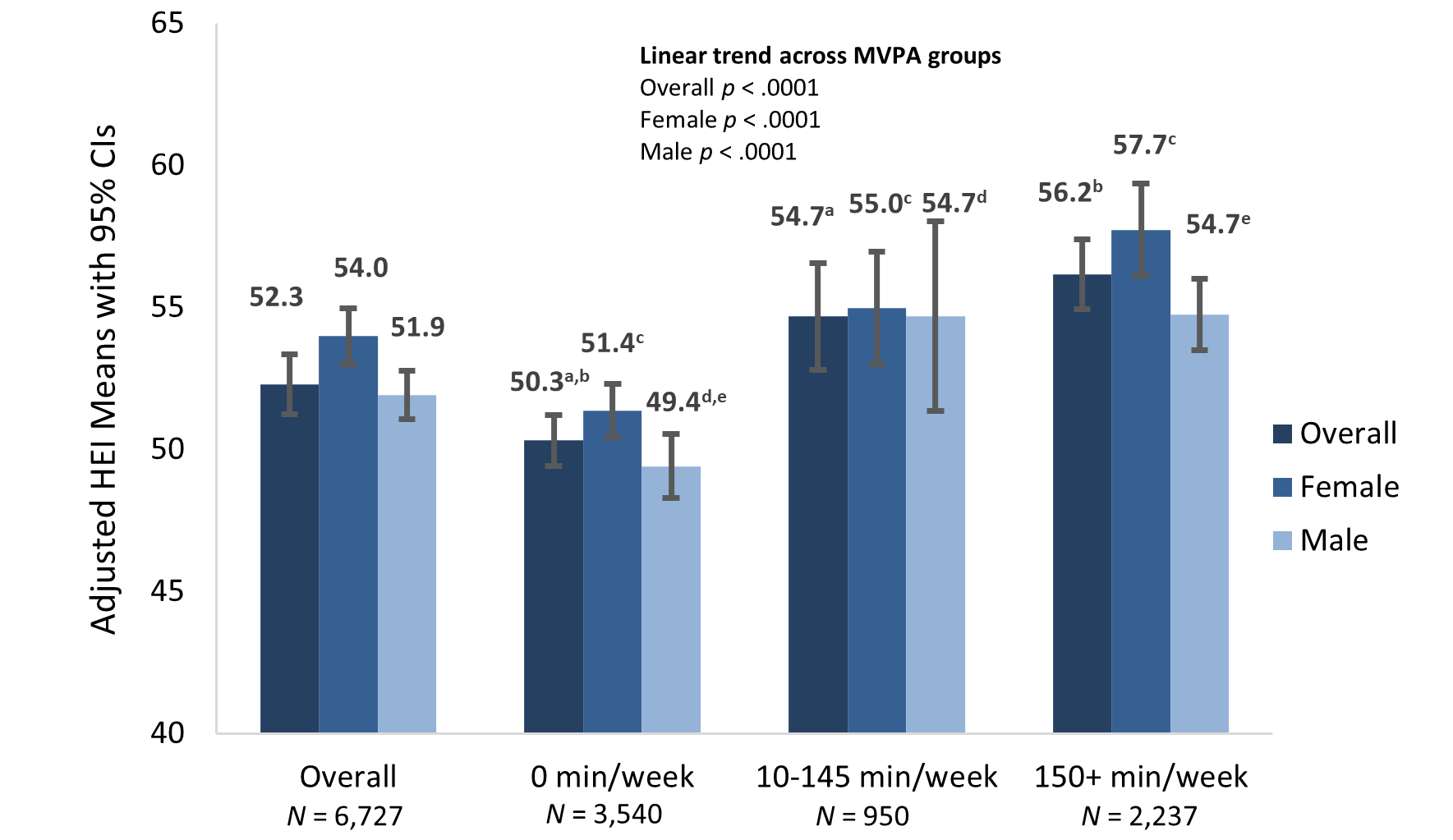
This BriefTrends summarizes Healthy Eating Index (HEI) scores across physical activity (PA) groups in U.S. adults from 2017 to 2020.
Purpose
To examine Healthy Eating Index (HEI) scores in adults across physical activity (PA) groups after adjusting for demographic covariates.
Data Source
The 2017 - March 2020 pre-pandemic National Health and Nutrition Examination Survey (NHANES).
Population
Noninstitutionalized U.S. adults 20+ years of age who report on all relevant study variables.
Variables
1) HEI (HEI-2015) ranging from 0 to 100 where a higher score represents a better-quality diet, 2) moderate-to-vigorous PA (MVPA) group consisting of a) no PA, b) insufficient amounts of PA, and c) recommended amounts of PA and 3) demographic variables of age, sex, race/ethnicity, and income.
Analysis
Multiple linear regression with least squares means, 95% confidence intervals (CIs), and contrasts for testing linear trend in HEI means across MVPA groups. Means are adjusted for age, sex, race/ethnicity, and income. BMI was initially included with no considerable changes except a small loss of power.
Findings
Females had significantly greater HEI than males overall and among those meeting recommended amounts of PA. Significant linear trend in HEI was observed across MVPA groups overall and within each sex group. HEI was significantly different across all three MVPA groups among females. HEI was statistically equal for those with insufficient and sufficient amounts of PA in males.

| [1] | Akinbami LJ, Chen TC, Davy O, Ogden CL, Fink S, Clark J, et al. National Health and Nutrition Examination Survey, 2017–March 2020 prepandemic file: Sample design, estimation, and analytic guidelines. National Center for Health Statistics. Vital Health Stat 2(190). 2022. | ||
| In article | View Article | ||
| [2] | U.S. Department of Health & Human Services. Healthy Eating Index SAS Code. National Institutes of Health. National Cancer Institute. Updated August 19, 2024. Accessed November 1, 2024: https://epi.grants.cancer.gov/hei/sas-code.html. | ||
| In article | |||
| [3] | SAS Institute Inc. 2017. SAS/STAT® 14.3 User’s Guide: The SURVEYREG Procedure. Cary, NC: SAS Institute Inc. | ||
| In article | |||
Published with license by Science and Education Publishing, Copyright © 2024 Peter D. Hart
 This work is licensed under a Creative Commons Attribution 4.0 International License. To view a copy of this license, visit
http://creativecommons.org/licenses/by/4.0/
This work is licensed under a Creative Commons Attribution 4.0 International License. To view a copy of this license, visit
http://creativecommons.org/licenses/by/4.0/
| [1] | Akinbami LJ, Chen TC, Davy O, Ogden CL, Fink S, Clark J, et al. National Health and Nutrition Examination Survey, 2017–March 2020 prepandemic file: Sample design, estimation, and analytic guidelines. National Center for Health Statistics. Vital Health Stat 2(190). 2022. | ||
| In article | View Article | ||
| [2] | U.S. Department of Health & Human Services. Healthy Eating Index SAS Code. National Institutes of Health. National Cancer Institute. Updated August 19, 2024. Accessed November 1, 2024: https://epi.grants.cancer.gov/hei/sas-code.html. | ||
| In article | |||
| [3] | SAS Institute Inc. 2017. SAS/STAT® 14.3 User’s Guide: The SURVEYREG Procedure. Cary, NC: SAS Institute Inc. | ||
| In article | |||