Background: Regular physical activity (PA) and life satisfaction (LS) are critical concepts of healthy aging that enhance physical functioning and psychosocial resilience in later life. Evidence suggests that PA may improve general health (GH) indirectly through improvements in subjective well-being. Purpose: The purpose of this study was to examine whether LS functions as a psychosocial pathway through which PA influences GH among older adults. Methods: Longitudinal data from a sample of more than 3,600 adults aged 50 and older in the 2020 and 2022 Health and Retirement Study were analyzed. Latent constructs for PA and LS (2020) were validated using factor analysis and item response theory. Structural equation models (SEMs) were then estimated to predict GH in 2022, including an unadjusted model, a model adjusting for baseline GH, and a fully adjusted model controlling for sociodemographic, behavioral, and health covariates. Indirect effects were evaluated using joint significance and Sobel tests, and additional binary, ordinal, and linear path models using factor scores assessed robustness. Results: All survey‑adjusted SEMs demonstrated good fit and significant effects. In the fully adjusted model, PA predicted higher LS, and LS predicted improvements in GH over time. PA also showed a significant indirect effect on GH through LS, indicating partial mediation. Path model analyses supported these findings; notably, each one‑unit increase in PA was associated with higher odds of maintaining or achieving good GH partly because PA improved LS. Conclusion: Overall, results suggest that LS is an important psychosocial mechanism linking PA to better health outcomes in later life. Strengthening LS may enhance the health benefits of PA and serve as a promising target for interventions aimed at promoting healthy aging.
Population aging represents one of the most significant demographic trends of the twenty-first century, creating an increasing need to identify factors that promote health and well-being throughout later life. As adults live longer, maintaining health becomes increasingly important for preserving independence, quality of life, and participation in valued social activities. Among indicators of successful aging, general health (GH) status is especially important because it reflects individuals' perceptions of their overall physical and mental health and serves as a robust predictor of future morbidity, disability, healthcare utilization, and mortality. 1, 2 Consequently, identifying modifiable behavioral and psychosocial factors that support health and functioning in older adulthood remains a major public health priority. 3
Regular physical activity (PA) is widely recognized as one of the most effective health-promoting behaviors across the lifespan. Substantial evidence demonstrates that physically active older adults experience lower rates of cardiovascular disease, type 2 diabetes, functional limitations, cognitive decline, and mortality compared with their less active peers. 4, 5 PA is also associated with improved mobility, maintenance of independence, and enhanced quality of life among aging populations. 6 Beyond these physiological benefits, PA contributes to psychological well-being by reducing symptoms of depression and anxiety while promoting positive mood and psychological resilience. 7, 8 Consequently, PA is widely regarded as a cornerstone of healthy aging.
Although the direct benefits of PA are well established, researchers have increasingly suggested that some of its effects on later-life health may occur through psychosocial pathways. 9 One psychosocial factor that may be particularly important is life satisfaction (LS), which reflects an individual's cognitive evaluation of life according to personally determined criteria. 10 Unlike affective indicators such as happiness or depressive symptoms, LS reflects a broader appraisal of how individuals evaluate their lives as a whole. As a central component of subjective well-being, LS has been associated with numerous positive outcomes, including greater resilience, improved social functioning, healthier behavioral profiles, and lower mortality risk. 11, 12, 13 LS is therefore considered an important indicator of successful adaptation and psychological well-being in later life.
Emerging evidence suggests that PA and LS are closely interconnected. Older adults who engage in regular PA generally report higher levels of LS than their sedentary counterparts. 14, 15 Several mechanisms may explain this relationship. Participation in PA can enhance physical functioning, preserve autonomy, improve self-efficacy, and increase opportunities for social participation. 16 Additionally, PA may facilitate engagement in meaningful activities and social roles that contribute to a more favorable evaluation of one's overall life circumstances. 17 Collectively, these findings suggest that LS may represent an important psychosocial benefit of regular PA.
LS has also been identified as an important predictor of subsequent health outcomes. The broaden-and-build theory proposes that positive psychological states help individuals develop enduring personal, social, and behavioral resources that contribute to long-term health and resilience. 18 Individuals with greater LS may be more likely to engage in health-promoting behaviors, maintain stronger social connections, and cope more effectively with age-related challenges. Longitudinal research has demonstrated that higher LS predicts better self-rated health, healthier behaviors, lower incidence of chronic conditions, and improved physical functioning over time. 19, 20 Consequently, LS may represent an important mechanism through which health-promoting behaviors influence long-term health outcomes.
Taken together, existing evidence supports three key relationships: PA is associated with greater LS, LS is associated with better health outcomes, and PA is associated with improved health. However, relatively little research has examined whether LS functions as a psychosocial pathway linking PA to subsequent GH among older adults. Much of the existing literature has relied on cross-sectional designs that limit causal inference and the evaluation of mediation processes. Furthermore, studies examining psychosocial pathways have often focused on mental health outcomes rather than broader indicators of GH. As a result, additional longitudinal research is needed to determine whether LS serves as a mechanism through which PA influences later health outcomes in aging populations.
Therefore, the purpose of the present study was to examine whether LS functions as a psychosocial pathway through which PA influences GH among older adults using longitudinal data from the Health and Retirement Study (HRS). Specifically, latent constructs of PA and LS measured in 2020 were used to predict GH in 2022 while accounting for baseline GH and relevant sociodemographic, behavioral, and health-related covariates. It was hypothesized that (1) higher levels of PA would predict greater LS, (2) higher LS would predict better subsequent GH, and (3) LS would partially mediate the relationship between PA and later GH. By identifying a potentially modifiable psychosocial mechanism underlying the benefits of PA, this study may provide insights for interventions designed to promote healthy aging and improve health-related quality of life among older adults.
Study Design and Data Source
This longitudinal study used data from the 2020 and 2022 waves of the HRS, a nationally representative panel survey of U.S. adults aged 50 years and older sponsored by the National Institute on Aging and conducted by the University of Michigan. 21 The HRS employs a multistage area probability sampling design with oversampling of selected demographic groups and follows participants biennially. Psychosocial data were obtained from the Leave-Behind Questionnaire (LBQ), which includes validated measures of subjective well-being and lifestyle behaviors. 22 Data from the 2020 and 2022 HRS core interviews, LBQ modules, and the cross-wave tracker file were merged for analysis.
Participants were eligible if they were aged 50 years or older, completed the 2020 LBQ, participated in the 2022 HRS interview, possessed a nonzero LBQ sampling weight, and had complete data for the study variables. After exclusions for missing PA or LS data, the final analytic sample consisted of 3,647 respondents for measurement analyses and approximately 3,571 to 3,646 respondents across adjusted structural models depending on covariate availability.
Measures
Physical Activity (PA)
PA was assessed in 2020 using three HRS items measuring the frequency of vigorous, moderate, and light PA. Response categories ranged from hardly ever or never to every day. Items were reverse coded so that higher scores reflected greater activity participation. Three observed indicators representing vigorous PA (VPA), moderate PA (MPA), and light PA (LPA) were used as indicators of a latent PA construct. A simple summed score was also calculated for robustness analyses. For descriptive analyses, PA was further classified as >1 time/week versus ≤1 time/week based on participation across all activity intensities.
Life Satisfaction (LS)
LS was measured in 2020 using the five-item Satisfaction with Life Scale included in the HRS psychosocial questionnaire. 23 Participants rated their agreement with statements regarding overall satisfaction with life on a seven-point Likert scale, with higher scores indicating greater satisfaction. The five items served as indicators of a latent LS construct in the measurement and structural models. A mean composite score was additionally calculated for descriptive analyses and alternative path models. Finally, LS was categorized as satisfied versus dissatisfied based on the mean SWLS score, with mean scores greater than 4.0 classified as satisfied and scores of 4.0 or lower classified as dissatisfied.
General Health (GH)
GH was assessed in 2020 and 2022 using the standard HRS self-rated health item. Participants rated their health as excellent, very good, good, fair, or poor. Responses were reverse coded such that higher values represented better health. The 2022 GH measure served as the primary outcome. Baseline GH measured in 2020 was included in adjusted models to evaluate change in health over time. Binary GH variables classifying respondents as having good health (excellent, very good, or good) versus poor health (fair or poor) were created for supplemental logistic analyses.
Covariates
The fully adjusted models included demographic, behavioral, and health-related covariates assessed in 2020. Demographic variables included age, sex, race/ethnicity, educational attainment, household income quartile, and marital status. Behavioral and health-related variables included smoking status, body mass index (BMI), number of physician-diagnosed chronic conditions, and functional limitation status based on activities of daily living. These variables were selected a priori based on previous research demonstrating associations with PA, subjective well-being, and health status among older adults.
Statistical Analysis
Prior to structural modeling, the psychometric properties of the PA and LS measures were examined using both classical test theory (CTT) and item response theory (IRT) approaches. Under CTT, internal consistency reliability was assessed using Cronbach's alpha, ordinal alpha, and McDonald's omega coefficients. 24 Dimensionality was evaluated using exploratory factor analysis (EFA) based on both Pearson and polychoric correlation matrices. Survey-adjusted factor analyses were additionally performed to account for the complex sampling design. Confirmatory factor analysis (CFA) was then used to evaluate the measurement properties of the latent PA and LS constructs. Factor score correlations with observed scale scores were examined as evidence of construct validity. To further evaluate scale performance, graded response models (GRMs) were estimated for both constructs. 25, 26 Item discrimination and threshold parameters were examined, and latent trait scores were generated. Marginal reliability coefficients, test information functions, and conditional measurement precision were evaluated.
The primary hypothesis that LS partially mediates the association between PA and subsequent GH was tested using survey-adjusted structural equation models (SEMs). 27 First, a two-factor CFA including latent PA and LS constructs was estimated to establish the measurement model. The structural model then specified a direct path from PA to LS, a direct path from LS to GH, and a direct path from PA to GH. Indirect effects were evaluated through the product of coefficients (a × b pathway). Thus, three SEMs were estimated: 1) SEM 1 (Unadjusted): PA predicting LS predicting GH with a direct PA predicting GH effect. 2), SEM 2 (Baseline-adjusted): SEM 1 plus adjustment for baseline (2020) GH, thereby modeling change in health over time, and 3) SEM 3 (Fully adjusted): SEM 2 plus adjustment for age, sex, race/ethnicity, education, income quartile, marital status, smoking status, BMI, comorbidity burden, and functional limitation status. Standardized path coefficients were reported for all models. Model fit was evaluated using the standardized root mean square residual (SRMR), global coefficient of determination (R²), and structural R² statistics available for survey-adjusted SEMs.
Mediation was evaluated using both the joint significance approach and the Sobel test of indirect effect. 28, 29, 30, 31 Joint significance was supported when both the PA predicting LS path and the LS predicting GH path were statistically significant. Sobel tests were estimated from the product of coefficients using nonlinear combinations of model parameters. Evidence of mediation was considered strongest when both constituent pathways (PA → LS and LS → GH) were statistically significant and the indirect effect was statistically significant. The joint significance approach has demonstrated favorable statistical performance in simulation studies and performs comparably to bootstrap procedures under many conditions. Given the large sample size available in the present study, Sobel tests were also used as an additional robustness check of indirect effects. Indirect effects and associated p-values were reported for each SEM. Additional exploratory moderated mediation analyses were conducted to determine whether the indirect effect of PA on GH through LS differed across demographic and health-related characteristics. Separate multiple-group SEMs were estimated for sex, race, education, income, marital status, smoking status, obesity status, functional limitation status, and comorbidity burden. Differences in indirect effects between groups were evaluated using nonlinear combinations of pathway coefficients.
To evaluate robustness of the findings, three additional survey-adjusted path modeling approaches were conducted using CFA-derived factor scores. Binary logistic models examined the odds of good versus poor health. Ordinal logistic models evaluated the likelihood of reporting higher categories of GH. Linear path models treated GH as a continuous outcome. 32 For each modeling framework, unadjusted, baseline-adjusted, and fully adjusted versions were estimated. Indirect effects were calculated using the product of coefficients and Sobel tests.
All inferential analyses incorporated HRS sampling weights, strata, and primary sampling units to account for the complex survey design and to generate nationally representative estimates. The 2020 LBQ respondent weight was applied, and variance estimation employed Taylor series linearization procedures. All analytical phases were executed independently and in parallel using both STATA (Version 16) and R (Version 4.4.2). 33, 34, 35 Statistical significance was evaluated using two-sided tests with an alpha level of .05.
Sample Characteristics
A total of 3,646 participants from the HRS were included in the primary analyses. In 2022, 77.8% (95% CI = 75.8%-79.8%) of respondents reported good GH, whereas 22.2% (95% CI = 20.2%-24.2%) reported poor GH (Table 1). Several demographic characteristics were associated with subsequent GH status. Poor GH was more prevalent among older adults, racial and ethnic minority groups, lower-income participants, individuals without a college degree, and those who were not currently married (all p < .01). For example, the prevalence of poor GH increased from 19.3% among adults aged 65-74 years to 31.8% among adults aged 85 years and older. Similarly, poor GH was reported by 43.0% of participants in the lowest income quartile compared with only 9.9% of those in the highest income quartile. Participants without a college degree were nearly three times more likely to report poor GH than those with a college degree (28.3% vs. 10.7%, respectively).
Health-related characteristics were also strongly associated with GH status (Table 2). Participants reporting lower PA participation, lower LS, obesity, current smoking, multiple comorbidities, and functional limitations were significantly more likely to report poor GH in 2022 (all p < .0001). Poor GH was reported by 40.5% of individuals dissatisfied with life compared with 16.7% among those reporting LS. Likewise, the prevalence of poor GH increased from 4.2% among respondents with no comorbidities to 36.6% among those reporting three or more comorbid conditions. Functional limitations demonstrated one of the strongest associations, with 55.0% of affected participants reporting poor GH compared with 17.4% among those without limitations.
Measurement Model Evaluation
Results from EFA and CFA analyses supported the unidimensionality of both latent constructs (Table 3). For the PA scale, the first factor eigenvalue ranged from 1.77 to 1.88 across estimation approaches and accounted for approximately 59% to 63% of total variance. For the LS scale, the first factor eigenvalue ranged from 3.42 to 3.67 and explained between 68% and 73% of variance. Survey-adjusted CFA analyses further supported the proposed measurement models. Standardized factor loadings ranged from 0.48 to 0.84 for PA items and from 0.55 to 0.89 for LS items. Correlations between scale scores and latent factor scores were high for both constructs (r = .95 to .99), suggesting that observed scores closely represented the underlying latent traits. Reliability evidence was generally acceptable for PA and strong for LS. Cronbach's alpha, ordinal alpha, and McDonald's omega ranged from .66 to .70 for PA and from .88 to .91 for LS.
IRT analyses using GRMs provided additional support for construct validity and measurement precision (Table 4). Survey-adjusted marginal reliability estimates were .74 for PA and .91 for LS. Average item discrimination parameters were 1.91 for PA and 3.18 for LS, indicating that LS items provided particularly strong discrimination across levels of the latent trait. Threshold parameters demonstrated broad coverage of the latent continua. PA thresholds ranged from -1.93 to 3.70, whereas LS thresholds ranged from -2.38 to 1.51. Peak test information values were 4.94 for PA and 18.89 for LS. Figure 1 and Figure 2 illustrate the test information functions and associated conditional standard errors. Both scales demonstrated their greatest measurement precision within the central range of the latent trait continuum. Survey-adjusted models indicated that approximately 89% of PA information and 90% of LS information were captured within the typical theta range of -3 to +3, supporting the appropriateness of both instruments for population-based applications among older adults.
Structural Equation Modeling (SEM)
The measurement model demonstrated adequate fit and stable factor loadings across all SEMs (Table 5). The latent PA and LS factors were moderately correlated in the CFA model (r = .25). In the unadjusted SEM (SEM 1), PA was positively associated with LS (β = .25), LS was positively associated with GH (β = .27), and PA demonstrated a direct positive association with GH (β = .39). Because both constituent mediation paths were statistically significant, the joint significance criterion for mediation was satisfied. Consistent with this finding, the indirect effect of PA on GH through LS was significant (β = .07; Sobel p < .0001), providing evidence of partial mediation. The model explained 28% of the variance in GH.


After adjusting for baseline GH (SEM 2), all pathways remained statistically significant. PA predicted higher LS (β = .11), LS predicted improvements in GH over time (β = .12), and PA retained a direct effect on GH change (β = .16). Thus, the joint significance criterion remained satisfied. A significant indirect effect was also observed (β = .01; Sobel p = .001), indicating that LS partially mediated the association between PA and changes in GH. The model explained 52% of the variance in GH.
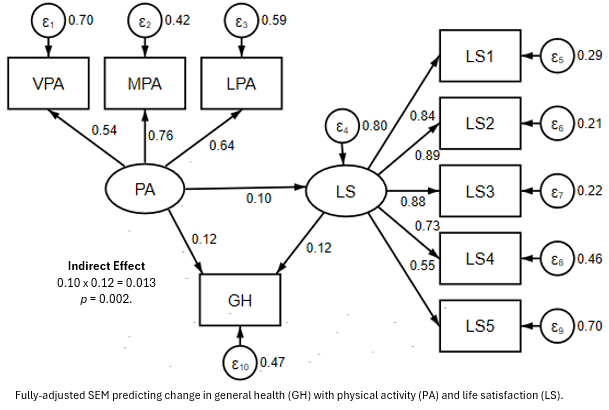
Results from the fully adjusted SEM (SEM 3), displayed in Figure 3, were highly consistent with prior models. After adjustment for baseline GH, age, sex, education, income, race, marital status, smoking status, body mass index, comorbidities, and functional limitations, PA remained positively associated with LS (β = .10), LS remained positively associated with GH (β = .12), and PA maintained a significant direct effect on GH (β = .12). Thus, the joint significance criterion for mediation was satisfied. Consistent with this finding, the indirect effect of PA on GH through LS was statistically significant (β = .01; Sobel p = .002), providing evidence that LS partially mediated the PA-GH relationship. Overall model fit was strong (SRMR = .029), and the fully adjusted model explained approximately 53% of the variance in GH.

Consistent with a partial mediation framework, PA influenced GH both directly and indirectly through LS. Across all SEM specifications, the constituent mediation paths (PA → LS and LS → GH) were statistically significant, satisfying the joint significance criterion for mediation. Furthermore, Sobel tests indicated significant indirect effects in all models (all p ≤ .002), providing convergent evidence for partial mediation. No evidence was found that mediation effects differed according to demographic or health-related covariates (all moderation p-values > .05), suggesting that the mediation pathway was consistent across the demographic and health subgroups examined.
Sensitivity (Robustness) Analyses
Results from alternative path modeling approaches were highly consistent with the SEM findings (Table 6). Across binary logistic, ordinal logistic, and linear regression frameworks, PA and LS remained significant predictors of GH in both unadjusted and adjusted models. In the fully adjusted binary logistic model, higher PA was associated with increased odds of reporting good GH (OR = 1.51, 95% CI = 1.27-1.79), while higher LS was associated with increased odds of reporting good GH (OR = 1.80, 95% CI = 1.31-2.46). Similar findings emerged in ordinal logistic models, where higher PA (OR = 1.30, 95% CI = 1.17-1.45) and higher LS (OR = 1.33, 95% CI = 1.22-1.45) were associated with greater odds of reporting a higher GH category. Linear regression analyses produced comparable findings, with PA (β = .09, 95% CI = .05-.12) and LS (β = .11, 95% CI = .08-.15) each contributing positively to GH.
Mediation findings were also consistent across all alternative modeling approaches. In every binary logistic, ordinal logistic, and linear regression model, the PA predicting LS and LS predicting GH pathways remained statistically significant, satisfying the joint significance criterion for mediation. Corresponding Sobel tests were likewise significant across all path modeling frameworks (all p < .0001), providing additional evidence that LS partially mediated the relationship between PA and GH regardless of outcome scaling or model specification.
Collectively, the findings support the hypothesized mediation model. Higher levels of PA were associated with greater LS, and greater LS was associated with better subsequent GH. Although PA exerted a direct effect on GH, a significant portion of this relationship operated indirectly through LS. The consistency of these findings across SEM, binary logistic, ordinal logistic, and linear regression models provides strong evidence that LS represents an important psychosocial pathway linking PA to better health outcomes in later life.
The purpose of this study was to examine whether LS functions as a psychosocial pathway through which PA influences subsequent GH among older adults. Consistent with all study hypotheses, higher levels of PA were associated with greater LS, greater LS was associated with better subsequent GH, and LS partially mediated the relationship between PA and GH. These findings were observed in unadjusted, baseline-adjusted, and fully adjusted SEMs and were replicated across binary logistic, ordinal logistic, and linear path modeling approaches. Collectively, the results suggest that the health benefits of PA in later life may operate through both direct physiological mechanisms and indirect psychosocial mechanisms involving greater satisfaction with life.
The first major finding was that physically active older adults reported higher levels of LS. This result is consistent with previous research demonstrating positive associations between PA, subjective well-being, and quality of life among older adults. 14, 15, 16, 17 Regular PA may enhance LS through several interconnected pathways. Individuals who remain physically active often experience better functional capacity, greater independence, enhanced self-efficacy, and increased opportunities for social participation. 16 These benefits may help older adults maintain meaningful roles and valued activities that contribute to a more positive evaluation of life circumstances. From a successful aging perspective, PA may therefore provide benefits that extend beyond disease prevention and physical functioning to include broader indicators of psychological well-being.
The second major finding was that LS predicted better subsequent GH even after controlling for baseline health status and numerous demographic and health-related factors. This finding is consistent with longitudinal studies demonstrating that individuals with greater LS tend to experience more favorable health trajectories over time. 19, 20 Several explanations may account for this relationship. Older adults with greater LS may be more likely to engage in preventive health behaviors, maintain social relationships, adhere to medical recommendations, and employ effective coping strategies when confronted with age-related challenges. 18 Additionally, positive evaluations of life may foster psychological resilience that helps individuals preserve functioning despite chronic health conditions or other adversities. Consequently, LS appears to represent more than a marker of well-being; it may also function as a resource that promotes adaptive health-related behaviors and perceptions throughout later life.
The principal contribution of the present study was the identification of LS as a significant mediator linking PA to future GH. Even after adjustment for baseline GH and numerous sociodemographic, behavioral, and health-related covariates, PA remained positively associated with LS and LS remained positively associated with subsequent GH. Importantly, both the joint significance criterion and Sobel tests supported the existence of a statistically significant indirect effect across all SEM analyses. These findings suggest that part of the relationship between PA and later health operates through improvements in how individuals evaluate and experience their lives. Although the mediation effect was modest in magnitude, its persistence across multiple analytic frameworks indicates that the observed pathway is robust and unlikely to be an artifact of a particular modeling approach. Furthermore, many important psychological and behavioral processes operate through relatively small effects. 36 Small effects are expected when studying complex population health outcomes influenced by numerous biological, behavioral, social, and environmental determinants. Even modest indirect effects may accumulate across large populations and prolonged periods of time to produce meaningful public health consequences.
The finding of partial rather than complete mediation is also noteworthy. PA continued to demonstrate direct associations with GH after accounting for LS, suggesting that multiple pathways likely explain the relationship between PA and health. Physiological mechanisms involving cardiovascular fitness, metabolic regulation, muscular strength, balance, and physical functioning likely contribute directly to health perceptions and outcomes. 4, 5, 6 However, the present findings indicate that psychosocial processes should not be overlooked. Improvements in LS appear to represent one pathway through which physically active adults may experience better health over time. Thus, interventions designed to improve population health among older adults may benefit from simultaneously targeting both behavioral and psychosocial domains.
An additional contribution of this study was the use of rigorous measurement procedures prior to structural modeling. Both PA and LS demonstrated adequate psychometric properties across CTT and IRT frameworks. Measurement evidence supported the unidimensional nature of both constructs, while survey-adjusted GRMs indicated acceptable reliability and substantial measurement precision across the latent trait continuum. The consistency of findings obtained using latent variable SEMs and CFA-derived factor scores further strengthens confidence in the observed relationships. This feature distinguishes the present study from many previous investigations that have relied exclusively on observed composite scores without formally evaluating measurement quality.
The robustness analyses also warrant attention. Findings were highly consistent across SEM, binary logistic, ordinal logistic, and linear regression path models. Furthermore, evidence for mediation was supported by both the joint significance approach and Sobel tests in every model specification examined. Previous methodological work has suggested that joint significance testing performs favorably in mediation analyses and often performs comparably to more computationally intensive approaches. 28 The convergence of results across multiple statistical frameworks provides strong support for the stability of the proposed mediation pathway. Additionally, no evidence was observed for moderated mediation across demographic or health-related subgroups, suggesting that the indirect pathway linking PA, LS, and GH may operate similarly across diverse segments of the older adult population.
Several study strengths should be acknowledged. First, the analyses utilized longitudinal nationally representative HRS data, enhancing the generalizability of findings to community-dwelling older adults in the United States. Second, adjustment for baseline GH allowed the models to evaluate changes in health over time rather than simple cross-sectional associations. Third, the use of latent variable modeling reduced measurement error and provided stronger tests of the hypothesized relationships. Fourth, psychometric evaluation using both CTT and IRT approaches provided extensive evidence for the quality of the PA and LS measures. Finally, the consistency of findings across multiple modeling approaches, mediation tests, and subgroup analyses substantially strengthens confidence in the robustness of the results.
Despite these strengths, several limitations should be considered. First, although the longitudinal design improves temporal ordering, causal relationships cannot be definitively established because participants were not randomly assigned to levels of PA or LS. Unmeasured confounding variables may partially explain the observed associations. Second, PA, LS, and GH were assessed using self-report measures and may therefore be susceptible to recall error, reporting bias, and shared method variance. Third, GH was measured with a single self-rated health item. Although self-rated health is a widely used and powerful predictor of morbidity and mortality, 1, 2 it cannot capture the full complexity of physical, psychological, and social health. Fourth, PA was assessed using three broad indicators of activity frequency and did not include detailed information regarding activity duration, intensity, context, or objectively measured activity. Finally, although extensive covariate adjustment was employed, residual confounding remains possible.
Future research should continue investigating psychosocial mechanisms linking health behaviors to health outcomes in later life. Additional studies could examine whether other dimensions of subjective well-being, such as purpose in life, optimism, social connectedness, or psychological flourishing, function similarly as mediators of the PA-health relationship. Longitudinal investigations spanning additional follow-up periods may also clarify the long-term stability of these pathways. Intervention studies designed to increase PA while simultaneously enhancing LS could provide stronger evidence regarding causal mechanisms and identify strategies for maximizing healthy aging outcomes.
The present study provides evidence that LS serves as an important psychosocial mechanism linking PA to subsequent GH among older adults. Higher levels of PA were associated with greater LS, and greater LS predicted better health over time. Although PA demonstrated direct associations with later health, significant indirect effects indicated that part of its influence operated through enhanced LS. These findings suggest that promoting healthy aging may require attention not only to PA behavior itself but also to the psychological benefits that accompany an active lifestyle. Interventions that foster both PA and LS may offer a particularly effective approach for supporting health and well-being in later life.
| [1] | Hart P. Self-rated health, physical activity, measures of physical functioning and mortality among older U.S. adults. Innov Aging. 2025; 9(Suppl 2): igaf122.4005. Published 2025 Dec 31. | ||
| In article | View Article PubMed | ||
| [2] | Reinwarth AC, Wicke FS, Hettich N, et al. Self-rated physical health predicts mortality in aging persons beyond objective health risks. Sci Rep. 2023; 13(1): 19531. Published 2023 Nov 9. | ||
| In article | View Article PubMed | ||
| [3] | Decade of healthy ageing: baseline report. Geneva: World Health Organization; 2020. | ||
| In article | |||
| [4] | Cunningham C, O' Sullivan R, Caserotti P, Tully MA. Consequences of physical inactivity in older adults: A systematic review of reviews and meta-analyses. Scand J Med Sci Sports. 2020; 30(5): 816-827. | ||
| In article | View Article PubMed | ||
| [5] | Langhammer B, Bergland A, Rydwik E. The Importance of Physical Activity Exercise among Older People. Biomed Res Int. 2018; 2018: 7856823. Published 2018 Dec 5. | ||
| In article | View Article PubMed | ||
| [6] | Billot M, Calvani R, Urtamo A, et al. Preserving Mobility in Older Adults with Physical Frailty and Sarcopenia: Opportunities, Challenges, and Recommendations for Physical Activity Interventions. Clin Interv Aging. 2020; 15: 1675-1690. Published 2020 Sep 16. | ||
| In article | View Article PubMed | ||
| [7] | White RL, Vella S, Biddle S, et al. Physical activity and mental health: a systematic review and best-evidence synthesis of mediation and moderation studies. Int J Behav Nutr Phys Act. 2024; 21(1): 134. Published 2024 Nov 28. | ||
| In article | View Article PubMed | ||
| [8] | Mahindru A, Patil P, Agrawal V. Role of Physical Activity on Mental Health and Well-Being: A Review. Cureus. 2023; 15(1): e33475. Published 2023 Jan 7. | ||
| In article | View Article PubMed | ||
| [9] | Lee S, Ahn B, Na C. Physical Activity and Psychological Well-Being among Older Adults: A Dual Social-Affective Pathway Model. Behav Sci (Basel). 2026; 16(8): 1381. Published 2026 Aug 11. | ||
| In article | View Article PubMed | ||
| [10] | Pavot W, Diener E. Review of the Satisfaction with Life Scale. Psychol Assess. 1993; 5(2): 164-172. | ||
| In article | View Article | ||
| [11] | Kim ES, Delaney SW, Kubzansky LD, et al. Life Satisfaction and Subsequent Physical, Behavioral, and Psychosocial Health and Well-Being. The Milbank Quarterly. 2021; 99(1): 230-264. | ||
| In article | View Article PubMed | ||
| [12] | González-García L, Duque A, Molins M, et al. Resilience and Social Support as Predictors of Life Satisfaction in Healthy Older Adults: A Moderation Analysis. International Journal of Environmental Research and Public Health. 2024; 21(2): 167, | ||
| In article | View Article | ||
| [13] | Boehm JK, Kim ES, Hofschneider L, et al. Variability Modifies Life Satisfaction's Association with Mortality Risk in Older Adults. Psychological Science. 2015; 26(8): 1239-1248. | ||
| In article | View Article PubMed | ||
| [14] | An HY, Chen W, Wang CW, Yang HF, Huang WT, Fan SY. The Relationships between Physical Activity and Life Satisfaction and Happiness among Young, Middle-Aged, and Older Adults. Int J Environ Res Public Health. 2020; 17(13): 4817. Published 2020 Jul 4. | ||
| In article | View Article PubMed | ||
| [15] | Park S, Noe Y, Moon H, Lee WS. Leisure and Aging: The Effect of Physical Activity on Health and Life Satisfaction among Older Adults in a Longitudinal Study. J Phys Act Health. 2025; 23(3): 347-354. Published 2025 Oct 31. | ||
| In article | View Article PubMed | ||
| [16] | Gusi N, Prieto J, Cobos X, et al. Physical Activity and the Improvement of Autonomy, Functional Ability, Subjective Health, and Social Relationships in Women over the Age of 60. International Journal of Environmental Research and Public Health. 2021; 18(14): 7303. | ||
| In article | View Article PubMed | ||
| [17] | Regier NG, Parisi JM, Perrin N, Gitlin LN. Engagement in Favorite Activity and Implications for Cognition, Mental Health, and Function in Persons Living With and Without Dementia. J Appl Gerontol. 2022; 41(2): 441-449. | ||
| In article | View Article PubMed | ||
| [18] | Fredrickson BL. The role of positive emotions in positive psychology. The broaden-and-build theory of positive emotions. Am Psychol. 2001; 56(3): 218-226. | ||
| In article | View Article PubMed | ||
| [19] | Siahpush M, Spittal M, Singh GK. Happiness and life satisfaction prospectively predict self-rated health, physical health, and the presence of limiting, long-term health conditions. Am J Health Promot. 2008; 23(1): 18-26. | ||
| In article | View Article PubMed | ||
| [20] | Alumona CJ, Scott DR, Aladejebi T, et al. Association between life satisfaction and health behaviours among older adults: a systematic review and meta-analysis. Int J Behav Nutr Phys Act. 2026; 23(1): 15. Published 2026 Jan 26. | ||
| In article | View Article PubMed | ||
| [21] | Sonnega, A. (2025). Using Health and Retirement Study data: A guide for new users. Survey Research Center, Institute for Social Research, University of Michigan, Ann Arbor, MI. | ||
| In article | |||
| [22] | National Institute on Aging. The Health and Retirement Study (HRS) 2022 Core and Leave-Behind Psychosocial Survey Data. Ann Arbor, MI: Survey Research Center, Institute for Social Research, University of Michigan. | ||
| In article | |||
| [23] | Diener E, Emmons RA, Larsen RJ, Griffin S. The Satisfaction with Life Scale. Journal of Personality Assessment. 1985; 49(1): 71-75. | ||
| In article | View Article PubMed | ||
| [24] | McDonald, R. P. (1999). Test theory: A unified treatment. Mahwah, NJ: Lawrence Erlbaum Associates. | ||
| In article | |||
| [25] | Samejima, F. (1969). Estimation of Latent Ability Using a Response Pattern of Graded Scores. Psychometric Monograph, No. 17. Psychometric Society [published as a supplement to Psychometrika, Volume 34, Issue S1, pp. 1–97]. | ||
| In article | View Article | ||
| [26] | De Ayala RJ. The Theory and Practice of Item Response Theory. 2nd ed. The Guilford Press; 2022. | ||
| In article | |||
| [27] | Kline, R. B. (2011). Principles and practice of structural equation modeling (3rd ed.). The Guilford Press. | ||
| In article | |||
| [28] | Hayes, A. F., & Scharkow, M. (2013). The relative trustworthiness of inferential tests of the indirect effect in statistical mediation analysis: Does method really matter? Psychological Science, 24, 1918-1927. | ||
| In article | View Article PubMed | ||
| [29] | Stone, C. A., & Sobel, M. E. (1990). The asymptotic distribution of estimates of indirect effects in structural equation models. Psychometrika, 55(2), 337-352. | ||
| In article | View Article | ||
| [30] | Fritz, M. S., & MacKinnon, D. P. (2007). Required sample size to detect the mediated effect. Psychological Science, 18, 233-239. | ||
| In article | View Article PubMed | ||
| [31] | Fritz, M. S., Taylor, A. B., & MacKinnon, D. P. (2012). Explanation of two anomalous results in statistical mediation analysis. Multivariate Behavioral Research, 47, 61-87. | ||
| In article | View Article PubMed | ||
| [32] | Huh, I., & Gim, J. (2025). Exploration of Likert scale in terms of continuous variable with parametric statistical methods. BMC medical research methodology, 25(1), 218. | ||
| In article | View Article PubMed | ||
| [33] | StataCorp. (2025). Stata 16 structural equation modeling reference manual. Stata Press. | ||
| In article | |||
| [34] | Rosseel, Y. (2012). lavaan: An R package for structural equation modeling. Journal of Statistical Software, 48(2), 1–36. | ||
| In article | View Article | ||
| [35] | Chalmers, R. P. (2012). mirt: A multidimensional item response theory package for the R environment. Journal of Statistical Software, 48(6), 1–29. | ||
| In article | View Article | ||
| [36] | Götz FM, Gosling SD, Rentfrow PJ. Small Effects: The Indispensable Foundation for a Cumulative Psychological Science. Perspect Psychol Sci. 2022; 17(1): 205-215. | ||
| In article | View Article PubMed | ||
Published with license by Science and Education Publishing, Copyright © 2026 Peter D. Hart
 This work is licensed under a Creative Commons Attribution 4.0 International License. To view a copy of this license, visit
http://creativecommons.org/licenses/by/4.0/
| [1] | Hart P. Self-rated health, physical activity, measures of physical functioning and mortality among older U.S. adults. Innov Aging. 2025; 9(Suppl 2): igaf122.4005. Published 2025 Dec 31. | ||
| In article | View Article PubMed | ||
| [2] | Reinwarth AC, Wicke FS, Hettich N, et al. Self-rated physical health predicts mortality in aging persons beyond objective health risks. Sci Rep. 2023; 13(1): 19531. Published 2023 Nov 9. | ||
| In article | View Article PubMed | ||
| [3] | Decade of healthy ageing: baseline report. Geneva: World Health Organization; 2020. | ||
| In article | |||
| [4] | Cunningham C, O' Sullivan R, Caserotti P, Tully MA. Consequences of physical inactivity in older adults: A systematic review of reviews and meta-analyses. Scand J Med Sci Sports. 2020; 30(5): 816-827. | ||
| In article | View Article PubMed | ||
| [5] | Langhammer B, Bergland A, Rydwik E. The Importance of Physical Activity Exercise among Older People. Biomed Res Int. 2018; 2018: 7856823. Published 2018 Dec 5. | ||
| In article | View Article PubMed | ||
| [6] | Billot M, Calvani R, Urtamo A, et al. Preserving Mobility in Older Adults with Physical Frailty and Sarcopenia: Opportunities, Challenges, and Recommendations for Physical Activity Interventions. Clin Interv Aging. 2020; 15: 1675-1690. Published 2020 Sep 16. | ||
| In article | View Article PubMed | ||
| [7] | White RL, Vella S, Biddle S, et al. Physical activity and mental health: a systematic review and best-evidence synthesis of mediation and moderation studies. Int J Behav Nutr Phys Act. 2024; 21(1): 134. Published 2024 Nov 28. | ||
| In article | View Article PubMed | ||
| [8] | Mahindru A, Patil P, Agrawal V. Role of Physical Activity on Mental Health and Well-Being: A Review. Cureus. 2023; 15(1): e33475. Published 2023 Jan 7. | ||
| In article | View Article PubMed | ||
| [9] | Lee S, Ahn B, Na C. Physical Activity and Psychological Well-Being among Older Adults: A Dual Social-Affective Pathway Model. Behav Sci (Basel). 2026; 16(8): 1381. Published 2026 Aug 11. | ||
| In article | View Article PubMed | ||
| [10] | Pavot W, Diener E. Review of the Satisfaction with Life Scale. Psychol Assess. 1993; 5(2): 164-172. | ||
| In article | View Article | ||
| [11] | Kim ES, Delaney SW, Kubzansky LD, et al. Life Satisfaction and Subsequent Physical, Behavioral, and Psychosocial Health and Well-Being. The Milbank Quarterly. 2021; 99(1): 230-264. | ||
| In article | View Article PubMed | ||
| [12] | González-García L, Duque A, Molins M, et al. Resilience and Social Support as Predictors of Life Satisfaction in Healthy Older Adults: A Moderation Analysis. International Journal of Environmental Research and Public Health. 2024; 21(2): 167, | ||
| In article | View Article | ||
| [13] | Boehm JK, Kim ES, Hofschneider L, et al. Variability Modifies Life Satisfaction's Association with Mortality Risk in Older Adults. Psychological Science. 2015; 26(8): 1239-1248. | ||
| In article | View Article PubMed | ||
| [14] | An HY, Chen W, Wang CW, Yang HF, Huang WT, Fan SY. The Relationships between Physical Activity and Life Satisfaction and Happiness among Young, Middle-Aged, and Older Adults. Int J Environ Res Public Health. 2020; 17(13): 4817. Published 2020 Jul 4. | ||
| In article | View Article PubMed | ||
| [15] | Park S, Noe Y, Moon H, Lee WS. Leisure and Aging: The Effect of Physical Activity on Health and Life Satisfaction among Older Adults in a Longitudinal Study. J Phys Act Health. 2025; 23(3): 347-354. Published 2025 Oct 31. | ||
| In article | View Article PubMed | ||
| [16] | Gusi N, Prieto J, Cobos X, et al. Physical Activity and the Improvement of Autonomy, Functional Ability, Subjective Health, and Social Relationships in Women over the Age of 60. International Journal of Environmental Research and Public Health. 2021; 18(14): 7303. | ||
| In article | View Article PubMed | ||
| [17] | Regier NG, Parisi JM, Perrin N, Gitlin LN. Engagement in Favorite Activity and Implications for Cognition, Mental Health, and Function in Persons Living With and Without Dementia. J Appl Gerontol. 2022; 41(2): 441-449. | ||
| In article | View Article PubMed | ||
| [18] | Fredrickson BL. The role of positive emotions in positive psychology. The broaden-and-build theory of positive emotions. Am Psychol. 2001; 56(3): 218-226. | ||
| In article | View Article PubMed | ||
| [19] | Siahpush M, Spittal M, Singh GK. Happiness and life satisfaction prospectively predict self-rated health, physical health, and the presence of limiting, long-term health conditions. Am J Health Promot. 2008; 23(1): 18-26. | ||
| In article | View Article PubMed | ||
| [20] | Alumona CJ, Scott DR, Aladejebi T, et al. Association between life satisfaction and health behaviours among older adults: a systematic review and meta-analysis. Int J Behav Nutr Phys Act. 2026; 23(1): 15. Published 2026 Jan 26. | ||
| In article | View Article PubMed | ||
| [21] | Sonnega, A. (2025). Using Health and Retirement Study data: A guide for new users. Survey Research Center, Institute for Social Research, University of Michigan, Ann Arbor, MI. | ||
| In article | |||
| [22] | National Institute on Aging. The Health and Retirement Study (HRS) 2022 Core and Leave-Behind Psychosocial Survey Data. Ann Arbor, MI: Survey Research Center, Institute for Social Research, University of Michigan. | ||
| In article | |||
| [23] | Diener E, Emmons RA, Larsen RJ, Griffin S. The Satisfaction with Life Scale. Journal of Personality Assessment. 1985; 49(1): 71-75. | ||
| In article | View Article PubMed | ||
| [24] | McDonald, R. P. (1999). Test theory: A unified treatment. Mahwah, NJ: Lawrence Erlbaum Associates. | ||
| In article | |||
| [25] | Samejima, F. (1969). Estimation of Latent Ability Using a Response Pattern of Graded Scores. Psychometric Monograph, No. 17. Psychometric Society [published as a supplement to Psychometrika, Volume 34, Issue S1, pp. 1–97]. | ||
| In article | View Article | ||
| [26] | De Ayala RJ. The Theory and Practice of Item Response Theory. 2nd ed. The Guilford Press; 2022. | ||
| In article | |||
| [27] | Kline, R. B. (2011). Principles and practice of structural equation modeling (3rd ed.). The Guilford Press. | ||
| In article | |||
| [28] | Hayes, A. F., & Scharkow, M. (2013). The relative trustworthiness of inferential tests of the indirect effect in statistical mediation analysis: Does method really matter? Psychological Science, 24, 1918-1927. | ||
| In article | View Article PubMed | ||
| [29] | Stone, C. A., & Sobel, M. E. (1990). The asymptotic distribution of estimates of indirect effects in structural equation models. Psychometrika, 55(2), 337-352. | ||
| In article | View Article | ||
| [30] | Fritz, M. S., & MacKinnon, D. P. (2007). Required sample size to detect the mediated effect. Psychological Science, 18, 233-239. | ||
| In article | View Article PubMed | ||
| [31] | Fritz, M. S., Taylor, A. B., & MacKinnon, D. P. (2012). Explanation of two anomalous results in statistical mediation analysis. Multivariate Behavioral Research, 47, 61-87. | ||
| In article | View Article PubMed | ||
| [32] | Huh, I., & Gim, J. (2025). Exploration of Likert scale in terms of continuous variable with parametric statistical methods. BMC medical research methodology, 25(1), 218. | ||
| In article | View Article PubMed | ||
| [33] | StataCorp. (2025). Stata 16 structural equation modeling reference manual. Stata Press. | ||
| In article | |||
| [34] | Rosseel, Y. (2012). lavaan: An R package for structural equation modeling. Journal of Statistical Software, 48(2), 1–36. | ||
| In article | View Article | ||
| [35] | Chalmers, R. P. (2012). mirt: A multidimensional item response theory package for the R environment. Journal of Statistical Software, 48(6), 1–29. | ||
| In article | View Article | ||
| [36] | Götz FM, Gosling SD, Rentfrow PJ. Small Effects: The Indispensable Foundation for a Cumulative Psychological Science. Perspect Psychol Sci. 2022; 17(1): 205-215. | ||
| In article | View Article PubMed | ||