Despite its clinical use, the reversibility of gonadotropin-releasing hormone agonist (GnRHa) treatment after discontinuation remains poorly understood, particularly regarding offspring physical activity. Therefore, this study examined voluntary wheel-running activity as an assessment of physical activity in male and female offspring born to female rats that received GnRHa treatment early in life followed by its discontinuation. Four-week-old female Sprague-Dawley rats received either daily 100 µg subcutaneous injections of the gonadotropin releasing hormone agonist (GnRHa) triptorelin as a puberty blocker (P, n=6) or saline as a control (C, n=6) daily for 28 days. Injections then discontinued and female rats were paired with male rats for breeding. Male (M) and female (F) Offspring (O) from the P and C females were housed in cages outfitted with voluntary running wheels for 56 days (M WR (M+WR+PO, n=3; F+WR+PO, n=3; M+WR+CO, n=3; F+WR+CO, n=3). Wheel running activity was then assessed for 8 weeks. A significant main parent treatment effect (p=0.0213) and sex effect (p=0.0228) was observed for total WR distance (M+WR+PO, 158 ± 54 km; M+WR+CO, 378 ± 27 km; F+WR+PO 373 ± 58 km; F+WR+CO 738 ± 187 km), but there was no parent treatment x sex interaction (p=0.4988). No significant main effects or interactions were observed in weekly WR distances during Week 1, but significant parent treatment effects were observed in Weeks 2-5 (p=0.0157, p=0.0131, p=0.0114, p=0.0263, respectively) with significant main sex effects observed in Weeks 2, 3, and 4 (p=0.0026, p=0.0088 and p= 0.0169 respectively). No significant main effects or interactions were observed in WR distances for Weeks 6-8 (p>0.05). Male and female offspring from GnRHa treated and discontinued female rats had lower WR activity than their respective control counterparts suggesting that physical activity levels may be impacted by the temporary disruption in maternal reproductive development even after discontinuation of pubertal suppression.
Triptorelin is a gonadotropin releasing hormone agonist (GnRHa) that can be used to suppress the release of luteinizing hormone (LH) and follicle stimulating hormone (FSH) from the hypothalamic pituitary-gonadal axis (HPGA) which results in reduced production of the sex hormones estrogen and testosterone from the gonads (ovaries and testes, respectively) 1. Gonadotropin releasing hormone agonists (GnRHas) like triptorelin are a commonly used treatment for the condition known as central precocious puberty (CPP), by which prepubescent age children have early onset of puberty due to high production of gonadotropin releasing hormone (GnRH) earlier than expected 2, 3. Youth who are diagnosed with CPP often feel socially isolated from their peers due to having noticeably accelerated physiological and anatomical secondary sex characteristics 4, 5. The delay of puberty in youth with CPP through GnRHa treatment helps align their physical development more closely with their chronological age which can reduce social challenges and psychological stressors 6. In recent years, GnRHa treatment has also been used as a puberty blocker for individuals with gender dysphoria 7. Gender dysphoria is defined as the distress felt by those whose gender identity does not align with their sex assigned at birth 7. As such, those with gender dysphoria often face societal, economical, familial and intrapersonal challenges and barriers 8. Due to these societal, economical, familial, and intrapersonal challenges, transgender individuals are ranked as one of the highest groups at risk for depression and suicide 9. The use of GnRHas as a treatment option for those with gender dysphoria has shown to decrease feelings of depression and anxiety 9, 10, while also improving outcomes for potential gender affirming care later in life 11. Therefore, it is this delay in puberty that provides an extended time frame for exploring gender identity and pursuing more permanent treatment later in life 11, 12. It is important to recognize that there are many reasons why individuals with gender dysphoria may choose to discontinue GnRHa treatment as many assume that GnRHa discontinuation means that one is choosing to “detransition” 13. Stopping GnRHa treatment does not necessarily mean that someone is choosing to “detransition”. In many cases, individuals discontinue GnRHa because they have reached an age at which other treatment options, such as hormone replacement therapy, become viable or accessible 13. Nonetheless, the discontinuation of GnRHa treatment raises important questions about its reversibility, particularly with respect to the reproductive system and associated physiological systems.
Data from our laboratory found that young (4-week-old), female Sprague Dawley rats treated with triptorelin for 4 weeks as a puberty blocker had disrupted follicle development and significantly reduced ovarian and uteri mass 14. However, after triptorelin discontinuation, these female rats regained reproductive function and were able achieve pregnancy after being paired with male rats.14 These data from our lab further support the need to explore the topic of GnRHa use in early life and its possible lasting impacts.
GnRHa use goes beyond CPP and gender dysphoria, they have also been used in the treatment of hormone dependent cancers since the 1980s including prostate, ovarian and some breast cancers 15, 16, 17. The use of GnRHa treatment in the early stages of these forms of cancer can help to reduce the need for more permanent treatment options such as the surgical removal of the ovaries and testes (ovariectomy and orchiectomy, respectively) 17.
GnRHa’s are also used as part of in vitro fertilization (IVF) (treatment used to help infertile individuals achieve pregnancy) 18, 19, 20. A common part of IVF treatment is the stimulation of the ovaries to release oocytes that can be taken and fertilized; however, a common side effect of this can lead to what is known as ovarian hyperstimulation 21. GnRHas can help with two aspects of IVF treatment, first they initiate a hormonal flare response of LH which can increase ovarian oocyte release, and secondly their eventual down regulation of LH, estrogen and progesterone help mitigate OHS 18, 19, 22. The ability to preserve reproductive organs in certain cancer patients, along with the use of IVF treatment, further highlights the broad clinical applications of GnRHas while also raising important questions regarding their potential long-term side effects.
Common short- and long-term symptoms and side effects associated with GnRHa treatment are extremely broad and variable based on many factors including but not limited to type of GnRHa used, delivery method, duration, condition for treatment, individual physiology, sex (male vs female), age, and individual pre-conceptions 23, 24, 25 26, 27, 28, 29. Nonetheless, little is known about GnRHa treatment’s impacts on health-related physical activity. Data from our lab has shown that female and male rats who received the GnRHa goserelin for 4-weeks while also given access to voluntary running wheels showed significantly reduced wheel running distance compared to controls 30. Our laboratory has also shown that female rats treated with the GnRHa triptorelin for four weeks exhibited significant reductions in both daily and total voluntary wheel running distance 31. Similarly, we found that four weeks of triptorelin treatment during voluntary wheel running significantly reduced total running distance in both male and female rats compared with control counterparts 31.
Together, these findings suggest that GnRHa exposure reduces physical activity, either directly or indirectly, as indicated by voluntary wheel running behavior in animal research models. Although the mechanisms underlying this effect remain unclear, these results from our laboratory warrant further investigation into the relationship between GnRHa exposure and physical activity.
As discussed previously, evidence exists which supports the reversibility of GnRHa treatment with respect to the recovery of sexual function 14. However, the growing clinical use of GnRHas for fertility preservation in cancer patients and in assisted reproductive technologies such as IVF 15, 16, 17, 18 19, 20, 21, 22 highlights the importance of understanding their broader reproductive and physiological effects. Despite these considerations, little is known about how disruptions in sex hormone availability during early life may affect the next generation. Therefore, regardless of the clinical use for GnRHa treatment, health care providers, exercise specialists, and individuals undergoing GnRHa treatment would benefit from an understanding of the potential impacts on offspring.
In the hopes of beginning to answer these questions the purpose of this study was to evaluate physical activity behavior in offspring born to mothers who underwent pubertal suppression with the GnRHa triptorelin followed by treatment discontinuation. Voluntary wheel running was used as a general measure of locomotor activity and overall physical activity behavior.
This study presents data on the impacts of maternal GnRHa treatment using triptorelin acetate for 4-weeks (28 days) followed by drug discontinuation and breeding on male and female offspring voluntary wheel running activity.
2.1. Animal Subjects and Animal CareAll Procedures were approved by the Institutional Animal Care and Use Committee (IACUC) at the University of Northern Colorado and carried out in accordance with the Animal Welfare Act. Four-week-old female and male Sprague-Dawley rats were obtained from Inotiv (Indianapolis, IN). The animals were housed in our animal research holding facility on a 12: 12-h light: dark cycle, provided standard chow and water ad libitum throughout the duration of the study.
2.2. Maternal GnRHa TreatmentFemale Sprague-Dawley rats (F, n= 12) were randomly assigned to receive either daily 100 µg (1mg/ml) subcutaneous injections at the scruff of the neck of the gonadotropin releasing hormone agonist (GnRHa) triptorelin acetate as a puberty blocker (P, n=6) or saline as a control (C, n=6) for 28 days (4-weeks). Male rats (M, n=12) did not receive any treatment and remained sedentary in the animal housing facility until used for breeding.
2.3. Breeding and Offspring ProtocolInjections discontinued after the 28-day (4-weeks) treatment period, and female rats were immediately paired with male rats for breeding. After successful breeding, male (M) and female (F) offspring (O) from the P and C females (PO or CO) were housed in cages outfitted with voluntary running wheels (WR) for 56 days (8-weeks) (M+WR+PO, n=3; F+WR+PO, n=3; M+WR+CO, n=3; F+WR+CO, n=3). Daily WR distance (m) was recorded during the experimental period using a Starr Life Sciences Vital View Data Acquisition System (Star life sciences, Oakmont, PA). Body mass (g) was measured weekly on the same day and time (0800).
2.4. Data AnalysisStatistical analyses for this study were performed using GraphPad Prism version 9.5.0., and data are presented as mean ± standard deviation (SD). A two-way analysis of variance (ANOVA) was used to identify main parent treatment effect, sex effect, and parent x sex interactions among groups for total WR distances, weekly WR distances, and weekly body mass. If a significant main effect or interaction was found, post hoc analyses were conducted using Tukey’s Honestly Significant Difference (HSD) tests to assess pairwise group comparisons. Significance levels for all tests were set to p< 0.05.
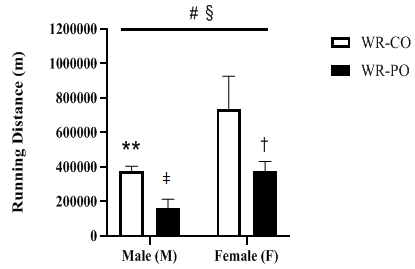
After the 8-week offspring wheel running intervention, there was a significant main parent treatment effect for total voluntary wheel running distance (M+WR+PO, 158 ± 54 km; M+WR+CO, 378 ± 27 km; F+WR+PO 373 ± 58 km; F+WR+CO 738 ± 187 km) (p= 0.021, Figure 1). Post hoc analyses revealed that M+WR+PO ran ~82% less than M+WR+CO (p=0.030, Figure 1) and F+WR+PO ran ~65% less than F+WR+CO (p=0.0024, Figure 1). There was a significant main sex effect for total voluntary wheel running distance (M+WR+PO, 158 ± 54 km; M+WR+CO, 378 ± 27 km; F+WR+PO 373 ± 58 km; F+WR+CO 738 ± 187 km) (p=0.023, Figure 1). Post hoc analyses revealed that M+WR+PO ran ~80% less than F+WR+PO (p=0.038) and M+WR+CO ran ~64% less than F+WR+CO (p=0.002). There was no sex x parent treatment interaction for total wheel running distance (p>0.05). There were also no significant main parent effect, sex effect or parent x sex interactions in weekly body mass (g) (p>0.05, data not shown).
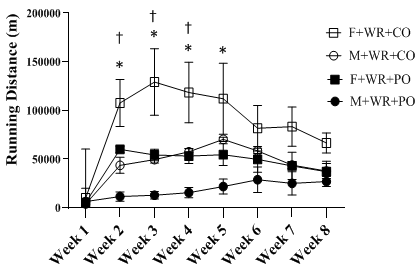
Weekly wheel running distances were analyzed to assess how maternal GnRHa treatment influenced offspring running behavior across the 8-week intervention. There were significant main parent treatment effects during Weeks 2–5 (p = 0.0157, 0.0131, 0.0114, and 0.0263, respectively; Figure 2). A significant main sex effect was also observed during Weeks 2–4 (p = 0.0026, 0.0088, and 0.0169, respectively; Figure 2). No significant parent treatment × sex interactions were detected during Weeks 1–8 (p>0.05; Figure 2). Additionally, no significant main effects of parent treatment or sex were observed during Weeks 1, 6, 7, and 8 (p > 0.05; Figure 2).

 , p<0.05). M+WR+PO vs. M+WR+CO and F+WR+PO (‡, p=0.030, p=0.001, respectively). M+WR+CO vs F+WR+CO (**, p=0.0026). F+WR+PO vs F+WR+CO (†, p=0.0024)
 ), (p<0.05)
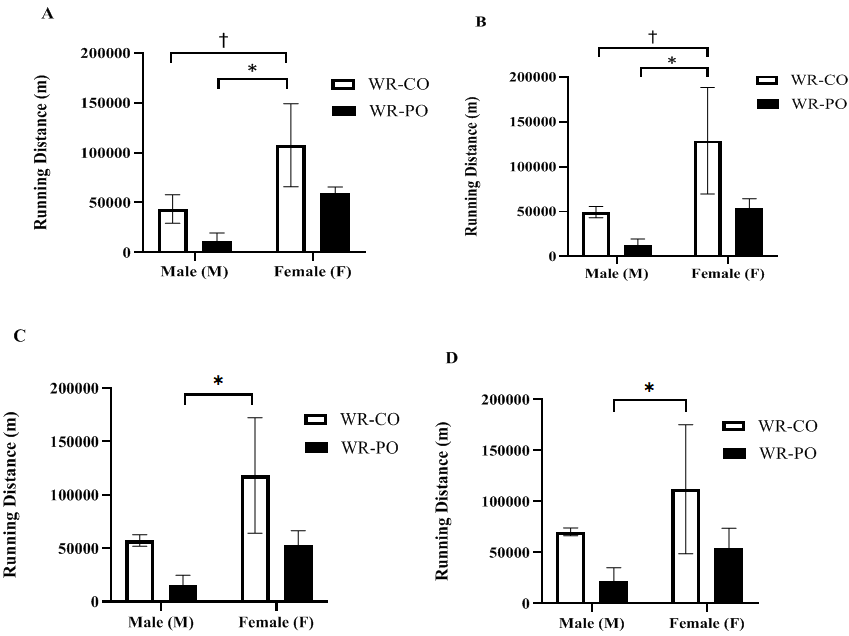
Post hoc analyses for Weeks 2–5 are presented in Figure 3. During Week 2 (Figure 3A), M+WR+CO (43 ± 14 km) ran ~85% less than F+WR+CO (107 ± 41 km) (p=0.0345). Additionally, M+WR+PO (11 ± 8 km) ran ~162% less than F+WR+CO (p=0.0036). During Week 3 (Figure 3B), M+WR+CO (49 ± 6 km) ran ~89% less than F+WR+CO (129 ± 59 km) (p=0.0498) while M+WR+PO (12 ± 6 km) ran ~165% less than F+WR+CO (p=0.0069). During Week 4 (Figure 3C), M+WR+PO (15 ± 9 km) ran ~154% less than F+WR+CO (118 ± 54 km) (p=0.0094). During Week 5 (Figure 3D), M+WR+PO (21 ± 13 km) ran ~136% less than F+WR+CO (112 ± 63 km) (p=0.0454).

The purpose of this study was to evaluate physical activity behavior in offspring born to mothers who underwent pubertal suppression with the GnRHa triptorelin followed by treatment discontinuation. To our knowledge, this is the first study to investigate the effects of maternal GnRHa exposure on offspring physical activity behavior using voluntary wheel running as a measure. An important aspect of this study is that it also supports previous findings from our laboratory demonstrating that four weeks of GnRHa treatment followed by discontinuation is reversible with respect to sexual function, successful breeding, and the birth of viable offspring. Despite this reversibility, offspring born to GnRHa treated mothers exhibited significantly reduced total and weekly voluntary wheel running distances compared with controls. Although the mechanisms underlying these findings remain to be elucidated, the observed reduction in voluntary physical activity among offspring should not be overlooked. Physical activity plays a crucial part of health in individuals throughout all stages of life and has been shown to help reduce the risk of many types of diseases including but not limited to hypertension and diabetes 32.
One major strength of this study includes the use of animal research subjects and its controlled experimental design, which minimizes many confounding variables known to influence physical activity and behavior in human populations 33. This level of control helps highlight the potential of physiological mechanisms being the primary contributor to the observed reductions in physical activity rather than social and economic factors; however, several limitations should also be considered. The delivery method, timing of exposure, and overall purpose of the drug in this experimental model may limit its direct translation of these findings to human populations. As discussed previously, the symptoms and potential adverse effects associated with GnRHa treatment can be influenced by numerous factors 23, 24, 25 26, 27, 28, 29 that were not examined in the current study. Therefore, these findings do not necessarily indicate that similar effects would always be observed in humans, as limitations in direct translation are a common challenge in animal research.
Although this study did not assess detailed measures of growth, maturation, or other developmental outcomes potentially influenced by maternal GnRHa exposure, offspring body mass was evaluated. No significant main effect or interactions for body mass were observed (p> 0.05), suggesting that maternal GnRHa exposure did not appear to affect at least one measure of offspring growth. A major limitation, however, of using body mass as a measure is that it does not reflect body composition which refers to the distribution of fat and lean mass 34. Therefore, despite the absence of differences in body mass, potential alterations in body composition cannot be ruled out. Future studies should assess body composition to more precisely determine whether GnRHa exposure influences growth and maturation with respect to body composition.
Previous research has demonstrated that GnRHa treatment can affect bone mineral density (BMD) and bone quality, particularly in individuals treated for CPP and gender dysphoria 35, 36, 37. These findings, however, do not necessarily imply that offspring born to mothers exposed to GnRHas will exhibit altered BMD or bone quality. Nevertheless, lean body mass markers such as BMD and bone quality in offspring born under similar conditions warrant further investigation.
Total (56-day) voluntary wheel running distance of offspring in this study showed that irrespective of parent treatment, females ran significantly more than their male counterparts (Figure 1) when given access to voluntary running wheels. These sex differences are congruent with the literature, as female rats typically run more than males when given access to voluntary running wheels 38. However, total (56-day) wheel running results also indicate that regardless of sex, offspring born from GnRHa-treated mothers ran significantly less than control counterparts (Figure 1). These data imply that maternal GnRHa exposure reduces offspring total voluntary wheel running as a measure of physical activity. Notably, these results demonstrate that even temporary suppression of sex hormones in female rats can influence physical activity in the next generation.
Weekly voluntary wheel running comparisons allude to the fact that this impact may be even more complex. The absence of differences observed during week 1 (Figure 2) are not surprising or abnormal, as rodent research animals usually display minimal wheel running activity during initial exposure to voluntary running wheels 39. Across weeks 2–5, offspring of GnRHa-treated mothers ran significantly less than control offspring. Additionally, females exhibited greater voluntary wheel running than males during weeks 2–4 (Figure 2). A closer look into these weeks’ differences (Figure 3 A-D) highlight that males seem to be impacted the most from maternal GnRHa exposure as indicated by higher percent differences when compared to male controls and female groups, which would warrant future studies to explore possible sex specific epigenetic and transgenerational bio-markers. It is well known that lifestyle choices, behaviors, and overall health of prospective mothers prior to and during gestation can influence health of offspring 40, 41, 42, therefore the temporary disruption in sex hormone availability in early life of future prospective mothers warrants further investigation.
Interestingly though, it appears that weekly wheel running distances showed no significant differences among groups starting at week 6 and through week 8 (Figure 2). This suggests that reductions in offspring physical activity may only occur during early stages of life. It is unknown, however, if this period of wheel running behavior during weeks 6-8 would continue into adulthood suggesting the need for future investigation with a longer observation period (into later adulthood) with continued physical activity monitoring of offspring born under similar conditions.
In addition to the need for more long-term monitoring of physical activity in offspring born under similar conditions, future studies should investigate the potential mechanisms underlying this phenomenon. Although voluntary wheel running was used in this study as a primary measure of physical activity, it can also reflect behavioral processes. Therefore, future research should examine whether other behavioral outcomes such as memory, learning, anxiety, and depression are also affected. Finally, future studies should explore potential interventions that may mitigate the reductions in physical activity observed in offspring such as increased maternal physical activity (i.e., wheel running).
Overall, this study provides novel insight into how early-life exposure to GnRH agonists in females influence offspring physical activity as measured by voluntary wheel running. Additional research is needed to better understand the broader implications of these findings within healthcare. Nevertheless, health care providers, exercise specialists, and individuals who have undergone or may undergo GnRHa treatment with future intentions of having children would benefit from this information and from continued research on this topic.
No funding was received for the completion of this study.
The authors have no competing interests
| [1] | Vukovic R, Milenkovic T, Soldatovic I, Pekic S, Mitrovic K, Todorovic S. Triptorelin-stimulated luteinizing hormone concentrations for diagnosing central precocious puberty: study of diagnostic accuracy. Endocrine. 2022; 75(3): 934-941. | ||
| In article | View Article PubMed | ||
| [2] | Wang L, Jiang Q, Wang M, Xu J, Jin J. The effect of triptorelin and leuprolide on the level of sex hormones in girls with central precocious puberty and its clinical efficacy analysis. Transl Pediatr. 2021; 10(9): 2307-2312. | ||
| In article | View Article PubMed | ||
| [3] | Latronico AC, Brito VN, Carel JC. Causes, diagnosis, and treatment of central precocious puberty. Lancet Diabetes Endocrinol. 2016; 4(3): 265-274. | ||
| In article | View Article PubMed | ||
| [4] | Carel JC, Eugster EA, Rogol A, et al. Consensus statement on the use of gonadotropin-releasing hormone analogs in children. Pediatrics. 2009; 123(4): e752-e762. | ||
| In article | View Article PubMed | ||
| [5] | Mensah FK, Bayer JK, Wake M, Carlin JB, Allen NB, Patton GC. Early puberty and childhood social and behavioral adjustment. J Adolesc Health. 2013; 53(1): 118-124. | ||
| In article | View Article PubMed | ||
| [6] | Popovic J, Geffner ME, Rogol AD, Silverman LA, Kaplowitz PB, Mauras N, et al. Gonadotropin-releasing hormone analog therapies for children with central precocious puberty in the United States. Front Pediatr. 2022; 10: 968485. | ||
| In article | View Article PubMed | ||
| [7] | Hembree WC, Cohen-Kettenis PT, Gooren L, Hannema SE, Meyer WJ, Murad MH, Rosenthal SM, Safer JD, Tangpricha V, T'Sjoen GG. Endocrine treatment of gender-dysphoric/gender-incongruent persons: an Endocrine Society clinical practice guideline. J Clin Endocrinol Metab. 2017; 102(11): 3869-3903. | ||
| In article | View Article PubMed | ||
| [8] | Brik T, Vrouenraets LJJJ, de Vries MC, Hannema SE. Trajectories of adolescents treated with gonadotropin-releasing hormone analogues for gender dysphoria. Arch Sex Behav. 2020; 49(7): 2611-2618. | ||
| In article | View Article PubMed | ||
| [9] | Shumer DE, Nokoff NJ, Spack NP. Advances in the care of transgender children and adolescents. Adv Pediatr. 2016; 63(1): 79-102. | ||
| In article | View Article PubMed | ||
| [10] | Chen D, Abrams M, Clark L, Ehrensaft D, Tishelman AC, Chan YM, Garofalo R, Olson-Kennedy J, Rosenthal SM, Hidalgo MA. Psychosocial characteristics of transgender youth seeking gender-affirming medical treatment: baseline findings from the Trans Youth Care Study. J Adolesc Health. 2021; 68(6): 1104-1111. | ||
| In article | View Article PubMed | ||
| [11] | Jensen RK, Jensen JK, Simons LK, Chen D, Rosoklija I, Finlayson CA. Effect of concurrent gonadotropin-releasing hormone agonist treatment on dose and side effects of gender-affirming hormone therapy in adolescent transgender patients. Transgend Health. 2019; 4(1): 300-303. | ||
| In article | View Article PubMed | ||
| [12] | Anacker C, Sydnor E, Chen BK, LaGamma CC, McGowan JC, Mastrodonato A, et al. Behavioral and neurobiological effects of GnRH agonist treatment in mice: potential implications for puberty suppression in transgender individuals. Neuropsychopharmacology. 2021; 46(5): 882-890. | ||
| In article | View Article PubMed | ||
| [13] | MacKinnon KR, Kia H, Salway T, Ashley F, Lacombe-Duncan A, Abramovich A, Enxuga G, Ross LE. Health care experiences of patients discontinuing or reversing prior gender-affirming treatments. JAMA Netw Open. 2022; 5(7): e2224717. | ||
| In article | View Article PubMed | ||
| [14] | Jones B, Hydock D. The effects of puberty blocking treatment (gonadotropin releasing hormone agonist) on reproductive function in young female rats. Arch Clin Biomed Res. 2025; 9: 552-558. | ||
| In article | View Article | ||
| [15] | Garrido MP, Hernandez A, Vega M, Araya E, Romero C. Conventional and new proposals of GnRH therapy for ovarian, breast, and prostatic cancers. Front Endocrinol (Lausanne). 2023; 14: 1143261. | ||
| In article | View Article PubMed | ||
| [16] | Eisenberger MA, O'Dwyer PJ, Friedman MA. Gonadotropin hormone-releasing hormone analogues: a new therapeutic approach for prostatic carcinoma. J Clin Oncol. 1986; 4(3): 414-424. | ||
| In article | View Article PubMed | ||
| [17] | Robertson JF, Blamey RW. The use of gonadotrophin-releasing hormone (GnRH) agonists in early and advanced breast cancer in pre- and perimenopausal women. Eur J Cancer. 2003; 39(7): 861-869. | ||
| In article | View Article PubMed | ||
| [18] | Itskovitz-Eldor J, Kol S, Mannaerts B. Use of a single bolus of GnRH agonist triptorelin to trigger ovulation after GnRH antagonist ganirelix treatment in women undergoing ovarian stimulation for assisted reproduction. Hum Reprod. 2000; 15(9): 1965-1968. | ||
| In article | View Article PubMed | ||
| [19] | Tay CC. Use of gonadotrophin-releasing hormone agonists to trigger ovulation. Hum Fertil (Camb). 2002; 5(1): G35-G48. | ||
| In article | View Article PubMed | ||
| [20] | Mayo Clinic. In vitro fertilization (IVF). Mayo Clinic. Published September 1, 2023. Accessed March 2026. https: // www. mayoclinic.org/tests-procedures/in-vitro-fertilization/about/pac-20384716. | ||
| In article | |||
| [21] | Pirtea P, de Ziegler D, Poulain M, Ayoubi JM. New twists in ovarian stimulation and their practical implications. Front Med (Lausanne). 2019; 6: 197. | ||
| In article | View Article PubMed | ||
| [22] | Kol S. Luteolysis induced by a gonadotropin-releasing hormone agonist is the key to prevention of ovarian hyperstimulation syndrome. Fertil Steril. 2004; 81(1): 1-5. | ||
| In article | View Article PubMed | ||
| [23] | Surrey ES. GnRH agonists in the treatment of symptomatic endometriosis: a review. F S Rep. 2022; 4(2 Suppl): 40-45. | ||
| In article | View Article PubMed | ||
| [24] | Dal Prato L, Borini A, Cattoli M, Bonu MA, Sereni E, Flamigni C. GnRH analogs: depot versus short formulations. Eur J Obstet Gynecol Reprod Biol. 2004; 115(Suppl): S40-S43. | ||
| In article | View Article PubMed | ||
| [25] | De Sanctis V, Soliman AT, Di Maio S, Soliman N, Elsedfy H. Long-term effects and significant adverse drug reactions associated with the use of gonadotropin-releasing hormone analogs for central precocious puberty. Acta Biomed. 2019; 90(3): 345-359. | ||
| In article | |||
| [26] | Ali M, Raslan M, Ciebiera M, Zaręba K, Al-Hendy A. Current approaches to overcome the side effects of GnRH analogs in the treatment of patients with uterine fibroids. Expert Opin Drug Saf. 2022; 21(4): 477-486. | ||
| In article | View Article PubMed | ||
| [27] | National Institute of Diabetes and Digestive and Kidney Diseases. Gonadotropin-releasing hormone (GnRH) analogues. Published 2012. Accessed March 2026. https: // www. ncbi.nlm.nih. gov/books/ NBK547863/. | ||
| In article | |||
| [28] | Salas-Humara C, Sequeira GM, Rossi W, Dhar CP. Gender affirming medical care of transgender youth. Curr Probl Pediatr Adolesc Health Care. 2019; 49(9): 100683. | ||
| In article | View Article PubMed | ||
| [29] | Kim EY. Long-term effects of gonadotropin-releasing hormone analogs in girls with central precocious puberty. Korean J Pediatr. 2015; 58(1): 1-7. | ||
| In article | View Article PubMed | ||
| [30] | Hydock DS. Sex hormone suppression and physical activity: possible implications for transgender individuals. Transgend Health. 2022; 7(1): 43-51. | ||
| In article | View Article PubMed | ||
| [31] | Jones BC, Hydock DS. Effects of puberty blocker treatment on voluntary wheel running activity in young rats. Int J Sport Exerc Health Res. 2023; 7(2): 83-89. | ||
| In article | View Article | ||
| [32] | US Department of Health and Human Services. Physical Activity Guidelines for Americans. 2nd ed. Washington, DC: US Dept of Health and Human Services; 2018. | ||
| In article | |||
| [33] | Chen TJ, Whitfield GP, Watson KB, Fulton JE, Ussery EN, Hyde ET, Rose K. Awareness and knowledge of the Physical Activity Guidelines for Americans, 2nd edition. J Phys Act Health. 2023; 20(8): 742-751. | ||
| In article | View Article PubMed | ||
| [34] | Kuriyan R. Body composition techniques. Indian J Med Res. 2018; 148(5): 648-658. | ||
| In article | View Article PubMed | ||
| [35] | Mayo Clinic. Pubertal blockers for transgender and gender diverse youth. Mayo Clinic. Published June 14, 2023. Accessed March 2026. https: //www.mayoclinic.org/diseases-conditions/gender-dysphoria/in-depth/pubertal-blockers/art-20459075. | ||
| In article | |||
| [36] | Vlot MC, Klink DT, den Heijer M, Blankenstein MA, Rotteveel J, Heijboer AC. Effect of pubertal suppression and cross-sex hormone therapy on bone turnover markers and bone mineral apparent density in transgender adolescents. Bone. 2017; 95: 11-19. | ||
| In article | View Article PubMed | ||
| [37] | Neely EK, Bachrach LK, Hintz RL, et al. Bone mineral density during treatment of central precocious puberty. J Pediatr. 1995; 127(5): 819-822. | ||
| In article | View Article PubMed | ||
| [38] | Tanner MK, Hohorst AA, Mellert SM, Loetz EC, Baratta MV, Greenwood BN. Female rats are more responsive than males to the protective effects of voluntary physical activity against the behavioral consequences of inescapable stress. Stress. 2023; 26(1): 2245492. | ||
| In article | View Article PubMed | ||
| [39] | Mathis V, Wegman-Points L, Pope B, Lee CJ, Mohamed M, Rhodes JS, Clark PJ, Clayton S, Yuan LL. Estrogen-mediated individual differences in female rat voluntary running behavior. J Appl Physiol. 2024; 136(3): 592-605. | ||
| In article | View Article PubMed | ||
| [40] | Capra L, Tezza G, Mazzei F, Boner AL. The origins of health and disease: the influence of maternal diseases and lifestyle during gestation. Ital J Pediatr. 2013; 39: 7. | ||
| In article | View Article PubMed | ||
| [41] | Kartchner LC, Dunn A, Taylor KH, et al. Lifestyle modifications prior to pregnancy and their impact on maternal and perinatal outcomes: a review. J Clin Med. 2025; 14(18): 6582. | ||
| In article | View Article PubMed | ||
| [42] | Johnson K, Posner SF, Biermann J, et al. Recommendations to improve preconception health and health care—United States. MMWR Recomm Rep. 2006; 55(RR-6): 1-23. | ||
| In article | |||
Published with license by Science and Education Publishing, Copyright © 2026 Curtis S. Davis, Kara C. Phillips and David S. Hydock
 This work is licensed under a Creative Commons Attribution 4.0 International License. To view a copy of this license, visit
http://creativecommons.org/licenses/by/4.0/
This work is licensed under a Creative Commons Attribution 4.0 International License. To view a copy of this license, visit
http://creativecommons.org/licenses/by/4.0/
, p<0.05). M+WR+PO vs. M+WR+CO and F+WR+PO (‡, p=0.030, p=0.001, respectively). M+WR+CO vs F+WR+CO (**, p=0.0026). F+WR+PO vs F+WR+CO (†, p=0.0024)| [1] | Vukovic R, Milenkovic T, Soldatovic I, Pekic S, Mitrovic K, Todorovic S. Triptorelin-stimulated luteinizing hormone concentrations for diagnosing central precocious puberty: study of diagnostic accuracy. Endocrine. 2022; 75(3): 934-941. | ||
| In article | View Article PubMed | ||
| [2] | Wang L, Jiang Q, Wang M, Xu J, Jin J. The effect of triptorelin and leuprolide on the level of sex hormones in girls with central precocious puberty and its clinical efficacy analysis. Transl Pediatr. 2021; 10(9): 2307-2312. | ||
| In article | View Article PubMed | ||
| [3] | Latronico AC, Brito VN, Carel JC. Causes, diagnosis, and treatment of central precocious puberty. Lancet Diabetes Endocrinol. 2016; 4(3): 265-274. | ||
| In article | View Article PubMed | ||
| [4] | Carel JC, Eugster EA, Rogol A, et al. Consensus statement on the use of gonadotropin-releasing hormone analogs in children. Pediatrics. 2009; 123(4): e752-e762. | ||
| In article | View Article PubMed | ||
| [5] | Mensah FK, Bayer JK, Wake M, Carlin JB, Allen NB, Patton GC. Early puberty and childhood social and behavioral adjustment. J Adolesc Health. 2013; 53(1): 118-124. | ||
| In article | View Article PubMed | ||
| [6] | Popovic J, Geffner ME, Rogol AD, Silverman LA, Kaplowitz PB, Mauras N, et al. Gonadotropin-releasing hormone analog therapies for children with central precocious puberty in the United States. Front Pediatr. 2022; 10: 968485. | ||
| In article | View Article PubMed | ||
| [7] | Hembree WC, Cohen-Kettenis PT, Gooren L, Hannema SE, Meyer WJ, Murad MH, Rosenthal SM, Safer JD, Tangpricha V, T'Sjoen GG. Endocrine treatment of gender-dysphoric/gender-incongruent persons: an Endocrine Society clinical practice guideline. J Clin Endocrinol Metab. 2017; 102(11): 3869-3903. | ||
| In article | View Article PubMed | ||
| [8] | Brik T, Vrouenraets LJJJ, de Vries MC, Hannema SE. Trajectories of adolescents treated with gonadotropin-releasing hormone analogues for gender dysphoria. Arch Sex Behav. 2020; 49(7): 2611-2618. | ||
| In article | View Article PubMed | ||
| [9] | Shumer DE, Nokoff NJ, Spack NP. Advances in the care of transgender children and adolescents. Adv Pediatr. 2016; 63(1): 79-102. | ||
| In article | View Article PubMed | ||
| [10] | Chen D, Abrams M, Clark L, Ehrensaft D, Tishelman AC, Chan YM, Garofalo R, Olson-Kennedy J, Rosenthal SM, Hidalgo MA. Psychosocial characteristics of transgender youth seeking gender-affirming medical treatment: baseline findings from the Trans Youth Care Study. J Adolesc Health. 2021; 68(6): 1104-1111. | ||
| In article | View Article PubMed | ||
| [11] | Jensen RK, Jensen JK, Simons LK, Chen D, Rosoklija I, Finlayson CA. Effect of concurrent gonadotropin-releasing hormone agonist treatment on dose and side effects of gender-affirming hormone therapy in adolescent transgender patients. Transgend Health. 2019; 4(1): 300-303. | ||
| In article | View Article PubMed | ||
| [12] | Anacker C, Sydnor E, Chen BK, LaGamma CC, McGowan JC, Mastrodonato A, et al. Behavioral and neurobiological effects of GnRH agonist treatment in mice: potential implications for puberty suppression in transgender individuals. Neuropsychopharmacology. 2021; 46(5): 882-890. | ||
| In article | View Article PubMed | ||
| [13] | MacKinnon KR, Kia H, Salway T, Ashley F, Lacombe-Duncan A, Abramovich A, Enxuga G, Ross LE. Health care experiences of patients discontinuing or reversing prior gender-affirming treatments. JAMA Netw Open. 2022; 5(7): e2224717. | ||
| In article | View Article PubMed | ||
| [14] | Jones B, Hydock D. The effects of puberty blocking treatment (gonadotropin releasing hormone agonist) on reproductive function in young female rats. Arch Clin Biomed Res. 2025; 9: 552-558. | ||
| In article | View Article | ||
| [15] | Garrido MP, Hernandez A, Vega M, Araya E, Romero C. Conventional and new proposals of GnRH therapy for ovarian, breast, and prostatic cancers. Front Endocrinol (Lausanne). 2023; 14: 1143261. | ||
| In article | View Article PubMed | ||
| [16] | Eisenberger MA, O'Dwyer PJ, Friedman MA. Gonadotropin hormone-releasing hormone analogues: a new therapeutic approach for prostatic carcinoma. J Clin Oncol. 1986; 4(3): 414-424. | ||
| In article | View Article PubMed | ||
| [17] | Robertson JF, Blamey RW. The use of gonadotrophin-releasing hormone (GnRH) agonists in early and advanced breast cancer in pre- and perimenopausal women. Eur J Cancer. 2003; 39(7): 861-869. | ||
| In article | View Article PubMed | ||
| [18] | Itskovitz-Eldor J, Kol S, Mannaerts B. Use of a single bolus of GnRH agonist triptorelin to trigger ovulation after GnRH antagonist ganirelix treatment in women undergoing ovarian stimulation for assisted reproduction. Hum Reprod. 2000; 15(9): 1965-1968. | ||
| In article | View Article PubMed | ||
| [19] | Tay CC. Use of gonadotrophin-releasing hormone agonists to trigger ovulation. Hum Fertil (Camb). 2002; 5(1): G35-G48. | ||
| In article | View Article PubMed | ||
| [20] | Mayo Clinic. In vitro fertilization (IVF). Mayo Clinic. Published September 1, 2023. Accessed March 2026. https: // www. mayoclinic.org/tests-procedures/in-vitro-fertilization/about/pac-20384716. | ||
| In article | |||
| [21] | Pirtea P, de Ziegler D, Poulain M, Ayoubi JM. New twists in ovarian stimulation and their practical implications. Front Med (Lausanne). 2019; 6: 197. | ||
| In article | View Article PubMed | ||
| [22] | Kol S. Luteolysis induced by a gonadotropin-releasing hormone agonist is the key to prevention of ovarian hyperstimulation syndrome. Fertil Steril. 2004; 81(1): 1-5. | ||
| In article | View Article PubMed | ||
| [23] | Surrey ES. GnRH agonists in the treatment of symptomatic endometriosis: a review. F S Rep. 2022; 4(2 Suppl): 40-45. | ||
| In article | View Article PubMed | ||
| [24] | Dal Prato L, Borini A, Cattoli M, Bonu MA, Sereni E, Flamigni C. GnRH analogs: depot versus short formulations. Eur J Obstet Gynecol Reprod Biol. 2004; 115(Suppl): S40-S43. | ||
| In article | View Article PubMed | ||
| [25] | De Sanctis V, Soliman AT, Di Maio S, Soliman N, Elsedfy H. Long-term effects and significant adverse drug reactions associated with the use of gonadotropin-releasing hormone analogs for central precocious puberty. Acta Biomed. 2019; 90(3): 345-359. | ||
| In article | |||
| [26] | Ali M, Raslan M, Ciebiera M, Zaręba K, Al-Hendy A. Current approaches to overcome the side effects of GnRH analogs in the treatment of patients with uterine fibroids. Expert Opin Drug Saf. 2022; 21(4): 477-486. | ||
| In article | View Article PubMed | ||
| [27] | National Institute of Diabetes and Digestive and Kidney Diseases. Gonadotropin-releasing hormone (GnRH) analogues. Published 2012. Accessed March 2026. https: // www. ncbi.nlm.nih. gov/books/ NBK547863/. | ||
| In article | |||
| [28] | Salas-Humara C, Sequeira GM, Rossi W, Dhar CP. Gender affirming medical care of transgender youth. Curr Probl Pediatr Adolesc Health Care. 2019; 49(9): 100683. | ||
| In article | View Article PubMed | ||
| [29] | Kim EY. Long-term effects of gonadotropin-releasing hormone analogs in girls with central precocious puberty. Korean J Pediatr. 2015; 58(1): 1-7. | ||
| In article | View Article PubMed | ||
| [30] | Hydock DS. Sex hormone suppression and physical activity: possible implications for transgender individuals. Transgend Health. 2022; 7(1): 43-51. | ||
| In article | View Article PubMed | ||
| [31] | Jones BC, Hydock DS. Effects of puberty blocker treatment on voluntary wheel running activity in young rats. Int J Sport Exerc Health Res. 2023; 7(2): 83-89. | ||
| In article | View Article | ||
| [32] | US Department of Health and Human Services. Physical Activity Guidelines for Americans. 2nd ed. Washington, DC: US Dept of Health and Human Services; 2018. | ||
| In article | |||
| [33] | Chen TJ, Whitfield GP, Watson KB, Fulton JE, Ussery EN, Hyde ET, Rose K. Awareness and knowledge of the Physical Activity Guidelines for Americans, 2nd edition. J Phys Act Health. 2023; 20(8): 742-751. | ||
| In article | View Article PubMed | ||
| [34] | Kuriyan R. Body composition techniques. Indian J Med Res. 2018; 148(5): 648-658. | ||
| In article | View Article PubMed | ||
| [35] | Mayo Clinic. Pubertal blockers for transgender and gender diverse youth. Mayo Clinic. Published June 14, 2023. Accessed March 2026. https: //www.mayoclinic.org/diseases-conditions/gender-dysphoria/in-depth/pubertal-blockers/art-20459075. | ||
| In article | |||
| [36] | Vlot MC, Klink DT, den Heijer M, Blankenstein MA, Rotteveel J, Heijboer AC. Effect of pubertal suppression and cross-sex hormone therapy on bone turnover markers and bone mineral apparent density in transgender adolescents. Bone. 2017; 95: 11-19. | ||
| In article | View Article PubMed | ||
| [37] | Neely EK, Bachrach LK, Hintz RL, et al. Bone mineral density during treatment of central precocious puberty. J Pediatr. 1995; 127(5): 819-822. | ||
| In article | View Article PubMed | ||
| [38] | Tanner MK, Hohorst AA, Mellert SM, Loetz EC, Baratta MV, Greenwood BN. Female rats are more responsive than males to the protective effects of voluntary physical activity against the behavioral consequences of inescapable stress. Stress. 2023; 26(1): 2245492. | ||
| In article | View Article PubMed | ||
| [39] | Mathis V, Wegman-Points L, Pope B, Lee CJ, Mohamed M, Rhodes JS, Clark PJ, Clayton S, Yuan LL. Estrogen-mediated individual differences in female rat voluntary running behavior. J Appl Physiol. 2024; 136(3): 592-605. | ||
| In article | View Article PubMed | ||
| [40] | Capra L, Tezza G, Mazzei F, Boner AL. The origins of health and disease: the influence of maternal diseases and lifestyle during gestation. Ital J Pediatr. 2013; 39: 7. | ||
| In article | View Article PubMed | ||
| [41] | Kartchner LC, Dunn A, Taylor KH, et al. Lifestyle modifications prior to pregnancy and their impact on maternal and perinatal outcomes: a review. J Clin Med. 2025; 14(18): 6582. | ||
| In article | View Article PubMed | ||
| [42] | Johnson K, Posner SF, Biermann J, et al. Recommendations to improve preconception health and health care—United States. MMWR Recomm Rep. 2006; 55(RR-6): 1-23. | ||
| In article | |||