Many adults understand the health benefits of physical activity (PA) yet struggle to translate intentions into sustained behaviour. Narrative-based approaches may support this process by reactivating affective and identity-related mechanisms linked to past PA experiences. Guided Autobiography (GAB) is a structured, non-directive small-group method designed to facilitate meaning-making through reflective writing and sharing, but it has not previously been applied in a PA context. This proof-of-concept study examined the feasibility, acceptability, and preliminary psychological impact of a brief PA-themed GAB intervention and explored whether it showed sufficient promise to warrant further testing. Seventeen mature-aged adults participated in a PA-themed GAB intervention, “My Physically Active Life”, involving completion of a 25-year PA timeline, autobiographical writing, and shared reflection. A mixed-methods pre–post design was used, with quantitative measures of PA-related attitudes (instrumental and affective), identity, and behavioural intentions collected at baseline, with a 7-day follow-up. Qualitative data were analysed thematically to examine participants’ experiences of reflection and narrative reframing. Participants reported high acceptability and described GAB as a meaningful prompt for reconnecting with positive early-life PA experiences and active identities. Instrumental attitudes were high at baseline and unchanged, functioning as a control indicator. In contrast, small-to-moderate positive effects were observed for affective attitudes (enjoyment, pleasantness) and PA-related identity, with a modest increase in behavioural intention. Qualitative findings supported these patterns, highlighting shifts in affective meaning, and self-concept. This ORBIT Phase IIa proof-of-concept study provides initial evidence that PA-themed GAB is feasible, acceptable, and engages theoretically relevant psychological mechanisms. Further refinement and controlled testing are warranted to examine its role as a preparatory intervention supporting intention–behaviour translation.
Regular physical activity (PA) is widely recognized as a cornerstone of health, delivering benefits across physical, psychological, social, and environmental domains. At a physical level, PA reduces the risk of noncommunicable diseases such as cardiovascular disease, type 2 diabetes, and several cancers 1. Mental health is also enhanced, with robust evidence showing that PA reduces symptoms of depression and improves psychological well-being in adults 2. Beyond the individual, PA provides social benefits by strengthening community connections and fostering a sense of belonging 3, while also supporting environmental sustainability through promotion of active transport 4. Despite a compelling evidence base, the WHO has estimated 22% of adults are insufficiently active, whilst ~80% of adolescents fail to meet the recommended minimum level of weekly PA 5.
Over the past 50 years, cognitive-behavioural approaches have struggled to bridge the gap between PA intentions and behavior 6, 7. Traditionally, health promotion has utilised an array of tactics to influence community attitudes and behaviours, such as educating people about risk factors and adverse consequences, along with highlighting the personal benefits of PA. This has been accompanied by an array of cognitive and behaviour change techniques (BCT) that seek to influence attitudes and behaviors, such as goal setting, action planning, rewards, behavioural instruction and electronic messaging 8, 9. In essence, these methods attempt to change behaviour by changing how people think about PA. However, researchers have increasingly advocated for an “escape from cognitivism” 7 and greater focus on the role of affect in the action control process 10. An alternate approach is to try and change how people feel about PA, either by exploring their general level of intrinsic interest, or more specific interests related to specific physical pursuits 11, 12, 13. According to this perspective, PA promotion should concentrate more on helping people orient towards what they might find enjoyable or satisfying 14, 15, via the use of change techniques that help individuals improve their affective judgments and hedonic motivation 10, 16.
Another construct of relevance to PA intention-behaviour translation is personal identity. According to 17 this relatively stable aspect of self-concept may anchor long-term engagement when individuals are able to internalize PA as part of “who they are”. Given identity overlaps conceptually with the autonomous regulatory styles elucidated in self-determination theory (SDT), specifically integrated regulation 18, such internalisation is likely to be accompanied by a sense of volition that yields a more enduring motivation than that emanating from the presence of transient affective states. As such, identity represents as a potentially fruitful avenue of enquiry, as part of interventions that seek to combine enhanced emotional engagement with durable self-concept change. Given the change techniques required to effectively target and modify these constructs are not well defined and poorly understood 16, 19, 20 innovation is needed to address some important gaps in knowledge.
Guided autobiography (GAB) is a form of life review that provides a structured approach to recalling and writing about life experiences through thematic prompts and reflective exercises 21. Typically facilitated in a small group setting, GAB provides individuals with opportunities to explore personal growth, identity, and meaning by organizing their memories into a cohesive narrative. Whilst its evidence-base is relatively small, several benefits are known to flow from GAB, including tangible outcomes, like a written life review document and positive subjective outcomes like increased self-acceptance, vigor and connectedness, and decreased depression and increased mastery 22, 23, 24. As most empirical work has been conducted in older adult, educational and counselling contexts, using a broad life review agenda 22, the examination of GAB for the specific purpose of enhancing PA motivation and engagement is yet to be explored. As such, a proof of concept is an appropriate form of exploration, as it allows for the initial testing of the feasibility, acceptability, and potential utility of applying GAB in this new domain before committing to larger-scale or more resource-intensive trials.
In this study, the rationale for using GAB as the basis of an affective change technique rests on two related assumptions. First, PA is inherently engaging for human beings and often a significant source of enjoyment, particularly during the formative stages of life. This implies a latent motivational foundation likely exists within most people, rooted in positive early-life experiences. Second, traces of their intrinsic interest are likely reflected in the personal narratives they construct when recalling early PA experiences. Constructing these autobiographical accounts may serve as a powerful stimulant for activating or reactivating affective connections to PA and/or identity clarification or re-engagement, with aspects of the self that had previously been neglected 25.
2.1. Research QuestionsBuilding on the assumptions outlined above, this study explored the potential of GAB as a tool for facilitating improvements in PA-related attitudes, identity and behavioural intentions. Using the Obesity-Related Behavioral Interventions Trials (ORBIT) model as a guide 26, a Phase IIa proof-of-concept was chosen to determine how well the intervention could be operationalised in a PA context, and its capability of signalling change on key variables of interest. The following research questions guided the study:
1. To what extent is GAB perceived as acceptable and helpful for supporting self-reflection and narrative reframing among participants?
2. What preliminary signals of change can be detected in PA-related cognitions following the intervention?
This mixed-methods, single group, proof of concept study aimed to assess the viability and preliminary impact of using an abridged form of GAB as a PA change technique. As such, the study was not powered to detect statistically significant differences. Rather, it utilised a small convenience sample for the purpose of evaluating feasibility outcomes and informing future trial design. It is also noted that the first author has formal training in both coaching psychology and exercise science, which may have shaped the framing of interview questions and the interpretation of participant responses.
Participants were postgraduate students at the University of Sydney enrolled in a 5-day intensive on applied positive psychology. As outlined below, the intervention was tied to specific GAB course content and associated experiential learning. While these classroom activities were undertaken by all students, research participation was entirely voluntary with data collection occurring outside classroom hours. In accordance with institutional human research ethics approval, students were informed that (i) participation in classroom activities did not require participation in the research, and (ii) non-participation would not impact their relationship to teaching staff or assessment outcomes.
3.1. InterventionThe intervention occurred within experiential learning undertaken by students on Day 3 and Day 4 of the course. It began on Day 3, with a 25-minute introductory lecture covering the theoretical and empirical foundations of GAB, the core process, and illustrative examples of use. Its relevance to health behaviour change was also explained, to ensure alignment with subject learning outcomes. As shown in Tables 1 and 2, the experiential component commenced on the afternoon of Day 3 and concluded on the morning of Day 4.
The experiential learning was split into 2 x 90-minute blocks, one per day. As the subject learning outcomes only required a basic appreciation of GAB, it was not necessary to replicate the full process, which uses nine life themes to structure self-reflection and narrative writing 22. Accordingly, an abridged version was designed that included an icebreaker activity and two life themes (see Table 1). The first, Major Turning Points, was selected for its ability to prime autobiographical memories and acquaint students with the method. The second, My Physically Active Life, was included to illustrate the flexibility of a thematic approach and its potential utility in a health-related behaviour change context.
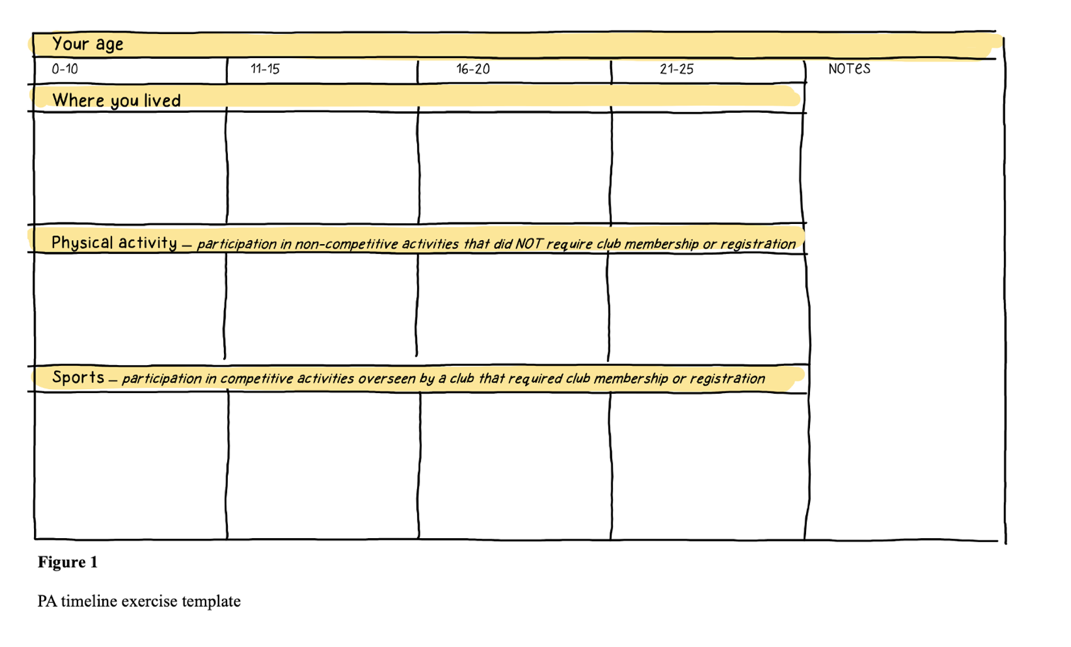
Day 3 experiential learning. Immediately after the introductory lecture, students were randomly assigned to pairs for the duration of the 90-minute session and given a worksheet to assist their reflection and narrative writing. Given autobiographical memories are not always easily retrieved, a simple timeline was included (see Figure 1) to provide temporal anchor points to assist PA recall and reflection 27. A total of 20-minutes was assigned for individual reflection, followed by 25-minutes sharing and debriefing with a reflective partner.

After completing the individual and paired PA reflection, the remaining class time was given to autobiographical writing, using the following prompt:
“Having reflected on your experience of physical activity over the first 25 years of your life, you can begin organising those reflections into a personal narrative. Most likely, your experiences will be a mixture of what was positive and satisfying, and what as negative and unsatisfying. Whilst both are important, try to focus on what has been good or beneficial, rather than bad or unhelpful. It you can, link details of your past experiences (e.g., a satisfying achievement) with emerging insights about the connection physical activity has to your values, sense of identity, and/or your beliefs about life and living”.
Day 3 ended by encouraging students to develop their narratives overnight and, where possible, strengthen their memory recall by sharing their PA timelines with family or friends, or doing things to induce reminiscence (e.g., phone an ex-teammate, look at old photos or trophies). The aim was to return the next morning (Day 4) with a more developed version of their narrative, which they would share and discuss with their reflective partner.
Day 4 experiential learning. Having developed their PA narratives overnight, students re-connected with their reflective partner and engaged in 45-minutes of peer sharing and discussion. As outlined in Table 2, this involved reading the narratives aloud without interruption, having explicitly agreed to create a safe space for self-disclosure. Following the readings, pairs supported convergent thinking by identifying common themes, clarifying aspects of self-concept (e.g., values and identity), and noting any emerging behavioural intentions. The exercise concluded with a 45-minute class discussion and consideration of how coaches might use a structured life review process, like GAB, to facilitate support goal setting, personal insight, and behaviour change in an array of contexts (such as using personal strengths as a reflective theme to support job performance or career development efforts).
In sum, GAB was used to create an open and permissive space for participants to freely recall and reminisce about past PA experiences, supported by autobiographical writing and mutual sharing.
During the Day 1 course overview, all students were briefed on the project’s aims and timeline. This was followed by a Canvas announcement one week prior to Day 3, that included a link to the participant information statement, consent screen, and Qualtrics survey (T1). One week after Day 4, a second announcement was posted requesting completion of post-intervention measures (T2), including a re-invitation to non-participating students, who may have become interested in contributing data after experiencing the intervention. Of the 34 students enrolled in the subject, 10 completed both pre- and post-intervention surveys, whilst seven students submitted post-intervention data only.
3.3. MeasuresSubjective experiences. To understand participant experiences with GAB and inform future refinements, the following open-ended free-response questions were included in the post-intervention data collection:
i.To what extent did the guided autobiography process help you generate insights about your early experiences of physical activity?
ii. What was easy or difficult about being guided in this way?
iii.How helpful was it to write a personal narrative?
iv.How helpful was it to share your experiences with a classmate?
v.What would have helped you get more out of the exercise?
vi.To what extent did reflecting on past PA generate insights about other aspects of life?
Measures of PA attitudes, identity, and behavioural intentions were administered pre- and post-intervention to assess changes, with items assessing instrumental attitudes and behavioural intentions included as dummy measures to ensure coverage of key theoretical constructs. As these measures were not expected to change within the scope of this brief intervention, they are considered manipulation check indicators rather than primary outcomes. Given data collection was to be completed outside class time, to separate learning from research participation, all efforts were made to minimise the number of measures students needed to complete.
PA Attitudes. Four items were extracted from the Attitudes Toward Physical Activity scale 28 to measure changes in affective and instrumental attitudes. Participants responded to the item stem, “Over the next 3 months, engaging in physical activity on a regular basis would be…”, using a 7-point Likert scale (1 = strongly disagree, 7 = strongly agree). These were presented as single items to measure the perception PA is enjoyable and pleasant (affective attitudes) and beneficial and useful (instrumental attitudes), with each item analysed independently to retain its distinct contribution.
PA Identity. A 3-item version of the Physical Activity Identity scale 29 was used to assess the extent to which participants consider regular PA to be a core aspect of their self-concept. Items such as “When I describe myself to others, I usually include my involvement in physical activity” were rated on a 5-point Likert scale (1 = strongly disagree, 5 = strongly agree). Due to the use of a small item scale, the Spearman–Brown coefficient was calculated as an estimate of reliability, rather than Cronbach’s alpha, and found to be 0.77 for the 3-item scale, which indicates acceptable reliability.
Behavioural Intentions. Participant intentions to be physically active were assessed using a single-item that asked participants to indicate the number of times per week they intended to engage in PA over the next three months 30. This behavioural intention item provides a direct and quantifiable indicator of planned PA frequency and has been widely used in exercise psychology research.
Memory (T2 only). As GAB relies on the ability of individuals to recall and relive past experiences, 14-items were drawn from the Memory Experiences Questionnaire (MEQ) to assess this aspect of the intervention 31. Five dimensions were measured: vividness, accessibility, emotional intensity, distancing, and valence. Example items include: “My memory of this event is very detailed” (vividness), “The overall tone of the memory is positive” (valence), “When I recall this memory, I think, ‘That’s not me anymore’” (distancing) and were rated on a 5-point Likert scale (1=strongly disagree, 5=strongly agree).
3.4. Analysis PlanThe first research question was explored by applying Reflexive Thematic Analysis (RTA) to the textual data, which is appropriate for a study that aims to identify early signals of engagement and change from a target intervention 32. This six-phase process includes (i) reading and re-read of responses to understand meaning, (ii) generating initial codes to be applied to the dataset, (iii) clustering of codes into broader patterns of meaning, (iv) reviewing and refining codes to ensure coherence and distinction, (v) defining and naming themes to capture essence and relevance to research questions, and (vi) writing up findings as part of an analytic narrative, supported by data extracts. In contrast, quantitative data included a series of paired samples t-tests conducted to examine changes in PA attitudes, identity and behavioural intentions and calculation of the standardised effect size estimation, Hedges’ g, which adjusts for small sample bias 33. These estimates are presented only to help inform future trial design, not as evidence of efficacy.
Data was analysed from a combined sample of 17 mature age adults ( age = 48.9 years, SD = 5.6), the majority of whom identify as female (71%). As stated earlier, T1 and T2 quantitative data was collected from 10 participants, with 17 students providing data at T2.
As noted earlier, the primary research question of interest was “to what extent is GAB perceived as acceptable and helpful for supporting self-reflection and narrative reframing among participants?” As part of their response, participants were probed to elaborate on the type and importance of any insights, before then answering five supplementary questions (as stated earlier). Of the 17 responses received, one set was excluded due to insufficient content, including two unanswered questions. As such, RTA was used on 16 records, with two main themes emerging:
Theme 1: Joyful reconnection with the physical self. By raising awareness of participants’ PA patterns during childhood and adolescence, the GAB process seemed to catalyse a realisation of a past value attached to PA that has been forgotten:
“It was very helpful to move through a structured process to rediscover that being active is part of who I am and something I do enjoy” (P7).
“I didn't realise how active my childhood was and I had forgotten the fun and freedom of growing up in the 1980s. As someone who later dreaded PE classes in high school, I realised I had perhaps being telling myself something that may not have been very accurate” (P10).
Given the instructions were to focus on the positive aspects of PA, it was not surprising words like “joy”, “fun”, “play”, “carefree”, and “love” were prominent. However, this was not merely nostalgic. The use of an age-based timeline (see Figure 1) provided temporal anchors that seemed to make personal recall more specific, nuanced and emotionally granular:
“Dividing into sections helped to isolate and recognise patterns with physical activity [e.g., outdoors to indoors] …and more importantly the feelings I had about each section” (P6).
Whilst participants had different ways of expressing their unique PA patterns, most showed evidence of diachronic reflection and the revival of a forgotten younger self. For one participant this involved recalling the “joy of moving…[and] freedom on wheels e.g., riding bikes” (P17) during childhood, whilst another stated that PA was “somewhat carefree…and part of me” (P5). For several other participants, the use of a broad definition of PA led them to realise a physically active childhood meant more regularly participating in organised sport:
“It brought up lovely childhood memories of my sisters and friends and how we played together outdoors in much simpler times. It gave me a different perspective on how I used my physicality back then and that exercise doesn't need to be in the gym. I had always thought I wasn't active…but the story I’d told myself wasn't true” (P12).
Overall, GAB seemed to activate latent motivation for PA by restoring a sense of continuity between the participant’s past and present self. Thus, “joyful reconnection with the physical self” captures how participants used memory as a bridge, not only to make sense of their history with PA but to reclaim ownership of an active identity they assumed was lost:
“The insight that came through the activity is that I am someone who loves to move and always have…. [which] will help me change how I relate to [PA] and I believe will influence how often I do it” (P14).
Theme 2: Physical activity as a social glue. For many, PA was an important “bonding tool” (P2) during childhood, adolescence and early adulthood, and an important source of support. For one participant, the exercise was a reminder of:
“…how important exercise was for social connection and as a way to get support that I really needed in those formative years” (P17)
Participants also reflected on how PA provided a context for forming and deepening social connections, which they expressed in various ways. For one participant, PA “went hand-in-hand with spending quality and really special time with my family” (P8), whilst for another it was inextricably linked to the enjoyment of past PA, and a key determinant of sustained future engagement in PA:
“One of the most telling insights was that I increased my exercise in my early 20s when I begin working… Much of this was through social connections and wanting to spend time with others. It’s important because it shows that exercise has more meaning to me when it’s with others (P3).”
Whilst many participants referred to the importance that PA played in enhancing connection with specific family and friends, one participant reflected on their loyalty to a specific coach (P16) and another recalled her “…love of team sports. It reminded me that whatever type of exercise I consider, it might be sustained if I include other people, support etc” (P13). Attraction to communities of like-minded others also featured for several participants with one noting that her past enjoyment of running was underpinned by pairing the solitude of long runs with regular participation in running groups:
“One thing that’s become clear is that, beyond the movement itself, one element of exercise that’s important is the connection with others. This is a common thread as I look at how I engage with movement now. I realise movement with others is more enjoyable than movement by myself” (P10).
Overall, PA appears to have acted like a “social glue” in two ways. First, many participants reflected on how PA was an important context for forming and strengthening social bonds during their first 25 years. Second, the involvement of others also appears to have bonded participants to their chosen physical pursuits at different times of life. Whilst these bonds did not always endure, the opportunity to reflect on past patterns seemed to flag social connections as a key determinant of ongoing participation in PA.
Whilst GAB confirmed the importance of PA for personal identity and social wellbeing, more insight into the reflective experience was sought by asking participants: “What was easy or difficult about being guided in this way?” Participants overwhelmingly reported that the core activities were not difficult to undertake and were positive in various ways (e.g., “I’m a nostalgic person so thinking about memories and past times is enjoyable”; P13; “It was really lovely to learn more about a classmate”; P08). Whilst some did report the process of recalling early PA memories to be challenging, elements of GAB helped to neutralise those challenges. This included the presence of the reflective partner (“Once I started, and was prompted with some probing questions, I recalled a range of experiences that I had simply forgotten”; P10) and the instruction to selectively attend to the positive aspects of early PA (“it gave me permission to let go of some difficult memories”; P07). In another case, difficult memories proved a little harder to overcome but this was aided by the extended nature of the reflective period and narrative writing:
“…there were traumatic events in my teens that had me avoiding the exercise, not wanting to share this either. During the overnight period…where we extended our narratives, it became easier and more positive” (P6).
Any exercise involving the recall of autobiographical memories carries the possibility of reengaging past unpleasant or traumatic experiences, for which PA may or may not be core. For example, traumatic childhood illnesses created trepidation for one participant:
“I didn't enjoy organised exercise in my teens, as I felt very self-conscious. So, I was nervous talking about it. However, my partner held a safe space, and it… opened up my perspective and how I had previously made meaning of my relationship with my body and exercise” (P12).
For P09, the trauma was deeply felt and associated with the pressures of ballet training that involved:
“…harsh regimes, pressure around weight, performance, lack of care for wellbeing, constant messages of not being good enough, 'fat', public humiliation. I have intense memories of moments of peak performance and associated exhilaration - and around these then just a slush of heaviness. Overall, the memories feel very distorted. Lack of joyful, carefree physical activity experiences triggered deep sadness, feelings of missing out”.
Notably, as difficult as these recollections were, some positive memories did surface:
“Interestingly my memories were very dim - it was a blank - and as others described experiences, I remembered times I enjoyed running, climbing a tree, being good at high jumps. I vividly remembered performance experiences and the exhilaration of peak performance”.
This case offers useful insight into the subjective dynamics of GAB, or the evolving inner process by which participants made sense of their PA history. Despite being confronted by the reflective nature of the task, the participant found it “very insightful”, also noting:
“[PA] has always been an important part of my identity…I still bring competitiveness to physical activity - things like running, cross fit… [and] other aspects of my life. To some extent this gets in the way of present moment being, joy and acceptance. Food for thought!”
Whilst the classroom environment only permitted enough time for an abridged form of GAB, two important components were retained: the writing of a personal narrative, and the sharing of that narrative with others. As these activities are important to GAB for cultivating rich, detailed memories that can facilitate “developmental exchange” 21, participants in this study were asked to comment on these elements of the process. As shown in Table 3, both components were valued by participants.
For most participants, the narrative writing was helpful because it helped pull together threads of their early PA experiences into a coherent story. Not surprisingly, this was an exciting and enjoyable experience for many, in line with what Johns (2020) notes about the impact of reflexive narratives 34. Anecdotally, one participant found preparing the narrative led to a profound and enjoyable family interaction. Whilst debriefing her GAB experience over dinner, her children listened intently to stories and reminiscences she had never previously shared. Whilst the lengthy discussion helped the writing of the narrative, the topic enabled some unique and valuable family time.
The sharing of personal narratives with a reflective partner was likewise deemed to be helpful as it facilitated reflection, memory retrieval, and meaning making. Participants found the process helpful for recalling overlooked positive experiences, reframing past narratives, and gaining new insights about their physically active life. It was also enhanced by trust and rapport with their partner, supporting deeper engagement and self-disclosure. Given the participants were postgraduate students studying an applied science focused on interpersonal skills (i.e., coaching psychology), this reflection on trust and rapport is not surprising. Whilst some participants felt their GAB experience could have been enhanced by providing advance notice (to allow memory priming and psychological preparation), most wanted to dwell more in the process, with more time to reflect, reminisce and/or share with others:
“I could have spent hours more time with my paired partner the next morning, [when] it felt safer… and the sharing of experiences was positive” (P06).
Finally, participants were generally surprised at how a simple reflective task, focused on PA, could generate insights that were pertinent to other aspects of life. For some, these were broad and general, such as P09’s realisation that their childhood competitiveness has unhelpfully generalised to other aspects of life, and another’s insight that “I don’t like being told what to do…[and] I could use a more flexible attitude” (P03). For others, GAB appeared to have both an immediate and a delayed effect, with one participant noting lingering insights that enabled her to spot personal strengths both at work and at home.
4.2. Quantitative Analysis4.2.1. T1-T2 differences. As shown in Table 4, analysis of attitudinal variables revealed negligible pre-post differences for instrumental attitudes, with no difference observed for the perception that PA is beneficial, and only a small positive increase for it being useful (mean differences 0.10; SD = 0.57).
In contrast, both affective attitudes showed more sizable increases. The perception PA would be enjoyable increased from 6.0 to 6.4 (SD = 1. 17), representing a small-to-moderate positive effect (g = 0.46). This raw score increase of 0.4 was repeated for the perception PA would be pleasant (5.5 to 5.9; SD = 1.84), although this equated to only a small positive effect (g = 0.29). A similar trend was observed for PA identity (mean difference = 1.10, SD = 1.20), which equated to a small-to-medium positive effect (g = 0.42). Taken together, these results signal changes in the affective judgements participants made about PA, whilst simultaneously strengthening the extent to which they construed PA as being part of their self-concept. Finally, a small increase in the second control indicator was also observed, with participants’ PA intentions increasing from 4.40 to 4.70 (SD = 0.80), equating to a small positive effect (g = 0.20).
4.2.2. T2 data. Analysis of the MEQ data indicated that participants (n=17) found it relatively easy to remember PA experiences from their first 25 years. Using on a 5-point rating scale, they reported autobiographical memories to have relatively good accessibility ( = 3.47, SD = 0.8) and vividness (
 = 3.75, SD = 1.1), along with predominantly positive valence (
 = 4.03, SD = 1.0), and strong emotional intensity (
 = 4.18, SD = 1.26). Interestingly, participants also reflected moderate distancing in their memories, indicating the younger version of themselves seemed somewhat unlike the present-day person (
 = 3.22, SD = 1.0). Whilst the priming value of the PA timeline was not directly accessed, it seems likely this tool made PA memories more accessible and vivid, leading to higher ratings of valence, intensity and temporal quality.
This proof-of-concept study aimed to examine whether a brief PA-themed GAB intervention could assist participants to reflect on and meaningfully reframe their PA narratives, and to explore early patterns of change in attitudes, identity and behavioural intentions. The design was appropriate because GAB has not previously been applied in this context, and thus the primary goal was to assess feasibility, acceptability and indications of psychological impact, as a preparatory step for testing the effectiveness of a more comprehensive intervention. Two questions guided the research. First, to what extent was GAB perceived as acceptable and helpful for supporting self-reflection and narrative reframing among participants? Second, what preliminary signals of change could be detected in PA-related cognitions following the intervention?
5.1. Utility for Self-reflection and Narrative ReframingThe thematic analysis of qualitative data indicated the GAB process was experienced as a meaningful prompt. Many participants described the activity in positive terms, either because it enabled them to revisit early-life PA experiences they recalled as being joyful, fun, or carefree, or it reconnected them with a lost or diminished active identity (see Theme 1: Joyful reconnection with the physical self). A second benefit was the rediscovery of the strong social dimensions attached to early PA experiences (see Theme 2: Physical activity as social glue), where many participants recalled treasured moments shared with family, friends, and teammates, and some gained insight about the importance of social connection for sustaining PA across the lifespan. The facilitating effect of PA on attachment ties and relatedness is well documented in the literature 35, 36.
Whilst GAB appeared to be overwhelmingly positive, for two participants the process began uncomfortably because it encouraged engagement with unpleasant memories. This was not unexpected as personal attitudes towards PA can be complicated by an array of formative factors, such as being bullied or socially excluded during school recess 37 or being picked last for sporting teams 38. For one participant, dancing occurred within a highly controlled, pressurised environment that stripped enjoyment from it, creating a “shush of heaviness”. Not surprisingly, this student found GAB “triggered deep sadness, feelings of missing out”. However, as the process developed, she was able to recall many moments of enjoyment “running, climbing trees, being good at high jumps”, which revealed that PA had always been important, an emerging insight at odds with her belief that it only became important “post 32” years of age.
Whilst the data does not indicate which GAB elements contributed most to the positive outcomes ultimately reported in both cases, their outcomes are consistent with effects often reported for small-group GAB and other narrative interventions. As noted by de Vries et al (2013), GAB is not focused on processing trauma or used as a form of therapy 21. Rather, these groups offer mutual social support 39 and a structure to guide “thinking about, writing and sharing one’s life story” (p.23) 21. As outlined by 39, when people encounter the socially supportive behaviours typical to these encounters, they often feel a greater sense of belonging, with the bidirectional caregiving leading to increased trust in others. Importantly, this can also reduce distress from life events through changes in meaning making 39 and suggests PA-themed GAB may aid the repair of negative hedonic motivation, helping to surface positive affective experiences that balance memories 40, 41. This suggests a direction for future research: What elements of GA are most helpful for shifting the negative attitudes people hold towards PA?
5.2. Impact on PA-related CognitionsA key assumption underlying this study was that participants already understood the importance of PA for health, given decades of exposure to health promotion messages 7. Consequently, instrumental attitude items (e.g., “PA is beneficial/useful”) were not expected to change. In contrast, there was some expectation that affective attitude items (e.g., “PA is enjoyable/pleasant”) might change, given the GAB process focused on (likely) more autonomously regulated early-life PA. This distinction was supported by the data. On a 7-point scale, instrumental attitudes were high at baseline (beneficial = 6.8; useful = 6.5) and remained stable at post-test, whereas small-to-moderate positive effects emerged for affective attitudes (enjoyable, g = 0.46; pleasant, g = 0.29).
A strengthening of PA-related identity was also observed, with a small-to-medium positive effect observed (g = 0.42). As argued in 17, identity is central to behavioural maintenance because “acting in alignment with one’s identity is believed to require less effortful self-regulation over time, thereby reducing the risk of behavioural discontinuation” (p. 2) 17. In this context, the observed change is theoretically consistent with the expectation that GAB would re-engage participants with the personal meaning and value previously associated with PA, and its role in shaping self-concept. Analysis of the qualitative data provides support for this interpretation.
Finally, a modest increase in behavioural intention is noted. Given the intervention did not include an action-planning component and pre-post data was collected over a short (seven-day) period, no change was expected. Nevertheless, it is plausible the observed shifts in affective attitudes and identity may have created a degree of cognitive dissonance for participants, which they resolved by adjusting their intentions to be more physically active. Alternatively, when considered from the perspective of the Theory of Reasoned Action 42, the GAB process may have strengthened behavioural intentions by reactivating salient PA-related identities from participants’ pasts. By triggering conscious awareness in this way, a strengthening of behavioural intentions would flow from a greater sense of relevance for being a physically active person 17.
5.3. Situating GAB within Existing Behaviour Change OntologiesThe contention that GAB offers a novel mechanism for facilitating intention-behaviour translation warrants closer examination. To explore this, the intervention components (see Tables 1 and 2) were systematically compared with behaviour change techniques (BCTs) catalogued in the Behaviour Change Technique Ontology (BCTO) 43. The BCTO comprises 281 distinct techniques organised into 20 higher-order groupings across five hierarchical levels as part of the broader Behaviour Change Intervention Ontology (BCIO). Supplementary materials provided in 43 were examined to identify BCTs conceptual alignment with key elements of the GAB intervention, principally the PA timeline exercise, autobiographical writing, and paired and small group sharing. Where similarities were found, BCIO identifiers were used to retrieve labels and definitions via the BCIO Search Interface. As summarised in Table 5, eight BCTs were identified as having some alignment with the core GAB components.
In interpreting these areas of alignment, it is important to emphasise the non-directive nature of GAB, which was not used to suggest, advise, recommend, or advocate for any specific PA response or course of action. Although several of the BCIO-coded techniques identified in Table 5 appear conceptually related to the PA-themed GAB process (e.g., past behaviour: 007056, 007057, 007139; enjoyment: 007061), these techniques are inherently directive. For example, Reframe Past Behaviour is designed to prompt a more helpful reattribution of past actions, while Plan Inclusion of Enjoyment involves actively advising individuals to select behaviours that are pleasurable or satisfying. By contrast, PA-themed GAB oriented participants toward past and enjoyable experiences, with any reattribution of meaning, identification of pleasurable activities, or recognition of discrepant beliefs allowed to emerge organically from the reflective process. Similarly, while identity-related insights were prominent in participants’ accounts, there were no instructions to reflect on identity, in contrast to the identity-focused BCTs listed in Table 5 (i.e., 007157, 007159, 007161), that explicitly direct attention toward aspects of self-concept.
5.3.1. Theoretical interpretation. From a theoretical perspective, the non-directive stance adopted within GAB can be understood as an autonomy-supportive practice, consistent with principles of SDT 44. By avoiding prescriptive guidance and allowing meaning, value, and relevance to emerge through self-directed reflection, GAB supports individuals’ basic psychological need for autonomy, which is central to the internalisation and maintenance of health behaviours 44, 45. At the same time, the GAB process aligns with solution-focused principles in that it assumes individuals possess some history of positive valanced PA, even if it has become obscured or devalued over time 46. Rather than attempting to instil motivation externally, the intervention is predicated on the view that the foundations of sustainable motivation already reside within the person and can be reactivated by surfacing these latent autobiographical resources. In this sense, GAB may facilitate motivation not by instructing behaviour change, but by restoring access to personally meaningful experiences and identities that support autonomous engagement in PA.
Taken together, these observations suggest GAB may be best conceptualised not as a conventional BCT, but as a preparatory, context-shaping process that precedes or supports the effective deployment of directive BCTs. Stated differently, it may operate upstream of traditional BCTs, enhancing their salience and acceptability by first reactivating personally meaningful PA identities and values, rather than attempting to directly instruct behaviour change.
This study was conducted to evaluate whether a GAB intervention demonstrated sufficient promise to justify more rigorous future testing 26. Consistent with the ORBIT model, Phase IIa proof-of-concept studies focus primarily on determining whether the intervention produces an effect. As a result, many standard research conventions are intentionally relaxed during this phase, including the use of small convenience samples and treatment-only designs 26, rendering issues like selection bias and the inability to draw causal inferences less of a concern. Nonetheless, some limitations should be acknowledged. First, the pre-post data collection timeframe (i.e., 7 days) may have been insufficient for capturing the full effects of the GAB process. As the effects of cognitive–behavioural interventions can be slow to emerge 47, the true effect may not have been adequately captured. Second, the study did not include behavioural PA measures, which prevents any conclusions being drawn about whether changes in attitudinal and identity variables translated into actual behaviour.
Many of these issues will be addressed in pilot testing (Phase IIb), when the intervention is subjected to more rigorous scrutiny. This would include developing different versions of GAB that can be adapted and tested for feasibility, acceptability, and preliminary efficacy across diverse PA contexts, along with the tailoring of delivery formats, session structures, and facilitator guidance. Such developmental work is essential before progressing to Phase III pilot trials and eventual large-scale evaluation.
This proof-of-concept study provides preliminary support for the utility of a brief, PA-themed GAB intervention as a tool for fostering self-reflection, narrative reframing, and early shifts in PA-related cognitions. Participants generally experienced the process as meaningful and socially satisfying, with several reporting renewed engagement with positive early-life PA memories and aspects of their active identity. Quantitative findings aligned with this narrative, showing small but consistent improvements in affective attitudes, PA identity and, to a lesser extent, behavioural intentions. While these effects are modest, they indicate GAB holds promise as a strategy for supporting psychological readiness for PA engagement, serving as a foundation for further development and more rigorous testing in subsequent ORBIT phases.
The authors have no competing interests
| [1] | Warburton, D. E., & Bredin, S. S. (2017). Health benefits of physical activity: A systematic review of current systematic reviews. Current Opinion in Cardiology, 32(5), 541-556. | ||
| In article | View Article PubMed | ||
| [2] | Schuch, F. B., Vancampfort, D., Firth, J., Rosenbaum, S., Ward, P. B., Silva, E. S., ... & Stubbs, B. (2018). Physical activity and incident depression: A meta-analysis of prospective cohort studies. American Journal of Psychiatry, 175(7), 631-648. | ||
| In article | View Article PubMed | ||
| [3] | Eime, R. M., Young, J. A., Harvey, J. T., Charity, M. J., & Payne, W. R. (2013). A systematic review of the psychological and social benefits of participation in sport for children and adolescents: Informing development of a conceptual model of health through sport. International Journal of Behavioral Nutrition and Physical Activity, 10(1), 98. | ||
| In article | View Article | ||
| [4] | Audrey, S., & Procter, S. (2015). Employers’ views of promoting walking to work: A qualitative study. International Journal of Behavioral Nutrition and Physical Activity, 12(1), 12. | ||
| In article | View Article PubMed | ||
| [5] | WHO (2022). Global Status Report on Physical Activity 2022: Country profiles. World Health Organization. | ||
| In article | |||
| [6] | Rhodes, R. E. (2014). Bridging the physical activity intention–behaviour gap: Contemporary strategies for the clinician. Applied Physiology, Nutrition, and Metabolism, 39(1), 105-107. | ||
| In article | View Article PubMed | ||
| [7] | Ekkekakis, P., & Zenko, Z. (2016). Escape from cognitivism: Exercise as hedonic experience. In M. Raab, P. Wylleman, R. Seiler, A. M. Elbe, & A. Hatzigeorgiadis (Eds.), Sport and Exercise Psychology Research from Theory to Practice (pp. 389-414). Academic. | ||
| In article | View Article | ||
| [8] | Michie, S., Richardson, M., Johnston, M., Abraham, C., Francis, J., Hardeman, W., ... & Wood, C. E. (2013). The behavior change technique taxonomy (v1) of 93 hierarchically clustered techniques: Building an international consensus for the reporting of behavior change interventions. Annals of Behavioral Medicine, 46(1), 81-95. | ||
| In article | View Article PubMed | ||
| [9] | Rhodes, R. E., McEwan, D., & Rebar, A. (2019). Theories of physical activity behavior change: A history and synthesis of approaches. Psychology of Sport & Exercise, 42, 100-109. | ||
| In article | View Article | ||
| [10] | Rhodes, R. E. & Gray, S. (2018). Affect in the process of action control of health protective behaviors. In D.W. Williams, R. E. Rhodes & M. T. Conner (Eds.) Affective Determinants of Health Behavior (pp. 21-47), Oxford University Press. | ||
| In article | View Article | ||
| [11] | Williams, D. M., Rhodes, R. E., & Conner, M. T. (2019). Conceptualizing and intervening on affective determinants of health behaviour. Psychology & Health, 34(11), 1267-1281. | ||
| In article | View Article PubMed | ||
| [12] | McGonigal, K. (2021). The joy of movement: How exercise helps us find happiness, hope, connection, and courage. Penguin. | ||
| In article | |||
| [13] | Segar, M. (2022). The Joy Choice: How to Finally Achieve Lasting Changes in Eating and Exercise. Hachette. | ||
| In article | |||
| [14] | Segar, M. L., Guérin, E., Phillips, E., & Fortier, M. (2016). From a vital sign to vitality: Selling exercise so patients want to buy it. Current Sports Medicine Reports, 15(4), 276-281. | ||
| In article | View Article PubMed | ||
| [15] | Lieberman, D. E. (2021). Exercised: The Science of Physical Activity, Rest and Health. Penguin. | ||
| In article | |||
| [16] | Stevens, C. J., Baldwin, A. S., Bryan, A. D., Conner, M., Rhodes, R. E., & Williams, D. M. (2020). Affective determinants of physical activity: A conceptual framework and narrative review. Frontiers in Psychology, 11, 568331. | ||
| In article | View Article PubMed | ||
| [17] | Rhodes, R. E., Rebar, A. L., & Strachan, S. (2025). Physical activity identity as an axis of dual process motivation and self-regulation processes: Current evidence and future research directions. Psychology of Sport and Exercise, 102923. | ||
| In article | View Article PubMed | ||
| [18] | Soenens, B., & Vansteenkiste, M. (2011). When is identity congruent with the self? A self-determination theory perspective. In S. J. Schwartz, K. Luyckx, & V. L. Vignoles (Eds.), Handbook of Identity Theory and Research (pp. 381–402). Springer. | ||
| In article | View Article | ||
| [19] | Rhodes, R. E., Gray, S. M., & Husband, C. (2019). Experimental manipulation of affective judgments about physical activity: A systematic review and meta-analysis of adults. Health Psychology Review, 13, 18-34. | ||
| In article | View Article PubMed | ||
| [20] | Rhodes, R. E., Wierts, C., Kullman, S., Magel, E., & Strachan, S. M. (2024). Intervention effects on physical activity identity: A systematic review and meta-analysis. Health Psychology Review, 19(1), 123-144. | ||
| In article | View Article PubMed | ||
| [21] | De Vries, B., Birren, J. E., & Deutchman, D. E. (2013). Method and uses of the guided autobiography. In J.D. Webster & B. Haight (Eds), The Art and Science of Reminiscing (pp. 165-177). Taylor & Francis. | ||
| In article | |||
| [22] | De Vries, B., & Thornton, J. E. (2018). Research on guided autobiography: A review of content, process, and outcome. The International Journal of Reminiscence and Life Review, 5(1), 22-27. | ||
| In article | |||
| [23] | Reedy, M., & Birren, J. (1980). Life review through guided autobiography. Poster session presented at the annual meeting of the American Psychological Association, Montreal, Canada (September 1980). | ||
| In article | |||
| [24] | Bohlmeijer, E., Valenkamp, M., Westerhof, G., Smit, F., & Cuijpers, P. (2005). Creative reminiscence as an early intervention for depression: Results of a pilot project. Aging & Mental Health, 9(4), 302-304. | ||
| In article | View Article PubMed | ||
| [25] | Luyckx, K., Schwartz, S. J., Goossens, L., Beyers, W., & Missotten, L. (2011). Processes of personal identity formation and evaluation. In S. J. Schwartz, K. Luyckx, & V. L. Vignoles (Eds.), Handbook of Identity Theory and Research (pp. 77-98). Springer. | ||
| In article | View Article | ||
| [26] | Czajkowski, S. M., Powell, L. H., Adler, N., Naar-King, S., Reynolds, K. D., Hunter, C. M., ... & Charlson, M. E. (2015). From ideas to efficacy: The ORBIT model for developing behavioral treatments for chronic diseases. Health Psychology, 34(10), 971. | ||
| In article | View Article PubMed | ||
| [27] | Spence, G.B. (2025). The health activation process: An autonomy-supportive coaching model for facilitating sustainable active living. International Coaching Psychology Review, 20(1), 6-22. | ||
| In article | View Article | ||
| [28] | Rhodes, R. E., & Courneya, K. S. (2003). Investigating multiple components of attitude, subjective norm, and perceived control: An examination of the theory of planned behaviour in the exercise domain. British Journal of Social Psychology, 42(1), 129-146. | ||
| In article | View Article PubMed | ||
| [29] | Wilson, P. M., & Muon, S. (2008). Psychometric properties of the exercise identity scale in a university sample. International Journal of Sport and Exercise Psychology, 6, 115-131. | ||
| In article | View Article | ||
| [30] | Courneya, K. S. (1994). Predicting repeated behavior from intention: The issue of scale correspondence. Journal of Applied Social Psychology, 24(7), 580-594. | ||
| In article | View Article | ||
| [31] | Luchetti, M., & Sutin, A. R. (2016). Measuring the phenomenology of autobiographical memory: A short form of the Memory Experiences Questionnaire. Memory, 24(5), 592-602. | ||
| In article | View Article PubMed | ||
| [32] | Braun, V., & Clarke, V. (2006). Using thematic analysis in psychology. Qualitative Research in Psychology, 3 (2), 77–101. | ||
| In article | View Article | ||
| [33] | Lakens, D. (2013). Calculating and reporting effect sizes to facilitate cumulative science: A practical primer. Frontiers in Psychology, 4, 863. | ||
| In article | View Article PubMed | ||
| [34] | Johns, C. (2020). Reflexive narrative: Self inquiry toward self-realization and its performance. SAGE Publications. | ||
| In article | View Article | ||
| [35] | Rhodes, R. E., & Beauchamp, M. R. (2024). Development of the social dimensions of health behavior framework Health Psychology Review Advance Online, 1–17. | ||
| In article | |||
| [36] | Ryan, R. M., Williams, G. C., Patrick, H., & Deci, E. L. (2009). Self-determination theory and physical activity: The dynamics of motivation in development and wellness. Hellenic Journal of Psychology, 6, 107-124. | ||
| In article | |||
| [37] | Massey, W. V., Szarabajko, A., Thalken, J., Perez, D., & Mullen, S. P. (2021). Memories of school recess predict physical activity enjoyment and social-emotional well-being in adults. Psychology of Sport and Exercise, 55, 101948. | ||
| In article | View Article | ||
| [38] | Cardinal, B. J., Yan, Z., & Cardinal, M. K. (2013). Negative experiences in physical education and sport: How much do they affect physical activity participation later in life? Journal of Physical Education, Recreation & Dance, 84(3), 49-53. | ||
| In article | View Article | ||
| [39] | Thorsheim, H. I., & Roberts, B. (2013). Finding common ground and mutual social support through reminiscing and telling one's story. In J.D. Webster & B. Haight (Eds), The Art and Science of Reminiscing (pp. 193-204). Taylor & Francis. | ||
| In article | |||
| [40] | Rebar, A. L., Rhodes, R. E., & Williams, D. (2025). A tale of two influences: Commonalities and distinctions of the influences of habit and hedonic motivation on health behaviors. Motivation Science. Advance online publication. | ||
| In article | View Article | ||
| [41] | Brand, R., & Ekkekakis, P. (2018). Affective-reflective theory of physical inactivity and exercise: Foundations and preliminary evidence. German Journal of Sport Research, 48, 58-58. | ||
| In article | View Article | ||
| [42] | Fishbein, M., & Ajzen, I. (1975). Belief, attitude, intention, and behavior: An introduction to theory and research. Addison-Wesley. | ||
| In article | |||
| [43] | Marques, M. M., Wright, A. J., Corker, E., Johnston, M., West, R., Hastings, J., ... & Michie, S. (2024). The behaviour change technique ontology: Transforming the behaviour change technique taxonomy v1. Wellcome Open Research, 8, 308. | ||
| In article | View Article PubMed | ||
| [44] | Ryan, R. M., & Deci, E. L. (2017). Self-determination theory: Basic psychological needs in motivation, development, and wellness. Guilford Press. | ||
| In article | View Article PubMed | ||
| [45] | Teixeira, P. J., Carraça, E. V., Markland, D., Silva, M. N., & Ryan, R. M. (2012). Exercise, physical activity, and self-determination theory: A systematic review. International Journal of Behavioral Nutrition and Physical Activity, 9, 78. | ||
| In article | View Article PubMed | ||
| [46] | de Shazer, S., Dolan, Y., Korman, H., Trepper, T., McCollum, E., & Berg, I. K. (2007). More than miracles: The state of the art of solution-focused brief therapy. Haworth Press. | ||
| In article | |||
| [47] | Spence, G. B., Stout-Rostron, S., Reenen, M. V., & Glashoff, B. (2019). Exploring the delayed effects of leadership coaching: A pilot study. Coaching: An International Journal of Theory, Research and Practice, 12(2), 125-146. | ||
| In article | View Article | ||
Published with license by Science and Education Publishing, Copyright © 2026 Gordon B. Spence and Ryan E. Rhodes
 This work is licensed under a Creative Commons Attribution 4.0 International License. To view a copy of this license, visit
http://creativecommons.org/licenses/by/4.0/
This work is licensed under a Creative Commons Attribution 4.0 International License. To view a copy of this license, visit
http://creativecommons.org/licenses/by/4.0/
| [1] | Warburton, D. E., & Bredin, S. S. (2017). Health benefits of physical activity: A systematic review of current systematic reviews. Current Opinion in Cardiology, 32(5), 541-556. | ||
| In article | View Article PubMed | ||
| [2] | Schuch, F. B., Vancampfort, D., Firth, J., Rosenbaum, S., Ward, P. B., Silva, E. S., ... & Stubbs, B. (2018). Physical activity and incident depression: A meta-analysis of prospective cohort studies. American Journal of Psychiatry, 175(7), 631-648. | ||
| In article | View Article PubMed | ||
| [3] | Eime, R. M., Young, J. A., Harvey, J. T., Charity, M. J., & Payne, W. R. (2013). A systematic review of the psychological and social benefits of participation in sport for children and adolescents: Informing development of a conceptual model of health through sport. International Journal of Behavioral Nutrition and Physical Activity, 10(1), 98. | ||
| In article | View Article | ||
| [4] | Audrey, S., & Procter, S. (2015). Employers’ views of promoting walking to work: A qualitative study. International Journal of Behavioral Nutrition and Physical Activity, 12(1), 12. | ||
| In article | View Article PubMed | ||
| [5] | WHO (2022). Global Status Report on Physical Activity 2022: Country profiles. World Health Organization. | ||
| In article | |||
| [6] | Rhodes, R. E. (2014). Bridging the physical activity intention–behaviour gap: Contemporary strategies for the clinician. Applied Physiology, Nutrition, and Metabolism, 39(1), 105-107. | ||
| In article | View Article PubMed | ||
| [7] | Ekkekakis, P., & Zenko, Z. (2016). Escape from cognitivism: Exercise as hedonic experience. In M. Raab, P. Wylleman, R. Seiler, A. M. Elbe, & A. Hatzigeorgiadis (Eds.), Sport and Exercise Psychology Research from Theory to Practice (pp. 389-414). Academic. | ||
| In article | View Article | ||
| [8] | Michie, S., Richardson, M., Johnston, M., Abraham, C., Francis, J., Hardeman, W., ... & Wood, C. E. (2013). The behavior change technique taxonomy (v1) of 93 hierarchically clustered techniques: Building an international consensus for the reporting of behavior change interventions. Annals of Behavioral Medicine, 46(1), 81-95. | ||
| In article | View Article PubMed | ||
| [9] | Rhodes, R. E., McEwan, D., & Rebar, A. (2019). Theories of physical activity behavior change: A history and synthesis of approaches. Psychology of Sport & Exercise, 42, 100-109. | ||
| In article | View Article | ||
| [10] | Rhodes, R. E. & Gray, S. (2018). Affect in the process of action control of health protective behaviors. In D.W. Williams, R. E. Rhodes & M. T. Conner (Eds.) Affective Determinants of Health Behavior (pp. 21-47), Oxford University Press. | ||
| In article | View Article | ||
| [11] | Williams, D. M., Rhodes, R. E., & Conner, M. T. (2019). Conceptualizing and intervening on affective determinants of health behaviour. Psychology & Health, 34(11), 1267-1281. | ||
| In article | View Article PubMed | ||
| [12] | McGonigal, K. (2021). The joy of movement: How exercise helps us find happiness, hope, connection, and courage. Penguin. | ||
| In article | |||
| [13] | Segar, M. (2022). The Joy Choice: How to Finally Achieve Lasting Changes in Eating and Exercise. Hachette. | ||
| In article | |||
| [14] | Segar, M. L., Guérin, E., Phillips, E., & Fortier, M. (2016). From a vital sign to vitality: Selling exercise so patients want to buy it. Current Sports Medicine Reports, 15(4), 276-281. | ||
| In article | View Article PubMed | ||
| [15] | Lieberman, D. E. (2021). Exercised: The Science of Physical Activity, Rest and Health. Penguin. | ||
| In article | |||
| [16] | Stevens, C. J., Baldwin, A. S., Bryan, A. D., Conner, M., Rhodes, R. E., & Williams, D. M. (2020). Affective determinants of physical activity: A conceptual framework and narrative review. Frontiers in Psychology, 11, 568331. | ||
| In article | View Article PubMed | ||
| [17] | Rhodes, R. E., Rebar, A. L., & Strachan, S. (2025). Physical activity identity as an axis of dual process motivation and self-regulation processes: Current evidence and future research directions. Psychology of Sport and Exercise, 102923. | ||
| In article | View Article PubMed | ||
| [18] | Soenens, B., & Vansteenkiste, M. (2011). When is identity congruent with the self? A self-determination theory perspective. In S. J. Schwartz, K. Luyckx, & V. L. Vignoles (Eds.), Handbook of Identity Theory and Research (pp. 381–402). Springer. | ||
| In article | View Article | ||
| [19] | Rhodes, R. E., Gray, S. M., & Husband, C. (2019). Experimental manipulation of affective judgments about physical activity: A systematic review and meta-analysis of adults. Health Psychology Review, 13, 18-34. | ||
| In article | View Article PubMed | ||
| [20] | Rhodes, R. E., Wierts, C., Kullman, S., Magel, E., & Strachan, S. M. (2024). Intervention effects on physical activity identity: A systematic review and meta-analysis. Health Psychology Review, 19(1), 123-144. | ||
| In article | View Article PubMed | ||
| [21] | De Vries, B., Birren, J. E., & Deutchman, D. E. (2013). Method and uses of the guided autobiography. In J.D. Webster & B. Haight (Eds), The Art and Science of Reminiscing (pp. 165-177). Taylor & Francis. | ||
| In article | |||
| [22] | De Vries, B., & Thornton, J. E. (2018). Research on guided autobiography: A review of content, process, and outcome. The International Journal of Reminiscence and Life Review, 5(1), 22-27. | ||
| In article | |||
| [23] | Reedy, M., & Birren, J. (1980). Life review through guided autobiography. Poster session presented at the annual meeting of the American Psychological Association, Montreal, Canada (September 1980). | ||
| In article | |||
| [24] | Bohlmeijer, E., Valenkamp, M., Westerhof, G., Smit, F., & Cuijpers, P. (2005). Creative reminiscence as an early intervention for depression: Results of a pilot project. Aging & Mental Health, 9(4), 302-304. | ||
| In article | View Article PubMed | ||
| [25] | Luyckx, K., Schwartz, S. J., Goossens, L., Beyers, W., & Missotten, L. (2011). Processes of personal identity formation and evaluation. In S. J. Schwartz, K. Luyckx, & V. L. Vignoles (Eds.), Handbook of Identity Theory and Research (pp. 77-98). Springer. | ||
| In article | View Article | ||
| [26] | Czajkowski, S. M., Powell, L. H., Adler, N., Naar-King, S., Reynolds, K. D., Hunter, C. M., ... & Charlson, M. E. (2015). From ideas to efficacy: The ORBIT model for developing behavioral treatments for chronic diseases. Health Psychology, 34(10), 971. | ||
| In article | View Article PubMed | ||
| [27] | Spence, G.B. (2025). The health activation process: An autonomy-supportive coaching model for facilitating sustainable active living. International Coaching Psychology Review, 20(1), 6-22. | ||
| In article | View Article | ||
| [28] | Rhodes, R. E., & Courneya, K. S. (2003). Investigating multiple components of attitude, subjective norm, and perceived control: An examination of the theory of planned behaviour in the exercise domain. British Journal of Social Psychology, 42(1), 129-146. | ||
| In article | View Article PubMed | ||
| [29] | Wilson, P. M., & Muon, S. (2008). Psychometric properties of the exercise identity scale in a university sample. International Journal of Sport and Exercise Psychology, 6, 115-131. | ||
| In article | View Article | ||
| [30] | Courneya, K. S. (1994). Predicting repeated behavior from intention: The issue of scale correspondence. Journal of Applied Social Psychology, 24(7), 580-594. | ||
| In article | View Article | ||
| [31] | Luchetti, M., & Sutin, A. R. (2016). Measuring the phenomenology of autobiographical memory: A short form of the Memory Experiences Questionnaire. Memory, 24(5), 592-602. | ||
| In article | View Article PubMed | ||
| [32] | Braun, V., & Clarke, V. (2006). Using thematic analysis in psychology. Qualitative Research in Psychology, 3 (2), 77–101. | ||
| In article | View Article | ||
| [33] | Lakens, D. (2013). Calculating and reporting effect sizes to facilitate cumulative science: A practical primer. Frontiers in Psychology, 4, 863. | ||
| In article | View Article PubMed | ||
| [34] | Johns, C. (2020). Reflexive narrative: Self inquiry toward self-realization and its performance. SAGE Publications. | ||
| In article | View Article | ||
| [35] | Rhodes, R. E., & Beauchamp, M. R. (2024). Development of the social dimensions of health behavior framework Health Psychology Review Advance Online, 1–17. | ||
| In article | |||
| [36] | Ryan, R. M., Williams, G. C., Patrick, H., & Deci, E. L. (2009). Self-determination theory and physical activity: The dynamics of motivation in development and wellness. Hellenic Journal of Psychology, 6, 107-124. | ||
| In article | |||
| [37] | Massey, W. V., Szarabajko, A., Thalken, J., Perez, D., & Mullen, S. P. (2021). Memories of school recess predict physical activity enjoyment and social-emotional well-being in adults. Psychology of Sport and Exercise, 55, 101948. | ||
| In article | View Article | ||
| [38] | Cardinal, B. J., Yan, Z., & Cardinal, M. K. (2013). Negative experiences in physical education and sport: How much do they affect physical activity participation later in life? Journal of Physical Education, Recreation & Dance, 84(3), 49-53. | ||
| In article | View Article | ||
| [39] | Thorsheim, H. I., & Roberts, B. (2013). Finding common ground and mutual social support through reminiscing and telling one's story. In J.D. Webster & B. Haight (Eds), The Art and Science of Reminiscing (pp. 193-204). Taylor & Francis. | ||
| In article | |||
| [40] | Rebar, A. L., Rhodes, R. E., & Williams, D. (2025). A tale of two influences: Commonalities and distinctions of the influences of habit and hedonic motivation on health behaviors. Motivation Science. Advance online publication. | ||
| In article | View Article | ||
| [41] | Brand, R., & Ekkekakis, P. (2018). Affective-reflective theory of physical inactivity and exercise: Foundations and preliminary evidence. German Journal of Sport Research, 48, 58-58. | ||
| In article | View Article | ||
| [42] | Fishbein, M., & Ajzen, I. (1975). Belief, attitude, intention, and behavior: An introduction to theory and research. Addison-Wesley. | ||
| In article | |||
| [43] | Marques, M. M., Wright, A. J., Corker, E., Johnston, M., West, R., Hastings, J., ... & Michie, S. (2024). The behaviour change technique ontology: Transforming the behaviour change technique taxonomy v1. Wellcome Open Research, 8, 308. | ||
| In article | View Article PubMed | ||
| [44] | Ryan, R. M., & Deci, E. L. (2017). Self-determination theory: Basic psychological needs in motivation, development, and wellness. Guilford Press. | ||
| In article | View Article PubMed | ||
| [45] | Teixeira, P. J., Carraça, E. V., Markland, D., Silva, M. N., & Ryan, R. M. (2012). Exercise, physical activity, and self-determination theory: A systematic review. International Journal of Behavioral Nutrition and Physical Activity, 9, 78. | ||
| In article | View Article PubMed | ||
| [46] | de Shazer, S., Dolan, Y., Korman, H., Trepper, T., McCollum, E., & Berg, I. K. (2007). More than miracles: The state of the art of solution-focused brief therapy. Haworth Press. | ||
| In article | |||
| [47] | Spence, G. B., Stout-Rostron, S., Reenen, M. V., & Glashoff, B. (2019). Exploring the delayed effects of leadership coaching: A pilot study. Coaching: An International Journal of Theory, Research and Practice, 12(2), 125-146. | ||
| In article | View Article | ||