Background: Poor general health, inactivity, and functional limitations are three of the stronger predictors of mortality in older adults. Furthermore, the predictive power of functional limitation can depend on the specific measure assessed. Purpose: The objective of this study was to determine if different measures of physical functioning (PF) can predict mortality independent of self-rated health (SRH) and physical activity (PA). Methods: A baseline sample of 6,173 adults 65+ years of age was included from the 2001-2018 NHANES. An SRH variable was created with categories of excellent/very good, good, fair, and poor. PA status was based on participants reporting either no (inactive) or at least some (active) recreational PA. Seven different PF measures were used and included a 19-item total PF score (PFT), activities of daily living (ADL), instrumental activities of daily living (IADL), leisure and social activities (LSA), general physical activities (GPA), lower extremity mobility (LEM), and an IRT-derived total PF score (PFIRT). All PF measures were scored so larger values represented greater PF limitation. Seven Cox regression models were employed, each with a different PF measure and adjusted for age, sex, race, income, SRH, PA, BMI, BSI, smoking, alcohol consumption, and chronic disease status. Results: A total of 2,103 deaths occurred during a median follow-up of 10.3 years. Risk of death decreased for 1st (HR=0.70, 0.60-0.82), 2nd (HR=0.77, 0.64-0.93), and 3rd (HR=0.82, 0.72-0.94) PFIRT quartiles (reference: 4th), increased for poor (HR=2.11, 1.51-2.97), fair (HR=1.82, 1.54-2.15), and good (HR=1.20, 1.07-1.35) SRH (reference: excellent/very good), and increased for inactive (HR=1.27, 1.12-1.43) PA status (reference: active). Each PF model saw similar results, less LSA, where LSA lost its predictive ability in light of SRH. Conclusion: These findings indicate that SRH, PA, and PF are robust independent predictors of all-cause mortality in older adults.
Impaired physical functioning (PF) is a known risk factor for mortality among older adult populations 1, 2, 3. Physical activity (PA) is an equally strong predictor of mortality as well as premature mortality in this population 4. Self-reported measures of wellness, such as self-reported health (SRH), have been shown to predict mortality more strongly in aged populations than even objective health metrics 5, 6. Despite these known associations, data examining the independent effects of PF, PA, and SRH on survival in older adult populations are sparse 7. Moreover, the magnitude of influence that PF has as a predictor of mortality appears to vary depending on the PF measure used 8. Therefore, the purpose of this study was to examine the extent to which different measures of PF can predict mortality independent of SRH and PA.
Study design
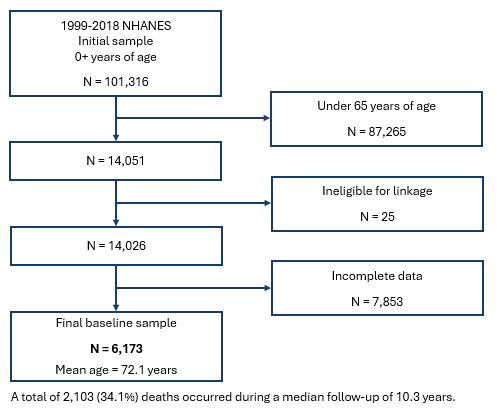
This study used nine cycles (2001-2018) of National Health and Nutrition Examination Survey (NHANES) data along with National Center for Health Statistics (NCHS) 2019 public-use linked mortality files 9. The initial dataset consisted of 101,316 adults 0+ years of age, and after excluding those under 65 years of age, those ineligible for linkage, or those with incomplete data, the result was a baseline sample of 6,173 older adults (Figure 1).
Self-rated health (SRH) and Physical activity (PA)
An SRH variable was created from a single question that asked participants to rate their general health as either “excellent,” “very good,” “good,” “fair,” or “poor.” The new SRH variable was recoded using only four categories of “excellent/very good,” “good,” “fair,” or “poor”. PA was assessed by first computing variables indicating if participants reported typically engaging in any weekly moderate PA (MPA) or vigorous PA (VPA) for at least 10 minutes continuously. Using these variables, a two-level PA status variable was created that categorized participants as either physically active in MPA, VPA, or both MPA and VPA (active) or physically active in neither MPA nor VPA (inactive).

Physical functioning (PF)
Six different PF measures were used and included a 19-item total PF score (PFT), activities of daily living (ADL), instrumental activities of daily living (IADL), leisure and social activities (LSA), general physical activities (GPA), and lower extremity mobility (LEM) 10, 11. Each of the 19 items contained a common response scale with categories of no difficulty, some difficulty, much difficulty, and unable to do the activity. Binary PF items were then created indicating no difficulty (0) or at least some difficulty (1). Summing the 19 binary PF items created the PFT variable. Summing the binary items related to 1) dressing themselves, 2) walking between rooms, 3) getting in and out of bed, and 4) eating with a knife, fork, and cup created the ADL variable. Likewise, summing binary items related to 5) managing money, 6) house chores, and 7) preparing meals created the IADL variable. Summing binary items related to 8) going out to events, 9) attending social events, and 10) home leisure activities created the LSA variable. Summing binary items related to 11) stooping, crouching, and kneeling, 12) standing from armless chair, 13) standing for long periods, 14) sitting for long periods, 15) reaching up, 16) grasping/holding small objects, and 17) lifting or carrying created the GPA variable. Finally, summing the binary items related to 18) walking a quarter of a mile and 19) walking up 10 stairs created the LEM variable. Each of the six PF measures above were also dichotomized to indicate if a participant had a PF limitation (score>0) or had no limitations (score=0).
A seventh PF measure was constructed using item response theory (IRT) factor scores (PFIRT) 12, 13. All 19 items were entered into a 2-parameter logistic (2PL) IRT model and evaluated for unidimensionality and item fit. A dominant factor was observed with an eigenvalue of 10.8 that accounted for 57% of item variation. Additionally, all inter-item polychoric correlations ranged between 0.238 and 0.892 with a Cronbach’s alpha of 0.86. Finally, all 19 items significantly (all p<0.0001) fit the 2PL IRT model with item difficulty values ranging from 0.34 to 2.78 and item discrimination values between 1.25 and 3.25. For regression modeling purposes, PFIRT was converted to quartiles, where larger quartile group membership represented greater PF limitation.
Health-related covariates
Five different health-related covariates were used and included body mass index (BMI), body shape index (BSI), smoking, alcohol consumption, and chronic disease status. Four BMI (kg/m2) categories were formed using the following BMI criteria: 1) underweight (BMI<18.5), 2) normal weight (18.5≤BMI<25.0), 3) overweight (25.0≥BMI<30.0), and 4) obese (BMI≥30.0). BSI was computed from objectively measured height, weight, and waist circumference (WC) using the following formula: BSI (m11/6/kg2/3) = WC / (BMI2/3 × height1/2) 14. Smoking status was assessed using a series of questions asking participants about their lifetime and current smoking habits. From these responses, a smoking status variable was created that assigned participants to one of three categories: non-smoker, former smoker, or current smoker. Alcohol use was assessed using a series of questions asking participants about their alcohol consumption history and average alcohol consumption. From these responses, an alcohol status variable was created that assigned participants to one of three categories: non-drinker, light drinker, or moderate-to-heavy drinker. A chronic disease status variable was created from nine different disease conditions that included 1) coronary heart disease, 2) congestive heart failure, 3) coronary heart disease, 4) angina pectoris, 5) heart attack, 6) stroke, 7) emphysema, 8) chronic bronchitis, and 9) arthritis. A two-group chronic condition status variable was created with participants considered to either have no chronic conditions or at least one chronic condition.
Sociodemographic covariates
Four different sociodemographic variables were used and included age, sex, race, and income. Age was used as a continuous variable, ranging from 65 years to 80+ years, as well as a grouping variable for descriptive purposes. Sex included male and female groups. Race/ethnicity was used as a categorical variable and included White, Black, Hispanic, and Other groupings. Lastly, income was used as a continuous variable and computed as a ratio of the family income to poverty, ranging from 0 to 5, as well as a grouping variable (quartiles) for descriptive purposes.
Statistical analyses
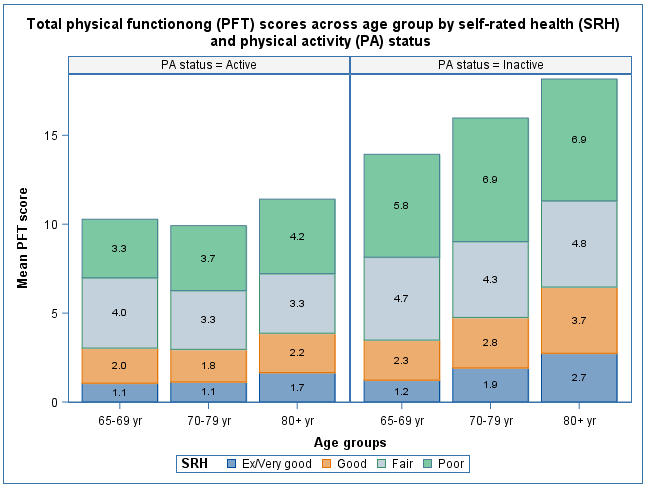
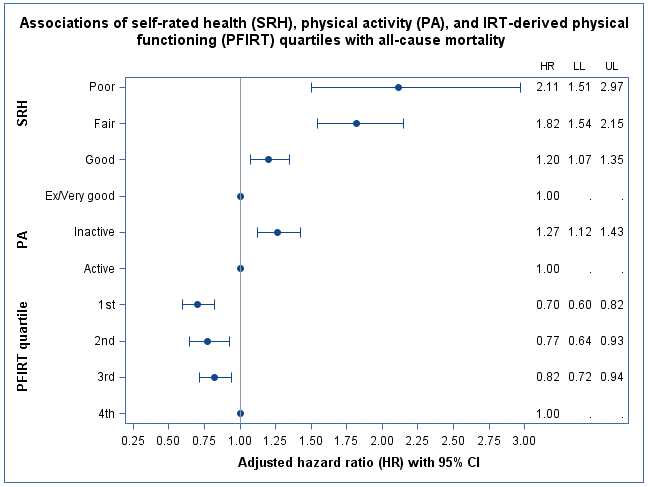
Weighted percentages of PF categories and PA status groups across sample characteristics were computed with 95% confidence intervals (CIs) and Rao-Scott chi-square (X2) statistics (Table 1 and Table 2). Similar weighted percentages and inferential statistics were computed for any PF limitation across age groups by SRH and PA status (Table 3). To descriptively examine the influence of PA and SRH on PF across different age groups, mean PFT scores were computed and presented visually in a stacked column panel chart (Figure 2). Linear regression was used to formally test for differences in PF between the age groups for each PA status group. Specifically, contrast statements were used to test for linear trend in means, and Tukey-Kraemer post-hoc tests used to test for group mean differences. Six (6) Cox proportional hazard models were employed, associating each PF measure along with PA status and SRH with all-cause mortality while adjusted for age, sex, race, income, BMI, BSI, smoking, alcohol consumption, and chronic conditions status (Table 4 and Table 5). A similar hazard regression model was employed using the IRT-derived PF quartile variable (PFIRT) and displayed visually as a forest plot (Figure 3). SAS version 9.4 was used for all analyses 15.

Analysis of baseline characteristics revealed that approximately 24.8% (95% CI: 23.3-26.3) of older adults suffered a high number (PFT≥4) of physical limitations, with even greater percentages observed in female (30.1%), 80+ year-old (31.9%), lowest income quartile (34.7%), obese (32.2%), and chronic disease suffering (32.2%) populations (Table 1). Approximately 54.1% (95% CI: 51.9-56.2) of older adults were considered physically active at baseline, with even greater percentages observed in male (58.3%), 65-69 year-old (58.6%), Other race group (56.3%), highest income quartile (65.4%), normal weight (58.7%), and non-chronic disease suffering (55.7%) populations (Table 2). The oldest (80+ years) of older adults were more likely to report having any PF limitation, as compared to their counterparts (Table 3). However, among physically active older adults with “fair” or “poor” SRH, the oldest adults were less likely to report having any PF limitation.
The influence of age on PF limitation was more apparent among physically inactive adults than their active counterparts (Figure 2). The linear trend in PF means across age group categories was stronger for the inactive group (L′β=1.22, F=35.38, p<0.0001) than the active group (L′β=0.41, F=7.19, p=0.0082). Moreover, Tukey-Kramer post-hoc comparisons indicated significant (all p<0.0200) differences between all age groups in inactive older adults. Whereas only the oldest (80+ years) group had significantly (both p<0.0200) different PF in active older adults.
Survival analysis revealed a total of 2,103 deaths during a median follow-up of 10.3 years. Risk of all-cause mortality decreased for older adults who were not limited with PFT (HR=0.80, 95% CI: 0.70-0.92), ADL (HR=0.86, 95% CI: 0.75-0.99), or IADL (HR=0.79, 95% CI: 0.69-0.91) (Table 4). Additionally, risk of all-cause mortality decreased for those not limited with GPA (HR=0.83, 95% CI: 0.73-0.95) or LEM (HR=0.68, 95% CI: 0.60-0.77) (Table 5). There was no significant change in all-cause mortality risk associated with LSA limitation status. However, after dropping SRH from the model, LSA regained its ability to predict mortality (HR=0.78, 95% CI: 0.67-0.91). Finally, risk of all-cause mortality decreased for 1st (HR=0.70, 95% CI: 0.60-0.82), 2nd (HR=0.77, 95% CI: 0.64-0.93), and 3rd (HR=0.82, 95% CI: 0.72-0.94) PFIRT quartiles (reference: 4th), increased for poor (HR=2.11, 95% CI: 1.51-2.97), fair (HR=1.82, 95% CI: 1.54-2.15), and good (HR=1.20, 95% CI: 1.07-1.35) SRH (reference: excellent/very good), and increased for inactive (HR=1.27, 95% CI: 1.12-1.43) PA status (reference: active) (Figure 3).
This study had three important findings worth highlighting, including 1) the mitigated influence of age on PF in physically active participants, 2) the independent association between PF and all-cause mortality in six of the seven fully adjusted PF measure models, and 3) seeing PA and SRH as robust independent predictors of all-cause mortality in all seven fully adjusted PF measure models. The first finding is considered novel due to the fact that PA moderated the well-known age and PF relationship. This finding is supported with results from a 20-year longitudinal study that investigated the association between changes in PA and frailty in community-dwelling older adults 16. Specifically, participants that increased their PA across the 20-year period had the lowest frailty scores. Moreover, participants that decreased their PA across the same period had the highest frailty scores. Thus, results from this longitudinal study corroborate the moderating effect of PA on the age and PF relationship found in the current study. The second finding addressed the main purpose of the study and showed that six different measures of PF (PFT, ADL, IADL, GPA, LEM, and PFIRT) were each individually associated with all-cause mortality risk independent of PA, SRH, health, and demographic covariates. These results are the first, to date, to show such a robust PF and mortality relationship after adjusting for two major predictors (PA and SRH) of survival in older adults. Interestingly, LSA lost its ability to predict mortality after adjusting for PA, SRH, and covariates. It was found in post-hoc testing of the LSA model, however, that SRH was responsible for the loss of significance. Although no studies to date have specifically corroborated this finding, the relationship between measures of social activity and measures of perceived health are well established 17, 18, 19. The third and last finding was addressed to support the study’s aim and showed that PA and SRH both independently predicted mortality in all seven fully adjusted PF measure models. This finding supports the study’s objective by providing clear evidence for PA and SRH as important predictors of mortality in older adult populations. Evidence that is also well established 20, 21, 22.
There are three main strengths regarding this study that support its credibility. Firstly, the data used in this analysis come from the NHANES series of health surveys and are collected in a way that allow for generalizations to all older noninstitutionalized U.S. adults 65+ years of age. This data attribute improves the study’s external validity and allows its inferences to be considered for related program planning and evaluation. Secondly, NHANES data collection includes a variety of methods that are both objective and subjective in nature. The current study used objective measures of BMI and BSI as well as subjective measures of PF, PA, SRH, smoking, alcohol consumption, and chronic disease status. This data attribute allowed for a deeper understanding of the study’s main variables and related covariates. Thirdly, this study was strengthened by its use of seven different PF measures. This study attribute helped determine that PF was indeed a robust predictor of all-cause mortality whereas single-measure studies may be influenced by measurement error. There are two primary limitations in this study that require discussion. The first limitation is that many of the study variables were assessed using self-report methods and may suffer from reporting bias. Specifically, objective measures such as functional exams could improve the validity of PF assessment. Despite this limitation, NHANES questionnaire items have a long-standing reputation for being valid and reliable in assessing health concepts. The second limitation is that a large percentage of NHANES participants were excluded from this study due to missing data. This limits the study’s inferences because large amounts of missing data can be an indication of systematic bias. Despite this limitation, several of the study’s findings were corroborated by other studies from similar populations. Thus, it is reasonable to assume the current sample resembles its intended population. In sum, the findings from this study should be interpreted along with its limitations and with caution.
This study found that PA moderated the influence of age on PF in older U.S. adults. Additionally, it was found that SRH, PA, and PF are robust independent predictors of all-cause mortality in older adults. Finally, socialization and leisure activity may not be as important to survival after considering perceived health in older adults. Health promotion strategies should collectively target improving SRH, PA, and PF in this population.
| [1] | Shen, S., Yang, J., Ma, N., Xiong, Y., Wu, T., & Qin, F. (2025). Trajectories of physical functioning and its implication for all-cause mortality in Chinese older people: a large-scale national longitudinal study. Journal of global health, 15, 04184. | ||
| In article | View Article PubMed | ||
| [2] | Macinko, J., Beltrán-Sánchez, H., Mambrini, J. V. M., & Lima-Costa, M. F. (2024). Socioeconomic, Disease Burden, Physical Functioning, Psychosocial, and Environmental Factors Associated With Mortality Among Older Adults: The Brazilian Longitudinal Study of Ageing (ELSI-Brazil). Journal of aging and health, 36(1-2), 25–34. | ||
| In article | View Article PubMed | ||
| [3] | Gao, Y., Du, L., Cai, J., & Hu, T. (2023). Effects of functional limitations and activities of daily living on the mortality of the older people: A cohort study in China. Frontiers in public health, 10, 1098794. | ||
| In article | View Article PubMed | ||
| [4] | Barbería-Latasa M, Martínez-González MA, de la Fuente-Arrillaga C, Bes-Rastrollo M, Carlos S, Gea A. Predictors of total mortality and their differential association on premature or late mortality in the SUN cohort. Exp Gerontol. 2023; 172: 112048. | ||
| In article | View Article PubMed | ||
| [5] | Macinko, J., Beltrán-Sánchez, H., Mambrini, J. V. M., & Lima-Costa, M. F. (2024). Socioeconomic, Disease Burden, Physical Functioning, Psychosocial, and Environmental Factors Associated With Mortality Among Older Adults: The Brazilian Longitudinal Study of Ageing (ELSI-Brazil). Journal of aging and health, 36(1-2), 25–34. | ||
| In article | View Article PubMed | ||
| [6] | Reinwarth AC, Wicke FS, Hettich N, et al. Self-rated physical health predicts mortality in aging persons beyond objective health risks. Sci Rep. 2023; 13(1): 19531. Published 2023 Nov 9. | ||
| In article | View Article PubMed | ||
| [7] | Gobbens RJJ, van der Ploeg T. The Prediction of Mortality by Disability among Dutch Community-Dwelling Older People. Clin Interv Aging. 2020; 15: 1897-1906. Published 2020 Oct 5. | ||
| In article | View Article PubMed | ||
| [8] | Wu LW, Chen WL, Peng TC, et al. All-cause mortality risk in elderly individuals with disabilities: a retrospective observational study. BMJ Open. 2016; 6(9): e011164. Published 2016 Sep 13. | ||
| In article | View Article PubMed | ||
| [9] | Hart, P. D. (2025). Body shape and healthy lifestyle are independent predictors of survival in older adults: NHANES 1999 to 2018. American Journal of Medical Sciences and Medicine, 13(4), 53-59. | ||
| In article | View Article | ||
| [10] | Polyakova M., Sonnabend N., Sander C., Mergl R., Schroeter M. L., Schroeder J., et al. (2014). Prevalence of minor depression in elderly persons with and without mild cognitive impairment: a systematic review. J. Affect. Disord. 152-154, 28–38. | ||
| In article | View Article PubMed | ||
| [11] | Han S, Gao Y, Gan D. The combined associations of depression and cognitive impairment with functional disability and mortality in older adults: a population-based study from the NHANES 2011-2014. Front Aging Neurosci. 2023; 15: 1121190. Published 2023 May 4. | ||
| In article | View Article PubMed | ||
| [12] | Hart PD. An IRT-constructed brief physical functioning scale and its association with health status. American Journal of Public Health Research. 2020 Dec 12; 8(6): 184-9. | ||
| In article | View Article | ||
| [13] | De Ayala RJ. The theory and practice of item response theory. Guilford Publications; 2013 Oct 15. | ||
| In article | |||
| [14] | Hart PD. Sleep Quality Predicts Body Shape Index While Adjusting for Physical Activity. American Journal of Public Health Research. 2024; 12(3) 40-47. | ||
| In article | View Article | ||
| [15] | Lewis, T.H., 2016. Complex survey data analysis with SAS. Chapman and Hall/CRC. | ||
| In article | View Article | ||
| [16] | Lin YK, Chen CY, Cheung DST, Montayre J, Lee CY, Ho MH. The relationship between physical activity trajectories and frailty: a 20-year prospective cohort among community-dwelling older people. BMC Geriatr. 2022; 22(1): 867. Published 2022 Nov 16. | ||
| In article | View Article PubMed | ||
| [17] | Park JH, Kang SW. Social Interaction and Life Satisfaction among Older Adults by Age Group. Healthcare (Basel). 2023; 11(22): 2951. Published 2023 Nov 12. | ||
| In article | View Article PubMed | ||
| [18] | Elena MG, Pablo MA. Sociocultural interactions and self-perception of health in older adults from an active participation centre: A qualitative study. Geriatr Nurs. 2024; 57: 73-79. | ||
| In article | View Article PubMed | ||
| [19] | Fernandez-Portero C, Amian JG, Alarcón D, Arenilla Villalba MJ, Sánchez-Medina JA. The Effect of Social Relationships on the Well-Being and Happiness of Older Adults Living Alone or with Relatives. Healthcare (Basel). 2023; 11(2): 222. Published 2023 Jan 11. | ||
| In article | View Article PubMed | ||
| [20] | Martinez-Gomez D, Luo M, Huang Y, et al. Physical Activity and All-Cause Mortality by Age in 4 Multinational Megacohorts. JAMA Netw Open. 2024; 7(11): e2446802. Published 2024 Nov 4. | ||
| In article | View Article PubMed | ||
| [21] | Miao Y, Zhao B, Yang Y, et al. Healthy lifestyle partly mediates the association between self-rated health and risk of overall and cause-specific mortality. BMC Med. 2025; 23(1): 574. Published 2025 Oct 21. | ||
| In article | View Article PubMed | ||
| [22] | Bijani A, Shah-Hosseini Z, Hosseini SR, Ghadimi R, Mouodi S. Self-Rated Health and its Impact on Survival of Older Adults. Adv Biomed Res. 2024; 13: 45. Published 2024 Jul 29. | ||
| In article | View Article PubMed | ||
Published with license by Science and Education Publishing, Copyright © 2025 Peter D. Hart
 This work is licensed under a Creative Commons Attribution 4.0 International License. To view a copy of this license, visit
http://creativecommons.org/licenses/by/4.0/
This work is licensed under a Creative Commons Attribution 4.0 International License. To view a copy of this license, visit
http://creativecommons.org/licenses/by/4.0/
| [1] | Shen, S., Yang, J., Ma, N., Xiong, Y., Wu, T., & Qin, F. (2025). Trajectories of physical functioning and its implication for all-cause mortality in Chinese older people: a large-scale national longitudinal study. Journal of global health, 15, 04184. | ||
| In article | View Article PubMed | ||
| [2] | Macinko, J., Beltrán-Sánchez, H., Mambrini, J. V. M., & Lima-Costa, M. F. (2024). Socioeconomic, Disease Burden, Physical Functioning, Psychosocial, and Environmental Factors Associated With Mortality Among Older Adults: The Brazilian Longitudinal Study of Ageing (ELSI-Brazil). Journal of aging and health, 36(1-2), 25–34. | ||
| In article | View Article PubMed | ||
| [3] | Gao, Y., Du, L., Cai, J., & Hu, T. (2023). Effects of functional limitations and activities of daily living on the mortality of the older people: A cohort study in China. Frontiers in public health, 10, 1098794. | ||
| In article | View Article PubMed | ||
| [4] | Barbería-Latasa M, Martínez-González MA, de la Fuente-Arrillaga C, Bes-Rastrollo M, Carlos S, Gea A. Predictors of total mortality and their differential association on premature or late mortality in the SUN cohort. Exp Gerontol. 2023; 172: 112048. | ||
| In article | View Article PubMed | ||
| [5] | Macinko, J., Beltrán-Sánchez, H., Mambrini, J. V. M., & Lima-Costa, M. F. (2024). Socioeconomic, Disease Burden, Physical Functioning, Psychosocial, and Environmental Factors Associated With Mortality Among Older Adults: The Brazilian Longitudinal Study of Ageing (ELSI-Brazil). Journal of aging and health, 36(1-2), 25–34. | ||
| In article | View Article PubMed | ||
| [6] | Reinwarth AC, Wicke FS, Hettich N, et al. Self-rated physical health predicts mortality in aging persons beyond objective health risks. Sci Rep. 2023; 13(1): 19531. Published 2023 Nov 9. | ||
| In article | View Article PubMed | ||
| [7] | Gobbens RJJ, van der Ploeg T. The Prediction of Mortality by Disability among Dutch Community-Dwelling Older People. Clin Interv Aging. 2020; 15: 1897-1906. Published 2020 Oct 5. | ||
| In article | View Article PubMed | ||
| [8] | Wu LW, Chen WL, Peng TC, et al. All-cause mortality risk in elderly individuals with disabilities: a retrospective observational study. BMJ Open. 2016; 6(9): e011164. Published 2016 Sep 13. | ||
| In article | View Article PubMed | ||
| [9] | Hart, P. D. (2025). Body shape and healthy lifestyle are independent predictors of survival in older adults: NHANES 1999 to 2018. American Journal of Medical Sciences and Medicine, 13(4), 53-59. | ||
| In article | View Article | ||
| [10] | Polyakova M., Sonnabend N., Sander C., Mergl R., Schroeter M. L., Schroeder J., et al. (2014). Prevalence of minor depression in elderly persons with and without mild cognitive impairment: a systematic review. J. Affect. Disord. 152-154, 28–38. | ||
| In article | View Article PubMed | ||
| [11] | Han S, Gao Y, Gan D. The combined associations of depression and cognitive impairment with functional disability and mortality in older adults: a population-based study from the NHANES 2011-2014. Front Aging Neurosci. 2023; 15: 1121190. Published 2023 May 4. | ||
| In article | View Article PubMed | ||
| [12] | Hart PD. An IRT-constructed brief physical functioning scale and its association with health status. American Journal of Public Health Research. 2020 Dec 12; 8(6): 184-9. | ||
| In article | View Article | ||
| [13] | De Ayala RJ. The theory and practice of item response theory. Guilford Publications; 2013 Oct 15. | ||
| In article | |||
| [14] | Hart PD. Sleep Quality Predicts Body Shape Index While Adjusting for Physical Activity. American Journal of Public Health Research. 2024; 12(3) 40-47. | ||
| In article | View Article | ||
| [15] | Lewis, T.H., 2016. Complex survey data analysis with SAS. Chapman and Hall/CRC. | ||
| In article | View Article | ||
| [16] | Lin YK, Chen CY, Cheung DST, Montayre J, Lee CY, Ho MH. The relationship between physical activity trajectories and frailty: a 20-year prospective cohort among community-dwelling older people. BMC Geriatr. 2022; 22(1): 867. Published 2022 Nov 16. | ||
| In article | View Article PubMed | ||
| [17] | Park JH, Kang SW. Social Interaction and Life Satisfaction among Older Adults by Age Group. Healthcare (Basel). 2023; 11(22): 2951. Published 2023 Nov 12. | ||
| In article | View Article PubMed | ||
| [18] | Elena MG, Pablo MA. Sociocultural interactions and self-perception of health in older adults from an active participation centre: A qualitative study. Geriatr Nurs. 2024; 57: 73-79. | ||
| In article | View Article PubMed | ||
| [19] | Fernandez-Portero C, Amian JG, Alarcón D, Arenilla Villalba MJ, Sánchez-Medina JA. The Effect of Social Relationships on the Well-Being and Happiness of Older Adults Living Alone or with Relatives. Healthcare (Basel). 2023; 11(2): 222. Published 2023 Jan 11. | ||
| In article | View Article PubMed | ||
| [20] | Martinez-Gomez D, Luo M, Huang Y, et al. Physical Activity and All-Cause Mortality by Age in 4 Multinational Megacohorts. JAMA Netw Open. 2024; 7(11): e2446802. Published 2024 Nov 4. | ||
| In article | View Article PubMed | ||
| [21] | Miao Y, Zhao B, Yang Y, et al. Healthy lifestyle partly mediates the association between self-rated health and risk of overall and cause-specific mortality. BMC Med. 2025; 23(1): 574. Published 2025 Oct 21. | ||
| In article | View Article PubMed | ||
| [22] | Bijani A, Shah-Hosseini Z, Hosseini SR, Ghadimi R, Mouodi S. Self-Rated Health and its Impact on Survival of Older Adults. Adv Biomed Res. 2024; 13: 45. Published 2024 Jul 29. | ||
| In article | View Article PubMed | ||