This study aimed to investigate the associations between travel distance from the residence to a regularly attended community facility, subjective life-space, and physical fitness and motor function among community-dwelling older adult females in China. Overall, 352 females aged ≥65 (70.6 ± 5.4) years living in Ji’an City were categorized into three age groups: 65–69 (group 65), 70–74 (group 70), and ≥75 years (group 75). Travel distance was calculated as the shortest walking route from each participant’s residence to the farthest regularly attended location using ArcGIS and classified into four groups: 0 m (0 group), 1–399 m (<400 group), 400–799 m (<800 group), and ≥800 m (≥800 group). Evaluation items encompassed life-space assessment (LSA), travel distance, height, weight, hand grip strength (HGS), leg grip strength (LGS), one-leg standing time with eyes open (OLS), functional reach (FR), 10-m maximal walking time (10-m walking), cross-step moving on four spots (CSF), and hip displacement (Hip-D). Pearson’s correlation coefficients revealed significant but weak correlations (r = 0.17–0.21) between travel distance and LSA or multiple physical indicators in group 65. In group 70, only the 10-m walking time demonstrated a significant correlation (r = −0.249), whereas group 75 exhibited significant correlations with LSA, weight, OLS, FR, and 10-m walking time (r = 0.25–0.39). Two-way analysis of variance (age × distance) indicated significant interaction effects for LSA and weight. In each age group, participants with ≥800-m travel distances tended to show higher physical fitness and motor performance scores, with particularly significant differences observed in groups 65 and 70. These findings suggest that maintaining a travel and activity radius of >800 m can contribute to preserving and improving physical fitness and motor performance among older adults aged ≥65 years.
Japan, one of the world’s leading longevity countries, has shown progress in policies aimed at extending healthy life expectancy. These outcomes are attributed to improvements in dietary habits, the establishment of regular exercise routines, and the promotion of community-based preventive care activities. The “Health Japan 21 (the Third Term)” initiative by the Ministry of Health, Labour and Welfare lays our core guidelines, including developing a sustainable society where all citizens can lead healthy and fulfilling lives and promoting inclusive health initiatives that leave no one behind 1. These principles highlight the significance of community-level health promotion, focusing on “building communities where health comes naturally.” Key elements comprise encouraging resident-led local activities and opportunities for social participation. In particular, the development and use of community activity spaces (referred to as “Kayoi-no-ba”), where older adults regularly gather for social interaction, physical activity, and recreational engagement, have been demonstrated in previous studies to help maintain or increase physical activity levels and to be effective in preventing social withdrawal and frailty 2.
Similar to Japan, China is also undergoing a rapid demographic shift toward an aged population. By 2025, the aging rate is anticipated to exceed 15%, officially entering the stage of an aged society; by 2050, older adults are projected to comprise approximately 30.7% of the total population, exceeding 400 million individuals 3. Although average life expectancy continues to increase, a substantial disparity remains between life expectancy and healthy life expectancy. Challenges, including increased numbers of individuals requiring care, escalating chronic disease prevalence, and declining physical independence among older adults, have become persistent social issues 4. In particular, rural areas have slower medical and caregiving infrastructure development than urban regions, indicating clear disparities in regional health conditions.
In response to this situation, in 2019, China launched a national initiative called the “Healthy China Action,” aiming to extend the average life expectancy and reduce health disparities by 2030 5. As of 2023, China has an average life expectancy of 78.6 years (males, 75.4 years; females, 80.9 years), whereas the average healthy life expectancy stands at 68.7 years (males, 67.2 years; females, 70.1 years) 6, 7. Although these figures indicate certain achievements, further extension of healthy life expectancy remains a key public health challenge. Incorporating the aforementioned concept of “Kayoi-no-ba” and a regionally integrated support system into China’s framework likely enhances the effectiveness of older adult support and enhance community-based health initiatives for older adults. Although public transportation systems in major urban centers, including Beijing and Shanghai, are well-developed, similar to Tokyo’s 23 wards, this is not necessarily the case in regional cities and rural areas. In some regions, walking is the primary means of transportation for older adults as the use of private vehicles or bicycles is limited. Therefore, in such areas, establishing “Kayoi-no-ba” facilities within walking distance is considered crucial.
In extending healthy life expectancy, the level of independence in daily life among older adults has received increasing attention, with maintaining and improving physical fitness and motor function being recognized as crucial factors 8. Life-space, which refers to the geographical range of an individual’s daily movement and activities, has also drawn attention as an essential concept reflecting mobility, social participation, and overall quality of life. Previous studies have reported associations between life-space and physical fitness and motor function in older adults 9, 10. Life-space is a concept that captures the range of an individual’s actual movement and activity in daily life, while also reflecting interactions with the environment and connections with society 11. The concept was adopted as an index for evaluating mobility and independence in older adults, leading to the development of the life-space assessment (LSA) 9.
The LSA is a questionnaire that assesses the spatial extent of an individual’s movement over the past 4 weeks, considering the range of travel from home, the frequency of outings, and whether assistance was required. Previous research has indicated the positive correlation between LSA scores and physical fitness and motor performance indicators, including grip strength, walking speed, and balance 12, 13. Furthermore, reduced life-space has been linked to physical fitness and motor function decline, increased fall risk, and progression to frailty or need for care 14. However, as the LSA is based on subjective self-report, it may not accurately reflect the actual living space. For instance, one of the LSA items asks about the travel frequency “within town (within 16 km)” and “outside town (beyond 16 km),” with response options ranging from “never” to “daily.” The ease of achieving these distances significantly varies depending on geographical conditions, including whether the individual resides in an urban or rural area. Furthermore, the range and frequency of travel can considerably differ depending on whether the individual uses a private vehicle or walks. The capacity of the LSA to fully capture the actual life-space is limited owing to its susceptibility to regional and transportation-related factors. Therefore, considering more objective indicators, including the travel distance from home to facilities that are regularly visited, known as “Kayoi-no-ba,” is necessary. Moreover, as physical fitness and motor function naturally change with aging, analyzing differences by age group may help reveal age-specific patterns. In particular, understanding the association between walking-based travel distance and physical fitness and motor function can offer valuable insights for regional health promotion and community planning initiatives aimed at health maintenance and improvement among older adults.
Older adult females tend to have a longer average life expectancy and constitute a higher proportion of the older adult population than their male counterparts, making age-related health issues more prolonged and pronounced in this group 15. In particular, in China, factors, including family structure and sex-specific role expectations, frequently constrain the size of a female’s life-space 16, 17. In other words, older adult females experience the following dual challenges: limited physical fitness and motor function, as well as restricted life-space. Understanding the association between these two factors is significant for prolonging healthy life expectancy and designing effective community support systems. However, few studies have simultaneously examined both subjective life-space and objectively measured walking-based travel distance in relation to physical fitness and motor function, particularly among older adult females in China. This dual-perspective approach addresses the limitations of self-reported assessments and provides a more comprehensive understanding of mobility-related health outcomes in this population.
Therefore, this study aimed to investigate the association between travel distance from residence to community-based activity sites, subjective life-space, and physical fitness and motor function among community-dwelling older adult females in China.
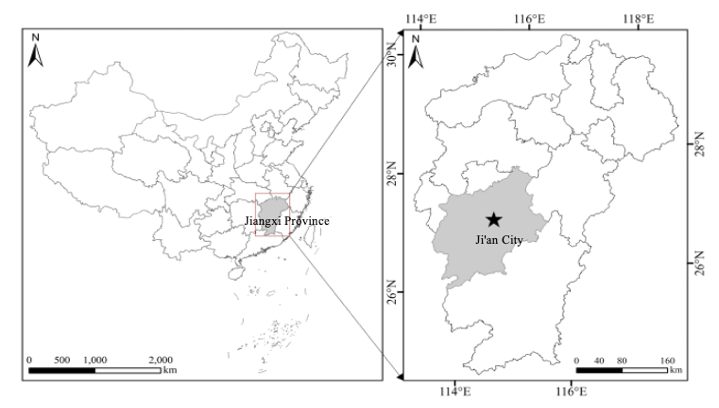
This study was conducted in Ji’an City, located in central-western Jiangxi Province, China (Figure 1), between 114°37′–115°56′E and 26°01′–27°29′N. Ji’an has a temperate humid climate, with an annual average temperature of 18.5°C, hot and humid summers (approximately 28°C), and cold winters (approximately 8°C). It is a medium-sized regional city with ongoing urbanization in the central districts, while rural areas extend across its periphery. Public transportation infrastructure is limited, with no subway system; the main public option is bus transit. Older adult residents typically rely on walking, bicycles, electric scooters, or private cars, contributing to a generally narrow range of daily mobility. As of 2024, the aging rate (proportion of residents aged ≥60 years) in Ji’an was approximately 13.7%, making it a notable region for population aging in China. Awareness of older adult health and preventive care is growing, and community-based initiatives are gradually expanding under local government leadership.

This study encompassed 432 community-dwelling older adult females aged ≥65 years in Ji’an City. The following were the inclusion criteria: (1) no major illnesses, (2) no history of total knee or hip arthroplasty, and (3) ability to walk independently. Data were collected from June 1 to July 1, 2024. Participants were recruited through local community organizations and the Ji’an Elderly Sports Association. Measurements were conducted at six facilities, including community activity centers and senior centers. Of the initial participants, 80 were excluded owing to incomplete address data or missing values. The final sample comprised 352 participants (70.6 ± 5.4 years). Considering that physical fitness and motor function vary with age, participants were categorized into the following three age groups for analysis: 65–69 (group 65), 70–74 (group 70), and ≥75 years (group 75) (Table 1).
All participants received a detailed explanation of the study purpose and procedures and provided written informed consent. The Human Research Ethics Committee of Fukui University of Technology approved the study protocol (approval number: Hito-2024-15).
2.3. Survey and Measurement ItemsParticipant data on age, travel distance, and life-space mobility were collected using a structured questionnaire. Two co-investigators, several local social workers, and student assistants were present at each survey site. When participants had questions, clarifications were provided without guiding their answers.
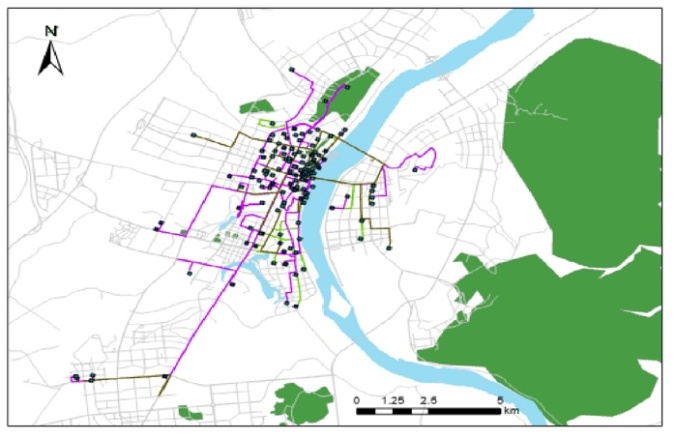
Travel distance was objectively calculated as the shortest route between each participant’s home and the community facility (kayoi-no-ba) they regularly visited. The analysis was conducted using ArcGIS Pro (version 3.3.0, Esri) based on China’s national road network dataset (Map ID: GS [2023] 2767) via path analysis (Figure 2). When a participant regularly attended multiple facilities, the distance to the farthest one was used in the analysis. The Ministry of Health, Labour and Welfare of Japan (2020) 18 recommended that the average comfortable walking speed for older adults is approximately 5 km/h, translating to approximately 400 and 800 m in 5 and 10 min, respectively. Based on this standard, travel distance was categorized into the following four groups: 0 m (0 group), 1–399 m (<400 group), 400–799 m (<800 group), and ≥800 m (≥800 group) (Table 1).
Life-space mobility was evaluated using the Life-Space Assessment (LSA) 9. The Chinese version, translated and adapted from the original scale, has demonstrated both reliability and validity among older adults in China 19. The LSA evaluates the extent of spatial mobility over the past 4 weeks across five levels (within the home, nearby areas, neighborhood, town, and beyond town), along with the frequency of movement and whether assistance was required. A composite score of 0–120 is calculated, with higher scores indicating broader and more independent mobility.


Body composition was assessed using height and weight.
Muscle strength was evaluated using hand grip strength (HGS) and leg grip strength (LGS). HGS was measured using a digital hand dynamometer (EH101, SENSSUN), and LGS was measured by knee extension strength, using a μTAS device (F-1, ANIMA Corporation).
Isometric strength was recorded once for each side, and the average of the left and right trials was used as the representative value.
Balance ability was evaluated using one-leg standing time with eyes open (OLS) and functional reach (FR) tests. In the OLS test, participants were instructed to maintain balance on either leg with eyes open for as long as possible (maximum, 120 s). For the FR test, participants reached forward horizontally using a telescopic rod, following established protocols 20, 21. One trial was conducted for each test.
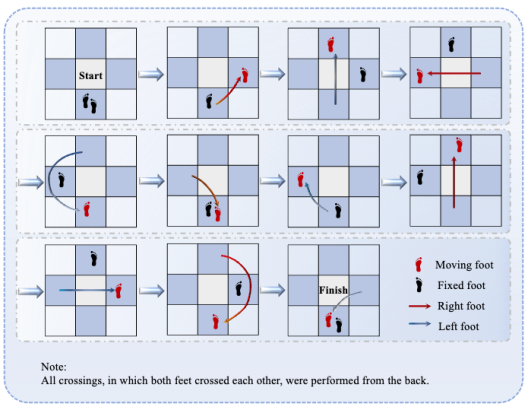
Motor performance was measured using the 10-m maximal walking time (10-m walking), the cross-step moving on four spots (CSF) 22, and hip displacement in the anteroposterior direction (Hip-D) 23. The 10-m walking was measured over a 12-m walkway by recording the time to traverse the 10-m segment (from 1 to 11 m) at maximal effort. The CSF was performed by stepping across and apart on four floor mats (Figure 3), and the time required was recorded twice. The faster of the two trials was used as the representative value. Hip-D was measured as the anteroposterior displacement of the greater trochanter when the hip was moved forward and backward from a standing position (0-position). To accurately identify the trochanter over clothing, a medical support belt (AS ONE, 45 × 1,200 mm) was wrapped around the pelvis, and marker stickers were applied to the greater trochanter. Both the 10-m walking and Hip-D were measured once.
2.4. Statistical AnalysisPearson’s product-moment correlation coefficients were calculated to investigate the associations between travel distance, LSA, and physical fitness and motor function across different age groups. Correlations were interpreted as follows: <0.50, ≥0.50, and ≥0.70 as low, moderate, and high, respectively 24.
To assess differences in each variable by age group and travel distance, two-way analysis of variance (ANOVA) was performed with two independent factors (age × travel distance). When significant main effects or interaction effects were observed, Tukey’s Honestly Significant Difference (Tukey’s HSD) test was employed for post-hoc comparisons. To assess the magnitude of group differences, effect sizes were calculated using eta squared (η²). Effect sizes were interpreted as follows: 0.01, 0.06, and 0.14 as small, medium, and large, respectively 25. For all hypothesis testing, the statistical significance level was set at p < 0.05. All analyses were conducted using IBM Statistical Package for the Social Sciences Statistics for Windows, version 28.0.
The Pearson correlation coefficients between travel distance and LSA or physical fitness and motor function variables across age groups are presented in Table 2. In group 65, travel distance was significantly positively correlated with LSA (r = 0.187), height (r = 0.215), HGS (r = 0.176), LGS (r = 0.173), OLS (r = 0.202), FR (r = 0.163), and Hip-D (r = 0.206), whereas 10-m walking showed a significant negative correlation (r = −0.187). In contrast, in group 70, travel distance was only significantly negatively correlated with 10-m walking (r = −0.249). In group 75, travel distance was significantly positively correlated with LSA (r = 0.341), body weight (r = 0.340), OLS (r = 0.249), FR (r = 0.386), and again negatively with 10-m walking (r = −0.331).
The mean values, standard deviations, and results of the two-way ANOVA for LSA and physical fitness and motor function variables by age group and travel distance categories are shown in Table 3. LSA and body weight demonstrated a significant interaction effect. Post-hoc comparisons revealed that in the 0 and <400 groups, participants in groups 65 and 70 exhibited significantly higher LSA scores than those in group 75. In the <800 group, groups 65 and 75 showed significantly higher LSA scores than group 70. Furthermore, in groups 65 and 75, LSA scores in the <800 and ≥800 categories were significantly higher than those in the 0 and <400 categories. Regarding body weight, values were significantly higher in the <800 group than those in the <400 group across all age groups.
The following eight physical fitness and motor function variables showed significant main effects of travel distance: height, HGS, LGS, OLS, FR, 10-m walking, CSF, and Hip-D. Specifically, the <800 and ≥800 groups had significantly greater height than the other two groups. The <800 and ≥800 groups exhibited significantly higher HGS than the 0 group; the <800 group had higher values than the <400 group. LGS values were significantly greater in the <800 and ≥800 groups than those in the 0 group. Regarding OLS, the ≥800 group showed significantly higher values than the 0 and <400 groups. FR values were significantly greater in the <800 and ≥800 groups than those in the 0 group and further increased in the ≥800 group than those in the <400 group. Regarding 10-m walking, the 0 group required significantly more time than the <400 and <800 groups, whereas the <400 group was also slower than the ≥800 group. The 0 and <400 groups had significantly longer CSF times than the ≥800 group. The ≥800 group exhibited a significantly greater Hip-D than the 0 group. Among these, height and 10-m walking showed moderate effect sizes (η² = 0.08–0.12), whereas the other variables had small effect sizes.
Regarding the main effects of age group, significant differences were observed in the following five variables: HGS, LGS, OLS, 10-m walking, and CSF. Post-hoc comparisons revealed that groups 65 and 70 had significantly higher HGS and LGS values than group 75. group 65 exhibited significantly greater OLS values than groups 70 and 75. In contrast, 10-m walking and CSF were significantly longer in group 75 than those in the younger age groups. Effect sizes for OLS and 10-m walking were moderate (η² = 0.08), whereas those for the remaining variables were small.
This study investigated the association between objectively measured travel distance, calculated using ArcGIS as the shortest route from home to a regularly attended community facility, and self-reported LSA based on a questionnaire. The results showed weak but statistically significant associations in groups 65 and 75. Although travel distance serves as a geographic and objective indicator, representing the farthest community facility regularly attended, the LSA reflects the farthest location reached within the past 4 weeks, based on self-report. Unlike travel distance, the LSA incorporates subjective judgment and psychological aspects, including perceived mobility and the need for assistance. Moreover, the LSA may be valid among relatively independent older adults; however, its reliability and validity may be compromised among those with memory impairments or cognitive decline owing to aging 26, 27. Although the two concepts are similar in nature, the present findings suggest that they do not provide consistent evaluations. This observation suggests that the LSA have limitations in accurately capturing life-space mobility among older adults. Therefore, combining self-reported LSA with objectively measured travel distance may facilitate a more comprehensive and accurate assessment of life-space in this population.
4.2. Association between Travel Distance and Physical Fitness and Motor FunctionThe association between travel distance and physical fitness and motor function was investigated by age group. In group 65, significant positive correlations were observed with height, HGS, LGS, OLS, FR, and Hip-D. However, all correlation coefficients were <0.22, indicating that the strength of these associations remained weak. In contrast, in group 70, a significant correlation was noted only with 10-m walking, and even this association was weak. Other physical fitness and motor function variables exhibited no significant associations. Previous studies have indicated that among individuals aged ≥70 years, factors beyond physical fitness and motor function, including lifestyle, social engagement, and motivation to go out, have relatively stronger influences 28. Based on these findings, the association between travel distance and physical fitness and motor function may be less apparent in the 65–74-year-old age group.
In group 75, travel distance was significantly correlated with body weight, OLS, FR, and 10-m walking. The correlation coefficients were generally in the 0.3 range, indicating slightly stronger associations than those in the 65 and 70 groups. This finding suggests that among individuals aged ≥75 years, aging-associated physical limitations become more pronounced, making balance and walking ability more vulnerable to the influence of travel distance. Furthermore, previous studies have noted that travel distance and broader life-space are associated with lower limb strength and balance ability 29, 30, and the findings of the present study align with those trends.
Based on the abovementioned findings, no moderate or strong linear associations were observed between travel distance and physical fitness and motor function in any of the age groups, showing that physical indicators alone cannot fully explain variations in travel distance. Future studies should adopt a more multidimensional perspective, incorporating physical, social, and psychological aspects.
4.3. Age- and Distance-Related Differences in LSA and Physical Fitness and Motor FunctionA large-scale study, involving 21,305 Chinese adults aged ≥70 years, reported that males and females demonstrated age-related declines in muscle strength, endurance, flexibility, and balance ability 31. Similarly, physical fitness and motor function assessments among urban Chinese older adults aged 60–98 years showed declines in lower limb strength, dynamic balance, flexibility, agility, and endurance, with particularly steep decreases between 75 and 80 years 32. Consistent with these previous findings, the present study also identified significant age-related differences in LSA and physical function. HGS, LGS, OLS, 10-m walking, and CSF exhibited significant differences, with OLS and 10-m walking showing the largest differences. Although most variables showed marked declines in group 75, OLS began to decrease already in the 70 group. This finding suggests that OLS can act as an early indicator of age-related decline in physical fitness and motor function. OLS, a well-established measure of balance ability, has been associated with fall risk 33. Moreover, maintaining a single-leg stance for at least 30 s has been reported to contribute to fall prevention 34. In this study, the mean OLS time was 27.2 ± 31.2 s in group 70 and 15.4 ± 15.4 s in group 75, indicating a potentially elevated fall risk in both groups. Regarding other physical fitness and motor function measures, group 75 performed significantly worse than the younger groups, consistent with previous studies. Notably, OLS and 10-m walking showed relatively large effect sizes for age group, and group 75 showed significantly poorer performance than groups 65 and 70. These findings suggest that at approximately 70 years old, balance ability, as reflected by OLS, begins to markedly decline; by 75 years old, walking ability and other physical fitness and motor function components also show clear deterioration.
The study site, Ji’an City in Jiangxi Province, China, is a mid-sized city undergoing rapid urbanization. Since 2019, road surface improvements have been promoted under government initiatives, with noticeable progress expected by 2025. However, some areas still retain unpaved sidewalks with level differences and aging stairways. Additionally, the region experiences high rainfall, resulting in slippery road conditions. These environmental factors continue to pose challenges for mobility among older adult residents 35. These physical environmental constraints have been demonstrated to reduce the willingness of older adults to go outdoors36. Furthermore, several older adults, having returned their driver’s licenses and experiencing limited access to convenient public transportation, heavily rely on walking as their primary mode of mobility. In such environments, although outdoor activity may be frequent, declines in balance ability increase the risk of falls and subsequent loss of independence in daily life. Considering these circumstances, early assessment of balance ability using indicators, including OLS, and the introduction of fall prevention interventions, including balance training, at approximately 70 years old may be effective. Furthermore, from approximately 75 years old onward, implementing comprehensive physical fitness programs, encompassing strength, walking ability, and Hip-D strategies, may be beneficial. These efforts may contribute to prolonging the healthy life expectancy of older adult females in China.
Height, weight, LSA, HGS, LGS, FR, 10-m walking, OLS, CSF, and Hip-D showed significant differences in physical fitness and motor function by travel distance. Participants with ≥ 400-m travel distances (<800 and ≥ 800 groups) tended to show higher values in these variables. In particular, those in the ≥ 800 group demonstrated better performance in OLS, CSF, and Hip-D. Although travel distance and these physical or motor indicators exhibited no strong linear correlations, individuals with longer travel distances showed superior balance and hip-related abilities than those with shorter travel distances. Evidence has shown that a < 1-km distance from home to destinations is associated with motivation for walking-based outings. Considering these present findings, a travel distance of approximately 800 m may represent a realistic and effective range for regular physical activity among older adults 37.
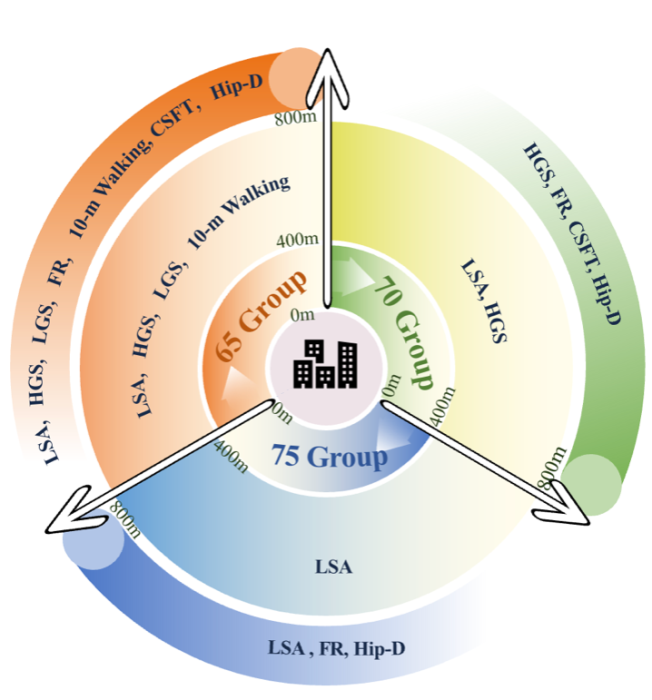
Furthermore, the 400- and 800-m travel distances defined in this study were based on the actual distances’ older adults in the target region typically travel to local exercise facilities, parks, or public squares. Notably, >50% of the participants (194 individuals, 55.1%) participated in regular activities within this range. Therefore, these distances reflect a “realistically accessible range” in the community and may serve as effective and practical targets for encouraging regular physical activity and maintaining physical fitness and motor function. As shown in Figure 4, among those aged < 75 years with travel distances of ≥ 800 m, several physical and motor function indicators showed superior performance. This finding suggests that ensuring a travel circle of at least 800 m can be an effective and sustainable strategy for maintaining physical fitness and mobility in older adults. Particularly among those aged ≥ 75 years, diminished travel distance has been associated with physical decline and an increased risk of social isolation and homebound tendencies 38. Therefore, developing and supporting sustainable travel zones may significantly contribute to promoting physical and mental health in older adults. Improving regional infrastructure and implementing mobility support policies for preserving such “living distances” may play crucial roles in extending healthy life expectancy. Notably, the travel distance in this study was calculated using ArcGIS with reference to several previous studies. As such distances can also be estimated relatively easily using free applications, such as Google Maps, this method may be broadly applicable in field settings. Moreover, applying these simple measurement techniques may enable the planning and implementation of region-specific support strategies.
Here, travel distance was defined as the distance from the participant’s residence to the farthest regularly attended exercise facility. Therefore, it may not fully capture the entire range of daily activities undertaken by older adults. Although travel distances were calculated using ArcGIS on the basis of the shortest route, actual travel behavior may deviate from this owing to individual habits, including intentional detours for increasing step counts or stopping by multiple locations for shopping, likely causing discrepancies from real-world distances. Moreover, this study did not adequately account for differences in modes of transportation. Future research should incorporate analyses based on travel means. To improve accuracy, a more comprehensive assessment of life-space should also consider various destination patterns and combine subjective measures (LSA) with objective tools (Global Positioning System, GPS or accelerometers).
Among females in China aged ≥ 65 years, the association between travel distance to community activity facilities and LSA was not strong. However, when classified by 400- and 800-m thresholds, travel distance was associated with physical fitness and motor performance, particularly walking ability. Notably, participants with >800-m travel distances showed better physical and motor functions. These findings suggest that maintaining a travel distance and activity zone of >800 m can be effective for preserving and enhancing physical fitness and motor abilities in older adults.
Research funds were not provided by any institution.
None of the authors has any financial disclosure to report.
| [1] | Ministry of Health, Labour and Welfare, Health Japan 21 (the Third Term), 2023. [E-book] Available: https:// www.mhlw.go.jp/ stf/seisakunitsuite/bunya/kenkou_iryou/kenkou/kenkounippon21_00006.html. | ||
| In article | |||
| [2] | Tsuji, T., Takagi, D., Kondo, N., Maruyama, Y., Ide, K., L, L., Wang H., Kondo K, “Promoting community gathering places “Kayoinoba” for healthy aging reduce health inequalities among communities: An eight-year ecological study,” (Nihon Koshu Eisei Zasshi) Japanese Journal of Public Health, 69(5), 383–393, Mar.2022. | ||
| In article | |||
| [3] | National Bureau of Statistics of China. China Statistical Yearbook, Beijing: China Statistics Press, 2022. [E-book] Available: https://www.stats.gov.cn/sj/ndsj/2022/indexch.htm. | ||
| In article | |||
| [4] | Chen W, “Forecast Negative Population Growth and Population Ageing in China,” Social Science Journal, 0 (5): 133-144. 2023. | ||
| In article | |||
| [5] | The State Council of the People’s Republic of China. Opinions on Implementing the Healthy China Initiative [E-book]. June 24, 2019. Available: https://www.gov.cn/zhengce/zhengceku/2019-07/15/content_5409492.htm. | ||
| In article | |||
| [6] | National Health Commission of the People’s Republic of China. Statistical Bulletin on the Development of China’s Health Sector in 2023 [E-book]. Available: https:// www.gov.cn/ lianbo/bumen/ 202408/content_6971241.htm. | ||
| In article | |||
| [7] | World Health Organization, China: Country Statistics. [E-book] Available: https://data.who.int/countries/156?utm_source. | ||
| In article | |||
| [8] | Miri, S., Farhadi, B., Takasi, P., Ghorbani Vajargah, P. and Karkhah, S, “Physical independence and related factors among older adults: A systematic review and meta-analysis,” Annals of Medicine & Surgery, 86(6), 3400–3408. Jun.2024. | ||
| In article | View Article PubMed | ||
| [9] | Baker, P.S., Bodner, E.V., and Allman, R.M, “Measuring life-space mobility in community-dwelling older adults,” Journal of the American Geriatrics Society, 51(11), 1610–1614. Oct. 2003. | ||
| In article | View Article PubMed | ||
| [10] | Peel, C., Sawyer, B.P., Roth, D.L., Brown, C.J., Brodner, E.V. and Allman, R.M, “Assessing mobility in older adults: the UAB Study of Aging Life-Space Assessment,” Physical Therapy, 85(10), 1008–1019. Oct. 2005. | ||
| In article | View Article PubMed | ||
| [11] | Lewin, K, Principles of Topological Psychology, McGraw-Hill, New York and London, 1936, 37-63. | ||
| In article | View Article | ||
| [12] | Shimada, H., Makizako, H., Suzukawa, M. and Suzuki, T, “The Correlates of Life-Space Mobility in Older Adults Using a Structural Equation Modeling,” Japanese Physical Therapy Association, 36(7), 370-376. Aug. 2009. | ||
| In article | |||
| [13] | Hamachi, N., Yamaguchi, H., Kaneko, H., Takano, Y., Nakahara, M., Nagai, R., Eguchi, M., Matsuda, K., Ikeda, T., Oka, S., Shimoda, T., Suzuki, A. and Morita, M, “Relationships between Life Spaces and Motor Functions among the Community-dwelling Elderly,” Japanese Physical Therapy Association, 34(4), 485-489. Apr. 2019. | ||
| In article | View Article | ||
| [14] | Johnson, J., Rodriguez, M.A. and Al Snih, S, “Life-space mobility in the elderly: Current perspectives,” Clinical Interventions in Aging, 15, 1665–1674. Sep. 2020. | ||
| In article | View Article PubMed | ||
| [15] | World Health Organization, World Health Statistics 2019: Monitoring health for the SDGs, sustainable development goals. Geneva: WHO, 2019. [E-book] Available: https:// www.who.int/ publications/i/item/9789241565707. | ||
| In article | |||
| [16] | Little J., Peake L., Richardson P. Women in Cities: Gender and the Urban Environment, New York University Press, New York, 1989, 98–116. | ||
| In article | |||
| [17] | Feng J., Dijst M., Wissink B., Prillwitz J, “Elderly co-residence and the household responsibilities hypothesis: Evidence from Nanjing, China,” Urban Geography. 36(5):757–776. May.2015. | ||
| In article | View Article | ||
| [18] | Ministry of Health, Labour and Welfare, Outline of the Simplified Life Table 2023 023. [E-book] Available: https:// www.mhlw.go.jp/ toukei/saikin/hw/life/life23/dl/life23-15.pdf. | ||
| In article | |||
| [19] | Ji, M., Zhou, Y., Liao, J., Feng, F., “Pilot study on the Chinese version of the Life Space Assessment among community-dwelling elderly,” Archives of Gerontology and Geriatrics, 61, 301–306, Jun. 2015. | ||
| In article | View Article PubMed | ||
| [20] | Duncan, P.W., Weiner, D.K., Chandler, J., Studenski, S, “Functional reach: a new clinical measure of balance,” Journal of Gerontology, 45(6), M192–7, Sep. 1990. | ||
| In article | View Article PubMed | ||
| [21] | Demura, S., Yamada, T, “Simple and easy assessment of falling risk in the elderly by functional reach test using elastic stick,” The Tohoku Journal of Experimental Medicine, 213(2), 105–111, Aug. 2007. | ||
| In article | View Article PubMed | ||
| [22] | Yamaji, S., Demura, S, “Reliability and fall experience discrimination of cross step moving on four spots test in the elderly,” Physical Medicine and Rehabilitation, 94(7), 1312–1319, Jul. 2013. | ||
| In article | View Article PubMed | ||
| [23] | Yamaji, S., Demura, S, “Validation of Physical Function Tests to Evaluate the Risk for Falls and Mild Cognitive Impairment in Community-dwelling Older Adults,” Japanese Education and Health Science, 2020, 66(2), 101–111, Oct.2020. | ||
| In article | |||
| [24] | Yamaji, S. and Demura, S, Easy Statistics for Health and Sports Sciences, Kyorin Institute, Tokyo, 2011, 174. | ||
| In article | |||
| [25] | Cohen, J, Statistical Power Analysis for the Behavioral Sciences, Routledge, New York, 1988, 35–40. | ||
| In article | |||
| [26] | Golomb, J., de Leon, M.J., Kluger, A., George, A.E., Tarshish, C. and Ferris, S.H, “Hippocampal atrophy in normal aging: An association with recent memory impairment,” Archives of Neurology, 50(9), 967–973, Sep. 1993. | ||
| In article | View Article PubMed | ||
| [27] | Takemoto, M., Carlson, J. A., Moran, K., Godbole, S., Crist, K. and Kerr, J, “Relationship between objectively measured transportation behaviors and health characteristics in older adults,” International Journal of Environmental Research and Public Health, 12(11), 13923–13937, Oct. 2015. | ||
| In article | View Article PubMed | ||
| [28] | Kilgour, A., Rutherford, M., Higson, J. and Meredith, S. J, “Barriers and motivators to undertaking physical activity in adults over 70—a systematic review of the quantitative literature,” Age and Ageing, 53(4), Apr. 2024. | ||
| In article | View Article PubMed | ||
| [29] | Snih, S.A.L., Peek, K.M., Sawyer, P., Markides, K.S., Allman, R.M., Ottenbacher, K.J, “Life-space mobility in Mexican Americans aged 75 and older,” Journal of the American Geriatrics Society, 60(3): 532–537, Mar. 2012. | ||
| In article | View Article PubMed | ||
| [30] | Takemoto, M., Carlson, J.A., Moran, K., Godbole, S., Crist, K. and Kerr, J, “Relationship between objectively measured transportation behaviors and health characteristics in older adults,” International Journal of Environmental Research and Public Health, 12(11), 13923–13937, Oct. 2015. | ||
| In article | View Article PubMed | ||
| [31] | Yang, S.L., Yu, W.Q., L, X.Y. and Huang, X.A, “Establishing sex- and age-specific normative values for the Senior Fitness Test among community-dwelling elderly aged 70 and older in Eastern China: a community-based study,” BMC Geriatrics, 24, 833, Oct. 2024. | ||
| In article | View Article PubMed | ||
| [32] | Zhao, Y.N., Wang, Z.Y., Chung, P.-K. and Wang, S, “Functional fitness norms and trends of community-dwelling older adults in urban China,” Scientific Reports, 11, 17745, Sep. 2021. | ||
| In article | View Article PubMed | ||
| [33] | Blodgett, J. M., Hardy, R., Davis, D., Peeters, G., Kuh, D. and Cooper, R, “One-legged balance performance and fall risk in mid and later life: Longitudinal evidence from a British birth cohort,” American Journal of Preventive Medicine, 63(6), 997–1006, Dec. 2022. | ||
| In article | View Article PubMed | ||
| [34] | Murata, S., Kai, Y., Mizota, K., Yamazaki, S., Yumioka, M., Otawo, H. and Takeda, I, “Relationship between One-leg Standing Duration with Vision and Physical Function among Community Dwelling Older Adults,” Japanese Physical Therapy Association, 21(4), 437–440, Aug. 2006. | ||
| In article | View Article | ||
| [35] | Ji'an Municipal Urban Management Bureau, Urban environment improvement status Government information disclosure [In Chinese], Ji'an City Government, 2025. [E-Book], 2025. Available: cgj.jian.gov.cn. | ||
| In article | |||
| [36] | Van Cauwenberg, J., Van Holle, V., Simons, D., Deridder, R., Clarys, P., Goubert, L., Nasar, J., Salmon, J., De Bourdeaudhuij, I. and Deforche, B, “Environmental factors influencing older adults’ walking for transportation: A study using walk-along interviews,” International Journal of Behavioral Nutrition and Physical Activity, 9, 85, Jul. 2012. | ||
| In article | View Article PubMed | ||
| [37] | Tsunoda, K., Soma, Y., Kitano, N., Jindo, T., Fujii, K. and Okura, T, “Acceptable walking and cycling distances and their correlates among older Japanese adults,” Journal of Population Ageing, 14, 183–200, Feb. 2020. | ||
| In article | View Article | ||
| [38] | Lindeman, K., Karavirta, L., Koivunen, K., Keskinen, K. E., Eronen, J., Portegijs, E. and Rantanen, T, “Longitudinal changes in life-space mobility and autonomy in participation outdoors among Finnish community-dwelling older adults from pre-COVID-19 to through the pandemic,” Aging Clinical and Experimental Research, 36, 85, Apr. 2024. | ||
| In article | View Article PubMed | ||
Published with license by Science and Education Publishing, Copyright © 2025 Ke Wu, Zhonglin Li, Xiaohao Li and Hiroki Sugiura
 This work is licensed under a Creative Commons Attribution 4.0 International License. To view a copy of this license, visit
http://creativecommons.org/licenses/by/4.0/
This work is licensed under a Creative Commons Attribution 4.0 International License. To view a copy of this license, visit
http://creativecommons.org/licenses/by/4.0/
| [1] | Ministry of Health, Labour and Welfare, Health Japan 21 (the Third Term), 2023. [E-book] Available: https:// www.mhlw.go.jp/ stf/seisakunitsuite/bunya/kenkou_iryou/kenkou/kenkounippon21_00006.html. | ||
| In article | |||
| [2] | Tsuji, T., Takagi, D., Kondo, N., Maruyama, Y., Ide, K., L, L., Wang H., Kondo K, “Promoting community gathering places “Kayoinoba” for healthy aging reduce health inequalities among communities: An eight-year ecological study,” (Nihon Koshu Eisei Zasshi) Japanese Journal of Public Health, 69(5), 383–393, Mar.2022. | ||
| In article | |||
| [3] | National Bureau of Statistics of China. China Statistical Yearbook, Beijing: China Statistics Press, 2022. [E-book] Available: https://www.stats.gov.cn/sj/ndsj/2022/indexch.htm. | ||
| In article | |||
| [4] | Chen W, “Forecast Negative Population Growth and Population Ageing in China,” Social Science Journal, 0 (5): 133-144. 2023. | ||
| In article | |||
| [5] | The State Council of the People’s Republic of China. Opinions on Implementing the Healthy China Initiative [E-book]. June 24, 2019. Available: https://www.gov.cn/zhengce/zhengceku/2019-07/15/content_5409492.htm. | ||
| In article | |||
| [6] | National Health Commission of the People’s Republic of China. Statistical Bulletin on the Development of China’s Health Sector in 2023 [E-book]. Available: https:// www.gov.cn/ lianbo/bumen/ 202408/content_6971241.htm. | ||
| In article | |||
| [7] | World Health Organization, China: Country Statistics. [E-book] Available: https://data.who.int/countries/156?utm_source. | ||
| In article | |||
| [8] | Miri, S., Farhadi, B., Takasi, P., Ghorbani Vajargah, P. and Karkhah, S, “Physical independence and related factors among older adults: A systematic review and meta-analysis,” Annals of Medicine & Surgery, 86(6), 3400–3408. Jun.2024. | ||
| In article | View Article PubMed | ||
| [9] | Baker, P.S., Bodner, E.V., and Allman, R.M, “Measuring life-space mobility in community-dwelling older adults,” Journal of the American Geriatrics Society, 51(11), 1610–1614. Oct. 2003. | ||
| In article | View Article PubMed | ||
| [10] | Peel, C., Sawyer, B.P., Roth, D.L., Brown, C.J., Brodner, E.V. and Allman, R.M, “Assessing mobility in older adults: the UAB Study of Aging Life-Space Assessment,” Physical Therapy, 85(10), 1008–1019. Oct. 2005. | ||
| In article | View Article PubMed | ||
| [11] | Lewin, K, Principles of Topological Psychology, McGraw-Hill, New York and London, 1936, 37-63. | ||
| In article | View Article | ||
| [12] | Shimada, H., Makizako, H., Suzukawa, M. and Suzuki, T, “The Correlates of Life-Space Mobility in Older Adults Using a Structural Equation Modeling,” Japanese Physical Therapy Association, 36(7), 370-376. Aug. 2009. | ||
| In article | |||
| [13] | Hamachi, N., Yamaguchi, H., Kaneko, H., Takano, Y., Nakahara, M., Nagai, R., Eguchi, M., Matsuda, K., Ikeda, T., Oka, S., Shimoda, T., Suzuki, A. and Morita, M, “Relationships between Life Spaces and Motor Functions among the Community-dwelling Elderly,” Japanese Physical Therapy Association, 34(4), 485-489. Apr. 2019. | ||
| In article | View Article | ||
| [14] | Johnson, J., Rodriguez, M.A. and Al Snih, S, “Life-space mobility in the elderly: Current perspectives,” Clinical Interventions in Aging, 15, 1665–1674. Sep. 2020. | ||
| In article | View Article PubMed | ||
| [15] | World Health Organization, World Health Statistics 2019: Monitoring health for the SDGs, sustainable development goals. Geneva: WHO, 2019. [E-book] Available: https:// www.who.int/ publications/i/item/9789241565707. | ||
| In article | |||
| [16] | Little J., Peake L., Richardson P. Women in Cities: Gender and the Urban Environment, New York University Press, New York, 1989, 98–116. | ||
| In article | |||
| [17] | Feng J., Dijst M., Wissink B., Prillwitz J, “Elderly co-residence and the household responsibilities hypothesis: Evidence from Nanjing, China,” Urban Geography. 36(5):757–776. May.2015. | ||
| In article | View Article | ||
| [18] | Ministry of Health, Labour and Welfare, Outline of the Simplified Life Table 2023 023. [E-book] Available: https:// www.mhlw.go.jp/ toukei/saikin/hw/life/life23/dl/life23-15.pdf. | ||
| In article | |||
| [19] | Ji, M., Zhou, Y., Liao, J., Feng, F., “Pilot study on the Chinese version of the Life Space Assessment among community-dwelling elderly,” Archives of Gerontology and Geriatrics, 61, 301–306, Jun. 2015. | ||
| In article | View Article PubMed | ||
| [20] | Duncan, P.W., Weiner, D.K., Chandler, J., Studenski, S, “Functional reach: a new clinical measure of balance,” Journal of Gerontology, 45(6), M192–7, Sep. 1990. | ||
| In article | View Article PubMed | ||
| [21] | Demura, S., Yamada, T, “Simple and easy assessment of falling risk in the elderly by functional reach test using elastic stick,” The Tohoku Journal of Experimental Medicine, 213(2), 105–111, Aug. 2007. | ||
| In article | View Article PubMed | ||
| [22] | Yamaji, S., Demura, S, “Reliability and fall experience discrimination of cross step moving on four spots test in the elderly,” Physical Medicine and Rehabilitation, 94(7), 1312–1319, Jul. 2013. | ||
| In article | View Article PubMed | ||
| [23] | Yamaji, S., Demura, S, “Validation of Physical Function Tests to Evaluate the Risk for Falls and Mild Cognitive Impairment in Community-dwelling Older Adults,” Japanese Education and Health Science, 2020, 66(2), 101–111, Oct.2020. | ||
| In article | |||
| [24] | Yamaji, S. and Demura, S, Easy Statistics for Health and Sports Sciences, Kyorin Institute, Tokyo, 2011, 174. | ||
| In article | |||
| [25] | Cohen, J, Statistical Power Analysis for the Behavioral Sciences, Routledge, New York, 1988, 35–40. | ||
| In article | |||
| [26] | Golomb, J., de Leon, M.J., Kluger, A., George, A.E., Tarshish, C. and Ferris, S.H, “Hippocampal atrophy in normal aging: An association with recent memory impairment,” Archives of Neurology, 50(9), 967–973, Sep. 1993. | ||
| In article | View Article PubMed | ||
| [27] | Takemoto, M., Carlson, J. A., Moran, K., Godbole, S., Crist, K. and Kerr, J, “Relationship between objectively measured transportation behaviors and health characteristics in older adults,” International Journal of Environmental Research and Public Health, 12(11), 13923–13937, Oct. 2015. | ||
| In article | View Article PubMed | ||
| [28] | Kilgour, A., Rutherford, M., Higson, J. and Meredith, S. J, “Barriers and motivators to undertaking physical activity in adults over 70—a systematic review of the quantitative literature,” Age and Ageing, 53(4), Apr. 2024. | ||
| In article | View Article PubMed | ||
| [29] | Snih, S.A.L., Peek, K.M., Sawyer, P., Markides, K.S., Allman, R.M., Ottenbacher, K.J, “Life-space mobility in Mexican Americans aged 75 and older,” Journal of the American Geriatrics Society, 60(3): 532–537, Mar. 2012. | ||
| In article | View Article PubMed | ||
| [30] | Takemoto, M., Carlson, J.A., Moran, K., Godbole, S., Crist, K. and Kerr, J, “Relationship between objectively measured transportation behaviors and health characteristics in older adults,” International Journal of Environmental Research and Public Health, 12(11), 13923–13937, Oct. 2015. | ||
| In article | View Article PubMed | ||
| [31] | Yang, S.L., Yu, W.Q., L, X.Y. and Huang, X.A, “Establishing sex- and age-specific normative values for the Senior Fitness Test among community-dwelling elderly aged 70 and older in Eastern China: a community-based study,” BMC Geriatrics, 24, 833, Oct. 2024. | ||
| In article | View Article PubMed | ||
| [32] | Zhao, Y.N., Wang, Z.Y., Chung, P.-K. and Wang, S, “Functional fitness norms and trends of community-dwelling older adults in urban China,” Scientific Reports, 11, 17745, Sep. 2021. | ||
| In article | View Article PubMed | ||
| [33] | Blodgett, J. M., Hardy, R., Davis, D., Peeters, G., Kuh, D. and Cooper, R, “One-legged balance performance and fall risk in mid and later life: Longitudinal evidence from a British birth cohort,” American Journal of Preventive Medicine, 63(6), 997–1006, Dec. 2022. | ||
| In article | View Article PubMed | ||
| [34] | Murata, S., Kai, Y., Mizota, K., Yamazaki, S., Yumioka, M., Otawo, H. and Takeda, I, “Relationship between One-leg Standing Duration with Vision and Physical Function among Community Dwelling Older Adults,” Japanese Physical Therapy Association, 21(4), 437–440, Aug. 2006. | ||
| In article | View Article | ||
| [35] | Ji'an Municipal Urban Management Bureau, Urban environment improvement status Government information disclosure [In Chinese], Ji'an City Government, 2025. [E-Book], 2025. Available: cgj.jian.gov.cn. | ||
| In article | |||
| [36] | Van Cauwenberg, J., Van Holle, V., Simons, D., Deridder, R., Clarys, P., Goubert, L., Nasar, J., Salmon, J., De Bourdeaudhuij, I. and Deforche, B, “Environmental factors influencing older adults’ walking for transportation: A study using walk-along interviews,” International Journal of Behavioral Nutrition and Physical Activity, 9, 85, Jul. 2012. | ||
| In article | View Article PubMed | ||
| [37] | Tsunoda, K., Soma, Y., Kitano, N., Jindo, T., Fujii, K. and Okura, T, “Acceptable walking and cycling distances and their correlates among older Japanese adults,” Journal of Population Ageing, 14, 183–200, Feb. 2020. | ||
| In article | View Article | ||
| [38] | Lindeman, K., Karavirta, L., Koivunen, K., Keskinen, K. E., Eronen, J., Portegijs, E. and Rantanen, T, “Longitudinal changes in life-space mobility and autonomy in participation outdoors among Finnish community-dwelling older adults from pre-COVID-19 to through the pandemic,” Aging Clinical and Experimental Research, 36, 85, Apr. 2024. | ||
| In article | View Article PubMed | ||