Background: The survival benefits associated with meeting physical activity (PA) and muscle strengthening (MS) guidelines are well established. Data examining the independent association of PA with all-cause mortality, specifically among MS-compliant adults, are sparse. Purpose: The primary purpose of this study was to examine the association that PA status has on all-cause mortality among adults meeting MS guidelines. The secondary purpose was to examine the joint influence of PA and disease status on all-cause mortality. Methods: A baseline sample of 116,512 adults from the 1997 to 2018 National Health Interview Survey (NHIS) was used with the National Center for Health Statistics (NCHS) 2019 public-use linked mortality files. Meeting PA guidelines was defined as engaging in 150+ min/week of moderate-to-vigorous aerobic PA (MVPA) during leisure time. The sample was limited to adults 18+ years of age meeting MS guidelines (i.e., MS 2+ days/week). Demographic variables included age, sex, race, and income. Health indicators included BMI categories, smoking status, and number of diseases. Cox proportional hazards regression was used to estimate hazard ratio (HR) statistics associated with all-cause mortality and their 95% confidence intervals (CIs). Poisson regression with robust error variance was used to estimate similar relative risk (RR) statistics. Results: During a median follow-up period of 10.2 (95% CI: 10.10–10.24) years, 8,589 (7.4%) deaths were observed. Approximately 83.5% (95% CI: 83.12-83.77) of MS-compliant adults met PA guidelines at baseline. Among those that survived and died, 84.7% (95% CI: 84.40–85.03) and 63.5% (95% CI: 62.18–64.74) met PA guidelines at baseline, respectively. In the fully adjusted hazards model, those not meeting PA guidelines saw 59% (HR = 1.58, 95% CI: 1.49–1.67) greater risk of mortality as compared to their PA-compliant counterparts. In the eight-group joint PA and disease status model, those not meeting PA guidelines with 3+, 2, 1, and 0 diseases and those meeting PA guidelines with 3+, 2, 1, and 0 (reference) diseases saw a significant (p < .0001) linear trend in mortality risk decreasing from HR = 5.27 (95% CI: 4.66–5.95) to HR = 1.70 (95% CI: 1.56–1.85), respectively. A separate analysis of disease-free adults showed a 51% (HR = 1.51, 95% CI: 1.38-1.66) greater risk of mortality in those not meeting PA guidelines. Poisson models with RR statistics saw similar risk statistics and similar linear trend. Conclusion: A considerable mortality risk was observed among adults not meeting aerobic PA guidelines, despite meeting MS guidelines. The mortality risk was seen in disease-free adults, however, the risk grew in magnitude as the number of diseases increased. Engaging in recommended amounts of aerobic PA could add survival benefit even among strength-trained populations.
The benefits associated with physical activity (PA) among adults include lower risk of chronic disease, improved mental health, prolonged longevity, and greater health-related quality of life 1, 2, 3. Muscle strengthening (MS) activities are associated with many of the same benefits and can additionally provide protection from functional limitations in older populations 4, 5. As such, both PA and MS arerecommended as part of the national PA guidelines set by the U.S. Department of Health and Human Services (USDHHS) 6. Specifically, adults (including older adults) should accumulate at least 2.5 hours a week of moderate-to-vigorous-intensity aerobic PA as well as 2 days a week of MS activities involving all major muscle groups.
There is clear evidence showingpositiveassociations between PAand risk of all-cause mortality in olderadult populations 7, 8, 9, 10. However, few studies have specifically examined the PA and all-cause mortality relationship among only olderadults meeting MS guidelines. Said differently, there are no data examining if additional survival benefit is seen by meeting aerobic PA guidelines above those received by meeting MS guidelines? Therefore, the primary purpose of this study was to examine the extent to which meeting the aerobic PA guidelines relates to all-cause mortality in olderadults who meet MS guidelines. The secondary purpose was to examine the extent to which the number of diseases contributes to the aforementioned relationship.
Study design
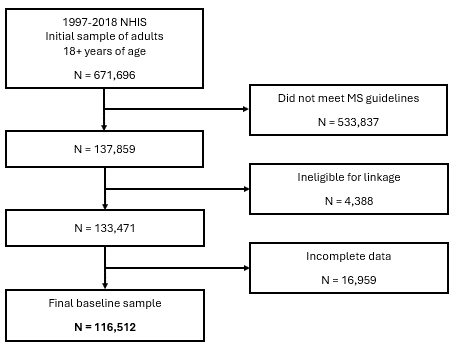
Data for this study came from the National Health Interview Survey (NHIS) and theNational Center for Health Statistics (NCHS) 2019 public-use linked mortality files 11, 12. NHIS is an annual survey of health-related topics and reaches approximately 27,000noninstitutionalized adults from the U.S. each year.Data are collected through personal interviews about health status, health behaviors, functional limitations, healthcare, and preventive services. For this study, NHIS data across 20 different years (1997 to 2018) were concatenated to form an initial sample of 671,696adults 18+ years of age. From that point, participants were excluded if 1) they did not meet MS guidelines, 2) they were ineligible for mortality linkage, or 3) they had incomplete data. These exclusions resulted in a final baseline sample of 116,512 adults (Figure 1). NHIS variables were only used in this study if they were assessed and available for every year across the 20 years of surveys.

Physical activity (PA) and Muscle strengthening (MS) guidelines
A PA guidelines status variable was created by first computing a moderate-to-vigorous PA (MVPA) variable. MVPA was formed by computing two preliminary variables of time spent in vigorous (VPA) and moderate (MPA) intensity PA per week. A final MVPA variable was calculated by adding MPA to twice VPA. Finally, ameeting PA guidelines status variable was created by assigning a “yes” to those participating in at least 150 minutes of MVPA each weekwith a “no” assigned otherwise.MS activity was assessed using questions asking about the frequency of leisure-time activities designed to strengthen muscles. A meeting MS guidelines status variable was then computed by assigning a “yes” to those participating in at least 2 days per week of MS and a “no” assigned otherwise. Only those assigned an MS of “yes” were included in this study.
Disease status
Disease status was used for the secondary aim with a variable created using the responses from single questions regarding nine different chronic conditions. Each question included a stem similar to “Have you EVER been told by a doctor or other health professional that you had…” The nine conditions included1) coronary heart disease, 2) angina pectoris, 3) heart attack, 4) other heart conditions or diseases, 5) a stroke, 6) emphysema, 7) chronic bronchitis, 8) diabetes, and 9) cancer. Each question’s response was subsequently recoded into individual indicator variables, assigning the participant a “1” for a “yes” response and “0” for a “no” response. A disease score was then created by summing across the nine indicator variables. Finally, a disease status variable was created by categorizing participants into groups of none (0), one (1), two (2), or three or more (3+) conditions.
Assessment of covariates
To control for possible confounding, body mass index (BMI) category, smoking status, age, sex, race, and income variables were created.BMI was measured using the standard formula yielding units of kg/m2 with standard groups of underweight (BMI < 18.5), normal weight (18.5 ≤BMI <25.0), overweight (25.0 ≥BMI <30.0), and obese (BMI ≥30.0). Smoking status was assessed using a series of questions asking participants about their smoking habits, smoking frequency, smoking quantity, and smoking history. From these responses, a smoking status variable was created that assigned participants to one of three groups of either current smoker, former smoker, or never smoker. A sex variable was used that included the conventional groups of male or female. An age group variable was created with ranges of 18 to 44 years, 45 to 64 years, and 65 to 85+ years. The race/ethnicity variable categorized adults into groups of either White, Black, or Other. Finally, a crude income variable was created that assigned each participant into one of three ordinal groups of low, middle, or high income.
Statistical analyses
The sample was described using percentages (%s) and 95% confidence intervals (CIs). Tests of association were also conducted for descriptive purposes using the Rao-Scott chi-square statistic and interaction tests using logistic regression. To examine the association between PA status and all-cause mortality, Cox proportional hazards regression was used with hazard ratio (HR) statistics and their 95% CI. Similarly, to estimate the relative risk (RR) statisticsassociated with mortality, Poisson regression with robust error variance was used. However, since the RR statistics were close to identical to the HR statistics, due primarily to the low event rate, the Poisson regression analyses were omitted from the paper. Tests of linear trend in HR statistics were conducted using orthogonal contrast statements. To weigh the effects of different covariates, three different models were employed examining the influence of PA status on mortality: unadjusted, demographics adjusted (age, sex, race, and income), and fully adjusted (age, sex, race, income, BMI category, and smoking status). Finally, to address the secondary purpose, a joint PA and disease status variable was modeled for its fully adjusted influence on all-cause mortality. SAS version 9.4 survey procedures were used for all analyses 13, 14.
The study saw a median follow-up of 10.2 (95% CI: 10.10–10.24) years. During which 8,589 (7.4%) deaths were observed. At baseline, mean age was 41.6 (95% CI: 41.3-41.8) years. Approximately 83.5% (95% CI: 83.12-83.77) of MS-compliant adults met PA guidelines at baseline. Among those that survived and died, 84.7% (95% CI: 84.40–85.03) and 63.5% (95% CI: 62.18–64.74) met PA guidelines, respectively (Table 1). All covariates had a significant mortality interaction when predicting PAstatus except for age. Thus, the percentages of adults meeting PA guidelines were statistically equivalent between those that died and those that survived, across the three age groups. Contrarily, all other covariates saw significantly different percentages meeting PA guidelines between those that died (lower percentages) and those that survived (higher percentages).

Modeling showed that those not meeting PA guidelines saw 281% (HR = 2.81, 95% CI: 2.67–2.97) greater risk of mortality as compared to those meeting guidelines (Table 2). In the demographics-adjusted model, those not meeting PA guidelines saw 74% (HR = 1.74, 95% CI: 1.65–1.83) greater risk of mortality as compared to those meeting guidelines. In the fully adjusted hazards model, those not meeting PA guidelines saw 59% (HR = 1.58, 95% CI: 1.49–1.67) greater risk of mortality as compared to their PA-compliant counterparts.
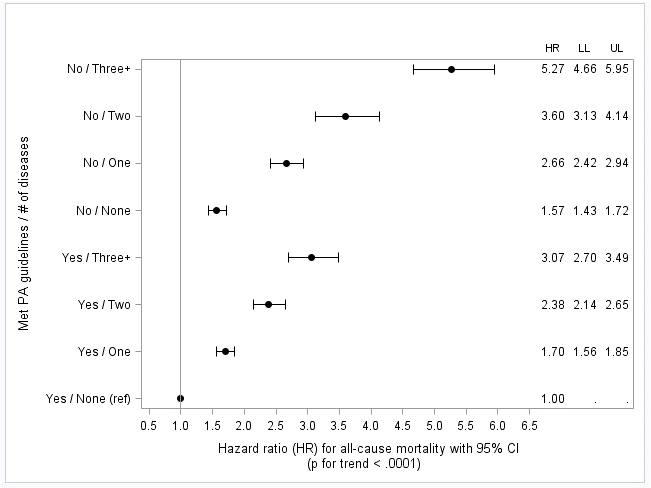
In the eight-group joint PA and disease status model, those not meeting PA guidelines with 3+, 2, 1, and 0 diseases and those meeting PA guidelines with 3+, 2, 1, and 0 (reference) diseases saw a significant (p < .0001) linear trend in mortality risk decreasing from HR = 5.27 (95% CI: 4.66–5.95) to HR = 1.70 (95% CI: 1.56–1.85), respectively (Figure 2). A separate analysis of disease-free adults showed a 51% (HR = 1.51, 95% CI: 1.38-1.66) greater risk of mortality in those not meeting PA guidelines. Additionally, each disease status group saw a significant difference in mortality risk between PA status groups – as seen by the nonoverlapping CIs.
The primary findings of this study showed that not meeting aerobic PA guidelines wasassociated with all-cause mortality risk among adults meeting MS guidelines. Furthermore, the increased risk remained after controlling for the common demographic and health covariates. A review of the current literature found no studies examining this same research question in a nationally representative sample of olderadults. However, one study did examine the risk of all-cause mortality associated with meeting aerobic PA, MS activity, and combined PA and MS guidelines in olderadults 15. Specifically, the risk of all-cause mortality for those meeting aerobic PA, MS, and both PA and MS guidelines was reported to be 35%, 8%, and 43% lower than counterparts, respectively. Although the findings from this study were positive in terms of the benefits associated with the different types of PA, their results do not provide the same evidence found in the current paper. This is because the 43% lower risk associated with meeting both guidelines was set relative to a group of olderadults that were both “inactive” in aerobic PA and non-compliant with MS guidelines.i.e., there was no direct comparison to a group meeting MS guidelines. Nevertheless, their findings do support meeting both guidelines and therefore provide someendorsementfor the current results.
The secondary findings of this paper showed a linear trend in all-cause mortality risk across joint PA and disease status groups. Since the joint grouping variable was arranged to have an ordinal dose of PA and disease status, the linear trend could be interpreted as PA having more survival benefit among greater diseased populations than inactivity has amongless diseased populations. More importantly, however, at each level of disease status, those meeting aerobic PA guidelines saw significantly lower mortality risk than their counterparts.As previously mentioned, no previous studies were found that examined the PA status and mortality risk relationship only among those meeting MS guidelines. Therefore, there are no data corroborating these joint effect findings. However, published data do support the PA and comorbidity, PA and mortality,as well as comorbidity and mortality relationships in olderadult populations 16, 17, 18, 19, 20.
The limitations regarding this study relate to its use of NHIS data and have been reported elsewhere 21, 22. Specifically, PA and MS activity were both assessed using self-reported measures and are therefore prone to recall bias as well as overestimation. Additionally, due to the cross-sectional nature of NHIS, findings are limited to correlational inferences only and not cause-and-effect. Finally, this study assessed aerobic PA engaged in during leisuretime or recreation and did not include PA performed during work or transportation. Thus, this study was not able to remove thepossible confounding effects of healthy user bias. That is, adults participating in leisure-time PA may be health-oriented individuals that are likely to live longer than their less active peers because of a healthier lifestyle. In sum, the findings from this study should be interpreted with caution.
These findings showed that the risk of mortality was greater among adults not meeting aerobic PA guidelines, despite meeting MS guidelines. The mortality risk associated with not meeting aerobic PA guidelines was seen in disease-free adults, however, the risk grew in magnitude as the number of diseases increased. Engaging in recommended amounts of aerobic PA could add survival benefit in strength-trained populations and attenuate the risk of mortality associated with chronic disease.
| [1] | Piercy KL, Troiano RP, Ballard RM, et al. The Physical Activity Guidelines for Americans. JAMA. 2018; 320(19):2020-2028. | ||
| In article | View Article PubMed | ||
| [2] | National Center for Chronic Disease Prevention and Health Promotion (NCCDPHP). Benefits of physical activity. Physical Activity Basics. Published April 24, 2024. https:// www.cdc.gov /physical-activity-basics/benefits/index.html. | ||
| In article | |||
| [3] | Hart PD. Meeting Recommended Levels of Physical Activity and Health-Related Quality of Life in Rural Adults. J Lifestyle Med. 2016; 6(1): 1-6. | ||
| In article | View Article PubMed | ||
| [4] | Fragala MS, Cadore EL, Dorgo S, et al. Resistance Training for Older Adults: Position Statement from the National Strength and Conditioning Association. J Strength Cond Res. 2019; 33(8): 2019-2052. | ||
| In article | View Article PubMed | ||
| [5] | Seguin R, Nelson ME. The benefits of strength training for older adults. Am J Prev Med. 2003; 25(3 Suppl 2): 141-149. | ||
| In article | View Article PubMed | ||
| [6] | U.S. Department of Health and Human Services. Physical Activity Guidelines for Americans 2nd Edition.; 2018. https:// odphp.health.gov/ sites/default/files/2019-09/ Physical_ Activity_ Guidelines_ 2nd_edition.pdf. | ||
| In article | |||
| [7] | Fukushima N, Kikuchi H, Sato H, et al. Dose-Response Relationship of Physical Activity with All-Cause Mortality among Older Adults: An Umbrella Review. J Am Med Dir Assoc. 2024; 25(3): 417-430. | ||
| In article | View Article PubMed | ||
| [8] | Yang Y, Chen L, Filippidis FT. Accelerometer-measured physical activity, frailty, and all-cause mortality and life expectancy among middle-aged and older adults: a UK Biobank longitudinal study. BMC Med. 2025; 23(1): 125. Published 2025 Feb 27. | ||
| In article | View Article PubMed | ||
| [9] | Coleman CJ, McDonough DJ, Pope ZC, Pope CA. Dose-response association of aerobic and muscle-strengthening physical activity with mortality: a national cohort study of 416 420 US adults. Br J Sports Med. Published online August 11, 2022. | ||
| In article | View Article PubMed | ||
| [10] | Nie J, Haberstroh M, Acosta T, Huang W, Wang Y, Barengo NC. Independent and Joint Associations Between Leisure Time Physical Activity and Strength Activities With Mortality Outcomes in Older Adults At least 65 Years of Age: A Prospective Cohort Study. J Gerontol A Biol Sci Med Sci. 2021; 76(12): 2122-2131. | ||
| In article | View Article PubMed | ||
| [11] | National Center for Health Statistics. CDC. About NHIS. National Health Interview Survey. Published November 21, 2024. https://www.cdc.gov/nchs/nhis/about/index.html. | ||
| In article | |||
| [12] | National Center for Health Statistics. Public-Use Linked Mortality Files. National Center for HealthStatistics. Updated May 2022. https://www.cdc.gov/nchs/data/datalinkage/public-use-linked-mortality-file-description.pdf. | ||
| In article | |||
| [13] | Allison PD. Survival analysis using SAS: a practical guide. Sas Institute; 2010 Mar 29. | ||
| In article | |||
| [14] | SAS Institute Inc. 2013. Introduction to Survival Analysis Procedures. SAS/STAT® 13.1 User’s Guide.Cary, NC: SAS Institute Inc. | ||
| In article | |||
| [15] | Nie J, Haberstroh M, Acosta T, Huang W, Wang Y, Barengo NC. Independent and Joint Associations Between Leisure Time Physical Activity and Strength Activities With Mortality Outcomes in Older Adults At least 65 Years of Age: A Prospective Cohort Study. J Gerontol A Biol Sci Med Sci. 2021; 76(12): 2122-2131. | ||
| In article | View Article PubMed | ||
| [16] | Srivastava S, Joseph K J V, Dristhi D, Muhammad T. Interaction of physical activity on the association of obesity-related measures with multimorbidity among older adults: a population-based cross-sectional study in India. BMJ Open. 2021; 11(5): e050245. Published 2021 May 21. | ||
| In article | View Article PubMed | ||
| [17] | Loprinzi PD. Accelerometer-determined sedentary and physical activity estimates among older adults with diabetes: considerations by demographic and comorbidity characteristics. J Aging Phys Act. 2014; 22(3): 432-440. | ||
| In article | View Article PubMed | ||
| [18] | Wang Y, Meng T, Yang W, et al. Association of grip strength and comorbidities with all-cause mortality in the older hypertensive adults. Front Public Health. 2023; 11: 1162425. Published 2023 Jun 28. | ||
| In article | View Article PubMed | ||
| [19] | He A, Wang Y, Du C, et al. Sex differences in the association of physical activity patterns with all-cause and cardiovascular mortality: a prospective cohort study from NHANES 2007-2018. Sci Rep. 2025; 15(1): 22197. Published 2025 Jul 1. | ||
| In article | View Article | ||
| [20] | Leroux A, Cui E, Smirnova E, Muschelli J, Schrack JA, Crainiceanu CM. NHANES 2011-2014: Objective Physical Activity Is the Strongest Predictor of All-Cause Mortality. Med Sci Sports Exerc. 2024; 56(10): 1926-1934. | ||
| In article | View Article PubMed | ||
| [21] | Abildso CG, Daily SM, Umstattd Meyer MR, Perry CK, Eyler A. Prevalence of Meeting Aerobic, Muscle-Strengthening, and Combined Physical Activity Guidelines During Leisure Time Among Adults, by Rural-Urban Classification and Region - United States, 2020. MMWR Morb Mortal Wkly Rep. 2023; 72(4): 85-89. Published 2023 Jan 27. | ||
| In article | View Article PubMed | ||
| [22] | Whitfield GP, Carlson SA, Ussery EN, Fulton JE, Galuska DA, Petersen R. Trends in Meeting Physical Activity Guidelines among Urban and Rural Dwelling Adults - United States, 2008-2017. MMWR Morb Mortal Wkly Rep. 2019; 68(23): 513-518. Published 2019 Jun 14. | ||
| In article | |||
Published with license by Science and Education Publishing, Copyright © 2025 Peter D. Hart
 This work is licensed under a Creative Commons Attribution 4.0 International License. To view a copy of this license, visit
http://creativecommons.org/licenses/by/4.0/
This work is licensed under a Creative Commons Attribution 4.0 International License. To view a copy of this license, visit
http://creativecommons.org/licenses/by/4.0/
| [1] | Piercy KL, Troiano RP, Ballard RM, et al. The Physical Activity Guidelines for Americans. JAMA. 2018; 320(19):2020-2028. | ||
| In article | View Article PubMed | ||
| [2] | National Center for Chronic Disease Prevention and Health Promotion (NCCDPHP). Benefits of physical activity. Physical Activity Basics. Published April 24, 2024. https:// www.cdc.gov /physical-activity-basics/benefits/index.html. | ||
| In article | |||
| [3] | Hart PD. Meeting Recommended Levels of Physical Activity and Health-Related Quality of Life in Rural Adults. J Lifestyle Med. 2016; 6(1): 1-6. | ||
| In article | View Article PubMed | ||
| [4] | Fragala MS, Cadore EL, Dorgo S, et al. Resistance Training for Older Adults: Position Statement from the National Strength and Conditioning Association. J Strength Cond Res. 2019; 33(8): 2019-2052. | ||
| In article | View Article PubMed | ||
| [5] | Seguin R, Nelson ME. The benefits of strength training for older adults. Am J Prev Med. 2003; 25(3 Suppl 2): 141-149. | ||
| In article | View Article PubMed | ||
| [6] | U.S. Department of Health and Human Services. Physical Activity Guidelines for Americans 2nd Edition.; 2018. https:// odphp.health.gov/ sites/default/files/2019-09/ Physical_ Activity_ Guidelines_ 2nd_edition.pdf. | ||
| In article | |||
| [7] | Fukushima N, Kikuchi H, Sato H, et al. Dose-Response Relationship of Physical Activity with All-Cause Mortality among Older Adults: An Umbrella Review. J Am Med Dir Assoc. 2024; 25(3): 417-430. | ||
| In article | View Article PubMed | ||
| [8] | Yang Y, Chen L, Filippidis FT. Accelerometer-measured physical activity, frailty, and all-cause mortality and life expectancy among middle-aged and older adults: a UK Biobank longitudinal study. BMC Med. 2025; 23(1): 125. Published 2025 Feb 27. | ||
| In article | View Article PubMed | ||
| [9] | Coleman CJ, McDonough DJ, Pope ZC, Pope CA. Dose-response association of aerobic and muscle-strengthening physical activity with mortality: a national cohort study of 416 420 US adults. Br J Sports Med. Published online August 11, 2022. | ||
| In article | View Article PubMed | ||
| [10] | Nie J, Haberstroh M, Acosta T, Huang W, Wang Y, Barengo NC. Independent and Joint Associations Between Leisure Time Physical Activity and Strength Activities With Mortality Outcomes in Older Adults At least 65 Years of Age: A Prospective Cohort Study. J Gerontol A Biol Sci Med Sci. 2021; 76(12): 2122-2131. | ||
| In article | View Article PubMed | ||
| [11] | National Center for Health Statistics. CDC. About NHIS. National Health Interview Survey. Published November 21, 2024. https://www.cdc.gov/nchs/nhis/about/index.html. | ||
| In article | |||
| [12] | National Center for Health Statistics. Public-Use Linked Mortality Files. National Center for HealthStatistics. Updated May 2022. https://www.cdc.gov/nchs/data/datalinkage/public-use-linked-mortality-file-description.pdf. | ||
| In article | |||
| [13] | Allison PD. Survival analysis using SAS: a practical guide. Sas Institute; 2010 Mar 29. | ||
| In article | |||
| [14] | SAS Institute Inc. 2013. Introduction to Survival Analysis Procedures. SAS/STAT® 13.1 User’s Guide.Cary, NC: SAS Institute Inc. | ||
| In article | |||
| [15] | Nie J, Haberstroh M, Acosta T, Huang W, Wang Y, Barengo NC. Independent and Joint Associations Between Leisure Time Physical Activity and Strength Activities With Mortality Outcomes in Older Adults At least 65 Years of Age: A Prospective Cohort Study. J Gerontol A Biol Sci Med Sci. 2021; 76(12): 2122-2131. | ||
| In article | View Article PubMed | ||
| [16] | Srivastava S, Joseph K J V, Dristhi D, Muhammad T. Interaction of physical activity on the association of obesity-related measures with multimorbidity among older adults: a population-based cross-sectional study in India. BMJ Open. 2021; 11(5): e050245. Published 2021 May 21. | ||
| In article | View Article PubMed | ||
| [17] | Loprinzi PD. Accelerometer-determined sedentary and physical activity estimates among older adults with diabetes: considerations by demographic and comorbidity characteristics. J Aging Phys Act. 2014; 22(3): 432-440. | ||
| In article | View Article PubMed | ||
| [18] | Wang Y, Meng T, Yang W, et al. Association of grip strength and comorbidities with all-cause mortality in the older hypertensive adults. Front Public Health. 2023; 11: 1162425. Published 2023 Jun 28. | ||
| In article | View Article PubMed | ||
| [19] | He A, Wang Y, Du C, et al. Sex differences in the association of physical activity patterns with all-cause and cardiovascular mortality: a prospective cohort study from NHANES 2007-2018. Sci Rep. 2025; 15(1): 22197. Published 2025 Jul 1. | ||
| In article | View Article | ||
| [20] | Leroux A, Cui E, Smirnova E, Muschelli J, Schrack JA, Crainiceanu CM. NHANES 2011-2014: Objective Physical Activity Is the Strongest Predictor of All-Cause Mortality. Med Sci Sports Exerc. 2024; 56(10): 1926-1934. | ||
| In article | View Article PubMed | ||
| [21] | Abildso CG, Daily SM, Umstattd Meyer MR, Perry CK, Eyler A. Prevalence of Meeting Aerobic, Muscle-Strengthening, and Combined Physical Activity Guidelines During Leisure Time Among Adults, by Rural-Urban Classification and Region - United States, 2020. MMWR Morb Mortal Wkly Rep. 2023; 72(4): 85-89. Published 2023 Jan 27. | ||
| In article | View Article PubMed | ||
| [22] | Whitfield GP, Carlson SA, Ussery EN, Fulton JE, Galuska DA, Petersen R. Trends in Meeting Physical Activity Guidelines among Urban and Rural Dwelling Adults - United States, 2008-2017. MMWR Morb Mortal Wkly Rep. 2019; 68(23): 513-518. Published 2019 Jun 14. | ||
| In article | |||