sciepub.com
 Quick Submission

Relationship between Low School Performance and Obesity in Adolescents: An Article Review
Alejandra Lozano Bustillo1, , Daniela Michell Ocampo Eguigurems1, Waleska Rosario Betancourth Melendez1, Kelly Anaid Montalvan Chirinos1, 2
1Doctor in Medicine and General Surgery, Hospital Escuela Universitario, Tegucigalpa, Honduras
2Regional Hospital of Atlántida, La Ceiba, Honduras
Abstract
Since 1980, children with obesity between 6 and 11 years of age have doubled, and the percentage of obese adolescents from 12 to 19 years has tripled. It has been found a deterioration of cognitive performance in a growing number of obese adolescents. It has been observed a relationship between birth weight and an adverse academic performance a posteriori. In this review we describe the different relationships between obesity in adolescents and its impact on the academic performance from different articles published between the years 2008 to 2016.
Keywords: obesity, adolescent, overweight, academic performance, school performance, physical activity
Copyright © 2016 Science and Education Publishing. All Rights Reserved.Cite this article:
- Alejandra Lozano Bustillo, Daniela Michell Ocampo Eguigurems, Waleska Rosario Betancourth Melendez, Kelly Anaid Montalvan Chirinos. Relationship between Low School Performance and Obesity in Adolescents: An Article Review. World Journal of Nutrition and Health. Vol. 4, No. 1, 2016, pp 10-15. http://pubs.sciepub.com/jnh/4/1/3
- Bustillo, Alejandra Lozano, et al. "Relationship between Low School Performance and Obesity in Adolescents: An Article Review." World Journal of Nutrition and Health 4.1 (2016): 10-15.
- Bustillo, A. L. , Eguigurems, D. M. O. , Melendez, W. R. B. , & Chirinos, K. A. M. (2016). Relationship between Low School Performance and Obesity in Adolescents: An Article Review. World Journal of Nutrition and Health, 4(1), 10-15.
- Bustillo, Alejandra Lozano, Daniela Michell Ocampo Eguigurems, Waleska Rosario Betancourth Melendez, and Kelly Anaid Montalvan Chirinos. "Relationship between Low School Performance and Obesity in Adolescents: An Article Review." World Journal of Nutrition and Health 4, no. 1 (2016): 10-15.
| Import into BibTeX | Import into EndNote | Import into RefMan | Import into RefWorks |
At a glance: Figures
1. Introduction
Obesity has become a major public health problem worldwide. The percentage of children and adolescents with overweight or obesity has reached record numbers in most regions around the world. Since 1980, children with obesity between 6 and 11 years old have doubled, and the percentage of obese adolescents from 12 to 19 years has tripled. Childhood obesity has both immediate and long-term severe impacts on health. The prevalence of obesity differs between the racial/ethnic groups and also varies according to age, sex, family environment and the educational level of the parents [2].
The overall records show that in the most recent period (2011-2014), 17% of children and adolescents presented obesity and 5.8% extreme obesity. [32]. The global epidemic of obesity and physical inactivity may have detrimental consequences for young individuals in their cognitive function and academic achievement [3, 4, 5, 6, 7].
The overweight on early ages predicts a negative academic performance in adolescence and also a decrease in the level of schooling of the adults and the economic income in the future [5].
Different studies agree that food and nutrition, among other factors, are determinant in the biological development of humans; but over time, it has been demonstrated that also are determinant in the psychological and social development of these [12].
Data of a smaller volume hippocampal, increase in the brain, the spinal fluid and reductions of integrity in the microstructure of the main routes of white substance have been observed in obese adolescents primarily those who go on to develop more complex situations as the metabolic syndrome [4].
A comprehensive review of different relationships between obesity in adolescents and its impact on the academic performance from articles published in the last few years.
2. Methodology
The bibliographic search was extracted from the databases: MEDLINE (PubMed), Cochrane, Scielo and Google Scholar published between the years from 2008 to 2016 in English and Spanish languages. The period of time of collecting data was approximately 2 month. A broad search was conducted using the keywords: academic achievement, adolescent, overweight and obesity, to determine the domains evaluated in current studies. The different subjects of the articles had an average age of 12.2 years. Inclusion criteria were as follows: English and Spanish language, all races, ethnicities, and genders (a) subjects were in the age range of 6 – 20 year, or the mean age was in this range; (b) a measure of overall academic achievement; and (c) variables were tested for their association with obesity, academic achievement, and life habits. The exclusion criteria were articles published before the year 2008, languages other than English or Spanish, documents non original as case reports, comments, editorials or textbooks.
3. Adolescent Obesity: A Growing Problem
More than 60% of children who are overweight before puberty shall be overweight in early adulthood. Childhood obesity is strongly associated with risk factors for cardiovascular diseases, type 2 diabetes, orthopedic problems, mental disorders, poor performance in school and low self-esteem [22]. In Latin America according to estimates the total number of adolescents overweight or obese is 16.5 to 22.1 million [29] and in the United States has increased in adolescents 12 to 19 years of age of 10.5 per cent between 1988-1994 and 20.6% between 2013-2014.
According to the Center of Disease and Control (CDC) between the years 2011-2012, 8.4 per cent of children between 2 to 5 years had obesity in comparison with 17.7 per cent of 6 to 11 years and 20.5% of 12 to 19 years. Childhood obesity is also more common among certain racial and ethnic groups. In 2011-2012, the prevalence among children and adolescents was greater among Hispanics (22.4%) and non-Hispanic blacks (20.2%) than among non-Hispanic whites (14.1 per cent) [31] and is lower in Asian youth non-Hispanics (8.6%) than in the younger white non-Hispanics and Black non-Hispanics [31]
4. Obesity: Individual, Family and Social Factors
Obesity is defined as a body mass index (BMI) greater than or equal to the 95th percentile for children and adolescents of the same age and sex. This is the more parameter used to measure the patterns of growth in children and adolescents [24].
The obesity is related to physical and psychosocial consequences both for the teenager who suffers it as to his family and the society. Obese children and teens are more likely to develop psychological and social problems such as discrimination and poor self-esteem. [1, 2] In addition to a reduced intelligent quotient (IQ) [4] the low concepts that are presented in the overweight or obese adolescents could be the causal factors of a low academic achievement, school absenteeism and low participation in sporting activities [34].
The obesity is a prognostic factor for the demotivation in the adolescent. The obese adolescents have a lower personal interest, motivational conflicts and a reduced degree in the implementation of goals compared with adolescents with a suitable weight [12].
According to some studies, students with overweight are five times more likely to have a higher number of detentions, a greater percentage of absences and more days of delay in school compared with those students with adequate weight [34].
A study conducted in the United States with middle-school students in five cities (Atlanta, Chicago, Denver, Fort Lee (New Jersey) and Los Angeles) concluded that students with overweight and obesity obtain significantly lower grades than their peers with healthy weight [20].
The great British study in adolescents, the ALSPAC, investigated the association of obesity in adolescents and later academic achievement, which suggests that the obesity in adolescents has a negative impact on the academic performance mainly in the students of women [5].
The educational level of the parents or caregivers (a higher educational level increased risk of obesity), the presence of overweight and obesity in the family and the low level of physical activity of the parents have been identified as risk factors for the development of obesity in adolescence [13, 26]. The prevalence of obesity among children, whose head of adult family term the university was approximately half that those who do not complete the secondary [31].
The family economic status is associated significantly with overweight or obesity according to the Health Behavior in School-aged Children (HBSC) Survey which concluded that those families with a lower income were more likely to be overweight or obesity [33].
The promotion and advertising of unhealthy food and beverages has been recognized as one of the major contributors and risk factors for childhood obesity. [28]
5. The Obesity and Impaired Cognitive Development
In children and adolescents, a great amount of body fat can lead to many diseases and other alterations of health [24].
Although adolescence is associated with the increase of the ability of abstract thinking and a unit for the independence, also is characterized by the assumption of risks and emotional reactivity. Some factors that affect the operation neurobehavioral during this stage of development can have a significant effect on the neurological outcome [16].
It has been found a deterioration of cognitive performance in a growing number of obese adolescents [4, 30]. From birth it has been observed a relationship between birth weight and an adverse academic performance a posteriori [9]. Studies have been conducted in which high levels of leptin in newborns with intrauterine growth restriction by associating this to insulin resistance and development of obesity in adolescence, all this together with factors such as maternal obesity and gestational diabetes [17].
Adolescents with metabolic syndrome show a tendency toward a general decline in the intelligence, these shows significantly lower performance in areas such as calculation, spelling, attention and a lower mental flexibility [4].
A poor motor activity in the early school years can contribute to establishing the child in a trajectory of negative development. A study conducted in Finland with 8,061 children investigated if the motor function in childhood predicts the late academic achievement through physical activity, the exercise and obesity. The physical activity was associated with an average better, and obesity was associated with a lower average in adolescence [3].
Another important disorder is the deficit of attention that has been found as a factor that has a direct impact on academic achievement. There are data that claim that the deficit of attention in childhood predicts prospectively the development of obesity in adolescence and that could be associated with a poor physical activity [11, 16].
6. Life Styles and Academic Achievement
The exercise is strongly and significantly associated with academic performance. Cardiovascular exercise has a dose-response relationship with the independent academic performance [10]. Physical activity can be beneficial for both the behavior problems and obesity [11, 30] There are data where those teenagers athletes present a better academic performance and have a better attitude to the study and better planning of free time [5, 14, 19].
Adolescents who practice a sport tend to sleep less during the day that teenagers who do not practice any [14]. The practice of sports that involves a significant time commitment (up to 20 hours a week for example), does not harm the academic performance at these ages [14]. According to recommendations of the CDC children and adolescents must perform 60 minutes or more of daily physical activity [27].
The consumption of alcohol and smoking are other factors that are associated with a lower academic performance. According to a study carried out in the Netherlands (E-MOVO) that monitors the state of health and lifestyles of adolescents with obesity or overweight, concluded that high alcohol consumption was associated with a low level of education [35].
The number of hours of sleep is important for a suitable academic performance. The highest percentage of sleep apnea syndrome in obese population is large and obese adolescents with this syndrome reported significantly increased symptoms of depression, a high percentage of abnormal neurological behaviors as in their executive functions, care, fatigue and behavior [16].
Moreover overweight adolescents tend to eat fewer vegetables daily and are more likely to watch more hours of television a day [25]. A diet consisting of frequent intakes of fruits, vegetables and milk, eat 3 times a day, without skipping meals, especially the breakfast are related with the good academic performance [23, 35]. However, eating a variety of processed foods such as sodas, instant foods, fast food and candies are correlated with a low school performance [23].
7. Conclusion
The number of obese adolescents has increased significantly in the last two decades, associating to perinatal factors ranging from maternal history of gestational diabetes maternal obesity and intrauterine growth restriction in addition to inadequate food and sedentary, taking psychological and physical impact as in the neurodevelopment, partnering with a lower academic achievement with limitations in the calculation, spelling and decline of IQ, lower self-esteem and reverberate in the long-term development of adolescents as adults.
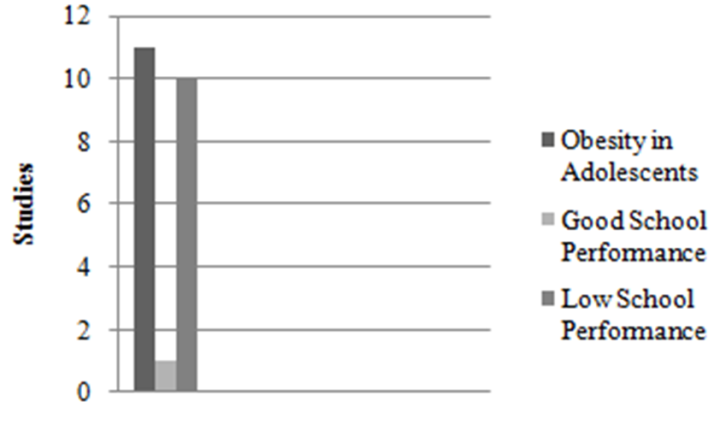
Of the 36 articles reviewed eleven of them communicate specifically the relationship between obesity and academic performance which 90% are related to low academic performance in this population and only one in which it was found a good performance in this adolescents (Figure 1).

 Download as

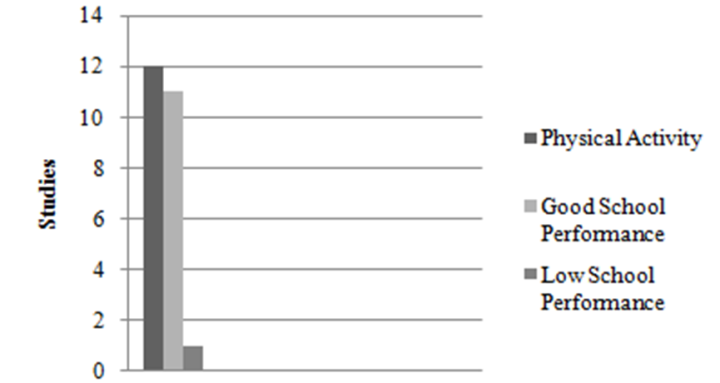
12 articles about physical activity and academic performance found in the 91 per cent of the articles a suitable academic performance in teenagers that perform exercise (Figure 2).
 Download as
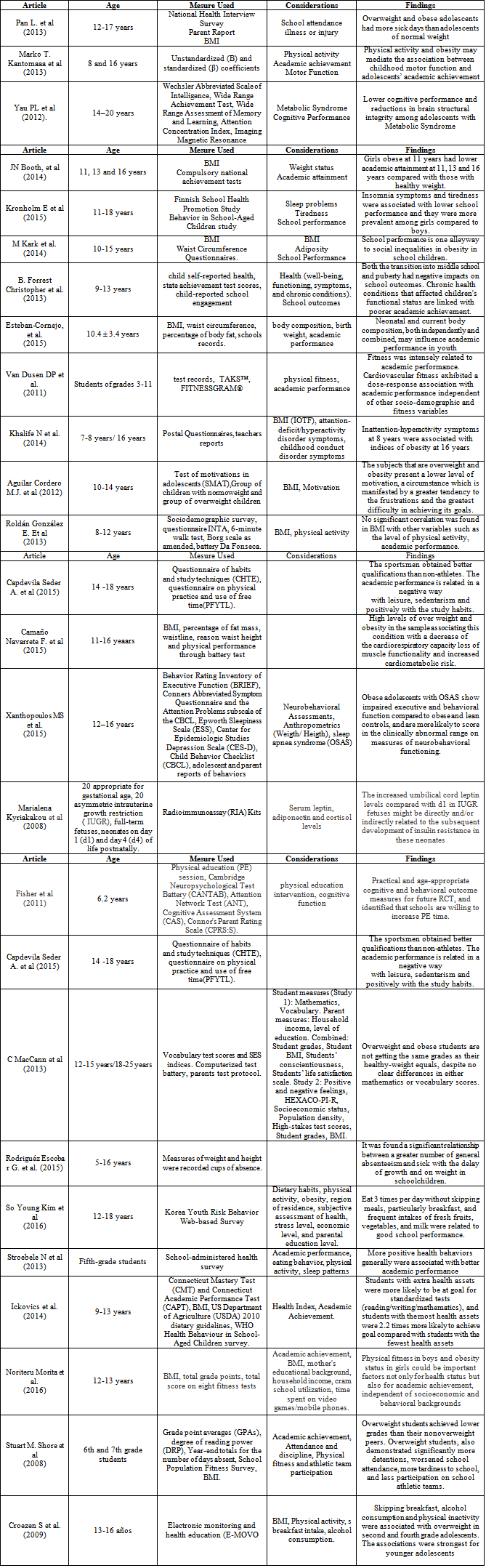
A proper food and practicing a sport or perform some physical activity for at least 60 minutes a day improve the quality of life of adolescents including the academic performance. Table 1 summarizes the original studies included in the revision that associated overweight, obesity, physical activity, school performance and other related factors in adolescents.
Table 1. Summary of original studies included that associated overweight, obesity, physical activity, school performance in adolescents




Statement of Competing Interests
We declare that we have no competing interests.
References
| [1] | Liping Pan, Bettylou Sherry, Sohyun Park, Heidi M. Blanck, The Association of Obesity and School Absenteeism Attributed to Illness or Injury Among Adolescents in the United States, 2009, Journal of Adolescent Health 2013; 52(1): 64-69. | ||
 In article In article | View Article PubMed | ||
| [2] | Centers For Disease Control, “Make a Difference at Your School” (2013). Chronic Disease. Paper 31. http://digitalcommons.hsc.unt.edu/disease/31. | ||
| In article | |||
| [3] | Marko T. Kantomaaa et all. Physical activity and obesity mediate the association between childhood motor function and adolescents’ academic achievement, PNAS 2013; 110 (5) 1917-192. | ||
| In article | View Article PubMed | ||
| [4] | Po Lai Yau, Mary Grace Castro, Adrian Tagani, Wai Hon Tsui, Antonio Convit, Obesity Metabolic Syndrome and Functional and Structural Brain Impairments in Adolescence, Pediatrics 2012; 130 (4). | ||
| In article | |||
| [5] | JN Booth, et al. Obesity impairs academic attainment in adolescence: findings from ALSPAC, a UK cohort International Journal of Obesity (2014) 38, 1335-1342. | ||
| In article | View Article | ||
| [6] | Erkki Kronholm, et al. Trends in self-reported sleep problems, tiredness and related school performance among Finnish adolescents from 1984 to 2011 J Sleep Res. (2015) 24, 3-10. | ||
| In article | View Article PubMed | ||
| [7] | M Kark, A Hjern, F Rasmussen. Poor school performance is associated with a larger gain in body mass index during puberty .Acta Paediatrica (2014) 103, 2; 207-213. | ||
| In article | View Article PubMed | ||
| [8] | Christopher B. Forrest, Katherine B. Bevans, Anne W. Riley, Richard Crespo, Thomas A. Louis. Health and School Outcomes During Children's Transition Into Adolescence. Journal of Adolescent Health (2013) 52, 2; 186-194. | ||
| In article | View Article PubMed | ||
| [9] | Esteban-Cornejo, et al. Independent and combined influence of neonatal and current body composition on academic performance in youth: The UP & DOWN Study. Pediatric Obesity (2015) 10;3 157-164. | ||
| In article | |||
| [10] | Van Dusen DP1, Kelder SH, Kohl HW 3rd, Ranjit N, Perry CL. Associations of physical fitness and academic performance among schoolchildren. J Sch Health. 2011, 81(12):733-40. | ||
| In article | View Article PubMed | ||
| [11] | Natasha Khalife, et al. Childhood Attention-Deficit/Hyperactivity Disorder Symptoms Are Risk Factors for Obesity and Physical Inactivity in Adolescence. Journal of the American academy of child & adolescent psychiatry. 2014 (53)-4. | ||
| In article | |||
| [12] | M.ª J. Aguilar Cordero, E. González Jiménez, C. A. Padilla López, R. Guisado Barrilao, A. M. Sánchez López. Sobrepeso y obesidad como factor pronóstico de la desmotivación en el niño y el adolescente. Nutr Hosp. 2012; 27(4):1166-1169. | ||
| In article | PubMed | ||
| [13] | Elizabeth Roldán González, Alexandra Paz Ortega. Relación de sobrepeso y obesidad con nivel de actividad física, condición física, perfil psicomotor y rendimiento escolar en población infantil (8 a 12 años) de popayán Mov.cient.Vol.7 (1): 71-84. | ||
| In article | |||
| [14] | Capdevila, A., Belmunt, H., Hernando, C. Estudio Del Rendimiento Académico En Atletas Adolescentes Del Club De Atletismo Playas De Castellón Revista de Ciencias del Deporte 2014, 10 (1), 53-66. | ||
| In article | |||
| [15] | Felipe Caamaño et al. La malnutrición por exceso en niños-adolescentes y su impacto en el desarrollo de riesgo cardiometabólico y bajos niveles de rendimiento físico Nutr Hosp. 2015; 32(6): 2576-2583. | ||
| In article | PubMed | ||
| [16] | Melissa S. Xanthopoulos, et al MBBCh Neurobehavioral Functioning in Adolescents With and Without Obesity and Obstructive Sleep Apnea SLEEP, Vol. 38, No. 3, 2015. | ||
| In article | |||
| [17] | M Kyriakakou et al. Leptin and adiponectin concentrations in intrauterine growth restricted and appropriate for gestational age fetuses, neonates, and their mothers European Journal of Endocrinology (2008) 158 343-348. | ||
| In article | View Article PubMed | ||
| [18] | Fisher et al. Effects of a physical education intervention on cognitive function in young children: randomized controlled pilot study. BMC Pediatrics 2011, 11:97 http://www.biomedcentral.com/1471-2431/11/97. | ||
| In article | View Article PubMed | ||
| [19] | Ana Capdevila Seder, Héctor Bellmunt Villalonga, Carlos Hernando Domingo. Estilo de vida y rendimiento académico en adolescentes: comparación entre deportistas y no-deportistas. Retos 2015, 27, 28-33. | ||
| In article | |||
| [20] | C MacCann, RD Roberts Just as smart but not as successful: obese students obtain lower school grades but equivalent test scores to nonobese students, International Journal of Obesity (2013) 37, 40-46. | ||
| In article | View Article PubMed | ||
| [21] | Gilma Rodríguez-Escobar, Sandra L. Vargas-Cruz, Edgar Ibáñez-Pinilla, María I. Matiz-Salazar, Hans Jörgen-Overgaard Relación entre el estado nutricional y el ausentismo escolar en estudiantes de escuelas rurales, 2015 Rev. salud pública. 17 (6): 861-873. | ||
| In article | |||
| [22] | World Health Organization. Regional Office for Europe. Data and statistics. http://www.euro.who.int/en/health-topics/noncommunicablediseases/obesity/dataand-statistics. | ||
| In article | |||
| [23] | So Young Kim et al. Dietary Habits Are Associated With School Performance in Adolescents. Medicine 2016 (95) 12. | ||
| In article | View Article | ||
| [24] | Centers for Disease Control and Prevention, About Child & Teen BMI, http://www.cdc.gov/healthyweight/assessing/bmi/childrens_bmi/about_childrens_bmi.html. | ||
| In article | |||
| [25] | Stroebele N, McNally J, Plog A, Siegfried S, Hill JO. The association of self-reported sleep, weight status, and academic performance in fifth-grade students [abstract]. J Sch Health. 2013 Feb;83(2):77-84. | ||
| In article | View Article PubMed | ||
| [26] | Ickovics et al. Health and Academic Achievement: Cumulative Effects of Health Assets on Standardized Test Scores Among Urban Youth in the United States. J Sch Health. 2014 ; 84(1): 40-48. | ||
| In article | View Article PubMed | ||
| [27] | Centers for Disease Control and Prevention. Physical activity for everyone. 2011. http://www.cdc.gov/physicalactivity/everyone/guidelines/children.html. | ||
| In article | |||
| [28] | Fondo de las Naciones Unidas para la Infancia (UNICEF), Estudio exploratorio sobre la promoción y publicidad la promoción y publicidad de alimentos y bebidas no saludables dirigida a niños en América Latina y el Caribe. 2015 http://www.unicef.org/lac/Estudio_exploratorio_promocion_alimentos_no_saludables_a_ninos_en_LAC_-_Informe_Completo_(3).pdf. | ||
| In article | |||
| [29] | Angel Rivera et al. Childhood and adolescent overweight and obesity in Latin America: a systematic review. Lancet Diabetes Endocrinol 2014; 2:4, 321-32 | ||
| In article | View Article | ||
| [30] | Noriteru Morita, Toshihiro Nakajima, Koichi Okita, Toru Ishihara, Masato Sagawa, Koji Yamatsu. Relationships among fitness, obesity, screen time and academic achievement in Japanese adolescents. 2016 163, (1) 161-166. | ||
| In article | |||
| [31] | Centers for Disease Control and Prevention. Childhood Obesity Facts. 2011 http://www.cdc.gov/obesity/data/ childhood html. | ||
| In article | |||
| [32] | Cynthia L. Ogden. et al Trends in Obesity Prevalence Among Children and Adolescents in the United States, 1988-1994 Through 2013-2014, JAMA. 2016; 315(21): 2292-2299. | ||
| In article | View Article PubMed | ||
| [33] | C. Roberts et al, The Health Behaviour in School-aged Children (HBSC) study: methodological developments and current tensions. Int J Public Health. 2009; 54(Suppl 2): 140-150. | ||
| In article | View Article PubMed | ||
| [34] | Stuart M. Shore et al, Decreased Scholastic Achievement in Overweight Middle School Students, Obesity 2008, 16; 7. | ||
| In article | View Article PubMed | ||
| [35] | S Croezen, TLS Visscher, NCW ter Bogt, ML Veling, A Haveman-Nies. Skipping breakfast, alcohol consumption and physical inactivity as risk factors for overweight and obesity in adolescents: results of the E-MOVO project. European Journal of Clinical Nutrition (2009) 63, 405-417. | ||
| In article | View Article PubMed | ||
 CiteULike
 Mendeley
 StumbleUpon
 Delicious
 Facebook
 Twitter
 LinkedIn