 OPEN ACCESS
  PEER-REVIEWED
Application of the He’s Semi-inverse Method for (2 + 1)-Dimensional Nonlinear PDEs
Mohammad Najafi1, , Malihe Najafi1, Somayeh Arbabi1
1Medical Biology Research Center, Kermanshah University of Medical Sciences, Kermanshah, Iran
Abstract
We make use of the He’s semi-inverse method and symbolic computation to construct new exact traveling wave solutions for the (2 + 1)-dimensional Boussinesq and breaking soliton equations. Many new exact traveling wave solutions are successfully obtained, which contain soliton solutions. This method is straightforward and concise, and it can also be applied to other nonlinear evolution equations.
At a glance: Figures
Keywords: He’s semi-inverse method, (2+1)-dimensional Boussinesq equation, (2+1)-dimensional breaking soliton equation
Journal of Mathematical Sciences and Applications, 2013 1 (2),
pp 29-31.
DOI: 10.12691/jmsa-1-2-3
Received May 07, 2013; Revised Septamber 17, 2013; Accepted September 23, 2013
Copyright © 2013 Science and Education Publishing. All Rights Reserved.Cite this article:
- Najafi, Mohammad, Malihe Najafi, and Somayeh Arbabi. "Application of the He’s Semi-inverse Method for (2 + 1)-Dimensional Nonlinear PDEs." Journal of Mathematical Sciences and Applications 1.2 (2013): 29-31.
- Najafi, M. , Najafi, M. , & Arbabi, S. (2013). Application of the He’s Semi-inverse Method for (2 + 1)-Dimensional Nonlinear PDEs. Journal of Mathematical Sciences and Applications, 1(2), 29-31.
- Najafi, Mohammad, Malihe Najafi, and Somayeh Arbabi. "Application of the He’s Semi-inverse Method for (2 + 1)-Dimensional Nonlinear PDEs." Journal of Mathematical Sciences and Applications 1, no. 2 (2013): 29-31.
| Import into BibTeX | Import into EndNote | Import into RefMan | Import into RefWorks |
1. Introduction
Nonlinear partial differential equations are very important in a variety of scientific fields, especially in fluid mechanics, solid state physics, plasma physics, plasma waves, capillary-gravity waves and chemical physics. The nonlinear wave phenomena observed in the above mentioned scientific fields, are often modeled by the bell-shaped sech solutions and the kink-shaped tanh solutions. The availability of these exact solutions, for those nonlinear equations can greatly facilitate the verification of numerical solvers on the stability analysis of the solution. Nonlinear wave phenomena of dispersion, dissipation, diffusion, reaction and convection are very important in nonlinear wave equations. In recent years, new exact solutions may help to find new phenomena. Also, the explicit formulas may provide physical information and help us to understand the mechanism of related physical models.
In this paper, by means of the He’s semi-inverse method, we will obtain some Solitary solutions of the (2 + 1)-dimensional Boussinesq and breaking soliton equations.
2. Description of He’s Semi-inverse Method
We suppose that the given nonlinear partial differential equation for  to be in the form
 | (1) |
Step 1. Seek solitary wave solutions of Eq. (3) by taking  and transform Eq. (3) to the ordinary differential equation
 | (2) |
where prime denotes the derivative with respect to  .
.
Step 2. If possible, integrate Eq. (3) term by term one or more times. This yields constant(s) of integration. For simplicity, the integration constant(s) can be set to zero.
Step 3. According to He’s semi-inverse method, we construct the following trial-functional
 | (3) |
where  is an unknown function of
  and its derivatives.
There exist alternative approaches to the construction of the trial-functionals, see Refs [1, 2].
Step 4. By the Ritz method, we can obtain different forms of solitary wave solutions, in the form
 | (4) |
where  and
and  are constants to be further determined.
Substituting Eq. (5) into Eq. (6) and making  stationary with respect to
  and
and  results in
 | (5) |
 | (6) |
Solving simultaneously Eqs. (5) and (6) we obtain  and
and  . Hence, the solitary wave solution (4) is well determined.
3. He’s Semi-inverse Method for (2 + 1)- Dimensional Boussinesq Equation
Consider the (2 + 1)-dimensional Boussinesq equation
 | (7) |
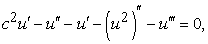
Using the wave variable reduces it to an ODE
 | (8) |
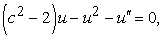
Integrating twice and setting the constants of integration to zero, we obtain
 | (9) |
According to Ref. [1], By He’s semi-inverse method [2], we can arrive at the following variational formulation:
 | (10) |
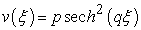
We assume the soliton solution in the following form
 | (11) |
where  ,
,  is an unknown constant to be further determined.
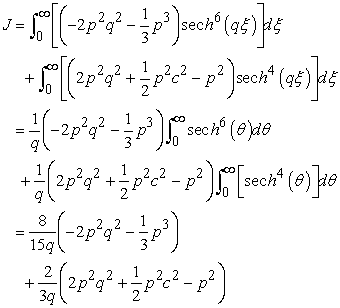
By Substituting Eq. (11) into Eq. (10) we obtain
 | (12) |
For making  stationary with respect to
  and
and  results in
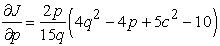 | (13-1) |
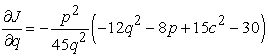 | (13-2) |
or simplifying
 | (14-1) |
 | (14-2) |
From Eqs. (14-1) and (14-2), we can easily obtain the following relations:
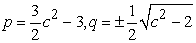 | (15) |
So the solitary wave solution can be approximated as
 | (16) |
In this solution  is an arbitrary complex parameter.( For
  , see Figure 1)


) PowerPoint Slide
PowerPoint Slide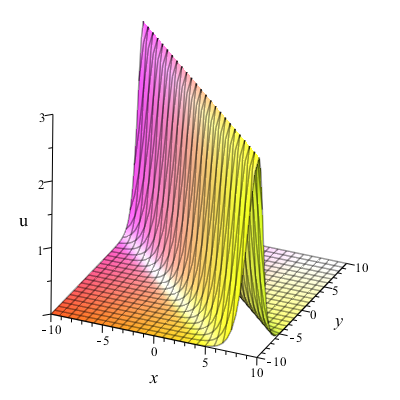 Larger image(png format)


4. He’s Semi-inverse Method for (2 + 1)-Dimensional Breaking Soliton Equation
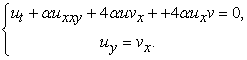
We now consider the (2 + 1)-dimensional breaking soliton equations
 | (17) |
Using the wave variable  reduces it to an ODE
 | (18) |
Integrating the second equation in the system and neglecting constants of integration we find
 | (19) |
Substituting (32) into the first equation of the system and integrating we find
 | (20) |
According to Ref. [1], By He’s semi-inverse method [2], we can arrive at the following variational formulation:
 | (21) |
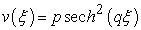
We assume the soliton solution in the following form
 | (22) |
where  ,
,  is an unknown constant to be further determined.

) PowerPoint Slide
PowerPoint Slide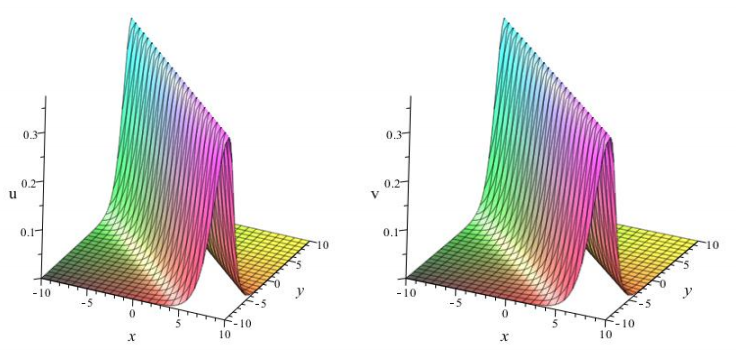 Larger image(png format)
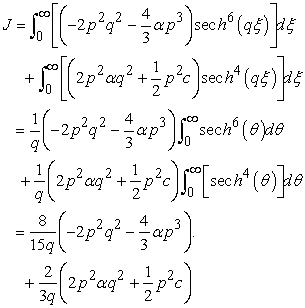
By Substituting Eq. (22) into Eq. (21) we obtain
 | (23) |
For making  stationary with respect to
  and
and  results in
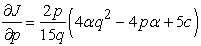 | (24-1) |
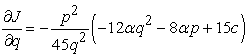 | (24-2) |
or simplifying
 | (25-1) |
 | (25-2) |
From Eqs. (25-1) and (25-2), we can easily obtain the following relations:
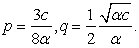 | (26) |
So the solitary wave solution can be approximated as
 | (27) |
And
 | (28) |
In this solutions  is an arbitrary complex parameter.( For
  , see Figure 2)
5. Conclusions
In this paper, by using the He’s semi-inverse method; we obtained some solitary solutions of (2+1)-dimensional Boussinesq and breaking soliton equations. He’s semi-inverse method is a very dominant instrument to find the solitary solutions for various nonlinear equations.
References
| [1] | He, J. H., “Some asymptotic methods for strongly nonlinear equations”, Internat. J. Modern Phys. B, Vol. 20, 2006, 1141-1199. | ||
 In article In article | CrossRef | ||
| [2] | He, J. H., “Variational principles for some nonlinear partial differential equations with variable coefficients”, Chaos, Solitons and Fractals, Vol. 19, 2004, 847-851. | ||
| In article | CrossRef | ||
| [3] | Najafi, M., Arbabi, S., Najafi, M., “New application of sine-cosine method for the generalized (2+1)-dimensional nonlinear evolution equations”, International Journal of Advanced Mathematical Sciences, Vol. 1, No. 2, 2013, 45-49. | ||
| In article | |||

 CiteULike
 Mendeley
 StumbleUpon
 Delicious
 Facebook
 Twitter
 LinkedIn
 Print
Print