This study investigates the chemical reactivity of a set of Clovamides and derivatives, including newly identified cis-diastereoisomers, through Density Functional Theory (DFT). Using the B3LYP/6-31+G(d,p) level of theory, global and local reactivity descriptors—such as HOMO-LUMO gap, electronegativity, hardness, electrophilicity, and Fukui functions—were calculated to evaluate reactivity profiles. Clovamide (Clova02) emerged as the most reactive compound due to its low energy gap and hardness, while Clova01 showed the highest electrophilic character. Local reactivity analysis identified O26 and O24 as the most nucleophilic, and C11 and C1 as the most electrophilic centers. Additionally, C20 and C23 on the phenylalanine moiety were revealed as sites favorable to radical attack. The study highlights the comparable reactivity of the newly isolated cis-Clovamide isomers to their trans counterparts, supporting further interest in their synthesis and potential biological applications.
Clovamides and derivatives are important chemical compounds with multiple biological activities. They have emerged as a class of specialized secondary metabolites isolated from numerous plant species, in which they play significant role in the tolerance of oxidative stress due to their high antioxidant activity 1. Clovamides and derivatives are Hydroxycinnamic Acid Amides (HCAA) reported as important resistance factor against pathogens in Cocoa (Theobroma cocoa) 2. They are also referred to as N-phenylpropenoyl-L-amino acids with cell reinforcing properties, or with direct antimicrobial activity 3. The biosynthesis of those HCAAs is made through the amide condensation of hydroxycinnamoyl-CoA thioesters and amines 4. Interestingly, recent researchs on the bioactive molecules from Ivorian medicinal plants, have led to the description of two (2) new Cis-Clovamides for the first time, among a total of five (5) N-phenylpropenoyl-L-amino acids, isolated from methanolic extract of peelings of Icacina mannii tubers. While several papers are found in the literature about Trans-Clovamides and derivatives, those about their Cis diastereoisomer counterparts like those described by Akissi et al.,(2023) 5, are rather rare.
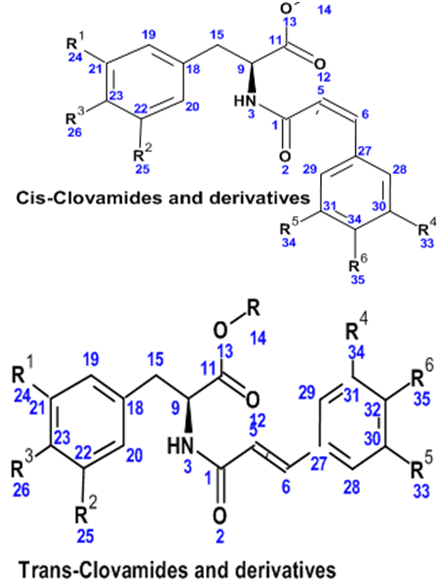
However, the Clovamides and derivatives, whose scaffolds are designed by Figure 1, can be synthesized by the amidation of cinnamic acids and derivatives with amino acids L-phenylalanine and derivatives 6. That leads to compounds with the junction of two moieties: An L-phenylalanine and derivatives moiety and a cinnamoyl moiety which is responsible of the diastereoisomery Cis or Trans of the Clovamides and derivatives.

All the promising chemical properties of the Clovamides and derivatives will be best understood, with a better understanding of their reactivity. Theoretical methods can help achieve that, in providing accurate information on the electronic populations around each atom constituting the molecules. So the aim of this work with a Density Functional Theory study on the 5 isolated Clovamides and derivatives (Table 1), is first to describe their chemical properties derived from the characteristics of their electronic densities, such as their Molecular Electrostatic potential (MEP), and their sites of electrophilic, nucleophilic and radical attacks. Then we will discuss the differences between the cis and Trans diastereoisomers, and see whether the Cis-Clovamides and derivatives are worth synthesizing like their Trans counterparts.
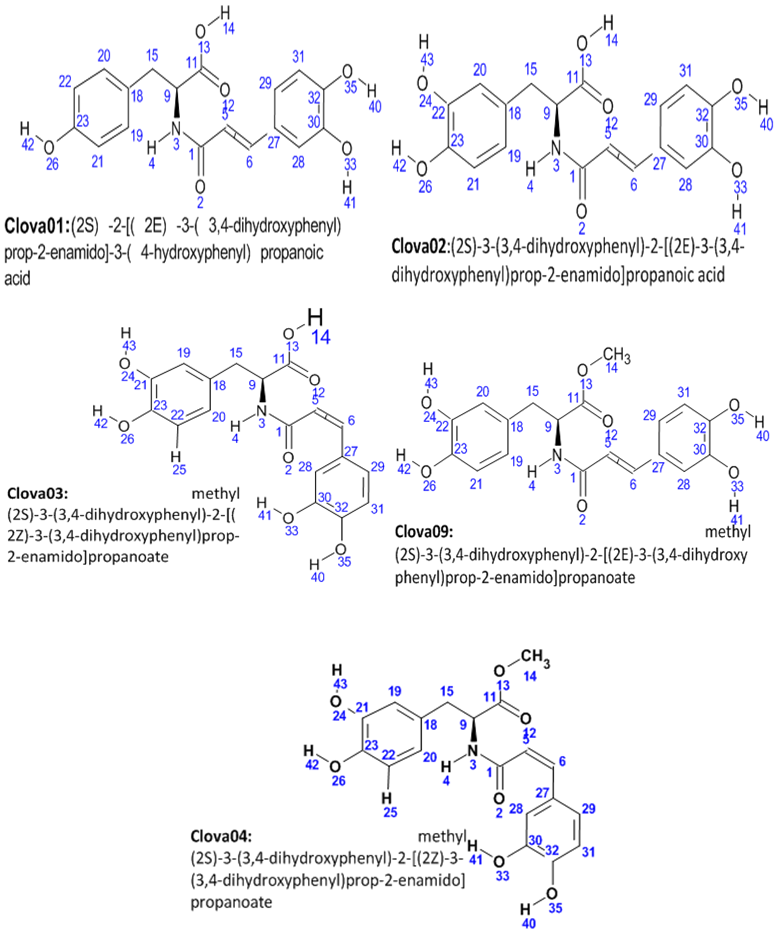
The chemical 2D structures of the five isolated Clovamides and derivatives, drawn and numbered appropriately, so as to allow the comparative study of their reactivity, are displayed in Figure 2. They were the main inputs of all the calculations. The isolated Trans Clovamide and derivatives are designated as Clova01, Clova02 and Clova09 while their isolated Cis counterparts are Clova03 and Clova04.

The theoretical study of chemical reactivity was done on three theoretical outputs. The first analysis is on the energy results of geometric optimization without imaginary frequencies which allowed the display of the surfaces of Molecular Electrostatic Potential. The second analysis is on concepts relative to the Frontier Molecular Orbitals (FMO), which makes it possible to describe the evolution of the electronic density when approaching the reagents, and the third focuses on local indices through the Fukui functions and the dual descriptors 7. The DFT calculations in order to optimize the geometries and the related frequencies of the molecules have been made with the functional B3LYP, in the basis 6-31+G (d, p) 8, 9, using the software Gaussian 09 10. The basis is sufficiently extended in taking into account the polarization functions for the explanation of the contributions of the lone pairs of electrons on the heteroatoms. Global reactivity indices were obtained from the conceptual DFT model 11; calculations with Natural Bond Orbitals (NBO) and Natural Population Analysis (NPA) 12.
2.2. Reactivity DescriptorsIn order to predict chemical reactivity, some theoretical descriptors related to the conceptual DFT have been determined. These are ionization potential (PI), electron affinity (AE), electronegativity (χ), global Softness (s), global hardness (η) and global electrophilicity (ω) 13. These descriptors are all determined from the optimized molecules. It should be noted that the descriptors related to the molecular frontier orbitals have been calculated as part of the Koopmans approximation 14. While the LUMO energy characterizes the sensitivity of the molecule to a nucleophilic attack, the HOMO energy characterizes the susceptibility of a molecule to an electrophilic attack. Electronegativity (χ) is the parameter that reflects the ability of a molecule not to let its electrons escape. Global softness (s) expresses the resistance of a system to the change in its number of electrons. The overall electrophilicity index (ω) characterizes the electrophilic power of the molecule. These different parameters are calculated from the following equations (1):
𝑃𝐼 = −𝐸𝐻𝑂𝑀𝑂
𝐴𝐸 = −𝐸𝐿𝑈𝑀𝑂
𝜒 = −𝜇 = −1⁄2 (𝐸𝐿𝑈𝑀𝑂 + 𝐸𝐻𝑂𝑀𝑂)
𝜂 = (𝐸𝐿𝑈𝑀𝑂 − 𝐸𝐻𝑂𝑀𝑂) ⁄2 ; 𝑠 = 1⁄𝜂 ; 𝜔 =𝜒2/2𝜂 (1)
The chemical potential (μ) is defined as the escaping tendency of electron from equilibrium while (χ) describes the ability of a molecule to attract electrons towards itself in a covalent bond. With regard to the global hardness (𝜂), it measures the resistance towards the deformation or polarization of the electron cloud of the atoms, ions or molecules under small perturbation of chemical reaction. Parr et al. introduced the concept of Electrophilicity (ω) as a global reactivity index similar to the chemical hardness and chemical potential (𝜇).
Ø Principle of using electron density
During a chemical transformation two phenomena take place; namely nuclear rearrangements and electronic rearrangements. Within the framework of the Born-Oppenheimer approximation, these two movements are studied separately. Likewise, due to the difference in time scale between these movements, bringing the reagents into contact will initially induce a variation in the electron density reflecting electronic polarization. Thus, the study of the variation in electron density under the effect of the arrival or departure of electrons, translates the notions of nucleophile or electrophile. While under the effect of such disturbance, the nucleophilic site easily becomes depleted of electrons, on the contrary an electrophilic site tends to become enriched in electrons.
Ø Definition of Fukui Functions
Generally, the addition or removal of an electron on/from a molecule (without the rearrangement of the nuclei, meaning that the nuclear potential v( ), remains constant), increases or decreases the electron density at each point in the space, but in a non-homogeneous manner:
While the most electrophilic sites become more enriched in response to the addition, the most nucleophilic areas will become more impoverished. This is the reason that justifies the interest in the derivatives of the electronic density with respect to the number of electrons N in the molecule, to arrive at the two Fukui functions 15, 16. By deriving left and right around N0, the initial number of electrons in the molecule, we have the Fukui functions:
 relative to the electrophilic character of the molecule and
 relative to the nucleophilic character of the molecule.
In practical terms, we calculate, with fixed geometry, the electronic density when we add an electron and when we remove an electron. We can rewrite the Fukui function without approximation:
 |
 |
For the special case of radicals, the barycenter of the Fukui functions is used:
 |
The chemical reactivity information brought by Fukui functions can both be synthesized in a quantity called a dual descriptor:
 |
In practice, the study of atomic charges resulting from the condensation of information from Fukui functions on each atom makes it possible to simplify the study of the distribution of the electronic density. Atom in molecules (AIM) type approaches are recommended; Mulliken’s being excluded because of its drawbacks 12. We have chosen the one based on natural population analysis. Since electrons have a negative charge, we obtain for each Ai atom of a molecule 17:
 |
 |
 |
 | (2) |
Ø Analysis of Surfaces of Molecular electrostatic potential
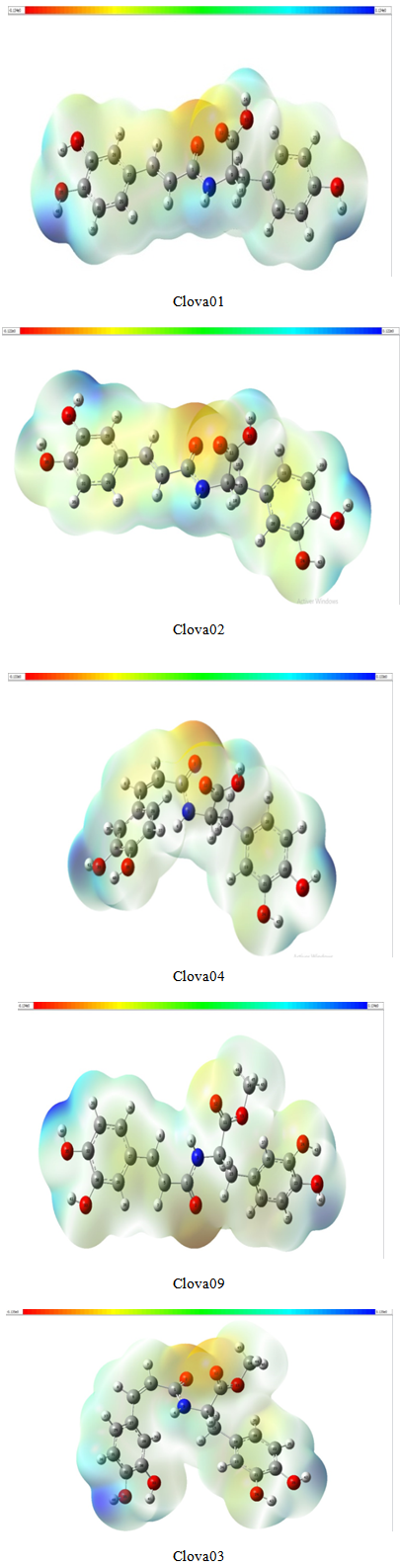
The five isolated Clovamides and derivatives are displayed with their surfaces of Molecular Electrostatic Potential (MEP) in Figure 3. These surfaces evolve continuously, from a red color code indicating the most negative electrostatic potentials, to blue indicating the most positive potentials 18.

These Molecular Electrostatic Potential maps indicates, on the one hand, that the surfaces around the oxygen atoms are the most negative potentials that evolve from red, orange to yellow.
Additionally, the surfaces on the aromatic rings are also negative with an orange and yellowish portion extending to the vicinal carbons of the linkage (between the two rings). That confirms the electrophilic characteristic of these zones which will be favorable to nucleophilic attacks, or Lewis base type reagents. Thus, while oxygen atoms can be engaged in hydrogen bonds, neighboring carbonyl functions can react with nucleophiles that arrive there. On the other hand, the most positive surfaces are around the hydrogen atoms with an accentuation at the level of the hydroxyl groups. That also, confirms the nucleophilic characteristic of these zones which will be favorable to electrophilic attacks or Lewis acid type reagents.
ØAnalysis of Frontier Orbitals
The Highest Occupied Molecular Orbital (HOMO) and the Lowest Unoccupied Molecular Orbital (LUMO), are also called Frontier Orbitals. They play the fundamental contribution in the understanding of the chemical reactivity of our studied compounds. Thus the HOMO is the external orbital with electrons, so it characterizes the ability to give them. On the other hand, the LUMO is the lowest orbital without any electron, so it characterizes the ability to receive them. This is how they allow us to explain the global reactivity descriptors defined by equations (1). The energy gap (ΔE) between the HOMO and LUMO helps to characterize the chemical reactivity (due to its polarizability) and kinetic stability of the molecules 17.
The larger its energy gap is, the less polarizable the molecule is and this is generally associated with low chemical reactivity and high kinetic stability 19, 20. The results of the calculations on Gaussian 09, at the level B3LYP/6-31+(d,p) are in Table 3. They show that compound Clova02 has the smallest energy gap (ΔE= 4.103 eV). Clova02 is the Clovamide itself and is thus the most polarizable and possesses the highest chemical reactivity and the lowest kinetic stability among the five isolated Clovamides and derivatives. On the other hand, Clova01 has the greatest value of energy gap (ΔE= 4.260 eV).
In terms of chemical reactivity, we have the following ranking: Clova02˃Clova09˃Clova03˃Clova04˃Clova01. It is noted that the two Trans diastereoisomers (1st and 2nd position) have a higher chemical reactivity than their Cis counterparts which come in 3rd and 4th position. As for the Trans diastereoisomers; the carboxylic acid form of Clovamide has a higher chemical reactivity than the methyl ester form. Conversely, as for the Cis diastereo-isomers, it is the methyl ester form that has a higher chemical reactivity than the carboxylic acid form.
ØAnalysis of the global reactivity descriptors
Following the calculations of equation (1), the global reactivity descriptors are recorded in table 3. The chemical hardness η value of Clova02, η= 2.051 eV is the lowest among the studied Clovamide and derivatives. So, Clova02 is more reactive than the other studied compounds. It confirms the above ranking of chemical reactivity: Clova02˃Clov09˃Clova03˃Clova04˃Clova01.
3.2. With the Local and Dual Reactivity DescriptorsØAnalysis of the local and dual reactivity descriptors
Local reactivity indices were calculated for each molecule, with equation (2). In order to obtain the data necessary for the analysis of local and dual descriptors, calculations at the level of the B3LYP functional with the basis 6-31+(d,p) were carried out with populations of natural bonding orbitals (NBO). First, calculations are made on the neutral molecule, then on the molecule with charge -1 and finally on the molecule with charge +1. The results are used to calculate the Fukui functions according to equations (3). This work was done on each of the 5 molecules, studied in this work.
√Electrophilic sites, prone to nucleophilic attacks.
The most significant electrophilic zones characterized by the three highest of  and positive values of the dual descriptor
  , are located on carbons C11 and C1, followed by the labile hydrogen H40 carried by oxygen O35 (see Table 4 and Table 5). Thus the Lewis base type reagent 21 attacks on Clovamides and derivatives will be carried out on C11 carbonyls.
And there, the following ranking is noticed: Clova04˃Clov09~Clova01˃Clova03˃Clova02.
It is observed that the Cis form of Clovamide(Clova03) and its ester derivative (Clova04), have an electrophilic power similar to that of their Trans counterparts, and even a few point higher. Indeed, when considering the values of the Fukui descriptors of the electrophilic power on the C11 carbonyl, Clova03 is 20 points higher than Clova02. Also Clova04 is 10 points higher than Clova09.
√Nucleophilic sites, prone to electrophilic attacks.
Nucleophilic zones are found on oxygens, nitrogen with non-bonding electron pairs and carbon with π (pi) electrons. The strongest being, of course the zones characterized by the 3 or 4 highest values of  with negative values of the dual descriptor
  . The most nucleophilic sites are carried by the oxygens (O26; O24; O35 and O33) of the hydroxyl groups on the aromatic nuclei of the Clovamides and derivatives which are the subject of our study (see Table 6). Thus, the attacks of Lewis acid type reagents 21 on the studied compounds will be done on O26. The following ranking of the most nucleophilic sites, with negative values of the dual descriptor
  , can be made: O26 ˃O24˃O35 ˃O33; at the level of each molecule. The oxygen atoms O26 and O24, respectively on para and meta positions of the aromatic ring of the phenylalanine moiety, are the first and second most nucleophilic sites of the Clovamides and derivatives. The oxygen atoms O35 and O33, respectively on para and meta positions of the aromatic ring of the cinnamoyl moiety, are the third and fourth most nucleophilic sites.
This difference can be explained by the conjugate effect in which the lone pair electrons of O33 and O35, are involved with the π electrons of the aromatic cycles of the cinnamoyl moiety, the latter being themselves conjugated with the π electrons of the ethylenic bond on C5 and C6, these being in turn conjugated with the π electrons of the carbonyl function consisting of C1 and O2
The following ranking of the nucleophilic power of O26 of the studied Clovamide and derivatives is: (see Table 7): Clova02 ˃ Clova03 ˃ Clova09 ˃ Clova04 ˃ Clova01.
We see that the difference in the values of the descriptors is very minimal between the Trans and Cis Clovamide with regard to their nucleophilic power on O26. This suggests that the Cis form might be a good alternative in the absence of the trans form.
√ Sites of radical attacks
Sites favorable to free radical attacks have in common with nucleophilic sites the presence of π electrons or non-bonding electrons. Thus, the carbons of the aromatic cycle of the phenylalanine moiety, C20 and C23, are the most favorable to free radical attacks. With the exception of Clova01 and Clova02 where C5 comes in second place as the most favorable site for free radical attack, C20 and C23 are the two most favorable sites for free radical attack. A ranking of the studied compounds, relatively to the values of  on C20 and C23, can be displayed like this Clova03˃Clova09˃Clova04˃Clova02. Cis forms are more susceptible to radical attack than their Trans form counterparts: Clova03˃Clova09 and Clova04˃Clova02. These results show the interest in synthesizing the cis forms of Clovamides and derivatives, in order to learn more about their properties through experimental measurements.
The computational analysis of the molecular properties of the set of Clovamides and its derivatives, isolated by Akichi et al. 5, reveals significant insights into their chemical reactivity and stability. The study focused on the global reactivity descriptors, such as the energy gap (ΔE), chemical hardness (η), electronegativity (χ), and electrophilic index (ω), as well as local and dual reactivity indices to evaluate the sites most prone to nucleophilic, electrophilic, and radical attacks. Among the five compounds studied, Clova02 (trans-Clovamide) exhibited the highest chemical reactivity due to its smallest energy gap and lowest chemical hardness, indicating its enhanced polarizability and low kinetic stability. In contrast, Clova01 showed the highest electronegativity and electrophilic index, making it the best electron acceptor.
These findings arouse particular interest in Clovamides and derivatives in general (carboxylic acid or methyl ester forms), but also, they reveal a particular interest, for the Cis diastereoisomers, isolated for the first time from methanolic extracts of icacina mannii tubers. Indeed, they showed chemical reactivity close to that of their trans diastereoisomers counterparts. Therefore, they deserve further studies and even synthesis work so that complementary experiments can be carried out on them.
Analysis of local reactivity indices highlighted the nucleophilic and electrophilic sites most susceptible to interaction, with oxygen atoms (O26, O24, O35, and O33) identified as the most nucleophilic sites, and carbonyl groups on C11 and C1 as the most electrophilic. The study also indicated that the radical attack susceptibility varies across the compounds, with Cis isomers being more prone to radical attacks compared to their Trans counterparts. This reactivity trends observed for the compounds follow a clear pattern, with Clova02 being the most reactive in terms of both nucleophilicity and electrophilicity, while Clova01, despite its higher electrophilic character, exhibited lower nucleophilic reactivity.
In conclusion, the molecular properties of Clovamides and its derivatives reveal distinct trends in reactivity that could guide the development of these compounds in various chemical and pharmacological applications. Future studies may focus on the experimental validation of these theoretical findings and further exploration of their reactivity in different environments.
Authors have declared that no competing interest exist
| [1] | Macoy, D. M., Kim, W. -Y., Lee, S. Y., and Kim, M. G. (2015). Biotic stress related functions of hydroxycinnamic acid amide in plants. J. Plant Biol. 58, 156–163. | ||
| In article | View Article | ||
| [2] | Knollenberg BJ, Li G-X, Lambert JD, Maximova SN and Guiltinan MJ (2020) Clovamide, a Hydroxycinnamic Acid Amide, is a Resistance Factor Against Phytophthora spp. in Theobroma cacao. Front. Plant Sci. 11:617520. | ||
| In article | View Article PubMed | ||
| [3] | Lechtenberg, M., Henschel, K., Liefländer-Wulf, U., Quandt, B., and Hensel, A. (2012). Fast determination of N-phenylpropenoyl-l-amino acids (NPA) in cocoa samples from different origins by ultra-performance liquid chromatography and capillary electrophoresis. Food Chem. 135, 1676–1684. | ||
| In article | View Article PubMed | ||
| [4] | Bontpart, T., Cheynier, V., Ageorges, A., and Terrier, N. (2015). BAHD or SCPL acyltransferase? What a dilemma for acylation in the world of plant phenolic compounds. New Phytol. 208, 695–707. | ||
| In article | View Article PubMed | ||
| [5] | Z.L.E. Akissi, A.A. Magid, A. P. Kouassi-Yao, et al., New diterpenoids and phenolic amides from Icacina mannii Oliv., Fitoterapia (2023). | ||
| In article | View Article PubMed | ||
| [6] | Bontpart, T., Cheynier, V., Ageorges, A., and Terrier, N. (2015). BAHD or SCPL acyltransferase? What a dilemma for acylation in the world of plant phenolic compounds. New Phytol. 208, 695–707. | ||
| In article | View Article PubMed | ||
| [7] | Ayers PW, Levy M. Density-functional approach to the Frontier-electron Theory of chemical reactivity. Theor. Chem. Acc. 2000; 103(3-4):353-360. | ||
| In article | View Article | ||
| [8] | A. D. Becke (1993). A new mixing of Hatree-Fock and local density-functional theories.. J.Chem. Phys. 98 (2): 1372-1377 | ||
| In article | View Article | ||
| [9] | J. G. Hill. Gaussian Basis sets for Molecular Applications. Int. J. Quantum. Chem. 2013, 113, 21-34. | ||
| In article | View Article | ||
| [10] | Gaussian 09, Revision A.02, Frisch MJ, G. W. Trucks, H. B. Schlegel, G. E. Scusera, Gaussian, Inc., Wallingford CT; 2009. | ||
| In article | |||
| [11] | Parr RG, Yang W. Density-functional theory of the electronic structure of molecules, Annu. Rev. Phys. Chem. 1995; 46: 701-728. | ||
| In article | View Article PubMed | ||
| [12] | A. E. Reed, R.B. Weinstock, F. Weinhold, Natural population analysis. J. Chem. Phys. 83, 735 (1985). | ||
| In article | View Article | ||
| [13] | Yang W, Parr RG. Chemistry, Hardness, Softness and the Fukui functions in the electronic theory of metals and catalysis, Proc. Natl. Acad. Sci. USA. 1985; 82:6723-6726. | ||
| In article | View Article PubMed | ||
| [14] | Koopmans T. About the assignment of wave functions and eigenvalues to individual electrons atoms. Physica. 1934; 1:104-113. | ||
| In article | View Article | ||
| [15] | Yang W, Parr RG, Pucci R. Electron density, Kohn-Sham frontier orbitals, and Fukui Functions. J. Chem. Phys. 1984; 81(6):2862-2863. | ||
| In article | View Article | ||
| [16] | C. Morell, A. Grand & A. Toro-Labbé, (2005). New Dual Descriptor for Chemical Reactivity. The Journal of Physical Chemistry A, 109(1), 205–212. | ||
| In article | View Article PubMed | ||
| [17] | Chattaraj, P. K., Maiti, B., & Sarkar, U. (2003). Philicity: A Unified Treatment of Chemical Reactivity and Selectivity. The Journal of Physical Chemistry A, 107(25), 4973–4975. | ||
| In article | View Article | ||
| [18] | Frisch MJ, et al. (2009) Spectroscopic Evaluation of the Molecular Structures of di-μ-Chlorobis(1,5-Cyclooctadiene) Iridium (I) and Rhodium (I) Complexes. J Appl Math Phy 03: 140-144 | ||
| In article | View Article | ||
| [19] | Gouasmia A, Villemin D (2016) Molecular Structure, HOMO-LUMO, MEP and Fukui Function Analysis of Some TTF-donor Substituted Molecules Using DFT (B3LYP) Calculations Synthesis of new ILs and their spectroscopy analysis, View project Synthesis of New 4-Substituted Aminopyrido [2,3-d] pyrimidine Derivatives View project. | ||
| In article | |||
| [20] | Choudhary, VineetKumar; Bhatt, ArvindKumar; Dash, Dibyajit; Sharma, Neeraj . (2019). DFT calculations on molecular structures, HOMO-LUMO study, reactivity descriptors and spectral analyses of newly synthesized diorganotin(IV) 2-chloridophenylacetohydroxamate complexes. Journal of Computational Chemistry. | ||
| In article | View Article PubMed | ||
| [21] | Tuo, N. T.; Dembele, G. S.; Doh, S.; Konate, F.; Konate, B.; Kodjo, C. G.; Ziao, N. Theoretical Study of the Chemical Reactivity of a Series of 2, 3-Dihydro-1H-Perimidine. Int. Res. J. Pure Appl. Chem. 2022, 23, 13-25. | ||
| In article | View Article | ||
Published with license by Science and Education Publishing, Copyright © 2025 N’guessan Kan Lucien Yao, Doh Soro, Kouakou Nobel N’Guessan, Anoubilé Benié, Stephane Dembele, Philomène Akoua Kouassi-Yao and Nahosse Ziao
 This work is licensed under a Creative Commons Attribution 4.0 International License. To view a copy of this license, visit
http://creativecommons.org/licenses/by/4.0/
This work is licensed under a Creative Commons Attribution 4.0 International License. To view a copy of this license, visit
http://creativecommons.org/licenses/by/4.0/
| [1] | Macoy, D. M., Kim, W. -Y., Lee, S. Y., and Kim, M. G. (2015). Biotic stress related functions of hydroxycinnamic acid amide in plants. J. Plant Biol. 58, 156–163. | ||
| In article | View Article | ||
| [2] | Knollenberg BJ, Li G-X, Lambert JD, Maximova SN and Guiltinan MJ (2020) Clovamide, a Hydroxycinnamic Acid Amide, is a Resistance Factor Against Phytophthora spp. in Theobroma cacao. Front. Plant Sci. 11:617520. | ||
| In article | View Article PubMed | ||
| [3] | Lechtenberg, M., Henschel, K., Liefländer-Wulf, U., Quandt, B., and Hensel, A. (2012). Fast determination of N-phenylpropenoyl-l-amino acids (NPA) in cocoa samples from different origins by ultra-performance liquid chromatography and capillary electrophoresis. Food Chem. 135, 1676–1684. | ||
| In article | View Article PubMed | ||
| [4] | Bontpart, T., Cheynier, V., Ageorges, A., and Terrier, N. (2015). BAHD or SCPL acyltransferase? What a dilemma for acylation in the world of plant phenolic compounds. New Phytol. 208, 695–707. | ||
| In article | View Article PubMed | ||
| [5] | Z.L.E. Akissi, A.A. Magid, A. P. Kouassi-Yao, et al., New diterpenoids and phenolic amides from Icacina mannii Oliv., Fitoterapia (2023). | ||
| In article | View Article PubMed | ||
| [6] | Bontpart, T., Cheynier, V., Ageorges, A., and Terrier, N. (2015). BAHD or SCPL acyltransferase? What a dilemma for acylation in the world of plant phenolic compounds. New Phytol. 208, 695–707. | ||
| In article | View Article PubMed | ||
| [7] | Ayers PW, Levy M. Density-functional approach to the Frontier-electron Theory of chemical reactivity. Theor. Chem. Acc. 2000; 103(3-4):353-360. | ||
| In article | View Article | ||
| [8] | A. D. Becke (1993). A new mixing of Hatree-Fock and local density-functional theories.. J.Chem. Phys. 98 (2): 1372-1377 | ||
| In article | View Article | ||
| [9] | J. G. Hill. Gaussian Basis sets for Molecular Applications. Int. J. Quantum. Chem. 2013, 113, 21-34. | ||
| In article | View Article | ||
| [10] | Gaussian 09, Revision A.02, Frisch MJ, G. W. Trucks, H. B. Schlegel, G. E. Scusera, Gaussian, Inc., Wallingford CT; 2009. | ||
| In article | |||
| [11] | Parr RG, Yang W. Density-functional theory of the electronic structure of molecules, Annu. Rev. Phys. Chem. 1995; 46: 701-728. | ||
| In article | View Article PubMed | ||
| [12] | A. E. Reed, R.B. Weinstock, F. Weinhold, Natural population analysis. J. Chem. Phys. 83, 735 (1985). | ||
| In article | View Article | ||
| [13] | Yang W, Parr RG. Chemistry, Hardness, Softness and the Fukui functions in the electronic theory of metals and catalysis, Proc. Natl. Acad. Sci. USA. 1985; 82:6723-6726. | ||
| In article | View Article PubMed | ||
| [14] | Koopmans T. About the assignment of wave functions and eigenvalues to individual electrons atoms. Physica. 1934; 1:104-113. | ||
| In article | View Article | ||
| [15] | Yang W, Parr RG, Pucci R. Electron density, Kohn-Sham frontier orbitals, and Fukui Functions. J. Chem. Phys. 1984; 81(6):2862-2863. | ||
| In article | View Article | ||
| [16] | C. Morell, A. Grand & A. Toro-Labbé, (2005). New Dual Descriptor for Chemical Reactivity. The Journal of Physical Chemistry A, 109(1), 205–212. | ||
| In article | View Article PubMed | ||
| [17] | Chattaraj, P. K., Maiti, B., & Sarkar, U. (2003). Philicity: A Unified Treatment of Chemical Reactivity and Selectivity. The Journal of Physical Chemistry A, 107(25), 4973–4975. | ||
| In article | View Article | ||
| [18] | Frisch MJ, et al. (2009) Spectroscopic Evaluation of the Molecular Structures of di-μ-Chlorobis(1,5-Cyclooctadiene) Iridium (I) and Rhodium (I) Complexes. J Appl Math Phy 03: 140-144 | ||
| In article | View Article | ||
| [19] | Gouasmia A, Villemin D (2016) Molecular Structure, HOMO-LUMO, MEP and Fukui Function Analysis of Some TTF-donor Substituted Molecules Using DFT (B3LYP) Calculations Synthesis of new ILs and their spectroscopy analysis, View project Synthesis of New 4-Substituted Aminopyrido [2,3-d] pyrimidine Derivatives View project. | ||
| In article | |||
| [20] | Choudhary, VineetKumar; Bhatt, ArvindKumar; Dash, Dibyajit; Sharma, Neeraj . (2019). DFT calculations on molecular structures, HOMO-LUMO study, reactivity descriptors and spectral analyses of newly synthesized diorganotin(IV) 2-chloridophenylacetohydroxamate complexes. Journal of Computational Chemistry. | ||
| In article | View Article PubMed | ||
| [21] | Tuo, N. T.; Dembele, G. S.; Doh, S.; Konate, F.; Konate, B.; Kodjo, C. G.; Ziao, N. Theoretical Study of the Chemical Reactivity of a Series of 2, 3-Dihydro-1H-Perimidine. Int. Res. J. Pure Appl. Chem. 2022, 23, 13-25. | ||
| In article | View Article | ||