In the context of Vietnam’s educational reform shifting from content-based to competency-based approaches under the General Education Curriculum 2018, developing life skills for primary students has become a crucial objective. This study aims to develop a Life Skills Competency Framework tailored to the cognitive, emotional, and social characteristics of Vietnamese primary students. Guided by social constructivist theory and the competency-based education approach, the study employs a developmental research design combining document analysis, conceptual generalization, and curriculum content analysis. Domestic and international documents were systematically reviewed, including frameworks by WHO (1993), UNESCO - UNICEF (2003), CASEL (2013), P21 (2015), and OECD (2021). The findings propose an integrated Life Skills Competency Framework consisting of seven core competency domains: communication, collaboration, self-management, problem-solving, emotional intelligence, critical thinking, and financial literacy. These domains are structured along three foundational dimensions - cognitive, social, and emotional - reflecting the dialectical relationship between knowledge, attitude, and behavior. The proposed framework aligns with and extends the Vietnamese General Education Curriculum 2018, providing measurable indicators for assessing students’ life skills. It not only bridges theoretical gaps in life skills education at the primary level but also modernizes traditional Confucian values of self-control, empathy, and community responsibility within the context of global citizenship and digital transformation. The framework serves as a scientific and practical foundation for designing life skills education curricula in Vietnamese primary schools.
In the era of globalization and digital transformation, education is no longer limited to the transmission of knowledge but must aim at developing learners’ comprehensive competencies - especially life skills, adaptability, and collaboration. According to UNESCO 1, education in the twenty-first century should help learners “learn to know, learn to do, learn to live together, and learn to be.” The World Health Organization 2 also emphasized ten core life skills (LS) that enable individuals to adapt positively and effectively to the demands and challenges of modern life.
In Vietnam, within the framework of fundamental and comprehensive educational reform, general education is now oriented not merely toward knowledge acquisition but toward the holistic development of learners’ competencies and qualities. The Central Committee’s Resolution No. 29-NQ/TW (2013) clearly states: “Education must cultivate Vietnamese people who are well-rounded in morality, intellect, health, aesthetics, and profession, possessing life skills, competencies, and civic responsibility.” The 2018 General Education Curriculum (GEC 2018) marks a decisive shift from a content-based approach to a competency-based one. Accordingly, it identifies three core competencies to be developed from the primary level, including autonomy and self-learning, communication and collaboration, and problem-solving and creativity, which constitute the foundation for personality formation 3. Additionally, the MOET’s Official Dispatch No. 2345/BGDĐT-GDTH (2021) on organizing two school sessions per day highlights that the second session should focus on developing competencies, life skills, and creative experiential activities rather than merely increasing academic instruction in Mathematics or Vietnamese.
However, the current practice of life skills education (LSE) in Vietnamese primary schools reveals significant limitations. Many activities remain formalistic, fragmented, and lack a clear competency framework as a basis for curriculum design, teaching organization, and evaluation. Although some schools have introduced experiential learning, the content is often dominated by moral theory rather than fostering practical behavioral skills. Findings from field studies 4 indicate that Vietnamese primary teachers still face challenges in conceptualizing and systematically implementing LSE, especially under the GEC 2018 and the two-session schedule. Research in ethnic minority boarding schools 5 also shows that while most students recognize the value of LSE, administrators, teachers, and parents demonstrate limited engagement and understanding. Consequently, many primary students struggle with communication, collaboration, emotional control, problem solving, and personal financial - skills essential for adapting to a rapidly changing society.
Primary students represent a particularly important yet under-researched group in the field of life skills education. This stage marks a pivotal transition in children’s development: they move from concrete to logical thinking, begin to form self-awareness, seek recognition, and expand social relationships while still lacking experience and self-regulatory abilities. Inadequate life skills education may lead to difficulties in behavior, cooperation, and coping with the increasingly complex socio-emotional situations of modern schooling. Researchers have affirmed that, if properly nurtured, this age group possesses a high capacity for internalizing positive habits and behaviors, making it a “golden period” for building foundational life skills competencies (LSC) and personal values for future learning stages.
Education - particularly primary education - must also be contextualized within the realities of the digital age, characterized by rapid technological, social media, and consumer culture expansion. Primary students - the first generation of “digital citizens” - are exposed early to the internet, smart devices, and consumer behaviors, yet receive little guidance on digital safety, self-regulation, or responsible financial behavior. This underscores the urgent need to develop a life skills competency framework suitable for Vietnamese primary students’ developmental characteristics, aligned with the goals of nurturing both personal qualities and 21st-century competencies.
Globally, numerous studies have addressed life skills education for school-aged children, mainly focusing on identifying essential skills such as communication, self-awareness, decision-making, emotional regulation, and cooperation (UNICEF, WHO, UNESCO, 1997–2014). Other research examines specific skills - emotional management 6, 7 or social communication and collaboration in learning 8. Several international models have been developed, including Social and Emotional Learning (SEL) by CASEL 9 and the Framework for 21st Century Learning (P21) (2015). In Vietnam, however, most studies remain at a descriptive level, outlining the status of LSE in schools without establishing a structured competency framework specific to the primary level with clear behavioral indicators suited to cognitive, emotional, and social development (Nguyen Thanh Binh, 2019; Nguyen Thi Thu, 2022). This theoretical gap contributes to teachers’ difficulties in designing, implementing, and assessing LSE effectively in Vietnamese primary schools.
From both the need for educational reform and the aforementioned theoretical and practical gaps, this study seeks to propose a competency-based LS framework for primary education in Vietnam with three main objectives:
1.To clarify the scientific foundations for developing LS competencies in primary students through a competency-based approach (CBE).
2.To construct a structured life skills competency framework (LSCF) consisting of core cognitive, social, and emotional domains.
3.To propose orientations for applying the framework in designing LSE curriculum at the primary level.
The study adopts a theoretical research approach, utilizing document synthesis, analytical comparison, and generalization to construct a scientifically grounded and contextually feasible framework for Vietnam. The findings are expected to bridge the theoretical gap in LSE and offer practical implications for guiding primary schools in designing, implementing, and evaluating effective, modern, and contextually relevant LS curriculum for Vietnamese primary students in the new era.
Life skills are understood as personal competencies that enable learners to recognize and manage themselves, communicate and collaborate with others, make decisions, and solve problems positively, thereby forming appropriate behaviors in learning and everyday life. This definition builds upon theoretical perspectives from WHO 2, UNESCO - UNICEF 10, and CASEL 9, while being adapted to fit the developmental characteristics of primary school students.
LSE refers to an intentional and systematic process that helps students acquire, practice, and develop the essential competencies, values, and attitudes necessary to adapt effectively to life through learning, experiential, and social interaction activities. LSE acts as a bridge between knowledge and behavior, linking learning with living.
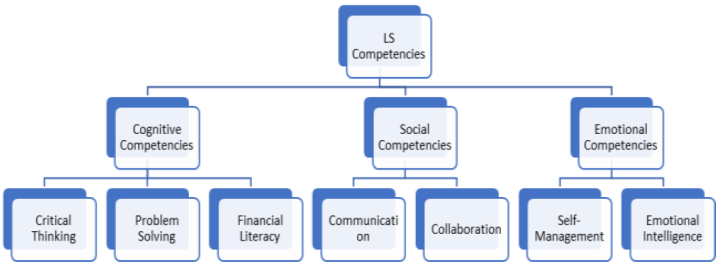
Under the competency-based approach, LS are not merely understood as isolated behaviors or habits but as an integrated competency structure that connects knowledge, skills, and attitudes & values, enabling individuals to respond effectively to academic and life situations. Numerous international studies 2, 7, 10 affirm that LS competencies are multidimensional constructs, reflecting the harmonious development of three fundamental domains: cognitive, social, and emotional competencies.
Cognitive Competencies: Include critical thinking, problem-solving, decision-making, creativity, and self-awareness. These components enable students to process information, analyze situations, and make rational choices.
Social Competencies: Refer to the ability to communicate, cooperate, listen, empathize, and build positive relationships. Students with strong social competencies can collaborate effectively, respect diversity, and regulate behavior within groups.
Emotional Competencies: Encompass the capacity to identify, express, and manage emotions while demonstrating empathy and adaptability under pressure.
The structure of LS competencies in primary education is built upon the interaction among these three domains, reflecting the developmental transition from awareness to attitude to behavior. Each domain can be operationalized through age-appropriate competency indicators, providing teachers with a foundation for designing learning activities and assessing students’ progress. The model of LS competency structure, in which each component is expressed through specific skill groups, is illustrated conceptually in Figure 1.

This structure ensures comprehensiveness and alignment with the Framework for 21st Century Learning (P21) while accommodating the psychological characteristics of primary students. It supports an integrated, flexible, and assessable approach to curriculum development in LSE.
2.2. Psychological and Developmental Characteristics of Primary StudentsPrimary students are at a transitional stage from concrete operational thinking to logical reasoning 11. They begin to compare, classify, analyze, and synthesize information but still require concrete examples and real-life contexts. Their intentional memory, concentration, and motivation for learning are emerging but remain unstable.
Therefore, LSE should emphasize experiential, action-oriented, and discovery-based learning rather than theoretical instruction. Through participating in situational activities, role-plays, or learning games, primary students naturally develop critical thinking, decision-making, and problem-solving skills, linking cognition with real-world practice.
Primary students possess rich yet easily fluctuating emotional lives and are sensitive to others’ evaluations. They begin to express and recognize personal emotions and seek affection, praise, and approval. However, their ability to regulate emotions and behavior is still limited; without guidance, they may become impulsive, competitive, or withdrawn after failure.
Thus, LSE at this stage should focus on developing self-awareness, emotional regulation, perseverance, and empathy. Activities such as emotion-sharing circles, storytelling, reflective journaling, and cooperative conflict resolution help primary students “understand themselves and others,” fostering emotional intelligence (EQ) - a foundational competency for future success.
At this stage, primary students expand their social relationships from family to peers, teachers, and the school community. They have a strong need to belong, cooperate, and affirm their role within groups. Yet, limited life experience and communication skills may lead to conflicts or misunderstandings.
LSE should thus prioritize social competence development through group work, cooperative games, and project-based learning. By learning to listen, respect diverse perspectives, and share responsibilities, primary students not only adapt better to learning environments but also develop positive character traits, citizenship, and social collaboration.
In primary education, students begin to form notions of right-wrong and good-bad, though their judgments remain subjective and heavily influenced by adults. When given opportunities to participate in purposeful activities, make choices, and assume responsibility, primary students gradually develop self-control and moral responsibility.
Hence, LSE should be integrated with moral education and experiential learning, guiding students to regulate behavior, make responsible decisions, follow group rules, and respect others - thereby fostering autonomy, self-management, and civic awareness.
In today’s digital and consumer-oriented society, primary students are increasingly exposed to technology, social media, and financial decisions. They start seeking independence and making small choices regarding spending or device use. This is a “golden stage” for cultivating responsible habits, safe technology use, and basic personal financial management skills.
Therefore, LSE should integrate modern topics such as “smart money management,” “digital citizenship,” and “self-protection in online environments.” These not only enhance practical competencies but also build ethical and responsible digital behaviors required of 21st-century citizens.
In summary, the psychological and developmental traits of primary students affirm that this is a formative stage in shaping personality and LS competencies. LSE must thus be comprehensive, integrated, and practice-oriented - closely linked to students’ daily lives. Through experiential learning, practice, games, and small projects, students simultaneously develop cognition, behavior, and emotion, thereby strengthening self-learning, autonomy, cooperation, and social adaptability - consistent with the competency-based orientation of the GEC 2018.
This study adopts a theoretical and developmental research orientation, aiming to propose a scientifically grounded and contextually relevant competency framework for LSE tailored to Vietnamese primary students. This approach ensures a dialectical relationship between theory, practice, and application, in which international models and competency frameworks serve as reference foundations, while the realities of Vietnamese primary education provide the contextual basis for adaptation and modification.
The research is guided by the principles of social constructivism 8, 12, 13 and the CBE approach, underpinned by experiential learning theory 14. This perspective views learners as active agents who construct knowledge through action and reflection. It is also conceptually aligned with the SEL framework proposed by CASEL 9 and the Framework for 21st Century Learning 15, both of which emphasize holistic competency development encompassing cognitive, social, and emotional dimensions.
In this study, the Life Skills Competency Framework (LSCF) is defined as a structured, integrative model that organizes essential life skills into three interrelated domains - cognitive, social, and emotional - each expressed through observable behavioral indicators. The LSCF thus serves as both a conceptual foundation and a practical guide for implementing LSE in Vietnamese primary schools.
3.2. Research MethodsTo establish a robust theoretical foundation for constructing the LSCF for Vietnamese primary education, this study adopted a qualitative, theory-driven design combining document analysis and synthesis, conceptual generalization, and curriculum content analysis. These methods were selected to ensure both theoretical rigor and contextual relevance within Vietnam’s current educational reform.
A systematic review of domestic and international literature was conducted to identify theoretical and empirical foundations related to LSE, social-emotional learning, and 21st-century competencies.
In total, approximately 50 key documents were analyzed. The selection criteria required that documents: (1) address LS or CBE at the primary or general education level; (2) originate from reputable organizations (e.g., UNESCO, OECD, MOET); (3) demonstrate relevance to cognitive, social, or emotional domains; and (4) be published in English or Vietnamese. Documents outside these criteria were excluded to maintain conceptual coherence and contextual relevance.
The analysis followed a four-step coding and synthesis process:
- Collection and categorization of documents by theme and scope;
- Extraction of definitions, structures, and competency indicators;
- Comparison across frameworks to identify common dimensions and unique elements;
- Synthesis of conceptual categories leading to the development of an integrated LS competency structure.
This process enabled the identification of key domains, behavioral indicators, and measurable components, later adapted to align with the developmental characteristics of Vietnamese primary students.
Insights derived from the analyzed documents were further synthesized through conceptual generalization. Using comparative analysis between international models and Vietnamese educational realities, the researcher conceptualized a three-domain competency structure: Cognitive, Social, and Emotional Competencies. Each domain encompasses interrelated skill clusters, forming the basis for the proposed LSCF. This theoretical model provides a comprehensive and culturally responsive foundation for designing, implementing, and assessing LSE in Vietnamese primary schools.
To ensure contextual validity, the proposed LSCF was cross-referenced with Vietnam’s GEC 2018. The analysis focused on three key aspects:
(1) Mapping LS competencies to the national core competencies (autonomy and self-learning, communication and collaboration, problem-solving and creativity);
(2) Examining alignment with subject-based moral, social, and experiential learning goals;
(3) Assessing potential integration points for classroom teaching, extracurricular activities, and experiential learning modules.
This alignment ensures that the proposed framework is coherent, adaptable, and implementable within Vietnam’s national education system, while maintaining fidelity to global competency standards. This multi-method design ensures methodological transparency, reliability, and validity in developing a scientifically grounded and practically applicable framework for LSE in Vietnamese primary schools.
In developing a competency framework for LSE in Vietnamese primary schools, this study inherits and integrates four internationally influential models: WHO 2, UNESCO & UNICEF’s Life Skills-Based Education (LSBE, 2003), CASEL’s Social and Emotional Learning Framework (2013), and the P21 Framework for 21st Century Learning 15.
The framework proposed by the World Health Organization (WHO, 1993) serves as the foundational basis for life skills education, identifying ten essential skills: self-awareness, empathy, communication, interpersonal relationships, decision-making, problem-solving, creative and critical thinking, emotional regulation, and stress management. This model provides the conceptual groundwork for defining the scope, structure, and core skill groups to be developed among primary school students.
The LSBE model developed by UNESCO and UNICEF 10 reinforces the central role of life skills as an integral component of general education. LSBE emphasizes the flexible integration of diverse learning areas - including health, citizenship, gender equality, environmental education, and sustainable development - thereby promoting the design of theme-based lessons and the expansion of students’ experiential learning spaces.
The SEL framework by CASEL 9 contributes the emotional and social dimensions to the life skills competency framework. The SEL model identifies five interrelated core competencies: self-awareness, self-management, social awareness, relationship skills, and responsible decision-making. These competencies enable students to develop empathy, emotional control, positive relationships, and responsible judgment - fundamental to fostering pro-social behavior during primary schooling.
Importantly, the P21 Framework for 21st Century Learning 15 expands the concept of LSE toward competencies necessary for learning and working in the modern world, through the 4Cs model: Communication, Collaboration, Critical Thinking, and Creativity. This framework highlights the interconnectedness between knowledge, higher-order thinking skills, and creative capacity in contemporary learning environments.
Building upon the P21 framework, this study further integrates an additional domain - Financial Literacy - a new competency recommended by OECD, UNESCO, and P21 for inclusion in primary education curricula. Financial literacy can help Vietnamese students develop a sense of responsibility in managing money and resources, distinguish between needs and wants, and plan appropriate spending and saving. At the primary level, students are capable of concrete thinking and the formation of basic financial habits; thus, financial education not only cultivates practical reasoning but also strengthens decision-making, autonomy, and critical thinking within the context of modern socio-economic life.
The proposed framework is therefore an integrative LS competency model that balances social-emotional development with higher-order thinking and practical life competencies. It reflects the spirit of Vietnam’s GEC 2018 while contributing to the modernization of primary education in alignment with global citizenship education - developing learners who are autonomous, creative, and socially responsible. The theoretical sources of the LSCF applied to the development of the framework for Vietnamese primary education are synthesized and presented in Table 1.
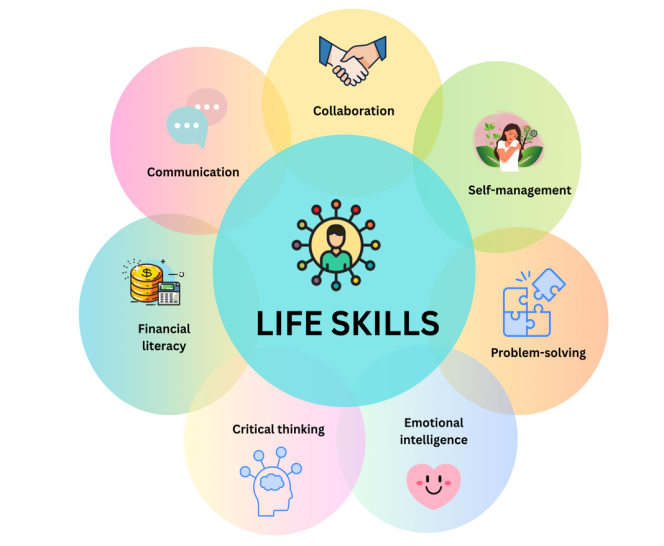
Based on the synthesis of international frameworks and the analysis of the developmental characteristics of Vietnamese primary students, this study identifies seven core groups of LS that need to be cultivated and developed through a competency-based approach. These skill groups ensure both comprehensiveness - encompassing cognitive, social, emotional, and behavioral dimensions - and high applicability within the context of modern education in Vietnam.
As illustrated in the competency framework above, LS do not exist in isolation but are organically and dynamically interconnected, complementing and reinforcing one another. The dialectical relationship among these seven core skills - communication, collaboration, self-management, problem-solving, emotional intelligence, critical thinking, and financial literacy - is visualized in Figure 2 below.
The LSCF proposed in this study aligns closely with the orientation toward competency- and value-based development defined in the GEC 2018 for primary education. Both frameworks adopt a learner-centered approach, emphasizing the holistic development of primary students who can “learn to know, learn to do, learn to live together, and learn to be” - the four pillars of education proposed by UNESCO.
The three core general competencies identified in the GEC 2018 - autonomy and self-learning, communication and collaboration, and problem-solving and creativity - form the conceptual foundation for the seven core LS proposed in this study: self-management, cooperation, communication, critical thinking, and problem-solving, among others. Hence, the LSCF is not a parallel or separate model, but rather an extension and operationalization of these general competencies, clarifying observable behavioral indicators within the context of primary education.
For example:
The competency “autonomy and self-learning” in the GEC 2018 is concretized through LS such as self-management, emotional regulation, decision-making, and personal financial management.
The competency “communication and collaboration” is reflected in skills of effective communication, teamwork, empathy, and respect for diversity.
The competency “problem-solving and creativity” is translated into skills of critical thinking, situational problem-solving, flexible reasoning, and creative application in learning and daily life.
Therefore, the proposed LSCF does not replace the GEC 2018 content; instead, it reinforces and deepens the behavioral and attitudinal dimensions of the competencies outlined in the national curriculum. By expanding these into specific, observable, and assessable behaviors, the framework provides Vietnamese teachers with a practical tool for designing, implementing, and evaluating students’ development of essential LS throughout the learning process in primary schools.
5.2. Correlation with Specific Subjects and Educational ActivitiesThe GEC 2018 in Vietnam emphasizes moral development through proper behavior toward oneself, family, community, and nation. Learning outcomes such as kindness, honesty, self-respect, and responsibility are reflected in the proposed LSCF through skills of self-regulation, emotional intelligence, positive communication, and responsible decision-making.
The LSCF transforms moral education from a value-based to a competency-based approach, helping Vietnamese primary students not only understand what is right but also act upon it - aligning with the competency orientation of the GEC 2018.
These subjects develop students’ awareness of humans, society, and the environment while promoting observation and problem-solving. The LSCF strengthens these aims by integrating critical thinking, decision-making, collaboration, and financial literacy.
For example, when studying topics such as “Saving Natural Resources” or “Electrical Safety,” students not only learn facts but also practice responsible decision-making, self-regulation, and understanding of basic financial values. This integration turns theoretical knowledge into practical, behavior-oriented learning.
Experiential learning plays a central role in developing autonomy, communication, cooperation, and social responsibility. However, the current GEC outlines these competencies only at a general level. The proposed LSCF provides specific behavioral indicators and developmental levels, offering teachers a clearer basis for designing and assessing experiential learning outcomes. This ensures coherence between classroom and extracurricular education, enhancing the applicability and consistency of experiential learning.
The LSCF also serves as a unified framework for other integrated topics in the GEC 2018 such as digital safety, traffic education, financial education, and environmental protection - thus preventing overlap and ensuring systematic implementation.
By connecting these domains, the LSCF reinforces cohesion and alignment across subjects and activities, contributing to a holistic and action-oriented primary education model.
5.3. Innovations and Extended Value of the Proposed FrameworkCompared with the GEC 2018, the proposed LSCF demonstrates three major innovations:
- From General to Behavioral Competencies
The LSCF specifies measurable behavioral indicators and developmental levels for each skill, enabling more objective and observable assessment.
- Incorporation of Emerging Competencies
It introduces modern competencies - such as emotional intelligence, financial literacy, and responsible technology use - reflecting global trends in 21st-century citizenship education.
- Flexible and Integrative Implementation
The framework can be embedded across subjects and activities without disrupting the current curriculum structure. It supports experiential and applied learning designs that promote active participation and practical competence.
Table 3 summarizes the correspondence between the proposed LSCF and the existing competencies in the GEC 2018, highlighting its complementary and developmental contributions.
- Inheritance and Continuity (or Consistency): Each life skill aligns directly with one of the three general competencies in the GEC 2018 – autonomy and self-learning, communication and collaboration, and problem-solving and creativity - translated into concrete behavioral indicators.
- Complementarity and Expansion: The LSCF extends both the scope (by including emotional, digital, and financial skills) and the depth (by specifying behavioral outcomes), addressing modern educational needs.
- Integration and Feasibility: The competencies operate cohesively across subjects and experiential programs, especially in afternoon sessions, allowing teachers to apply them through games, role-playing, group projects, and reflective activities.
Overall, the proposed LSCF not only strengthens but also enriches the GEC 2018, providing a solid theoretical and practical basis for competency-based LSE in Vietnamese primary schools. Its implementation will align moral, behavioral, and competency goals, promoting a humanistic, practical, and sustainable model of primary education.
LSE for primary students in the context of educational reform and the implementation of the GEC 2018 is not only a practical necessity but also a strategic direction aimed at cultivating life competencies, citizenship skills, and human qualities for Vietnamese learners in the 21st century. This study inherits, integrates, and develops key international theoretical frameworks (WHO, LSBE, CASEL, P21, OECD) to propose a scientifically grounded LSCF tailored to the psychological and developmental characteristics of Vietnamese primary students, ensuring both theoretical rigor and practical applicability. The proposed framework identifies seven core LS clusters: (1) Communication, (2) Collaboration, (3) Self-management, (4) Problem-solving, (5) Emotional Intelligence, (6) Critical Thinking, and (7) Financial Literacy. These clusters comprehensively embody the three foundational dimensions of competence - cognitive, social, and emotional - while also extending toward higher-order thinking skills and practical life competencies.
Each cluster is operationalized through specific competency indicators and behavioral manifestations, allowing primary schools to develop a competency-based LSE curriculum. Teachers can thereby design, implement, and assess learning activities that are quantifiable, observable, and developmentally appropriate.
Compared with the GEC 2018, this framework both reinforces its orientation toward developing core competencies and extends the depth of behavioral expression and practical applicability, concretizing the educational goal of “learning by doing - learning to be.” The inclusion of emotional intelligence, financial literacy, and digital citizenship further modernizes the framework, aligning it with the demands of global citizenship and the digital transformation era.
This study clarifies the theoretical foundations, psychological characteristics of primary students, and the close alignment between the proposed life skills framework and the GEC 2018, affirming that developing a competency-based LS curriculum for Vietnamese primary education is both feasible and essential. Previous Vietnamese research has partially addressed these issues by emphasizing the role of CBE with the application of a social constructivist approach in primary education 13, but has not yet proposed an operational framework integrating these competencies into LSE. The proposed framework supports the reorganization of afternoon sessions in Vietnamese primary schools toward practice-oriented, humanistic, and sustainable education, contributing to the enhancement of holistic student development.
Theoretical Contributions
- Constructing a LSCF specifically designed for Vietnamese primary students, based on a tripartite structure of cognitive, social, and emotional competencies.
- The framework builds upon and adapts international models - WHO 2, CASEL 9, P21 15, and OECD 7 - to fit the cultural and psychological context of Vietnam.
- Proposing an integrated and comprehensive competency model in which each life skill is expressed across three developmental levels - cognition, attitude, and behavior - supported by concrete behavioral indicators. This fills a theoretical gap left by previous studies that primarily offered conceptual descriptions without operationalization.
- Reinforcing the theoretical foundation for implementing competency-based approaches to LSE in primary schools, consistent with the orientation of the GEC 2018 and the social constructivist approach 8, 12, 14.
Practical Contributions
The study provides a reference framework for educators, administrators, and policymakers to:
- Design competency-based LS curricula aligned with the developmental characteristics of primary students in Vietnam.
- Develop lesson plans and experiential activities that emphasize application, practice, and real-life relevance.
- Utilize behavioral indicators to evaluate students’ LS quantitatively and observably.
Additionally, the framework may serve as a training and assessment tool for primary teachers’ capacity to organize LSE, thereby contributing to the advancement of holistic and global citizenship education. A notable innovation is the inclusion of personal financial literacy, which fosters self-reliance and responsible consumption, in line with OECD-PISA (2021) recommendations on 21st-century citizenship competencies.
Beyond its pedagogical significance, the study reflects the cultural depth of Vietnamese education, deeply influenced by the Confucian Heritage Culture. In Vietnamese society, values such as respect for teachers, love of learning, humility, self-restraint, and community orientation permeate educational environments, shaping students’ character and behavior. The proposed framework, particularly through its cognitive-social-emotional structure, modernizes and operationalizes these traditional values.
For instance, cooperation, autonomy, and responsible decision-making resonate with the Confucian ideal of “self-cultivation, family harmony, social order, and universal peace” [tu thân - tề gia - trị quốc - bình thiên hạ], while simultaneously meeting the demands of global citizenship in the 21st century.
Virtues such as respect, empathy, moderation, and integrity are reinterpreted as core life competencies - manifesting the synthesis of humanistic tradition and modern educational goals.
In the era of digitalization and globalization, integrating Confucian moral heritage with modern competency-based approaches helps shape a distinctive Vietnamese educational identity - one that preserves cultural integrity while aligning with global standards.
This contributes to realizing the overarching vision of the GEC 2018: developing well-rounded Vietnamese citizens who inherit traditional values while being adaptive, creative, and socially responsible in a rapidly changing world.
Policy and Pedagogical Recommendations
The findings can inform the Ministry of Education and Training of Vietnam in refining policies and guidelines for implementing LSE during afternoon sessions in primary schools - beyond the current focus on Mathematics and Vietnamese.
The proposed framework can serve as a national reference model for designing a competency-based LS curriculum, ensuring coherence, articulation, and integration among schools, families, and communities.
Limitations and Future Research
Despite its significant contributions, the study has certain limitations. It remains primarily theoretical and model-propositional, without empirical validation. Future research should focus on pilot implementation and large-scale pedagogical experimentation to test the reliability, validity, and applicability of the framework through contextualized measurement tools.
In conclusion, this research not only contributes a theoretical framework that redefines LS competencies in primary education but also offers a practical foundation for implementing competency-based LSE in Vietnamese primary schools. It aligns with the philosophy of the GEC 2018 and supports the broader national agenda of comprehensive educational reform in an era of global integration and digital transformation.
| [1] | UNESCO. (2003). Life skills education: A resource package for curriculum planners, teachers, and educators (Module 1: Teacher guide – Why focus on life skills?). Paris: UNESCO. Retrieved from https://healtheducationresources.unesco.org. | ||
| In article | |||
| [2] | Lakshmanan, S. (2017). Life skills education – recommended by WHO [Slides]. SlideShare. Retrieved from https:// www. slideshare.net. | ||
| In article | |||
| [3] | Ministry of Education and Training. (2018). 2018 General Education Curriculum. Hanoi: Vietnam Education Publishing House. [Bộ Giáo dục và Đào tạo. (2018). Chương trình giáo dục phổ thông 2018. Hà Nội: Nhà xuất bản Giáo dục Việt Nam.] | ||
| In article | |||
| [4] | Huynh, V., Giang, T., Nguyen, V., Nguyen, C., & Bui, H. (2023). The possibility of applying the social-emotional learning model in teaching of primary teachers: A Vietnamese case study. European Journal of Educational Research, 12(1), 387–395. | ||
| In article | View Article | ||
| [5] | Khuong, P. D. (2024). Evaluation of the structure and impact of life skills education activities for students in ethnic minority semi-boarding primary schools in Vietnam. International Journal of Learning, Teaching and Educational Research, 24(7), 45–58. | ||
| In article | View Article | ||
| [6] | Goleman, D. (1995). Emotional intelligence: Why it can matter more than IQ. New York, NY: Bantam Books. | ||
| In article | |||
| [7] | OECD. (2021). Beyond academic learning: Measuring social and emotional skills through PISA. Paris: OECD Publishing. | ||
| In article | View Article | ||
| [8] | Vygotsky, L. (1978). Mind in society: The development of higher psychological processes. Cambridge, MA: Harvard University Press. | ||
| In article | |||
| [9] | CASEL. (2013). The CASEL guide: Effective social and emotional learning programs. Chicago, IL: Collaborative for Academic, Social, and Emotional Learning. | ||
| In article | |||
| [10] | UNESCO & UNICEF. (2003). Life skills-based education for children and adolescents in schools. Paris: UNESCO. | ||
| In article | |||
| [11] | Piaget, J. (1952). The origins of intelligence in children. New York, NY: International Universities Press. | ||
| In article | View Article | ||
| [12] | Beck, C., & Kosnik, C. (2006). Innovations in teacher education: A social constructivist approach. New York, NY: State University of New York Press. | ||
| In article | View Article | ||
| [13] | Hằng, N. V. T., Meijer, M., Bulte, A. M. W. & Pilot, A. (2015). The implementation of a social constructivist approach in primary science education in Confucian heritage culture: The case of Vietnam. Cultural Studies of Science Education, 10(3), 665-693. | ||
| In article | View Article | ||
| [14] | Kolb, D. A. (1984). Experiential learning: Experience as the source of learning and development. Englewood Cliffs, NJ: Prentice Hall. | ||
| In article | |||
| [15] | P21. (2015). Framework for 21st century learning. Washington, DC: Partnership for 21st Century Skills. | ||
| In article | |||
| [16] | Battelle for Kids. (n.d.). P21 resources – 21st century learning resources. Retrieved from https:// www.battelleforkids.org/ insights/p21-resources/. | ||
| In article | |||
Published with license by Science and Education Publishing, Copyright © 2026 Ngo Vu Thu Hang, Le Ngoc Diem and Do Nhu Huong
 This work is licensed under a Creative Commons Attribution 4.0 International License. To view a copy of this license, visit
http://creativecommons.org/licenses/by/4.0/
This work is licensed under a Creative Commons Attribution 4.0 International License. To view a copy of this license, visit
http://creativecommons.org/licenses/by/4.0/
| [1] | UNESCO. (2003). Life skills education: A resource package for curriculum planners, teachers, and educators (Module 1: Teacher guide – Why focus on life skills?). Paris: UNESCO. Retrieved from https://healtheducationresources.unesco.org. | ||
| In article | |||
| [2] | Lakshmanan, S. (2017). Life skills education – recommended by WHO [Slides]. SlideShare. Retrieved from https:// www. slideshare.net. | ||
| In article | |||
| [3] | Ministry of Education and Training. (2018). 2018 General Education Curriculum. Hanoi: Vietnam Education Publishing House. [Bộ Giáo dục và Đào tạo. (2018). Chương trình giáo dục phổ thông 2018. Hà Nội: Nhà xuất bản Giáo dục Việt Nam.] | ||
| In article | |||
| [4] | Huynh, V., Giang, T., Nguyen, V., Nguyen, C., & Bui, H. (2023). The possibility of applying the social-emotional learning model in teaching of primary teachers: A Vietnamese case study. European Journal of Educational Research, 12(1), 387–395. | ||
| In article | View Article | ||
| [5] | Khuong, P. D. (2024). Evaluation of the structure and impact of life skills education activities for students in ethnic minority semi-boarding primary schools in Vietnam. International Journal of Learning, Teaching and Educational Research, 24(7), 45–58. | ||
| In article | View Article | ||
| [6] | Goleman, D. (1995). Emotional intelligence: Why it can matter more than IQ. New York, NY: Bantam Books. | ||
| In article | |||
| [7] | OECD. (2021). Beyond academic learning: Measuring social and emotional skills through PISA. Paris: OECD Publishing. | ||
| In article | View Article | ||
| [8] | Vygotsky, L. (1978). Mind in society: The development of higher psychological processes. Cambridge, MA: Harvard University Press. | ||
| In article | |||
| [9] | CASEL. (2013). The CASEL guide: Effective social and emotional learning programs. Chicago, IL: Collaborative for Academic, Social, and Emotional Learning. | ||
| In article | |||
| [10] | UNESCO & UNICEF. (2003). Life skills-based education for children and adolescents in schools. Paris: UNESCO. | ||
| In article | |||
| [11] | Piaget, J. (1952). The origins of intelligence in children. New York, NY: International Universities Press. | ||
| In article | View Article | ||
| [12] | Beck, C., & Kosnik, C. (2006). Innovations in teacher education: A social constructivist approach. New York, NY: State University of New York Press. | ||
| In article | View Article | ||
| [13] | Hằng, N. V. T., Meijer, M., Bulte, A. M. W. & Pilot, A. (2015). The implementation of a social constructivist approach in primary science education in Confucian heritage culture: The case of Vietnam. Cultural Studies of Science Education, 10(3), 665-693. | ||
| In article | View Article | ||
| [14] | Kolb, D. A. (1984). Experiential learning: Experience as the source of learning and development. Englewood Cliffs, NJ: Prentice Hall. | ||
| In article | |||
| [15] | P21. (2015). Framework for 21st century learning. Washington, DC: Partnership for 21st Century Skills. | ||
| In article | |||
| [16] | Battelle for Kids. (n.d.). P21 resources – 21st century learning resources. Retrieved from https:// www.battelleforkids.org/ insights/p21-resources/. | ||
| In article | |||