This systematic review investigates the state and progression of Research on ethnomathematics in the Philippines from 2009 to 2024. By examining 37 peer-reviewed studies, the review identifies prevailing themes, methodological trends, and gaps within literature. The analysis reveals that most research efforts focus on documenting indigenous mathematical practices, especially among cultural groups such as the Ifugao, Maranao, and T’boli. While these works contribute to preserving cultural heritage, they are largely descriptive and lack empirical evaluation of educational outcomes. Thematic synthesis categorizes the studies into five dominant areas: practices, development of competence, challenges, views, and effects, with the practices theme representing the largest proportion (40.5%). Methodologically, qualitative approaches, particularly ethnographic and phenomenological designs, dominate, underscoring the field’s cultural and contextual orientation. However, the scarcity of quantitative and mixed-methods research highlights a need for more robust, data-driven studies. Since 2020 onwards there has been a surge in the creation of publications. This rise aligns with the implementation of changes on a national scale, which support Indigenous Peoples Education (IPEd) along with the inclusion of ethnomathematical concepts, within the K–12 curriculum guidelines. Despite this growing interest, international visibility and interdisciplinary collaboration remain limited. This research underscores the importance of validating through real-world experiences and developing curriculum with the backing of institutions to progress in the field effectively. The analysis provides perspectives to aid educators, researchers, and policymakers in the Philippines in promoting culturally sensitive approaches to teaching mathematics.
The rapid progress of this century driven by globalization and technological progress has transformed methods globally. Although these advancements offer benefits they also challenge the use of culturally embedded mathematical methods in the Philippines. This is due to the increasing influence of educational programs and globally accessed learning materials. This situation reflects a pattern where conventional mathematical knowledge is, at risk of being sidelined or weakened as noted 1. Exploring concepts and applications in cultural settings is a key aspect of ethnomathematics studies. It promotes understanding ways of learning and supports a teaching approach that values inclusivity and community involvement, in math education.
Ethnomathematics, provides an avenue in field of research in understanding mathematics within its cultural context. It emphasizes the importance of recognizing diverse ways of knowledge and practices in mathematics, fostering inclusive teaching practices that honor community knowledge and traditions. Beyond cultural preservation, ethnomathematics helps teachers and students in enhancing problem-solving abilities, critical thinking, and motivation to learn 2. Furthermore, it encourages cross-cultural engagement and supports educational equity by valuing multiple knowledge systems 3. In recent years, Philippine-based research has increasingly explored ethnomathematical practices across various cultural communities. It is evident through the studies by 4, 5, 6, 7, which documented indigenous mathematical concepts and applications, highlighting the rich potential of local knowledge to inform and enhance mathematics education. However, while individual studies contribute valuable insights in the field, there remains a lack of comprehensive synthesis across this field. Specifically, it is necessary to identify recurring themes, assess the depth and breadth of current research, and evaluate its educational implications.
Thus, a systematic literature review is both timely and necessary. By consolidating existing findings, this review aims to identify the landscape of ethnomathematics research in the Philippines, identify research gaps, and give recommendations for curriculum development, teacher training, and policy formulation. Such an effort is necessary to strengthen culturally responsible mathematics teaching that is consistent with the different realities of Filipino students.
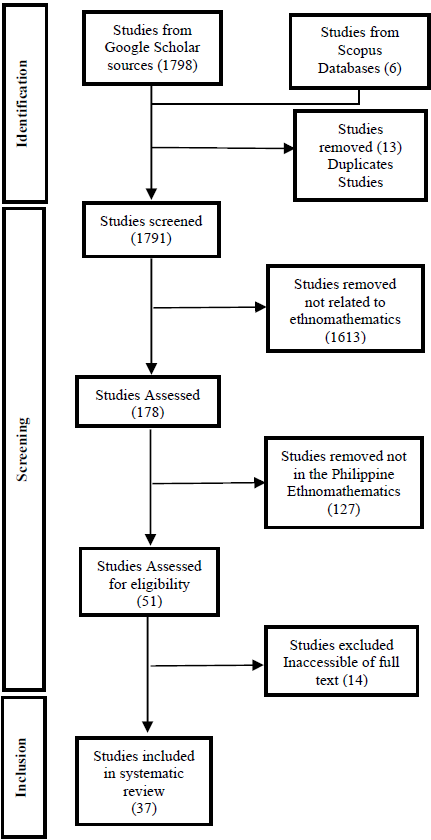
This research utilized a systematic review approach to comprehensively examine ethnomathematics studies conducted in the Philippines from 2009 to 2024. This method was selected to enable a structured, unbiased, and replicable analysis of the literature. The goal was to trace emerging research patterns, conceptual frameworks, and thematic developments that support the integration of indigenous mathematical knowledge within educational settings. This systematic literature review followed the PRISMA (Preferred Reporting Items for Systematic Reviews and Meta-Analyses) 2020 guidelines to ensure a transparent and rigorous process in identifying, screening, and selecting relevant studies. Figure 2 shows the systematic screening of the qualified Philippine research articles from 2009-2024.

The process of gathering the data utilized a systematic search across multiple academic databases, including Google Scholar, Publish or Perish, and Scopus. Keywords such as Ethnomathematics in the Philippines and Indigenous Mathematics were employed, with Boolean operators used to narrow and focus the search parameters for increased relevance. 1,804 sources were initially retrieved—1,798 from Google Scholar and 6 from Scopus. After eliminating 13 duplicates, there were 1,791 articles left for screening. Of these, 1,613 were excluded for not addressing ethnomathematics, and 127 more were removed for not being specific to the Philippine context. 14 articles were further excluded due to inaccessible full texts, resulting in 37 eligible studies for final inclusion. Figure 1 presents the PRISMA flowchart detailing the step-by-step procedures in evaluating the studies for inclusion in the review. Table 1 outlines the criteria that serve as the basis for including and excluding research in the Philippines, ensuring consistency in selecting relevant literature.
Ethnographic research, academic theses, and instructional materials were considered as qualifying sources for inclusion in this review. It must be published in English between 2009 and 2024 his timeframe was selected to capture both foundational and recent developments related to ethnomathematics research in the Philippines, particularly reflecting the growing interest and researcher discourse over the past 15 years. It also ensures that the review includes relevant and up-to-date research while establishing historical context. The criteria for exclusion eliminated sources that were not academic in nature, or unpublished manuscripts and articles that did not fit within the scope or were unrelated to mathematics or education subjects. This process guaranteed that the review focused on contextually appropriate research studies.
Information gathered from the chosen studies comprised details of publications, author credentials, keywords, summaries, and thematic elements. The data was well organized in Excel to help with sorting and referencing information efficiently and accurately. The studies were chosen systematically to cover a range of perspectives, including theoretical insights and real-world applications from various time periods and locations. This method allowed for a view of the subject while also emphasizing its relevance in academic settings and cultural contexts.
To gauge the quality of the research discussed in this review article's methodology section, the study utilized the Critical Appraisal Skills Programme (CASP) checklist as a tool for assessment purposes. With ten criteria set up to analyze how well the research objectives are outlined, the suitability of the methods employed, the comprehensiveness of data gathering and analysis, and the general academic significance of each study are evaluated. Through this approach, the study ensured that only research adhering to established standards and demonstrating credibility was included, based on CASP guidelines from 2018.
Keyword analysis was utilized to identify terms and central themes within the studies to categorize ideas and recognize patterns in the research topics of each study. This process directed the coding approach. Revealed prevalent trends and significant areas of research focus within the field.
The researchers used synthesis to analyze the collected data by sorting keywords and details from titles and abstracts to identify recurring themes related to practices and skill development challenges from different perspectives and their impacts. This process led to the identification of five themes that formed the basis for further exploration of the presentation, application, and evaluation of concepts in Philippine studies. Validation was reinforced using selection criteria and consistent coding methods, ensuring reliability through inclusion criteria. This approach provided an embedded perspective on the development and educational importance of ethnomathematics within the context of the Philippines.
The studies included in this systematic review encompass a wide range of ethnomathematics research conducted in the Philippines from 2009 to 2024. These studies were published in peer-reviewed journals, national research journals, and specialized international journals, ensuring that the findings reflect the dynamic discourse on the intersection of mathematics, culture, and education within local contexts. The research covers various themes, including indigenous mathematics practices, cultural documentation, curriculum development, and pedagogical integration. Some articles focus on specific cultural groups, such as the Ifugao, T'boli, Maranao, and Agta, while others address broader issues in mathematics education, such as the role of ethnomathematics in promoting inclusivity and motivating learners.
Most of the publications focused on qualitative research designs, particularly ethnographic and case study approaches, which are suitable for understanding the lived experiences and contextual meanings of mathematical practices. A smaller number of studies employed mixed methods or design-based methodologies to assess the practical implementation of ethnomathematics in formal education. Despite the differences in methodology, these studies highlighted the importance of preserving indigenous knowledge and promoting culturally responsive education.
Across the reviewed literature, a notable characteristic is the increased volume of publications after 2020, corresponding with strengthened educational policies supporting Indigenous Peoples Education (IPEd) and the K to 12 curriculum reforms. Furthermore, although publication venues differed in scope and indexing status, a growing effort is evident to align ethnomathematics research with national education goals and global conversations on decolonizing mathematics education. These characteristics collectively underscore the expanding relevance of ethnomathematics in the Philippine educational research landscape, while also highlighting the need for more empirical and interdisciplinary investigations moving forward.
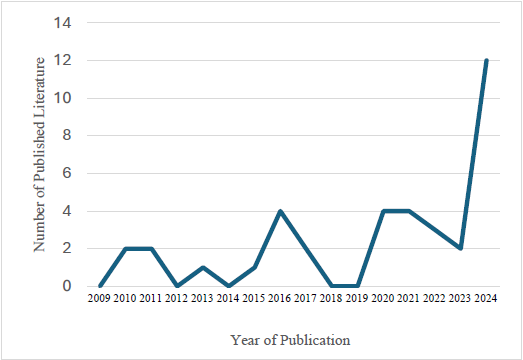
3.2. Trends in Research Development and PublicationThe increase in publications on ethnomathematics research in the Philippines from 2009 to 2024 is illustrated in Figure 2.

Figure 2 presents 37 ethnomathematics research studies conducted in the Philippines from 2009 to 2024. Interestingly, 25 of these publications were released in the last five years (2020–2024), highlighting a significant increase in research interest during this period. This trend is supported by studies from authors such as 8, 9, 10, 11, and 12, among others. Contrary to this, only 12 of them were published before 2020, examples of which are those of 4, 5, 13, 14, 15. This upward trend in publication activity is also further depicted in Figure 2, showing an increasing momentum in ethnomathematics studies in the Philippine academic environment.
Figure 2 presents the trend of ethnomathematics publications in the Philippines between 2009 and 2024, highlighting intervals of considerable increase as well as phases of noticeable reduction. Publication activity was low between 2009 and 2019, whereas existing from peaks to troughs, which occurred in 2016 and 2017, and subsequent shakes of hiatuses stretched grandly into 2018 and 2019. However, from 2020 onward, there appears to be an encouraging tide that implies an uptick in said research. The year 2024 sees the highest recorded volume of publications, showing a significant increase in scholarly productivity.
A growing interest in ethnomathematics appears to be indicated by certain results. This result has more institutions supporting it, more research grants are available for it, and more academics are beginning to recognize its importance. Ethnomathematics has been steadily growing over the years, and this recent trend is promising as it strengthens the field as a solid foundation for future research in the Philippine context.
A systematic comparison with global ethnomathematics research shows that, despite this advancement, the Philippines' contributions remain low in databases like Scopus and Web of Science worldwide 16. Brazilian, American, and South African studies prevail, especially concerning ethnomathematics pedagogy, policy development, and critical mathematics education.
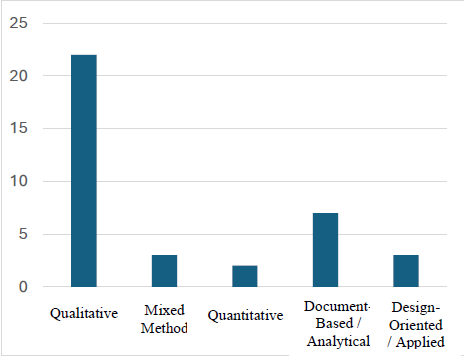
3.3. Development of Methodologies used in Philippine Ethnomathematics ResearchFigure 3 illustrates the methodological distribution of 37 reviewed studies, offering insights into prevailing research practices within the field.

Figure 3 highlights the development of methodologies in Philippine ethnomathematics research reflects a steady alignment with the socio-cultural and context-driven nature of the field. Over the years, there has been a marked preference for qualitative methodologies, particularly ethnographic, phenomenological, and case study designs. This trend is consistent with the core objective of ethnomathematics: to uncover and interpret mathematical ideas embedded within indigenous cultural practices, local traditions, and community knowledge systems. The dominance of these qualitative approaches underscores the commitment of scholars to capture the nuanced, lived experiences of indigenous groups, emphasizing the importance of cultural sensitivity and contextual understanding in the research process.
The presence of document-based and analytical methodologies, including meta-synthesis and systematic review, indicates a growing scholarly interest in consolidating existing knowledge, developing theoretical insights, and critically assessing the progression of ethnomathematics as an academic discipline in the Philippines. These analytical works not only provide a foundation for theoretical development but also help map research gaps, guide future inquiry, and inform policy and curriculum planning. Furthermore, the emergence of design-oriented methodologies, such as design-based research and developmental approaches, reflects a shift towards application-oriented studies. These methodologies demonstrate efforts to translate ethnomathematical knowledge into instructional tools and teaching strategies, particularly for integrating indigenous perspectives into the formal education system.
However, the relative scarcity of quantitative and mixed-methods studies suggests that empirical validation and generalizability remain underexplored. This limitation, in methodology could potentially impede the adoption of the field in mainstream educational policy and curriculum development settings that prioritize evidence based approaches greatly expanding methodological diversity to encompass experimental studies and long term research with a mix of methods could bolster the fields credibility and influence it would facilitate a comprehensive evaluation of the efficacy of ethnomathematics driven interventions specifically in improving student involvement performance and cultural identity formation.
The current approach to studying ethnomathematics in the Philippines offers qualitative perspectives and cultural context; however, its growth requires a more diverse methodological approach to shift towards a deeper understanding beyond descriptive and exploratory studies. This transition can enhance the field's knowledge base. Support data-driven educational advancements that focus on inclusivity. Such progression holds importance for mathematics education by encouraging.
3.4. Keyword Analysis of Ethnomathematics ResearchThe keyword analysis shown below plays a crucial role in identifying dominant themes such as indigenous practices, creative expressions, and mathematics education.

All the words selected from 85 total terms from published keywords of literature of ethnomathematics in the Philippines were considered in the five themes.
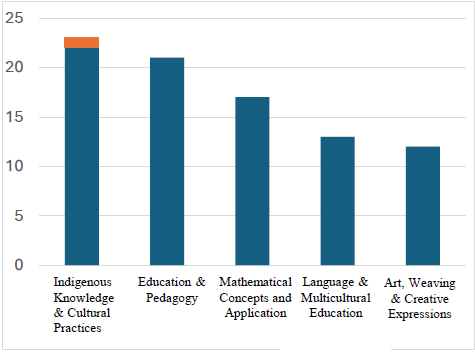
Keyword analysis of ethnomathematics literature in the Philippines is illustrated in Figure 4 under 5 key themes.
The theme "Indigenous Knowledge & Cultural Practices" appears to be the dominant theme, featuring 22 keywords that reflect significant research focus on traditional knowledge systems and cultural elements, such as folk dances and games. Closely following is that of "Education & Pedagogy" with 21 keywords indicating a strong concern for entraining ethnomathematical concepts in pedagogy and instructional materials.
The keyword analysis (Figure 4) highlights the thematic distribution of ethnomathematics research based on 85 published keywords. Among the five identified themes, "Indigenous Knowledge & Cultural Practices" emerges as the most dominant, with 22 keywords reflecting significant research attention on traditional knowledge systems, cultural elements, folk dances, and games. Closely following is "Education & Pedagogy" (21 keywords), indicating a strong focus on incorporating ethnomathematical concepts into instructional materials and classroom pedagogy. This aligns with the principles outlined in the K-12 Mathematics Curriculum of the Philippines 17, which promotes contextualized learning strategies and the integration of Indigenous knowledge to enhance students' mathematical understanding 18.
However, other themes, such as "Language & Multicultural Education" (13 keywords) and "Art, Weaving & Creative Expressions" (12 keywords), are underrepresented. These areas, which explore the interaction between mathematics, language acquisition, cultural diversity, and artistic traditions, highlight the need for further research. Studies by 19 have demonstrated that incorporating Indigenous cultural contexts into mathematics instruction significantly improves student engagement and comprehension. The "Mathematical Concepts & Applications" category, with 17 keywords, also suggests a gap in studies that explores how ethnomathematical principles can be systematically applied to modern mathematical practices and contribute to innovations in multicultural education. Expanding research in these areas would provide a more comprehensive understanding of the role of ethnomathematics in Philippine society, particularly in ensuring that Indigenous knowledge is valued alongside Western mathematical traditions 1.
3.5. Philippines Ethnomathematics Research Emerging TrendsThis study examines the prevailing directions of ethnomathematics research in the Philippines, highlighting the main subjects and areas frequently addressed by researchers. An overview of these thematic focuses and how often they appear in the literature is outlined in Table 2.
Results indicated that most studies, 40.5%, concentrate on ethnomathematical practices, which reflect the cultural traditions and mathematical concepts within indigenous communities. Approximately 21.6% of the studies focus on the development of competencies, which shows a growing effort to integrate ethnomathematics into formal education. In contrast, fewer studies have explored challenges 16.2%, views 13.5%, and effects 8.1% of its integration, showing a dearth of research in implementation issues, stakeholder perspectives, and holistic effectiveness.
The most prominent theme, Practices, reflects an extensive body of work focused on documenting indigenous mathematical knowledge found in cultural artifacts, rituals, and everyday practices. Studies by Rubio (2016), 20, and 21 illustrate the richness of ethnomathematical practices within various Philippine indigenous communities. These studies aid in preserving intangible cultural heritage and highlight ethnomathematics as an important element of local knowledge systems. However, while the descriptive nature of this research is foundational, it underscores the need for more applied investigations that explore how such documented knowledge may be meaningfully integrated into formal education settings.
Several studies explore the presence of mathematical ideas within cultural expressions, including weaving, folk dances, and traditional architecture. The works of 22 and 23 highlight that indigenous artistic and daily practices often reflect complex mathematical reasoning, including patterns, symmetry, and geometric transformation. These studies reinforce the notion that culture is not peripheral but central to the way mathematics is understood and practiced in diverse contexts. However, while these insights are theoretically rich, further research is needed to operationalize such cultural content into measurable learning materials and strategies for classroom instruction.
Researchers focused on curriculum design, teacher education, and the institutional implementation of culturally responsive pedagogy. Contributions from 24, 25, and 4 illustrate how ethnomathematics can support the localization of curriculum and improve pedagogical relevance in multicultural classrooms. These studies align with the Department of Education’s IPEd framework and the objectives of the K to 12 curriculums. However, the implementation of these policies remains inconsistent. Future research should focus on how institutional support, professional development, and community collaboration can enhance the sustainability and scalability of integrating ethnomathematics into Philippine education.
Reference 12 and 10 investigate the impact of ethnomathematics on learner engagement, motivation, and understanding. These works provide preliminary evidence that contextualizing mathematical instruction through culture can yield positive educational outcomes. Nonetheless, the limited number of empirical studies in this category suggests a research gap that must be addressed. There is a clear need for more robust, data-driven investigations, particularly those utilizing longitudinal or experimental designs, to assess the effectiveness of ethnomathematical approaches in improving students’ cognitive and affective learning outcomes.
3.7. CASP Quality Assessment Summary of 37 Ethnomathematics Research Articles in the Philippines (2009–2024)To assess the quality of the 37 studies included in this review this study used a checklist provided by the Critical Appraisal Skills Programme (CASP). Each study was reviewed based on the ten criteria outlined in the CASF checklist. Then classified as "Yes" (√) "No" (×) or "Can’t Tell". A summary of these assessments is provided in the table.
The CASP assessment in Table 4 reveals that 37 out of 37 studies (100%) clearly stated their research aims, and 35 (95%) applied appropriate qualitative methodologies. Additionally, 34 studies (92%) demonstrated effective data collection, while 28 (76%) showed sufficiently rigorous data analysis. These results indicate that most Philippine ethnomathematics studies from 2009 to 2024 possess strong methodological foundations.
However, only 20 studies (54%) adequately considered the researcher-participant relationship, and 26 (70%) addressed ethical issues. These figures highlight areas for improvement in reflexivity and ethical reporting. Strengthening these aspects will enhance the overall transparency and credibility of future ethnomathematics research.
Several factors contribute to the limited exploration of certain research topics. Many studies fail to reach rural and Indigenous communities, such as the Agta Tabangnon in Camarines Sur—where traditional mathematical knowledge is deeply embedded due to accessibility issues 7, where traditional mathematical knowledge remains most deeply embedded. Research in these contexts is frequently constrained by institutional barriers, insufficient funding, and persistent challenges related to language and effective communication based on the field of research among communities like the Eskaya tribe often require intensive logistics and funding, as exemplified by a year-long data collection including observation and quasi-experiments 6. Beyond these issues, there remains a noticeable gap in comprehensive, evidence-driven investigations that evaluate the actual influence of ethnomathematics. This gap largely stems from the logistical hurdles and methodological complexities inherent in carrying out such studies within the Philippine educational framework.
3.9. Understanding International Ethnomathematics Research Comparative AnalysisWhile ethnomathematics research in the Philippines has made initial progress, it remains relatively limited compared to more advanced and integrated efforts in countries such as Brazil and New Zealand. Insights drawn from these countries offer evidence-based pathways that the Philippines could consider moving beyond documentation toward culturally responsive mathematics education.
In Brazil, 1 has laid the theoretical foundation for ethnomathematics as a tool to decolonize mathematics education. His work emphasizes the importance of recognizing and valuing mathematical practices rooted in diverse cultural traditions, such as those of Indigenous and Afro-Brazilian communities. Several Brazilian studies have operationalized this theory by incorporating local knowledge systems—such as basket-weaving patterns, agricultural calendars, and spatial reasoning—into classroom instruction, thereby validating learners' cultural identities and making mathematics more contextually relevant 26.
In New Zealand, efforts to integrate Māori mathematical knowledge into formal education have been supported by national policy and curriculum design. Research by 27 illustrates how Māori-medium schools (kura kaupapa Māori) embed indigenous concepts such as whakapapa (genealogy) and whenua (land-based measurements) into mathematics instruction, enhancing cultural engagement and student participation. These developments were not only pedagogical but also part of a broader movement to affirm Indigenous sovereignty and language preservation through education.
By comparison, Philippine ethnomathematics research often remains descriptive or exploratory, focusing on cataloguing cultural practices without fully transforming them into instructional frameworks or policy-based curriculum initiatives. While some studies—such as those exploring mathematical patterns in weaving and indigenous numeracy systems—highlight the rich cultural potential, few have evaluated their classroom application or impact on student learning.
Grounded in the evidence from Brazil and New Zealand, this comparison suggests a clear research gap and an opportunity: the Philippines could benefit from adopting a more applied, curriculum-integrated approach that transitions from ethnographic documentation to pedagogical design. Doing so would align with global best practices and advance both cultural responsiveness and mathematics equity in the Philippine educational system.
Based on the findings of the study, the following conclusions can be drawn:
1. Increasing Emphasis on Indigenous Knowledge in Ethnomathematics Research
ο There is a strong emphasis on documenting indigenous mathematical practices, aligned with DepEd’s IPEd framework. However, research remains largely descriptive rather than applied, necessitating studies that focus on the pedagogical integration of ethnomathematics.
2. Methodologies used in Ethnomathematics research
ο The increasing volume of publications means that much of the literature remains confined to descriptive narratives, indicating the need for methodological expansion and curriculum integration supported by longitudinal or action-based research.
3. Publication Growth and Institutional Support
ο Since 2020, there has been a growing interest in ethnomathematics research within academic and institutional circles. However, limited interdisciplinary collaboration and weak international visibility hinder the field’s global impact.
4. There is insufficient research on the practical implementation and impact of this topic.
ο There is a notable gap in research evaluating the real-world effects of ethnomathematics-based education. Only 8.1% of studies evaluate learning outcomes, highlighting the need for controlled experiments and longitudinal investigations.
5. The Potential of Ethnomathematics to Transform Mathematics Education
ο Ethnomathematics offers a chance to transition Philippine mathematics education from a Western-centric framework to one that embraces cultural inclusivity. Models from countries like New Zealand and Brazil illustrate the possibility of incorporating indigenous mathematics into mainstream curricula.
To address the identified gaps and enhance both research and practice in ethnomathematics, the following recommendations are proposed:
1. Advancing Educator Expertise and Capacity Building
ο CHED and DepEd are encouraged to develop professional development programs that equip educators with the skills to meaningfully incorporate ethnomathematics into their instructional practices. Emphasis should be placed on conducting workshops that promote culturally responsive pedagogy and foster interdisciplinary collaboration with indigenous communities.
2. Limited use of quantitative and experimental research designs reflects a methodological gap that restricts generalizability and empirical validation
ο The need for methodological expansion and curriculum integration is supported by longitudinal or action-based research.
3. Strengthening Research on the Practical Implementation of Ethnomathematics in Education
ο Extensive experimental research should be undertaken to evaluate the effects of ethnomathematics-based instruction on student achievement and engagement.
4. Strengthening Collaborative and Interdisciplinary Academic Initiatives
ο Higher education institutions are encouraged to establish interdisciplinary research centers that bring together mathematicians, anthropologists, linguists, and educators to foster collaborative inquiry and facilitate the exchange of knowledge across disciplines.
5. Expanding Institutional Engagement and Policy Execution
ο Government agencies should provide targeted research funding to ensure the continued growth and meaningful integration of ethnomathematics into national education policies.
6. Integrating Technology into Ethnomathematics Research and Practice
ο Future studies may explore the role of digital tools and technology in improving the accessibility, implementation, and instructional value of ethnomathematics in classrooms.
Implementing these recommendations will strengthen the Philippines’ role in ethnomathematics research, preserve indigenous knowledge, and promote a more inclusive and culturally relevant mathematics education.
I thank God for giving me the strength, patience, and wisdom to finish this study. Special thanks to my family – from the start, they showed me support and later kept pushing me even when the going seemed to get very tough. I am grateful to my thesis adviser for dedicating his time to my thesis work, for trusting me enough to give me the opportunity to present my work, and for the advice. Not forgetting my friends who were my support system while walking on this journey; thank you, guys, you all made this happen.
| [1] | D’Ambrosio, U. (2001) In My Opinion: What Is Ethnomathematics, and How Can It Help Children in Schools? Teaching Children Mathematics, 7, 308-310. | ||
| In article | View Article | ||
| [2] | Balamurugan, M. (2015). Ethnomathematics: An approach for learning mathematics from multicultural perspectives. International Journal of Modern Research and Reviews, 3(6), 716–720. Retrieved from http:// journalijmrr.com/ wp-content/uploads/2015/08/IJMRR-175.pdf. | ||
| In article | |||
| [3] | Mania, S. & Alam, S. (2021). Teachers’ perception toward the use of ethnomathematics approach in teaching math. International Journal of Education in Mathematics, Science, and Technology (IJEMST), 9(2), 282-298. | ||
| In article | View Article | ||
| [4] | Vistro-Yu, C. P. (2010). Ethnomathematics for capacity building in mathematics education. Intersection, 11, 2–15. Retrieved from https:// archium.ateneo.edu/ mathematics-faculty-pubs/141/. | ||
| In article | |||
| [5] | Rubio, J. S. (2016). The ethnomathematics of the Kabihug tribe in Jose Panganiban, Camarines Norte, Philippines. Malaysian Journal of Mathematical Sciences, 10(S), 211–231.retrieved from mjms.upm.edu.my/fullpaper/ 2016-August-10(S)/Jennifer S. Rubio-211-231.pdf. | ||
| In article | |||
| [6] | Janiola, F. J., & De Los Santos, R. A. (2021). Exploring mathematics in the Eskaya tribe: An ethnolearning theory. Journal of Education and Practice, 12(30), 1–10. Retrieved from https:// www.researchgate.net/ profile/Fe-Janiola/publication/ 365013347_ Exploring_Mathematics_ in_the_Eskaya_Tribe_An_Ethnolearning_ Theory_An_Ethnolearning_Theory/ links/63632194431b1f53006659f1/ Exploring-Mathematics-in-the-Eskaya-Tribe-An-Ethnolearning-Theory- An-Ethnolearning-Theory.pdf. | ||
| In article | |||
| [7] | Briones, S. V. II, Briones, S. C., & Palmes, M. P. (2023). Linking mathematics and cultural practices of the Agta Tabangnon in the upland communities of Goa, Philippines. Ethnomathematics Journal, 4(2), 149–159. | ||
| In article | View Article | ||
| [8] | Alabat, R. L., & Oledan, A. M. (2024). A meta-synthesis on the challenges and benefits of integrating ethnomathematics in the Philippine mathematics curriculum. Journal of Education and Practice, 15(8), 29–36. | ||
| In article | |||
| [9] | Oledan, A. M., & Gumangan, A. M. (2024). A systematic review on ethnomathematics integration in secondary education. Journal of Education and Practice, 15(9), 1–12. | ||
| In article | |||
| [10] | Briones, S. V. II, Briones, S. C., & Palmes, M. P. (2024). Ethnomathematics: Linking mathematics and cultural practices of the Agta Tabangnon in the upland communities of Goa, Philippines. AIP Conference Proceedings, 2895(1), 020015. | ||
| In article | View Article | ||
| [11] | Herrera, R. V., Jr., & Palomo, E. G. (2022). Linking community and pedagogy: Ethnomodels from coastal villages in Panay, Philippines. Philippine Social Science Journal, 5(2), 73–81. | ||
| In article | View Article | ||
| [12] | aniola, F. R., & de los Santos, M. S. M. (2020). Exploring mathematics in the Eskaya tribe: An ethnolearning theory. Solid State Technology, 63(2S), 7638–7642. Retrieved from https:// solidstatetechnology.us/ index.php/JSST/ article/view/5133. | ||
| In article | |||
| [13] | Alangui, W. V. (2010). Stone walls and water flows: Interrogating cultural practice and mathematics (Doctoral dissertation). University of Auckland. Retrieved from https:// researchspace. auckland.ac.nz/items/ d1b6951e-3c20-443e-b2e9-8c5be2b666fc. | ||
| In article | |||
| [14] | Alangui, W. V. (2017). Ethnomathematics and culturally relevant mathematics education in the Philippines. In M. Rosa, L. Shirley, M. E. Gavarrete, & W. V. Alangui (Eds.), Ethnomathematics and its diverse approaches for mathematics education (pp. 183–208). Springer. | ||
| In article | View Article | ||
| [15] | Galvez, R. G. (2013). Mathematics and Panay Bukidnon women in Alan Cabalfin’s paintings. WVSU Research Journal, 2(2), 1-18. | ||
| In article | View Article | ||
| [16] | Rosa, M., & Orey, D. C. (2021). An ethnomathematical perspective of STEM education in a glocalized world. Bolema: Boletim de Educação Matemática, 35(70), 840-876. | ||
| In article | View Article | ||
| [17] | Department of Education. (2016). DepEd Order No. 42, s. 2016: Policy Guidelines on Daily Lesson Preparation for the K to 12 Basic Education Program. Department of Education, Republic of the Philippines. https:// www.deped.gov.ph/ 2016/06/17/do-42-s-2016-policy-guidelines- on-daily-lesson-preparation-for-the-k-to-12-basic-education-program/. | ||
| In article | |||
| [18] | Department of Education. (2011). DepEd Order No. 62, s. 2011: Adopting the National Indigenous Peoples Education Policy Framework. Department of Education, Republic of the Philippines. https://www.deped.gov.ph/ 2011/08/08/ do-62-s-2011-adopting-the-national-indigenous-peoples-education-policy-framework/. | ||
| In article | |||
| [19] | Lipka, J., Hogan, M. P., Webster, J. P., Yanez, E., Adams, B., Clark, S., & Lacy, D. (2005). Math in a cultural context: Two case studies of a successful culturally based math project. Anthropology & Education Quarterly, 367-385. | ||
| In article | View Article | ||
| [20] | Hortelano, J. C., & Lapinid, M. R. (2024). Recontextualizing Kalinga’s batek and laga into an ethnomathematical teaching resource: An application of the second generation of didactical engineering. Journal on Mathematics Education, 15(2), 385–402. | ||
| In article | View Article | ||
| [21] | Agup, R. M., & Agup, R. S. (2020). In math, culture also counts: A case study on the integration of Ilokano culture in teaching mathematics. Asian Journal of Education and Human Development, 1(1), 1-8. Retrieved from https:// www.researchgate.net/ publication/ 382069989_In_ Math_Culture_Also_Counts_A_Case_Study_on_the_Integration_of_Ilokano_ Culture_in_Teaching_Mathematics/fulltext/668bd7abf3b61c4e2cb7e190/In-Math-Culture- Also-Counts-A-Case-Study-on-the-Integration-of-Ilokano-Culture-in-Teaching-Mathematics.pdf. | ||
| In article | View Article | ||
| [22] | Solaiman, N. P., Manalundong, M. Q., & Bula, N. B. (2017). The mathematical ideas involved in Maranao weaving. Journal of Social Sciences (COES&RJ-JSS), 6(3), 610–617. | ||
| In article | View Article | ||
| [23] | Gayagay, G. (2021). Geometric designs in the indigenous attires of the Bontoc tribe: An evidence of "ethnomathematics". IJRDO - Journal of Mathematics, 7(3), 1-15. Retrieved from https:// www.researchgate.net/ publication/ 364311519_ Geometric_ Designs_ in_the_Indigenous_ Attires_of_the_Bontoc_Tribe_An_ Evidence_of_Ethnomathematics. | ||
| In article | |||
| [24] | Villarin, J., Dolino, C., Fin, R., Miñoza, M. L., Ubay, R., & Kilag, O. K. (2024). Unlocking mathematical learning: Exploring ethnomathematics' impact on student engagement, conceptual understanding, and equity in mathematics education. International Multidisciplinary Journal of Research for Innovation, Sustainability, and Excellence, 1(3), 157–163. https:// risejournals.org/ index.php/imjrise/article/view/199?utm_source. | ||
| In article | |||
| [25] | Palarao, V., Palarao, R., & Oledan, A. M. (2024). Summarizing findings and looking the trend of the ethnomathematical exploration in folk dances. Journal of Education and Practice, 15(8), 51–59. | ||
| In article | |||
| [26] | Rosa, M., & Orey, D. C. (2011). Ethnomathematics: The cultural aspects of mathematics. Revista Latinoamericana de Etnomatemática, 4(2), 32–54. Retrieved from https:// www.researchgate.net/ profile/Milton-Rosa/ publication/ 277262543_ Ethnomathematics_ The_cultural_aspects_of_ mathematics/links/ 558d5dc708ae817475e63680/ Ethnomathematics-The-cultural-aspects-of-mathematics.pdf. | ||
| In article | |||
| [27] | Meaney, T., Trinick, T., Fairhall, U., Meaney, T., Trinick, T., & Fairhall, U. (2012). “Māori were Traditional Explorers”: Māori Pedagogical Practices. Collaborating to Meet Language Challenges in Indigenous Mathematics Classrooms, 225-248. | ||
| In article | View Article | ||
Published with license by Science and Education Publishing, Copyright © 2025 Horencio C. Adaro Jr. and Dennis B. Roble
 This work is licensed under a Creative Commons Attribution 4.0 International License. To view a copy of this license, visit
http://creativecommons.org/licenses/by/4.0/
This work is licensed under a Creative Commons Attribution 4.0 International License. To view a copy of this license, visit
http://creativecommons.org/licenses/by/4.0/
| [1] | D’Ambrosio, U. (2001) In My Opinion: What Is Ethnomathematics, and How Can It Help Children in Schools? Teaching Children Mathematics, 7, 308-310. | ||
| In article | View Article | ||
| [2] | Balamurugan, M. (2015). Ethnomathematics: An approach for learning mathematics from multicultural perspectives. International Journal of Modern Research and Reviews, 3(6), 716–720. Retrieved from http:// journalijmrr.com/ wp-content/uploads/2015/08/IJMRR-175.pdf. | ||
| In article | |||
| [3] | Mania, S. & Alam, S. (2021). Teachers’ perception toward the use of ethnomathematics approach in teaching math. International Journal of Education in Mathematics, Science, and Technology (IJEMST), 9(2), 282-298. | ||
| In article | View Article | ||
| [4] | Vistro-Yu, C. P. (2010). Ethnomathematics for capacity building in mathematics education. Intersection, 11, 2–15. Retrieved from https:// archium.ateneo.edu/ mathematics-faculty-pubs/141/. | ||
| In article | |||
| [5] | Rubio, J. S. (2016). The ethnomathematics of the Kabihug tribe in Jose Panganiban, Camarines Norte, Philippines. Malaysian Journal of Mathematical Sciences, 10(S), 211–231.retrieved from mjms.upm.edu.my/fullpaper/ 2016-August-10(S)/Jennifer S. Rubio-211-231.pdf. | ||
| In article | |||
| [6] | Janiola, F. J., & De Los Santos, R. A. (2021). Exploring mathematics in the Eskaya tribe: An ethnolearning theory. Journal of Education and Practice, 12(30), 1–10. Retrieved from https:// www.researchgate.net/ profile/Fe-Janiola/publication/ 365013347_ Exploring_Mathematics_ in_the_Eskaya_Tribe_An_Ethnolearning_ Theory_An_Ethnolearning_Theory/ links/63632194431b1f53006659f1/ Exploring-Mathematics-in-the-Eskaya-Tribe-An-Ethnolearning-Theory- An-Ethnolearning-Theory.pdf. | ||
| In article | |||
| [7] | Briones, S. V. II, Briones, S. C., & Palmes, M. P. (2023). Linking mathematics and cultural practices of the Agta Tabangnon in the upland communities of Goa, Philippines. Ethnomathematics Journal, 4(2), 149–159. | ||
| In article | View Article | ||
| [8] | Alabat, R. L., & Oledan, A. M. (2024). A meta-synthesis on the challenges and benefits of integrating ethnomathematics in the Philippine mathematics curriculum. Journal of Education and Practice, 15(8), 29–36. | ||
| In article | |||
| [9] | Oledan, A. M., & Gumangan, A. M. (2024). A systematic review on ethnomathematics integration in secondary education. Journal of Education and Practice, 15(9), 1–12. | ||
| In article | |||
| [10] | Briones, S. V. II, Briones, S. C., & Palmes, M. P. (2024). Ethnomathematics: Linking mathematics and cultural practices of the Agta Tabangnon in the upland communities of Goa, Philippines. AIP Conference Proceedings, 2895(1), 020015. | ||
| In article | View Article | ||
| [11] | Herrera, R. V., Jr., & Palomo, E. G. (2022). Linking community and pedagogy: Ethnomodels from coastal villages in Panay, Philippines. Philippine Social Science Journal, 5(2), 73–81. | ||
| In article | View Article | ||
| [12] | aniola, F. R., & de los Santos, M. S. M. (2020). Exploring mathematics in the Eskaya tribe: An ethnolearning theory. Solid State Technology, 63(2S), 7638–7642. Retrieved from https:// solidstatetechnology.us/ index.php/JSST/ article/view/5133. | ||
| In article | |||
| [13] | Alangui, W. V. (2010). Stone walls and water flows: Interrogating cultural practice and mathematics (Doctoral dissertation). University of Auckland. Retrieved from https:// researchspace. auckland.ac.nz/items/ d1b6951e-3c20-443e-b2e9-8c5be2b666fc. | ||
| In article | |||
| [14] | Alangui, W. V. (2017). Ethnomathematics and culturally relevant mathematics education in the Philippines. In M. Rosa, L. Shirley, M. E. Gavarrete, & W. V. Alangui (Eds.), Ethnomathematics and its diverse approaches for mathematics education (pp. 183–208). Springer. | ||
| In article | View Article | ||
| [15] | Galvez, R. G. (2013). Mathematics and Panay Bukidnon women in Alan Cabalfin’s paintings. WVSU Research Journal, 2(2), 1-18. | ||
| In article | View Article | ||
| [16] | Rosa, M., & Orey, D. C. (2021). An ethnomathematical perspective of STEM education in a glocalized world. Bolema: Boletim de Educação Matemática, 35(70), 840-876. | ||
| In article | View Article | ||
| [17] | Department of Education. (2016). DepEd Order No. 42, s. 2016: Policy Guidelines on Daily Lesson Preparation for the K to 12 Basic Education Program. Department of Education, Republic of the Philippines. https:// www.deped.gov.ph/ 2016/06/17/do-42-s-2016-policy-guidelines- on-daily-lesson-preparation-for-the-k-to-12-basic-education-program/. | ||
| In article | |||
| [18] | Department of Education. (2011). DepEd Order No. 62, s. 2011: Adopting the National Indigenous Peoples Education Policy Framework. Department of Education, Republic of the Philippines. https://www.deped.gov.ph/ 2011/08/08/ do-62-s-2011-adopting-the-national-indigenous-peoples-education-policy-framework/. | ||
| In article | |||
| [19] | Lipka, J., Hogan, M. P., Webster, J. P., Yanez, E., Adams, B., Clark, S., & Lacy, D. (2005). Math in a cultural context: Two case studies of a successful culturally based math project. Anthropology & Education Quarterly, 367-385. | ||
| In article | View Article | ||
| [20] | Hortelano, J. C., & Lapinid, M. R. (2024). Recontextualizing Kalinga’s batek and laga into an ethnomathematical teaching resource: An application of the second generation of didactical engineering. Journal on Mathematics Education, 15(2), 385–402. | ||
| In article | View Article | ||
| [21] | Agup, R. M., & Agup, R. S. (2020). In math, culture also counts: A case study on the integration of Ilokano culture in teaching mathematics. Asian Journal of Education and Human Development, 1(1), 1-8. Retrieved from https:// www.researchgate.net/ publication/ 382069989_In_ Math_Culture_Also_Counts_A_Case_Study_on_the_Integration_of_Ilokano_ Culture_in_Teaching_Mathematics/fulltext/668bd7abf3b61c4e2cb7e190/In-Math-Culture- Also-Counts-A-Case-Study-on-the-Integration-of-Ilokano-Culture-in-Teaching-Mathematics.pdf. | ||
| In article | View Article | ||
| [22] | Solaiman, N. P., Manalundong, M. Q., & Bula, N. B. (2017). The mathematical ideas involved in Maranao weaving. Journal of Social Sciences (COES&RJ-JSS), 6(3), 610–617. | ||
| In article | View Article | ||
| [23] | Gayagay, G. (2021). Geometric designs in the indigenous attires of the Bontoc tribe: An evidence of "ethnomathematics". IJRDO - Journal of Mathematics, 7(3), 1-15. Retrieved from https:// www.researchgate.net/ publication/ 364311519_ Geometric_ Designs_ in_the_Indigenous_ Attires_of_the_Bontoc_Tribe_An_ Evidence_of_Ethnomathematics. | ||
| In article | |||
| [24] | Villarin, J., Dolino, C., Fin, R., Miñoza, M. L., Ubay, R., & Kilag, O. K. (2024). Unlocking mathematical learning: Exploring ethnomathematics' impact on student engagement, conceptual understanding, and equity in mathematics education. International Multidisciplinary Journal of Research for Innovation, Sustainability, and Excellence, 1(3), 157–163. https:// risejournals.org/ index.php/imjrise/article/view/199?utm_source. | ||
| In article | |||
| [25] | Palarao, V., Palarao, R., & Oledan, A. M. (2024). Summarizing findings and looking the trend of the ethnomathematical exploration in folk dances. Journal of Education and Practice, 15(8), 51–59. | ||
| In article | |||
| [26] | Rosa, M., & Orey, D. C. (2011). Ethnomathematics: The cultural aspects of mathematics. Revista Latinoamericana de Etnomatemática, 4(2), 32–54. Retrieved from https:// www.researchgate.net/ profile/Milton-Rosa/ publication/ 277262543_ Ethnomathematics_ The_cultural_aspects_of_ mathematics/links/ 558d5dc708ae817475e63680/ Ethnomathematics-The-cultural-aspects-of-mathematics.pdf. | ||
| In article | |||
| [27] | Meaney, T., Trinick, T., Fairhall, U., Meaney, T., Trinick, T., & Fairhall, U. (2012). “Māori were Traditional Explorers”: Māori Pedagogical Practices. Collaborating to Meet Language Challenges in Indigenous Mathematics Classrooms, 225-248. | ||
| In article | View Article | ||