This paper compares explicit mathematics instruction, and error analysis in teaching Polya’s Problem Solving Strategy, Descriptive Statistics, Measures of Central Tendency, Measures of Variability, Simple Interest, Compound Interest and Annuity, Loans and Investments. The study was conducted in University of Science and Technology of Southern Philippines Cagayan de Oro with the undergraduate students taking Mathematics in the Modern World for the first semester 2024-2025. The researchers employed explicit instruction as a teaching method for the first group and the error analysis on the second group. To determine the pre-test and post test scores of the students’, descriptive analysis was employed with use of the mean and standard deviation. The Analysis of Covariance (ANCOVA) was used to determine if there is a significant difference between achievement of students exposed to explicit instruction, and error analysis. The result showed that there is no significant influence of the pre-test towards the mathematics achievement of the students’ achievement of the students F(1, 61) = 1.94, p = 0.17. This further indicates that the initial pretest difference did not affect much on the variance of the post test scores. Moreover, this suggest that prior knowledge of the students did not have a large impact towards the result. Conversely, the group effect was significant F(1,61)=14.69, p<0.001, it implies that the method used in the intervention significantly influenced the achievement score of the students. The pre-test did not have a significant impact towards the post-test. This suggest that students’ prior knowledge did not affect the resulting posttest. Additionally, the scores of the students both group improved during the post-test. However, it worth noting that those exposed to explicit instruction group scored higher than the those in error analysis. There is a significant difference between the achievement scores of the students. This can be attributed on the method used namely, explicit instruction, and error analysis. The use of explicit is more effective than the use of error analysis as a teaching method. The effectiveness of traditional methods is often linked to their ability to facilitate straightforward assessment. This allows educators to measure student understanding objectively and efficiently. Many studies indicate that students often perform well academically under traditional methods due to the structured nature of these approaches . It is recommended that teachers discussed mathematics topics using explicit instruction.
The poor performance of learners in mathematics continues to be a global concern, prompting efforts to bring about positive change in various nations, including the Philippines. Filipino students' struggles in subjects requiring higher-order thinking skills, including mathematics, have been highlighted 1. This issue underscores the importance of addressing the challenges associated with mathematics education to support the growth and development of students in the country and beyond. Hence, recent researches have focused on factors contributing to poor performance, such as inadequate teaching and learning materials, ineffective curriculum and examinations, and the impact of underperforming schools on overall student achievement 13.
Various method were employed by teachers to aid in the undergoing problem. This includes the studies in learning styles and study habits to improve the academic performance of the students 14. Aside from this, researches on differentiated instructions were conducted to address the issue on students’ achievement 2. Also, studies on the used flipped mathematics classrooms were done to increase students’ engagement and performance in mathematics. Despite this ongoing efforts, problems in mathematics performance are still prevalent as seen in the PISA 2022 Result, wherein the Philippines ranked 77th out of 81 countries. Even in the National Achievement Test (NAT) results from the 2022-2023, Filipino students’ showed a poor academic performance in math, reading, and science. These extends to their tertiary level performance, where struggle with math, often leading to negative attitudes towards the subject 18.
Explicit instruction is a high structured and direct teaching method that gives clear and guided instruction towards the students 4. Thus, students can follow and understand the method as well as the discussion easily.
Aside from explicit instruction this study uses another teaching method, the error analysis. However, most of the studies employing error analysis, simply focused on identifying the common errors committed by the students 3, 10, 15, 20, 22, In which had been found to be an effective method to improve students’ mathematics performance. These studies have identified error analysis as an essential tool for teachers to comprehend and rectify mathematical errors. Error analysis is a vital tool for teachers to comprehend and tackle mistakes made by their students. It helps them to identify the root cause of errors and develop effective method to address them. Errors in mathematics are categorized into types such as conceptual errors, procedural errors, processing language information, selecting appropriate procedures, making concept associations, calculation errors, and more. With this error, educators can find a way to solve this foregoing problems.
Aside from studies onto identifying errors through error analysis, it is utilized in the classroom setting as a teaching method 19, 21. Error analysis requires students to find and account for mistakes in mathematical exercises, rectify the mistakes, and offer justifications for their corrections. This approach is coherent with the National Council of Teachers of Mathematics (NCTM) Standards for Mathematical Practice because it is in conjunction with in improving students’ mathematical understanding 21. Studies suggest that within the context of error analysis, an improvement in the retention of information that lasts even when there is no immediate testing feedback 21. In addition, it helps teachers detect students' persistent mistakes so they can focus on those most in need of help, including students with learning difficulties and children who are underachieving 12. Error analysis allows students to comprehend their mistakes better so that they can adeptly understand more complex relational concepts in mathematics 16.
Moreover, Mathematics in the Modern World, is the only mathematics general education course in all the undergraduate programs. According to Carang, et. al 7 that students face challenges in the Mathematics in the Modern World course highlighting problems in remembering facts, concepts, rules, formulas, sequences, and procedures. This study employed error analysis in one group and explicit instruction in another group exploring which method is more appropriate in the context of teaching Mathematics in the Modern World to undergraduate Bachelor in Technical-Vocational Teacher Education students.
This study is anchored in the following theories: Bruner’s discovery learning, Vygotsky’s Zone of Proximal Development and Learning by doing by Dewey.
Discovery Learning, pioneered by Jerome Bruner, is an approach to Inquiry-Based Instruction rooted in constructivist learning theory. Learners actively build their knowledge by structuring and classifying information through a coding system 5. He advocated for learners to develop this coding system through self-discovery rather than direct instruction from teachers. In this method, learning occurs within problem-solving contexts where individuals leverage their prior experiences and existing knowledge to uncover new facts, relationships, and truths. In this study, the first group of students was exposed to error analysis ,exploring what went wrong with the given problem or exercises. In this sense, they can develop a deeper understanding of the concepts and procedures while exploring on their own. Through the self-exploration using Error Analysis as a teaching method students are given the freedom to explore and see what went wrong with the problems or the statements. In this sense, students can deepen their understanding of the subject matter. While those who are in the explicit instruction, they can do the exploration after the teacher had guided them to the right process.
The Zone of Proximal Development (ZPD) is a concept developed by psychologist Lev Vygotsky that emphasizes the importance of social interaction in the learning process. According to Vygotsky, learning is a social activity that occurs through collaboration with more knowledgeable individuals, such as teachers, mentors, or peers with higher skill levels 17. The ZPD represents the range of abilities an individual can perform with guidance but cannot yet perform independently. It is not a fixed concept and varies depending on the learner's current level of development, prior knowledge, and the quality of guidance they receive. The goal is for learners to move from their current level of development to their potential level through interaction with More Knowledgeable Others (MKOs). In this study, the error analysis will be done by group in this sense it can facilitate and help students to work collaboratively with their group and will aid them to fully understanding the topic with the help of their groupmates. Students will learn more if they are allowed to work and interact with their more knowledgeable classmates. Aside from this those who are exposed in explicit instruction had the guidance of their teacher as a More Knowledgeable Other 19.
Moreover, 9 emphasized that students learn if they are the active doer of their own learning. In this case, students learn more if they are the one performing the task rather than a receiver of information. Further is this supported by 11 students learned by doing the action, thus having error analysis in class will be beneficial and an efficient way to correct their mistakes. In this study the group with error analysis was exposed to error analysis that is a new and transformative way of teaching them. They were the one identifying the errors in a way that they will more engage compared to the traditional way of teaching them.
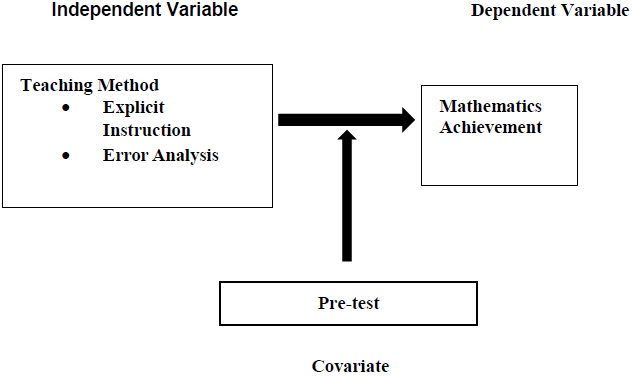
The schematic diagram of the study is shown in figure one. The independent variables of the study is the teaching method, namely, the explicit instruction and the error analysis. Error analysis is a method wherein students would identify the errors committed through the given activity, exercise and assignment.

The focus of this study is to determine the significant impact of having explicit instruction, and error analysis in Mathematics in the Modern World to Bachelor in Technical-Vocational Teacher Education (BTVTEd) students in improving their academic performance . Moreover, the study intends to answer the following:
1. What is the pretest and posttest mathematics achievement scores of the when exposed to the explicit instruction and error analysis method?
2. Is there a significant difference on the students’ mathematics achievement scores when exposed to explicit instruction and error analysis method?
1.3. Scope and Limitation of the StudyThe participants of this study were Third Year Bachelor in Technical-Vocational Teacher Education students of the University of Science and Technology of Southern Philippines Cagayan de Oro Campus, enrolled in Mathematics in the Modern World course during the First Semester of the Academic Year 2024-2025.
The topics included in this study were Polya’s Problem Solving Strategy, Descriptive Statistics, Measures of Central Tendency, Measures of Variability. Simple Interest, Compound Interest, lastly, Annuity, Loans and Investment were the lessons during the conduct of the study. The focus of this study was to investigate the students’ mathematics achievement as influence to two method the first one is explicit instruction and the second one is Error Analysis as a teaching method.
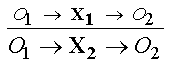
This study employed a quasi-experimental pre-test-posttest comparative group design that was used to determine the impact of using explicit instruction, and error analysis as a teaching methods on the participants’ mathematics achievement. The treatment (X1) represented by the explicit instruction and the treatment (X2) used error analysis as a teaching method.
As shown in the Figure 2, the study were composed of two (2) intact sections and were assigned as group exposed to explicit instruction and the group exposed to error analysis. These groups were given a pre-test ( ) and a posttest (
 ).
).

The research instrument used in this study is a 20 item multiple choice test questionnaire for pre-test and posttest. The test includes topic in Polya’s Problem Solving Strategy, Descriptive Statistics, Measures of Central Tendency Measures of Variability ,Simple Interest, Compound Interest and Annuity, Loans and Investments. This instrument was used for the pretest and the same instrument was used for the posttest. The time allotted to answer this instrument was one hour. Moreover, the questionnaires were assessed for its internal consistency thus leading to this small number of questions remaining with a reliability index of 0.80. This reliability index is highly acceptable this means that the research instrument will give a consistent result when taken with the same set of students.
The second instrument was a lesson plan. The lesson plan of those exposed to error analysis is parallel towards those exposed to explicit instruction. It just that those exposed in error analysis had an additional contents for finding or spotting the errors. The lesson plan was checked by experts before the implementation of the study. Each lesson was allotted for one hour and thirty minutes. The lesson plan was used as a guide in the implementation of the method in the class instruction.
2.3. Data Gathering ProcedureUpon the proper approval from school authority, the experiment started. The researcher administered the pre-test using the teacher-made Mathematics Achievement Test to both groups. The participants were given one hour to answer the questions. After the pre-test, the students are exposed to the respected method, the first group were taught using explicit instruction while the second group were instructed using Error Analysis.
The study was conducted for two months or 16 weeks error analysis, and explicit instruction had the same topics or coverage. Though they had the same coverage those instructed using error analysis was given two to three error analysis questions as a review activity before the formal start of the discussion of the new topic. During the discussion, the students then were given problems with wrong solutions as well as problems that they need solve on their own. A group activity was conducted for both groups wherein errors with solutions and answers were given and be checked by the students in the error analysis group. Furthermore, those taught using explicit instruction had review activity, were given examples with solutions, afterwards they worked on their own with the guidance of the teacher, then on their self-exploration. Consequently, they had a group activity, individual assessments as well as assignments.
During the conduct of this study, the teacher-researcher facilitated the learning of the participants. The classroom environment was prepared to facilitate an active, responsible and engaged community of learners.
Moreover, an assignment were given as a preparation for their next topic. The explicit instruction group was given an exercise or a problem for the next lesson applying the correct formula or concept while the error analysis group was given the same question only that there were some questions which involved spotting an error in it and students should identify.
After the implementation of the study, a post-test was given to both the experimental and the control group to test if there is a significant effect in the method used.
2.4. Data AnalysisTo determine the pre-test and post test scores of the students’, descriptive analysis was employed using the mean and standard deviation. The Analysis of Covariance (ANCOVA) was used to determine if there was a significant difference between achievement of the two groups.. Furthermore, all assumptions for ANCOVA were tested and were found to be satisfied. In line with this the result can be treated with confidence and ensured validity.
The table presents the descriptive analysis of the mean scores and standard deviation of the students’ achievement scores before and after the intervention. The mean scores reveal that the students who are exposed to explicit instruction have a higher score with a mean of 7.50 while those exposed to error analysis scored lower with a mean of 6.47. This means that before the conduct of the experimentation both students exposed to explicit instruction and error analysis have a low background on the selected topics in Mathematics in the Modern World.
Furthermore, the results of after intervention showed that those taught using explicit instruction have achieved a significantly higher level of improvement in mathematics achievement compared with those in error analysis group. Those exposed to explicit instruction recorded a mean posttest score of 12.53 (SD = 2.81) in the unadjusted results and 12.44 (SD = 2.75) in the adjusted results. In contrast, those students who are exposed to error analysis had showed a lower mean post test scores compared to explicit instruction mean of 9.69 (SD=2.68) while the adjusted mean is 9.78 (SD=2.75). These findings unequivocally indicate that the explicit instruction outperformed the error analysis method in fostering immediate academic improvement of the students. These suggest that the students exposed in explicit instruction scored higher compared to those employing error analysis as a teaching method.
The analysis of covariance shown in Table 2 revealed that there is no significant influence of the pre-test toward the mathematics achievement of the students F(1, 61) = 1.94, p = 0.17. This further indicates that the initial pretest different did not affect much on the variance of the post test scores. Moreover, this suggest that prior knowledge of the students did not have a large impact towards the result.
Conversely, the group effect was significant F(1,61)=14.69, p<0.0001, it implies that the method used in the intervention significantly influenced the achievement score of the students. This further suggest that the post-test achievement score of those students exposed in explicit instruction varies to those students exposed in error analysis. Therefore, there is a significant difference between the pretest and post test scores of the students exposed to explicit instruction, and error analysis. This further suggests that students.
The pre-test did not have a significant impact towards the post-test. This suggest that students’ prior knowledge did not affect the resulting posttest. Additionally, the scores of the students both group improved during the post-test. However, it worth noting that those exposed to explicit instruction group scored higher than the those in error analysis.
There is a significant difference between the achievement scores of the students. This can be attributed on the method used namely, explicit instruction, and error analysis. The use of explicit instruction is more effective than the use of error analysis as a teaching strategy. The effectiveness of traditional methods is often linked to their ability to facilitate straightforward assessment .This allows educators to measure student understanding objectively and efficiently. Many studies indicate that students often perform well academically under traditional methods due to the structured nature of these approaches 8. It is recommended that teachers discussed mathematics topics using explicit instruction.
The researchers extend their heartfelt gratitude to all people who made this research possible especially to BTVTEd students who are the participants of the study, and their colleagues for the support throughout the implementation of the study.
| [1] | Abalde, G. D., & Oco, R. M. (2023). Factors associated with mathematics performance. Asian Research Journal of Mathematics, 19(6), 45–60. | ||
| In article | View Article | ||
| [2] | Aguhayon, H.G., Tingson, & Pentang, J.T. (2023). Addressing Students Learning Gaps in Mathematics through Differentiated Instruction. International Journal of Educational Management and Development Studies, 4 (1), 69-87. | ||
| In article | View Article | ||
| [3] | Ancheta, C. M. (2022). An Error Analysis of Students’ Misconceptions and Skill Deficits in PreCalculus SubjectsJournal for Educators, Teachers and Trainers,Vol. 13(5). 283-295. | ||
| In article | View Article | ||
| [4] | Bandahala, D. E. (2024). Explicit instruction in teaching general mathematics and the application of concrete – Pictorial-Abstract approach. INTERNATIONAL JOURNAL OF MULTIDISCIPLINARY RESEARCH AND ANALYSIS, 07(10). | ||
| In article | View Article | ||
| [5] | Bernas, K. (2022, February 1). Grade 9 learners’ engagement and performance in flipped Mathematics classroom. https:// papers.ssrn.com/sol3/papers.cfm?abstract_id=4595154#. | ||
| In article | |||
| [6] | Bruner, J. S. (1961). The act of discovery. Harvard Educational Review, 31, 21–32. | ||
| In article | |||
| [7] | Carang ESP, Caguete RR, and Balmes JMR. (2024). Attitude and challenges in learning mathematics in the modern world (MMW): basis for intervention program, Int. J. Mat. Math. Sci., 6(3), 85-99. | ||
| In article | View Article | ||
| [8] | Cielo, A., Lopez, M. P., Torres, J., Tenio, A., & Fuente, A. L. D. (2019). Effectiveness of Traditional Method of Teaching in Academic Performance of General Academic Strand Students at Bestlink College of the Philippines. Ascendens Asia Singapore – Bestlink College of the Philippines Journal of Multidisciplinary Research, 1(1). https:// ojs.aaresearchindex.com/ index.php/ aasgbcpjmra/article/view/1245. | ||
| In article | |||
| [9] | Dewey, J. (1938). Experience and Education. New York: Macmillan Company. | ||
| In article | |||
| [10] | Fahrudin, D., Mardiyana, & Pramudya, I. (2019). Profile of students’ errors in trigonometry equations. Journal of Physics: Conference Series, 1188, 012044. | ||
| In article | View Article | ||
| [11] | Kolb, D. A. (2014). Experiential Learning: Experience as the Source of Learning and Development. New Jersey: FT Press. | ||
| In article | |||
| [12] | Lai, C. (2012.). Error analysis in Mathematics. Technical Report #1012. https://eric.ed.gov/?id=ED572252. | ||
| In article | |||
| [13] | Mabena, N., Mokgosi, P. N., & Ramapela, S. S. (2021). FACTORS CONTRIBUTING TO POOR LEARNER PERFORMANCE IN MATHEMATICS: A CASE OF SELECTED SCHOOLS IN MPUMALANGA PROVINCE, SOUTH AFRICA. Problems of Education in the 21st Century, 79(3), 451–466. | ||
| In article | View Article | ||
| [14] | Magulod, G.C., Jr. (2019). Learning styles, study habits and academic performance of Filipino university students in applied science courses: Implications for instruction. Journal of Technology and Science Education, 9(2), 184-198. | ||
| In article | View Article | ||
| [15] | Makamure, C., & Jojo, Z. (2022). An analysis of errors for pre-service teachers in first order ordinary differential equations. Eurasia Journal of Mathematics, Science and Technology Education, 18(6), em2117. | ||
| In article | View Article | ||
| [16] | Nahdi, D. S., & Jatisunda, M. G. (2020). Conceptual Understanding and Procedural Knowledge: A case study on learning mathematics of fractional material in elementary school. Journal of Physics, 1477(4), 042037. | ||
| In article | View Article | ||
| [17] | Pappas, C. (2023, May 8). A guide to Vygotsky’s zone of proximal development and scaffolding. eLearning Industry. . | ||
| In article | |||
| [18] | Pelayo, E. O., & Tan, R. G. (2025). The Influence of Social Trends-Based Instruction on Students’ Mathematical Problem-Solving Skills. American Journal of Educational Research, 13(1), 23-28. | ||
| In article | View Article | ||
| [19] | Peligro, R.M., Luna, C.A., & Lomibao, L.S. (2017). Students’ error Analysis on a given Geometric Proofs and Solutions: Its Effect on their Achievement and Conceptual Understanding. | ||
| In article | |||
| [20] | Rong, L., & Mononen, R. (2022). Error analysis of students with mathematics learning difficulties in Tibet. Asian Journal for Mathematics Education, 1(1), 52–65. | ||
| In article | View Article | ||
| [21] | Rushton, S. J. (2018). Teaching and learning mathematics through error analysis. Fields Mathematics Education Journal Volume, 3(1). | ||
| In article | View Article | ||
| [22] | Valtoribio, D., Gurat, M., & Bautista, G. (2018). Exploring Students‟ Image Concepts of Mathematical Functions Through Error Analysis. International Journal of Advanced Research and Publications, 2(9), pp. 33-46. | ||
| In article | |||
Published with license by Science and Education Publishing, Copyright © 2025 Angel Caroline A. Casiño and Rosie G. Tan
 This work is licensed under a Creative Commons Attribution 4.0 International License. To view a copy of this license, visit
http://creativecommons.org/licenses/by/4.0/
This work is licensed under a Creative Commons Attribution 4.0 International License. To view a copy of this license, visit
http://creativecommons.org/licenses/by/4.0/
| [1] | Abalde, G. D., & Oco, R. M. (2023). Factors associated with mathematics performance. Asian Research Journal of Mathematics, 19(6), 45–60. | ||
| In article | View Article | ||
| [2] | Aguhayon, H.G., Tingson, & Pentang, J.T. (2023). Addressing Students Learning Gaps in Mathematics through Differentiated Instruction. International Journal of Educational Management and Development Studies, 4 (1), 69-87. | ||
| In article | View Article | ||
| [3] | Ancheta, C. M. (2022). An Error Analysis of Students’ Misconceptions and Skill Deficits in PreCalculus SubjectsJournal for Educators, Teachers and Trainers,Vol. 13(5). 283-295. | ||
| In article | View Article | ||
| [4] | Bandahala, D. E. (2024). Explicit instruction in teaching general mathematics and the application of concrete – Pictorial-Abstract approach. INTERNATIONAL JOURNAL OF MULTIDISCIPLINARY RESEARCH AND ANALYSIS, 07(10). | ||
| In article | View Article | ||
| [5] | Bernas, K. (2022, February 1). Grade 9 learners’ engagement and performance in flipped Mathematics classroom. https:// papers.ssrn.com/sol3/papers.cfm?abstract_id=4595154#. | ||
| In article | |||
| [6] | Bruner, J. S. (1961). The act of discovery. Harvard Educational Review, 31, 21–32. | ||
| In article | |||
| [7] | Carang ESP, Caguete RR, and Balmes JMR. (2024). Attitude and challenges in learning mathematics in the modern world (MMW): basis for intervention program, Int. J. Mat. Math. Sci., 6(3), 85-99. | ||
| In article | View Article | ||
| [8] | Cielo, A., Lopez, M. P., Torres, J., Tenio, A., & Fuente, A. L. D. (2019). Effectiveness of Traditional Method of Teaching in Academic Performance of General Academic Strand Students at Bestlink College of the Philippines. Ascendens Asia Singapore – Bestlink College of the Philippines Journal of Multidisciplinary Research, 1(1). https:// ojs.aaresearchindex.com/ index.php/ aasgbcpjmra/article/view/1245. | ||
| In article | |||
| [9] | Dewey, J. (1938). Experience and Education. New York: Macmillan Company. | ||
| In article | |||
| [10] | Fahrudin, D., Mardiyana, & Pramudya, I. (2019). Profile of students’ errors in trigonometry equations. Journal of Physics: Conference Series, 1188, 012044. | ||
| In article | View Article | ||
| [11] | Kolb, D. A. (2014). Experiential Learning: Experience as the Source of Learning and Development. New Jersey: FT Press. | ||
| In article | |||
| [12] | Lai, C. (2012.). Error analysis in Mathematics. Technical Report #1012. https://eric.ed.gov/?id=ED572252. | ||
| In article | |||
| [13] | Mabena, N., Mokgosi, P. N., & Ramapela, S. S. (2021). FACTORS CONTRIBUTING TO POOR LEARNER PERFORMANCE IN MATHEMATICS: A CASE OF SELECTED SCHOOLS IN MPUMALANGA PROVINCE, SOUTH AFRICA. Problems of Education in the 21st Century, 79(3), 451–466. | ||
| In article | View Article | ||
| [14] | Magulod, G.C., Jr. (2019). Learning styles, study habits and academic performance of Filipino university students in applied science courses: Implications for instruction. Journal of Technology and Science Education, 9(2), 184-198. | ||
| In article | View Article | ||
| [15] | Makamure, C., & Jojo, Z. (2022). An analysis of errors for pre-service teachers in first order ordinary differential equations. Eurasia Journal of Mathematics, Science and Technology Education, 18(6), em2117. | ||
| In article | View Article | ||
| [16] | Nahdi, D. S., & Jatisunda, M. G. (2020). Conceptual Understanding and Procedural Knowledge: A case study on learning mathematics of fractional material in elementary school. Journal of Physics, 1477(4), 042037. | ||
| In article | View Article | ||
| [17] | Pappas, C. (2023, May 8). A guide to Vygotsky’s zone of proximal development and scaffolding. eLearning Industry. . | ||
| In article | |||
| [18] | Pelayo, E. O., & Tan, R. G. (2025). The Influence of Social Trends-Based Instruction on Students’ Mathematical Problem-Solving Skills. American Journal of Educational Research, 13(1), 23-28. | ||
| In article | View Article | ||
| [19] | Peligro, R.M., Luna, C.A., & Lomibao, L.S. (2017). Students’ error Analysis on a given Geometric Proofs and Solutions: Its Effect on their Achievement and Conceptual Understanding. | ||
| In article | |||
| [20] | Rong, L., & Mononen, R. (2022). Error analysis of students with mathematics learning difficulties in Tibet. Asian Journal for Mathematics Education, 1(1), 52–65. | ||
| In article | View Article | ||
| [21] | Rushton, S. J. (2018). Teaching and learning mathematics through error analysis. Fields Mathematics Education Journal Volume, 3(1). | ||
| In article | View Article | ||
| [22] | Valtoribio, D., Gurat, M., & Bautista, G. (2018). Exploring Students‟ Image Concepts of Mathematical Functions Through Error Analysis. International Journal of Advanced Research and Publications, 2(9), pp. 33-46. | ||
| In article | |||