This research was conducted to address the students’ speaking skills adversities, increase self-esteem, and reduce nervousness during speaking activities inside an English class using GALAK-TUWA, a classroom-based intervention program. This research employed quantitative and qualitative designs using action research and narratology as approaches. Data revealed that (1) the Pre-test and Post-test results have significant differences, which mean that the intervention program enhanced the participants’ speaking skills, boosted self-esteem, and reduced nervousness level; (2) when the participants’ nervousness level decreases, their self-esteem increases; (3) giving rewards could be a motivation to participate in the game that ripples to their active participation in the class discussion; (4) the GALAK-TUWA intervention program is effective and beneficial in developing the participants’ speaking aptitude, and boosting self-esteem and reducing nervousness level while speaking; and (5) when a learning environment is fun, stress-free, and comfortable, learning takes place that hone skills development, boosting self-esteem, and reducing nervousness to speak. The findings of this study suggest that the intervention program is effective and beneficial to students who have difficulty in boosting their English-speaking skills. With this, language teachers may adapt the program to enhance their students’ communicative skills in their target languages thereby making them avoid the use of code-switching in a daily discourse and formal setting. The results of this study are critical evidence that games are effective in the teaching and learning processes complimenting the idea of Richard N. Landers. Thus, gamified learning may be used in a classroom, especially in a non-gaming environment.
Speaking skills play a critical role in expressing or communicating thoughts, especially in the classroom. Among the five macro skills in English, speaking is a significant skill that the students should hone because it helps them in various activities that tremendously impact their academic performances inside the class, such as oral recitation, reporting, role-playing, among others. According to reference 1, the students need to learn this skill to achieve their ambitions, goals, and desires to succeed in their respective fields. Indeed, English is an international language, which means that this language is widely used around the world.
Furthermore, according to a conducted research study 2, the students are governed by the “English Only Policy” in their English-related subjects. Their English teachers strictly impose this policy on students to develop their capabilities to speak English in their daily activities. With this, L2 learners encounter difficulties in following the policy 3.
For instance, the approach of teaching and learning processes today is learner-centered, where the students are the main focus of the process and teachers are their facilitators 4. In this approach, the students are expected to participate in the class by explaining, giving examples, sharing knowledge about something, and the like. In this connection, the students are required to speak. Since they have difficulty following the mentioned policy, the probability there is that they will remain silent because they may not express their thoughts clearly and logically. This attitude signifies that they have fear in speaking, which may cause them to fail 5.
In addition, research findings revealed four reasons why students cannot follow the policy well aside from they cannot express themselves freely and clearly: (i) thinking of failing, (ii) being judged by others, (iii) being misunderstood by the listeners, and (iv) committing grammar mistakes 6. These mentioned four reasons are complemented by a study 7 by adding another reason, which is pronunciation and intonation imperfections.
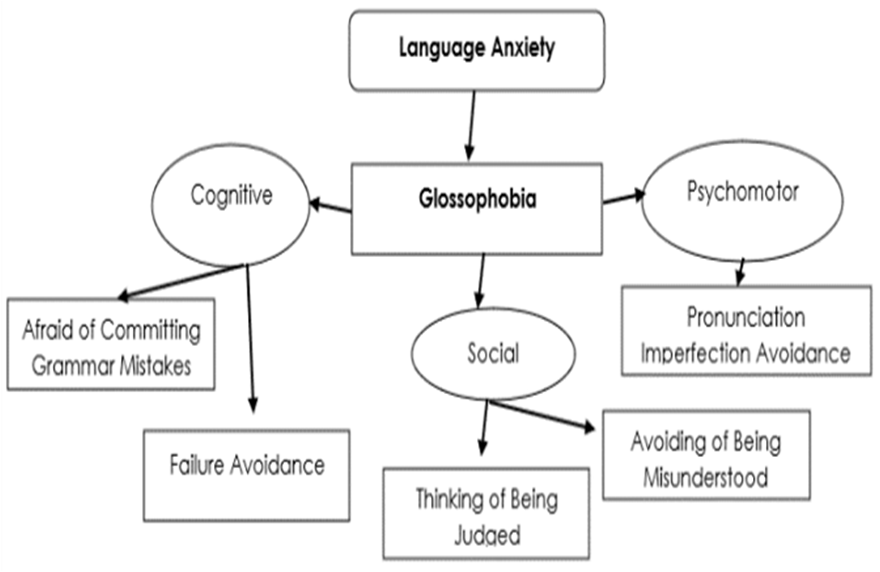
In a conducted study 8, they cited another study 9 stating that if the students have the mentioned identified five reasons, they have “Language Anxiety.” This anxiety is a language learning situation where a student is asked to speak a second or foreign language in public, having the risk of social embarrassment that negatively impacts the language learning (similar to Glossophobia) 9. Thus, language anxiety is shown in the Figure 1: an illustration of the indicators of having Language Anxiety including its specific aspects of categories 8:

Since the students are afraid to speak English in public due to the aforementioned common causes, the researchers of this study envisioned to address students’ adversities in speaking English inside the class during speaking and related activities using an intervention program in a classroom-based setting through an action research design.
Specifically, it worked on the following objectives:
1. assess students’ English-speaking skills using the International English Language Testing System (IELTS) rubrics and levels of confidence and nervousness during speaking activities before and after an intervention program;
2. determine the differences in the students’ English-speaking skills and levels of confidence and nervousness in their Pre-test and Post-test results;
3. administer various speaking games as strategies in every lesson as a method to implement the intervention program; and
4. provide speaking games to boost students’ self-confidence in speaking English.
1.2. Theoretical Framework of the StudyGamified Learning Theory brings a non-gaming learning atmosphere to be interactive. Though gamification does not directly impact learning, it kindles learning-related attributes and behaviors in a mediating or moderating process. This theory increases students’ involvement and motivation to perform better while learning and absorbing novelty information and concepts. Further, through gamified learning, the teacher encourages students to participate and collaborate with their classmates using their five macro skills. Among these skills, the speaking skills are focused on being developed because games are more on verbal communication skills.
Aside from this, the students are taught to be more competent and productive to show their capability in the global job market, which is one of the objectives of K to 12 Curriculum: to develop globally competitive students 10.
However, the elements of gamification, such as point scoring, peer competition, teamwork encouragement, testing knowledge and new information assimilation, can be used as instructional materials by the teacher in teaching the lesson and fostering the macro skills, especially in language-related subjects.
Ultimately, Richard N. Landers, a proponent of this theory, claimed that gamified environment leads to learning gains 11. That is, gamification strengthens critical educational skills such as problem-solving, collaboration, and communication 12.
This study employed the quantitative and qualitative research designs using action research and narratology as approaches.
The data were collected from the respondents’ Pre-test and Post-test results. The researchers used an adapted interview questionnaire from a conducted action research 13 that contains two parts: general self-introduction and picture description. The researchers used an oral evaluation sheet adapted from the International English Language Testing System (IELTS) rubrics to assess their speaking skills during the face-to-face interview. Also, Observation sheets during Pre-test and Post-test were employed to determine the enhancement of the students’ nervousness and confidence levels.
Moreover, the researchers analysed the data using statistical tools such as the Wilcoxon Signed-Rank Test for comparing and determining the significant differences between the Pre-Test and Post-Test results and Mean Distribution for getting the average of the Pre-Test and Post-Test results and determining the participants’ satisfactory level per criterion and factor. Thematic analysis was also used to analyze the observations about the confidence and nervousness of the participants during the Pre-test and Post-test.
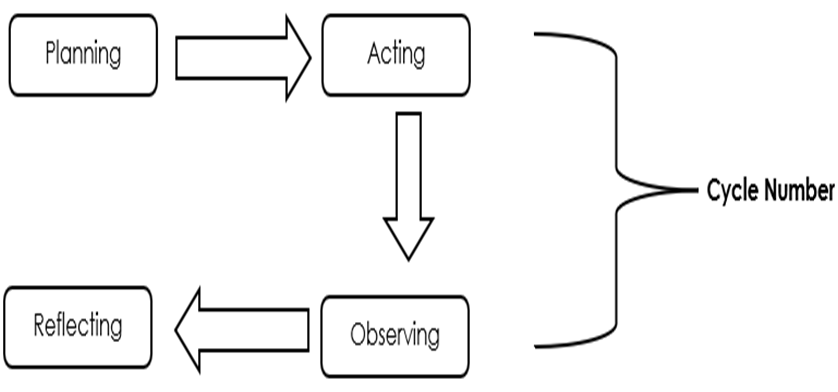
However, in conducting this study, the researchers followed Kurt Lewin’s Action Research Design 14:

Furthermore, the researchers addressed the identified problems from the Pre-test results on April 21, 2022, using an intervention program. Besides, the problems are expected to be solved after administering the classroom-based intervention program, the GALAK TUWA. Below is the descriptions of the intervention program:
2.1. Intervention ProgramThe Games for Active Learning speaking English Abilities as a Kombat to Thread of Unwanted difficulties to Win self-esteem in speaking Aptitude (GALAK-TUWA) program is aimed to address the adversities of students in their English-speaking skills, boost their confidence, and reduce their nervousness levels to speak in the class using a various planned set of games in every cycle.
Albert Einstein once said that the highest form of research is playing. This means that the students learn effectively if they are playing. The researchers administered this program in every lesson. That is, the researchers conducted the intervention program by employing it as a strategy in teaching.
The Pre-test results showed that there are four major problems of the students in terms of pronunciation and intonation, fluency, accuracy and range (grammatical structures), vocabulary (lexical resource), and external factors like low confidence level and high level of nervousness.
The researchers allowed the students undergo four cycles. This GALAK-TUWA has one cycle for each problem, and the two identified external factors were addressed in each cycle, according to Kurt 14, as shown below:
Furthermore, the table below shows the set of games that the researchers administered in each cycle to address the target problem of each cycle. Each game uses a reward system as motivation for the participants to do their best.
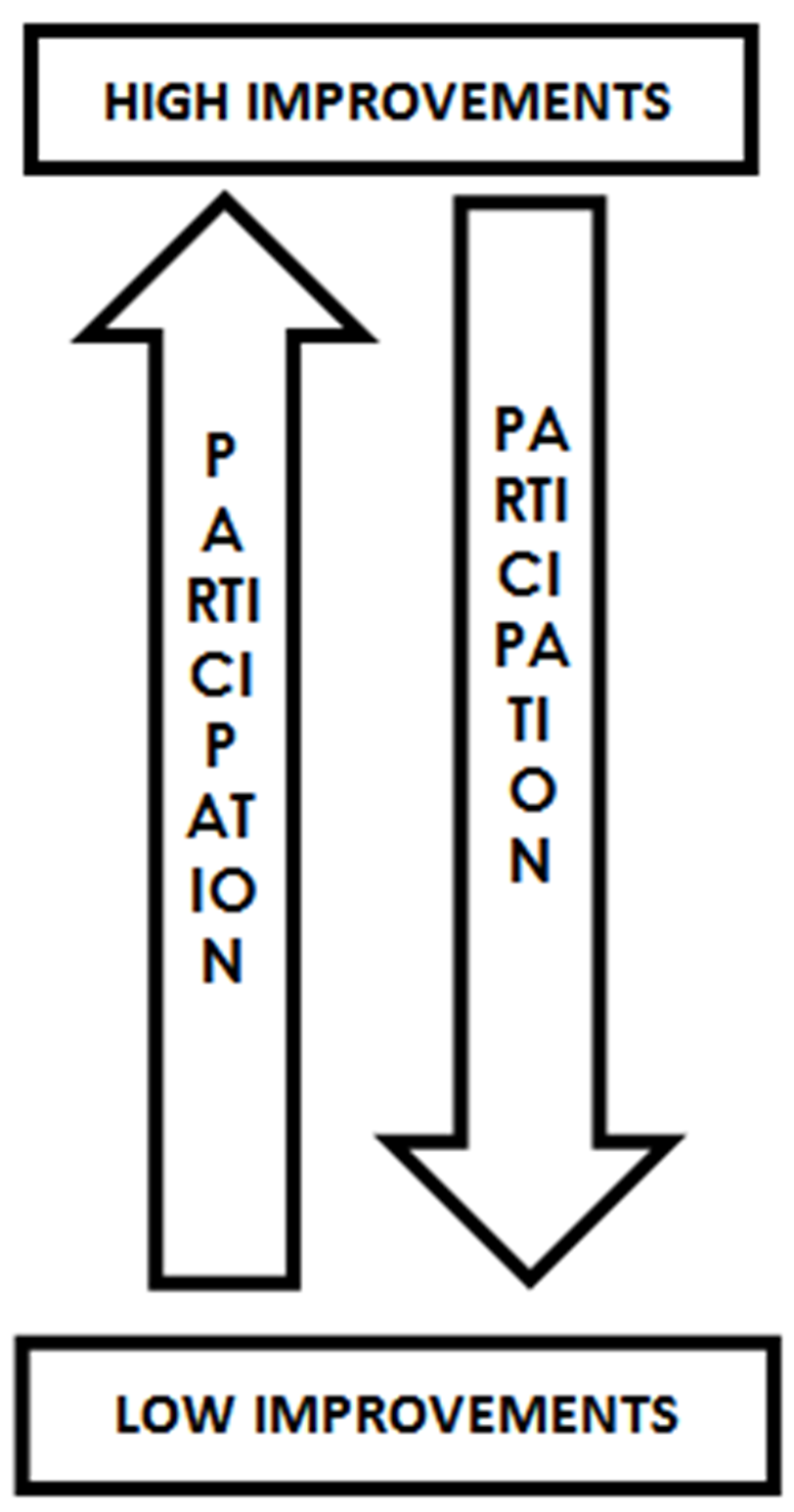
Ultimately, this intervention program is designed for students to interact and collaborate to boost their confidence, eliminate their nervousness when speaking English, and improve their speaking skills. Thus, the illustration below shows how active participation affects the students’ improvements:

Figure 3 shows how participation in the set of games affect improvements. The higher the participation of a student in the administered games, the higher is the chance of their improvement. On the other hand, the lower their participation, the lower is the chance to have enormous improvements—there will be improvements but not as high as those who will highly participate.
Before conducting this study, one of the researchers taught seven lessons to establish ease and a friendly environment where the learners were comfortable with him. After teaching these lessons, one of the researchers started the study by administering a Pre-test to determine what specific problems in their speaking skills need to be addressed. Thus, the table below shows the results of the Pre-test administered:
Table 3 displays the mean distributions of the Pre-test and Post-test results of the participants. The results revealed that the students performed “Poorly” during their Pre-test in all criteria in the oral evaluation sheet. On the other hand, the students showcased “Excellent” performances during their Post-test. Therefore, the students developed their speaking skills and the two identified external factors, which are the levels of nervousness (reduced) and confidence (increased).
In this connection, if the participants are excellent with the mentioned criteria, their nervousness level is low, and their self-confidence level is high; thus, affecting their academic performance.
The foregoing results are complimented by a study 15 in which the results revealed that low speaking skills might affect the levels of self-confidence, anxiety, worry and fear, which in turn may affect academic performance. That is, self-confidence significantly correlates with speech achievement—the students with high self-confidence and low nervousness to speak have higher achievement 15. Thus, to have higher confidence and low nervousness levels, there is a need to improve speaking skills because when the nervousness starts to decrease, the confidence will increase 16.
Table 4 presents the Wilcoxon Signed-Rank Test of the Pre-test and Post-test results on the pronunciation and intonation of the participants. The results revealed a significant difference. This indicates that the participants' pronunciation and intonation are improved, pre-test and post-test results. This means that their pronunciation and intonation are always accurate, clear, and understandable. Therefore, the games administered to improve the pronunciation and intonation of the intervention program are effective.
In addition, one of the researchers observed the following during the reading sessions: (a) correcting them immediately, (b) helping them out to pronounce whenever they stop or reutter the word as evidence of difficulty to pronounce, (c) checking them after reading the whole sentence by pronouncing the word correctly, (d) and stating the proper intonation of the sentence and asking the whole class to follow are ways and strategies to feel that they are cared for by the teacher and to learn easier the proper way of pronouncing the word and the correct intonation of phrase or a sentence.
For instance, for the word “Mischievous”, the students pronounced it as /mis-chee-vee-ee-us/. Another example is that, for proper intonation, instead of having a rising intonation to the end of this interrogative sentence: “How are you?”, they intonated it as a declarative sentence.
The foregoing observations are complemented by reference 17 when they stated that repeating the mispronounced word with proper pronunciation and immediate teacher-oriented correction of mispronounced words are preferred by the students among the correction strategies for them to learn the proper pronunciation and intonation of the word. Besides, these mentioned results are supported by a reference 18 when they suggested that gamification can be used as a strategy in teaching English pronunciation and intonation.
Table 5 displays the Wilcoxon Signed-Rank Test of the Pre-test and Post-test results on the fluency of the participants. The results revealed that there is a significant difference. This implies that the intervention program improved the participants’ fluency. This means that they can now speak spontaneously, with little hesitation that does not interfere with communication. In conclusion, the speaking games administered in that cycle are all effective and contributing factors to their significant development.
The foregoing results are supported by a blog 19, stating that games are effective educational tools that English learners can play to develop their fluency. Another blog 20 also agreed with the results because games can assist an individual with lower proficiency in English-speaking fluency to eliminate hesitation that may interfere with communication and help them speak fluently.
In addition to the results, one of the researchers observed that when the learning atmosphere is fun, at ease, and comfortable, the participants do not hesitate to speak English even if there are grammatical mistakes. They do not mind others if they are judging them or measuring their capabilities based on their fluency.
The mentioned observations are true in the two cited journal articles 21, 22 when they concluded that the students could speak fluently if the learning environment is fun, comfortable, and low stress. On the other hand, the mentioned observation contradicts a study 23 regarding individual differences of the students in which the applicable strategy to one student does not apply to other students, and differentiated instruction should be made.
Table 6 shows the Wilcoxon Signed-Rank Test of the Pre-test and Post-test results on the participants' accuracy and range (grammatical structures). The results revealed a significant difference between the Pre-test and Post-test results. This suggests that the intervention program improved their accuracy and range (grammatical structures). This means that the participants can express their thoughts using a variety of structures and commit errors ranging from “some” to “occasionally.” With this, the games administered to the cycle are beneficial and effective in their accuracy and range developments.
Further, the foregoing results were complemented by a study 24 when the results revealed that games are effective in teaching grammar to learners. Consequently, their study 23 suggested that the EFL teachers who frequently use games in teaching grammar should use gamification as a teaching strategy, and they accepted it.
In addition, to strengthen the foregoing results, one of the researchers observed that during the Pre-test, the participants had troubles along their basic rule of Subject-Verb Agreements and Pronoun Antecedent Agreements.
First, the participants did not know when to use the plural and singular verb, the plural form of a certain noun, and the use of present and past tenses. For instance, instead of saying “Children” for the plural form of “Child,” they would say, “Childs”. Another example is that instead of using plural present tense “are” for the subject “People,” they would say, “People is...”.
The last example is that when they are required to recount one memorable experience, they used present tenses of the verb and vice versa when they are asked to talk about something that is going on at present.
Second, the participants did not know when to use the pronouns: its, he and she. For example, when talking about their male classmate, they use the pronoun “its”, and they confusedly utter the pronoun “she” for male and vice versa.
However, during their Post-test, the researcher observed that the mentioned flaws were improved, and minimal errors were found in their sentences compared to their Pre-test.
Moreover, the above-mentioned observations are supported by the studies 21, 24 when they said that games could help increase students’ proficiency in grammar communication. After all, using grammar games allows students to use the language to communicate and collaborate with their classmates freely and authentically.
Table 7 illustrates the Wilcoxon Signed-Rank Test of the Pre-test and Post-test results on the participants' vocabulary (lexical resource). The results revealed a significant difference between the Pre-test and Post-test results. This implies that participants’ vocabulary was developed wherein they can use a variety of vocabulary and expressions. Then, some make “some” and “no” errors in their word choice, making their sentences clear, accurate, and meaningful. In this connection, it is concluded that the games administered in the cycles were effective and useful in widening and extending students’ lexical resources.
The foregoing results complemented the studies 9, 25, 26 and a blog 27 when they claimed that employing vocabulary games in class while teaching a lesson can be useful to improve and widen students’ vocabulary buildings and mastery. After all, they can memorize the word in the game, interact with their classmates, and improve their communicative skills 24.
In addition, one of the researchers observed that during their Pre-test, the participants used basic words they often utter repeatedly. Their word choices were unsuitable and did not complement what they really meant, thus, one of the researchers always asked them to rephrase their thoughts. However, during their Post-test, the participants could express their thoughts well by utilizing beyond basic words (considering their grade level and ages). They were not repeating words like when they uttered the word “sad”, they would next utter the synonyms of that word like “melancholia,” “pessimism,” and “sorrow.”
In conclusion, based on the observations and the foregoing results, the participants improved their vocabulary (lexical resource), and they can apply it well when communicating with their classmates during class activities.
Table 8 shows the emerging themes of the researchers’ observations regarding the self-esteem and nervousness of participants during the Pre-test and Post-test. The themes revealed that their levels of confidence and nervousness were developed in comparison of during the Pre-test and Post-test. That is, their confidence was boosted, and their nervousness was reduced. Therefore, all the games administered throughout the intervention program effectively boosted their self-confidence and reduced their nervousness to speak.
In addition, one of the researchers observed that the lower the participants’ nervousness level is, the higher is their self-confidence. That is if a student has good speaking skills, the level of nervousness is low; the confidence level is high, and vice versa.
The foregoing results and observations were supported by a study 5 that found a statistically significant negative correlation between social anxiety and self-esteem. This means that if social anxiety decreases, self-esteem increases, and vice versa.
Moreover, one of the researchers observed that the participants increased their self-esteem by participating in the game. Also, they were motivated to participate because the reward would be given to the winner, and all of them were eager to win. This observation is supported by a reference 28 when she stated that gamification helps to increase engagement by giving them incentives as a reward for the learners.
Further, one of the researchers noted that as they played the administered speaking games during the various lessons, the learning atmosphere became fun, engaging, and low-stress. With this, the participants freely expressed themselves using the English language without any indication of nervousness. This observation is complemented by a reference 29 when her study found that games as a stress-free tool are potential methods of reducing students' anxiety to develop their speaking skills.
Lastly, one of the researchers observed that during the Pre-test, the participants pulled themselves not to speak much because they were unconfident with what they were saying. In addition, the nervousness was there due to their mannerisms, like sweating, fidgeting, and squeaky voice. However, these indications of nervousness were reduced and could not be traced during the Post-test.
Based on the foregoing results, the following are concluded: (1) the Pre-test and Post-test results have significant differences, which mean that the intervention program enhanced the participants’ speaking skills, boosted self-esteem, and reduced nervousness level; (2) when the participants’ nervousness level decreases, their self-esteem increases; (3) giving rewards could be a motivation to participate to the game that ripples to their active participation in the class discussion; (4) the GALAK-TUWA intervention program is effective and beneficial in developing participants’ speaking aptitude, and boosting self-esteem and reducing nervousness level while speaking; and (5) when a learning environment is fun, stress-free, and comfortable, learning takes place, skills development, boosting self-esteem, and reducing nervousness to speak.
The findings of this study suggested that the intervention program is effective and beneficial to students who have difficulty in boosting their English-speaking skills—the higher their participation, the higher is their chance of developing. However, it is indispensable to note that the program’s efficacy depends on the students' participation. Hence, Richard N. Landers claimed that in establishing a gamified learning atmosphere, a reward system should be encouraged to motivate students to participate as this study found out 11. Likewise, when utilizing the study's intervention program in a classroom, a reward system should be used to increase students' motivation, participation, and engagement in the games 22 to achieve the target goal.
Furthermore, English teachers who are challenged in developing and boosting students with their English-speaking skills are encouraged to use or to replicate GALAK-TUWA program as part of the teaching and learning processes 30. Also, with the flexibility of this intervention, Filipino teachers may adapt the program to boost their students’ Filipino communication skills to help them avoid code-switching. Lastly, the idea of the gamified environment should be established in a classroom, and applying the intervention program used in this study is a stepping stone towards the said goal.
| [1] | Rao, P.S. (2019). Tne Importance pf Speaking Skills in English Classrooms. Alford Council of International English & Literature Journal (ACIELJ), 6-18. | ||
| In article | |||
| [2] | Villanueva, B., Pagdato, A., Advincula, C., Tiballa, N., & Tamon, C.-j. (2020). Effects of English-Only Policy to Students’ Class Participation in Bestlink College of the Philippines, S.Y. 2019-2020. Ascendens Asia Singapore – Bestlink College of the Philippines Journal of Multidisciplinary Research. | ||
| In article | |||
| [3] | Buckley, D. (2022). The Pros and Cons of English Only in the Classroom. Retrieved from Man Writes: https://manwrites.com/the-pros-and-cons-of-english-only-in-the-classroom/#. | ||
| In article | |||
| [4] | Tout, D. (2016, June 16). The teacher as a facilitator and resource person. Retrieved from Teacher Magazine: https://www.teachermagazine.com/au_en/articles/the-teacher-as-a-facilitator-and-resource-person. | ||
| In article | |||
| [5] | Murad, O. S. (2020). Social Anxiety in Relation to Self-Esteem among University Students in Jordan. International Education Studies, 96-103. | ||
| In article | View Article | ||
| [6] | Clark, G. (2020, March 04). Clark and Miller. Retrieved from Afraid of Speaking English? https://www.clarkandmiller.com/afraid-of-speaking-english/#:~:text=The%20fear%20of%20failure%2C%20being,there%20is%20the%20inevitable%20anxiety. | ||
| In article | |||
| [7] | Bista, K. (2011, June 23). Faculty Focus. Retrieved from Why Some International Students Are Silent in the U.S. Classroom? https://www.facultyfocus.com/articles/teaching-and-learning/a-first-person-explanation-of-why-some-international-students-are-silent-in-the-u-s-classroom/. | ||
| In article | |||
| [8] | Tinjacá, R. A., & Contreras, R. A. (2008). Overcoming Fear of Speaking in English through Meaningful Activities: A Study with Teenagers. Profile Issues in Teachers` Professional Development. | ||
| In article | |||
| [9] | Huyen, N. T., & Nga, K. T. (n.d.). LEARNING VOCABULARY THROUGH GAMES: The Effectiveness of Learning Vocabulary Through Games. Asian EFL Journal. Retrieved from https://asian-efl-journal.com/dec_03_vn.pdf. | ||
| In article | |||
| [10] | BusinessMirror. (2022, May 19). K to 12: What Advantages and Disadvantages Has It Created? Retrieved from BusinessMirror: https://businessmirror.com.ph/2022/05/19/k-to-12-advantages-and-disadvantages/. | ||
| In article | |||
| [11] | Landers, R. N. (2015). Developing a Theory of Gamified Learning: Linking Serious Games and Gamification of Learning. SAGE journals, 752-768. | ||
| In article | View Article | ||
| [12] | Rabah, J., Cassidy, R., & Beauchemin, R. (2018). Gamification in education: Real benefits or edutainment? ResearchGate. | ||
| In article | |||
| [13] | Sharma, D. R. (2018). Action Research on Improving Students' Speaking Proficiency in Using Cooperative Storytelling Strategy. Journal of NELTA Surkhet, 97-105. | ||
| In article | View Article | ||
| [14] | Lewin, K. (1946). Action research and minority problems. Journal of Social Issues, 2, 4, 34-46. | ||
| In article | View Article | ||
| [15] | Tridinanti, G. (2018). The Correlation between Speaking Anxiety, Self-Confidence, and Speaking Achievement of Undergraduate EFL Students of Private University in Palembang. International Journal of Education & Literacy Studies, 35-39. | ||
| In article | View Article | ||
| [16] | Communication, D. o. (2015-2022). Speech Anxiety. Retrieved from https://www.comm.pitt.edu/speech-anxiety. | ||
| In article | |||
| [17] | Ustaci, H., & Ok, S. (2014). Preferences of ELT Learners in the Correction of Oral Vocabulary and Pronunciation Errors. Canadian Center of Science and Education, 29-41. | ||
| In article | View Article | ||
| [18] | Bityutskikh, K., & Kuzmina, N. (2017). Teaching English Pronunciation Online: A Gamification Journey. EDULEARN17 Proceedings, (pp. 979-984). Barcelona, Spain. | ||
| In article | View Article | ||
| [19] | Brown, S. (2021, January 19). The 10 Best Games to Learn English Without Even Realizing It. Retrieved from FluentU: https://www.fluentu.com/blog/english/learn-english-games/#:~:text=Games%20are%20actually%20an%20effective,play%20to%20improve%20their%20fluency. | ||
| In article | |||
| [20] | Engvarta. (2018, September 22). How Video Games can help you to Remove Hesitation & Speak English Fluently? Retrieved from ENGVARTA: https://engvarta.com/how-video-games-can-help-you-to-remove-hesitation-speak-english-fluently/. | ||
| In article | |||
| [21] | Deesri, A. (2002). Games in the ESL and EFL Class. The Internet TESL Journal. | ||
| In article | |||
| [22] | Dichev, C., Dicheva, D. Gamifying education: what is known, what is believed and what remains uncertain: a critical review. Int J Educ Technol High Educ. 14, 9 (2017). | ||
| In article | View Article | ||
| [23] | Williams, B., Myerson, J., & Hale, a. S. (2008). Individual Differences, Intelligence, and Behavior Analysis. Journal of the Experimental Analysis of Behavior, 219-231. | ||
| In article | View Article PubMed | ||
| [24] | Yolageldili, G., & Arikan, A. (2011). Effectiveness of Using Games in Teaching Grammar to Young Learners. Elementary Education Online, 219-229. | ||
| In article | |||
| [25] | Derakhshan, A., & Khatir, E. D. (2015). The Effects of Using Games on English Vocabulary Learning. Journal of Applied Linguistics and Language Research, 39-47. | ||
| In article | |||
| [26] | Jannah, I. M., Muna, I., Kuswari, N., & Nabilla, a. K. (2020). Exploring the Effects of Using Game on Students’ Vocabulary Mastery: A Case Study in Instructional Material and Media Development Class. Advances in Social Science, Education and Humanities Research, 184-190. | ||
| In article | View Article | ||
| [27] | Shults, D. (2008, October 08). Playing with Words: The Fun Way to Expand Your Vocabulary. Retrieved from Teachers at Work: https://www.vocabulary.com/articles/teachersatwork/playing-with-words-the-fun-way-to-expand-your-vocabulary/#: ~:text=Many%20teachers%20use%20games%20to,students%20expand%20their%20word%20knowledge. | ||
| In article | |||
| [28] | Gatto, S. (2020, November 24). The Influence & Effectiveness of Gamification in eLearning. Retrieved from Technology Advice: https://technologyadvice.com/blog/human-resources/gamification-elearning/. | ||
| In article | |||
| [29] | Aramnia, S. (2015). The Effect of Using Games On Iranian EFL Learners' Anxiety and Speaking Skill. ResearchGate. | ||
| In article | |||
| [30] | Liu F, Vadivel B, Rezvani E and Namaziandost E (2021) Using Games to Promote English as a Foreign Language Learners’ Willingness to Communicate: Potential Effects and Teachers’ Attitude in Focus. Front. Psychol. 12:762447. | ||
| In article | View Article PubMed | ||
Published with license by Science and Education Publishing, Copyright © 2022 Regane B. Gapasin and Romiro G. Bautista
 This work is licensed under a Creative Commons Attribution 4.0 International License. To view a copy of this license, visit
http://creativecommons.org/licenses/by/4.0/
This work is licensed under a Creative Commons Attribution 4.0 International License. To view a copy of this license, visit
http://creativecommons.org/licenses/by/4.0/
| [1] | Rao, P.S. (2019). Tne Importance pf Speaking Skills in English Classrooms. Alford Council of International English & Literature Journal (ACIELJ), 6-18. | ||
| In article | |||
| [2] | Villanueva, B., Pagdato, A., Advincula, C., Tiballa, N., & Tamon, C.-j. (2020). Effects of English-Only Policy to Students’ Class Participation in Bestlink College of the Philippines, S.Y. 2019-2020. Ascendens Asia Singapore – Bestlink College of the Philippines Journal of Multidisciplinary Research. | ||
| In article | |||
| [3] | Buckley, D. (2022). The Pros and Cons of English Only in the Classroom. Retrieved from Man Writes: https://manwrites.com/the-pros-and-cons-of-english-only-in-the-classroom/#. | ||
| In article | |||
| [4] | Tout, D. (2016, June 16). The teacher as a facilitator and resource person. Retrieved from Teacher Magazine: https://www.teachermagazine.com/au_en/articles/the-teacher-as-a-facilitator-and-resource-person. | ||
| In article | |||
| [5] | Murad, O. S. (2020). Social Anxiety in Relation to Self-Esteem among University Students in Jordan. International Education Studies, 96-103. | ||
| In article | View Article | ||
| [6] | Clark, G. (2020, March 04). Clark and Miller. Retrieved from Afraid of Speaking English? https://www.clarkandmiller.com/afraid-of-speaking-english/#:~:text=The%20fear%20of%20failure%2C%20being,there%20is%20the%20inevitable%20anxiety. | ||
| In article | |||
| [7] | Bista, K. (2011, June 23). Faculty Focus. Retrieved from Why Some International Students Are Silent in the U.S. Classroom? https://www.facultyfocus.com/articles/teaching-and-learning/a-first-person-explanation-of-why-some-international-students-are-silent-in-the-u-s-classroom/. | ||
| In article | |||
| [8] | Tinjacá, R. A., & Contreras, R. A. (2008). Overcoming Fear of Speaking in English through Meaningful Activities: A Study with Teenagers. Profile Issues in Teachers` Professional Development. | ||
| In article | |||
| [9] | Huyen, N. T., & Nga, K. T. (n.d.). LEARNING VOCABULARY THROUGH GAMES: The Effectiveness of Learning Vocabulary Through Games. Asian EFL Journal. Retrieved from https://asian-efl-journal.com/dec_03_vn.pdf. | ||
| In article | |||
| [10] | BusinessMirror. (2022, May 19). K to 12: What Advantages and Disadvantages Has It Created? Retrieved from BusinessMirror: https://businessmirror.com.ph/2022/05/19/k-to-12-advantages-and-disadvantages/. | ||
| In article | |||
| [11] | Landers, R. N. (2015). Developing a Theory of Gamified Learning: Linking Serious Games and Gamification of Learning. SAGE journals, 752-768. | ||
| In article | View Article | ||
| [12] | Rabah, J., Cassidy, R., & Beauchemin, R. (2018). Gamification in education: Real benefits or edutainment? ResearchGate. | ||
| In article | |||
| [13] | Sharma, D. R. (2018). Action Research on Improving Students' Speaking Proficiency in Using Cooperative Storytelling Strategy. Journal of NELTA Surkhet, 97-105. | ||
| In article | View Article | ||
| [14] | Lewin, K. (1946). Action research and minority problems. Journal of Social Issues, 2, 4, 34-46. | ||
| In article | View Article | ||
| [15] | Tridinanti, G. (2018). The Correlation between Speaking Anxiety, Self-Confidence, and Speaking Achievement of Undergraduate EFL Students of Private University in Palembang. International Journal of Education & Literacy Studies, 35-39. | ||
| In article | View Article | ||
| [16] | Communication, D. o. (2015-2022). Speech Anxiety. Retrieved from https://www.comm.pitt.edu/speech-anxiety. | ||
| In article | |||
| [17] | Ustaci, H., & Ok, S. (2014). Preferences of ELT Learners in the Correction of Oral Vocabulary and Pronunciation Errors. Canadian Center of Science and Education, 29-41. | ||
| In article | View Article | ||
| [18] | Bityutskikh, K., & Kuzmina, N. (2017). Teaching English Pronunciation Online: A Gamification Journey. EDULEARN17 Proceedings, (pp. 979-984). Barcelona, Spain. | ||
| In article | View Article | ||
| [19] | Brown, S. (2021, January 19). The 10 Best Games to Learn English Without Even Realizing It. Retrieved from FluentU: https://www.fluentu.com/blog/english/learn-english-games/#:~:text=Games%20are%20actually%20an%20effective,play%20to%20improve%20their%20fluency. | ||
| In article | |||
| [20] | Engvarta. (2018, September 22). How Video Games can help you to Remove Hesitation & Speak English Fluently? Retrieved from ENGVARTA: https://engvarta.com/how-video-games-can-help-you-to-remove-hesitation-speak-english-fluently/. | ||
| In article | |||
| [21] | Deesri, A. (2002). Games in the ESL and EFL Class. The Internet TESL Journal. | ||
| In article | |||
| [22] | Dichev, C., Dicheva, D. Gamifying education: what is known, what is believed and what remains uncertain: a critical review. Int J Educ Technol High Educ. 14, 9 (2017). | ||
| In article | View Article | ||
| [23] | Williams, B., Myerson, J., & Hale, a. S. (2008). Individual Differences, Intelligence, and Behavior Analysis. Journal of the Experimental Analysis of Behavior, 219-231. | ||
| In article | View Article PubMed | ||
| [24] | Yolageldili, G., & Arikan, A. (2011). Effectiveness of Using Games in Teaching Grammar to Young Learners. Elementary Education Online, 219-229. | ||
| In article | |||
| [25] | Derakhshan, A., & Khatir, E. D. (2015). The Effects of Using Games on English Vocabulary Learning. Journal of Applied Linguistics and Language Research, 39-47. | ||
| In article | |||
| [26] | Jannah, I. M., Muna, I., Kuswari, N., & Nabilla, a. K. (2020). Exploring the Effects of Using Game on Students’ Vocabulary Mastery: A Case Study in Instructional Material and Media Development Class. Advances in Social Science, Education and Humanities Research, 184-190. | ||
| In article | View Article | ||
| [27] | Shults, D. (2008, October 08). Playing with Words: The Fun Way to Expand Your Vocabulary. Retrieved from Teachers at Work: https://www.vocabulary.com/articles/teachersatwork/playing-with-words-the-fun-way-to-expand-your-vocabulary/#: ~:text=Many%20teachers%20use%20games%20to,students%20expand%20their%20word%20knowledge. | ||
| In article | |||
| [28] | Gatto, S. (2020, November 24). The Influence & Effectiveness of Gamification in eLearning. Retrieved from Technology Advice: https://technologyadvice.com/blog/human-resources/gamification-elearning/. | ||
| In article | |||
| [29] | Aramnia, S. (2015). The Effect of Using Games On Iranian EFL Learners' Anxiety and Speaking Skill. ResearchGate. | ||
| In article | |||
| [30] | Liu F, Vadivel B, Rezvani E and Namaziandost E (2021) Using Games to Promote English as a Foreign Language Learners’ Willingness to Communicate: Potential Effects and Teachers’ Attitude in Focus. Front. Psychol. 12:762447. | ||
| In article | View Article PubMed | ||