sciepub.com
 Quick Submission

X-Ray Fluorescence Base Investigation of the Gwon-Gwon Pegmatite Field Wamba, Northcentral, Nigeria
Abdullahi A.M1, , Haruna A.I1, Usman A.M1, A. S. Arabi2
1Applied Geology Department, Abubakar Tafawa Balewa University Bauchi
2Department of Geology, Faculty of Earth and Environmental Sciences, Bayero University, Kano
Abstract
The Gwon-Gwon area Pegmatite is hosted by the late Pan-African Leucogranite and the Migmatites. X-ray fluorescence base investigation was conducted on the twenty four (24) representative samples from the granites, pegmatites and migmatites. Major and trace elements analysis of the samples was carried out and the results shows that the granites are fertile, silicic (quartz-rich) and peraluminous (Aluminium Saturation Index - Al/CNK >1.1) suggesting an S-type origin, resulting in the crystallization of Al-rich minerals like Muscovite. It is therefore proposed that the development of the rare-metal pegmatite of Gwon-Gwon is related to the granite magmatism which is evident from the ternary plots, deducing a genetic link between the granitoids and the pegmatites even though there exist incomplete fractionation due to incomplete partial melting or poor sourcing of materials during anatexes. Also the clustering of samples suggest that fractionation was precisely partial, and that the paucity of rare elements in the migmatites precludes it from being the origin of the pegmatites.
Keywords: granites, pegmatite, rare elements, migmatite, gwon-gwon, Nigeria
Copyright © 2017 Science and Education Publishing. All Rights Reserved.Cite this article:
- Abdullahi A.M, Haruna A.I, Usman A.M, A. S. Arabi. X-Ray Fluorescence Base Investigation of the Gwon-Gwon Pegmatite Field Wamba, Northcentral, Nigeria. Journal of Geosciences and Geomatics. Vol. 5, No. 1, 2017, pp 37-45. http://pubs.sciepub.com/jgg/5/1/4
- A.M, Abdullahi, et al. "X-Ray Fluorescence Base Investigation of the Gwon-Gwon Pegmatite Field Wamba, Northcentral, Nigeria." Journal of Geosciences and Geomatics 5.1 (2017): 37-45.
- A.M, A. , A.I, H. , A.M, U. , & Arabi, A. S. (2017). X-Ray Fluorescence Base Investigation of the Gwon-Gwon Pegmatite Field Wamba, Northcentral, Nigeria. Journal of Geosciences and Geomatics, 5(1), 37-45.
- A.M, Abdullahi, Haruna A.I, Usman A.M, and A. S. Arabi. "X-Ray Fluorescence Base Investigation of the Gwon-Gwon Pegmatite Field Wamba, Northcentral, Nigeria." Journal of Geosciences and Geomatics 5, no. 1 (2017): 37-45.
| Import into BibTeX | Import into EndNote | Import into RefMan | Import into RefWorks |
At a glance: Figures
1. Introduction
Pegmatites are coarse grained igneous and metamorphic rocks. They represent the later products of magmatic crystallization in the evolution of granitic melt. The rare-metals (rare-elements) that serve as petrogenetic indicators (geochemical indicators) and potential ore indicators are Rb, Cs, Li, Sn, Ta, Nb, Be and W. Also, volatiles like B, F and H2O play a very important role in the whole process.
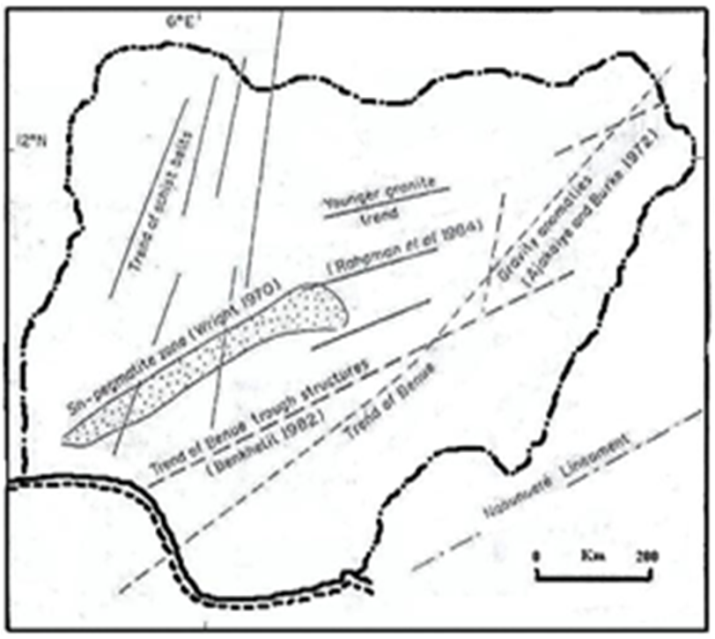
The mineralized Gwon-Gwon pegmatite at Wamba falls within the Nigeria’s 400km stretch of pegmatite belt which trends northwest to the central North. The pegmatite “belt” in Nigeria is part of the Pan- African reactivation zone which extends in a southwest-northeast direction for about 400km and finally passes into the Jos ‘Tin fields’ associated with the Younger Granites (Figure 1) [1]. The Pan-African mobile belt on which Nigeria is located lies between the West African Craton and the Congo craton and at the south of the Tuareg shield. The Tuareg shield is the southern prolongation of the Pan-African mobile belt [2].
The Gwon-Gwon pegmatite at Wamba, is the third mineralized pegmatite field in Nigeria, the first being Egbe-Ijero while the second is the Jema’a pegmatite [1]. The Wamba pegmatites are complex and have been investigated for their Tin, Columbite and Tantalum contents [1].
This paper provides geological, geochemical data and economic potentials of the Gwon-Gwon pegmatite field of Wamba Central Nigeria.

 Download as

The classification of pegmatite in Nigeria into rare-metal bearing pegmatite and barren pegmatite within the Pan-African reactivation zone by Matheis and Cean Vanchette, (1983) and Matheis and Kuster, (1989), was based on the above fact i.e. the economic parameters/benefits. The areas investigated by such workers (Figure 1) were Iregun, Ijero, Egbe and a reconnaissance work at Wamba and Jema’a. Matheis and Kuster, (1989), later concluded that “Detailed Geochemistry on heavy mineral concentrates, whole rock samples and rock forming minerals will determine the final economic potential of the areas”. The least investigated is the Wamba rare-metal pegmatite both in terms of host lithology, petrology and Petro-chemistry. Also, little is known about the adjoining parent granite and its economic potential.
This paper provides geological, geochemical data and economic potentials of the Gwon-Gwon pegmatite field of Wamba central Nigeria. The XRF analytical method employed here, determines the chemical composition of the rock samples. The wavelength dispersive system (WDXRF) is the spectrometer system used here with an elemental range from beryllium to uranium (Be to U), with concentration range from (sub) ppm levels to 100%. Generally, in XRF, the elements with high atomic numbers have better detection limits than the lighter elements, and the precision and reproducibility of XRF analysis is very high with very accurate results.
2. Materials and Methods
2.1. Geologic MappingGeological mapping of the Gwon-Gwon area was carried out using a topographic map of 1:100,000 representing part of sheet 189 Kurra for the exercise. A total area of 145km2 was covered using traverse mapping employing the use of compass and global positioning system (GPS) for detail and accurate mapping exercise. Twenty-four (24) representative rock samples from the various rock units of the study area were selected out of a total of Sixty-four (64) samples for geochemical studies of their major and trace elements. The samples of rocks and minerals collected were grouped based on similarities in colours, textures, mineralogy, alteration and deformational structure in hand specimen examination.
Each group of samples were analyzed for their major oxides, rare-metal, and trace elements contents using the XRF method of analysis to know their chemical variations and in characterizing the pegmatite (whether peraluminous, metaluminous or peralkaline) and the parent rock (whether S—type or I-type granite). The XRF – method of chemical analysis is based on the principle of using X-ray tube as the source of exciting radiations on the pellets of the sample which emits wavelengths, it is this quantum of energy in the X-ray wavelength region which is referred to as the X-ray fluorescence.
 Download as
3. Results
3.1. GeologyGeological mapping of the study area reveals the presence of the Basement Complex rocks identified are the Migmatite and members of the Older Granite series, which includes Biotite-Granite, Biotite-Muscovite Granite and the Pegmatites. Field description and petrographic study of these rocks are given below.
3.1.1. Hand Specimen Description of Rock Types
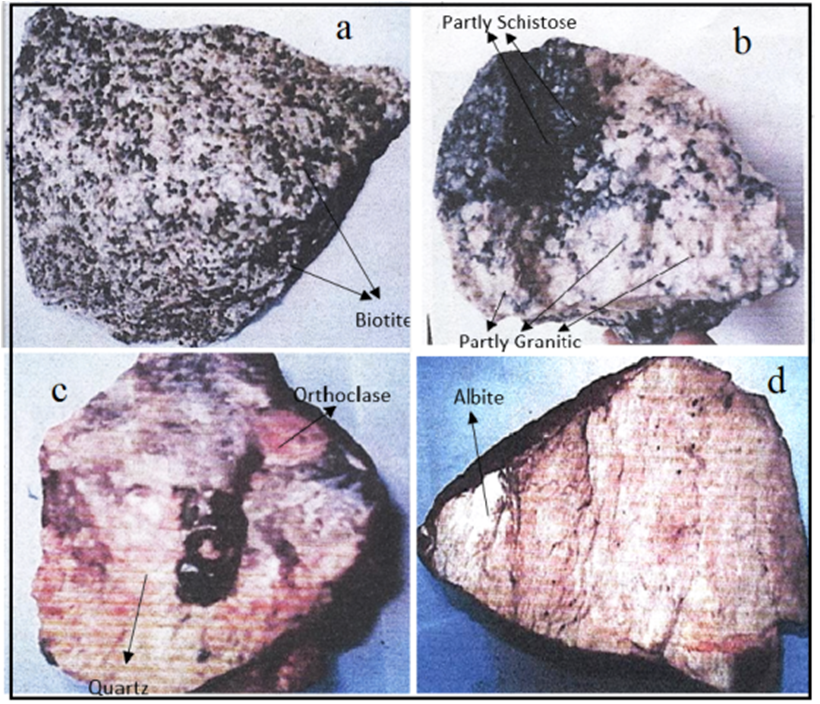
Two samples of the 2 mica granites shows that they are medium to fine grain. They are grayish white in colour. Biotite is more pronounced in hand specimen but the muscovite is only visible under the petrographic microscope (plate 1a).
 Download as
The hand specimen samples of the migmatite shows that the rock is partly granitic and partly schistose implying that granitic magma intruded the schist to form the Migmatite (plate 1b).
The hand specimen samples of the pegmatite are divided into potassic pegmatites (F9, F21) and albitized pegmatities (F3, F4 and F7) as representatives of the two main groups (plate 1c and d).
The potassic pegmatites have pegmatitic crystals of orthoclase and this is evident from the pinkish brown colour. Large blebs of muscovite and coarse grains of quartz are the associated minerals and are also visible in hand specimen. The albitized pegmatite is whitish in colour with tints of pink colour. The quartz and muscovite seems assimilated and so are not too coarse. (Plate 1d).
3.2. Field Relationship and Petrography3.2.1. Migmatite
The Migmatite occupies about 55% of the area. In hand sample, there are traces of layering of the felsic and mafic minerals (Plate 1b), but it is difficult to identify distinct minerals in hand specimen due to its closeness to the metasomatized areas. Under plain polarized light (PPL), biotite, hornblende and the multicoloured (purplish green) mica show high relief and were pleochroic. Biotite display dark brown colour while hornblende display medium brown colour. The multicoloured mica display purplish green colours. Quartz and feldspars were colourless. Under cross polarized light (CPL), biotite and multicoloured mica maintain their brown and purplish green colours respectively as the stage is rotated. Quartz display light grey interference colours while albite display dark grey colours ,and in some parts, the albite display a clear albite twinning that goes into extinction at different angles due to orientation. Another part of the migmatite displaying large blebs of multicoloured mica changing colour to greenish-purple (under cross polarized light).
3.2.2. Biotite-Granite
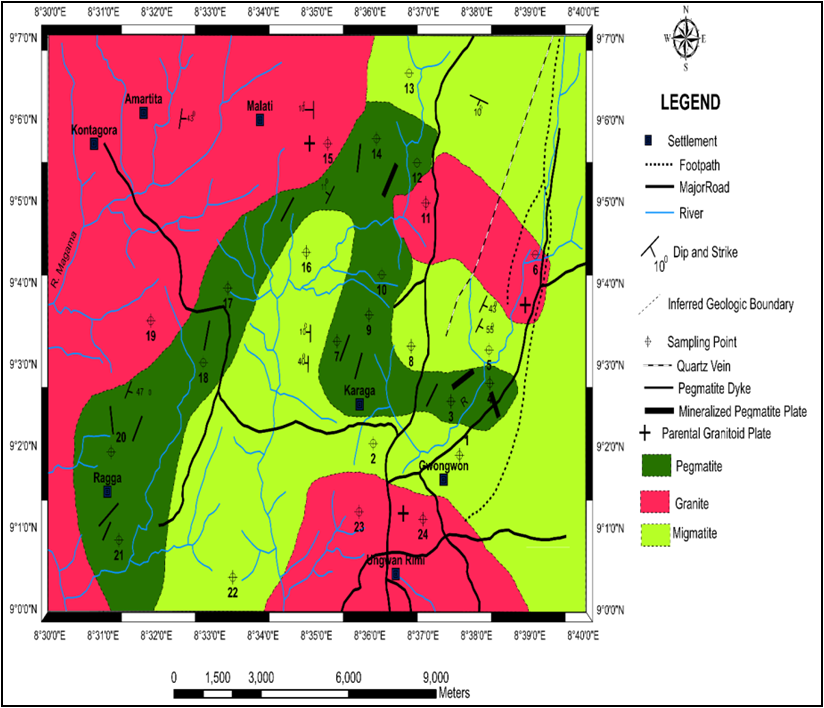
The rock occupies part of the north-western study area around Amartita, Kontagora areas down towards river magama tributary (Figure 3). The rock appears massive and medium grained in texture and outcrops as low-lying. Akintola et al. 2008 reported that this rock appears to represent the first major episode of granite plutonism in the area. The rock is composed of essentially quartz, biotite and plagioclase feldspar in hand specimen sample (Plate 1a). Microscopically, quartz, biotite, microcline and plagioclase feldspar is observed. There may be minor or no hornblende in thin section study. Quartz occur as anhedral crystals and give grey interference colour with complete extinction. Biotite occurs as flaky brown crystals and could be up to 22% by composition in some samples and are sericitized. The colour is brown and pleochroic, from pale brown to dark brown. Some crystals show bent twin lamellae, which could indicate deformation. Microcline is much more than plagioclase ranging from 7% to 12% by composition. Microcline, which are fractured, occur as tabular crystals some of which contained myrmekitic structures. Microcline shows cross-hatched twinning. Some plagioclase shows some sericitization.
3.2.3. Biotite-Muscovite Granite
The rock outcrops as low-lying around Malati at the northern extreme of the study area and around Ungwan-Rimi at the southern extension (Figure 2). The rock is massive and ranges from fine-medium grained and medium grained in texture, comprising of quartz, albite and biotite in hand specimen sample. Microscopically it consist of quartz, albite, orthoclase, plagioclase, biotite and muscovite. Iron-oxide constitute the accessory mineral of this rock. The quartz occur as anhedral crystals with grey interference colour with complete undulose extinction which may be as a result of deformation. Orthoclase exhibits carlsbad twinning and occurs in tabular form. Biotite occurs as flakes or in tabular form with perfect one directional cleavage. They are brown and pleochroic from pale brown to dark brown. Muscovite is present but much less in quantity compared to biotite. The muscovite displayed faint multicolours (blue-purplish) with a faint one directional cleavage under plain polarized light (PPL). Under cross polarized light (CPL), quartz displays second order grey and goes into extinction as dark grey. There is no cleavage. Biotite shows dark brown interference colour with a perfect one directional cleavage. The traces of the blue musvcovite turns to multicoloured (blue-purplish-green) lath as the stage is rotated. In some part of the slide, muscovite shows a clear navy blue colour embedded on albite matrix, while the albite matrix partly shows perfect lamella twinning in one direction and partly looking metasomatized.
3.2.4. Pegmatite
The pegmatite occupies about one-third of the study area (Figure 2). Hand specimen sample study indicate two types of pegmatites within the study area; the potassic and albitized pegmatites (Plate 3 and Plate 4 respectively). Samples F9, F21 represents the potassic pegmatites, while samples F3, F4 and F7 are the representatives of the albitized pegmatite types. The potassic pegmatites have pegmatitic crystals of orthoclase and this is evident from the pinkish-brown colour. Hand specimen study also reveals large blebs of muscovite and coarse grains of quartz as associated minerals. The albitized pegmatite is whitish in colour with tints of pink colour. The quartz and muscovite are not too coarse (Plate 1d).
Microscopic study shows quartz, orthoclase, plagiocase and minor biotite. Chlorite constitute the accessory mineral. Quartz occurs as anhedral crystals with grey interference colour and undulose extinction. Orthoclase displays carlsbad twinning under cross polarized light (Plate 17). It is colourless with a general low relief in most points of the slides in plane polarized light. Plate 14 is a plagioclase lath (under cross polarized ligth) covering the whole slide and displaying perfect lamellae twinning. This suggest a primary albite that is quite distinct from the massive cloudy plagioclase that forms from albite metasomatism. Biotite is one of the minor minerals here and occurs as flaky/tabular brown crystal displaying a perfect one directional cleavage. They are brown and pleochroic from pale browm to dark brown. Chlorite possesses a thin nature and bluish colour which disappears upon rotation under cross polarized light.
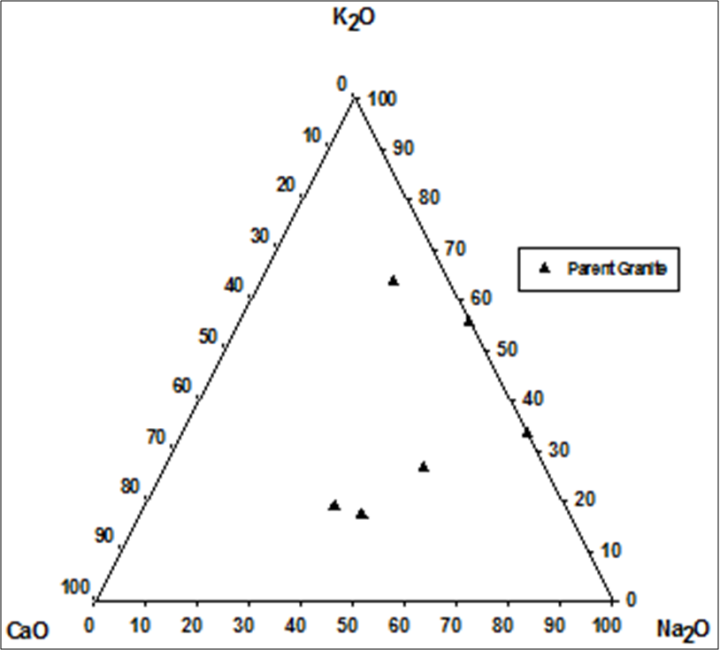
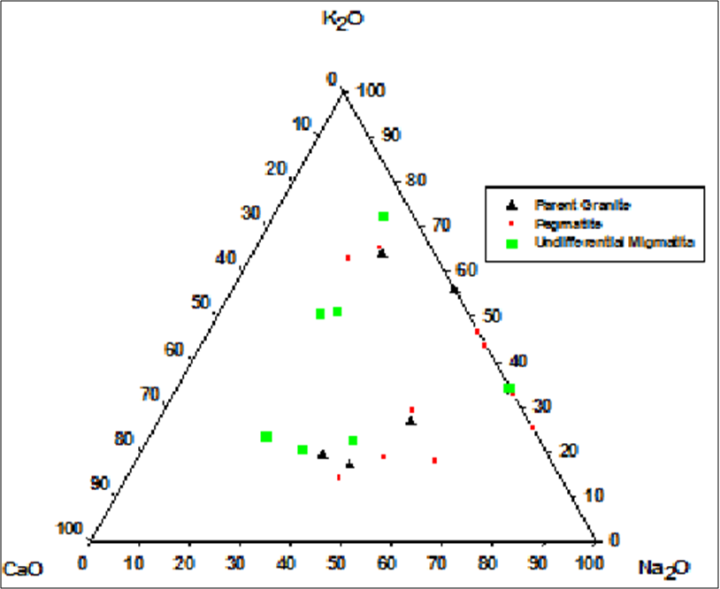
3.3. Geochemical ResultsIn Figure 3, the ternary plot show that two granites (F15 and F24) are possible sources of pegmatite fluids through fractionation and to some extent granite (F6) because they fall on the granite trend between K2O to Na2O based on [3] and [4]. The granite closer to Na2O is the most fractionated because fractionation trends from higher temperature, (K2O) to lower temperature (Na2O), so the granite close to Na2O appeared to be more fractionated and is likely the one that released the residual fluids that form the pegmatite.
 Download as
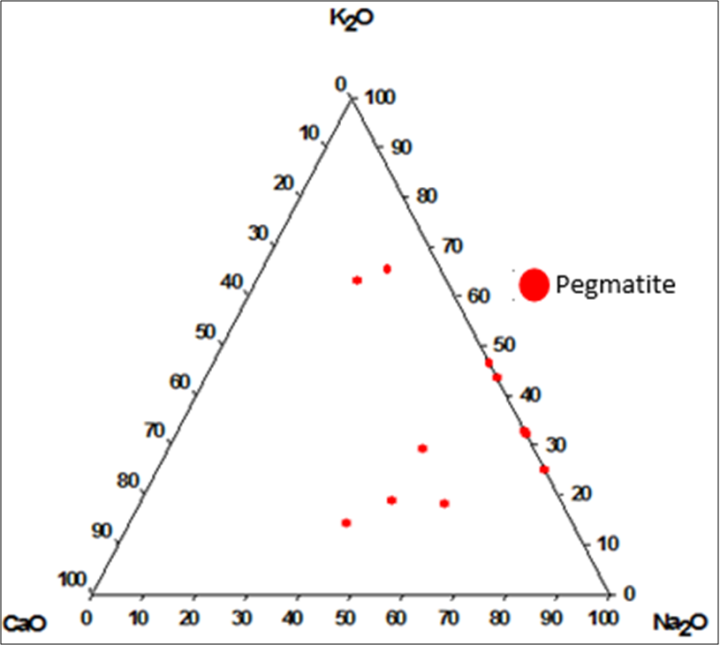
Figure 4 is the ternary plot for the pegmatite. The ones that fall on the granite trend near the Na2O appeared to be the more fractionated while those at the centers of K2O-Na2O (granite trend) are less fractionated. Those at the Centre are the contaminated ones due to high content of CaO.
 Download as
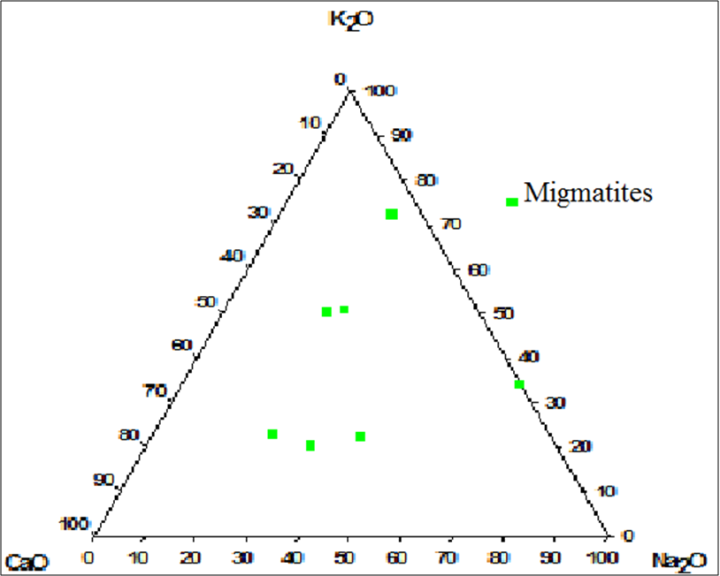
Figure 5 shows the distribution of the migmatites. Most of them concentrated at the centre due to high influence of CaO in the migmatite. They may not be parental to any pegmatite. Figure 6 shows the relationship on the ternary plot between granites, migmatite and the pegmatite based on [3] and [4]. The rocks that are cogenetic would nucleate together while the pegmatite that are distributed towards the Na2O from any granite on the granite trend are the most fractionated and more economically viable. The pegmatites that surround the granites at the center could have originated from same granite even though they fall on the trondhjemitic trend. So pegmatite bodies F18, F12 and F20 are the most fractionable and so more prone to be economically viable than the rest.
 Download as
 Download as


)


)
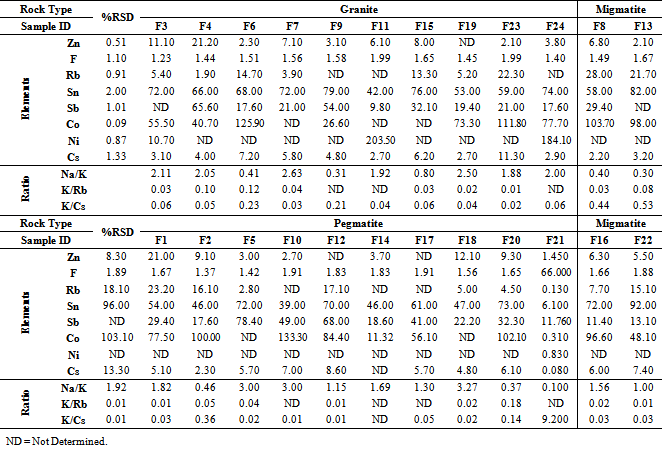


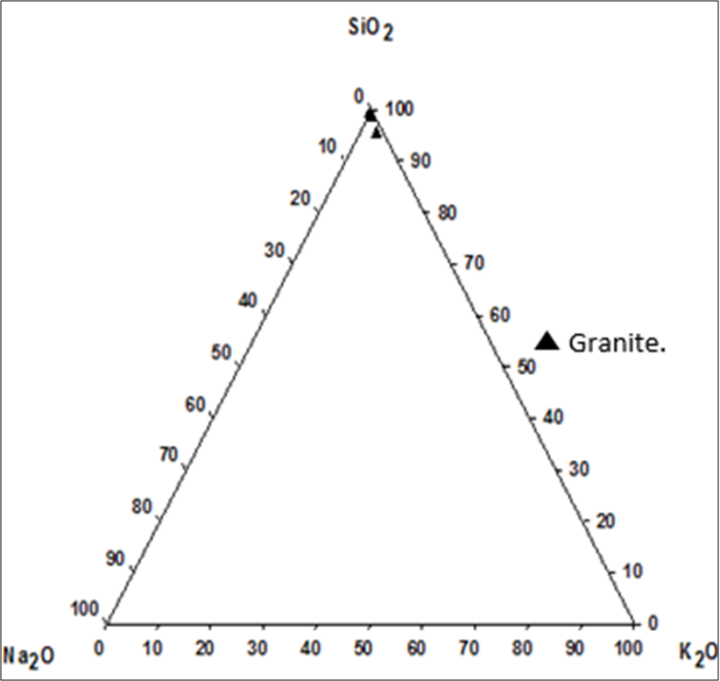
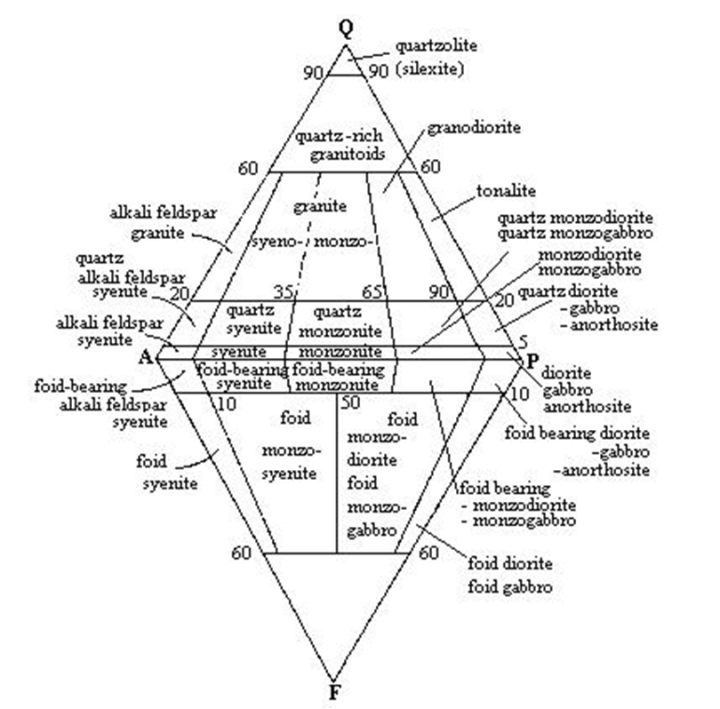
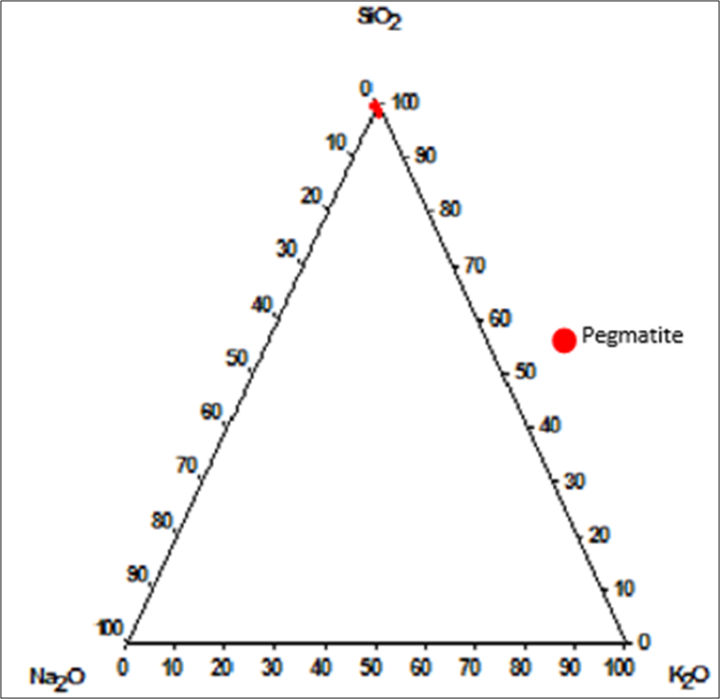
Figure 7a shows the QAP diagram for the granite. It falls between quartz rich granites and quartzolite (Figure 7b). High quartz content is a characteristic of the S-type granites. Fig 8 is the QAP diagram for the pegmatite and they are also congested around the granite position, and sharing the high quartz content characteristic with the granite. This also suggests a genetic relationship.
 Download as
 Download as
 Download as
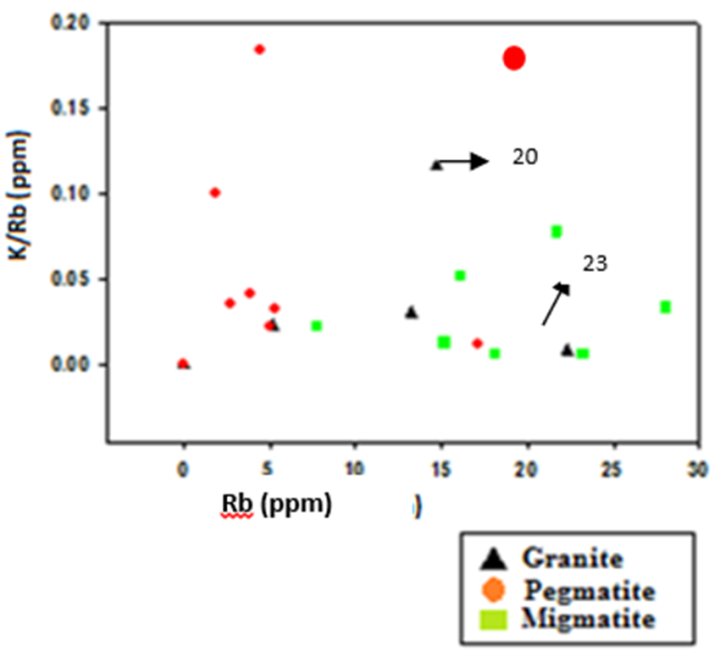
Figure 9 is a combine binary plot for all the rocks in order to determine the degree of fractionation of the granites and pegmatites. Rocks with low K/Rb content are the well fractionated. In this case, the pegmatite and granite (F20 and F23) contain the highest quantity of Rb (between 15-25ppm). Majority of the pegmatites (F3, F10, F12, F21, F14 and F18) contain the least quantity of Rb (between (1-6ppm) and form the least fractionated group. This is the least in terms of economic potential.
 Download as
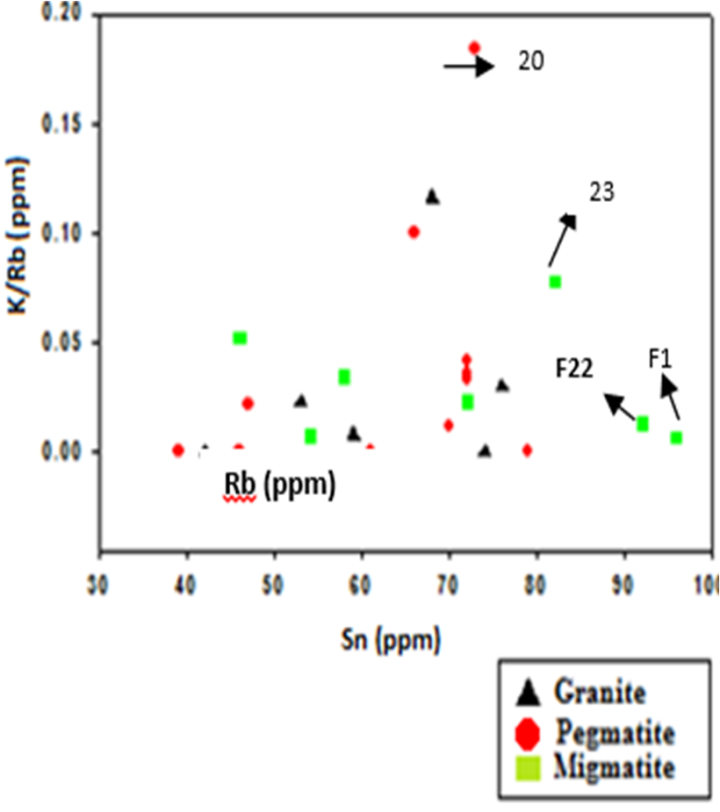
Figure 10, a plot of K/Rb Vs Sn shows consistent pattern. The behaviour of tin is fairly understood in pegmatite research because tin is found disseminated in granite, pegmatite and migmatite that coexist in the area. Sn was won from weathered rare element pegmatite, granite and migmatite (e.g migmtite samples F22 and F1 having between 90-100ppmSn; Figure 10). Sn content appeared to be generally high in the area but the area was not too weathered to release enough and that’s why not up to 2 tonnes were won annually in the early 70’s. This was among the older tin fields. The Figure 10, also shows that only fractionated pegmatite and granite could contain the higher quantity of tin as the changes in quantity of tin at all levels took place only at a lower K/Rb rate. Low K/Rb is an indices of fractionation. Very few pegmatite and granites are well fractionated from the figure. Most of the rocks form clusters at the centre (between 30-80ppmSn) suggesting that the fractionation was precisely partial.
 Download as
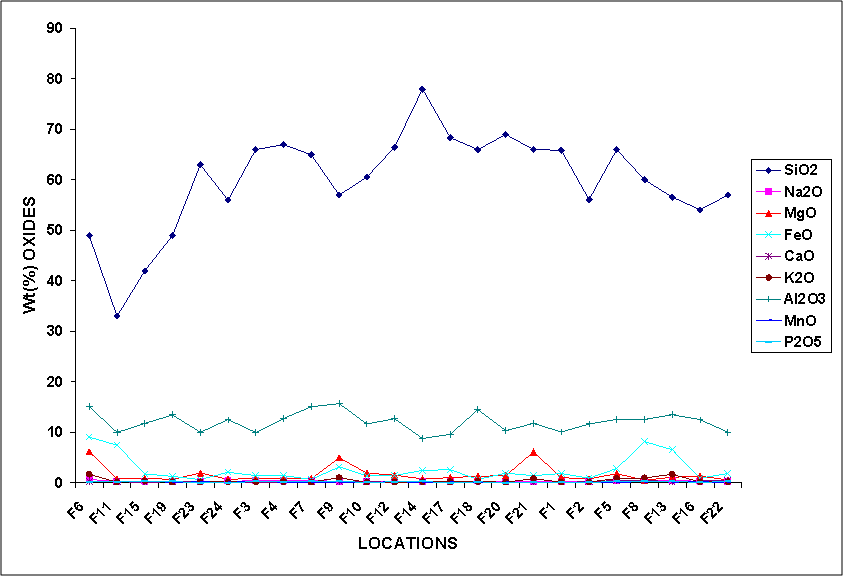
Figure 11 is the Harker’s variation diagram that displays the variations of the different rock forming oxides with SiO2. The quantity of SiO2 is very high ranging between 30-80wtpercent, while Al2O3 shows between 10 – 18wt% all rest fall between 0-10wt% (Figure 11). The gap in quantity shows that this granite/ pegmatite contain high quartz which is an attributes of S-type granite.
 Download as
The local variation from place to place might be due to the influence of the rare elements. This pattern also suggests incomplete partial melting or at least poor sourcing of rare elements during partial melting. The scattered pattern proves that the granites are mostly S-type and pegmatites emanate from them. Fluorine and Phosphoros are the common volatiles in pegmatite, the low values show that the residual fluid was relatively viscous which also points to partial or poor fractionation.
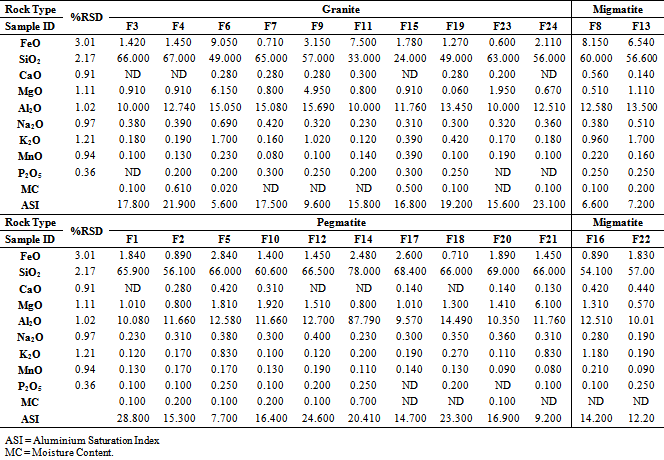
From Table 2, we could infer that the K/Rb value, low K/ Cs shows that the area has actually experienced fractionation. But low values for rare elements, Rb and Cs shows that there was partial or poor fractionation as the higher these values the more fractionated the pegmatite and the granites.
4. Discussion
In discussing, a number of petrogenetic geochemical parameters were employed in the interpretation of results. The essence is to understand the nature of the magma in relation to the granite and adjoining pegmatite dykes using the various binary and ternary diagrams.
a) Ternary plot of CaO-Na2O-K2O; this is meant to determine which alkali or alkaline earth element is dominant in the granite and pegmatite, and to know which granite falls along the granite trend with the pegmatite. This would show a clear trend of fractionation of the magma. The method was adopted from [4].
b) Ternary plot of QAP; This is meant to give an impression about the type of granite rock using three parameters from the chemical data (Quartz, Alkali and Plagioclase).This will throw more light on the granitic rocks formed from the fractionation.
c) The binary plot of K/Rb Vs Rb is a plot devised by [5] to determine the degree of fractionation in pegmatite and their relationship to the parental granite through replacement of K by Rb (Rb is a rare element). The higher the Rb, the more fractionated the granite as well as the pegmatite.
d) The Binary plot K/Rb Vs Sn was adopted from [6]. It is meant to access the degree of fractionation of pegmatite in relation to Sn mineralization.
e) Harkers Variation diagram is a plot of rock forming oxides against SiO2. It is meant to check the variation of SiO2 withother oxides from the granite to the pegmatite. This could add more evidence as to whether the granite is S-type or I-type.
In magma fractionation, elements are subdivided into 2 groups; compatible and incompatible elements. Elements that enter the cation site (XYZ) are called compatible and those that could not fit into the cation sites are called incompatible. The incompatibles are those that remain in the melt during crystallization because; they have very large ionic radius or they have very large valencies. They are as follows; Rb, Li, B, Cs, Ta, Nb, Sn, Ba, Be, P, Th, Zn, Pb, Ni, Zr, U, REE. They are sub-grouped into rare elements, REE and trace elements but they are all trace elements as follows:
-Rare elements: -Cs, Ta, Li, Rb, Sn, Nb, Be.
-Rare earth elements: - Lanthanide series.
-Volatiles: - H2O, B, F, P.
The type of incompatible elements, in the magma determines the type of pegmatite that would be formed. The more the rare elements, the more mobile is the pegmatite forming fluid and so the farther the fluid travels into the surrounding rocks before crystallization. Fractionation even from the ternary plot is from K-rich areas to Na- rich areas.
The partial melting of the sedimentary rocks should be thorough in order to generate enough incompatibles in the melt. This is the only way the final residual pegmatite forming fluid would have enough incompatible elements that would later form many economic minerals in the final pegmatite.
Fractionation is very important because it is related to economic potentials. The most fractionated pegmatites in the world are the ones with the highest economic minerals like tourmaline, petalite, spodumene, lepidolite, and etc and they contain the highest quantity of rare elements (Rb, Cs, Li, Ta, Nb, Sn), e.g Tanco pegmatite, Winnipeg, Canada.
From the available data presented, it is clear that the development of the rare-metal pegmatite of Gwon-Gwon in Wamba Central Nigeria is related to granite magmatism [7, 8]. From the ternary plots, it could be deduced that there is a clear genetic link between the parent granite and the pegmatite with incomplete fractionation which could be due to incomplete partial melting or poor source materials during the partial melting (Figure 2). Most of the rocks and pegmatite form clusters at the center suggesting that the fractionation was precisely partial (Figure 3, Figure 4, Figure 5 and Figure 6).
The S-type granite resulted from the closure of the ocean. The Pan-African continental collision trigged the partial re-melting of the sediments which has led to the generation and intrusion of several magma batches rich in quartz representing the now parent granite. High quartz content (Figure 7a) is a characteristic of the S-type granite.
The pegmatite fluid that intruded the area led to the formation of migmatites with no distinct pattern of fractionation. This is represented by samples clustering at the middle of the ternary plot. So the migmatites may not be a favourable source for the pegmatites because they do not fall along the granite trend of Na2O-K2O (Figure 5).
The peraluminous composition (Figure 9) of the samples of the Gwon-Gwon area is an indication of their crustal origin probably derived from intermediate to felsic crustal source.
According to [8], the Wamba pegmatites are members of the rare-elements class of pegmatite. They are geochemically and mineralogically only slightly evolved K/Rb, and K/Cs ratios of individual samples are at a minimum value respectively. The Wamba pegmatite also lack the extensive development of Li and Cs minerals and minerals of the columbite-tantalite series are only of minor important. Tin (Sn) is the one element which has been concentrated to amounts high enough to form cassiterite mineralization [9].
The results/ findings of this present work is in agreement with the above work (Figure 9 and Figure 10). The anomalous concentration of Sn above Crustal average pass across the whole rocks (granite pegmatites and migmatites) in the area (Gwon-Gwon). To give a significant anomaly it would depend on the extent of weathering.
The extent of weathering was not appreciable, as such the dissemination of Sn in migmatite and parental granite forms insignificant anomalies that can never be won. The only significant Sn anomaly was found in the buried pegmatite where the Sn occur in cavities and were won mostly by blasting [9].
5. Conclusions
From the available data presented, it is clear that the development of the rare-metal pegmatite of Gwon-Gwon in Wamba Central Nigeria is related to granite magmatism.
From the ternary plots, it could be deduced that there is a clear genetic link between the parent granite and the pegmatite with incomplete fractionation which could be due to incomplete partial melting or poor source materials during the partial melting. Most of the rocks and pegmatite form clusters at the center suggesting that the fractionation was precisely partial.
Also, the S-type granite resulted from the closure of the ocean. The Pan-African continental collision trigged the partial re- melting of the sediments which has led to the generation and intrusion of several magma batches rich in quartz representing the now parent granite. High quartz content is a characteristic of the S-type granite.
The pegmatite fluid that intruded the area led to the formation of migmatites with no distinct pattern of fractionation. So the migmatites may not be a favourable source for the pegmatites because they do not fall along the granite trend of Na2O-K2O.
The peraluminous composition of the samples of the Gwon-Gwon area is an indication of their crustal origin probably derived from intermediate to felsic crustal source.
The Wamba pegmatite also lacks the extensive development of Li and Cs minerals and minerals of the columbite-tantalite series are only of minor important. Tin (Sn) is the one element which has been concentrated to amounts high enough to form cassiterite mineralization.
Acknowledgements
The authors wish to acknowledge the contribution of Dr. Ismaila Vella Haruna of Geology Department, Federal University of Technology, Yola, Adamawa State-Nigeria and Dr. Jalo Muhammad El-Nafaty of Geology Department, University Of Maiduguri.
References
| [1] | Matheis G. and Cean-Vachette M. (1983). Rb – Sr Isotopic study of Rare Metal Bearing and Barren Pegmatites in the Pan-African Reactivation Zone of Nigeria. Journal of African Earth Science, Pp 35-40. | ||
 In article In article | View Article | ||
| [2] | Trompette R. (1980). The Pan-African Dahomeyide Fold Belt. A Collision Orogeny? (Abstract) 10th Colloque de Geologic Africaine, Montepellier, Pp 72-73. | ||
| In article | |||
| [3] | Nockolds, S. R. & Allen, R. (1953). The geochemistry of some igneous rock series. Part 1. Geochimica et Cosmochimica Acta 4, 105-142. | ||
| In article | View Article | ||
| [4] | Barker, F. and Arth, J. G. (1976). Generation of trondhjemitic tonalitic liquids and Archean bimodal trondhjemite-basalt suites. Geology 4, 596-600. | ||
| In article | View Article | ||
| [5] | Cerny, P. (1991). Rare-element granitic pegmatites. Part 1: Anatomy and internal evolution of pegmatite deposits. Part 2: Regional to global environments and petrogenesis. Geoscience Canada, 18, 49-81. | ||
| In article | |||
| [6] | Kuster D. (1989). Trace Element Distribution in Pegmatite Muscovites from Central Nigeria 13th Coll. Africa Geol. 10-13 Sept, 1985, St. Andrews. CIFEG, Paris. | ||
| In article | |||
| [7] | Wright J.B. (1970). Controls of Mineralization in the Older and Younger Granites Tin Fields of Nigeria. Economic Geology, Pp 945-951. | ||
| In article | View Article | ||
| [8] | Kuster, D. (1990). Rare-Metal Pegmatite of Wamba, Central Nigeria – Their Formation in Relation to Late Pan-African Granites. Mineral Deposita 25, Pp 25-33. | ||
| In article | View Article | ||
| [9] | Abdullahi,A.M.(2013). Geology and Petrochemistry of Gwon-Gwon Pegmatite Field Wamba, Nasarawa State-Nigeria, Grin Publishers. | ||
| In article | |||
 CiteULike
 Mendeley
 StumbleUpon
 Delicious
 Facebook
 Twitter
 LinkedIn
)
)
 Hand specimen of Sample F24 (mica granite) (b) Hand specimen of Sample F5 (migmatite) (c) Hand Specimen of Sample F9 (Potassic pegmatite) (d) Hand Specimen of Sample F7 (albitized pegmatite))