Exploration and exploitation of geothermal resources is a very high-risk venture with high upfront costs. Hence, a clear understanding of the subsurface structural controls is more important in the development of a geothermal system. In this study, gravity data was processed to remove all the variations which do not result from the effects of underlying masses. Using the Golden Surfer Software, a grid and bouguer anomaly map was generated. To separate regional and residual anomalies and also remove effects of noise, the gridded data in Geosoft Oasis Montaj Software was subjected to band pass filter, high pass filter, upward continuation and both first order vertical and horizontal derivatives. The respective anomaly maps were plotted and analyzed. Finally, a gravity profile was obtained across the anomaly and 2D forward modelling performed. From the analysis, it was observed that there were two peaks, one at the Korosi and other at Chepchuk which are interpreted as the magma intrusions appearing at the depth of approximately 3km. Linear gravity gradients were also detected trending NE-SW direction which are possibly the Nakaporon and Nagoreti faults. Two target wells expected to be more productive in the area could be decided.
Kenya is committed to joining the global nations to address issues of climate change, hence the championing for reliable and sustainable energy for all under vision 2030 with last mile Connectivity Program aiming at enhancing electricity access across rural and underserved areas, addressing the growing demand for energy which is essential for social- economic development. This initiative revolves around the country’s rich geothermal resources. Geothermal energy plays a major role in mitigating climate change by reducing reliance on fossil fuels, lowering green-house gas emissions and sustainability of energy development. Even though geothermal energy is renewable, it faces some challenges in development such as high cost and uncertainty at the exploration drilling phase. One way of addressing these challenges, is to conduct a detailed subsurface analysis before embarking on drilling by using geophysical studies, including seismic, gravity, electrical and electromagnetic methods.
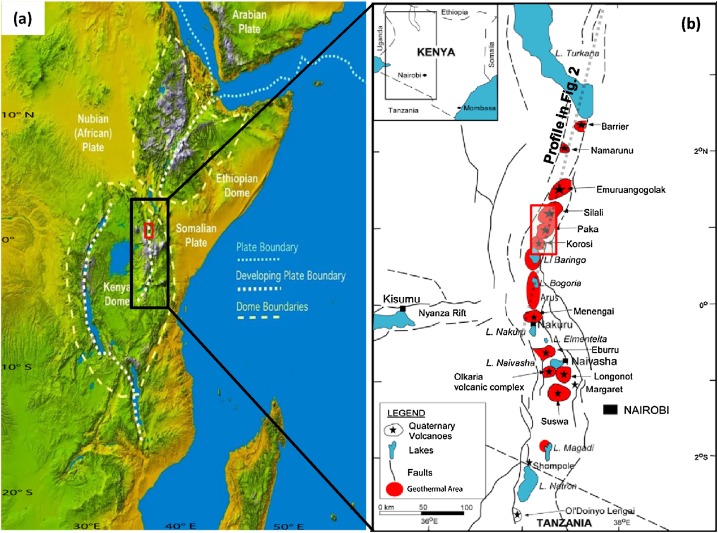
Korosi – Chepchuk area is situated in the Great Rift Valley. It lies to the north of Lake Baringo approximately 1° 30′ N, 36° 30′ E and neighbors Lake Baringo to the south and Paka volcano to the north. Korosi and Chepchuk volcanoes are located in the inner trough of the Kenyan rift, which is a NNE-trending zone of Quaternary volcanism and sedimentation as shown in Figure 1.

Korosi is one of the main volcanoes in the northern rift floor rising about 500 m above the surrounding floor of the trough and covers an area of about 260 km2. No caldera or major crater is developed on the volcano. Its landforms are degraded and the shield is broken by a set of prominent NNE trending faults. Chepchuk is the highest point (1380masl) of a series of prominent N-S trending ridges that rise 220m above the plains to the NW of Korosi and SW of Paka. It is heavily faulted with half of its volcanic complex down and faulted westward 1.
The goal of gravity surveying is to locate and describe subsurface structures that control the geothermal system from the gravity effects caused by their anomalous densities. Gravity studies have been carried out in different regions of the world and have yielded useful results for geothermal exploration, such as investigation of magma chambers and intrusive bodies related to the heat source of the geothermal system 2.
Gravity method is a geophysical technique that measures differences in the earth’s gravitational field at specific locations. It depends on the fact that different earth materials have different bulk densities (mass) that produce variations in the measured gravitational field which can then be interpreted by a variety of analytical and computer methods to determine the depth, geometry and density that causes the gravity field variations. There are many unique techniques used in gravity anomaly interpretation procedures depending on the quality of the data-set and the goals of the analysis 3. The gravity survey method is based on Newton’s Law of Gravitation, which describes the force of attraction between two masses whose dimensions are small with respect to the distance between them and the second law of motion which explains how forces cause acceleration as shown in equation 1.
 | (1) |
where G is the gravitational constant (6.67x10⁻¹¹ m3 kg-1 s-2), m1 and m2 are the masses of the two objects and r2 distance between centers of the two masses.
 | (2) |
where m is the mass of the object and g is acceleration due to gravity
For a small mass m on the surface of a spherical, non-rotating, homogeneous Earth of mass M and radius R, the gravitational attraction is;
 | (3) |
Filtering of gravity data employs Fast Fourier Transform (FFT), a mathematical expression that investigates both residual (shallow) and regional (deep) subsurface structures, taking gravity as a potential field extrapolated vertically. The approach relies on how the frequency energy, resulting from differences in densities between surface and subsurface materials, is distributed.The Fourier transform of the periodic function f(
 ) is mathematically expressed as given by 4: y)
 | (4) |
where (x) and (y) are the spatial coordinates in the x and y directions respectively. μ and γ are wave numbers given as angular frequencies in the x and y directions respectively.
In gravity modelling, polygonal prism solution calculates gravity effect of 2D polygon by summing contributions from each polygon edges using logarithmic and arctangent functions, 5.
 | (5) |
Where
 is the geometric function (depends on the polygon vertices relative to observation point) evaluated analytically.
The Kenya rift lithospheric structure was revisited based on regional 3D gravity modeling 6. The study generally explained the positive gravity anomaly in Kenya rift crustal at the regional analysis > 10 km as due to magnesium and iron reach mafic intrusions. While the gravity ‘low’ in the northern Kenya rift was explained as due to positive thermal anomalies within the crust, involving partial melting/or rock expansion which strongly weakens the lithosphere. The local analysis for the key geothermal concealed structural features like heat sources inform that shallow faults that are significant have remained relatively poorly constrained.
Gravity surveys across the Nakaporon fault in Korosi geothermal field 7 established that the eastern side had high gravity and displaced upward while the western side had lower gravity and displaced downward forming a normal fault that ran in the NNE direction.
7 conducted a magnetotelluric (MT) resistivity survey at Korosi-Chepchuk geothermal field as part of a geothermal development project in Kenya Rift Valley, aiming at understanding the subsurface structures and identifying potential geothermal sites. This study revealed low resistivity of less than 10Ω·m at mid depths of 500-2000m beneath Korosi and Chepchuk representing hydrothermally altered zones and high resistivity of greater than 100Ω·m found at surface levels and deeper zones promising geothermal anomalies overlying potential reservoir zones.
Secondary gravity data of the study area obtained from Geothermal Development Company (GDC) was reduced to remove all the variations which do not result from the effects of underlying masses. Drift, tide and terrain corrections had already been taken care of at the time of data collection.
3.1. Latitude Correction (LC)Gravity varies with latitude because the earth is non-spherical shape of the earth and angular velocity of a point on the earth’s surface decreases from maximum at equator to zero at the pole.Geodetic Reference Formula of 1967 was used to predict value of gravity that would be observed if the Earth were a perfect sphere. The value of g is given by;
g∅ =9780318.5(1+0.005278895(sin2∅) + 0.000023462(sin4∅)mGal (6)
∅ is measured in radians. This value was calculated using the Eastings and Northings of the particular station by using Magpick UTM (Gauss-Kruger) Transformation setup software. This gravity value was subtracted from the observed gravity value for all stations.
3.2. Free Air Correction (FAC)This correction accounted for the elevation variations. The value 0.3086h was used in calculation while substituting the value of height recorded for each station. The correction was added to the latitude corrected gravity.
3.3. Bouguer Slab Correction (BC)This correction takes care of the attraction of a slab of rock present between the observation point and the datum (geoid) which is measured by the gravimeter. The correction was calculated by using the density value of rocks as 2.67g/cm3 and using the equation 0.4191ρhr. The correction value obtained was subtracted from the free air corrected value to obtain the Complete Bouguer Anomaly (CBA).
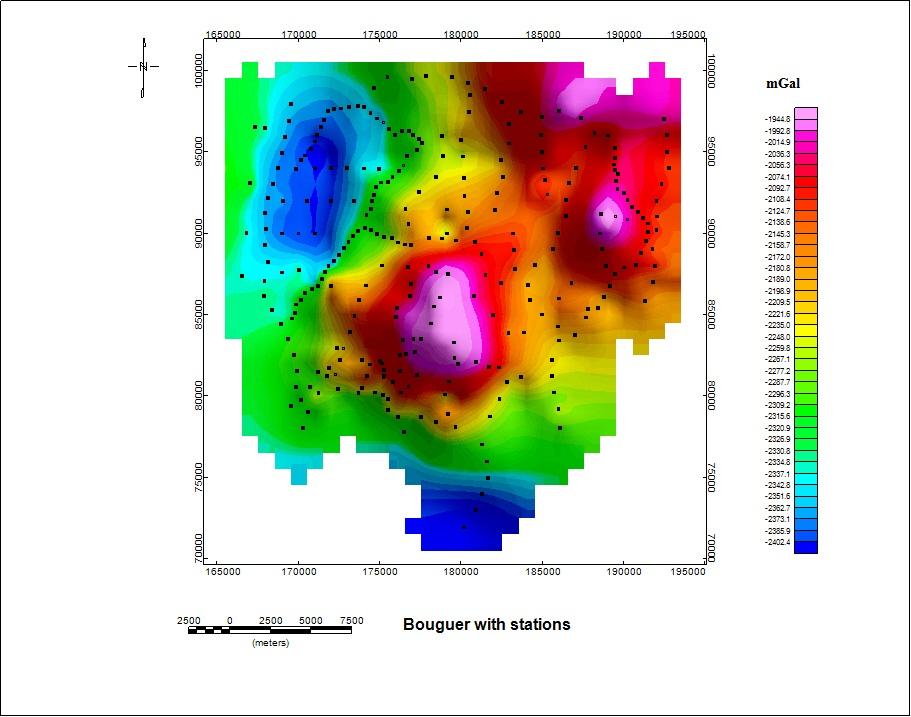
3.4. Bouguer Anomaly MapAfter data reduction, the northings, eastings and complete bouguer anomaly readings were saved as dat.file and extrapolated into Golden Surfer Software. Kriging Method was used to grid data and Bouguer Anomaly map was plotted covering the study area (Figure 2). The black dots in the map are stations covering Korosi and Chepchukevenly.The inhomogeneity in rock density in the study area was evidenced in the nature of the gravity contours distribution with highest gravity points in this area beneath the Chepchuk massif to the East and Korosi massif to the West. The area with lowest gravity anomaly was towards the north west of Korosi.The centered high gravity anomalies at – 1940mGals corresponds to high dense subsurface material associated with magmatic intrusions and it trends to the North East. The low gravity anomalies at – 2340mGals corresponds to a less dense subsurface associated with sedimentary rocks trending North West-South East.
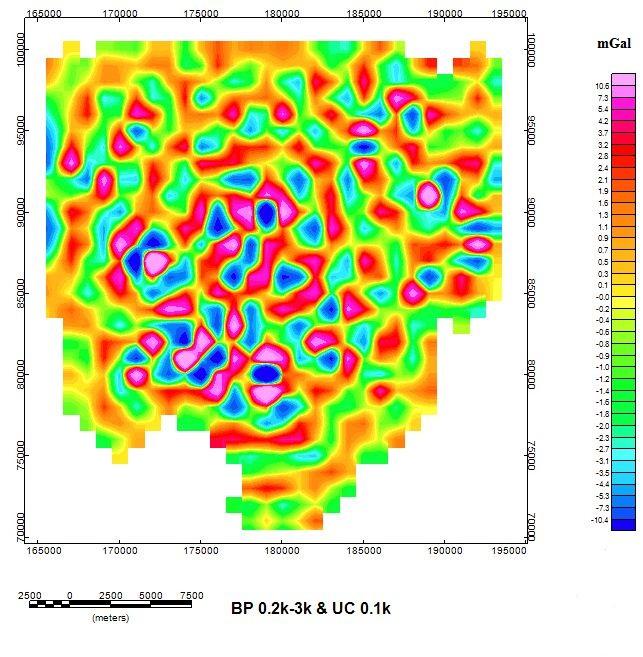
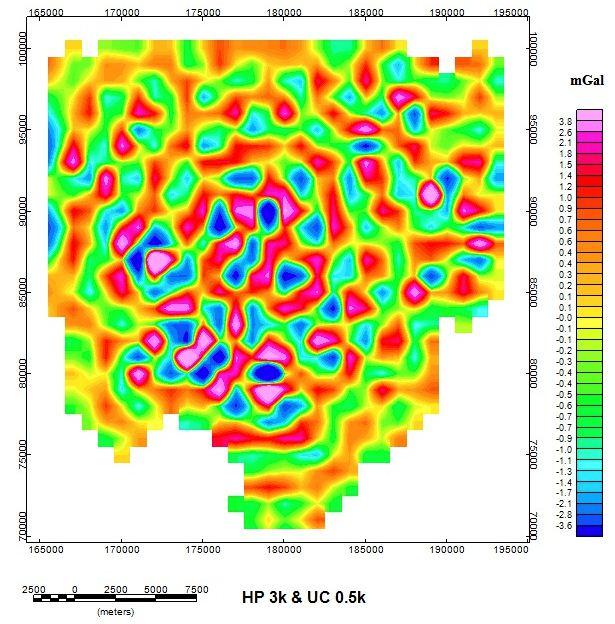
Gridded gravity data was imported from excel sheet into Geosoft Oasis Montaj Software and Fast Fourier Transform was selected. Various filtering techniques were applied to get region range interest, reduce effects of noise, separate regional and residual anomalies. The first filter was a band pass filter at wavelength between 0.2km and 3km with upward continuation at 0km and 0.1km. The second filter was the high pass at a wavelength of 3km with upward continuation at 0.1km, 0.5km and 1km respectively. All the anomaly maps plotted for both filters showed similar features inferred to be magmatic intrusions of igneous origin estimated to be dykes and sills (Figure 3 and Figure 4).


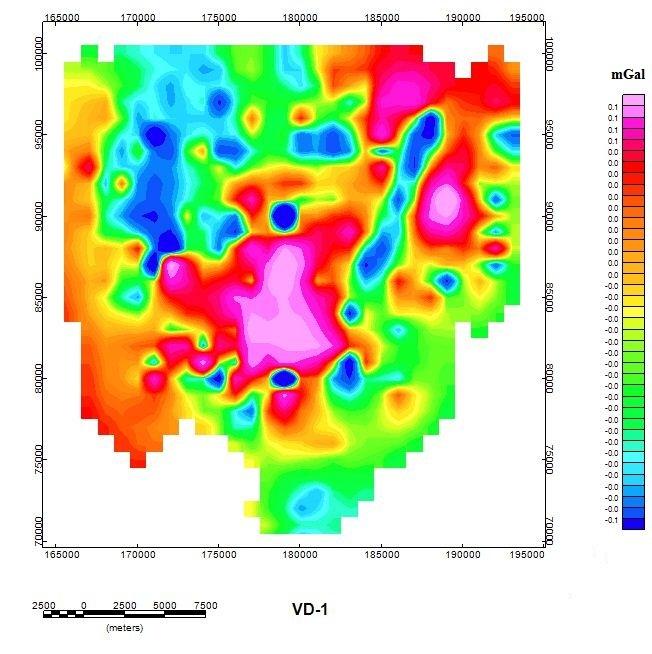
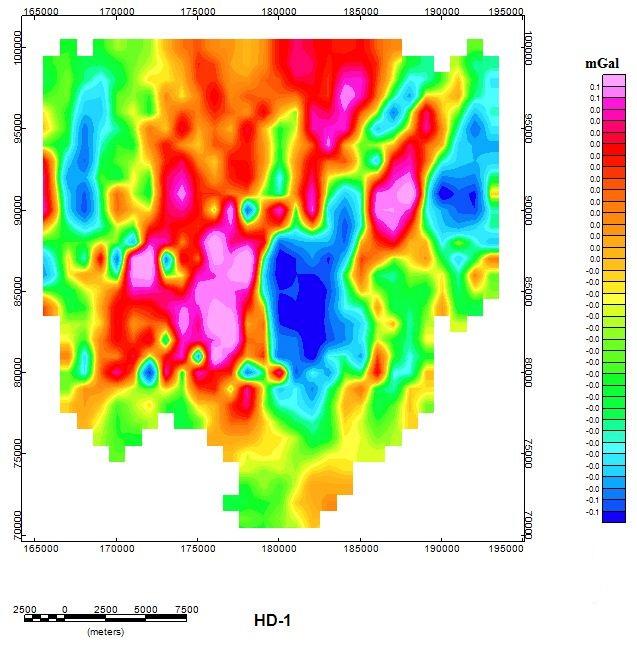
The third and fourth filters were first order vertical and horizontal derivatives. They were applied to highlight shallow surface lineaments and make features more visible. Circular gravity gradients were observed and edges of the anomalies were clearly seen. Also, linear gravity gradients were detected trending NE-SW direction which are possibly the Nakaporon fault with downthrows 7 to the west of Korosi and the Nagoreti fault to east of Chepchuk as compared to the existing surface geological maps.There is low gravity gradient in between the high anomalies trending to the NE-SW direction which it correlates with the Nagoreti fault (Figure 5 and Figure 6).
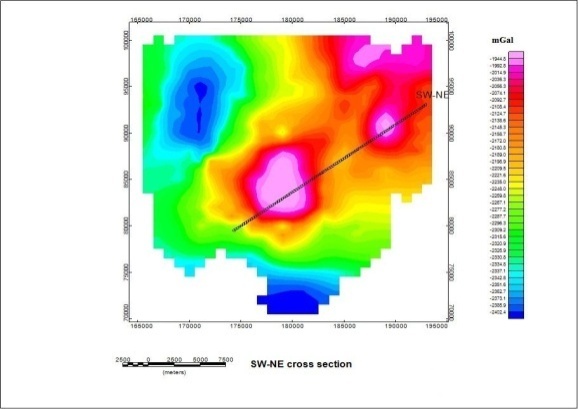
First was obtaining a gravity profile. This was done by slicing across the bouguer anomaly map in the SW-NE direction for the purpose of fitting the model to the observed data as shown in Figure 7.

From the profile in Figure 7, it was established that there was a variation in gravity across the field in the SW-NE direction. Two gravity peaks were observed, one beneath the Korosi massif and the second beneath the Chepchuk massif. These high gravity regions were associated with deep seated dense structures of magmatic origin that could be the source of heat for geothermal exploitation in the region. In between the two gravity peaks, there was a region of low gravity. This was associated with the Nagoreti fault.
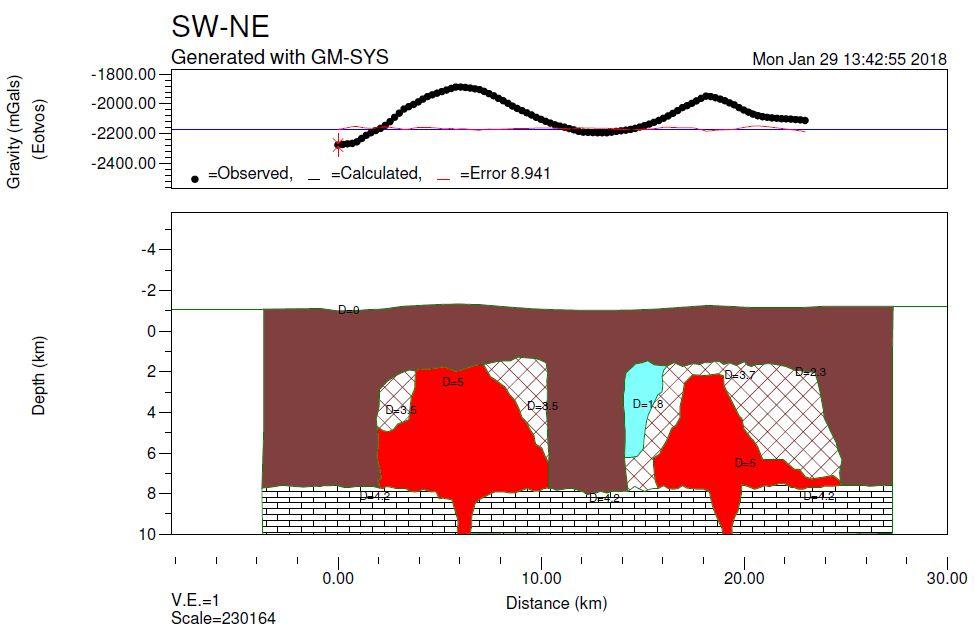
2D forward gravity modelling of the study area was performed by launching a new model in GM-SYS tool of the Oasis Montaj software. The generated profile was input into the model to generate an output of the same. The densities and depth of the delineated structures had to be varied by trial and error and forward algorithm calculations were run until a model that matched the observed data was achieved as shown in Figure 8.
The forward cross section model of the geothermal field marched the observed data achieving a close fit with an error of 8.076% which is within the acceptable margin. From the model, two intrusions at density D = 5g/cm3 were delineated and found to rise to shallow depths of 3 km below surface. The intrusion beneath Korosi appears larger than the one beneath Chepchuk which explains why it has more surface manifestations when the two are compared according to [10]. These intrusions were interpreted to be the sources of heat for these geothermal systems with the zone immediately above them at D=2.3 to 3.7g/cm3inferred to be the reservoir zone that enhances permeability for geothermal fluids.


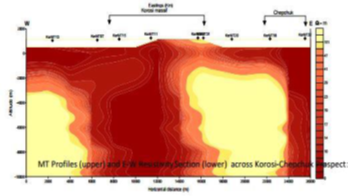
The model was validated with magnetotelluric (MT) resistivity research of the study area by JICA, 2010 as shown in Figure 9 where the low resistivity of less than 10Ω·m dominated at mid depths of 500-2000m beneath Korosi and Chepchuk representing hydrothermally altered zones which are conductive due to presence of hot fluids. The high resistivity of greater than 100Ω·m were found at surface levels and deeper zones in the profile representing dry zones and resistive basement rocks respectively. This MT study revealed promising geothermal anomalies between Korosi and Chepchuk characterized by low resistivity caps overlying potential reservoir zones.
The correlation of the two methods is evident by low resistivity zones in MT aligning spatially with dense zones in gravity at corresponding depths of between 1.5km and 2km. This confirms that magmatic intrusions inferred from gravity data are heat sources responsible for altering overlying rocks and driving the convection. Optimal drilling targets would be above or along the margins of the dense intrusions, below the cap rock (light blue zone) and in zones with intermediate density (2.3–3.7g/cm3) indicating fractured volcanic sequences
The gravity method revealed two intrusive bodies, one beneath Korosi and other beneath Chepchuk with a low gravity region dominant between them which is associated with the Nagoreti fault. Based on the model results, two optimal well locations can be identified, both of which are anticipated to deliver the highest productivity within the area.
Targeted exploratory drilling will be implemented along the SW–NE profile to validate the interpreted subsurface features, including reservoir zones, structural boundaries, and deep-seated heat sources. Priority drilling sites should focus on areas directly above the modeled high-density intrusive bodies and along pronounced gravity gradients, which are indicative of fault zones and enhanced subsurface permeability. Also, gravity model to be combined with geochemical and resistivity data in 3D inversion framework for more detailed resource mapping.
| [1] | Riedl, M., Strecker, M. R., Olaka, L. A., Mtelela, K., &Wamalwa, A. (2022). Mid‐Pleistocene to recent crustal extension in the inner graben of the northern Kenya Rift. Geochemistry, Geophysics, Geosystems, 23(3), e2021GC010123. | ||
| In article | View Article | ||
| [2] | Warega, J. A., Githiri, J. G., &Ambusso, W. J. (2020). Geothermal prospecting of Olkaria Dome areas in Naivasha, Nakuru County, Kenya, using gravity method. Journal of Earth and Environmental Sciences, 4, 190. | ||
| In article | |||
| [3] | Hinze, W. J., Von Frese, R. R., and Saad, A. H. (2013). Gravity and magnetic exploration: Principles, practices, and applications. Cambridge University Press. | ||
| In article | View Article | ||
| [4] | Renaut, R. A., Hogue, J. D., &Vatankhah, S. (2020). A fast methodology for large-scale focusing inversion of gravity and magnetic data using the structured model matrix and the 2D fast Fourier transform. arXiv. https://arxiv.org/abs/2004.13904. | ||
| In article | View Article | ||
| [5] | Aydın, N. G., &İşseven, T. (2024). Gravity modelling by using vertical prismatic polyhedra and application to a sedimentary basin in Eastern Anatolia. Near Surface Geophysics, 22(3), 383–401. | ||
| In article | View Article | ||
| [6] | Sippel, J., Meeßen, C., Cacace, M., Mechie, J., Fishwick, S., Heine, C., ... and Strecker, M. R. (2017). The Kenya rift revisited: insights into lithospheric strength through data-driven 3-D gravity and thermal modeling. Solid Earth, 8(1), 45-46. | ||
| In article | View Article | ||
| [7] | Namaswa, S.W., Ambusso, W.J. and Migwi, C.M., (2014). Gravity variation across Nakaporon fault in Korosi geothermal prospecting field. The International Journal of Science and Technology, 2(8), 121-124. | ||
| In article | |||
| [8] | JICA. (2010). Project for reviewing GDC's geothermal development strategy: Final report (Vol. 1). Japan International Cooperation Agency. | ||
| In article | |||
| [9] | Lichoro, C.M, Árnason, K. and Cumming, K., (2019). Joint interpretation of gravity and resistivity data from the Northern Kenya volcanic rift zone: structural and geothermal significance. Geothermics (2019) | ||
| In article | View Article | ||
Published with license by Science and Education Publishing, Copyright © 2025 Chelangat Hellen, Namaswa Solomon and Munyithya James
 This work is licensed under a Creative Commons Attribution 4.0 International License. To view a copy of this license, visit
http://creativecommons.org/licenses/by/4.0/
This work is licensed under a Creative Commons Attribution 4.0 International License. To view a copy of this license, visit
http://creativecommons.org/licenses/by/4.0/
| [1] | Riedl, M., Strecker, M. R., Olaka, L. A., Mtelela, K., &Wamalwa, A. (2022). Mid‐Pleistocene to recent crustal extension in the inner graben of the northern Kenya Rift. Geochemistry, Geophysics, Geosystems, 23(3), e2021GC010123. | ||
| In article | View Article | ||
| [2] | Warega, J. A., Githiri, J. G., &Ambusso, W. J. (2020). Geothermal prospecting of Olkaria Dome areas in Naivasha, Nakuru County, Kenya, using gravity method. Journal of Earth and Environmental Sciences, 4, 190. | ||
| In article | |||
| [3] | Hinze, W. J., Von Frese, R. R., and Saad, A. H. (2013). Gravity and magnetic exploration: Principles, practices, and applications. Cambridge University Press. | ||
| In article | View Article | ||
| [4] | Renaut, R. A., Hogue, J. D., &Vatankhah, S. (2020). A fast methodology for large-scale focusing inversion of gravity and magnetic data using the structured model matrix and the 2D fast Fourier transform. arXiv. https://arxiv.org/abs/2004.13904. | ||
| In article | View Article | ||
| [5] | Aydın, N. G., &İşseven, T. (2024). Gravity modelling by using vertical prismatic polyhedra and application to a sedimentary basin in Eastern Anatolia. Near Surface Geophysics, 22(3), 383–401. | ||
| In article | View Article | ||
| [6] | Sippel, J., Meeßen, C., Cacace, M., Mechie, J., Fishwick, S., Heine, C., ... and Strecker, M. R. (2017). The Kenya rift revisited: insights into lithospheric strength through data-driven 3-D gravity and thermal modeling. Solid Earth, 8(1), 45-46. | ||
| In article | View Article | ||
| [7] | Namaswa, S.W., Ambusso, W.J. and Migwi, C.M., (2014). Gravity variation across Nakaporon fault in Korosi geothermal prospecting field. The International Journal of Science and Technology, 2(8), 121-124. | ||
| In article | |||
| [8] | JICA. (2010). Project for reviewing GDC's geothermal development strategy: Final report (Vol. 1). Japan International Cooperation Agency. | ||
| In article | |||
| [9] | Lichoro, C.M, Árnason, K. and Cumming, K., (2019). Joint interpretation of gravity and resistivity data from the Northern Kenya volcanic rift zone: structural and geothermal significance. Geothermics (2019) | ||
| In article | View Article | ||