sciepub.com
 Quick Submission

Half a Century of Consensus and Controversies about Food Security
Patrice Zidouemba
Abstract
Food Security is now recognized as a concept centered on the individual. This is the result of an evolution, in the last half century, of the economic thought and the place of food security in that thought. Today, the consensus is that the improvement of food security goes mainly through the reduction of poverty. However, the policies to be implemented to achieve sustainable food security remain controversial. This is mainly due to the complexity of the mechanisms involved in determining the food and nutritional status of individuals: many variables are nested at different levels (macro, meso, and micro) with direct and indirect effects, while natural resources play a major role. In this context any attempt to generalize a policy is doomed to failure. The identification of bottlenecks in each context is the prerequisite for the success of policies intended to fight against food insecurity.
Keywords: food security, poverty, resilience, consensus and controversies
Copyright © 2016 Science and Education Publishing. All Rights Reserved.Cite this article:
- Patrice Zidouemba. Half a Century of Consensus and Controversies about Food Security. Journal of Food Security. Vol. 4, No. 6, 2016, pp 138-146. http://pubs.sciepub.com/jfs/4/6/3
- Zidouemba, Patrice. "Half a Century of Consensus and Controversies about Food Security." Journal of Food Security 4.6 (2016): 138-146.
- Zidouemba, P. (2016). Half a Century of Consensus and Controversies about Food Security. Journal of Food Security, 4(6), 138-146.
- Zidouemba, Patrice. "Half a Century of Consensus and Controversies about Food Security." Journal of Food Security 4, no. 6 (2016): 138-146.
| Import into BibTeX | Import into EndNote | Import into RefMan | Import into RefWorks |
At a glance: Figures
1. The Evolution of Thinking about Food Security
1.1. From 70s to the Early 80s: A Favorable Context for an Approach Focusing on Food AvailabilityThe 1970s have been characterized by a number of contractions in global agricultural production. Indeed, the later declined in 1972 and in 1974, as a result of unfavorable climate conditions in many major food-producing countries [1]. In 1972, global cereals’ production was declined by 41 million tonnes – half of which was in developing areas – and by 30 million tonnes in 1974. These declines led in a significant depletion of stocks, especially in the countries that were traditional exporters of grains. Global wheat’ stocks decreased from 50 million tonnes in 1971 to 27 million tonnes in 1973, their lowest level for 20 years. Rice was also in short supply owing to falls in production in the major rice-consuming countries of Asia. Consumer prices of food items rose in all regions of the world, causing hardship for the poor and reducing the level of nutrition, particularly of vulnerable population groups. Hardship was more severe in sub-Saharan Africa, where per capita food production had remained stagnant during the first half of the 1970s [1].
This global decline in agricultural production coincided, during the first half of the 70s, with serious regional and local food shortages. A dramatic food crisis occurred in Africa as a result of catastrophic droughts, including one that raged for many years in the Sahel countries (Burkina Faso, Chad, Mali, Mauritania, Niger and Senegal) and culminated in 1973, with net food production per capita in these countries that was at a third below the average of the years 1961-1965. Extensive international operation of emergency was launched in early 1973 while the establishment of the Permanent Interstate Committee for the Fight against Drought in the Sahel (CILSS) was the direct result of the drought [1].
The succession of these crises led to the FAO running the World Food Conference in November 1974. This conference aimed to create an international consensus on policies and programs to be implemented in order to increase production and productivity of food crops, especially in developing countries. One of the main concerns of the Conference was the constitution of adequate stocks of food products at national, regional and international levels. These stocks were intended to ensure food security during food crises at local, national or regional scale [1].
The food security issue was therefore considered primarily as a problem of availability. The World Conference also stressed the need to reduce rural unemployment by diversifying agriculture and developing lucrative activities, but attention has focused more on the issues of the availability due to the food crises of the early 70s still present in minds.
This focus on the availability problem probably reflected the twofold influence of the work of Malthus more than a century and a half ago, and the 1974 crisis caused by a shortfall in availability. In its An Essay on the Principle of Population, Malthus (1798) developed the idea that famines are the result of demographic growth stronger than growth of agricultural production. Famines then intervene as a natural regulator of population growth.
1.2. From 80s to the 2000s: The Return to Macro-economic BalancesThe 1980s were dominated by the long economic recession in many developed and developing countries, which slowed their economic development in general and agricultural development in particular.
Already in 1979, the second oil shock incited many developed countries to adopt fiscal and monetary austerity policies that have slowed their economic activity and resulted in a reduction in import demand. The fall of the international price of commodities also accentuated the crisis. One witnesses a sudden scarcity of international sources of credit and as well as capital inflows to developing countries. Many developing countries that had borrowed heavily during the 70s and invested in development projects whose productivity have been low, were in difficulties for their external debt service. The crisis also led to a drop in international trade in the 80s while the burden of the external debt of developing countries increased alarmingly [2].
Countries needing to stabilize their economies quickly, the only way to achieve this was necessarily to reduce public expenditures and imports. The structural adjustment programs (SAPs) imposed upon many countries by international financial institutions (IMF and World Bank) have become the cure - known as the Washington Consensus - which governments were required to use to restore the major macroeconomic balances [3]. These programs and the loans they were accompanied included some conditionalities: reducing public expenditure, currency devaluation, market liberalization and privatization of public enterprises.
Many farmers, especially in countries where agriculture was highly protected, suffered from falling prices of commodities, rising input prices and the disruption of organized sectors (cotton) following the liberalization. Public support programs for agriculture were reduced or even abandoned. Priority economic imperatives led to delay the improvement of farming systems, marketing and input supply. The drop in income and credit restrictions forced many farmers to reduce production costs by using less fertilizer and other inputs. All this resulted in a decline in agricultural productivity and created great difficulties for rural people in many developing countries.
These reforms resulted, in many developing countries, in an economic and social impact: real wages dropped sharply along with the social services provided by the public sector declined and unemployment increased, so that the urban sector also suffered. The state interventions, including social programs were abandoned in favor of liberalized markets. While stabilization was necessary to restore the economic equilibrium and create a more solid basis for growth, the immediate social cost of these measures has been important.
At the same time, the works of Amartya Sen [4, 5] showed that famines do not necessarily stem from a food availability decline. He developed the “Entitlements” approach that analyzes poverty in terms of people's access rights to food. This approach is based on three key concepts: i) resource endowments of individuals that may be tangible (land, equipment or animals ...) or intangible (human capital or labor); ii) the rights of access or entitlements that represent all possible combinations of goods and services an individual can obtain legally using its endowments and iii) the entitlement card that expresses the relationship between allocations and rights access or the rate at which resources can be converted into goods and services. In such an approach, famine intervenes in a market economy where individuals face an endowment failure (loss of income or employment) or an adverse change in terms of trade (rising prices for example) without necessarily reduced available food.
This approach, therefore, questioned the past concept of food security primarily based on availability. A new food security design is then developed by FAO. It is now based on three essential elements: food availability, stability of supplies and access to food. While the prevailing thought was that it was sufficient to act on the supply to ensure food security, that is to say, ensuring the availability and stability of supplies, including establishing sufficient stocks of food at national, regional and international levels, a new food security design emerges following Sen's work claiming one should also have the price and demand considerations. To ensure food security it is essential to improve the population's access to food not only by stimulating the production to ensure sufficient supply but also by increasing the opportunities to earn income to buy the necessary food.
1.3. The 2000s: The Fight against Poverty at the Core of Economic PoliciesThe 2000s marked a significant evolution in the strategies of international institutions in the fight against poverty. Following the growing dispute against the austerity policies advocated by the Washington Consensus and especially after the analysis of J. Stiglitz, former chief economist of the World Bank and Nobel Prize in Economics, which highlights devastating effects of excessively restrictive policies imposed by these institutions [6], the IMF and the World Bank adopted a new approach which consists in preparing, in a participatory way, of a Strategic Framework for the Fight against Poverty by all countries requesting loans from international financial institutions. This is a dramatic turnaround for institutions that were only primarily concerned with macroeconomic balances. Some even considered that it was a simple "make-up" hiding behind the fight against poverty, the same austerity prescriptions as structural adjustment [7, 8].
Strategic Frameworks of Fight against Poverty were therefore designed to address the problems arising in the implementation of structural adjustment programs (SAPs), namely the disastrous social consequences and weak national ownership of structural reforms. The issue of poverty was thus at the core of national objectives, alongside growth objectives. Also, promoting the participation of all social groups in a planning exercise should enable it to achieve the greatest possible cohesion around national goals. The search for a broad consensus was pursued through this type of participatory planning.
1.4. From 2008 to Nowadays: Shocks, Adaptation, Transformation: Resilience into the Analysis of Food SecurityThe 2000s marked a growth recovery in many low income countries. Growth was on average 5% compared to 2% during the adjustment period 1980-1990 [9]. This growth, however, did not result in a significant reduction of poverty and food insecurity in these countries especially in those of sub-Saharan Africa [10]. The food crisis of 2007-2008 and the recent drought in the Sahel and the horn of Africa have reminded the fragility of the global food system. These events indeed increased the number of food insecure people, highlighting the vulnerability of populations to price shocks. The concept of resilience initially applied to economic systems and households then emerged and became essential in food security analysis and the measures to strengthen it. We know that shocks can have lasting consequences: a severe drought forcing a farm household to sell his land and livestock can plunge him into permanent poverty. It is therefore recognized that one of the reasons that prevent the poorest exiting from that condition is their inability to cope with shocks.
There is no consensus on how best to strengthen the resilience, nor precise definition of this concept. The term "resilience" comes from the latin etymology resilio, meaning "bounce" [11]. In studies on this concept, it is defined as a return to the initial situation. In the field of environmental science, the concept is defined as the ability of a system to absorb shocks and to perpetuate itself [12]. Resilience has been adapted in development economics. It is not only the ability to resist change and to return to a previous state [13], it requires adjustments to meet the new stresses and may even require important transformations of the entire system. Three aspects are then distinguished in system resilience [14] : i) The absorption capacity which brings together the different strategies deployed by households or communities to limit the impact of shocks on their livelihood ; ii) adaptability is the ability to learn from experience and adjust their reactions to external conditions while still pursuing a normal operation; and iii) the transformation capacity is the ability to set up innovative systems when environmental, economic or social structures make the existing system unbearable.
The concept of resilience as a framework for analysis of food and nutrition security has advantages [15]. Resilience makes it possible to analyze problems in a coherent and holistic way. By analyzing jointly the short-term shocks and long-term systemic changes that are intrinsically linked to it, one obtains an overview of the factors that drive and deepen poverty for some populations and therefore cause food and nutrition insecurity or otherwise allow them to get out. Moreover, the concept of resilience allows taking into account the dynamics and changes in systems, better than did the earlier theories of development. It also explains how the inability of the poor to withstand crises represents an obstacle to escape from poverty and may also explain why people may find themselves in an absolute poverty [16, 17].
The concept of resilience, however, is controversial. Some detractors have argued that the concept, first used in the sciences of the environment, cannot be applied to social issues. They emphasize in particular that the resilience theory is not interested enough to social dynamics and issues related to power and its representatives [18, 19]. In addition, others point out that the positive connotation of this concept leads most actors to forget its potential drawbacks: some survival strategies such as prostitution or begging, can strengthen the resilience of an individual to the detriment of his wellbeing and self-esteem while other strategies, including criminality, can increase the resilience of a group while undermining the wellbeing of others. These forms of negative resilience reflected in some empirical studies [20] are sometimes neglected in the analysis of the concept. Finally, the definition of resilience as a return to the initial situation, makes this concept counterproductive in the long run; resistance as "attachment to the past," or "resistance to change" is not necessarily a good thing [21].
If the context of food security analysis has been enriched by the concept of resilience, the challenge for future research is to provide indicators for measuring resilience. However one of the characteristics of resilience is the complexity of its dynamics. In precarious socio-economic environments, individuals, households or communities may see their living standards fluctuate depending cyclical and seasonal shocks [15]. In addition, the passages from one state to another are often characterized by threshold effects or points of no return such as when drought causes the reduction in the size of a herd below the limit for reconstitution [22]. Finally, resilience requires a systemic approach at different levels (individual, family, community, environmental), socioeconomic categories and ethnic groups; this implies an understanding of the interrelationships between different groups and factors. For example, factors such as health, socio-political relations, culture, agro-ecological factors and macroeconomic conditions may affect resilience [15]. This resilience theory represents a significant revival in food security approach, but also conceptual, empirical and practical challenges.
2. The Causes of Food Insecurity: What do We Know?
Poverty and food insecurity are inextricably linked in a vicious circle (hunger-poverty trap): "A poor person may not have enough to eat; being malnourished, his health might be weakened; being physically weak, his capacity to work is reduced, making him poor and consequently, leading him to inadequate food consumption; and so on "[23]. While it is true that all the poor do not suffer from hunger and that nutritional deficiencies exist in non-poor households [24, 25, 26, 27], one considers however that poverty is the main cause of hunger [25, 28, 29, 30]. Poverty traps explain in some contexts, the persistence of food insecurity despite strong economic growth [31, 32, 33].
Moreover, since the work of Amartya Sen [4], Sen [5] on the capabilities, one recognizes the complexity of the mechanisms involved in determining the food and nutrition situation of individuals and the fundamental role of the factors and social rights endowment of individuals. Factors and social rights endowments of individuals are also determined in a very complex system where multiple levels (micro-macro) and scales (global-local) are nested and where natural resources play an important role [34, 35].
2.1. Poverty at the Core of the Food Security AnalysisSome Analyses highlighting food surplus problems overlooked the fact that these surpluses were rather due to the low purchasing power of poor in rural and urban areas. Nobel Laureate Amartya Sen has analyzed the causes of famines and observed situations where people were starving while the necessary foodstuffs were available, because their "right" on food was not guaranteed.
The problem of access to food has been a focal point at the World Food Summit in 1996. The second commitment contained in the Action Plan is stated as follows: "We will implement policies aimed at eradicating poverty and inequality and improving physical and economic access by all, at all times, to sufficient food and nutritionally adequate" [36]. The reduction of extreme poverty and hunger was also expressed in the first of eight Millennium Development Goals (MDGs) and is included today in the Sustainable Development Goals (SDGs).
Nowadays many progress has been made in the fight against poverty in many parts of the world but sub-Saharan Africa still has problems to reduce substantially the number of its poor [30]. Poorly functioning markets is often suggested in the literature to explain this situation. Price volatility is a deterring factor and has negative effects on both consumers and the producers. It creates uncertainty and discourages producers from making investments [25, 31, 37, 38, 39]. This is exacerbated by the weakness of public infrastructure such as roads, electricity, access to health and education making unprofitable economic activity. The result is therefore a low labor productivity that generates low income and low savings behind the low labor productivity.
2.2. The Concept of Food Security is at the Core of a Complex SystemThe issue of food security has been, over the years, analyzed from global, national, local, household and individual level, but it is only at the individual level that malnutrition and hunger manifest concretely. The traditional definition of food security is one of the world summit of the 1996 food: "Food security exists when all people, at all times, have physical, social and economic opportunity to obtain a sufficient, safe and nutritious food to meet their dietary needs and food preferences for an active and healthy life" [36]. It thus identifies four essential elements: physical availability, economic access, stability, access and proper utilization of food.
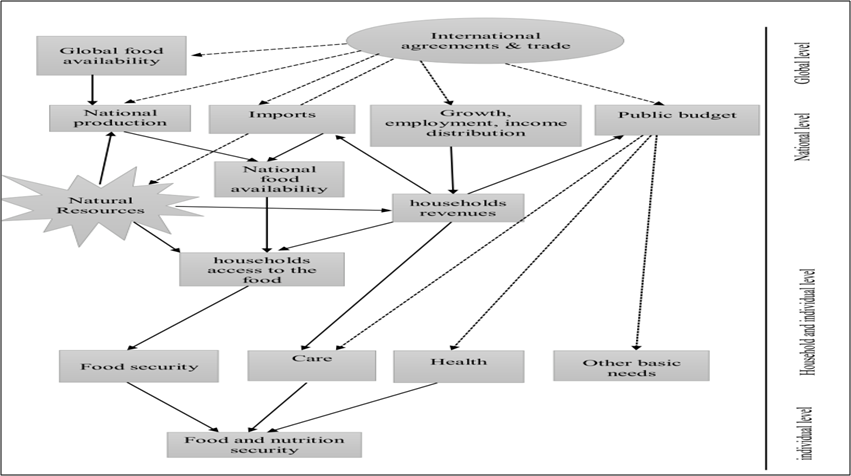
Figure 1 schematically describes the conceptual framework of food security. It shows how nutritional outcomes at the individual level are influenced by a number of factors ranging from the global to the household scale. It thus highlights the complex interactions between multiple factors and so the multitude of possible ways to address the problem in order to achieve food security.
Food availability at national level comes from two sources: there are on the one hand domestic production, and on the other hand imports (including food aid). International agreements and international trade affect the availability through global prices and domestic prices as well as volumes of food stocks. They affect the incentives mechanism for producers and therefore their investment decisions in agriculture and the adoption of new technologies. They can have greater indirect effects than targeted policies on agriculture. On the consumer side, international trade affects the cost of the consumption basket, affecting his real income.

 Download as
International trade also acts on macroeconomic indicators such as growth, employment, income distribution, and the public budget. All these macroeconomic aggregates, with food availability, determine household and/or individuals’ income levels in the household and hence access or not to enough food.
The level of public budget also determines the ability of the State to invest in new technologies, services and infrastructure necessary to support agricultural production and the provision of social services such as health and education. It also determines the capacity of the state to implement social transfers’ policies (grants and targeted cash transfers to the poor). Household incomes in turn determine the state budget as higher households’ incomes enable higher tax revenues for the state budget.
Natural resources are also essential for food and nutrition security for households. Their productivity, namely, soil productivity determines the level of national production. The availability or not of some natural resources, such as the products of hunting, fishing and gathering influences access both through the own consumption and sales. The level of these resources depends on both their ability to reproduce, but also the extraction (for direct consumption or for sale) the extent of which is influenced by the incentives offered by international trade.
Decisions within the household on income distribution and more generally on the management of resources are fundamental in terms of food and nutrition security at the individual level. When the distribution is in favor of a few number of privileged members of the household, even a large amount of resources or food available may not result in improved food and nutritional situation for a large part of the members especially the most vulnerable (as children).
All these macro-meso-micro variables and natural factors interact in a complex way to determine the status of food and nutrition security of individuals. This complexity reflects the difficulty in finding a consensus on what should be done to address food insecurity. Economic growth and food availability are necessary but not sufficient to ensure food safety.
3. The Remedies against Food Insecurity: The State of the Controversy
If we now agree that food security issue arises mainly in terms of access and poverty, the solutions to achieve it remain controversy. Barrett [41] identifies three essential elements for effective food security strategy: (i) a stable employment and strong labor productivity to obtain sufficient income; (ii) access to funding, food markets and storage technologies to smooth consumption in case of income shocks; and (iii) the existence of safety nets to provide transfers for those experiencing adverse shocks or who are excluded from economic benefits. Barrett [41] estimated that revenue growth is particularly essential to achieve food security.
In the case of sub-Saharan Africa where, despite the relatively good macroeconomic performance recorded in recent decades, progress in poverty reduction has been mixed, analyzes attempting to explain this phenomenon converge to the existence of an equilibrium of poverty where low incomes explain the low level of savings and therefore low investment behind the weak labor productivity and thus low incomes. The question then is how to break this vicious circle. The period of liberalization of the 1980s succeeded interventionist one of the 60s and 70s but the results in terms of poverty and food security remain below expectations [42]. Today, two approaches compete on the role of the state. Should it be interested only in its sovereign functions and let the markets free of any intervention or should it intervene to stabilize prices and remedy some market failures or should it be limited to the creation of public infrastructure for allowing a suitable economic environment for private activities? Should it base the fight against poverty on the development of agriculture or that of non-agricultural sectors?
3.1. Liberalizing the Economy and Trade for Better Food Security?The arguments in favor of trade liberalization to improve food security are rooted in the classical theory of international trade. This goes back to Adam Smith and David Ricardo. Smith [43] introduced the absolute advantage theory to describe situations where a country has an interest in producing more than it consumes what it produces better than other countries to export surplus and import goods that other countries produce better than it. Ricardo [44] extends the analysis of Smith and shows that even if a country has no absolute advantage in the production of a good, it has interest to participate in trade because of the comparative advantages it has. The idea is that trade allows countries to specialize in what they do better, maximizing the value of their production. If a government restricts trade, resources are wasted in the production of goods that can be imported cheaply.
Trade liberalization is then a priori favorable to food security. Indeed, on one hand, it guarantees efficiency, the goods produced and traded being in principle cheaper for consumers than those produced locally in worse conditions. On the other hand, it allows smoothing fluctuations in volumes related to natural hazards by the exchange between regions.
Moreover, international trade is supposed to promote income growth through its positive impact on employment and wages [45] while its positive effects related to the acquisition of technology, procurement of intermediate consumption goods and capital, as well as gains from economies of scale are highlighted by Grossman and Helpman [46].
In the 90s, a large number of econometric studies in cross section highlighted the virtues of trade liberalization in terms of economic growth. Among the most famous include the those by Dollar [47], Sachs and Warner [48] and Edwards [49].
The arguments in favor of liberalization are also based on the fact that public intervention of the 60s proved to be failures with substantial economic costs [50] and rent-seeking opportunities especially multiple diversions [51].
Budget deficits caused by the interventionist public policies of the 60s and 70s as well as these ineffectiveness and the development of the arguments in favor of the ability of free markets to solve poverty problems led the international financial institutions (IMF and World Bank) to impose some economic reforms - the Structural Adjustment Programs. Market liberalization was at the heart of these reforms: liberalization of the credit market (financial liberalization), liberalization of the factor of production market (abolition of minimum wages and input subsidies), trade liberalization (abolition of quotas, import subsidies and lower tariff especially export tax), liberalization of internal trade (end of state monopolies, administered prices and subsidized). All these reforms are known as the Washington Consensus.
These reforms therefore restricted the room for maneuver of states in many areas including agriculture and food. They marked for example the end of input subsidies to farmers and the fixed price sales of products to offices of food products. It is also the end of the fixed low consumer prices for urban [52]. SAPs resulted in the deterioration of the food and nutritional security of many population groups especially in sub-Saharan Africa [53].
The structural adjustment programs and, beyond, the liberalization that has formed the basis for their implementation, have been criticized. These are based mainly on the fact that the virtues attributed to liberalization were based on too idealistic world representations (hypotheses), inevitably leading to conclusions that overstate the positive impacts of liberalization [54]. The assumptions that have often been used in international trade models are related to the fact that; i) there is no market failure; ii) there is no outside intervention other than the interactions between market participants; and iii) markets operate in a purely competitive environment. These assumptions, we know, are far from reality.
In the early 2000s, some authors such as Rodriguez and Rodrik [55] questioned the findings of econometric studies of the 90s showing the beneficial effects of trade liberalization. In particular, they claim that their findings are based on very weak empirical foundations such as incorrect measurements of trade openness and serious econometric shortcomings. The expected benefits of trade liberalization on employment and wages are also challenged [56], while the reduction of public budgets related to lower tariffs is questioned [57].
The market failures such as environmental externalities, the income inequality and monopoly powers are examples that show that the free play of market is not enough and the need for state intervention is thus advanced by some authors.
3.2. Public Intervention to Achieve Food Security?The arguments in favor of state intervention are part of the welfare economics. The state intervention is justified for at least three reasons: the existence of externalities, public goods, and economic recovery. First, regarding externalities, the idea is that the market is not able to internalize everything, so that state intervention can be helpful. According to the British economist Arthur Cecil Pigou, it is the role of the State to manage externalities. He distinguishes the private net marginal product from social net marginal product and explains that when the latter is lower than the first it means that an agent produces negative externalities incurred by other agents. In this case, Pigou proposed a solution which consists to tax the person issuing a negative externality [58]. Ronald Coase instead advocates a contractual solution, more economically efficient than regulations. The state may decide to assign property rights to encourage actors to internalize themselves externalities [59]. Then, the State is required to deal with pure public goods as infrastructure. Indeed, there are indispensable goods for the society as road infrastructure, but which cannot be supplied by the private sector because the production cost is too high. Therefore, it belongs to the state through taxes to fund those assets. Finally, the necessary state intervention to stimulate the economy in periods of underemployment is defended by Keynes [60].
Other arguments related to the persistence of poverty and the fundamental role of public intervention to break the cycle of poverty traps are developed to show the importance of public intervention [30, 31, 61]. The price stabilization policies, according to Timmer [62], are necessary and are able to bring out from poverty in a time of generation the population of a nation.
3.3. Developing Agriculture or the Secondary and Tertiary Sectors?The debates on strategies for poverty reduction also concern areas that should be developed to ensure greater impact. Many authors like Von Braun and Keyzer [63], Löfgren, Doukkali, Serghini and Robinson [64], Diao, Doukkali and Yu [65], Timmer and Akkus [66], Hazell, Poulton, Wiggins and Dorward [67], Valdés and Foster [68] and international institutions such as the World Bank [30] (2008) and the International Food Policy Research Institute (IFPRI) [69] consider the development of agriculture as a particularly effective strategy for the fight against poverty and food insecurity. The arguments are:
- Agriculture constitutes an important part of the GDP in many developing countries, so that its growth can make a real difference in terms of rural living standards. In addition, agriculture has significant spillover effects on the rest of the economy, including providing a growing demand for infant industries.
- Many poor countries have no viable alternatives to agriculture. They have few minerals to be exported, their manufacturing sectors are small and uncompetitive at an international level, and services sectors are constrained by demand.
- Modern science is opening up new possibilities to increase agricultural productivity, even in countries and regions that have not really taken advantage of new technologies in the past.
- Agricultural growth is highly pro-poor especially when it is based on small farms and food staples.
- Structural adjustment programs have reduced one of the worst wrongs done to this sector: the bias against agriculture. This opened the way to more prosperous agricultural investments.
However, doubts still exist on the relevance of a poverty reduction strategy based on the development of the agricultural sector [67]. These doubts are raised mainly by the liberal current. These arguments against the development of agriculture are as follows:
- Agriculture has become a relatively small sector in some developing countries, and other fast-growing sectors should now be the priority. In many poor countries, low agricultural productivity and thus its low competitiveness on the international market limit markets prospects. In addition, the pro-poor growth potential attributed to agriculture may be lower in liberalized economies and may not be greater than the pro-poor growth potential of the manufacturing sectors of services rather intensive in labor.
- Trade liberalization and the development of foreign direct investment (FDI) have opened new opportunities for developing countries to be exporters of manufactured goods and services and rely more on imports of cheap food.
- The changes in market systems mean that there are very limited market opportunities for small farms today, and the prices of products that they cultivate are at historically low levels. The combination of falling prices and farm shortness reduce the impact of agriculture on poverty. Moreover, the rural poor have also diversified their sources of income outside agriculture. Large commercial farms and high-value supply chains also offer better prospects for job creation and poverty reduction.
- Finally, there is no tolerance today for large public expenditure in agriculture (including subsidies) that characterized the green revolution. Many countries also lack the right institutions to ensure sound management of public investments while the administrative capacity to implement ambitious agricultural development programs is sorely lacking.
Empirically, some studies have tried to compare, using econometric estimates, the potential for poverty reduction of different sectors of the economy (agriculture, industry, services). Ravallion and Datt [70] found that in the case of India, the elasticity of poverty rate is -0.9 for agricultural growth and -2.4 for the growth of the tertiary sector. In the case of China, Ravallion and Chen [71] show that growth in agriculture has more impact than the growth in the secondary and tertiary sectors. Bravo-Ortega and Lederman [72] find that the increase in agricultural GDP per agricultural worker is not as effective for increasing the income of the poorest quintile than an equivalent increase in non-agricultural GDP per non-agricultural worker in Latin American developing countries. For sub-saharan Africa Christiaensen [73] estimates that agricultural growth is more pro-poor than growth in non-agricultural sectors.
Today, the complex debate is still open and it’s difficult to find a consensus. It seems that taking into account the specific context of each country is crucial to firstly identify constraints to reducing poverty and food insecurity, and also to define more appropriate policies.
4. Conclusion
The concept of food security has undergone a change over the past 50 years. It was first analyzed in a Malthusian perspective that is to say, in terms of availability until 80s The social consequences of structural adjustment programs in terms of declining real incomes, resulting in food shortages and the work of Amartya Sen on the role of access rights in the 80s, led to broadening the concept of food security to take into account the economic dimension of access which implies a focus on income and prices. The 2000s have accordingly experienced a reversal of the policies of international financial institutions. The latter put the fight against poverty the focus of concern, with the implementation of the strategic frameworks for the fight against poverty in developing countries. Food crises caused by food price hikes in recent years (2007-2008) have reminded the vulnerability of people and led to introduce the concept of resilience in food security analysis. Today, food insecurity is understood as the result of interactions between several factors (economic, natural) at several levels (international, national, regional, family and individual). The emerging consensus is that poverty is the main cause of food insecurity but policies to be implemented remain controversial.
One criticism that can be raised in the various definitions of food security is that those suffering from food insecurity have rarely been associated with its definition and implementation of policies to combat food insecurity. The definitions of food security have been developed by people who do not suffer from food insecurity. In addition, food insecurity is often seen as a problem of developing countries. However, Food insecurity exists in developed countries too. It is massive in the USA where the United States Department of Agriculture (USDA) budget for food programs in American society is over $60 billion and growing. Food security also concerns issues of food safety. This issue is very worrying in developed countries where people are devoting more and more resources to health because of obesity problems and other problems created by the agro-food industry in its quest for great gains.
Acknowledgments
The author would like to thank the anonymous referees and the editor of the journal for useful comments and suggestions on the original version of this article.
References
| [1] | FAO, La situation mondiale de l'alimentation 2000, in, Food and Agriculture Organization of the United Nations, Rome, 2000, pp. 350. | ||
 In article In article | |||
| [2] | B. Galloux-Fournier, Histoire de l'Europe au XXe siècle: De 1974 à nos jours, Editions Complexe, 1995, 369. | ||
| In article | |||
| [3] | J. Williamson, Democracy and the “Washington consensus”, World Development, 21 (8), 1329-1336, 1993. | ||
| In article | View Article | ||
| [4] | A. Sen, Poverty and Famines. An Essay on Entitlement and Deprivation, Oxford University Press, Oxford, 1981. | ||
| In article | |||
| [5] | A. Sen, Ingredients of Famine Analysis: Availability and Entitlements, The Quarterly Journal of Economics, 96 (3), 433-464, 1981. | ||
| In article | View Article PubMed | ||
| [6] | J.E. Stiglitz, La Grande Désillusion, Fayard, Paris, 2002. | ||
| In article | |||
| [7] | J. Malaluan, S. Guttal, Structural Adjustment in the Name of the Poor: The PRSP Experience in the Lao PDR, Cambodia and Vietnam, in, Chulalongkorn University, Bangkok, 2002. | ||
| In article | |||
| [8] | B. Campbell, B. Losch, Les pauvres, bénéficiaires ou otages des stratégies de réduction de la pauvreté ? URL: www.cairn.info/revue-politique-africaine-2002-3-page-175.htm., 87 (2002/3), 175-184, 2002. | ||
| In article | |||
| [9] | World Bank, World Development Indicators (WDI), in, World Bank, Washington, D.C., 2016. | ||
| In article | |||
| [10] | FAO, The state of food insecurity in the world 2013, in, Food and Agriculture Organization of the United Nations, Rome, 2013, pp. 63. | ||
| In article | |||
| [11] | R.J.T. Klein, et al., Resilience to natural hazards: How useful is this concept?, Global Environmental Change Part B: Environmental Hazards, 5 (1-2), 35-45, 2003. | ||
| In article | View Article | ||
| [12] | C.S. Holling, Resilience and stability of ecological systems, Annual review of ecology and systematics, 1-23, 1973 | ||
| In article | View Article | ||
| [13] | C. Folke, Resilience: The emergence of a perspective for social–ecological systems analyses, Global Environmental Change, 16 (3), 253-267, 2006. | ||
| In article | View Article | ||
| [14] | B. Walker, et al., Resilience, adaptability and transformability in social--ecological systems, Ecology and society, 9 (2), 5, 2004. | ||
| In article | View Article | ||
| [15] | K. von Grebmer, et al., 2013 Global Hunger Index: The challenge of hunger: Building resilience to achieve food and nutrition security, Intl Food Policy Res Inst, Washington, 2013. | ||
| In article | |||
| [16] | A. McKay, Assets and chronic poverty: background paper, in, University of Sussex United Kingdom 2009, pp. 30. | ||
| In article | |||
| [17] | World Bank, Repositioning nutrition as central to development: A strategy for large scale action, World Bank Publications, Washington, 2006. | ||
| In article | |||
| [18] | D.J. Davidson, The Applicability of the Concept of Resilience to Social Systems: Some Sources of Optimism and Nagging Doubts, Society & Natural Resources, 23 (12), 1135-1149, 2010. | ||
| In article | View Article | ||
| [19] | A. Duit, et al., Governance, complexity, and resilience, Global Environmental Change, 20 (3), 363-368, 2010. | ||
| In article | View Article | ||
| [20] | K. Sapountzaki, Social resilience to environmental risks, Management of Environmental Quality: An International Journal, 18 (3), 274-297, 2007. | ||
| In article | View Article | ||
| [21] | H. Carton, et al., Faut-il sauver le concept de résilience ?, in, Institut Momentum, Paris, 2013, pp. 7. | ||
| In article | |||
| [22] | T.J. Lybbert, et al., Stochastic wealth dynamics and risk management among a poor population*, The Economic Journal, 114 (498), 750-777, 2004. | ||
| In article | View Article | ||
| [23] | R. Nurkse, Problems of capital formation in underdeveloped countries, Oxford University Press, Oxford, 1953. | ||
| In article | |||
| [24] | J. Bhattacharya, et al., Poverty, food insecurity, and nutritional outcomes in children and adults, Journal of Health Economics, 23 (4), 839-862, 2004. | ||
| In article | View Article PubMed | ||
| [25] | PAM, La faim et le rôle des marchés, Programme Alimentaire Mondial, Rome, 2009, 213. | ||
| In article | |||
| [26] | I. Bocoum, et al., Does monetary poverty reflect caloric intake?, Food Security, 6 (1), 113-130, 2014. | ||
| In article | View Article | ||
| [27] | I. Bocoum, Sécurité alimentaire et pauvreté. Analyse économique des déterminants de la consommation des ménages. Application au mali, in: Faculté des Sciences Economiques, Université Montpellier 1 Montpellier, 2011. | ||
| In article | PubMed | ||
| [28] | Foresight, The Future of Food and Farming: Challenges and choices for global sustainability, in: Final project report, The Government Office for Science, London, 2011. | ||
| In article | |||
| [29] | World Hunger Education Service, 2013 World Hunger and Poverty Facts and Statistics, in, 2013. | ||
| In article | |||
| [30] | World Bank, World development report 2008: Agriculture for development, in, World Bank, Washington, D.C., 2008, pp. 365. | ||
| In article | |||
| [31] | A. Dorward, et al., A Policy Agenda for Pro-Poor Agricultural Growth, World Development, 32 (1), 73-89, 2004. | ||
| In article | View Article | ||
| [32] | M.R. Carter, C.B. Barrett, The economics of poverty traps and persistent poverty: An asset-based approach, The Journal of Development Studies, 42 (2), 178-199, 2006. | ||
| In article | View Article | ||
| [33] | J. Sachs, et al., Ending Africa's poverty trap, Brookings papers on economic activity, 2004 (1), 117-240, 2004. | ||
| In article | View Article | ||
| [34] | C.B. Barrett, B.M. Swallow, Fractal poverty traps, World Development, 34 (1), 1-15, 2006. | ||
| In article | View Article | ||
| [35] | C.B. Barrett, Poverty traps and resource dynamics in smallholder agrarian systems, in: A. Ruijs, R.B. Dellink, D.W. Bromley (Eds.) Economics of poverty, environment and natural-resource use, 2008, pp. 17-40. | ||
| In article | |||
| [36] | FAO, Déclaration de Rome sur la sécurité alimentaire mondiale, in, Rome, 1996. | ||
| In article | |||
| [37] | A. De Janvry, et al., Peasant household behaviour with missing markets: some paradoxes explained, The Economic Journal, 1400-1417, 1991. | ||
| In article | View Article | ||
| [38] | A.D. Alene, et al., Smallholder market participation under transactions costs: Maize supply and fertilizer demand in Kenya, Food Policy, 33 (4), 318-328, 2008. | ||
| In article | View Article | ||
| [39] | E. Sadoulet, A. De Janvry, Quantitative development policy analysis, Johns Hopkins University Press Baltimore, 1995. | ||
| In article | PubMed | ||
| [40] | E. Díaz-Bonilla, J.F. Ron, Food Security, Price Volatility and Trade: Some Reflections for Developing Countries, in, International Centre for Trade and Sustainable Development, Geneva, Switzerland, 2010, pp. 66. | ||
| In article | View Article | ||
| [41] | C.B. Barrett, Chapter 40 Food security and food assistance programs, in: L.G. Bruce, C.R. Gordon (Eds.) Handbook of Agricultural Economics, Elsevier, 2002, pp. 2103-2190. | ||
| In article | |||
| [42] | P. Zidouemba, Sécurité alimentaire, productivité agricole et investissements publics au Burkina Faso : une analyse à l’aide d’un modèle d’Équilibre Général Calculable dynamique et stochastique, in: EDEG, CIRAD - Montpellier SupAgro, UMR 1110 MOISA, Montpellier, France., 2014, pp. 279. | ||
| In article | |||
| [43] | A. Smith, An Inquiry into the Nature and Causes of the Wealth of Nations, 1776. | ||
| In article | |||
| [44] | D. Ricardo, On the Principles of Political Economy and Taxation, Library of Economics and Liberty, 1821. | ||
| In article | |||
| [45] | W.F. Stolper, P.A. Samuelson, Protection and real wages, The Review of Economic Studies, 9 (1), 58-73, 1941. | ||
| In article | View Article | ||
| [46] | G. Grossman, E. Helpman, Innovation and growth in the global economy, MIT Press, Cambridge, MA and London, 1991. | ||
| In article | |||
| [47] | D. Dollar, Outward-oriented developing economies really do grow more rapidly: evidence from 95 LDCs, 1976-1985, Economic development and cultural change, 40 (3), 523-544, 1992. | ||
| In article | View Article | ||
| [48] | J.D. Sachs, A.M. Warner, Economic convergence and economic policies, in, National Bureau of Economic Research, Cambridge, 1995, pp. 47. | ||
| In article | View Article | ||
| [49] | S. Edwards, Openness, Productivity and Growth: What Do We Really Know?, The Economic Journal, 108 (447), 383-398, 1998. | ||
| In article | View Article | ||
| [50] | M.W. Schiff, A. Vald, The plundering of agriculture in developing countries, World Bank, Washington, DC, 1992, 99. | ||
| In article | View Article | ||
| [51] | World Bank, Managing food price risks and instability in an environment of market liberalization, World Bank Washington, DC, 2005. | ||
| In article | |||
| [52] | T. Reardon, C.P. Timmer, Chapter 55 Transformation of Markets for Agricultural Output in Developing Countries Since 1950: How Has Thinking Changed?, in: R. Evenson, P. Pingali (Eds.) Handbook of Agricultural Economics, Elsevier, 2007, pp. 2807-2855. | ||
| In article | View Article | ||
| [53] | G. Azoulay, J.-C. Dillon, La sécurité alimentaire en Afrique: manuel d'analyse et d'élaboration des stratégies, KARTHALA Editions, Paris, 1993, | ||
| In article | |||
| [54] | N. Serra, J.E. Stiglitz, The Washington Consensus Reconsidered: Towards a New Global Governance: Towards a New Global Governance, Oxford University Press, 2008. | ||
| In article | View Article | ||
| [55] | F. Rodriguez, D. Rodrik, Trade policy and economic growth: a skeptic's guide to the cross-national evidence, in: NBER Macroeconomics Annual 2000, Volume 15, MIT PRess, 2001, pp. 261-338. | ||
| In article | |||
| [56] | P. Lloyd, Generalizing the Stolper–Samuelson Theorem: A Tale of Two Matrices, Review of International Economics, 8 (4), 597-613, 2000. | ||
| In article | View Article | ||
| [57] | L.A. Winters, et al., Trade liberalization and poverty: the evidence so far, Journal of Economic literature, 42 (1), 72-115, 2004. | ||
| In article | View Article | ||
| [58] | A.C. Pigou, The economics of welfare, Transaction Publishers, London, 1920, 876. | ||
| In article | |||
| [59] | R.H. Coase, Problem of social cost, Journal of Law and Economics, 3 1-44, 1960. | ||
| In article | View Article | ||
| [60] | J.M. Keynes, The general theory of employment, The quarterly journal of economics, 209-223, 1937. | ||
| In article | View Article | ||
| [61] | C. Poulton, et al., State intervention for food price stabilisation in Africa: Can it work?, Food Policy, 31 (4), 342-356, 2006. | ||
| In article | View Article | ||
| [62] | C.P. Timmer, The macro dimensions of food security: economic growth, equitable distribution, and food price stability, Food Policy, 25 (3), 283-295, 2000. | ||
| In article | View Article | ||
| [63] | J. Von Braun, M. Keyzer, Global action for food security, in, Centre for World Food Studies (SOW-VU) Amsterdam 1991. | ||
| In article | |||
| [64] | H. Löfgren, et al., Rural development in Morocco: alternative scenarios to the year 2000, in, International Food Policy Research Institute, Washington, D.C., 1997, pp. 49. | ||
| In article | |||
| [65] | X. Diao, et al., Policy options and their potential effects on Moroccan small farmers and the poor facing increased world food prices: A general equilibrium model analysis, in, International Food Policy Research Institute (IFPRI), 2008. | ||
| In article | |||
| [66] | C.P. Timmer, S. Akkus, The structural transformation as a pathway out of poverty: analytics, empirics and politics, Center for Global Development Working Paper, (150), 2008. | ||
| In article | |||
| [67] | P. Hazell, et al., The Future of Small Farms: Trajectories and Policy Priorities, World Development, 38 (10), 1349-1361, 2010. | ||
| In article | View Article | ||
| [68] | A. Valdés, W. Foster, Reflections on the Role of Agriculture in Pro-Poor Growth, World Development, 38 (10), 1362-1374, 2010. | ||
| In article | |||
| [69] | International Food Policy Research Institute (IFPRI), The impacts of public investment in and for agriculture, in: T. Mogues, B. Yu, S. Fan, L. McBride (Eds.), Washington, DC, 2012, pp. 72. | ||
| In article | |||
| [70] | M. Ravallion, G. Datt, How important to India's poor is the sectoral composition of economic growth?, The World Bank economic review, 10 (1), 1-25 1996. | ||
| In article | View Article | ||
| [71] | M. Ravallion, S. Chen, China's (uneven) progress against poverty, Journal of Development Economics, 82 (1), 1-42, 2007. | ||
| In article | View Article | ||
| [72] | C. Bravo-Ortega, D. Lederman, Agriculture and national welfare around the world: causality and international heterogeneity since 1960, World Bank Publications, 2005. | ||
| In article | View Article | ||
| [73] | L.J. Christiaensen, Down to earth: agriculture and poverty reduction in Africa, World Bank, Washington, DC, 2007, 100. | ||
| In article | View Article | ||
 CiteULike
 Mendeley
 StumbleUpon
 Delicious
 Facebook
 Twitter
 LinkedIn
)