sciepub.com
 Quick Submission

Poverty, Food Security Status and Coping Strategies of Marginal Farm Households in Some Selected Areas of Bangladesh
M. Mohiuddin1, , M. S. Islam2, M. T. Uddin2
1Senior Scientific Officer, Bangladesh Agricultural Research Institute, RARS, Jamalpur, Bangladesh
2Department of Agricultural Economics, Bangladesh Agricultural University, Mymensingh, Bangladesh
Abstract
The present study was conducted in Bangladesh during the years 2012-13 to know the present status of poverty, food insecurity and coping strategies adopted by marginal farm households during food crisis. The study employed mainly farm level cross sectional data collected from 150 farm households taking 50 from each upazila of three districts of Bangladesh. Descriptive statistics such as cost-of-basic need method and direct calorie intake method were used to analyze the data. About 24% of the marginal farm households lie below the lower poverty line and about 37% lie below the upper poverty line. About 19% lie below the hardcore poverty line and about 35% lie below the absolute poverty line. The study observed that on an average, the rural households were more or less secured in relation to availability of food round the year. About 62% of the respondents identified landlessness as the prime cause of their food insecurity followed by lack of income generating activities and natural calamities, respectively. About 49% of farm households relied like on less expensive food for everyday as consumption coping strategy during food shortage where about 22% took less food and about 17% cut quantity of food per meal and reduce number of meals eaten in a day. Irrespective of location, about 53% reliant upon borrowing money for coping with food insecurity followed by sale of households assets (45%), reduce food cost (40%) and seeking help from relatives (36%). It is also recommended that creation of employment opportunities throughout the year, especially in the lean season, and government supports are suggested to tackle the food insecurity problems for the study areas.
Keywords: poverty, food security, coping strategy, Bangladesh
Copyright © 2016 Science and Education Publishing. All Rights Reserved.Cite this article:
- M. Mohiuddin, M. S. Islam, M. T. Uddin. Poverty, Food Security Status and Coping Strategies of Marginal Farm Households in Some Selected Areas of Bangladesh. Journal of Food Security. Vol. 4, No. 4, 2016, pp 86-94. http://pubs.sciepub.com/jfs/4/4/2
- Mohiuddin, M., M. S. Islam, and M. T. Uddin. "Poverty, Food Security Status and Coping Strategies of Marginal Farm Households in Some Selected Areas of Bangladesh." Journal of Food Security 4.4 (2016): 86-94.
- Mohiuddin, M. , Islam, M. S. , & Uddin, M. T. (2016). Poverty, Food Security Status and Coping Strategies of Marginal Farm Households in Some Selected Areas of Bangladesh. Journal of Food Security, 4(4), 86-94.
- Mohiuddin, M., M. S. Islam, and M. T. Uddin. "Poverty, Food Security Status and Coping Strategies of Marginal Farm Households in Some Selected Areas of Bangladesh." Journal of Food Security 4, no. 4 (2016): 86-94.
| Import into BibTeX | Import into EndNote | Import into RefMan | Import into RefWorks |
At a glance: Figures
1. Introduction
Bangladesh is one of the lower middle income economies of the world having per capita income of only around US$ 1314 [9]. The economy of Bangladesh is developing over the years. Bangladesh had made significant achievement in food grain production and food availability. Availability of sufficient food at the country or local level does not mean that all people within that geographic unit are food secured. Despite a significant progress in domestic food grain production, Bangladesh is still facing food insecurity. Approximately 40% of the population lacking the resources to acquire enough food and consequently remaining below the poverty line [16]. Food security and poverty are directly related to each other and poverty is one of the main causes of food insecurity [25].
Based on purchasing ability, incidence of poverty came down gradually during the last decade from 63 million poor people in 2000 to 47 million in 2010 [14].
The prevalent rates of global acute and chronic malnutrition among children under two years old in Bangladesh are alarming. Growth retardation, an outcome of chronic malnutrition, is widespread affecting an estimated 48.6% of the country’s 20 million children [12]. Approximately one third of adolescent girls in Bangladesh suffer from anemia and micronutrient deficiency [15]. Bangladesh is ranked 129th out of 169 countries in the 2010 Human Development Index [26]. In rural areas, poverty incidence remains especially high among households headed by a member working in agricultural sectors (48.2%) as well as among landless rural households (66.6%) [20]. The undernourishment according to DCI method indicate that the recent decline in “hardcore poverty” (from 20% to 19.5%) and in “ultra-poverty” (from 8.2% to 7.8%) has been less impressive than the decline in absolute poverty (from 47.5% to 40.4%), suggesting that many people tend to be “trapped” in the vicious cycles of hunger and poverty. The percentage of population living under the poverty line came down to 31.5 in 2010 from 40 in 2005 due to consistent economic and remittance growth. However, 17.6% of the population is still extremely poor [14].
It is often argued that land available for crop cultivation has been shrinking at around 1% per annum, which means a reduction of average farm size with concomitant increase in fragmentation and sub division of holdings [18]. Above all, these scarce cultivable lands are being used for making new houses. The number of landless, marginal and small farmers has, therefore, been increasing at alarming rate day by day in rural Bangladesh. These groups is forced to rely on labour selling/crop farming, fishing, petty business, service and other non-farm activities and often on a piecemeal, daily or seasonal basis. Due to the seasonal variation in agriculture employment and limited employment opportunities in non-farm sector, millions of people suffer from chronic and transitory food insecurity. The average Bangladesh diet is deficit in energy by about 15 percent [1]. Normal diet of Bangladeshi people is also seriously imbalanced; carbohydrates contribute nearly 74 percent to the total dietary energy and 57 percent by protein [3]. The extent of poverty in terms of calorie intake is relatively high in Bangladesh where about 49% households are poor and 23% are extreme poor [22]). Poverty stricken people usually use their natural environment in unsustainable ways, leading to further deterioration of their livelihood conditions [11]. As a consequence, food security for these people has become very challenging task. The ultra poor usually consume less than minimum calorie intake (1805 kcal/day) and any further reduction in food consumption will certainly deteriorate their physical ability and future potentiality [4, 13]. Under this tenuous food situation, how these rural households cope with the food insecurity situation is really unknown.
There have been substantial amounts of literature found on different aspects of food security at home and abroad [1, 8, 23], but very few of them dealt with the strategies adopted by the people suffering from poverty and food insecurity. There is hardly any study found conducted in the above mentioned population in this specific region of the country though they are recognized as one of the most vulnerable groups where food security needs to be ensured. So, the present study has been undertaken to provide information through fulfillment the objectives set for the study.
The specific objectives of the study are as follows:
1. To assess the poverty status of the marginal farm households;
2. To determine food security status of selected farm households; and
3. To investigate the coping strategies adopted during food crisis by farm households
2. Methodology
For this study, multi-stage simple random sampling was used for selecting the sample. The first stage involved purposively selection of three districts (i.e., Mymensingh, Netrokona and Kishoreganj) out of six in the greater Mymensingh region. After selecting three districts, one upazila from each district was selected again purposively considering the level of food security on the basis of the report of RDRS, 2004. Because of RDRS survey report on food security and hunger in Bangladesh divided all upazilas of Bangladesh into four categories; a) Very high food insecure; b) High food insecure; c) Moderate food insecure; and d) Low food insecure upazila based on availability, accessibility and utilization of food and vulnerability. From the above classification this study investigates prospective food security strategies in very high food insecured upazila of Phulpur (Mymensingh) and Kendua (Netrokona), moderate food insecure upazila of Kishoreganj sadar (Kishoreganj). Stage two involved a random selection of two third villages from the list of villages in a union of a upazila of the selected districts. From these three districts, a total of 12 villages were randomly selected taking 5 villages from the selected upazila of Mymensingh, 4 villages from the selected upazila of Netrokona, and the remaining 3 villages from the selected upazila of Kishoreganj district. The third stage involved a random selection of fifty farming households from selected villages. Data were collected during the period from December, 2012 to March, 2013. Thus, total numbers of sample farm households owning 0.02 to 0.2 ha of land were 150.
2.1. Analytical TechniquesGenerally, two methods were used in estimating poverty. The first one was based on direct calorie intake (DCI) and the other one was the cost-of-basic needs (CBN) method. Direct calorie intake method was used to determine whether an individual/family lives below or above a certain poverty threshold. These thresholds are predetermined for Bangladesh, e.g. 2122 kcal for absolute poverty line and 1805 kcal for hardcore poverty line. The first threshold (absolute poverty line) was used to determine ‘poor’ and ‘non-poor’. If daily food intake of an individual/family falls below the hardcore poverty line, then the individual/family is termed as hardcore poor. The DCI method allows estimation of the magnitude of food poverty base upon one’s food intake. In this study, threshold levels have been estimated based upon the calorie-value and nutrition information from multifarious types of food intake, as provided by a specialized entity in Bangladesh [6].
In the CBN method, ‘upper’ and ‘lower’ poverty lines were determined. Poverty lines were used to find a poor household which represents the level of per capita expenditure at which the members of households can buy an exogenously determined low-cost but adequate diet plus other objects of basic needs. In this study, both DCI and CBN methods have been used to estimate the poverty line at the household level.
2.2. Cost-of-basic Needs (CBN) MethodThe CBN method estimates the poverty level in a year in three steps. First, the cost of a bundle of fixed food items was estimated. The food items were rice, wheat, pulses, milk, oil, meat, fish, potato, vegetables, sugar and fruits which provide minimal nutritional requirements corresponding to 2,122 kcal per day per person.
The required quantities in the food bundle is denoted by (F1, F2,...,FN) to meet the calorie requirement; that is, Fj is the required per capita quantity of the food item j. The food poverty line is computed as Zf =ΣPjFj, where Pj is the unit price of j-th food item. In the second step, two non-food allowances for non-food consumption are computed. First one was obtained by taking the amount spent on non-food items by those households whose total consumption is equal to their food poverty line Zf. These households spend less amount on food than the food poverty line and spend only on the essential items in non-food consumption. Algebraically, if the total per capita consumption is denoted by y and food per capita consumption by x, the “lower” allowances for non-food consumption are estimated as ZLn=E[yi-xi | yi=Zf], where E denotes the mathematical expectation. The second one is “upper” allowances, which is obtained by taking the amount spent on nonfood items by those households whose food expenditure is equal to the food poverty line. These households do meet their food requirement comfortably. Mathematically, the “upper” allowances for non-food items can be expressed as ZUn=E[yi-xi | xi=Zf]. Obviously, ZUn is larger than ZLn, because the share of food expenditure in total consumption decreases as consumption increases.
In the third step, estimation of the poverty lines consisted simply of adding to the food poverty line with the “lower” and “upper” non-food allowances to yield the total lower and upper poverty lines.
Lower poverty line: ZL=Zf+ZLn where ZLn=E[yi-xi | yi=Zf]
Upper poverty line: ZU=Zf+ZUn where ZUn=E[yi-xi | xi=Zf].
The difference between the two lines is due to the difference in estimation of the allowances for non-food consumption. The lower poverty line incorporates a minimal allowance for non-food goods, while the upper poverty line includes more allowance.
In practice, some adjustments were necessary to estimate ZLn and ZUn, because it was not feasible to get desired data whose total consumption is equal to the food poverty line (Zf) or whose food expenditure is equal to the food poverty line. To avoid this problem, expectation should be taken for those households whose total consumption is less or equal to the food poverty line, in the computation of “lower” allowance for non-food consumption. Similarly, “upper” allowance can be computed by taking the expectation for those households whose food expenditure is less or equal to the food poverty line.
2.3. Direct Calorie Intake () MethodThe direct calorie intake method estimates the per capita calorie intake at household level. In this method, food consumed during the last three days in a household is first averaged and then the average content of food per day per household is converted into kilocalorie [17]. The amount of calorie intake is then converted into per capita per day. According to this method, a household is considered as ‘hardcore poor’ with per capita calorie intake is less than 1,805 kcal per day, and ‘absolute poor’ with less than 2,122 kcal per day. Irrespective of male and female, two children under six years old was considered one adult member in this study [21]. The tables of nutrient composition of Bangladeshi foods [7] was used to calculate the calorie and nutrient values of the foods.
2.4. Method of Measuring Food SecurityThe respondents had been requested to answer the month-wise food security status of the households during of the twelve months of the calendar year 2012. The respondents had three qualitative options for assessing their monthly food security status: (i) secured, (ii) more or less secured, and (iii) insecured. During the data processing, each of the qualitative values had been assigned with a numeric value in the following manner: 3 for secured, 2 for more or less secured and 1 for insecured. Thus, for each of the sample households have twelve numeric values on their food security status. All the numeric values of sample households for each of the twelve months have been added by all farms. Average value for food security status for a particular month is being estimated by dividing the estimated total value by the respective sample size. It is to note that the minimum and maximum limits of the average values must lie between 1 and 3, where the minimum value will be equal to or greater than 1 and the maximum value must be less or equal to 3. The aggregated food security status is estimated in the identical fashion by adding household status for the same for all twelve months together; and then average value was estimated using the procedure stated above. It is to note that the average values contain some fractional parts along with whole numbers. However, during the interpretation, the whole numbers are considered and the fractions are ignored. Two methods were applied for interpretation of the average numeric values: (i) conservative and (ii) moderate approach. According to conservative approach, only the whole numbers were given their respective qualitative interpretations.
2.5. Method of Estimating Coping StrategyTwo types of coping strategies are usually adopted by the victims of food insecurity: Consumption based and non-consumption based. Consumption coping strategies are specially related to food consumption and non-consumption coping strategies are related to asset sales and not directly related to food; for example, selling fuel wood is non-consumption but eating seed stock held for next season is a consumption coping strategy which was articulated by Maxwell et al., [19]. In this analysis, consumption coping strategies were further divided into four types, such as: i) Dietary change, ii) Short-term measures to increase household food availability, iii) Short-term measures to decrease numbers of people to feed, and iv) Rationing or managing the shortfall. Consumption coping strategies were identified by asking a simple question to the respondents and the answers were taken following different frequencies such as, every day, sometimes, rarely and never and discussed in results section.
3. Results and Discussions
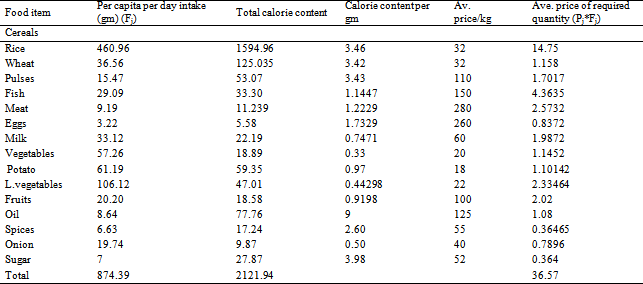
3.1. Estimation of Poverty Using CBN MethodsIt is recognized that an adult person in Bangladesh requires an average minimum amount of 832 gm of food a day, which is converted to 2112 kcal energy [5]. The food combination suggested by BIDS [5] was 397 gm of rice, 40 gm of wheat, 40 gm of pulse, 58 gm of milk, 20 gm of oil, 12 gm of meat, 48 gm of fish, 27 gm potato, 150 gm of vegetables, 20 gm of sugar, and another 20 gm of fruits. In practice, the rural people are dependent more on rice than on other items. BBS [2] used a larger combination of food and per capita per day intake of rice was suggested as 455 gm. However, the per capita per day food combination for this study has been prepared by considering the food combination suggested by BBS [2] and BIDS [5].
The per capita per day intake of food, calorie contents and price of food for this study population are presented in Appendix Table 1. In the estimation, the per capita per day requirements of food intake were fixed at 874.39 gm containing 460.96 gm of rice, which incurred cost amounted Tk. 36.57 at the survey point in time (Appendix Table 1).


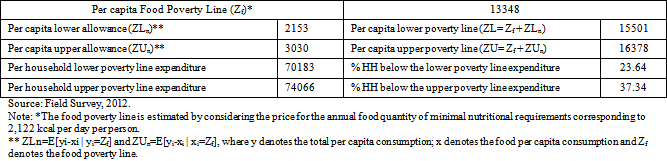


By converting the per capita poverty lines into household level, the “lower” and “upper” poverty lines had been estimated at Tk 70183, and Tk 74066, respectively (Table 1). The result suggests that about 23.64% households lie below the lower poverty line and about 37.34% households lie below the upper poverty line. The incidence of poverty in the study population was found consistent with the national figures (23.5 % by lower poverty line and 38.8 % by upper poverty line for rural area of Dhaka division of Bangladesh) which was reported by HIES (2010).
3.2. Poverty Estimation Using DCI MethodFigure 2 presents the incidence of poverty by using direct calorie intake (DCI) method described earlier. Considering the average household consumption of food during the last three days prior to the survey, the average per capita calorie intake was estimated at 2197.25 kcal (Table 2). However, the average per capita intake of calorie was obtained as 1637.91 kcal and 1926.55 kcal for the households fell below the hardcore and absolute poverty line, respectively.

 Download as
The head count ratio indicates that 18.65% households fell below the hardcore poverty line and 35.27% households fell below the absolute poverty line (Table 2). The poverty rate estimated by DCI method was relatively lower than that of by CBN method and that might be because of ingestion of more rice generally containing higher calorie value than other items of food.
 Download as


The aim of the study of differentials of poverty by selected background characteristics is to identify the sectors of the population where the incidence of poverty is high and need to be addressed through policy formulation. The background characteristics are: district, occupation and education of the household head, sanitation facilities and NGO membership and so on.
Using CBN method: The result suggests that proportion of households below the lower poverty line was almost identical in all districts under study, while significant (p<0.05) variation was observed in the proportion of households below the upper poverty line (Table 3). The proportion of households below the upper poverty line was found highest (38.18%) in Mymensingh district and lowest (36.31%) in Kishoreganj. The incidence of poverty was found to vary significantly (p<0.01) across the occupation of household head. The incidence of poverty was striking among labourer-headed households, about 42% of them in each category (agriculture and non-agriculture) fell below the upper poverty line. The incidence of poverty was found lower for the households whose heads were engaged in agriculture and job/service. There was a little variation in the incidence of poverty according to the education of the household heads may be because of the poor variation in their educational level. Family size was also appeared to have positively correlated with the incidence of poverty: about 44% of the larger households fell below the upper poverty line, but it was about 36% for small sized households (1-3 members) (Table 3).


The incidences of poverty was found to vary significantly across the sanitation facilities (p<0.05). The proportion of households fell in the poverty lines decreases as the sanitation facilities increases. The incidence of poverty was significantly higher (45%) for the households who were the member of any NGO than among non-member households (41%) which was consistent with the findings of Kazal et al [17].
Using DCI method: The findings indicate that proportion of households below the hardcore poverty did not vary significantly across the districts, while significant (p<0.01) variation was observed in case of absolute poverty (Table 4). Like CBN method, the incidence of absolute poverty was found to vary significantly (p<0.01) by DCI method. The incidence of poverty by DCI method was found lower for the households with heads in agriculture, business and engaged in job/service; however, it was found higher for the households whose heads were engaged in agricultural and non-agricultural labour.
The incidence of poverty in both the form (hardcore and absolute) was found lowest for the households with heads of 10 and above years of schooling, while it was found highest in absolute poverty for the households with illiterate heads. Like the CBN method, the positive impact of family size on the incidence of poverty was obviously found in the DCI method since an increasing trend was observed in the percentages of households falling below the poverty lines, both hardcore and absolute, with the increase in family size. The findings on the basis of sanitation reveal that the poverty in terms of hardcore and absolute level was observed lowest (14.64% in hardcore poverty and 34.17% in absolute poverty) for the households having pucca toilet. Unlike the impact of NGO-membership on the incidence of poverty by CBN method, this vary characteristic puts no significant impact in terms of variation on the incidence of poverty by DCI method. The overall findings of DCI method mostly differed from those of CBN method because of substantial inclusion of rice in the diet by rural people, which influenced and generally inflated the value of their calorie intake.


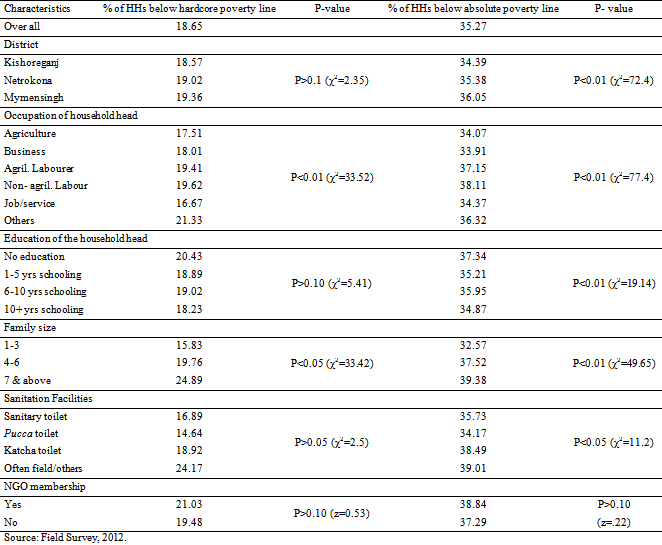

The above discussion indicates that the incidence of poverty in terms of percentage of households by both CBN and DCI methods varies according to location, occupation of the household head, family size and to some extent, the education of the household head. Therefore, policy implications should be formulated by properly addressing these salient factors to reduce the poverty and improve food security situation of the rural people in Bangladesh.
Month-wise household food security status: The study also investigated the food security status of farm households by months during 2012. Study revealed that on an average the rural households are more or less secured in relation to availability of food round the year (Table 5). However, Kartik (October-November) and Chaitra (March-April) are the two high food-insecured months common for almost all the marginal farm households. As a whole, the Ashyin (Sept-Oct) is also a food insecured month along with Ashar and Sravan.


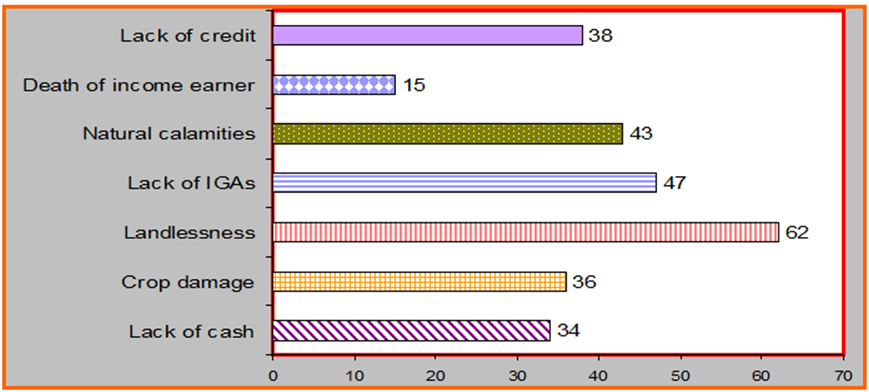
There were various causes responsible for food insecurity at marginal farm households. About 62% of the respondents identified landlessness as the prime cause for food insecurity. The other major causes were: lack of income generating activities i.e. seasonal unemployment, natural calamities, lack of credit and damage of crop generally caused by unexpectedly earlier heavy downpour and stone-slab as a considerable cause for food insecurity (Figure 3).
 Download as
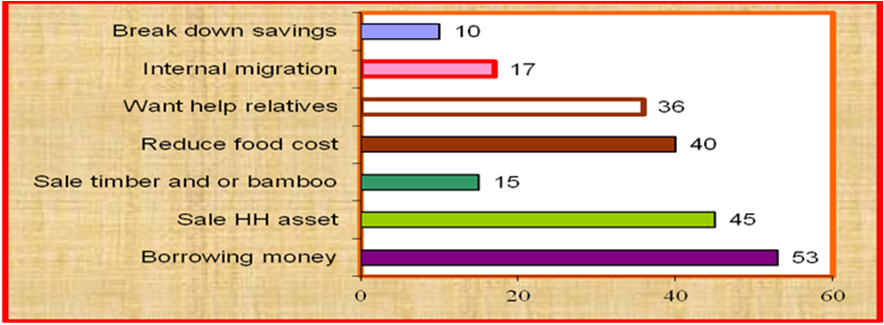
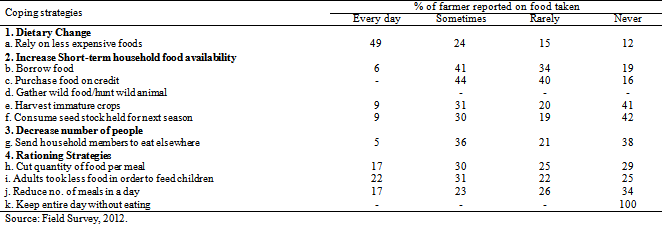
Food insecurity stricken households always try to cope with the situation in adopting various strategies. Coping strategies can be successful when they are able to preserve vital assets, or fail when they are unable to do so and may lead to downward spirals of impoverishment. Any response should aim to support existing positive coping strategies and release households and communities from dependence on negative ones [10]. The coping strategies of the sample households are presented in the Table 6 and Figure 4.
3.6. Consumption Coping StrategiesTable 6 revealed that 49 and 24% of the respondents relied like on less expensive foods for ‘everyday’ and ‘sometimes’, respectively as consumption coping strategy during food shortage. Relying on cheaper and less preferred foods “everyday” and “sometimes” means comparing the quality of the diet and can lead to inadequate intake of micronutrients and increased rates of malnutrition. Other major coping strategies adopted by marginal farm households were adult taking less food (22%), cut quantity of food per meal (17%), reduce number of meals eaten in a day (17%) and borrowing food (6%) etc. for everyday during food crisis (Table 6). Not a single farm household was found to be taking wild food and to be remaining without food in a whole day among the marginal farm households.



The interviewees were asked about the strategies they mainly adopt to cope with food insecurity. They spontaneously expressed the strategies they resorted during different periods of time over their life span (Figure 4). Very interestingly, the highest percentage of respondents (53%) reiterated their reliance upon borrowing money for coping with food insecurity problem obviously bearing the testimony of pervasive existence of exploiting money-lending culture in the survey areas in almost absence of access to formal credit.
The other major non-consumption coping strategies adopted by marginal farm households were sale of household assets (45%), reducing food cost (40%), seeking help from relatives (36%) and internal out-migration (17%) to other places for improving their food security.
 Download as
The food insecure respondents were invited to express their perceptions regarding supports and services to ensure household food security. About 85% of the respondents mentioned that they need to have work opportunities in all seasons, 74% strongly opted for ensuring agricultural land for farming and 66% mentioned for government support programmes (Table 7). About 67% advocated for provision of funds for alternative income generating activities and 52% for introducing food bank while 45% for membership under safety net food programme and appropriate actions from NGOs to ensure food security. From the results, it can easily be inferred that provision of government interventions is a must for a secure food situation in the study areas along with complementary support programmes of the private sector, especially of the NGOs.


4. Conclusion and Recommendation
The study concludes that the incidence of poverty by CBN method was found higher than that by the DCI method. According to CBN method, the highest percentage of marginal farm household below the lower poverty line was found in Mymensingh followed by Netrokona and Kishoreganj districts. The study also reveals that the incidence of poverty was striking between agriculture and non-agriculture labourer-headed households. Moderate food insecurity is existed within marginal farm household in the study areas. It is found that the prime strategies for coping with food insecurity are: borrowing money and food, reducing family expenditure, especially on food, less food consumption by the adults to feed small children.
To ensure food security with increased food production, marginal farmers should give more importance on increasing farming intensity. However, government’s support programs i.e., food for work, cash for work, coverage of VGD and VGF should be increased and strengthened during food crisis period. It is recommended that government should encourage the private entrepreneurs to establish small scale industries like food manufacturing, food processing industries and other suitable income generating activities in the rural areas so that the people of these areas could be able to earn their livelihoods. Finally appropriate training, especially for women should be offered to create the alternative income generating activities such as handicraft, tailoring, embroidering, poultry and livestock rearing throughout the year with the help of public-private partnership arrangements.
References
| [1] | Amin, M. R. and N. Farid (2005). “Food Security and Access to Food: Present Status and Future Perspective”, paper presented at the national workshop on Food Security in Bangladesh, held on 19-20 October, 2005 organized by Ministry of Food and Disaster Management, Government of the People's Republic of Bangladesh and World Food Programme-Bangladesh. pp. 17-42. | ||
 In article In article | |||
| [2] | BBS (2000). “Rural poverty monitoring survey 1998”, Bangladesh Bureau of Statistics, Ministry of Planning, Government of the people’s Republic of Bangladesh, Dhaka. Bangladesh. | ||
| In article | |||
| [3] | BBS (2003). Bangladesh Bureau of Statistics, Ministry of Planning, Government of the people’s Republic of Bangladesh. Dhaka. Bangladesh. | ||
| In article | |||
| [4] | BBS (2007). “Household income and expenditure survey-2005”, Bangladesh Bureau of Statistics, Ministry of Planning, Government of the people’s Republic of Bangladesh, Dhaka. Bangladesh. | ||
| In article | |||
| [5] | BIDS (1997). Methods of Measuring Poverty and Trend, In Rahman, RI edited “Poverty and Development: Bangladesh Context”, Bangladesh Development Studies, Dhaka. Bangladesh. Bangladesh. | ||
| In article | |||
| [6] | Cogill, B (2003). Anthropometric Indicators Measurement Guide, Food and Nutrition Technical Assistance Project, Academy for Educational Development, Washington, DC. | ||
| In article | |||
| [7] | Darnton-Hill Hassan N, Karim R and Duthie MR (1988). Tables of Nutrient Composition of Bangladeshi Foods (English version with particular emphasis on vitamin A content). Published by Helen Keller International, Bangladesh, Moni Printers & Packages Ltd. Dhaka. pp. 24. | ||
| In article | |||
| [8] | Dash, B. Paritosh (2005). “Regional Food Security Experience: Lessons Learnt from India and Timor Leste”, paper presented at the national workshop on Food Security in Bangladesh, held on 19-20 October, 2005 organized by Ministry of Food and Disaster Management, Government of the People's Republic of Bangladesh and World Food Programme-Bangladesh. pp. 61-80. | ||
| In article | |||
| [9] | Deb, Uttam Kumar (2016). “Agricultural Transformation in Bangladesh: Extent, Drivers and Implications” Key Note Paper, Paper presented at the 15th National Conference of the Bangladesh Agricultural Economists Association (BAEA) on “Transformation of Agricultural Sector in Bangladesh: 21st Century” held on 22-23 January 2016 at the Bangladesh Agricultural Research Council (BARC) Auditorium, Dhaka, Bangladesh. | ||
| In article | |||
| [10] | FAO and ILO (2008). The livelihood assessment tool-kit: analysis and responding to the impact of disasters on the livelihoods of people. Working draft; FAO-Rome and ILO-Geneva. Pp 16. | ||
| In article | |||
| [11] | FAO (2005). The state of Food Insecurity in the world. Food and Agriculture Organization of the United Nations, Viale delle Terme di Caracalla, 00100 Rome, Italy. | ||
| In article | |||
| [12] | FAO. 2009. The state of food insecurity in the world 2009: Economic crises – impacts and lessons learned. Rome: Food and Agriculture Organization. | ||
| In article | |||
| [13] | FPMU (2007). Food Division, Ministry of Food and Disaster Management. Government of the people’s Republic of Bangladesh. | ||
| In article | |||
| [14] | HIES (2010). Preliminary report of Household Income and Expenditure Survey. Bangladesh Bureau of Statistics, Ministry of Planning, Government of the people’s Republic of Bangladesh. p.61. | ||
| In article | |||
| [15] | HFSNA (2009). “Bangladesh Household Food Security and Nutrition Assessment” Report 2009 conducted by World Food Programme, UNICEF, Institute of Public Health Nutrition, Ministry of Health and Family Welfare and Government of the People's Republic of Bangladesh. www.unicef.org/bangladesh. | ||
| In article | |||
| [16] | Hossain M and A Bayes (2009). Rural Economy and Livelihoods Insights from Bangladesh, AH Development Publishing House, Dhaka. Bangladesh. | ||
| In article | |||
| [17] | Kazal, MMH, MZ Hossain and JU Ahmed (2012). Poverty and food insecurity for the haor people in Bangladesh: Status and coping strategies. Farm Economy, 2012. Vol. XIV.pp. 40-59. | ||
| In article | |||
| [18] | Mandal M. A. Sattar. (2007). Challenges of Agricultural research for poverty reduction in Bangladesh. Paper presented at the seminar held on 16 June 2007 on poverty alleviation through agricultural research in Bangladesh: challenges for 21st century, , Mymensingh. Bangladesh. | ||
| In article | |||
| [19] | Maxwell D.; B. Watkins; R. Wheeler and G. Collins. (2003). “The Coping Strategies Index: A tool for rapidly measuring food security and the impact of food aid programs in emergencies”, Field Methods Manual, and World Food Program (WFP) Vulnerability Assessment Mapping. | ||
| In article | |||
| [20] | NFPPoA (2008). The National Food Policy Plan of Action (2008-2015). Food Planning and Monitoring Unit (FPMU), Ministry of Food and Disaster Management (MoFDM), Government of the People's Republic of Bangladesh.p.24. | ||
| In article | |||
| [21] | Omotesho OA, Adewumi Lawal M, Ayinde O. (2006). Analysis of food security among rural households in Kwara State, Nigeria African journal of General Agriculture, 2(1) 7-15. | ||
| In article | |||
| [22] | PDO-ICZMP (Program Development Office for Integrated Coastal Zone Management Plant). (2003). Coastal Livelihood. Situation and context (WP 005). Water Resources Planning Organization, Dhaka. September, 2002. | ||
| In article | |||
| [23] | Rahman SM, A Hoque, RA Talukder (2005). “Food Security in Bangladesh: Utilization, Nutrition and Food Safety”, paper presented at the national workshop on Food Security in Bangladesh, held on 19-20 October, 2005 organized by Ministry of Food and Disaster Management, Government of the People's Republic of Bangladesh and World Food Programme-Bangladesh. pp.43-50. | ||
| In article | |||
| [24] | RDRS (2004). Survey on Food Security and Hunger in Bangladesh. Rangpur Dinajpur Rural Service, Dhaka, Bangladesh. | ||
| In article | |||
| [25] | Rukhsana (2011), ‘Dimension of food security in a selected state Uttar Pradesh’, Journal of Agricultural Extension and Rural Development 3 (2):29-41. | ||
| In article | |||
| [26] | UNDP (2010). “Human Development Report 2010”. Oxford University Press, New York. | ||
| In article | View Article | ||



 CiteULike
 Mendeley
 StumbleUpon
 Delicious
 Facebook
 Twitter
 LinkedIn